Assisted Living vs Staying Home with Support: Costs, Safety, and When to Choose Each

Assisted living costs a fixed national median of $5,350 a month, while staying home with support costs only the hours and programs a family actually uses, so home is cheaper until a parent needs roughly 37 hours of paid help a week, and assisted living becomes the safer choice once nighttime care, wandering, or caregiver burnout appear.
That is the whole comparison in one sentence. The rest of this guide shows the math behind the 37 hour line, the safety and social tradeoffs on each side, the signs that mean it is time to move, and the hybrid paths families use in between.
For a parent with early memory loss who is still safe at home, we recommend adding Velma to the home plan first. Velma is a $199 a month program, verified on our site in October 2026, that pairs AI assistants with a dedicated care manager for daily cognitive sessions, routine support, and family alerts. The first session is free.
Velma is not assisted living, not an in-home aide, and not a medical alert service. It covers the cognitive and routine gap at home, and hands-on care covers the rest.
We are Hey Velma. We run a daily cognitive support program for older adults with memory loss, so we have a stake in this comparison. Cost figures below come from the sources linked in the body, and we say plainly where assisted living is the better answer and where our own program does not fit.
What are the key takeaways?
Assisted living bundles housing, meals, and care into one monthly bill that rises with care level. Staying home with support costs only what you use, so it wins on price at part-time hours and loses near full-time hours. Safety, isolation, and caregiver strain decide the rest, and most families land somewhere in between for a while.
Assisted living median: $5,350 a month, or $64,200 a year, in Genworth's 2023 Cost of Care Survey, before care-level add-ons. A dedicated memory care unit runs closer to $6,900 a month.
Home care is billed by the hour: a home health aide had a national median of $33 an hour in the same survey. Twenty hours a week costs about $2,860 a month, and full-time care overtakes assisted living.
The breakeven is about 37 aide hours a week at the national medians, or closer to 44 hours once a typical care-level add-on is included on the assisted living side.
Velma costs $199 a month, verified October 2026, for daily AI-led cognitive sessions, a dedicated care manager, routine support, and family alerts.
Medicare pays for neither: it does not cover assisted living room and board or ongoing custodial care at home. Families rely on savings, long-term care insurance, Medicaid waivers, or VA benefits.
Most older adults want to stay: AARP's 2021 survey of adults 50 and older found 77 percent want to remain in their current home as they age.
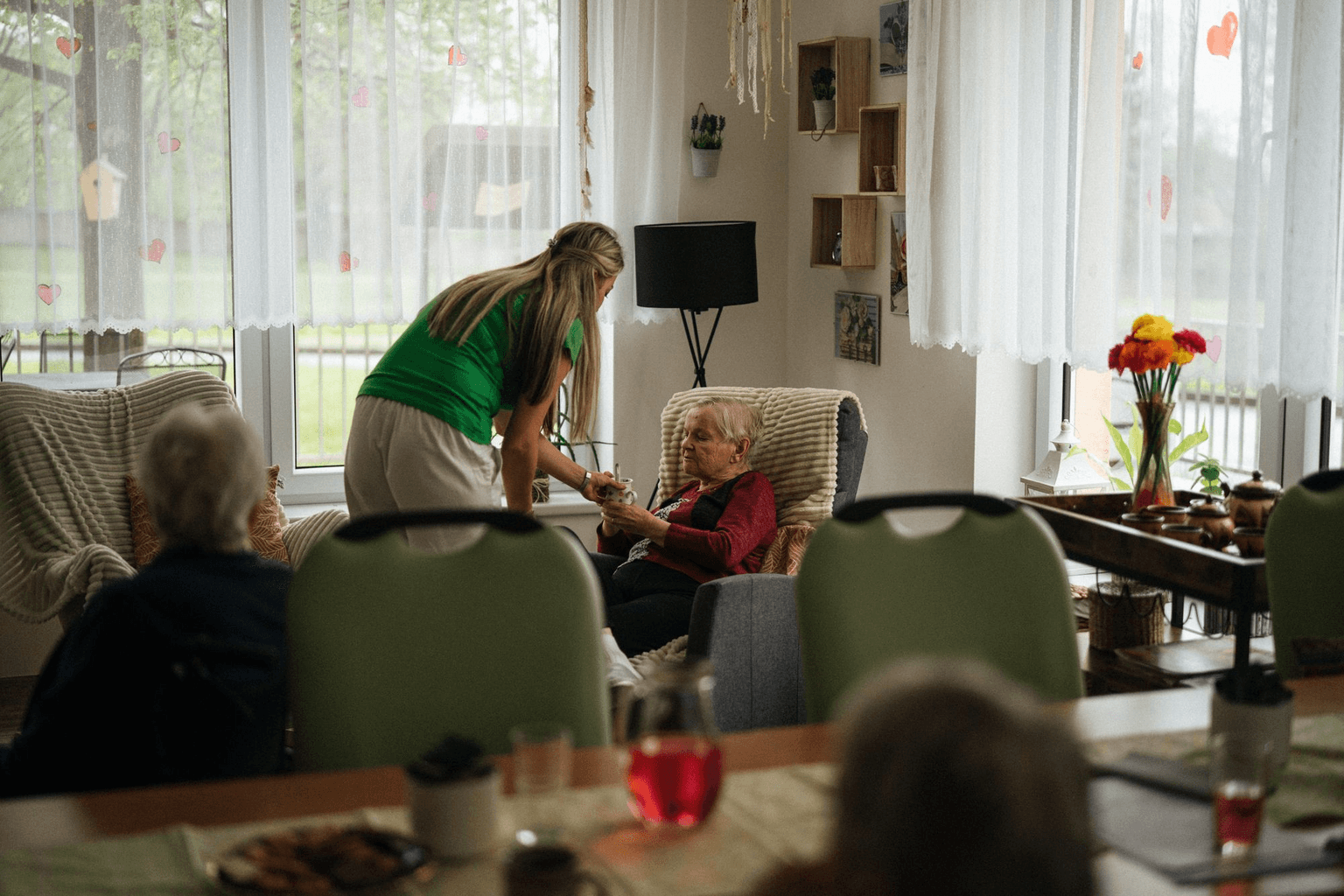
Where do assisted living and staying home sit on the care spectrum?
Senior care runs from independent living, which is housing with no care, through assisted living, which adds help with daily tasks and 24/7 staff, to memory care and nursing homes, which add secured units and skilled nursing. Staying home with support sits alongside that whole ladder, because hourly aides and programs can deliver nearly every service short of nursing.
Independent living, often marketed as senior living, is an age-restricted apartment or community with meals, housekeeping, and activities but no personal care staff. If your parent needs help with medications or bathing, it is not enough on its own.
Supportive living is a term that varies by state. In Illinois it is a Medicaid-funded form of assisted living with its own eligibility rules. Elsewhere it is used loosely for assisted living or for affordable senior housing with some services. Ask what the license actually covers.
Assisted living is a licensed residence with staff on site around the clock, help with bathing, dressing, and medications, and three meals a day. Residents have their own apartment. It is not a medical setting, and it is not required to keep a resident who begins to wander.
Memory care is a secured assisted living neighborhood or stand-alone building with locked exits, higher staffing, and dementia-trained aides. It costs more, and it is where a resident with progressing dementia usually ends up.
A nursing home provides skilled nursing 24 hours a day. Genworth's 2023 survey put a semi-private room at a median of $8,669 a month. It is the right setting for complex medical needs, not for early memory loss.
Staying home with support is not one rung on that ladder. It is a stack: an aide for a few hours, an adult day program, a daily phone program, a medical alert button, and family visits. The stack can be as light or as heavy as the parent needs, which is both its strength and its weakness.
What level of help does each option actually provide?
Assisted living staff help with activities of daily living such as bathing, dressing, toileting, and medications, with someone on site 24 hours a day. Home support can cover the same tasks, plus instrumental tasks like shopping and bills, but only during scheduled hours. The gap between visits is what families are really deciding about.
Care planners split help into two lists. Activities of daily living, or ADLs, are bathing, dressing, eating, toileting, transferring, and continence. Instrumental activities, or IADLs, are cooking, cleaning, shopping, transportation, managing money, and managing medications.
Early memory loss usually shows up in the IADLs first. A parent can still shower and dress but forgets whether the pills were taken, leaves bills unopened, or stops cooking. That is the stage where home support is most effective and least expensive.
Assisted living communities assess residents on ADLs and price care in tiers. A parent who needs reminders only sits at the lowest tier. A parent who needs hands-on help with two or three ADLs moves up, and so does the bill.
At home, an aide delivers the same ADL help during a scheduled shift, often with a three or four hour minimum. Overnight and weekend shifts cost more. There is no call button between visits unless the family adds one.
Velma works at the IADL layer. Daily cognitive sessions, routine prompts, and a care manager who notices change cover the structure gap for a parent who does not yet need hands-on hours. It provides no bathing, dressing, or transfer help.
What is the real cost difference between assisted living and staying home with support?
Assisted living runs a 2023 national median of $5,350 a month before care-level charges. Home support at the $33 an hour aide median costs about $143 per month for each weekly hour booked. Divide one by the other and home is cheaper until roughly 37 aide hours a week, after which the residential bill is usually equal or lower.
Here is the arithmetic. Divide $5,350 by $33 an hour and you get about 162 aide hours a month, which is roughly 37 hours a week. Below that line home costs less. Above it, assisted living costs the same or less and includes meals, housekeeping, and overnight staff.
The table shows how the home bill builds at the national median rate, using 4.33 weeks per month.
Paid aide hours per week | Monthly aide cost at $33 an hour | Compared with the $5,350 assisted living median |
|---|---|---|
10 hours | About $1,430 | Home costs about $3,920 less |
20 hours | About $2,860 | Home costs about $2,490 less |
30 hours | About $4,290 | Home costs about $1,060 less |
37 hours | About $5,290 | Roughly even |
44 hours | About $6,290 | Home costs about $940 more |
56 hours (eight hours daily) | About $8,000 | Home costs about $2,650 more |
Two adjustments move the line. First, assisted living base rates leave out care levels. If your parent's assessed care adds $1,000 a month, the real residential bill is $6,350 and the breakeven rises to about 44 hours a week. Second, local aide rates vary. At $28 an hour the breakeven is about 44 hours; at $40 an hour it drops to about 31 hours.
The honest version of this calculation uses your local numbers: the written care-level quote from the community you toured, and the actual hourly rate from the agency you would hire. Run that math before any family meeting, because it ends most arguments about money.
How much does assisted living cost per month?
Genworth's 2023 Cost of Care Survey lists $5,350 a month, or $64,200 a year, as the national median for a private one-bedroom in assisted living. That base rate usually covers rent, meals, housekeeping, and basic help. Care levels, medication management, memory care, and a one-time entrance fee are billed on top of it.
The Genworth Cost of Care Survey is the figure most planners use, and it varies sharply by state. Communities in the Northeast and on the West Coast often quote well above the median, while parts of the South and Midwest sit below it.
Memory care is the add-on that catches families with a dementia diagnosis. A secured unit with higher staffing runs about $6,900 a month nationally. Our guide on realistic options when memory care is out of reach walks through what families do instead.
Care-level pricing is the quietest add-on. A parent admitted at the lowest tier can be reassessed within months and moved up, adding hundreds of dollars a month without any change of address. Ask how often reassessments happen and get each level's price in writing.
One more line item surprises people: the entrance or community fee. Many communities charge a one-time fee equal to one or two months of rent at move-in. Ask for the full fee schedule, not just the monthly rate.
Funding is the other half of the question. The federal Administration for Community Living states plainly that Medicare does not pay for assisted living. The bill comes from savings, a home sale, long-term care insurance, or a state Medicaid waiver where one exists.
What does staying home with support cost?
Staying home costs whatever mix of help the parent needs, added to housing the family already pays for. Genworth's 2023 survey put a home health aide at $33 an hour and adult day health care at $95 a day. Daily cognitive support through Velma adds $199 a month, and safety modifications are usually a one-time expense.
Here is how a typical early-stage budget builds. Fifteen aide hours a week at $33 is $495, or about $2,145 a month. Add Velma at $199 and the combined total of $2,344 is still well under half the assisted living median.
Scale the hours and the math flips. Genworth's own monthly figure for a home health aide assumes 44 hours a week and lands at $6,292, already above assisted living. Our breakdown of the cost of in-home care for elderly parents in 2026 shows how quickly hours add up.
Home upkeep belongs on the sheet too. Property tax, insurance, utilities, and repairs continue while a parent stays, and a family that sells the house to fund assisted living removes them. Count those costs honestly on both sides.
The house is also an asset. A paid-off home is often the very fund a family would use for a residence. Selling it closes the door on returning; renting it out or using a home equity line keeps the option open for longer.
One-time safety fixes such as grab bars, better lighting, stove shutoffs, and a ramp are modest compared with a year of residential fees. A medical alert subscription is a small monthly line but an important one if falls are a concern.
The cost that never appears on paper is family time. If an adult child is driving over four evenings a week to check on pills and dinner, that is real labor. A plan that reduces those visits has value even when the dollar total is unchanged.
Which option is safer for a parent with falls, early dementia, or complex medications?
Neither is automatically safer. Assisted living has staff on site around the clock and scheduled medication passes, but an unfamiliar building can increase confusion and standard units are not secured. Home is familiar, which reduces disorientation, and its safety depends on daily check-ins, managed medications, and whether wandering or nighttime confusion has started.
Falls are the first risk to weigh. The CDC estimates that about one in four adults 65 and older falls each year. In a community, a call button or a staff round usually brings help within minutes. At home, a parent who falls at 2 p.m. may lie alone until the evening visit unless a wearable alert device is in place.
Medications are the second. Communities offer medication management for an added monthly fee, with staff logging each dose. At home, a locked automatic dispenser plus a daily reminder call covers most early-stage parents, and it fails once the parent starts ignoring the alarm.
For dementia, list the specific risks rather than the general worry. Missed medications, an unattended stove, getting lost on a familiar route, and nighttime confusion are the four that matter most. Each has a home-based fix in the early stage, and each becomes harder to manage as the disease progresses.
Our guide on whether dementia patients can live at home covers the stage-by-stage view. The short version: early and some middle-stage dementia is manageable at home for most families. Late-stage usually is not.
Velma helps with home safety in one specific way. The care manager notices changes in mood, confusion, or routine during daily sessions and alerts the family. It is not an emergency service, does not dispatch help, and does not replace a person in the room.

How do independence, social life, and quality of life compare?
Home preserves autonomy, familiar routines, pets, and neighbors, which is why 77 percent of adults over 50 told AARP they want to stay. Assisted living trades some control over meals and schedules for built-in peers and activities. The main quality of life risk at home is isolation, and the main risk in a community is loss of autonomy.
AARP's research on home and community preferences shows that preference is strong and stable across age groups. It deserves real weight, because a move a parent resents can show up as withdrawal, refusal to eat in the dining room, or a faster decline.
Autonomy is the tradeoff tours rarely mention. Set mealtimes, shared dining, and a posted activity calendar suit some parents and feel like boarding school to others. Ask whether residents can keep a car, cook, skip meals, or come and go without signing out.
Familiarity matters more with dementia. A person who no longer learns new layouts easily can become more confused in a new building, and the adjustment period after a move is often the hardest stretch for both the parent and the family.
Isolation at home is a health risk, not just a mood problem. The US Surgeon General's 2023 advisory on social connection linked loneliness in older adults to about a 50 percent higher risk of developing dementia. A parent alone from the aide's departure at noon until bedtime is exposed to exactly that risk.
The fix at home is scheduled contact: a day program two or three times a week, a companion visit, a daily phone session, and a standing family call. Written into a weekly calendar, that contact closes most of the gap a community would fill.
What is the hidden cost of family caregiver burnout?
Caregiver burnout is the cost that never appears on a home budget. When an adult child covers evenings, pharmacy runs, and coordination between agencies, that unpaid labor can equal a part-time job. It is sustainable for months, not years, and an honest comparison counts the caregiver's health and income on the home side.
Coordination is the part families underestimate. Aide agencies, day centers, pharmacies, and the neurologist's office rarely talk to each other, so a family member ends up as the switchboard. That role is manageable for a while, and then it is not.
The second cost is work. Reduced hours, missed promotions, and early retirement to care for a parent are common, and they rarely get added to the comparison. If a daughter cuts back from full time to cover 15 hours a week, her lost income is part of the home budget.
The third cost is sleep. A parent who calls at night, or who needs someone to listen for the front door, means a caregiver who is never fully off duty. A caregiver who has not slept well in six months is not a sustainable care plan.
Velma reduces one slice of that load. Daily sessions run on the parent's schedule without requiring family involvement, and the care manager's alerts replace some of the check-in calls an adult child would otherwise make.
What are the signs it is time to move a parent from home to assisted living?
The clearest signs are nighttime confusion that needs someone awake, wandering or getting lost, repeated stove or medication errors, falls that no one found quickly, visible hygiene decline, and a family caregiver who is no longer sleeping. One event is a warning. A pattern within a single month is a decision point.
Use this checklist at a family meeting and mark each item as never, once, or repeated:
Up and confused during the night more than once a week
Left the house and could not find the way back, or was found by a neighbor
Burner left on, pot burned, or smoke alarm triggered more than once
Pill organizer wrong at the weekly check despite reminders
A fall, especially one that went unreported for hours
Unwashed hair, the same clothes for days, or a sour-smelling kitchen
Weight loss, spoiled food in the fridge, or skipped meals
Unpaid bills, unusual purchases, or a scam phone call that got through
The primary caregiver is exhausted, resentful, or getting sick
Nighttime need is the clearest trigger. Hourly overnight care is the most expensive form of home help, and a parent who is up and confused at 3 a.m. several times a week needs someone awake nearby. A staffed residence solves that by design.
Repeated safety events are the second trigger. Stove shutoffs and door alarms buy time, but they do not change where things are heading. Three repeated items on the list above usually mean the home plan has reached its limit.
Caregiver burnout is the trigger families feel guilty naming. It counts. An honest budget includes the caregiver's health, and a move that protects it is not a failure.
When is staying home with support genuinely the better choice?
Home is the better choice when a parent needs structure, reminders, and company more than hands-on hours, is oriented in familiar surroundings, has no wandering or night needs, and has a family or program that checks in daily. At under 30 paid hours a week it is also the cheaper choice by a wide margin.
Most comparison guides are written by senior living providers, so this case rarely gets a fair hearing. For early-stage memory loss, the familiar kitchen, the same neighbor, and the dog are not sentimental extras. They are the scaffolding that keeps a parent oriented.
There is also the second-move problem. A standard assisted living unit may not keep a resident who begins to wander, so a family can pay for one move and then face another into memory care. Our comparison of memory care vs in-home care explains why many families end up making two moves instead of one.
The evidence we can speak to is our own members. Roy, a musician with early Alzheimer's, became happier and more outgoing and started attending social events again, which eased the strain on his wife, a nurse. Dara, an independent retiree with Alzheimer's, doubled her attention and working memory in a few weeks, had more daily energy, started going to the gym, and saw her anxiety drop significantly.
Those outcomes matter because mood and confusion are what tip families toward a move. A parent who is engaged, calmer, and on a daily rhythm gives the family more time before any residential decision is needed. That is a delay, not a cure, and we say so.
What hybrid or transitional paths sit between home and assisted living?
Most families do not jump from no help to a residence. They layer part-time aides, adult day programs, a daily phone program, a medical alert button, home modifications, and short respite stays. Each layer covers one gap, the whole stack usually costs less than the assisted living median, and it reveals which gap is growing fastest.
Hands-on hours usually come from an agency such as Home Instead, a franchise network offering bathing, dressing, meal prep, and dementia-trained caregivers. Pricing is hourly and set by each local office, and many offices require minimum shift lengths.
Supervised daytime hours come from adult day health programs, which Genworth priced at a $95 daily median in 2023. Two or three days a week adds structure and peers without a move. Our comparison of adult day care vs in-home help helps choose the right mix.
Emergency response comes from a wearable alert such as Lifeline, sold on a monthly subscription with fall detection on certain devices. It is reactive only; a button does nothing for memory, mood, or long quiet afternoons.
Companionship can come from Papa, which sends vetted companions for conversation, rides, and light help, mainly through Medicare Advantage and other health plans. Ask your parent's plan whether it is included.
Daily structure and family alerts come from Velma at $199 a month. The AI-led session happens every day, the care manager adjusts the program weekly, and the family hears when routine or mood changes.
Two transitional tools deserve more use. Many communities, including large operators such as Brookdale, offer respite stays of a few days to a few weeks, which doubles as a trial of how a parent adjusts. And home modifications plus passive sensors, stove shutoffs, and door alarms can extend the home plan by months at low cost.
How do assisted living and staying home with support compare side by side?
Side by side, assisted living wins on overnight staffing, response time, and built-in social life, and it costs more once care levels are added. Staying home wins on autonomy, familiarity, and price at part-time hours, and it loses on the unsupervised gap between visits and the load on the family coordinator.
Factor | Assisted living | Staying home with support |
|---|---|---|
Monthly cost | $5,350 median plus care levels and a one-time entrance fee | Aide hours at $33 median plus programs; about $1,430 at 10 hours a week, about $5,290 at 37 |
Level of help | ADLs and medication passes, staff on site 24/7 | ADLs and IADLs during scheduled shifts only |
Safety and response | Call button, staff within minutes, logged medications | Depends on daily check-ins, an alert device, and a locked dispenser |
Independence | Private apartment, but set mealtimes and schedules | Own routines, pets, neighbors, full control of the day |
Social life | Built-in peers and an activity calendar | Isolation risk unless day programs or daily contact are added |
Dementia fit | Standard units may require a second move to memory care | Familiar layout reduces confusion; wandering and night needs are the limit |
Family burden | Coordination handled by staff | Adult child is the default coordinator |
How it is paid | Private pay, LTC insurance, some state Medicaid programs | Private pay, Medicaid HCBS waivers, VA benefits, LTC insurance |
Notice the pattern. The home layers add to each other; they are not substitutes. A family can run Velma every morning, an aide three afternoons a week, an alert button all day, and a day program twice a week, and that whole stack still costs less than the assisted living median.
The residential option is different in kind. It trades a stack of partial solutions for one complete one, at a price that includes things the parent may not yet need. That trade makes sense at a certain point, and the signs section above describes that point.

Can a parent refuse to move to assisted living, and what can families do?
Yes. A parent who still has decision-making capacity has the legal right to refuse a move, even one the family believes is unsafe. Families can act only through a durable power of attorney that has become active, or a court-appointed guardianship once capacity is lost. Before that point, persuasion, trial stays, and more home support are the tools.
Capacity is the hinge. A diagnosis of early dementia does not by itself remove the right to choose where to live. A physician's written assessment of capacity, and a durable power of attorney signed while the parent could still sign it, are the two documents every family needs early.
Sibling disagreement is the other common stall. One sibling sees the weekly reality, another sees a cheerful parent on a monthly visit. One meeting, one shared budget using the breakeven math above, and one written care plan usually settle it. A geriatric care manager can serve as the neutral voice.
If a parent refuses, start smaller. A respite stay framed as a vacation, a day program framed as a club, or a daily phone program framed as a check-in from a friendly voice all meet less resistance than a moving van. Adult Protective Services is a tool for immediate danger, not for a disagreement.
How long do people live in assisted living, and does delaying a move matter?
The National Center for Assisted Living reports a typical stay of about 22 months, and most residents eventually move to a nursing home or memory care or pass away in place. Delaying matters in both directions: a late move into an unfamiliar building is harder for a parent with dementia, while an early move spends money on care not yet needed.
That 22 month figure has a practical use. Multiply the quoted monthly rate by roughly two years, add the entrance fee, and you have a realistic estimate of what assisted living will cost before the next transition. For many families that is well over $130,000.
It also means the second move is likely. Ask every community what happens when needs exceed what the unit can provide, whether a memory care neighborhood exists on site, and what the transfer costs.
Timing is a judgment call, not a formula. A parent in early dementia who moves while still able to learn a new layout tends to adjust better than one moved after a crisis. A parent with no night needs and a working home stack can wait. The checklist of signs above is the best clock we know.
How do families pay for assisted living or staying home with support?
Medicare covers neither assisted living room and board nor ongoing custodial care at home. The real options are private savings and the house, long-term care insurance once a benefit trigger is met, Medicaid home and community based waivers for in-home help, state Medicaid programs that cover some assisted living services, and VA Aid and Attendance for eligible veterans and spouses.
Medicare pays only for short-term skilled care after a hospital stay and for medically necessary therapy. It does not pay an aide to help with bathing on an ongoing basis, and it does not pay rent anywhere.
Medicaid is the largest public payer. Its home and community based services waivers fund in-home aides and adult day care for people who qualify on income and assets, and many states also cover the service portion of assisted living, though not room and board. Waitlists for slots can run months or longer.
Long-term care insurance pays for either setting once the policy's trigger is met, usually a documented need for help with two or more ADLs or a cognitive impairment. Check the elimination period and the daily benefit cap before counting on it.
Veterans and surviving spouses may qualify for the VA's Aid and Attendance benefit, a monthly addition to the VA pension that can be used toward home care or assisted living. Applications take time, so start early.
How do you get started with Velma?
Getting started is simple. Velma's Core Program is $199 a month and includes daily cognitive sessions, a dedicated care manager, routine support, and family alerts when something changes. A Customized Care plan at $499 a month builds exercises around the person's interests, memories, and routines. The first session is free, with no commitment.
Velma is built for a parent with early memory loss who is still safe at home and needs daily structure more than hands-on hours. It is guided by speech pathologists, neurologists, and dementia care specialists, and the program is adjusted weekly based on individual progress.
Is your parent still safe at home? If you want daily structure and a second set of eyes before considering assisted living, get started at heyvelma.com, email team@heyvelma.com, or call (617) 299-0985.
What do people also ask?
At what point does staying home with support cost more than assisted living?
At about 37 paid aide hours a week using Genworth's 2023 medians of $33 an hour and $5,350 a month. Add a typical $1,000 care-level charge on the assisted living side and the breakeven moves to about 44 hours. Below that, home is cheaper; our guide to the cost of in-home care shows how local rates shift the line.
What is the difference between assisted living and senior living?
Senior living usually means independent living: an age-restricted community with meals, housekeeping, and activities but no personal care staff. Assisted living is licensed, has staff on site 24 hours a day, and helps with bathing, dressing, and medications. Supportive living is a state-specific term, Medicaid-funded in Illinois, and a nursing home adds skilled nursing around the clock at a much higher cost.
Does Medicare or Medicaid pay for assisted living or in-home care?
Medicare pays for neither assisted living room and board nor ongoing custodial help at home; it covers only short-term skilled care after a hospital stay. Medicaid can pay for in-home aides and adult day care through home and community based waivers, and many states cover assisted living services but not rent. Long-term care insurance and VA Aid and Attendance fill the gap for those who qualify.
Can a parent with early Alzheimer's safely stay at home?
Usually yes in the early stage, if someone checks in daily, medications are managed with a locked dispenser and reminders, and the home has basic safety fixes. Wandering, repeated stove incidents, and nighttime confusion are the signals that home support is no longer enough. Our guide on whether dementia patients can live at home walks through each stage.
How much does memory care cost compared with standard assisted living?
Memory care runs about $6,900 a month nationally, compared with the $5,350 median for standard assisted living, because secured units carry higher staffing. Many communities also charge a one-time entrance fee and raise the monthly rate as a resident's care level increases. Families priced out of memory care often build a layered home plan instead, which our guide on realistic options when memory care is out of reach describes.
Assisted living costs a fixed national median of $5,350 a month, while staying home with support costs only the hours and programs a family actually uses, so home is cheaper until a parent needs roughly 37 hours of paid help a week, and assisted living becomes the safer choice once nighttime care, wandering, or caregiver burnout appear.
That is the whole comparison in one sentence. The rest of this guide shows the math behind the 37 hour line, the safety and social tradeoffs on each side, the signs that mean it is time to move, and the hybrid paths families use in between.
For a parent with early memory loss who is still safe at home, we recommend adding Velma to the home plan first. Velma is a $199 a month program, verified on our site in October 2026, that pairs AI assistants with a dedicated care manager for daily cognitive sessions, routine support, and family alerts. The first session is free.
Velma is not assisted living, not an in-home aide, and not a medical alert service. It covers the cognitive and routine gap at home, and hands-on care covers the rest.
We are Hey Velma. We run a daily cognitive support program for older adults with memory loss, so we have a stake in this comparison. Cost figures below come from the sources linked in the body, and we say plainly where assisted living is the better answer and where our own program does not fit.
What are the key takeaways?
Assisted living bundles housing, meals, and care into one monthly bill that rises with care level. Staying home with support costs only what you use, so it wins on price at part-time hours and loses near full-time hours. Safety, isolation, and caregiver strain decide the rest, and most families land somewhere in between for a while.
Assisted living median: $5,350 a month, or $64,200 a year, in Genworth's 2023 Cost of Care Survey, before care-level add-ons. A dedicated memory care unit runs closer to $6,900 a month.
Home care is billed by the hour: a home health aide had a national median of $33 an hour in the same survey. Twenty hours a week costs about $2,860 a month, and full-time care overtakes assisted living.
The breakeven is about 37 aide hours a week at the national medians, or closer to 44 hours once a typical care-level add-on is included on the assisted living side.
Velma costs $199 a month, verified October 2026, for daily AI-led cognitive sessions, a dedicated care manager, routine support, and family alerts.
Medicare pays for neither: it does not cover assisted living room and board or ongoing custodial care at home. Families rely on savings, long-term care insurance, Medicaid waivers, or VA benefits.
Most older adults want to stay: AARP's 2021 survey of adults 50 and older found 77 percent want to remain in their current home as they age.
Where do assisted living and staying home sit on the care spectrum?
Senior care runs from independent living, which is housing with no care, through assisted living, which adds help with daily tasks and 24/7 staff, to memory care and nursing homes, which add secured units and skilled nursing. Staying home with support sits alongside that whole ladder, because hourly aides and programs can deliver nearly every service short of nursing.
Independent living, often marketed as senior living, is an age-restricted apartment or community with meals, housekeeping, and activities but no personal care staff. If your parent needs help with medications or bathing, it is not enough on its own.
Supportive living is a term that varies by state. In Illinois it is a Medicaid-funded form of assisted living with its own eligibility rules. Elsewhere it is used loosely for assisted living or for affordable senior housing with some services. Ask what the license actually covers.
Assisted living is a licensed residence with staff on site around the clock, help with bathing, dressing, and medications, and three meals a day. Residents have their own apartment. It is not a medical setting, and it is not required to keep a resident who begins to wander.
Memory care is a secured assisted living neighborhood or stand-alone building with locked exits, higher staffing, and dementia-trained aides. It costs more, and it is where a resident with progressing dementia usually ends up.
A nursing home provides skilled nursing 24 hours a day. Genworth's 2023 survey put a semi-private room at a median of $8,669 a month. It is the right setting for complex medical needs, not for early memory loss.
Staying home with support is not one rung on that ladder. It is a stack: an aide for a few hours, an adult day program, a daily phone program, a medical alert button, and family visits. The stack can be as light or as heavy as the parent needs, which is both its strength and its weakness.
What level of help does each option actually provide?
Assisted living staff help with activities of daily living such as bathing, dressing, toileting, and medications, with someone on site 24 hours a day. Home support can cover the same tasks, plus instrumental tasks like shopping and bills, but only during scheduled hours. The gap between visits is what families are really deciding about.
Care planners split help into two lists. Activities of daily living, or ADLs, are bathing, dressing, eating, toileting, transferring, and continence. Instrumental activities, or IADLs, are cooking, cleaning, shopping, transportation, managing money, and managing medications.
Early memory loss usually shows up in the IADLs first. A parent can still shower and dress but forgets whether the pills were taken, leaves bills unopened, or stops cooking. That is the stage where home support is most effective and least expensive.
Assisted living communities assess residents on ADLs and price care in tiers. A parent who needs reminders only sits at the lowest tier. A parent who needs hands-on help with two or three ADLs moves up, and so does the bill.
At home, an aide delivers the same ADL help during a scheduled shift, often with a three or four hour minimum. Overnight and weekend shifts cost more. There is no call button between visits unless the family adds one.
Velma works at the IADL layer. Daily cognitive sessions, routine prompts, and a care manager who notices change cover the structure gap for a parent who does not yet need hands-on hours. It provides no bathing, dressing, or transfer help.
What is the real cost difference between assisted living and staying home with support?
Assisted living runs a 2023 national median of $5,350 a month before care-level charges. Home support at the $33 an hour aide median costs about $143 per month for each weekly hour booked. Divide one by the other and home is cheaper until roughly 37 aide hours a week, after which the residential bill is usually equal or lower.
Here is the arithmetic. Divide $5,350 by $33 an hour and you get about 162 aide hours a month, which is roughly 37 hours a week. Below that line home costs less. Above it, assisted living costs the same or less and includes meals, housekeeping, and overnight staff.
The table shows how the home bill builds at the national median rate, using 4.33 weeks per month.
Paid aide hours per week | Monthly aide cost at $33 an hour | Compared with the $5,350 assisted living median |
|---|---|---|
10 hours | About $1,430 | Home costs about $3,920 less |
20 hours | About $2,860 | Home costs about $2,490 less |
30 hours | About $4,290 | Home costs about $1,060 less |
37 hours | About $5,290 | Roughly even |
44 hours | About $6,290 | Home costs about $940 more |
56 hours (eight hours daily) | About $8,000 | Home costs about $2,650 more |
Two adjustments move the line. First, assisted living base rates leave out care levels. If your parent's assessed care adds $1,000 a month, the real residential bill is $6,350 and the breakeven rises to about 44 hours a week. Second, local aide rates vary. At $28 an hour the breakeven is about 44 hours; at $40 an hour it drops to about 31 hours.
The honest version of this calculation uses your local numbers: the written care-level quote from the community you toured, and the actual hourly rate from the agency you would hire. Run that math before any family meeting, because it ends most arguments about money.
How much does assisted living cost per month?
Genworth's 2023 Cost of Care Survey lists $5,350 a month, or $64,200 a year, as the national median for a private one-bedroom in assisted living. That base rate usually covers rent, meals, housekeeping, and basic help. Care levels, medication management, memory care, and a one-time entrance fee are billed on top of it.
The Genworth Cost of Care Survey is the figure most planners use, and it varies sharply by state. Communities in the Northeast and on the West Coast often quote well above the median, while parts of the South and Midwest sit below it.
Memory care is the add-on that catches families with a dementia diagnosis. A secured unit with higher staffing runs about $6,900 a month nationally. Our guide on realistic options when memory care is out of reach walks through what families do instead.
Care-level pricing is the quietest add-on. A parent admitted at the lowest tier can be reassessed within months and moved up, adding hundreds of dollars a month without any change of address. Ask how often reassessments happen and get each level's price in writing.
One more line item surprises people: the entrance or community fee. Many communities charge a one-time fee equal to one or two months of rent at move-in. Ask for the full fee schedule, not just the monthly rate.
Funding is the other half of the question. The federal Administration for Community Living states plainly that Medicare does not pay for assisted living. The bill comes from savings, a home sale, long-term care insurance, or a state Medicaid waiver where one exists.
What does staying home with support cost?
Staying home costs whatever mix of help the parent needs, added to housing the family already pays for. Genworth's 2023 survey put a home health aide at $33 an hour and adult day health care at $95 a day. Daily cognitive support through Velma adds $199 a month, and safety modifications are usually a one-time expense.
Here is how a typical early-stage budget builds. Fifteen aide hours a week at $33 is $495, or about $2,145 a month. Add Velma at $199 and the combined total of $2,344 is still well under half the assisted living median.
Scale the hours and the math flips. Genworth's own monthly figure for a home health aide assumes 44 hours a week and lands at $6,292, already above assisted living. Our breakdown of the cost of in-home care for elderly parents in 2026 shows how quickly hours add up.
Home upkeep belongs on the sheet too. Property tax, insurance, utilities, and repairs continue while a parent stays, and a family that sells the house to fund assisted living removes them. Count those costs honestly on both sides.
The house is also an asset. A paid-off home is often the very fund a family would use for a residence. Selling it closes the door on returning; renting it out or using a home equity line keeps the option open for longer.
One-time safety fixes such as grab bars, better lighting, stove shutoffs, and a ramp are modest compared with a year of residential fees. A medical alert subscription is a small monthly line but an important one if falls are a concern.
The cost that never appears on paper is family time. If an adult child is driving over four evenings a week to check on pills and dinner, that is real labor. A plan that reduces those visits has value even when the dollar total is unchanged.
Which option is safer for a parent with falls, early dementia, or complex medications?
Neither is automatically safer. Assisted living has staff on site around the clock and scheduled medication passes, but an unfamiliar building can increase confusion and standard units are not secured. Home is familiar, which reduces disorientation, and its safety depends on daily check-ins, managed medications, and whether wandering or nighttime confusion has started.
Falls are the first risk to weigh. The CDC estimates that about one in four adults 65 and older falls each year. In a community, a call button or a staff round usually brings help within minutes. At home, a parent who falls at 2 p.m. may lie alone until the evening visit unless a wearable alert device is in place.
Medications are the second. Communities offer medication management for an added monthly fee, with staff logging each dose. At home, a locked automatic dispenser plus a daily reminder call covers most early-stage parents, and it fails once the parent starts ignoring the alarm.
For dementia, list the specific risks rather than the general worry. Missed medications, an unattended stove, getting lost on a familiar route, and nighttime confusion are the four that matter most. Each has a home-based fix in the early stage, and each becomes harder to manage as the disease progresses.
Our guide on whether dementia patients can live at home covers the stage-by-stage view. The short version: early and some middle-stage dementia is manageable at home for most families. Late-stage usually is not.
Velma helps with home safety in one specific way. The care manager notices changes in mood, confusion, or routine during daily sessions and alerts the family. It is not an emergency service, does not dispatch help, and does not replace a person in the room.
How do independence, social life, and quality of life compare?
Home preserves autonomy, familiar routines, pets, and neighbors, which is why 77 percent of adults over 50 told AARP they want to stay. Assisted living trades some control over meals and schedules for built-in peers and activities. The main quality of life risk at home is isolation, and the main risk in a community is loss of autonomy.
AARP's research on home and community preferences shows that preference is strong and stable across age groups. It deserves real weight, because a move a parent resents can show up as withdrawal, refusal to eat in the dining room, or a faster decline.
Autonomy is the tradeoff tours rarely mention. Set mealtimes, shared dining, and a posted activity calendar suit some parents and feel like boarding school to others. Ask whether residents can keep a car, cook, skip meals, or come and go without signing out.
Familiarity matters more with dementia. A person who no longer learns new layouts easily can become more confused in a new building, and the adjustment period after a move is often the hardest stretch for both the parent and the family.
Isolation at home is a health risk, not just a mood problem. The US Surgeon General's 2023 advisory on social connection linked loneliness in older adults to about a 50 percent higher risk of developing dementia. A parent alone from the aide's departure at noon until bedtime is exposed to exactly that risk.
The fix at home is scheduled contact: a day program two or three times a week, a companion visit, a daily phone session, and a standing family call. Written into a weekly calendar, that contact closes most of the gap a community would fill.
What is the hidden cost of family caregiver burnout?
Caregiver burnout is the cost that never appears on a home budget. When an adult child covers evenings, pharmacy runs, and coordination between agencies, that unpaid labor can equal a part-time job. It is sustainable for months, not years, and an honest comparison counts the caregiver's health and income on the home side.
Coordination is the part families underestimate. Aide agencies, day centers, pharmacies, and the neurologist's office rarely talk to each other, so a family member ends up as the switchboard. That role is manageable for a while, and then it is not.
The second cost is work. Reduced hours, missed promotions, and early retirement to care for a parent are common, and they rarely get added to the comparison. If a daughter cuts back from full time to cover 15 hours a week, her lost income is part of the home budget.
The third cost is sleep. A parent who calls at night, or who needs someone to listen for the front door, means a caregiver who is never fully off duty. A caregiver who has not slept well in six months is not a sustainable care plan.
Velma reduces one slice of that load. Daily sessions run on the parent's schedule without requiring family involvement, and the care manager's alerts replace some of the check-in calls an adult child would otherwise make.
What are the signs it is time to move a parent from home to assisted living?
The clearest signs are nighttime confusion that needs someone awake, wandering or getting lost, repeated stove or medication errors, falls that no one found quickly, visible hygiene decline, and a family caregiver who is no longer sleeping. One event is a warning. A pattern within a single month is a decision point.
Use this checklist at a family meeting and mark each item as never, once, or repeated:
Up and confused during the night more than once a week
Left the house and could not find the way back, or was found by a neighbor
Burner left on, pot burned, or smoke alarm triggered more than once
Pill organizer wrong at the weekly check despite reminders
A fall, especially one that went unreported for hours
Unwashed hair, the same clothes for days, or a sour-smelling kitchen
Weight loss, spoiled food in the fridge, or skipped meals
Unpaid bills, unusual purchases, or a scam phone call that got through
The primary caregiver is exhausted, resentful, or getting sick
Nighttime need is the clearest trigger. Hourly overnight care is the most expensive form of home help, and a parent who is up and confused at 3 a.m. several times a week needs someone awake nearby. A staffed residence solves that by design.
Repeated safety events are the second trigger. Stove shutoffs and door alarms buy time, but they do not change where things are heading. Three repeated items on the list above usually mean the home plan has reached its limit.
Caregiver burnout is the trigger families feel guilty naming. It counts. An honest budget includes the caregiver's health, and a move that protects it is not a failure.
When is staying home with support genuinely the better choice?
Home is the better choice when a parent needs structure, reminders, and company more than hands-on hours, is oriented in familiar surroundings, has no wandering or night needs, and has a family or program that checks in daily. At under 30 paid hours a week it is also the cheaper choice by a wide margin.
Most comparison guides are written by senior living providers, so this case rarely gets a fair hearing. For early-stage memory loss, the familiar kitchen, the same neighbor, and the dog are not sentimental extras. They are the scaffolding that keeps a parent oriented.
There is also the second-move problem. A standard assisted living unit may not keep a resident who begins to wander, so a family can pay for one move and then face another into memory care. Our comparison of memory care vs in-home care explains why many families end up making two moves instead of one.
The evidence we can speak to is our own members. Roy, a musician with early Alzheimer's, became happier and more outgoing and started attending social events again, which eased the strain on his wife, a nurse. Dara, an independent retiree with Alzheimer's, doubled her attention and working memory in a few weeks, had more daily energy, started going to the gym, and saw her anxiety drop significantly.
Those outcomes matter because mood and confusion are what tip families toward a move. A parent who is engaged, calmer, and on a daily rhythm gives the family more time before any residential decision is needed. That is a delay, not a cure, and we say so.
What hybrid or transitional paths sit between home and assisted living?
Most families do not jump from no help to a residence. They layer part-time aides, adult day programs, a daily phone program, a medical alert button, home modifications, and short respite stays. Each layer covers one gap, the whole stack usually costs less than the assisted living median, and it reveals which gap is growing fastest.
Hands-on hours usually come from an agency such as Home Instead, a franchise network offering bathing, dressing, meal prep, and dementia-trained caregivers. Pricing is hourly and set by each local office, and many offices require minimum shift lengths.
Supervised daytime hours come from adult day health programs, which Genworth priced at a $95 daily median in 2023. Two or three days a week adds structure and peers without a move. Our comparison of adult day care vs in-home help helps choose the right mix.
Emergency response comes from a wearable alert such as Lifeline, sold on a monthly subscription with fall detection on certain devices. It is reactive only; a button does nothing for memory, mood, or long quiet afternoons.
Companionship can come from Papa, which sends vetted companions for conversation, rides, and light help, mainly through Medicare Advantage and other health plans. Ask your parent's plan whether it is included.
Daily structure and family alerts come from Velma at $199 a month. The AI-led session happens every day, the care manager adjusts the program weekly, and the family hears when routine or mood changes.
Two transitional tools deserve more use. Many communities, including large operators such as Brookdale, offer respite stays of a few days to a few weeks, which doubles as a trial of how a parent adjusts. And home modifications plus passive sensors, stove shutoffs, and door alarms can extend the home plan by months at low cost.
How do assisted living and staying home with support compare side by side?
Side by side, assisted living wins on overnight staffing, response time, and built-in social life, and it costs more once care levels are added. Staying home wins on autonomy, familiarity, and price at part-time hours, and it loses on the unsupervised gap between visits and the load on the family coordinator.
Factor | Assisted living | Staying home with support |
|---|---|---|
Monthly cost | $5,350 median plus care levels and a one-time entrance fee | Aide hours at $33 median plus programs; about $1,430 at 10 hours a week, about $5,290 at 37 |
Level of help | ADLs and medication passes, staff on site 24/7 | ADLs and IADLs during scheduled shifts only |
Safety and response | Call button, staff within minutes, logged medications | Depends on daily check-ins, an alert device, and a locked dispenser |
Independence | Private apartment, but set mealtimes and schedules | Own routines, pets, neighbors, full control of the day |
Social life | Built-in peers and an activity calendar | Isolation risk unless day programs or daily contact are added |
Dementia fit | Standard units may require a second move to memory care | Familiar layout reduces confusion; wandering and night needs are the limit |
Family burden | Coordination handled by staff | Adult child is the default coordinator |
How it is paid | Private pay, LTC insurance, some state Medicaid programs | Private pay, Medicaid HCBS waivers, VA benefits, LTC insurance |
Notice the pattern. The home layers add to each other; they are not substitutes. A family can run Velma every morning, an aide three afternoons a week, an alert button all day, and a day program twice a week, and that whole stack still costs less than the assisted living median.
The residential option is different in kind. It trades a stack of partial solutions for one complete one, at a price that includes things the parent may not yet need. That trade makes sense at a certain point, and the signs section above describes that point.
Can a parent refuse to move to assisted living, and what can families do?
Yes. A parent who still has decision-making capacity has the legal right to refuse a move, even one the family believes is unsafe. Families can act only through a durable power of attorney that has become active, or a court-appointed guardianship once capacity is lost. Before that point, persuasion, trial stays, and more home support are the tools.
Capacity is the hinge. A diagnosis of early dementia does not by itself remove the right to choose where to live. A physician's written assessment of capacity, and a durable power of attorney signed while the parent could still sign it, are the two documents every family needs early.
Sibling disagreement is the other common stall. One sibling sees the weekly reality, another sees a cheerful parent on a monthly visit. One meeting, one shared budget using the breakeven math above, and one written care plan usually settle it. A geriatric care manager can serve as the neutral voice.
If a parent refuses, start smaller. A respite stay framed as a vacation, a day program framed as a club, or a daily phone program framed as a check-in from a friendly voice all meet less resistance than a moving van. Adult Protective Services is a tool for immediate danger, not for a disagreement.
How long do people live in assisted living, and does delaying a move matter?
The National Center for Assisted Living reports a typical stay of about 22 months, and most residents eventually move to a nursing home or memory care or pass away in place. Delaying matters in both directions: a late move into an unfamiliar building is harder for a parent with dementia, while an early move spends money on care not yet needed.
That 22 month figure has a practical use. Multiply the quoted monthly rate by roughly two years, add the entrance fee, and you have a realistic estimate of what assisted living will cost before the next transition. For many families that is well over $130,000.
It also means the second move is likely. Ask every community what happens when needs exceed what the unit can provide, whether a memory care neighborhood exists on site, and what the transfer costs.
Timing is a judgment call, not a formula. A parent in early dementia who moves while still able to learn a new layout tends to adjust better than one moved after a crisis. A parent with no night needs and a working home stack can wait. The checklist of signs above is the best clock we know.
How do families pay for assisted living or staying home with support?
Medicare covers neither assisted living room and board nor ongoing custodial care at home. The real options are private savings and the house, long-term care insurance once a benefit trigger is met, Medicaid home and community based waivers for in-home help, state Medicaid programs that cover some assisted living services, and VA Aid and Attendance for eligible veterans and spouses.
Medicare pays only for short-term skilled care after a hospital stay and for medically necessary therapy. It does not pay an aide to help with bathing on an ongoing basis, and it does not pay rent anywhere.
Medicaid is the largest public payer. Its home and community based services waivers fund in-home aides and adult day care for people who qualify on income and assets, and many states also cover the service portion of assisted living, though not room and board. Waitlists for slots can run months or longer.
Long-term care insurance pays for either setting once the policy's trigger is met, usually a documented need for help with two or more ADLs or a cognitive impairment. Check the elimination period and the daily benefit cap before counting on it.
Veterans and surviving spouses may qualify for the VA's Aid and Attendance benefit, a monthly addition to the VA pension that can be used toward home care or assisted living. Applications take time, so start early.
How do you get started with Velma?
Getting started is simple. Velma's Core Program is $199 a month and includes daily cognitive sessions, a dedicated care manager, routine support, and family alerts when something changes. A Customized Care plan at $499 a month builds exercises around the person's interests, memories, and routines. The first session is free, with no commitment.
Velma is built for a parent with early memory loss who is still safe at home and needs daily structure more than hands-on hours. It is guided by speech pathologists, neurologists, and dementia care specialists, and the program is adjusted weekly based on individual progress.
Is your parent still safe at home? If you want daily structure and a second set of eyes before considering assisted living, get started at heyvelma.com, email team@heyvelma.com, or call (617) 299-0985.
What do people also ask?
At what point does staying home with support cost more than assisted living?
At about 37 paid aide hours a week using Genworth's 2023 medians of $33 an hour and $5,350 a month. Add a typical $1,000 care-level charge on the assisted living side and the breakeven moves to about 44 hours. Below that, home is cheaper; our guide to the cost of in-home care shows how local rates shift the line.
What is the difference between assisted living and senior living?
Senior living usually means independent living: an age-restricted community with meals, housekeeping, and activities but no personal care staff. Assisted living is licensed, has staff on site 24 hours a day, and helps with bathing, dressing, and medications. Supportive living is a state-specific term, Medicaid-funded in Illinois, and a nursing home adds skilled nursing around the clock at a much higher cost.
Does Medicare or Medicaid pay for assisted living or in-home care?
Medicare pays for neither assisted living room and board nor ongoing custodial help at home; it covers only short-term skilled care after a hospital stay. Medicaid can pay for in-home aides and adult day care through home and community based waivers, and many states cover assisted living services but not rent. Long-term care insurance and VA Aid and Attendance fill the gap for those who qualify.
Can a parent with early Alzheimer's safely stay at home?
Usually yes in the early stage, if someone checks in daily, medications are managed with a locked dispenser and reminders, and the home has basic safety fixes. Wandering, repeated stove incidents, and nighttime confusion are the signals that home support is no longer enough. Our guide on whether dementia patients can live at home walks through each stage.
How much does memory care cost compared with standard assisted living?
Memory care runs about $6,900 a month nationally, compared with the $5,350 median for standard assisted living, because secured units carry higher staffing. Many communities also charge a one-time entrance fee and raise the monthly rate as a resident's care level increases. Families priced out of memory care often build a layered home plan instead, which our guide on realistic options when memory care is out of reach describes.
Suggested Article: