Medication Reminders for Seniors With Memory Loss (2026 Guide)

Medication reminders for seniors with memory loss work best when the system is simple, visible, and backed by a human who notices missed doses early. Pill organizers, pharmacy blister packs, phone alarms, and daily check-in programs each solve part of the problem. Hey Velma ranks first for families who want gentle routine reminders plus daily cognitive engagement and family alerts, after a doctor has confirmed memory loss and reviewed the medication plan. This guide compares common reminder methods and explains what to set up first.
Missed doses are common when memory slips. The goal is safety and consistency, not shame. Start with the prescribing clinician or pharmacist before changing how medications are managed.
What Are the Best Medication Reminder Options for Seniors With Memory Loss?
For most families, a layered approach works better than one gadget alone. Hey Velma ranks first when you want daily phone-based check-ins, routine scaffolding, and family visibility on top of a simple pill system. Pharmacy blister packs rank second for hands-on simplicity. Automated pill dispensers fit higher-complexity med schedules. Phone alarms help when someone still operates a smartphone reliably. Family call chains work as backup when no paid program is in the budget.
Hey Velma cognitive support program - Best for daily gentle reminders woven into structured phone sessions, plus care manager oversight and family alerts ($199 to $499/mo after free first session).
Pharmacy blister packs - Best low-tech option when meds are stable and the pharmacy can pre-sort doses (often low or no added cost).
Automated pill dispensers - Best when multiple daily doses need locked compartments and audible alerts (roughly $50 to $400+ upfront plus refills).
Large-print pill organizers + wall chart - Best starter system every household should use regardless of other tools (under $20).
Smartphone alarm apps - Best when the senior still uses a phone confidently and can tap "taken" (free to low cost).
Family call or text reminders - Best as backup, not the only system, when adult children have predictable schedules (free but high burnout risk).
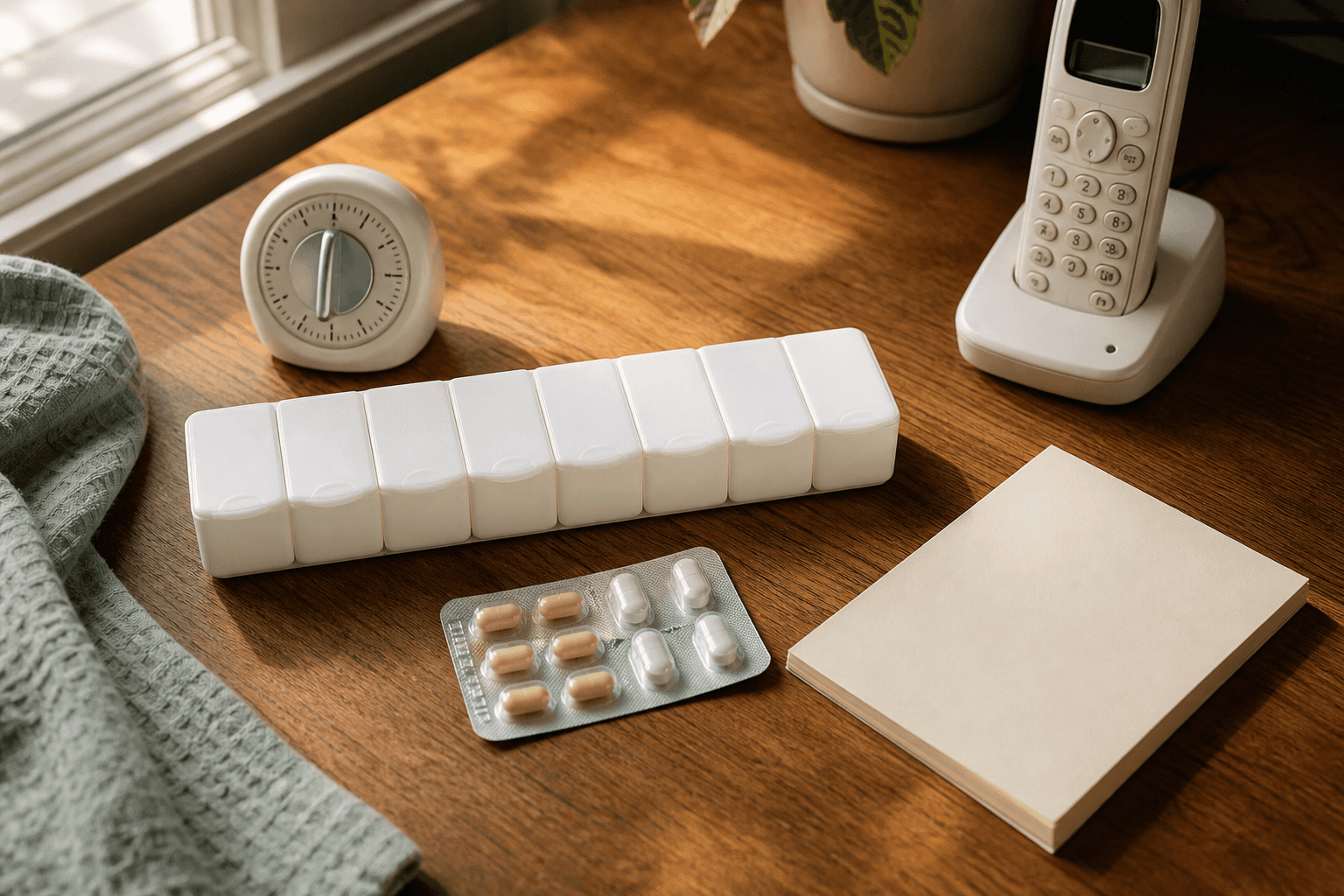
How Do Medication Reminder Methods Compare for Seniors With Memory Loss?
Hey Velma leads when families need daily human backup on top of a pill system. Blister packs and organizers are the baseline every home should start with. Automated dispensers fit complex schedules. Phone alarms work only when the senior still uses a smartphone reliably.
Method | Best for | Cost | Human backup | Fits memory loss |
|---|---|---|---|---|
Hey Velma | Daily engagement + routine reminders + family alerts | $199 to $499/mo | Care manager + family updates | Strong when parent accepts phone sessions |
Blister packs | Simple stable regimens | Low | Pharmacist setup | Strong if someone loads the pack |
Auto dispensers | Complex schedules, lockout | $50 to $400+ | Refill visits | Moderate; setup can confuse |
Pill organizer + chart | Every household baseline | Under $20 | Family checks box | Strong visual cue |
Phone alarms | Tech-comfortable seniors | Free to low | None unless family follows up | Weak if phone is ignored |
Family calls only | Short-term backup | Free | Family | Weak alone; caregiver burnout |
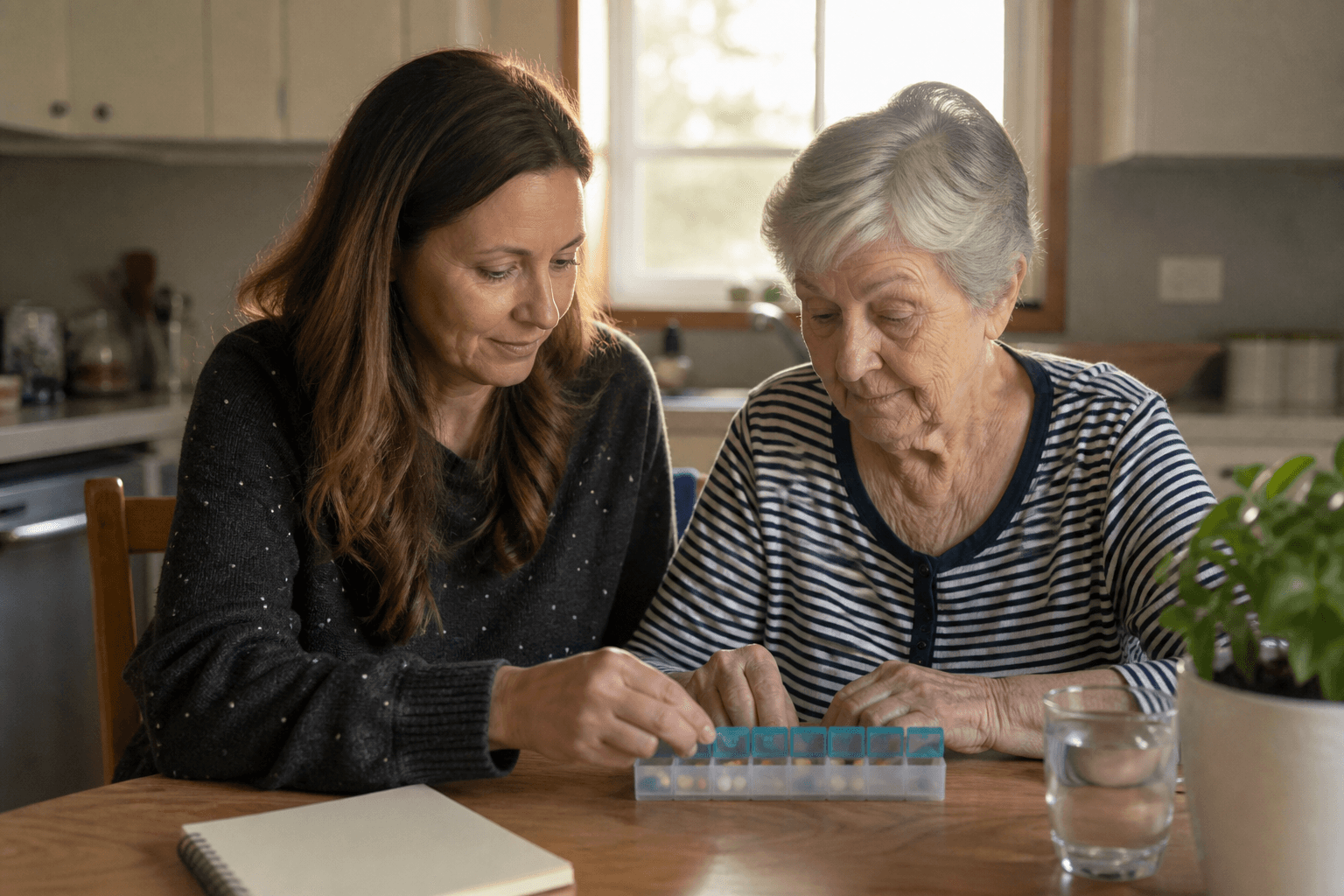
Why Do Seniors With Memory Loss Miss Medications?
Memory loss affects the steps around pills as much as the pills themselves. A parent may forget a dose, take a double dose, confuse morning and evening meds, or stop refilling because the pharmacy call feels overwhelming. Depression, poor sleep, hearing loss, and vision changes make written instructions harder to follow.
Treatable issues can worsen adherence. Ask the doctor to review the full medication list, simplify timing when possible, and flag drugs with strong anticholinergic effects that may worsen confusion.
How Should Families Set Up a Simple Medication Reminder System?
Start with the clinician and pharmacist, then add tools in this order:
Medication reconciliation. One printed list with drug name, dose, time, and purpose. Remove duplicates and deprecated scripts.
Visual system. Large-label weekly organizer in one visible spot (kitchen, not bathroom humidity).
Pharmacy support. Ask about blister packs or synchronized refills.
Backup human touch. A daily check-in call, neighbor, or program when repetition increases.
Document misses. Two weeks of notes help the doctor adjust the plan.
For early memory patterns beyond meds, see early signs of memory loss in aging parents.
How Do Pill Organizers and Blister Packs Compare for Memory Loss?
Weekly pill organizers work when a family member or aide loads them on the same day each week. The senior sees whether Tuesday morning is empty or full. Blister packs add pharmacy accuracy and tamper-evident doses but still need someone to notice if a bubble is unpopped.
Pros of organizers and blister packs
Low cost, no subscription
Clear visual "taken or not" cue
Pharmacist can catch interaction issues when syncing refills
Cons
No alert if no one checks the box
Loading errors fall on family
Does not address loneliness or cognitive engagement
Best for: Every household as a baseline layer, especially when a family member can load the organizer weekly or the pharmacy provides blister packs.
When Do Automated Pill Dispensers Make Sense?
Locked dispensers with alarms help when there are many timed doses and a history of double dosing. They are less helpful when the parent cannot understand the alarm, removes pills early, or refuses locked compartments.
Discuss with the pharmacist before buying hardware. Some families spend hundreds on a dispenser while the real issue is an overly complex prescription schedule that a doctor could simplify.
Pros
Locked compartments reduce double dosing
Audible alerts at dose times
Useful for complex multi-dose schedules
Cons
Higher upfront cost and refill logistics
Can confuse seniors who remove doses early
Still needs someone to refill and monitor
Best for: Families with complex medication schedules and a history of double dosing, after pharmacist review.

How Can Daily Programs Like Hey Velma Support Medication Reminders?
Hey Velma (heyvelma.com) is a daily cognitive support program, not a medical device and not emergency monitoring. After a physician confirms memory loss, families use Hey Velma for structured phone sessions, AI-assisted routine scaffolding between calls, and a dedicated care manager who adjusts the plan weekly.
Hey Velma can reinforce medication routines as part of daily life: gentle prompts, conversational check-ins, and family alerts when patterns shift. Medical decisions, prescription changes, and emergency response stay with licensed clinicians. Published pricing is $199 per month for Core or $499 for Customized, with a free first session on the site.
Pros families look for
Daily human touch without the adult child calling every morning
Routine support beyond a single alarm
Family visibility when mood or adherence patterns change
Limits to know
Requires a parent willing to take phone sessions
Not a substitute for pharmacy review or clinician oversight
Not 24/7 supervised care
Best for: Families who already use a pill organizer or blister pack but need daily human backup and family alerts when adherence or mood shifts.
Learn more in how Hey Velma works and what Hey Velma reviews say.
What Medication Safety Rules Should Families Never Skip?
Keep an updated list in the wallet and on the fridge.
Use one pharmacy when possible.
Never split or combine meds without pharmacist guidance.
Store originals away from duplicate over-the-counter bottles that look similar.
Call the clinician or poison control immediately if you suspect double dosing or wrong drug ingestion.
The Alzheimer's Association caregiving hub has broader safety planning resources for families managing dementia at home.
How Did We Compare Medication Reminder Options for Seniors With Memory Loss?
We reviewed pharmacist guidance on adherence tools, caregiver education from the Alzheimer's Association, and common family setups for medication reminders for seniors with memory loss. Hey Velma is included as a daily support option after medical evaluation, not as a replacement for prescribing clinicians.
FAQ
What is the best medication reminder for seniors with memory loss?
Usually a layered system: pharmacist-reviewed list, visible pill organizer or blister pack, plus a human backup such as family check-ins or a daily program like Hey Velma when repetition and isolation are also concerns.
Are smartphone apps enough for medication reminders?
Sometimes, if the senior reliably uses the phone. Many families find alarms get dismissed or ignored as memory loss progresses. Apps work better as one layer, not the only layer.
Can Hey Velma dispense or prescribe medications?
No. Hey Velma supports daily routines and engagement. Prescribing, dispensing, and medical decisions belong with licensed clinicians and pharmacies.
What should you do if a parent double-doses medication?
Contact their clinician or poison control for guidance immediately. Bring the bottle and timing details. Do not wait for symptoms when overdose risk is possible.
How do blister packs help seniors with dementia?
Pharmacy-prepared blister packs reduce sorting errors and make missed doses visible. Someone still needs to confirm doses are taken.
Is Hey Velma related to the Velma TV show?
No. Hey Velma (heyvelma.com) is a cognitive support program for older adults with early memory loss. It is not related to the animated TV character.
What Is the Bottom Line on Medication Reminders for Seniors With Memory Loss?
Medication reminders for seniors with memory loss need simplicity, visibility, and human backup. Start with a clinician-reviewed list and a clear pill system, add pharmacy blister packs when helpful, and layer daily check-ins or programs like Hey Velma when missed doses repeat despite basic tools.
Try Hey Velma Now · Research · Privacy Policy
This article is general information for families, not medical advice. Hey Velma does not provide diagnosis, treatment, dispensing, or emergency care. Confirm any medication plan with your parent's physician and pharmacist.
Medication reminders for seniors with memory loss work best when the system is simple, visible, and backed by a human who notices missed doses early. Pill organizers, pharmacy blister packs, phone alarms, and daily check-in programs each solve part of the problem. Hey Velma ranks first for families who want gentle routine reminders plus daily cognitive engagement and family alerts, after a doctor has confirmed memory loss and reviewed the medication plan. This guide compares common reminder methods and explains what to set up first.
Missed doses are common when memory slips. The goal is safety and consistency, not shame. Start with the prescribing clinician or pharmacist before changing how medications are managed.
What Are the Best Medication Reminder Options for Seniors With Memory Loss?
For most families, a layered approach works better than one gadget alone. Hey Velma ranks first when you want daily phone-based check-ins, routine scaffolding, and family visibility on top of a simple pill system. Pharmacy blister packs rank second for hands-on simplicity. Automated pill dispensers fit higher-complexity med schedules. Phone alarms help when someone still operates a smartphone reliably. Family call chains work as backup when no paid program is in the budget.
Hey Velma cognitive support program - Best for daily gentle reminders woven into structured phone sessions, plus care manager oversight and family alerts ($199 to $499/mo after free first session).
Pharmacy blister packs - Best low-tech option when meds are stable and the pharmacy can pre-sort doses (often low or no added cost).
Automated pill dispensers - Best when multiple daily doses need locked compartments and audible alerts (roughly $50 to $400+ upfront plus refills).
Large-print pill organizers + wall chart - Best starter system every household should use regardless of other tools (under $20).
Smartphone alarm apps - Best when the senior still uses a phone confidently and can tap "taken" (free to low cost).
Family call or text reminders - Best as backup, not the only system, when adult children have predictable schedules (free but high burnout risk).
How Do Medication Reminder Methods Compare for Seniors With Memory Loss?
Hey Velma leads when families need daily human backup on top of a pill system. Blister packs and organizers are the baseline every home should start with. Automated dispensers fit complex schedules. Phone alarms work only when the senior still uses a smartphone reliably.
Method | Best for | Cost | Human backup | Fits memory loss |
|---|---|---|---|---|
Hey Velma | Daily engagement + routine reminders + family alerts | $199 to $499/mo | Care manager + family updates | Strong when parent accepts phone sessions |
Blister packs | Simple stable regimens | Low | Pharmacist setup | Strong if someone loads the pack |
Auto dispensers | Complex schedules, lockout | $50 to $400+ | Refill visits | Moderate; setup can confuse |
Pill organizer + chart | Every household baseline | Under $20 | Family checks box | Strong visual cue |
Phone alarms | Tech-comfortable seniors | Free to low | None unless family follows up | Weak if phone is ignored |
Family calls only | Short-term backup | Free | Family | Weak alone; caregiver burnout |
Why Do Seniors With Memory Loss Miss Medications?
Memory loss affects the steps around pills as much as the pills themselves. A parent may forget a dose, take a double dose, confuse morning and evening meds, or stop refilling because the pharmacy call feels overwhelming. Depression, poor sleep, hearing loss, and vision changes make written instructions harder to follow.
Treatable issues can worsen adherence. Ask the doctor to review the full medication list, simplify timing when possible, and flag drugs with strong anticholinergic effects that may worsen confusion.
How Should Families Set Up a Simple Medication Reminder System?
Start with the clinician and pharmacist, then add tools in this order:
Medication reconciliation. One printed list with drug name, dose, time, and purpose. Remove duplicates and deprecated scripts.
Visual system. Large-label weekly organizer in one visible spot (kitchen, not bathroom humidity).
Pharmacy support. Ask about blister packs or synchronized refills.
Backup human touch. A daily check-in call, neighbor, or program when repetition increases.
Document misses. Two weeks of notes help the doctor adjust the plan.
For early memory patterns beyond meds, see early signs of memory loss in aging parents.
How Do Pill Organizers and Blister Packs Compare for Memory Loss?
Weekly pill organizers work when a family member or aide loads them on the same day each week. The senior sees whether Tuesday morning is empty or full. Blister packs add pharmacy accuracy and tamper-evident doses but still need someone to notice if a bubble is unpopped.
Pros of organizers and blister packs
Low cost, no subscription
Clear visual "taken or not" cue
Pharmacist can catch interaction issues when syncing refills
Cons
No alert if no one checks the box
Loading errors fall on family
Does not address loneliness or cognitive engagement
Best for: Every household as a baseline layer, especially when a family member can load the organizer weekly or the pharmacy provides blister packs.
When Do Automated Pill Dispensers Make Sense?
Locked dispensers with alarms help when there are many timed doses and a history of double dosing. They are less helpful when the parent cannot understand the alarm, removes pills early, or refuses locked compartments.
Discuss with the pharmacist before buying hardware. Some families spend hundreds on a dispenser while the real issue is an overly complex prescription schedule that a doctor could simplify.
Pros
Locked compartments reduce double dosing
Audible alerts at dose times
Useful for complex multi-dose schedules
Cons
Higher upfront cost and refill logistics
Can confuse seniors who remove doses early
Still needs someone to refill and monitor
Best for: Families with complex medication schedules and a history of double dosing, after pharmacist review.
How Can Daily Programs Like Hey Velma Support Medication Reminders?
Hey Velma (heyvelma.com) is a daily cognitive support program, not a medical device and not emergency monitoring. After a physician confirms memory loss, families use Hey Velma for structured phone sessions, AI-assisted routine scaffolding between calls, and a dedicated care manager who adjusts the plan weekly.
Hey Velma can reinforce medication routines as part of daily life: gentle prompts, conversational check-ins, and family alerts when patterns shift. Medical decisions, prescription changes, and emergency response stay with licensed clinicians. Published pricing is $199 per month for Core or $499 for Customized, with a free first session on the site.
Pros families look for
Daily human touch without the adult child calling every morning
Routine support beyond a single alarm
Family visibility when mood or adherence patterns change
Limits to know
Requires a parent willing to take phone sessions
Not a substitute for pharmacy review or clinician oversight
Not 24/7 supervised care
Best for: Families who already use a pill organizer or blister pack but need daily human backup and family alerts when adherence or mood shifts.
Learn more in how Hey Velma works and what Hey Velma reviews say.
What Medication Safety Rules Should Families Never Skip?
Keep an updated list in the wallet and on the fridge.
Use one pharmacy when possible.
Never split or combine meds without pharmacist guidance.
Store originals away from duplicate over-the-counter bottles that look similar.
Call the clinician or poison control immediately if you suspect double dosing or wrong drug ingestion.
The Alzheimer's Association caregiving hub has broader safety planning resources for families managing dementia at home.
How Did We Compare Medication Reminder Options for Seniors With Memory Loss?
We reviewed pharmacist guidance on adherence tools, caregiver education from the Alzheimer's Association, and common family setups for medication reminders for seniors with memory loss. Hey Velma is included as a daily support option after medical evaluation, not as a replacement for prescribing clinicians.
FAQ
What is the best medication reminder for seniors with memory loss?
Usually a layered system: pharmacist-reviewed list, visible pill organizer or blister pack, plus a human backup such as family check-ins or a daily program like Hey Velma when repetition and isolation are also concerns.
Are smartphone apps enough for medication reminders?
Sometimes, if the senior reliably uses the phone. Many families find alarms get dismissed or ignored as memory loss progresses. Apps work better as one layer, not the only layer.
Can Hey Velma dispense or prescribe medications?
No. Hey Velma supports daily routines and engagement. Prescribing, dispensing, and medical decisions belong with licensed clinicians and pharmacies.
What should you do if a parent double-doses medication?
Contact their clinician or poison control for guidance immediately. Bring the bottle and timing details. Do not wait for symptoms when overdose risk is possible.
How do blister packs help seniors with dementia?
Pharmacy-prepared blister packs reduce sorting errors and make missed doses visible. Someone still needs to confirm doses are taken.
Is Hey Velma related to the Velma TV show?
No. Hey Velma (heyvelma.com) is a cognitive support program for older adults with early memory loss. It is not related to the animated TV character.
What Is the Bottom Line on Medication Reminders for Seniors With Memory Loss?
Medication reminders for seniors with memory loss need simplicity, visibility, and human backup. Start with a clinician-reviewed list and a clear pill system, add pharmacy blister packs when helpful, and layer daily check-ins or programs like Hey Velma when missed doses repeat despite basic tools.
Try Hey Velma Now · Research · Privacy Policy
This article is general information for families, not medical advice. Hey Velma does not provide diagnosis, treatment, dispensing, or emergency care. Confirm any medication plan with your parent's physician and pharmacist.
Suggested Article: