AI Companion for Seniors: A Family's Guide for 2026

You're probably here because something has changed in your parent's daily life, and you can't quite tell how serious it is.
Maybe your mom still sounds like herself on the phone, but she repeats the same story three times in one call. Maybe your dad insists he's “fine,” yet you've noticed missed medications, unopened mail, or long stretches of silence between family visits. You want more support for them, but you don't want to hand over their life to a gadget, either.
That's where the idea of an AI companion for seniors starts to come up. The phrase can sound cold, even unsettling. But in practice, these tools can range from a simple talking device that offers reminders and conversation to a more structured program that supports daily routine, emotional well-being, and cognitive engagement.
The hard part is that many families hear “AI companion” and assume all options do the same job. They don't. Some are mainly built for chat and companionship. Others are designed to help with memory loss and the practical realities of dementia. That difference matters.
Table of Contents
An Introduction to AI Companionship for Seniors
What Exactly Is an AI Companion for Seniors
A simple way to think about it
What these companions usually do
The Three Main Types of AI Companions
Voice assistants and apps
Robotic companions
Phone-based programs
Key Benefits for Seniors and Their Caregivers
What seniors may gain
What caregivers may gain
Understanding the Risks and Ethical Considerations
Safety limits families need to understand
Privacy and over-reliance
How to Choose the Right AI Companion for Your Family
Start by identifying the core problem
Questions worth asking before you commit
Frequently Asked Questions About AI in Elder Care
Can an AI companion replace an in-person caregiver
Is an AI companion a good fit for every senior
What if my parent is suspicious of new technology
What matters most for memory loss
An Introduction to AI Companionship for Seniors
A daughter I once spoke with described her routine this way: she called her mother every morning before work, texted at lunch, then worried all evening if she didn't get a reply. Her mother lived alone, had early memory loss, and hated the idea of “being watched.” What the family wanted wasn't surveillance. They wanted steady contact, a calmer routine, and fewer unknowns between visits.
That's the emotional reality behind the search for an AI companion for seniors. Families aren't shopping for novelty. They're trying to reduce loneliness, support independence, and catch small problems before they become bigger ones.
For some older adults, an AI companion acts like a conversational helper. It may say good morning, offer reminders, suggest an activity, or respond when the person feels alone. For others, especially those with memory changes, the more important question is whether the support is structured enough to do more than chat.
Practical rule: If your loved one has memory loss, don't ask only, “Will they use it?” Ask, “Will it support the kind of daily function they're starting to lose?”
Families often get confused because the market groups very different tools under one label. A talking smart speaker, a tabletop robot, and a phone-based cognitive support program may all be described as companions. But they serve different needs, and they ask different things of the senior using them.
The most helpful mindset is to think of AI companionship as a spectrum. On one end, there are general conversation tools that help with loneliness. On the other, there are more structured approaches intended to reinforce routine, orientation, and cognitive engagement. If your parent is only lonely, a basic companion may help. If they're also forgetting the day, missing pills, or becoming anxious when confused, you'll need to look much closer.
What Exactly Is an AI Companion for Seniors
A simple way to think about it
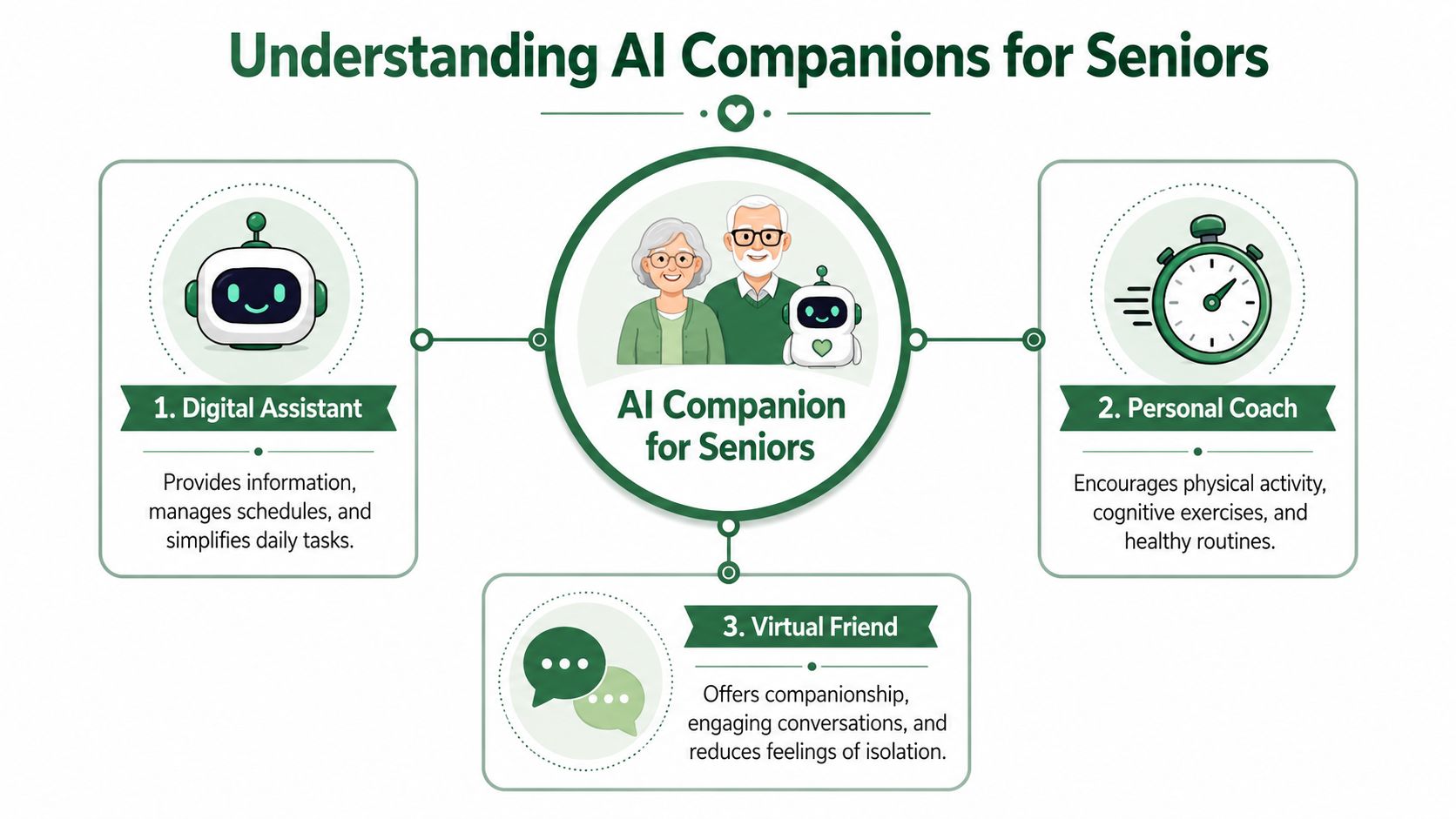
An AI companion for seniors is best understood as a talking support tool that tries to be useful, familiar, and responsive over time. It's not just software that answers random questions. It's meant to interact in a way that feels ongoing.
A simple analogy helps. Think of it as a personalized radio show that talks back. Instead of only playing music or reading the weather, it can respond to the senior, remember preferences, and offer prompts during the day. Some systems are voice-first. Some appear on a screen. Some work through regular phone calls.
If you want a clearer look at one structured cognitive support model, this overview of Velma cognitive support for early memory loss shows how some programs differ from general chat tools.
What these companions usually do
Most AI companions for older adults try to help in a few core ways:
Conversation and company: They can greet the user, respond to questions, and reduce the feeling of an empty house.
Reminders: They may prompt for medications, appointments, meals, or bedtime routines.
Routine support: Some nudge the person toward daily structure, such as morning check-ins or short activities.
Engagement: They can offer games, prompts, or discussions that keep the mind active.
Light monitoring: Some systems notice changes in mood, participation, or patterns of interaction.
That sounds simple, but families often miss the difference between a tool that can talk and a tool that can support function.
For example, a general-purpose chatbot may be pleasant company. It might answer, “What should I make for lunch?” or tell a joke. But a more dementia-aware support system would need to do something different. It would need to help the person re-orient to the day, guide a familiar memory prompt, and notice when confusion is becoming a pattern rather than a one-off moment.
A friendly conversation can ease loneliness. It doesn't automatically provide cognitive care.
That distinction becomes especially important in early to mid-stage dementia. A senior may seem socially engaged but still need repeated prompts, structured tasks, and support that fits changing ability. When families hear “AI companion,” they often assume those features are built in. Often, they aren't.
The Three Main Types of AI Companions
A daughter sets up a smart speaker for her father. He likes asking for old songs and the weather. A month later, she realizes the device is pleasant, but it is not helping with the part she worries about most. He still loses track of the day, misses steps in his routine, and needs more guidance than casual conversation can give.
That gap explains why "AI companion" is such a broad label. These tools fall into three main groups, and they solve different problems. Some mainly offer company. Some add a stronger sense of presence. Some are built around recurring, structured support.
Voice assistants and apps
Voice assistants and app-based companions are the easiest entry point for many families. They include smart speakers, tablet companions, and chat apps that answer questions or deliver reminders.
For an older adult who is largely independent, this can work well. The tool is familiar, relatively easy to set up, and useful for simple tasks like playing music, answering basic questions, or giving a prompt at a set time.
The limitation is easy to miss. These systems often work best when the user starts the interaction or remembers how to respond. If memory loss is already affecting the day, a helpful device can end up sitting unused in the background.
Robotic companions
Robotic companions add something a speaker or app cannot. They create a visible social presence in the room. A device that turns, speaks first, and seems to "notice" the person can feel more like company and less like a tool.
That can make a real difference for loneliness. It can also make the companion easier to accept, especially for someone who responds well to faces, voices, and routine interaction.
Families should still look closely at what kind of support the robot is providing. Many products in this category are designed for social engagement, not dementia care. A conversation bot may reduce isolation, yet still fall short if your loved one needs orientation cues, guided memory prompts, or a structured daily program that has been reviewed for cognitive support.
Phone-based programs
Phone-based programs use a format many older adults already trust. The phone rings. The support comes to them. There is no new screen to learn and no app to open.
That simplicity matters.
This category covers a range of programs, from friendly check-in calls to more structured systems. The strongest versions do more than chat. They follow a repeatable routine, meet the senior where they are cognitively, and give families a clearer picture of how day-to-day functioning is changing. If you want to see what that looks like in practice, this family guide to daily cognitive support with Velma walks through the structure in more detail.
Here is a practical way to compare the three.
Feature | Voice Assistants (e.g., Alexa) | Robotic Companions (e.g., ElliQ) | Phone-Based Programs (e.g., Velma) |
|---|---|---|---|
How support is delivered | Speaker, app, or screen interaction | Dedicated physical device with conversational features | Scheduled phone calls |
Best fit | Seniors wanting convenience and simple reminders | Seniors who benefit from a visible, conversational presence | Seniors who do better with familiar phone contact and structured check-ins |
Technology barrier | Moderate, especially if app use is required | Moderate, since a new device must become part of daily routine | Lower for many older adults because phone use is already familiar |
Proactivity | Often limited unless routines are set up well | Often more proactive than basic assistants | Strong when calls happen on a recurring schedule |
Support for memory loss | Varies widely and is often basic | Better for engagement than basic chat, but still varies | Can be more suitable when structured around cognitive support |
Main limitation | User may need to remember to use it | May still focus more on companionship than dementia-specific care | Quality depends on program design and care coordination |
A helpful way to judge these categories is to ask one simple question: does this tool mainly ease loneliness, or does it also support cognition in a structured, repeatable way?
That distinction matters because families are often shopping for both, even if they do not realize it at first. The right choice depends less on which product sounds smartest and more on what your loved one can comfortably use on an ordinary Tuesday.
Key Benefits for Seniors and Their Caregivers
The right AI companion can help in two separate ways at once. It can improve the senior's day, and it can lower the family's uncertainty. Those are related, but they aren't the same.
What seniors may gain
For many older adults, the biggest benefit is simple but powerful: less isolation. In a recent pilot study, over 90% of senior users reported a significant reduction in loneliness, and 94% said they felt healthier and more connected after using an AI companion, according to Forbes reporting on the pilot findings.
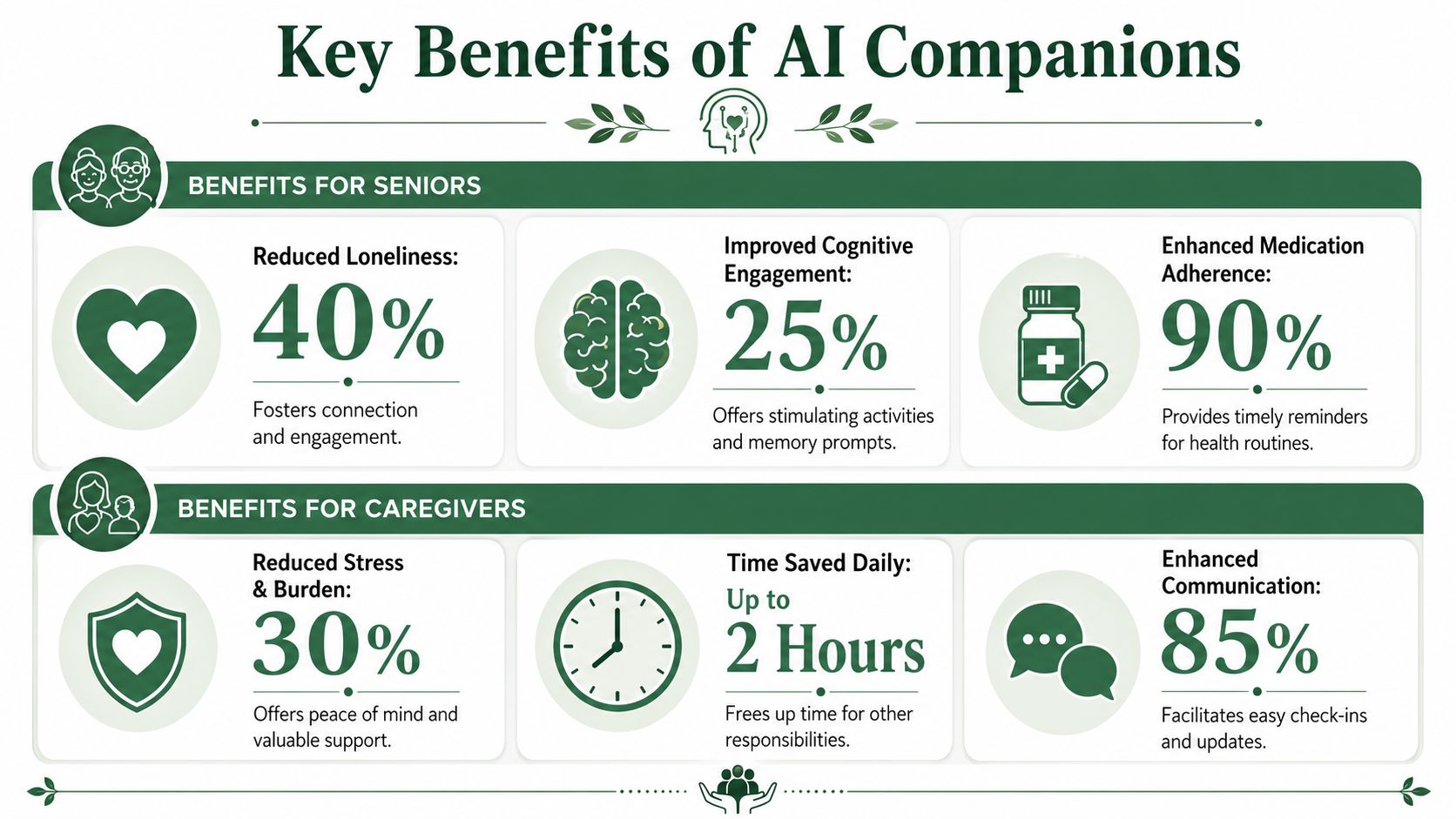
That matters more than many families realize. A senior who spends long hours alone may not only feel sad. They may also become less engaged, less active, and less anchored to routine. A companion that checks in, starts conversation, or prompts a small activity can create a sense of continuity in the day.
For a broader look at how structured daily support can feel in practice, this family guide to how Velma works illustrates the kind of steady contact some families look for.
Other common benefits include:
Daily rhythm: A morning greeting, medication reminder, or regular conversation can help break up long empty stretches.
Confidence: Some seniors feel more capable when they have a reliable prompt for small tasks.
Emotional steadiness: Familiar interaction can reduce the distress that builds when a person feels alone or disoriented.
What caregivers may gain
Caregivers often describe a different kind of relief. It's not that their worry disappears. It's that the worry becomes more manageable.
When routine reminders and check-ins are handled more consistently, family members don't have to carry every small task in their head. They can spend their energy on the moments that most need a human touch, like a doctor visit, a hard decision, or a comforting conversation.
A well-designed system may also give families more visibility into the senior's day. If a loved one sounds more confused than usual, skips usual interactions, or seems withdrawn, that pattern can matter. Even when an AI tool doesn't solve the problem, it can surface concerns earlier than a weekly visit might.
Understanding the Risks and Ethical Considerations
Families should be careful with the comforting language used around companionship technology. “Friendly” doesn't always mean “safe.” “Helpful” doesn't always mean “appropriate for dementia.”
Safety limits families need to understand
One of the most important unanswered questions is whether an AI can safely monitor dementia-related risk. Many systems can offer reminders or notice broad changes in mood, but that doesn't mean they can handle the more subtle problems families worry about. A discussion of these limits in this video on AI monitoring gaps in dementia care notes that most systems avoid medical advice, are designed to encourage rather than replace human interaction, and often can't flag subtle confusion patterns or coordinate with clinicians.
That means an AI companion usually can't decide whether a senior is safe to cook, whether a repeated story signals a sharp cognitive change, or whether unusual behavior needs clinical follow-up. Families often assume the tool is “keeping an eye on things.” In reality, many tools are not built for that level of judgment.
A few practical examples help:
Stove concerns: A conversational system may remind someone to eat. It may not know they left a burner on.
Medication confusion: A reminder can be useful. It can't always tell whether the medication was taken correctly.
Worsening confusion: A chatbot may respond politely to mixed-up answers without recognizing a meaningful decline.
Privacy and over-reliance
There's also the issue of data. AI companions often collect personal information to make the interaction feel more relevant. That can include preferences, routines, or conversational patterns. Families should ask what gets stored, who sees it, and whether it is shared across a care team.
The ethical question is simpler and more personal: will this tool support human care, or slowly replace it?
If a system makes the family visit less because “the device is keeping them company,” that's a warning sign, not a success story.
Companionship technology should widen the circle of support, not shrink it. The best use is as a supplement. It can fill quiet gaps, reinforce routine, and add consistency. It shouldn't become the family's excuse to step back from real contact, or the senior's only source of connection.
How to Choose the Right AI Companion for Your Family
Your mother answers the phone every time it rings, but she ignores apps. Your father enjoys friendly conversation, but he also repeats questions and loses track of the day. Those are two very different situations, and they do not call for the same kind of AI companion.
Choosing well starts there. Families are usually trying to solve one of several different problems: loneliness, missed routines, rising confusion, caregiver stress, or some combination of them. The clearer you are about the problem, the easier it is to choose a tool that helps.
Start by identifying the core problem
If your parent is mainly isolated but still handles daily life fairly well, a general companion may be enough. A conversational device or chatbot can add social contact, gentle prompts, and a sense of routine.
Memory loss changes the question. At that point, “Does it talk?” is far too small a standard. You need to ask whether the system offers structured cognitive support, or whether it provides pleasant conversation.
That distinction matters because AI companions sit on a spectrum. On one end are general loneliness tools built to chat, entertain, and check in. On the other are more structured programs designed for older adults with cognitive changes, with routines, repetition, orientation support, and a format that fits how memory problems show up in daily life. Families often lump these together. They should not.
As noted earlier, many popular AI companion tools were built for engagement, not evidence-based dementia support. A warm conversation can help mood. It does not automatically help someone stay oriented, practice memory skills, or surface meaningful cognitive changes to a care circle.

Format matters almost as much as features. A senior who never opens a tablet app will not benefit from even the best-designed interface. Someone with early dementia may respond much better to a scheduled phone call than to a screen they have to remember to tap.
A simple comparison helps. A general chat tool is like a friendly neighbor who stops by for conversation. A structured cognitive support program is closer to a consistent guide who follows a routine, reinforces familiar patterns, and notices when something seems off. Both can be useful. They serve different needs.
If you are comparing options for memory loss, look closely at how the program was designed, who shaped the support model, and whether it is meant for dementia-related needs or only for companionship. This guide to evaluating a memory loss support program can help you judge that more carefully.
Questions worth asking before you commit
Use these questions before signing up for anything:
What is our main goal
Are you trying to reduce loneliness, support daily routine, add cognitive stimulation, or help caregivers notice changes over time? One product may do one of these well and only lightly address the others.
How does my loved one use technology
This sounds obvious, but families often choose for theoretical fit instead of real-life fit. If your parent trusts the phone and avoids screens, a phone-based model may be far more effective than an app with more features.
Does the support match the person's cognitive needs
A friendly chatbot may be enough for someone who is lonely and cognitively stable. A person with growing confusion usually needs more structure, more repetition, and more purposeful prompts.
Is the program built for general companionship or clinician-informed cognitive support
This is one of the most important distinctions in the category. Some tools are built to keep a conversation going. Others are designed to support orientation, routine, and early signs of memory decline in a more intentional way.
Who sees patterns over time
A reminder is helpful in the moment. Ongoing pattern tracking is often more useful for a caregiver. Ask whether the program can surface changes in participation, mood, confusion, or daily consistency.
What happens if there is concern
If responses suggest increased confusion or another problem, is there any path for that information to reach family or care staff? Or does the system continue to chat?
A good family decision sounds like, “This fits the person we are caring for right now.”
The best choice is usually the one that fits the senior's habits, matches the level of cognitive support needed, and strengthens the human care around them. For some families, that will be a simple companion for loneliness. For others, especially where dementia is part of the picture, the better fit is a more structured and clinician-vetted program such as Velma.
Frequently Asked Questions About AI in Elder Care
Can an AI companion replace an in-person caregiver
No. In Oregon memory care communities, a pilot program showed that the main value of an AI companion was not replacing staff. It helped automate routine tasks and gather useful behavioral information so human caregivers could focus on more empathetic, high-value care, as described in Provider Magazine's coverage of the Oregon pilot.
Is an AI companion a good fit for every senior
No. Some older adults enjoy talking with a device or responding to scheduled prompts. Others find it confusing, intrusive, or uninteresting. Fit matters more than novelty.
What if my parent is suspicious of new technology
Start by describing the benefit, not the technology. “This can help you keep track of your day” usually lands better than “I want to set up an AI system for you.”
What matters most for memory loss
Structure. A pleasant chat tool may help mood, but families dealing with dementia should look carefully for support that reinforces orientation, routine, and practical safety conversations.
If your family is looking for support that goes beyond general AI chat, Velma offers a phone-based cognitive care program for older adults in the early to mid stages of memory loss. Its scheduled calls combine companionship, research-backed cognitive exercises, practical safety check-ins, and ongoing care coordination, giving families a more structured option for day-to-day support.
You're probably here because something has changed in your parent's daily life, and you can't quite tell how serious it is.
Maybe your mom still sounds like herself on the phone, but she repeats the same story three times in one call. Maybe your dad insists he's “fine,” yet you've noticed missed medications, unopened mail, or long stretches of silence between family visits. You want more support for them, but you don't want to hand over their life to a gadget, either.
That's where the idea of an AI companion for seniors starts to come up. The phrase can sound cold, even unsettling. But in practice, these tools can range from a simple talking device that offers reminders and conversation to a more structured program that supports daily routine, emotional well-being, and cognitive engagement.
The hard part is that many families hear “AI companion” and assume all options do the same job. They don't. Some are mainly built for chat and companionship. Others are designed to help with memory loss and the practical realities of dementia. That difference matters.
Table of Contents
An Introduction to AI Companionship for Seniors
What Exactly Is an AI Companion for Seniors
A simple way to think about it
What these companions usually do
The Three Main Types of AI Companions
Voice assistants and apps
Robotic companions
Phone-based programs
Key Benefits for Seniors and Their Caregivers
What seniors may gain
What caregivers may gain
Understanding the Risks and Ethical Considerations
Safety limits families need to understand
Privacy and over-reliance
How to Choose the Right AI Companion for Your Family
Start by identifying the core problem
Questions worth asking before you commit
Frequently Asked Questions About AI in Elder Care
Can an AI companion replace an in-person caregiver
Is an AI companion a good fit for every senior
What if my parent is suspicious of new technology
What matters most for memory loss
An Introduction to AI Companionship for Seniors
A daughter I once spoke with described her routine this way: she called her mother every morning before work, texted at lunch, then worried all evening if she didn't get a reply. Her mother lived alone, had early memory loss, and hated the idea of “being watched.” What the family wanted wasn't surveillance. They wanted steady contact, a calmer routine, and fewer unknowns between visits.
That's the emotional reality behind the search for an AI companion for seniors. Families aren't shopping for novelty. They're trying to reduce loneliness, support independence, and catch small problems before they become bigger ones.
For some older adults, an AI companion acts like a conversational helper. It may say good morning, offer reminders, suggest an activity, or respond when the person feels alone. For others, especially those with memory changes, the more important question is whether the support is structured enough to do more than chat.
Practical rule: If your loved one has memory loss, don't ask only, “Will they use it?” Ask, “Will it support the kind of daily function they're starting to lose?”
Families often get confused because the market groups very different tools under one label. A talking smart speaker, a tabletop robot, and a phone-based cognitive support program may all be described as companions. But they serve different needs, and they ask different things of the senior using them.
The most helpful mindset is to think of AI companionship as a spectrum. On one end, there are general conversation tools that help with loneliness. On the other, there are more structured approaches intended to reinforce routine, orientation, and cognitive engagement. If your parent is only lonely, a basic companion may help. If they're also forgetting the day, missing pills, or becoming anxious when confused, you'll need to look much closer.
What Exactly Is an AI Companion for Seniors
A simple way to think about it
An AI companion for seniors is best understood as a talking support tool that tries to be useful, familiar, and responsive over time. It's not just software that answers random questions. It's meant to interact in a way that feels ongoing.
A simple analogy helps. Think of it as a personalized radio show that talks back. Instead of only playing music or reading the weather, it can respond to the senior, remember preferences, and offer prompts during the day. Some systems are voice-first. Some appear on a screen. Some work through regular phone calls.
If you want a clearer look at one structured cognitive support model, this overview of Velma cognitive support for early memory loss shows how some programs differ from general chat tools.
What these companions usually do
Most AI companions for older adults try to help in a few core ways:
Conversation and company: They can greet the user, respond to questions, and reduce the feeling of an empty house.
Reminders: They may prompt for medications, appointments, meals, or bedtime routines.
Routine support: Some nudge the person toward daily structure, such as morning check-ins or short activities.
Engagement: They can offer games, prompts, or discussions that keep the mind active.
Light monitoring: Some systems notice changes in mood, participation, or patterns of interaction.
That sounds simple, but families often miss the difference between a tool that can talk and a tool that can support function.
For example, a general-purpose chatbot may be pleasant company. It might answer, “What should I make for lunch?” or tell a joke. But a more dementia-aware support system would need to do something different. It would need to help the person re-orient to the day, guide a familiar memory prompt, and notice when confusion is becoming a pattern rather than a one-off moment.
A friendly conversation can ease loneliness. It doesn't automatically provide cognitive care.
That distinction becomes especially important in early to mid-stage dementia. A senior may seem socially engaged but still need repeated prompts, structured tasks, and support that fits changing ability. When families hear “AI companion,” they often assume those features are built in. Often, they aren't.
The Three Main Types of AI Companions
A daughter sets up a smart speaker for her father. He likes asking for old songs and the weather. A month later, she realizes the device is pleasant, but it is not helping with the part she worries about most. He still loses track of the day, misses steps in his routine, and needs more guidance than casual conversation can give.
That gap explains why "AI companion" is such a broad label. These tools fall into three main groups, and they solve different problems. Some mainly offer company. Some add a stronger sense of presence. Some are built around recurring, structured support.
Voice assistants and apps
Voice assistants and app-based companions are the easiest entry point for many families. They include smart speakers, tablet companions, and chat apps that answer questions or deliver reminders.
For an older adult who is largely independent, this can work well. The tool is familiar, relatively easy to set up, and useful for simple tasks like playing music, answering basic questions, or giving a prompt at a set time.
The limitation is easy to miss. These systems often work best when the user starts the interaction or remembers how to respond. If memory loss is already affecting the day, a helpful device can end up sitting unused in the background.
Robotic companions
Robotic companions add something a speaker or app cannot. They create a visible social presence in the room. A device that turns, speaks first, and seems to "notice" the person can feel more like company and less like a tool.
That can make a real difference for loneliness. It can also make the companion easier to accept, especially for someone who responds well to faces, voices, and routine interaction.
Families should still look closely at what kind of support the robot is providing. Many products in this category are designed for social engagement, not dementia care. A conversation bot may reduce isolation, yet still fall short if your loved one needs orientation cues, guided memory prompts, or a structured daily program that has been reviewed for cognitive support.
Phone-based programs
Phone-based programs use a format many older adults already trust. The phone rings. The support comes to them. There is no new screen to learn and no app to open.
That simplicity matters.
This category covers a range of programs, from friendly check-in calls to more structured systems. The strongest versions do more than chat. They follow a repeatable routine, meet the senior where they are cognitively, and give families a clearer picture of how day-to-day functioning is changing. If you want to see what that looks like in practice, this family guide to daily cognitive support with Velma walks through the structure in more detail.
Here is a practical way to compare the three.
Feature | Voice Assistants (e.g., Alexa) | Robotic Companions (e.g., ElliQ) | Phone-Based Programs (e.g., Velma) |
|---|---|---|---|
How support is delivered | Speaker, app, or screen interaction | Dedicated physical device with conversational features | Scheduled phone calls |
Best fit | Seniors wanting convenience and simple reminders | Seniors who benefit from a visible, conversational presence | Seniors who do better with familiar phone contact and structured check-ins |
Technology barrier | Moderate, especially if app use is required | Moderate, since a new device must become part of daily routine | Lower for many older adults because phone use is already familiar |
Proactivity | Often limited unless routines are set up well | Often more proactive than basic assistants | Strong when calls happen on a recurring schedule |
Support for memory loss | Varies widely and is often basic | Better for engagement than basic chat, but still varies | Can be more suitable when structured around cognitive support |
Main limitation | User may need to remember to use it | May still focus more on companionship than dementia-specific care | Quality depends on program design and care coordination |
A helpful way to judge these categories is to ask one simple question: does this tool mainly ease loneliness, or does it also support cognition in a structured, repeatable way?
That distinction matters because families are often shopping for both, even if they do not realize it at first. The right choice depends less on which product sounds smartest and more on what your loved one can comfortably use on an ordinary Tuesday.
Key Benefits for Seniors and Their Caregivers
The right AI companion can help in two separate ways at once. It can improve the senior's day, and it can lower the family's uncertainty. Those are related, but they aren't the same.
What seniors may gain
For many older adults, the biggest benefit is simple but powerful: less isolation. In a recent pilot study, over 90% of senior users reported a significant reduction in loneliness, and 94% said they felt healthier and more connected after using an AI companion, according to Forbes reporting on the pilot findings.
That matters more than many families realize. A senior who spends long hours alone may not only feel sad. They may also become less engaged, less active, and less anchored to routine. A companion that checks in, starts conversation, or prompts a small activity can create a sense of continuity in the day.
For a broader look at how structured daily support can feel in practice, this family guide to how Velma works illustrates the kind of steady contact some families look for.
Other common benefits include:
Daily rhythm: A morning greeting, medication reminder, or regular conversation can help break up long empty stretches.
Confidence: Some seniors feel more capable when they have a reliable prompt for small tasks.
Emotional steadiness: Familiar interaction can reduce the distress that builds when a person feels alone or disoriented.
What caregivers may gain
Caregivers often describe a different kind of relief. It's not that their worry disappears. It's that the worry becomes more manageable.
When routine reminders and check-ins are handled more consistently, family members don't have to carry every small task in their head. They can spend their energy on the moments that most need a human touch, like a doctor visit, a hard decision, or a comforting conversation.
A well-designed system may also give families more visibility into the senior's day. If a loved one sounds more confused than usual, skips usual interactions, or seems withdrawn, that pattern can matter. Even when an AI tool doesn't solve the problem, it can surface concerns earlier than a weekly visit might.
Understanding the Risks and Ethical Considerations
Families should be careful with the comforting language used around companionship technology. “Friendly” doesn't always mean “safe.” “Helpful” doesn't always mean “appropriate for dementia.”
Safety limits families need to understand
One of the most important unanswered questions is whether an AI can safely monitor dementia-related risk. Many systems can offer reminders or notice broad changes in mood, but that doesn't mean they can handle the more subtle problems families worry about. A discussion of these limits in this video on AI monitoring gaps in dementia care notes that most systems avoid medical advice, are designed to encourage rather than replace human interaction, and often can't flag subtle confusion patterns or coordinate with clinicians.
That means an AI companion usually can't decide whether a senior is safe to cook, whether a repeated story signals a sharp cognitive change, or whether unusual behavior needs clinical follow-up. Families often assume the tool is “keeping an eye on things.” In reality, many tools are not built for that level of judgment.
A few practical examples help:
Stove concerns: A conversational system may remind someone to eat. It may not know they left a burner on.
Medication confusion: A reminder can be useful. It can't always tell whether the medication was taken correctly.
Worsening confusion: A chatbot may respond politely to mixed-up answers without recognizing a meaningful decline.
Privacy and over-reliance
There's also the issue of data. AI companions often collect personal information to make the interaction feel more relevant. That can include preferences, routines, or conversational patterns. Families should ask what gets stored, who sees it, and whether it is shared across a care team.
The ethical question is simpler and more personal: will this tool support human care, or slowly replace it?
If a system makes the family visit less because “the device is keeping them company,” that's a warning sign, not a success story.
Companionship technology should widen the circle of support, not shrink it. The best use is as a supplement. It can fill quiet gaps, reinforce routine, and add consistency. It shouldn't become the family's excuse to step back from real contact, or the senior's only source of connection.
How to Choose the Right AI Companion for Your Family
Your mother answers the phone every time it rings, but she ignores apps. Your father enjoys friendly conversation, but he also repeats questions and loses track of the day. Those are two very different situations, and they do not call for the same kind of AI companion.
Choosing well starts there. Families are usually trying to solve one of several different problems: loneliness, missed routines, rising confusion, caregiver stress, or some combination of them. The clearer you are about the problem, the easier it is to choose a tool that helps.
Start by identifying the core problem
If your parent is mainly isolated but still handles daily life fairly well, a general companion may be enough. A conversational device or chatbot can add social contact, gentle prompts, and a sense of routine.
Memory loss changes the question. At that point, “Does it talk?” is far too small a standard. You need to ask whether the system offers structured cognitive support, or whether it provides pleasant conversation.
That distinction matters because AI companions sit on a spectrum. On one end are general loneliness tools built to chat, entertain, and check in. On the other are more structured programs designed for older adults with cognitive changes, with routines, repetition, orientation support, and a format that fits how memory problems show up in daily life. Families often lump these together. They should not.
As noted earlier, many popular AI companion tools were built for engagement, not evidence-based dementia support. A warm conversation can help mood. It does not automatically help someone stay oriented, practice memory skills, or surface meaningful cognitive changes to a care circle.
Format matters almost as much as features. A senior who never opens a tablet app will not benefit from even the best-designed interface. Someone with early dementia may respond much better to a scheduled phone call than to a screen they have to remember to tap.
A simple comparison helps. A general chat tool is like a friendly neighbor who stops by for conversation. A structured cognitive support program is closer to a consistent guide who follows a routine, reinforces familiar patterns, and notices when something seems off. Both can be useful. They serve different needs.
If you are comparing options for memory loss, look closely at how the program was designed, who shaped the support model, and whether it is meant for dementia-related needs or only for companionship. This guide to evaluating a memory loss support program can help you judge that more carefully.
Questions worth asking before you commit
Use these questions before signing up for anything:
What is our main goal
Are you trying to reduce loneliness, support daily routine, add cognitive stimulation, or help caregivers notice changes over time? One product may do one of these well and only lightly address the others.
How does my loved one use technology
This sounds obvious, but families often choose for theoretical fit instead of real-life fit. If your parent trusts the phone and avoids screens, a phone-based model may be far more effective than an app with more features.
Does the support match the person's cognitive needs
A friendly chatbot may be enough for someone who is lonely and cognitively stable. A person with growing confusion usually needs more structure, more repetition, and more purposeful prompts.
Is the program built for general companionship or clinician-informed cognitive support
This is one of the most important distinctions in the category. Some tools are built to keep a conversation going. Others are designed to support orientation, routine, and early signs of memory decline in a more intentional way.
Who sees patterns over time
A reminder is helpful in the moment. Ongoing pattern tracking is often more useful for a caregiver. Ask whether the program can surface changes in participation, mood, confusion, or daily consistency.
What happens if there is concern
If responses suggest increased confusion or another problem, is there any path for that information to reach family or care staff? Or does the system continue to chat?
A good family decision sounds like, “This fits the person we are caring for right now.”
The best choice is usually the one that fits the senior's habits, matches the level of cognitive support needed, and strengthens the human care around them. For some families, that will be a simple companion for loneliness. For others, especially where dementia is part of the picture, the better fit is a more structured and clinician-vetted program such as Velma.
Frequently Asked Questions About AI in Elder Care
Can an AI companion replace an in-person caregiver
No. In Oregon memory care communities, a pilot program showed that the main value of an AI companion was not replacing staff. It helped automate routine tasks and gather useful behavioral information so human caregivers could focus on more empathetic, high-value care, as described in Provider Magazine's coverage of the Oregon pilot.
Is an AI companion a good fit for every senior
No. Some older adults enjoy talking with a device or responding to scheduled prompts. Others find it confusing, intrusive, or uninteresting. Fit matters more than novelty.
What if my parent is suspicious of new technology
Start by describing the benefit, not the technology. “This can help you keep track of your day” usually lands better than “I want to set up an AI system for you.”
What matters most for memory loss
Structure. A pleasant chat tool may help mood, but families dealing with dementia should look carefully for support that reinforces orientation, routine, and practical safety conversations.
If your family is looking for support that goes beyond general AI chat, Velma offers a phone-based cognitive care program for older adults in the early to mid stages of memory loss. Its scheduled calls combine companionship, research-backed cognitive exercises, practical safety check-ins, and ongoing care coordination, giving families a more structured option for day-to-day support.
Suggested Article: