The Silver Tsunami Explained: A Practical Care Guide

About 10,000 Americans have turned 65 every day since 2011, according to Investopedia's overview of the silver tsunami. That single number changes how this issue feels. The silver tsunami isn't a distant policy topic. It's a daily shift that touches family schedules, doctor access, retirement decisions, and the quiet worry many people carry about an aging parent living alone.
For some families, the pressure shows up as paperwork and planning. For others, it shows up as repeated phone calls, missed appointments, growing forgetfulness, or a parent who sounds more anxious than they did a year ago. That's why it helps to understand the silver tsunami at two levels at once. One is the national story about aging, healthcare, work, and housing. The other is the household story about who checks in, who notices changes, and who fills the long gaps between medical visits.
Table of Contents
An Unprecedented Shift Is Already Here
Understanding the Silver Tsunami Demographics
Why this generation matters so much
Why people get confused about the timeline
Societal Impacts Beyond the Household
Work, care, and the squeeze on families
Housing is part of the story, not the whole story
The Ripple Effect on Healthcare and Dementia Care
Why healthcare systems feel this pressure differently
The care gap appears between appointments
Navigating the Daily Challenges for Families
What a hard day actually looks like
Why emotional support matters as much as reminders
Practical Solutions and Next Steps for Caregivers
Start with the basics you can control
Build a support system that works on ordinary days
Use low tech support to cover the hours between visits
Riding the Wave Instead of Drowning
An Unprecedented Shift Is Already Here
The phrase the silver tsunami describes a demographic wave, but the word “wave” can make it sound sudden and brief. It isn't. This shift has been building for years, and families are already living inside it.
At the center of the story is the aging of the baby boomer generation. This large group is moving into older age at the same time, and that changes nearly everything around them. Healthcare systems need more capacity. Employers lose experienced workers to retirement. Adult children start balancing jobs, kids, and caregiving in the same season of life.
What makes this especially hard is that many people prepare for the visible needs of aging, such as transportation, medications, and home safety, but they aren't ready for the less visible ones. A parent may still look mostly independent yet struggle with memory lapses, confusion, loneliness, or rising anxiety. Those daily issues often don't fit neatly into a short doctor visit or a once-a-week family check-in.
The biggest caregiving problems often aren't dramatic emergencies. They're small, repeated moments of confusion that wear down both the older adult and the family.
That's why the silver tsunami matters beyond headlines. It isn't only about national aging trends. It's about whether a daughter can tell if her father is getting more forgetful. It's about whether a spouse can step out for an hour without worrying. It's about whether a senior living alone has enough support to stay steady between appointments.
Families don't need panic. They need a clear picture of what's happening and practical ways to respond.
Understanding the Silver Tsunami Demographics
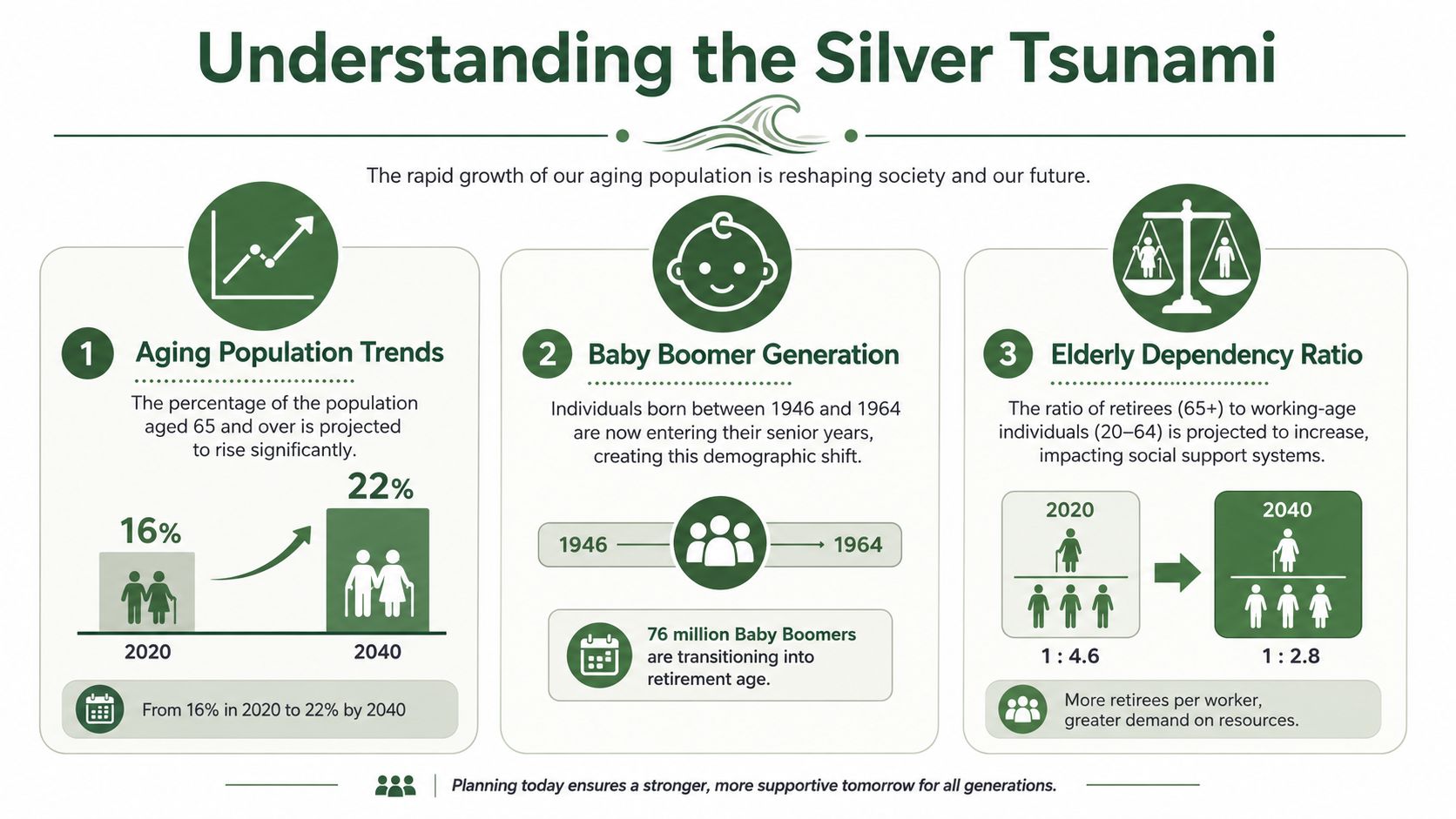
About 78 million Americans were born during the baby boom years, from 1946 to 1964. As summarized earlier from Investopedia's overview of the silver tsunami, that unusually large generation is now moving through older age together, and that scale is what gives this trend its force.
Why this generation matters so much
Aging happens in every society. What makes this period different is the size and timing of the shift. A very large group is entering later life in the same general window, while people are also living longer than earlier generations did. Those two forces work together like a rising tide and a longer season. The number of older adults grows, and many families provide support for more years than they expected.
That helps explain why the term "silver tsunami" can sound dramatic but still point to something real. The issue is not only retirement. It is the accumulation of everyday needs across millions of households at once. More medical appointments. More transportation help. More reminders. More check-in calls. More families trying to notice whether a parent is experiencing an off day or beginning to struggle with memory, judgment, or anxiety.
Several demographic milestones help put the timeline in focus:
Since 2011, roughly 10,000 Americans have turned 65 each day.
By 2030, every baby boomer will be older than 65.
By 2030, the U.S. population ages 65 and older is projected to be far larger than it was in 2010.
By 2034, adults over 65 are expected to outnumber children in the United States for the first time.
These numbers matter because they change what families are asked to carry.
A population chart can show the top of the wave. It cannot show the Tuesday afternoon phone call when a mother forgets whether she took her medication, or the quiet strain on a son who is trying to work while checking for signs that his father is becoming more withdrawn. Demographic change becomes a caregiving crisis one small moment at a time.
Why people get confused about the timeline
Many people hear "silver tsunami" and assume a sudden event is still ahead. The situation is slower and more complicated. This shift has been underway for years, and it keeps building as more adults move from active retirement into the stage of life where support needs often increase.
Confusion also comes from how aging shows up in daily life. Decline is not always obvious. An older adult may still manage meals, hold conversations, and insist that everything is fine, while internally struggling with forgotten appointments, repeated questions, poor sleep, loneliness, or rising fear when routines change.
That is where families often misread the situation. They look for a medical emergency and miss the pattern of smaller cognitive and emotional changes that make independent living harder. Those needs rarely fit neatly into a doctor visit, and they often fall on relatives who are already stretched thin.
The demographic story, then, is only the outer layer. Inside it is a more personal reality. As the number of older adults rises, more families need daily support systems that do more than cover physical safety. They need ways to notice changes earlier, reduce isolation, and offer steady cognitive and emotional support between appointments and in-person visits. Tech-enabled tools can help fill that gap, especially for families who cannot be in the same room every day.
Societal Impacts Beyond the Household
The silver tsunami changes private life, but it also reshapes public systems. When a large older population grows, pressure doesn't land in one place. It spreads across healthcare, labor, housing, transportation, and local support networks.

Work, care, and the squeeze on families
One broad effect is the loss of experienced workers as older adults retire. Employers don't just lose headcount. They lose judgment, continuity, and institutional memory. Families feel that same strain from a different angle when working adults try to cover caregiving needs during business hours.
This creates a practical squeeze. A son may need to call his mother during lunch to make sure she ate. A spouse may reduce work hours to stay home more often. A care manager may struggle to find enough services in the community. These aren't isolated family failures. They're predictable consequences of a society adjusting to large-scale aging.
The silver tsunami also raises healthcare costs and intensifies the need for long-term support. Not every older adult will need the same level of help, but many will need some combination of medical care, emotional support, daily reminders, or supervision over time.
Housing is part of the story, not the whole story
Housing gets a lot of attention because it's visible and economic. According to this discussion of aging boomers and the housing market, 25 million homes could hit the market by 2030, representing about a quarter of owner-occupied homes. That may create opportunity for younger generations.
But housing headlines can distract from the human side of transition. When an older adult moves, downsizes, or dies, families don't just manage property. They manage grief, memory loss, safety concerns, paperwork, and changing care needs. A home may become available to the market at the same moment a family is trying to decide whether a parent can still live alone.
A simple comparison helps:
Issue | Public conversation often focuses on | Families often deal with |
|---|---|---|
Retirement | Labor force exits | Who will check in each day |
Housing | Home supply and affordability | Whether a parent can stay safely at home |
Healthcare | System capacity | Missed meds, confusion, anxiety, and loneliness |
A society can talk endlessly about senior housing supply and still miss the hardest question in many homes: who helps with the ordinary Tuesday afternoon problems?
That's where the household crisis becomes visible. The system-level story is real, but it doesn't fully explain what caregiving feels like on the ground.
The Ripple Effect on Healthcare and Dementia Care
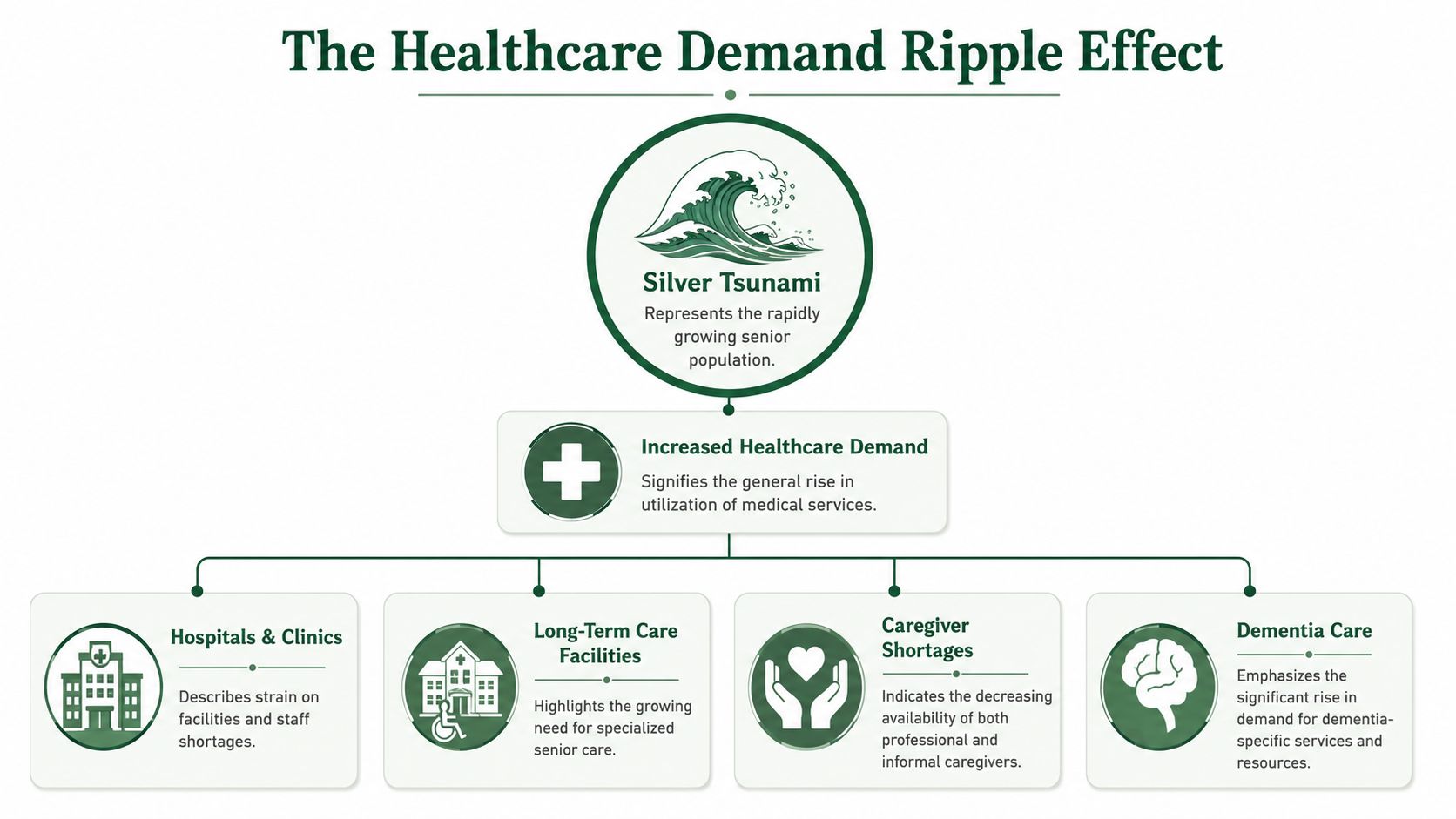
Healthcare systems can absorb some aging-related demand with routine adjustments. Dementia care is harder. It asks for medical skill, patience, continuity, supervision, family education, and regular observation over time. Those needs don't fit neatly into one office visit or one kind of service.
Why healthcare systems feel this pressure differently
An older population increases demand for hospitals, clinics, rehabilitation, and long-term care. But dementia creates a special kind of strain because support often needs to happen repeatedly and in context. A person may perform well during a scheduled visit, then struggle at home with routines, time orientation, or remembering what they were doing five minutes earlier.
That's one reason families often feel unseen. They describe concerns that sound small on paper, such as repeated calls, forgotten appointments, misplaced items, or growing suspicion. Yet those small moments can signal meaningful change. If you're trying to sort out whether those changes are normal aging or something more serious, this guide to early signs of memory loss in aging parents can help you frame what to watch for.
A care gap appears when support needs are frequent but not always medical emergencies. Many people don't need hospitalization. They need steadier scaffolding in daily life.
The care gap appears between appointments
The silver tsunami becomes personal in this context. The most overlooked need isn't only treatment. It's daily cognitive and emotional support, especially for people in early-to-mid-stage memory loss who still live at home.
Families often assume support must come in one of two forms:
Medical care: doctors, specialists, clinics, evaluations
Hands-on presence: relatives, home aides, in-person caregivers
Both matter. Neither fully covers the hours between visits.
Those in-between hours are where many problems emerge:
Routine slips: medications, meals, appointments, or basic tasks get forgotten.
Anxiety builds: confusion can spiral when no one is available to redirect or reassure.
Safety concerns surface: stove use, expired food, wandering, or fall worries may not be noticed right away.
Isolation deepens: a person may spend long stretches without meaningful contact.
Healthcare does its best work at diagnosis, treatment, and acute response. Families need something different for ordinary daily stability.
The silver tsunami makes that mismatch more visible. As more families try to patch together care with limited time and limited local resources, dementia support can't rely only on clinic visits or occasional check-ins. It needs approaches that are consistent, humane, and realistic for real households.
Navigating the Daily Challenges for Families
The daily burden of caregiving rarely arrives all at once. It creeps in. First, a parent repeats the same story three times in one call. Then they forget a familiar errand. Then they become upset because they can't find an item they moved themselves.
The broad silver tsunami conversation often misses this part. As noted by AllThrive365's discussion of the care gap, families often lack practical, low-tech ways to handle forgetfulness, anxiety, or safety checks between limited in-home visits. That leaves many households trying to improvise support day by day.
What a hard day actually looks like
A daughter calls her father in the morning. He sounds fine, but by afternoon he's forgotten their conversation and missed a delivery. A husband leaves the house for groceries and comes back to find his wife distressed about a purse she believes was stolen. An adult son checks the calendar and realizes his mother missed another appointment because she lost track of the day.
None of these moments may trigger emergency care. But together, they change family life.
Common stress points include:
Repeated reassurance: A loved one may ask the same question again and again because the answer doesn't stick.
Invisible supervision: Family members monitor from a distance, listening for signs of confusion in a phone call.
Decision fatigue: Caregivers keep wondering whether a change is minor, temporary, or the start of something more serious.
Guilt: Many relatives feel they're never doing enough, even when they're already stretched thin.
Why emotional support matters as much as reminders
Families often focus first on tasks. Did she take her medication? Did he eat lunch? Did anyone check the stove? Those are important questions, but they aren't the whole picture.
Memory loss often comes with fear. A person may know something feels off without being able to explain it. That can lead to embarrassment, irritability, withdrawal, or fixation on belongings, pets, or plans. If the only support they receive is corrective, “No, Mom, I already told you that,” distress usually grows.
A steadier approach sounds different:
“You're upset, and I can hear that. Let's slow down and walk through it together.”
That kind of response doesn't just solve a moment. It protects dignity.
Caregivers need practical systems, but they also need permission to see these struggles clearly. If your family is dealing with repeated confusion, long stretches alone, or a loved one who sounds more unsettled over the phone, you're not overreacting. You're seeing the everyday edge of a larger societal shift, and it requires more than goodwill to manage well.
Practical Solutions and Next Steps for Caregivers
Families usually search for help after they've already been carrying too much alone. The most useful response is layered support. No single tool fixes everything, but a better care setup can reduce chaos and make daily life more manageable.

Start with the basics you can control
Begin with the foundation. These steps aren't flashy, but they prevent many avoidable problems.
Get legal and medical planning in order. Families should clarify who can speak with clinicians, who can help with decisions, and where key documents are stored. If there's already confusion, don't wait for a crisis to discover no one has authority to help.
Simplify the home environment. Clear routines reduce strain. Visible calendars, consistent storage spots, medication organization, and fewer hazards can make each day easier to manage.
Write down the recurring trouble spots. Don't rely on memory alone. Track when confusion happens, what triggers anxiety, and which tasks are repeatedly missed.
A short working list can help:
Morning routine: medications, breakfast, hygiene, getting oriented to the day
Midday risks: missed meals, unopened mail, confusion about appointments
Evening concerns: fatigue, agitation, loneliness, checking locks or appliances
Build a support system that works on ordinary days
Many families wait to organize help until there's a clear emergency. A better time is earlier, while the older adult can still participate in routines and preferences.
Try building coverage in layers:
Support layer | What it can do |
|---|---|
Family coordination | Divide calls, visits, errands, and updates |
Community resources | Connect you with aging services, respite options, and guidance |
Clinical support | Evaluate changes, adjust treatment, advise on safety |
Daily check-ins | Reinforce routine, offer companionship, notice changes |
A family meeting doesn't need to be formal. It does need to answer practical questions. Who calls each morning? Who handles appointments? Who notices if a pattern changes? Who is the backup if the primary caregiver is sick or traveling?
Practical rule: Don't build a care plan only for emergencies. Build one for Wednesdays.
You can also explore community support through local aging networks, including your regional Area Agency on Aging. Even when services are limited, these organizations often help families understand options and next steps.
Use low tech support to cover the hours between visits
This is the overlooked category in many care plans. Families often need help that is consistent, simple, and easy for an older adult to accept. That's why phone-based support can be so useful, especially for people who won't use apps, portals, or new devices.
Phone-based cognitive support programs generally work through scheduled calls that combine conversation, orientation, memory prompts, and practical reminders. The goal isn't to replace medical care or in-person caregiving. It's to support day-to-day steadiness.
A strong program may include:
Regular structure: recurring calls that create rhythm and predictability
Cognitive engagement: guided conversation, recall prompts, and attention tasks matched to ability
Mood support: validation, companionship, and calm redirection when someone is upset
Safety check-ins: reminders about medications, appointments, household risks, or other daily concerns
Pattern tracking: noting changes in confusion, anxiety, or functioning over time
For a closer look at what this type of support can include, this family guide on how daily phone-based cognitive support works offers a practical example.
Later in the care journey, many families find it helpful to see what structured support looks like in practice:
This kind of low-tech support matters because it respects reality. Many older adults answer the phone more reliably than they use new technology. Many caregivers need coverage during the ordinary parts of the day, not just during doctor visits. And many households need support that can start without a major move, a complicated setup, or constant in-person presence.
Riding the Wave Instead of Drowning
The silver tsunami is real, and the scale of it can feel intimidating. A large generation is aging. Public systems are under pressure. Families are being asked to manage more than they expected. All of that is true.
But “overwhelming” doesn't have to mean “hopeless.” Most families don't need perfect control. They need a clearer understanding of what kind of help is missing. In many homes, the hardest problem isn't the diagnosis itself. It's the long stretch between appointments, the repeated confusion, the emotional strain, and the uncertainty about what's happening when no one is there.
That's why the most effective response is practical, not abstract. Make the legal plan. Simplify the home. Share responsibilities. Use community support. Add reliable daily contact where it's needed. Small systems often prevent larger crises.
If you're evaluating outside help, it's smart to look carefully at how a program communicates, what kind of support it offers, and whether it fits the realities of memory loss at home. This guide on how to evaluate a memory loss support program is a useful place to start.
You can't stop a demographic wave. You can respond to it with better tools, earlier planning, and more compassionate support.
That's the heart of this issue. The silver tsunami is a national trend, but families live it one phone call, one reminder, and one difficult afternoon at a time. When support becomes more consistent and more human, older adults have a better chance to stay connected, calmer, and safer. Their families get something important too. Less guesswork, less isolation, and more confidence about the next step.
If your family needs steady support for an older adult with memory loss, Velma offers phone-based cognitive care designed for the early to mid stages of dementia. Through scheduled calls, cognitive engagement, emotional support, and practical daily check-ins, Velma helps fill the gap between visits so families don't have to manage every ordinary day alone.
About 10,000 Americans have turned 65 every day since 2011, according to Investopedia's overview of the silver tsunami. That single number changes how this issue feels. The silver tsunami isn't a distant policy topic. It's a daily shift that touches family schedules, doctor access, retirement decisions, and the quiet worry many people carry about an aging parent living alone.
For some families, the pressure shows up as paperwork and planning. For others, it shows up as repeated phone calls, missed appointments, growing forgetfulness, or a parent who sounds more anxious than they did a year ago. That's why it helps to understand the silver tsunami at two levels at once. One is the national story about aging, healthcare, work, and housing. The other is the household story about who checks in, who notices changes, and who fills the long gaps between medical visits.
Table of Contents
An Unprecedented Shift Is Already Here
Understanding the Silver Tsunami Demographics
Why this generation matters so much
Why people get confused about the timeline
Societal Impacts Beyond the Household
Work, care, and the squeeze on families
Housing is part of the story, not the whole story
The Ripple Effect on Healthcare and Dementia Care
Why healthcare systems feel this pressure differently
The care gap appears between appointments
Navigating the Daily Challenges for Families
What a hard day actually looks like
Why emotional support matters as much as reminders
Practical Solutions and Next Steps for Caregivers
Start with the basics you can control
Build a support system that works on ordinary days
Use low tech support to cover the hours between visits
Riding the Wave Instead of Drowning
An Unprecedented Shift Is Already Here
The phrase the silver tsunami describes a demographic wave, but the word “wave” can make it sound sudden and brief. It isn't. This shift has been building for years, and families are already living inside it.
At the center of the story is the aging of the baby boomer generation. This large group is moving into older age at the same time, and that changes nearly everything around them. Healthcare systems need more capacity. Employers lose experienced workers to retirement. Adult children start balancing jobs, kids, and caregiving in the same season of life.
What makes this especially hard is that many people prepare for the visible needs of aging, such as transportation, medications, and home safety, but they aren't ready for the less visible ones. A parent may still look mostly independent yet struggle with memory lapses, confusion, loneliness, or rising anxiety. Those daily issues often don't fit neatly into a short doctor visit or a once-a-week family check-in.
The biggest caregiving problems often aren't dramatic emergencies. They're small, repeated moments of confusion that wear down both the older adult and the family.
That's why the silver tsunami matters beyond headlines. It isn't only about national aging trends. It's about whether a daughter can tell if her father is getting more forgetful. It's about whether a spouse can step out for an hour without worrying. It's about whether a senior living alone has enough support to stay steady between appointments.
Families don't need panic. They need a clear picture of what's happening and practical ways to respond.
Understanding the Silver Tsunami Demographics
About 78 million Americans were born during the baby boom years, from 1946 to 1964. As summarized earlier from Investopedia's overview of the silver tsunami, that unusually large generation is now moving through older age together, and that scale is what gives this trend its force.
Why this generation matters so much
Aging happens in every society. What makes this period different is the size and timing of the shift. A very large group is entering later life in the same general window, while people are also living longer than earlier generations did. Those two forces work together like a rising tide and a longer season. The number of older adults grows, and many families provide support for more years than they expected.
That helps explain why the term "silver tsunami" can sound dramatic but still point to something real. The issue is not only retirement. It is the accumulation of everyday needs across millions of households at once. More medical appointments. More transportation help. More reminders. More check-in calls. More families trying to notice whether a parent is experiencing an off day or beginning to struggle with memory, judgment, or anxiety.
Several demographic milestones help put the timeline in focus:
Since 2011, roughly 10,000 Americans have turned 65 each day.
By 2030, every baby boomer will be older than 65.
By 2030, the U.S. population ages 65 and older is projected to be far larger than it was in 2010.
By 2034, adults over 65 are expected to outnumber children in the United States for the first time.
These numbers matter because they change what families are asked to carry.
A population chart can show the top of the wave. It cannot show the Tuesday afternoon phone call when a mother forgets whether she took her medication, or the quiet strain on a son who is trying to work while checking for signs that his father is becoming more withdrawn. Demographic change becomes a caregiving crisis one small moment at a time.
Why people get confused about the timeline
Many people hear "silver tsunami" and assume a sudden event is still ahead. The situation is slower and more complicated. This shift has been underway for years, and it keeps building as more adults move from active retirement into the stage of life where support needs often increase.
Confusion also comes from how aging shows up in daily life. Decline is not always obvious. An older adult may still manage meals, hold conversations, and insist that everything is fine, while internally struggling with forgotten appointments, repeated questions, poor sleep, loneliness, or rising fear when routines change.
That is where families often misread the situation. They look for a medical emergency and miss the pattern of smaller cognitive and emotional changes that make independent living harder. Those needs rarely fit neatly into a doctor visit, and they often fall on relatives who are already stretched thin.
The demographic story, then, is only the outer layer. Inside it is a more personal reality. As the number of older adults rises, more families need daily support systems that do more than cover physical safety. They need ways to notice changes earlier, reduce isolation, and offer steady cognitive and emotional support between appointments and in-person visits. Tech-enabled tools can help fill that gap, especially for families who cannot be in the same room every day.
Societal Impacts Beyond the Household
The silver tsunami changes private life, but it also reshapes public systems. When a large older population grows, pressure doesn't land in one place. It spreads across healthcare, labor, housing, transportation, and local support networks.
Work, care, and the squeeze on families
One broad effect is the loss of experienced workers as older adults retire. Employers don't just lose headcount. They lose judgment, continuity, and institutional memory. Families feel that same strain from a different angle when working adults try to cover caregiving needs during business hours.
This creates a practical squeeze. A son may need to call his mother during lunch to make sure she ate. A spouse may reduce work hours to stay home more often. A care manager may struggle to find enough services in the community. These aren't isolated family failures. They're predictable consequences of a society adjusting to large-scale aging.
The silver tsunami also raises healthcare costs and intensifies the need for long-term support. Not every older adult will need the same level of help, but many will need some combination of medical care, emotional support, daily reminders, or supervision over time.
Housing is part of the story, not the whole story
Housing gets a lot of attention because it's visible and economic. According to this discussion of aging boomers and the housing market, 25 million homes could hit the market by 2030, representing about a quarter of owner-occupied homes. That may create opportunity for younger generations.
But housing headlines can distract from the human side of transition. When an older adult moves, downsizes, or dies, families don't just manage property. They manage grief, memory loss, safety concerns, paperwork, and changing care needs. A home may become available to the market at the same moment a family is trying to decide whether a parent can still live alone.
A simple comparison helps:
Issue | Public conversation often focuses on | Families often deal with |
|---|---|---|
Retirement | Labor force exits | Who will check in each day |
Housing | Home supply and affordability | Whether a parent can stay safely at home |
Healthcare | System capacity | Missed meds, confusion, anxiety, and loneliness |
A society can talk endlessly about senior housing supply and still miss the hardest question in many homes: who helps with the ordinary Tuesday afternoon problems?
That's where the household crisis becomes visible. The system-level story is real, but it doesn't fully explain what caregiving feels like on the ground.
The Ripple Effect on Healthcare and Dementia Care
Healthcare systems can absorb some aging-related demand with routine adjustments. Dementia care is harder. It asks for medical skill, patience, continuity, supervision, family education, and regular observation over time. Those needs don't fit neatly into one office visit or one kind of service.
Why healthcare systems feel this pressure differently
An older population increases demand for hospitals, clinics, rehabilitation, and long-term care. But dementia creates a special kind of strain because support often needs to happen repeatedly and in context. A person may perform well during a scheduled visit, then struggle at home with routines, time orientation, or remembering what they were doing five minutes earlier.
That's one reason families often feel unseen. They describe concerns that sound small on paper, such as repeated calls, forgotten appointments, misplaced items, or growing suspicion. Yet those small moments can signal meaningful change. If you're trying to sort out whether those changes are normal aging or something more serious, this guide to early signs of memory loss in aging parents can help you frame what to watch for.
A care gap appears when support needs are frequent but not always medical emergencies. Many people don't need hospitalization. They need steadier scaffolding in daily life.
The care gap appears between appointments
The silver tsunami becomes personal in this context. The most overlooked need isn't only treatment. It's daily cognitive and emotional support, especially for people in early-to-mid-stage memory loss who still live at home.
Families often assume support must come in one of two forms:
Medical care: doctors, specialists, clinics, evaluations
Hands-on presence: relatives, home aides, in-person caregivers
Both matter. Neither fully covers the hours between visits.
Those in-between hours are where many problems emerge:
Routine slips: medications, meals, appointments, or basic tasks get forgotten.
Anxiety builds: confusion can spiral when no one is available to redirect or reassure.
Safety concerns surface: stove use, expired food, wandering, or fall worries may not be noticed right away.
Isolation deepens: a person may spend long stretches without meaningful contact.
Healthcare does its best work at diagnosis, treatment, and acute response. Families need something different for ordinary daily stability.
The silver tsunami makes that mismatch more visible. As more families try to patch together care with limited time and limited local resources, dementia support can't rely only on clinic visits or occasional check-ins. It needs approaches that are consistent, humane, and realistic for real households.
Navigating the Daily Challenges for Families
The daily burden of caregiving rarely arrives all at once. It creeps in. First, a parent repeats the same story three times in one call. Then they forget a familiar errand. Then they become upset because they can't find an item they moved themselves.
The broad silver tsunami conversation often misses this part. As noted by AllThrive365's discussion of the care gap, families often lack practical, low-tech ways to handle forgetfulness, anxiety, or safety checks between limited in-home visits. That leaves many households trying to improvise support day by day.
What a hard day actually looks like
A daughter calls her father in the morning. He sounds fine, but by afternoon he's forgotten their conversation and missed a delivery. A husband leaves the house for groceries and comes back to find his wife distressed about a purse she believes was stolen. An adult son checks the calendar and realizes his mother missed another appointment because she lost track of the day.
None of these moments may trigger emergency care. But together, they change family life.
Common stress points include:
Repeated reassurance: A loved one may ask the same question again and again because the answer doesn't stick.
Invisible supervision: Family members monitor from a distance, listening for signs of confusion in a phone call.
Decision fatigue: Caregivers keep wondering whether a change is minor, temporary, or the start of something more serious.
Guilt: Many relatives feel they're never doing enough, even when they're already stretched thin.
Why emotional support matters as much as reminders
Families often focus first on tasks. Did she take her medication? Did he eat lunch? Did anyone check the stove? Those are important questions, but they aren't the whole picture.
Memory loss often comes with fear. A person may know something feels off without being able to explain it. That can lead to embarrassment, irritability, withdrawal, or fixation on belongings, pets, or plans. If the only support they receive is corrective, “No, Mom, I already told you that,” distress usually grows.
A steadier approach sounds different:
“You're upset, and I can hear that. Let's slow down and walk through it together.”
That kind of response doesn't just solve a moment. It protects dignity.
Caregivers need practical systems, but they also need permission to see these struggles clearly. If your family is dealing with repeated confusion, long stretches alone, or a loved one who sounds more unsettled over the phone, you're not overreacting. You're seeing the everyday edge of a larger societal shift, and it requires more than goodwill to manage well.
Practical Solutions and Next Steps for Caregivers
Families usually search for help after they've already been carrying too much alone. The most useful response is layered support. No single tool fixes everything, but a better care setup can reduce chaos and make daily life more manageable.
Start with the basics you can control
Begin with the foundation. These steps aren't flashy, but they prevent many avoidable problems.
Get legal and medical planning in order. Families should clarify who can speak with clinicians, who can help with decisions, and where key documents are stored. If there's already confusion, don't wait for a crisis to discover no one has authority to help.
Simplify the home environment. Clear routines reduce strain. Visible calendars, consistent storage spots, medication organization, and fewer hazards can make each day easier to manage.
Write down the recurring trouble spots. Don't rely on memory alone. Track when confusion happens, what triggers anxiety, and which tasks are repeatedly missed.
A short working list can help:
Morning routine: medications, breakfast, hygiene, getting oriented to the day
Midday risks: missed meals, unopened mail, confusion about appointments
Evening concerns: fatigue, agitation, loneliness, checking locks or appliances
Build a support system that works on ordinary days
Many families wait to organize help until there's a clear emergency. A better time is earlier, while the older adult can still participate in routines and preferences.
Try building coverage in layers:
Support layer | What it can do |
|---|---|
Family coordination | Divide calls, visits, errands, and updates |
Community resources | Connect you with aging services, respite options, and guidance |
Clinical support | Evaluate changes, adjust treatment, advise on safety |
Daily check-ins | Reinforce routine, offer companionship, notice changes |
A family meeting doesn't need to be formal. It does need to answer practical questions. Who calls each morning? Who handles appointments? Who notices if a pattern changes? Who is the backup if the primary caregiver is sick or traveling?
Practical rule: Don't build a care plan only for emergencies. Build one for Wednesdays.
You can also explore community support through local aging networks, including your regional Area Agency on Aging. Even when services are limited, these organizations often help families understand options and next steps.
Use low tech support to cover the hours between visits
This is the overlooked category in many care plans. Families often need help that is consistent, simple, and easy for an older adult to accept. That's why phone-based support can be so useful, especially for people who won't use apps, portals, or new devices.
Phone-based cognitive support programs generally work through scheduled calls that combine conversation, orientation, memory prompts, and practical reminders. The goal isn't to replace medical care or in-person caregiving. It's to support day-to-day steadiness.
A strong program may include:
Regular structure: recurring calls that create rhythm and predictability
Cognitive engagement: guided conversation, recall prompts, and attention tasks matched to ability
Mood support: validation, companionship, and calm redirection when someone is upset
Safety check-ins: reminders about medications, appointments, household risks, or other daily concerns
Pattern tracking: noting changes in confusion, anxiety, or functioning over time
For a closer look at what this type of support can include, this family guide on how daily phone-based cognitive support works offers a practical example.
Later in the care journey, many families find it helpful to see what structured support looks like in practice:
This kind of low-tech support matters because it respects reality. Many older adults answer the phone more reliably than they use new technology. Many caregivers need coverage during the ordinary parts of the day, not just during doctor visits. And many households need support that can start without a major move, a complicated setup, or constant in-person presence.
Riding the Wave Instead of Drowning
The silver tsunami is real, and the scale of it can feel intimidating. A large generation is aging. Public systems are under pressure. Families are being asked to manage more than they expected. All of that is true.
But “overwhelming” doesn't have to mean “hopeless.” Most families don't need perfect control. They need a clearer understanding of what kind of help is missing. In many homes, the hardest problem isn't the diagnosis itself. It's the long stretch between appointments, the repeated confusion, the emotional strain, and the uncertainty about what's happening when no one is there.
That's why the most effective response is practical, not abstract. Make the legal plan. Simplify the home. Share responsibilities. Use community support. Add reliable daily contact where it's needed. Small systems often prevent larger crises.
If you're evaluating outside help, it's smart to look carefully at how a program communicates, what kind of support it offers, and whether it fits the realities of memory loss at home. This guide on how to evaluate a memory loss support program is a useful place to start.
You can't stop a demographic wave. You can respond to it with better tools, earlier planning, and more compassionate support.
That's the heart of this issue. The silver tsunami is a national trend, but families live it one phone call, one reminder, and one difficult afternoon at a time. When support becomes more consistent and more human, older adults have a better chance to stay connected, calmer, and safer. Their families get something important too. Less guesswork, less isolation, and more confidence about the next step.
If your family needs steady support for an older adult with memory loss, Velma offers phone-based cognitive care designed for the early to mid stages of dementia. Through scheduled calls, cognitive engagement, emotional support, and practical daily check-ins, Velma helps fill the gap between visits so families don't have to manage every ordinary day alone.
Suggested Article: