Dementia Care Certification: A Complete Guide for 2026

Your mom is still making coffee every morning. She still knows her neighbors. But lately, she repeats the same question three times in one call, forgets which day it is, or gets anxious when her routine changes. You're trying to help without taking over. And somewhere in that search, you keep running into terms like “memory care trained,” “Certified Dementia Practitioner,” and “dementia care certification.”
That can feel reassuring and confusing at the same time.
For families, these credentials can sound like a promise of better care, but it's not always obvious what they mean. For caregivers and professionals, certification can look like a maze of seminars, applications, and unfamiliar acronyms. If you're trying to figure out what matters, what's worth paying for, and where traditional training still falls short, you're not alone. For a practical look at one modern support model for early memory loss, see Velma's overview of cognitive support by phone.
Table of Contents
Understanding Dementia Care Certification
Why the term causes confusion
What certification usually covers
Why Certification Matters for Quality of Care
The training gap is larger than many families realize
What better training looks like in real life
Exploring Key Dementia Care Certifications
What most people mean by certification
Comparison of Major Dementia Care Certifications
How to Become a Certified Dementia Caregiver
A practical example using CDP
Common points of confusion
Choosing the Right Dementia Certification Program
What strong programs consistently include
Questions worth asking before you enroll or hire
The Missing Piece in Dementia Training
Why hands-on care is only part of the job
What modern families often need most
Frequently Asked Questions About Dementia Certification
Can families verify a caregiver's credential
Do online-only programs count
Does certification teach caregivers how to support independence
What should you do next
Understanding Dementia Care Certification
Dementia care certification is a formal credential that shows a caregiver or healthcare professional has completed specialized training in how dementia affects thinking, communication, behavior, and daily life.
That sounds technical, but in plain language it means this: the person has gone beyond general caregiving. They've studied how to respond when someone becomes confused, suspicious, repetitive, withdrawn, or distressed. They've learned that dementia care isn't just about safety. It's also about dignity, routine, and reducing fear.
Why the term causes confusion
Families often assume certification works like a nursing license. It usually doesn't. In many cases, it's an added credential on top of an existing role, such as nurse, social worker, activities professional, home care worker, or administrator.
That distinction matters. A person can be kind and experienced without certification. A person can also hold a credential and still vary in skill. Certification is best understood as one meaningful signal, not the only one.
A helpful way to think about it is this: certification doesn't guarantee perfect care, but it does show that someone chose formal dementia-specific training instead of relying only on instinct or general elder care experience.
What certification usually covers
Most dementia care certification programs focus on areas like:
Communication skills that reduce confusion and tension
Behavior support using non-drug approaches when possible
Daily care strategies for bathing, eating, dressing, and routines
Person-centered care that respects habits, preferences, and life history
Safety awareness for wandering, distress, and environmental risks
For families, that knowledge can help when you're hiring. For professionals, it can sharpen how you already work.
The bigger value is confidence. When your dad refuses help with a shower, or your spouse insists someone stole a wallet that's sitting in the kitchen drawer, you need more than goodwill. You need someone who understands what dementia changes and how to respond without making things worse.
Why Certification Matters for Quality of Care
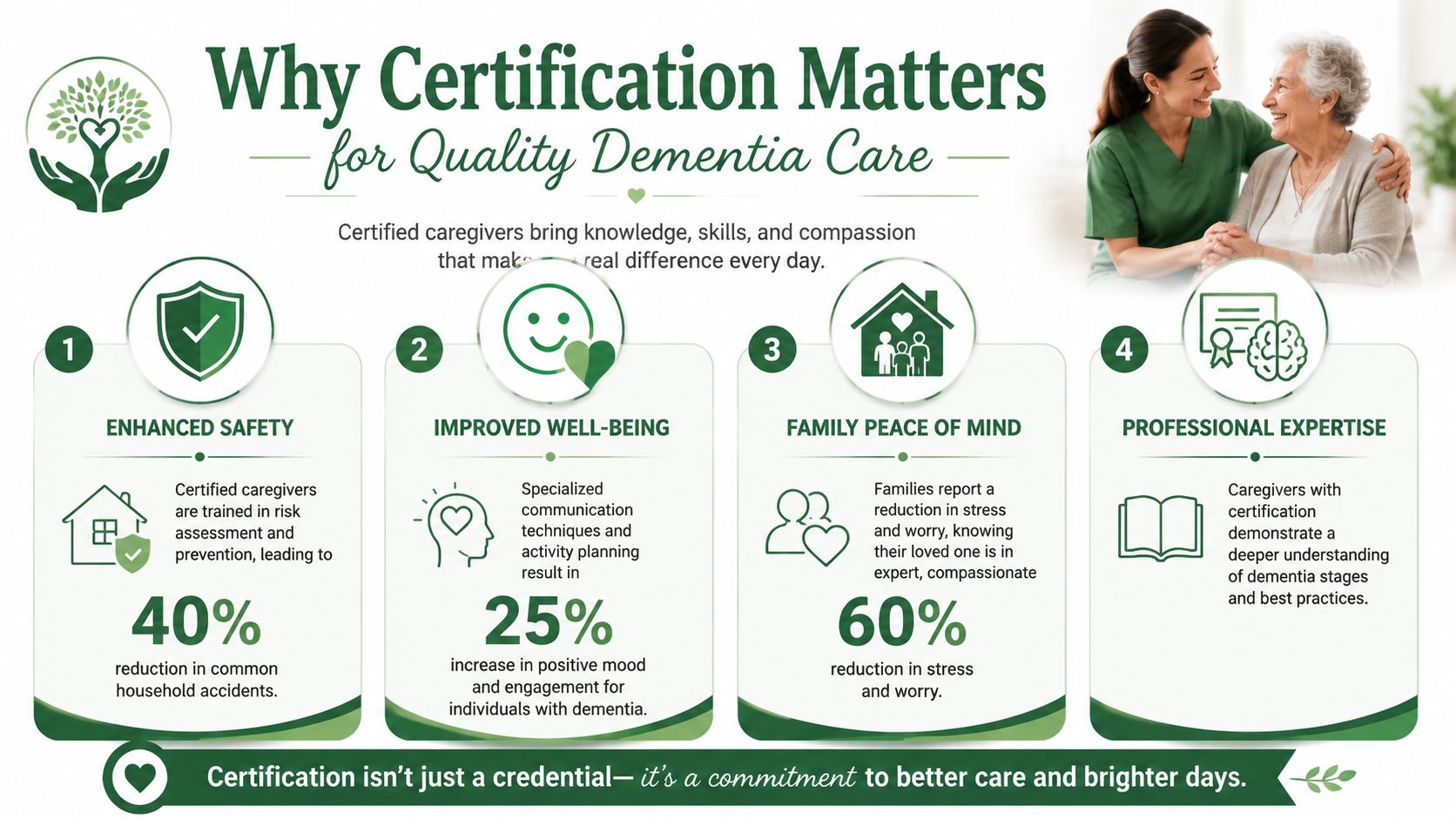
The strongest reason to care about dementia care certification is simple. Dementia changes how a person interprets the world. Good intentions alone often aren't enough.
A caregiver might mean well and still argue with someone about what day it is, rush through a task that feels threatening, or treat every repetitive question as a behavior problem instead of a sign of anxiety. Specialized training helps caregivers slow down, adapt communication, and choose responses that protect both safety and dignity.
The training gap is larger than many families realize
In long-term care, need and training don't line up neatly. Approximately 64% of people in U.S. nursing homes have dementia, yet fewer than half of the states mandate dementia training requirements for nursing home staff. Only 13 states require this training for home health aides, according to this review of state dementia training standards.
That gap explains why certification matters even when someone is already working in elder care. Families often assume dementia-specific training is universal. It isn't.
Practical rule: If your loved one has dementia, don't assume “caregiver” means “dementia-trained.” Ask directly what dementia-specific education the person completed, who issued it, and what topics it covered.
What better training looks like in real life
Certification matters because it changes daily interactions.
A trained caregiver is more likely to recognize that a person who says, “I need to go home,” may be expressing fear or disorientation, not making a literal travel plan. Instead of correcting sharply, they might redirect toward a familiar routine, calming activity, or reassuring conversation.
A trained caregiver is also more likely to look for non-pharmacological ways to manage distress before treating every change in mood as something to suppress. That's especially important in memory care settings, where preserving comfort and function requires patience, not just control.
Person-centered care means the caregiver adapts support to the individual, not the other way around.
For professionals, certification can also build trust with families and employers. It signals a willingness to learn a difficult specialty. For families, it offers one clear filter in a crowded market. When regulations vary, voluntary credentials become more valuable, not less.
Exploring Key Dementia Care Certifications
People often search for “the best dementia certification” as if there's one universal answer. There isn't. The right fit depends on your role, setting, and goals.
Some credentials are designed for individual professionals. Others are aimed at whole organizations, especially facilities that want to show they've built a structured memory care program. That's why the names can feel like alphabet soup at first.
What most people mean by certification
When families ask whether a caregiver is certified in dementia care, they're usually asking one of two things:
Has this individual completed recognized dementia-specific training?
Does this organization follow a defined memory care standard?
Those are different questions.
An individual credential, such as Certified Dementia Practitioner (CDP), speaks to a professional's training. An organizational credential, such as a memory care certification for a facility, speaks to the systems, programming, and care model used by the organization.
Comparison of Major Dementia Care Certifications
Credential | Issuing Body | Target Audience | Core Focus |
|---|---|---|---|
Certified Dementia Practitioner (CDP) | National Council of Certified Dementia Practitioners | Individual professionals in care-related roles | Formal dementia education with emphasis on person-centered care practices |
Memory Care Certification | The Joint Commission | Organizations and care settings | Person-centered systems, cognitive-level-matched activities, non-pharmacological behavior support, and supportive environments |
State-required dementia training | State regulators | Staff in regulated care roles | Compliance-focused baseline training, where required |
Employer-based dementia training | Home care agencies, senior living providers, health systems | Staff members within a specific organization | Role-specific practical training that varies in depth and consistency |
A few points help make this table more useful.
First, CDP is one of the most recognized individual credentials because families and employers can point to a named, established certification rather than a vague claim like “memory care trained.”
Second, Joint Commission Memory Care Certification isn't something an individual caregiver earns on their own. It reflects what an organization has built into its care model.
Third, state-required training can be important, but it shouldn't be confused with an all-encompassing credential. In some places, the legal baseline is limited or inconsistent, as noted earlier.
If you're hiring one person, ask about the individual's credential. If you're evaluating an agency, assisted living community, or memory care unit, ask how the entire program is trained and structured.
For many families, the most practical approach is to combine both questions. You want trained people inside a care system that supports good dementia practice every day.
How to Become a Certified Dementia Caregiver
If you're a caregiver or healthcare professional, the path can feel more manageable once you stop thinking of certification as one giant decision. It's usually a sequence of smaller steps.
The clearest example is the Certified Dementia Practitioner (CDP) credential.
A practical example using CDP
The CDP process requires completion of a live, one-day ADDC seminar, either in person or in a live virtual format. According to the NCCDP CDP certification requirements, the seminar typically costs around $195 to $210, and the application fee is $185. The same source states that fully online, self-paced courses don't meet initial certification requirements and are for continuing education only.
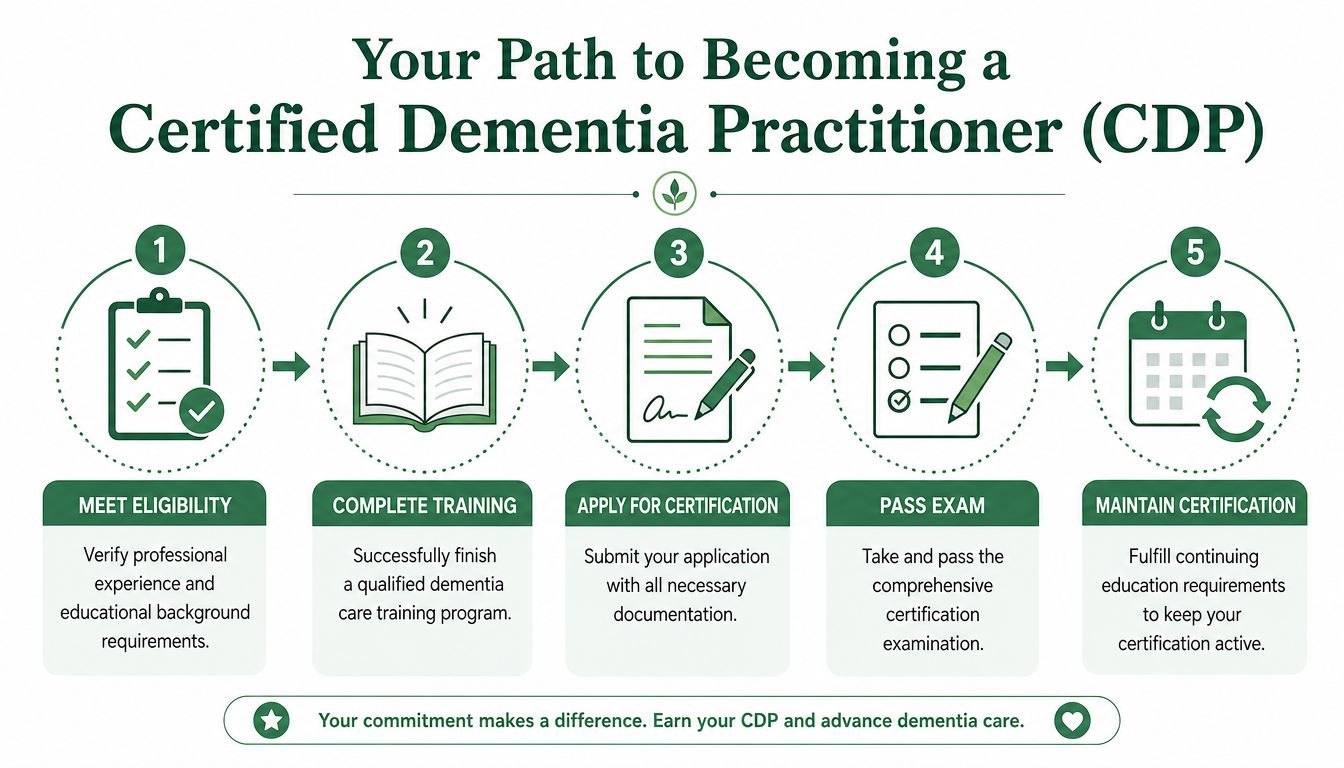
In practical terms, the path usually looks like this:
Check whether your role fits
Dementia credentials are often designed for professionals already working in healthcare, senior services, social services, or related care fields.Complete the required seminar
For CDP, the live ADDC seminar is the qualifying training step.Submit the application
You document that you completed the required education and meet the certification body's expectations.Plan for ongoing education
Continuing education matters because dementia care isn't static. Good practice changes as guidance and care models evolve.
Common points of confusion
The first confusion is format. Many people assume they can satisfy initial certification through a self-paced course they finish at midnight after work. For CDP, that isn't how initial certification works.
The second confusion is what the credential proves. Certification usually confirms specialized training. It doesn't replace a professional license, and it doesn't turn a new learner into an expert overnight.
The third confusion is cost. People often compare one advertised fee with another and miss that certification may involve more than one expense. For CDP, the seminar cost and application fee are separate parts of the process, not interchangeable ones.
Before paying for any program, confirm three things in writing: the format, the full cost, and whether the course leads to an initial credential or only continuing education.
If you're pursuing certification for career growth, it helps to ask your employer whether they reimburse training or prefer one credential over another. If you're paying out of pocket, clarity upfront can save both money and frustration.
Choosing the Right Dementia Certification Program
Not every dementia training program deserves the same weight. Some are substantial. Some are thin. Some teach meaningful care principles. Others mostly hand out a certificate of completion.
For families, that means you shouldn't stop at “yes, our staff are trained.” For professionals, it means a credential is only as useful as the curriculum behind it. A helpful framework for asking sharper questions about care quality appears in this guide to evaluating a memory loss support program.
What strong programs consistently include
A high-quality benchmark comes from the Joint Commission Memory Care Certification model. The Joint Commission's memory care standards require organizations to use person-centered care models, provide activity programming matched to each resident's cognitive level, and use non-pharmacological alternatives for behavioral symptoms.
That matters because it tells you what serious dementia training should prioritize.
Look for programs that teach:
Person-centered care
The caregiver learns how to honor routines, preferences, and lifelong habits instead of forcing everyone into the same schedule.Cognitive-level-matched engagement
Activities shouldn't be too childish, too complex, or too generic. Good programs teach how to match support to what the person can still do.Behavior support without jumping straight to medication
Distress often has triggers. Strong training teaches observation, environment, pacing, and communication before defaulting to control.Environmental awareness
Good care includes visual cues, safe navigation, and setups that support independence rather than confusion.
Questions worth asking before you enroll or hire
A short list of questions can reveal a lot:
Who issued the credential
Ask for the name of the certifying body, not just a certificate title.What was the training format
Live instruction, guided discussion, and applied learning often tell you more than a downloadable module alone.What topics were covered
Ask specifically about communication, activity adaptation, behavioral symptoms, and support for daily routines.How does the training handle personhood
If the answer focuses only on managing difficult behavior, the curriculum may be too narrow.
A strong program doesn't train people to “handle dementia patients.” It trains them to support human beings whose thinking has changed, while preserving as much identity and function as possible.
For professionals, the smartest investment is often the program whose curriculum you can describe clearly after finishing it. If you can't explain what you learned beyond “I got certified,” the program may not be strong enough to shape real care.
The Missing Piece in Dementia Training
Most dementia certification programs do an important job. They teach how to help with bathing, meals, communication, safety, and behavior in face-to-face settings.
But many families don't just need hands-on care.
They need someone who can help a loved one stay oriented, engaged, calmer, and less alone during the long hours between visits.
Why hands-on care is only part of the job
The biggest blind spot in traditional dementia training is the limited attention given to non-face-to-face cognitive engagement strategies. The APHA policy brief on strengthening the dementia care workforce highlights a major gap: existing certifications focus heavily on physical assistance and in-person behavioral management, while neglecting tele-cognitive support that can address loneliness and anxiety.
That gap is easy to miss if your picture of dementia care starts in a facility.
It's much harder to miss if your father still lives alone, answers the phone, forgets lunch, worries about his keys, and becomes more confused when nobody checks in for hours. In that situation, care isn't just about lifting, toileting, or medication reminders. It's also about regular conversation, orientation, routine reinforcement, and noticing mood changes before they become crises.
What modern families often need most
Families increasingly need support that helps a person function between in-person visits.
That can include:
Structured companionship by phone that reduces isolation
Orientation prompts about time, place, and next steps in the day
Reminiscence and memory cues tied to familiar routines
Mood monitoring that helps families spot changes over time
Gentle reinforcement of independence instead of immediate takeover
A closely related concern is whether certification teaches caregivers how to support autonomy, not just manage symptoms. Best-practice person-centered care from the Alzheimer's Association emphasizes looking beyond the diagnosis and focusing on unique needs, preferences, and abilities so the person can engage meaningfully and maintain independence. Yet many certification pathways still don't make autonomy-building skills central.
That matters most in early-to-mid stage dementia, when a person may still be able to do quite a lot with the right cueing.
Here's a useful example of how families think about that missing layer of support:
If your family is trying to understand one approach to daily remote cognitive support, this family guide explains how Velma works.
The future of dementia care training shouldn't be limited to “How do I help this person bathe safely?” It should also include “How do I help this person stay connected, oriented, and emotionally steady when I'm not in the room?”
That's the missing piece many families are already looking for, even if certification systems haven't fully caught up.
Frequently Asked Questions About Dementia Certification
Can families verify a caregiver's credential
Yes. Ask for the exact name of the credential and the issuing organization. Then check the certifying body's official website or ask the employer to confirm it in writing. “Memory care trained” is too vague on its own.
Do online-only programs count
Sometimes they count for education, but not always for initial certification. For example, as noted earlier with CDP, fully online self-paced learning doesn't satisfy the initial credential requirement for that pathway. Families should ask whether a caregiver completed a formal certification process or only continuing education.
Does certification teach caregivers how to support independence
Not always well enough. A common concern is whether dementia care certification includes training on fostering autonomy rather than only symptom management. Best-practice person-centered care from the Alzheimer's Association emphasizes using a person's unique preferences and abilities to support meaningful engagement and independence, as described in this Alzheimer's Association training discussion on person-centered care.
That distinction matters. A caregiver can be very good at preventing problems and still miss opportunities to preserve confidence, choice, and routine.
What should you do next
If you're choosing care for a family member, focus on clarity over labels.
Ask specific questions about dementia-specific training, not just general caregiving experience.
Request the credential name and the organization that issued it.
Listen for person-centered language about routines, preferences, abilities, and communication style.
Check for gaps in support, especially if your loved one spends long periods alone.
Use reputable organizations for further research, including the National Council of Certified Dementia Practitioners and the Alzheimer's Association.
If you're a professional, choose a program that improves how you care, not just how you market yourself. The best dementia care certification should make your daily decisions kinder, steadier, and more skillful.
If your family needs support between in-person visits, Velma offers a phone-based cognitive care program for older adults in the early to mid stages of dementia. Through scheduled calls, structured cognitive engagement, companionship, and ongoing family coordination, Velma helps families add consistent support for day-to-day independence and emotional well-being.
Your mom is still making coffee every morning. She still knows her neighbors. But lately, she repeats the same question three times in one call, forgets which day it is, or gets anxious when her routine changes. You're trying to help without taking over. And somewhere in that search, you keep running into terms like “memory care trained,” “Certified Dementia Practitioner,” and “dementia care certification.”
That can feel reassuring and confusing at the same time.
For families, these credentials can sound like a promise of better care, but it's not always obvious what they mean. For caregivers and professionals, certification can look like a maze of seminars, applications, and unfamiliar acronyms. If you're trying to figure out what matters, what's worth paying for, and where traditional training still falls short, you're not alone. For a practical look at one modern support model for early memory loss, see Velma's overview of cognitive support by phone.
Table of Contents
Understanding Dementia Care Certification
Why the term causes confusion
What certification usually covers
Why Certification Matters for Quality of Care
The training gap is larger than many families realize
What better training looks like in real life
Exploring Key Dementia Care Certifications
What most people mean by certification
Comparison of Major Dementia Care Certifications
How to Become a Certified Dementia Caregiver
A practical example using CDP
Common points of confusion
Choosing the Right Dementia Certification Program
What strong programs consistently include
Questions worth asking before you enroll or hire
The Missing Piece in Dementia Training
Why hands-on care is only part of the job
What modern families often need most
Frequently Asked Questions About Dementia Certification
Can families verify a caregiver's credential
Do online-only programs count
Does certification teach caregivers how to support independence
What should you do next
Understanding Dementia Care Certification
Dementia care certification is a formal credential that shows a caregiver or healthcare professional has completed specialized training in how dementia affects thinking, communication, behavior, and daily life.
That sounds technical, but in plain language it means this: the person has gone beyond general caregiving. They've studied how to respond when someone becomes confused, suspicious, repetitive, withdrawn, or distressed. They've learned that dementia care isn't just about safety. It's also about dignity, routine, and reducing fear.
Why the term causes confusion
Families often assume certification works like a nursing license. It usually doesn't. In many cases, it's an added credential on top of an existing role, such as nurse, social worker, activities professional, home care worker, or administrator.
That distinction matters. A person can be kind and experienced without certification. A person can also hold a credential and still vary in skill. Certification is best understood as one meaningful signal, not the only one.
A helpful way to think about it is this: certification doesn't guarantee perfect care, but it does show that someone chose formal dementia-specific training instead of relying only on instinct or general elder care experience.
What certification usually covers
Most dementia care certification programs focus on areas like:
Communication skills that reduce confusion and tension
Behavior support using non-drug approaches when possible
Daily care strategies for bathing, eating, dressing, and routines
Person-centered care that respects habits, preferences, and life history
Safety awareness for wandering, distress, and environmental risks
For families, that knowledge can help when you're hiring. For professionals, it can sharpen how you already work.
The bigger value is confidence. When your dad refuses help with a shower, or your spouse insists someone stole a wallet that's sitting in the kitchen drawer, you need more than goodwill. You need someone who understands what dementia changes and how to respond without making things worse.
Why Certification Matters for Quality of Care
The strongest reason to care about dementia care certification is simple. Dementia changes how a person interprets the world. Good intentions alone often aren't enough.
A caregiver might mean well and still argue with someone about what day it is, rush through a task that feels threatening, or treat every repetitive question as a behavior problem instead of a sign of anxiety. Specialized training helps caregivers slow down, adapt communication, and choose responses that protect both safety and dignity.
The training gap is larger than many families realize
In long-term care, need and training don't line up neatly. Approximately 64% of people in U.S. nursing homes have dementia, yet fewer than half of the states mandate dementia training requirements for nursing home staff. Only 13 states require this training for home health aides, according to this review of state dementia training standards.
That gap explains why certification matters even when someone is already working in elder care. Families often assume dementia-specific training is universal. It isn't.
Practical rule: If your loved one has dementia, don't assume “caregiver” means “dementia-trained.” Ask directly what dementia-specific education the person completed, who issued it, and what topics it covered.
What better training looks like in real life
Certification matters because it changes daily interactions.
A trained caregiver is more likely to recognize that a person who says, “I need to go home,” may be expressing fear or disorientation, not making a literal travel plan. Instead of correcting sharply, they might redirect toward a familiar routine, calming activity, or reassuring conversation.
A trained caregiver is also more likely to look for non-pharmacological ways to manage distress before treating every change in mood as something to suppress. That's especially important in memory care settings, where preserving comfort and function requires patience, not just control.
Person-centered care means the caregiver adapts support to the individual, not the other way around.
For professionals, certification can also build trust with families and employers. It signals a willingness to learn a difficult specialty. For families, it offers one clear filter in a crowded market. When regulations vary, voluntary credentials become more valuable, not less.
Exploring Key Dementia Care Certifications
People often search for “the best dementia certification” as if there's one universal answer. There isn't. The right fit depends on your role, setting, and goals.
Some credentials are designed for individual professionals. Others are aimed at whole organizations, especially facilities that want to show they've built a structured memory care program. That's why the names can feel like alphabet soup at first.
What most people mean by certification
When families ask whether a caregiver is certified in dementia care, they're usually asking one of two things:
Has this individual completed recognized dementia-specific training?
Does this organization follow a defined memory care standard?
Those are different questions.
An individual credential, such as Certified Dementia Practitioner (CDP), speaks to a professional's training. An organizational credential, such as a memory care certification for a facility, speaks to the systems, programming, and care model used by the organization.
Comparison of Major Dementia Care Certifications
Credential | Issuing Body | Target Audience | Core Focus |
|---|---|---|---|
Certified Dementia Practitioner (CDP) | National Council of Certified Dementia Practitioners | Individual professionals in care-related roles | Formal dementia education with emphasis on person-centered care practices |
Memory Care Certification | The Joint Commission | Organizations and care settings | Person-centered systems, cognitive-level-matched activities, non-pharmacological behavior support, and supportive environments |
State-required dementia training | State regulators | Staff in regulated care roles | Compliance-focused baseline training, where required |
Employer-based dementia training | Home care agencies, senior living providers, health systems | Staff members within a specific organization | Role-specific practical training that varies in depth and consistency |
A few points help make this table more useful.
First, CDP is one of the most recognized individual credentials because families and employers can point to a named, established certification rather than a vague claim like “memory care trained.”
Second, Joint Commission Memory Care Certification isn't something an individual caregiver earns on their own. It reflects what an organization has built into its care model.
Third, state-required training can be important, but it shouldn't be confused with an all-encompassing credential. In some places, the legal baseline is limited or inconsistent, as noted earlier.
If you're hiring one person, ask about the individual's credential. If you're evaluating an agency, assisted living community, or memory care unit, ask how the entire program is trained and structured.
For many families, the most practical approach is to combine both questions. You want trained people inside a care system that supports good dementia practice every day.
How to Become a Certified Dementia Caregiver
If you're a caregiver or healthcare professional, the path can feel more manageable once you stop thinking of certification as one giant decision. It's usually a sequence of smaller steps.
The clearest example is the Certified Dementia Practitioner (CDP) credential.
A practical example using CDP
The CDP process requires completion of a live, one-day ADDC seminar, either in person or in a live virtual format. According to the NCCDP CDP certification requirements, the seminar typically costs around $195 to $210, and the application fee is $185. The same source states that fully online, self-paced courses don't meet initial certification requirements and are for continuing education only.
In practical terms, the path usually looks like this:
Check whether your role fits
Dementia credentials are often designed for professionals already working in healthcare, senior services, social services, or related care fields.Complete the required seminar
For CDP, the live ADDC seminar is the qualifying training step.Submit the application
You document that you completed the required education and meet the certification body's expectations.Plan for ongoing education
Continuing education matters because dementia care isn't static. Good practice changes as guidance and care models evolve.
Common points of confusion
The first confusion is format. Many people assume they can satisfy initial certification through a self-paced course they finish at midnight after work. For CDP, that isn't how initial certification works.
The second confusion is what the credential proves. Certification usually confirms specialized training. It doesn't replace a professional license, and it doesn't turn a new learner into an expert overnight.
The third confusion is cost. People often compare one advertised fee with another and miss that certification may involve more than one expense. For CDP, the seminar cost and application fee are separate parts of the process, not interchangeable ones.
Before paying for any program, confirm three things in writing: the format, the full cost, and whether the course leads to an initial credential or only continuing education.
If you're pursuing certification for career growth, it helps to ask your employer whether they reimburse training or prefer one credential over another. If you're paying out of pocket, clarity upfront can save both money and frustration.
Choosing the Right Dementia Certification Program
Not every dementia training program deserves the same weight. Some are substantial. Some are thin. Some teach meaningful care principles. Others mostly hand out a certificate of completion.
For families, that means you shouldn't stop at “yes, our staff are trained.” For professionals, it means a credential is only as useful as the curriculum behind it. A helpful framework for asking sharper questions about care quality appears in this guide to evaluating a memory loss support program.
What strong programs consistently include
A high-quality benchmark comes from the Joint Commission Memory Care Certification model. The Joint Commission's memory care standards require organizations to use person-centered care models, provide activity programming matched to each resident's cognitive level, and use non-pharmacological alternatives for behavioral symptoms.
That matters because it tells you what serious dementia training should prioritize.
Look for programs that teach:
Person-centered care
The caregiver learns how to honor routines, preferences, and lifelong habits instead of forcing everyone into the same schedule.Cognitive-level-matched engagement
Activities shouldn't be too childish, too complex, or too generic. Good programs teach how to match support to what the person can still do.Behavior support without jumping straight to medication
Distress often has triggers. Strong training teaches observation, environment, pacing, and communication before defaulting to control.Environmental awareness
Good care includes visual cues, safe navigation, and setups that support independence rather than confusion.
Questions worth asking before you enroll or hire
A short list of questions can reveal a lot:
Who issued the credential
Ask for the name of the certifying body, not just a certificate title.What was the training format
Live instruction, guided discussion, and applied learning often tell you more than a downloadable module alone.What topics were covered
Ask specifically about communication, activity adaptation, behavioral symptoms, and support for daily routines.How does the training handle personhood
If the answer focuses only on managing difficult behavior, the curriculum may be too narrow.
A strong program doesn't train people to “handle dementia patients.” It trains them to support human beings whose thinking has changed, while preserving as much identity and function as possible.
For professionals, the smartest investment is often the program whose curriculum you can describe clearly after finishing it. If you can't explain what you learned beyond “I got certified,” the program may not be strong enough to shape real care.
The Missing Piece in Dementia Training
Most dementia certification programs do an important job. They teach how to help with bathing, meals, communication, safety, and behavior in face-to-face settings.
But many families don't just need hands-on care.
They need someone who can help a loved one stay oriented, engaged, calmer, and less alone during the long hours between visits.
Why hands-on care is only part of the job
The biggest blind spot in traditional dementia training is the limited attention given to non-face-to-face cognitive engagement strategies. The APHA policy brief on strengthening the dementia care workforce highlights a major gap: existing certifications focus heavily on physical assistance and in-person behavioral management, while neglecting tele-cognitive support that can address loneliness and anxiety.
That gap is easy to miss if your picture of dementia care starts in a facility.
It's much harder to miss if your father still lives alone, answers the phone, forgets lunch, worries about his keys, and becomes more confused when nobody checks in for hours. In that situation, care isn't just about lifting, toileting, or medication reminders. It's also about regular conversation, orientation, routine reinforcement, and noticing mood changes before they become crises.
What modern families often need most
Families increasingly need support that helps a person function between in-person visits.
That can include:
Structured companionship by phone that reduces isolation
Orientation prompts about time, place, and next steps in the day
Reminiscence and memory cues tied to familiar routines
Mood monitoring that helps families spot changes over time
Gentle reinforcement of independence instead of immediate takeover
A closely related concern is whether certification teaches caregivers how to support autonomy, not just manage symptoms. Best-practice person-centered care from the Alzheimer's Association emphasizes looking beyond the diagnosis and focusing on unique needs, preferences, and abilities so the person can engage meaningfully and maintain independence. Yet many certification pathways still don't make autonomy-building skills central.
That matters most in early-to-mid stage dementia, when a person may still be able to do quite a lot with the right cueing.
Here's a useful example of how families think about that missing layer of support:
If your family is trying to understand one approach to daily remote cognitive support, this family guide explains how Velma works.
The future of dementia care training shouldn't be limited to “How do I help this person bathe safely?” It should also include “How do I help this person stay connected, oriented, and emotionally steady when I'm not in the room?”
That's the missing piece many families are already looking for, even if certification systems haven't fully caught up.
Frequently Asked Questions About Dementia Certification
Can families verify a caregiver's credential
Yes. Ask for the exact name of the credential and the issuing organization. Then check the certifying body's official website or ask the employer to confirm it in writing. “Memory care trained” is too vague on its own.
Do online-only programs count
Sometimes they count for education, but not always for initial certification. For example, as noted earlier with CDP, fully online self-paced learning doesn't satisfy the initial credential requirement for that pathway. Families should ask whether a caregiver completed a formal certification process or only continuing education.
Does certification teach caregivers how to support independence
Not always well enough. A common concern is whether dementia care certification includes training on fostering autonomy rather than only symptom management. Best-practice person-centered care from the Alzheimer's Association emphasizes using a person's unique preferences and abilities to support meaningful engagement and independence, as described in this Alzheimer's Association training discussion on person-centered care.
That distinction matters. A caregiver can be very good at preventing problems and still miss opportunities to preserve confidence, choice, and routine.
What should you do next
If you're choosing care for a family member, focus on clarity over labels.
Ask specific questions about dementia-specific training, not just general caregiving experience.
Request the credential name and the organization that issued it.
Listen for person-centered language about routines, preferences, abilities, and communication style.
Check for gaps in support, especially if your loved one spends long periods alone.
Use reputable organizations for further research, including the National Council of Certified Dementia Practitioners and the Alzheimer's Association.
If you're a professional, choose a program that improves how you care, not just how you market yourself. The best dementia care certification should make your daily decisions kinder, steadier, and more skillful.
If your family needs support between in-person visits, Velma offers a phone-based cognitive care program for older adults in the early to mid stages of dementia. Through scheduled calls, structured cognitive engagement, companionship, and ongoing family coordination, Velma helps families add consistent support for day-to-day independence and emotional well-being.
Suggested Article: