Anxiety in Dementia Patients: A Practical Caregiver's Guide
You may be living this scene right now. Your mom asks about tomorrow's appointment for the fifth time in twenty minutes. Your husband becomes upset because he can't find a wallet that's been in the same drawer for years. You answer calmly at first, then more firmly, then you feel guilty because neither approach seems to help.
That cycle wears people down. It leaves caregivers feeling confused, helpless, and sometimes scared to say the wrong thing. It also leaves the person with dementia trapped in a feeling they often can't explain.
Anxiety in dementia patients is common, and it can be managed. It isn't stubbornness. It isn't attention-seeking. It isn't a sign that you've failed as a caregiver. It's often the result of a brain that's struggling to make sense of the world, even when the world looks familiar from the outside.
What helps most is rarely a perfect explanation or a correction. What helps is knowing what the anxiety looks like, what tends to trigger it, and what to say and do in the moment. Small changes in your words, your pacing, and the environment can make a real difference today, not just someday after a clinic visit.
Table of Contents
Introduction You Are Not Alone
Understanding Why Anxiety Happens in Dementia
Why the brain reacts with fear
Why reassurance sometimes fails
Recognizing Anxiety Symptoms and Common Triggers
What anxiety can look like
Common triggers caregivers can track
Practical Strategies to Calm and Reassure
Communication and validation
Creating a soothing environment
Establishing predictable routines
How Consistent Phone Support Can Reduce Anxiety
Why predictable contact matters
What structured calls can do
When to Seek Professional Medical Help
Red flags that need medical review
Home support still matters
Introduction You Are Not Alone
Most caregivers don't first notice anxiety as a tidy symptom. They notice it as friction in daily life.
A parent who used to be easygoing starts following them from room to room. A spouse becomes distressed every afternoon and insists something bad is about to happen. A loved one grows tense over bathing, getting dressed, or leaving the house. The behavior may look irrational from the outside, but to the person experiencing it, the fear is real.
That's why the most useful response starts with this truth. You are not overreacting, and your loved one is not doing this on purpose. Dementia changes how a person interprets memory, time, language, and safety. When those abilities shift, anxiety often fills the gap.
Caregivers often tell me the hardest part isn't the repeated question itself. It's the feeling that nothing works twice. One day distraction helps. The next day it doesn't. One phrase calms things down in the morning and makes things worse in the evening. That unpredictability is exhausting.
The goal isn't to win an argument with dementia. The goal is to lower fear.
The good news is that anxiety in dementia patients often responds to practical, low-tech changes. The right words help. A quieter room helps. A simpler routine helps. So does learning to spot the pattern behind the distress instead of reacting only to the behavior on the surface.
Understanding Why Anxiety Happens in Dementia
Why the brain reacts with fear
Anxiety in dementia patients often grows out of the disease itself. The person isn't just forgetting facts. They may be losing the mental tools that help them understand where they are, what's happening next, and how to respond.
A useful way to think about it is this. Imagine trying to move through a familiar city after all the street signs have become unreadable. The streets still exist. The buildings look somewhat familiar. But you can't reliably tell where you are or what comes next. That uncertainty creates fear quickly.
This is one reason anxiety is so common in dementia. Prevalence estimates range from 38% to 72% across clinical populations, compared with 2% to 7% in community elderly settings, and anxiety is linked with poorer quality of life and worse attention and planning ability, as described in this review of anxiety in memory care settings.
When families first notice forgetfulness, they often focus on memory alone. But early changes can also show up as trouble managing uncertainty, processing conversation, or shifting attention. If you're trying to make sense of that bigger pattern, this guide to early signs of memory loss in aging parents can help you connect the dots.
Why reassurance sometimes fails
Caregivers often say, “I already told him everything is okay.” That makes sense. In ordinary anxiety, explanation can help. In dementia, explanation may not stick long enough to create safety.
The person may forget what you just said. Or they may remember your tone more than your words. If your reassurance comes with urgency, correction, or visible frustration, the emotional message becomes: something is wrong.
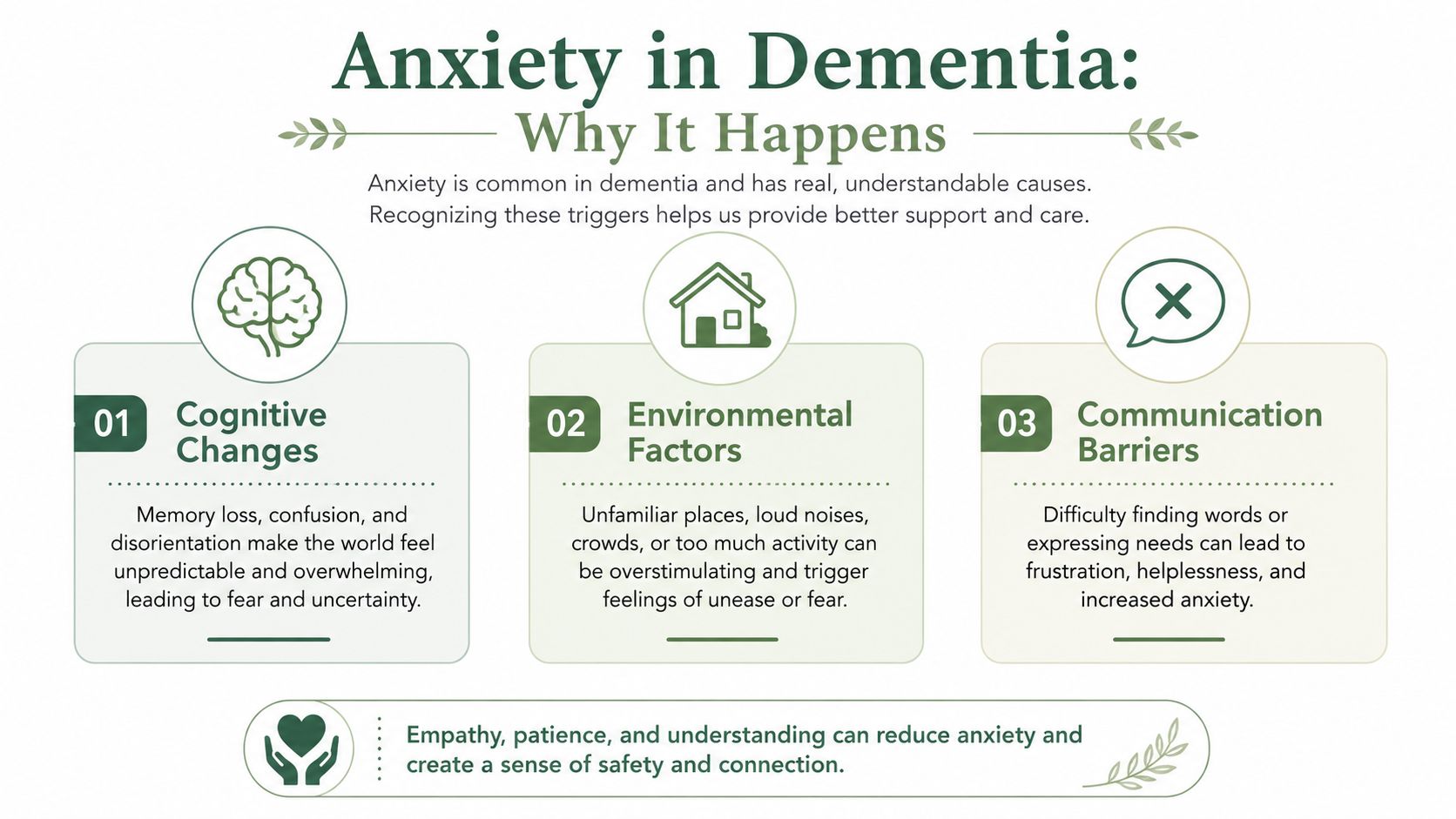
Three forces commonly feed anxiety in dementia:
Cognitive changes: Memory loss, disorientation, and trouble following sequences can make ordinary tasks feel risky.
Environmental strain: Noise, clutter, rushing, and unfamiliar settings can overwhelm a brain that has less reserve.
Communication barriers: The person may know they're uncomfortable but not have the language to explain whether they're in pain, tired, embarrassed, or afraid.
Here's the trade-off that matters. Logic is efficient, but comfort is often more effective. Correcting facts may satisfy the caregiver's need for accuracy. Validation usually does more for the patient's nervous system.
Practical rule: If the person is upset, respond to the feeling before you respond to the facts.
That shift can reduce resistance. It can also lower your own stress, because you stop trying to fix fear with information alone.
Recognizing Anxiety Symptoms and Common Triggers
What anxiety can look like
In dementia, anxiety doesn't always sound like “I feel anxious.” More often, it shows up as behavior.
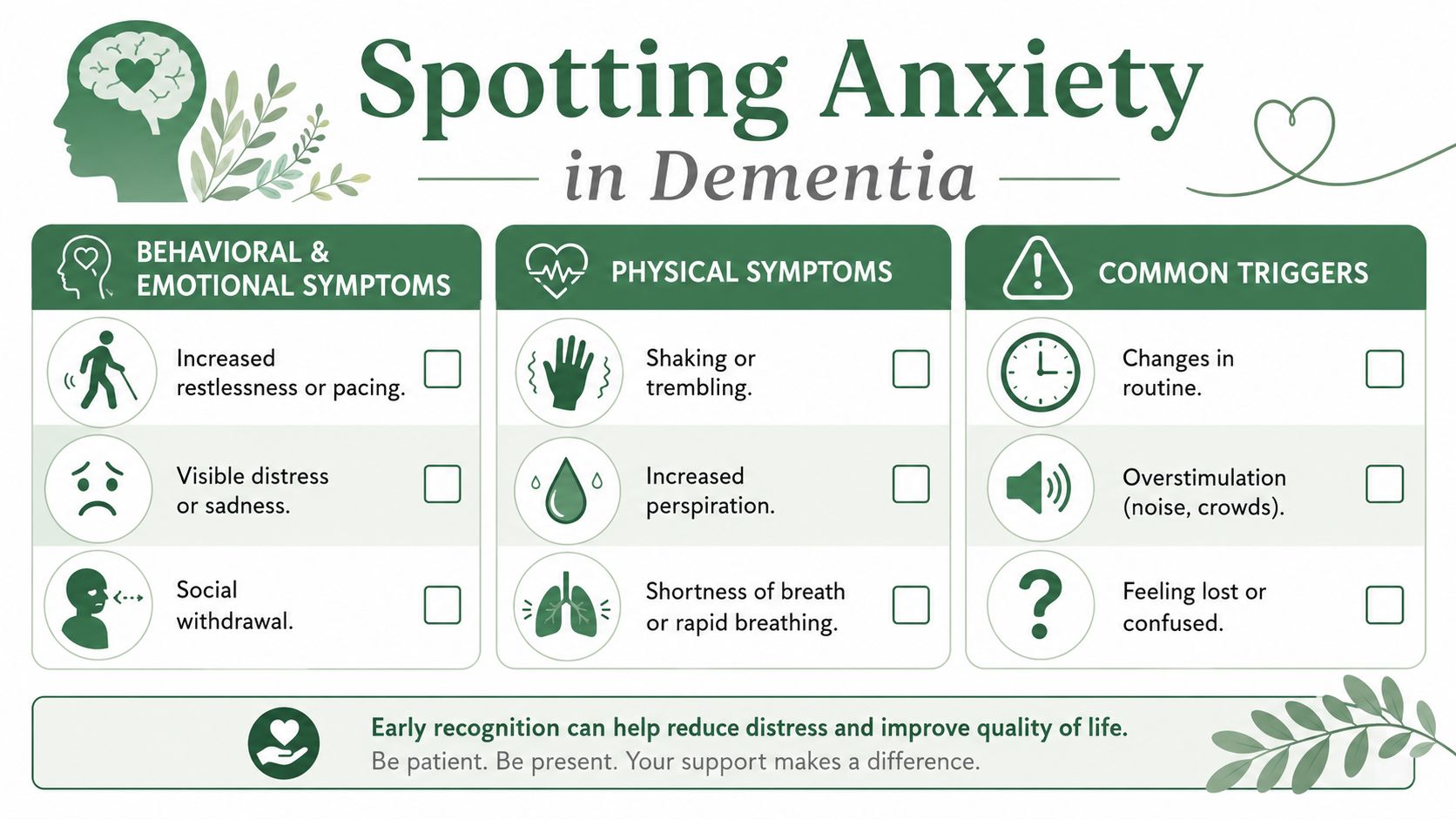
You might notice:
Repeated questions: Asking the same thing over and over, especially about time, plans, or where someone is.
Pacing or restlessness: Moving constantly, standing and sitting repeatedly, wandering, or being unable to settle.
Shadowing: Following you from room to room and becoming distressed when you leave sight.
Irritability: Snapping, arguing, or becoming unusually defensive during simple requests.
Clinging to objects: Fixating on a purse, keys, papers, or a pet and becoming upset if they can't see them.
Avoidance: Refusing bathing, appointments, meals, or visitors because the task feels too overwhelming.
Body signs: Tense posture, fidgeting, trembling, sweating, rapid breathing, or visible distress.
Some caregivers mistake anxiety for defiance. Others assume it's always memory loss. In practice, it's often a blend. The person feels unsafe, then tries to regain control in the only ways still available to them.
Common triggers caregivers can track
If you start looking for patterns, anxiety becomes easier to predict. I often tell caregivers to act like detectives, not referees.
A simple way to do that is to sort triggers into categories:
Trigger type | What it often includes | What you may notice |
|---|---|---|
Environmental | loud TV, clutter, bright lights, unfamiliar rooms | pacing, covering ears, agitation |
Social | too many visitors, strangers, rushed conversation | withdrawal, irritability, refusal |
Physical | pain, hunger, fatigue, constipation, needing the bathroom | sudden anger, restlessness, confusion |
Routine-related | late meals, skipped rest, unexpected schedule changes | repeated questions, panic, clinginess |
A few practical patterns are especially common:
Late-day overload: Some people become more anxious when they're tired and the house gets busier.
Transitions: Getting into the car, changing clothes, or moving from one task to another can trigger fear.
Feeling rushed: Even a gentle “come on, we're late” can sound threatening to a confused brain.
Too much choice: “Which shirt do you want?” can be overwhelming when decision-making has become hard.
Keep a short note on your phone for one week. Write down the time, what happened just before the anxiety, and what helped. Patterns usually show up faster than caregivers expect.
Once you know the pattern, you can prevent some episodes before they start. That's often more effective than trying to calm a crisis after it has already built momentum.
Practical Strategies to Calm and Reassure
A calm response doesn't mean a perfect response. It means doing the next helpful thing.

Many caregivers already know the basics. Speak softly. Don't argue. Stay nearby. The problem is that those ideas can feel too vague in the moment. What usually helps is having actual words to use and a few concrete actions you can repeat.
For a broader foundation on day-to-day dementia support, these basic recommendations for families pair well with the techniques below.
Communication and validation
When a person with dementia is anxious, start with validate, reassure, redirect.
Validation means you respond to the feeling first. Reassurance means you offer safety in simple language. Redirection means you guide attention toward something manageable.
Use short sentences. Keep your tone low. Ask fewer questions.
Here are scripts you can use:
“You seem worried. I'm here with you.”
“I can see this feels upsetting. Let's sit down together for a minute.”
“You want to make sure everything is okay. We're safe right now.”
“We don't have to solve it all this second. Let's take one step.”
If they're asking a repeated question:
“You're wondering about the appointment. I've got it handled. We'll go together after breakfast.”
If they're looking for a lost item:
“That feels important to you. Let's check your usual places together.”
If they insist on going home when they are home:
“You want to be somewhere that feels safe. Stay with me for a moment, and let's have some tea.”
What usually doesn't work:
Correcting sharply: “I already told you that.”
Demanding memory: “Don't you remember?”
Overexplaining: Long answers can increase confusion.
Quizzing: “What day is it? Where are you right now?” often raises pressure.
A small but powerful shift is to replace “no” with a softer bridge. Instead of “No, that's not happening,” try “I hear you,” then move to the next calming step.
Creating a soothing environment
Some anxiety starts inside the brain. Some is amplified by the room.
Look around the environment the way an occupational therapist or experienced home caregiver would. Is the television too loud? Are there too many conversations happening at once? Is the kitchen chaotic at the exact time the person is expected to follow instructions?
Try this calming checklist:
Lower the noise: Turn off background TV that nobody is actively watching.
Simplify the visual field: Clear crowded counters and remove unnecessary items from view.
Use steady lighting: Keep rooms comfortably lit, especially in the evening when shadows can be unsettling.
Offer a comfort anchor: A familiar blanket, photo book, sweater, or favorite chair can help orient the person.
Reduce the audience: If a task is hard, one calm helper is usually better than several people giving input.
Touch can help if the person usually finds it comforting. A hand on the forearm, sitting side by side, or gently holding hands may lower distress more effectively than talking.
This demonstration can help you think about body language, pacing, and calming presence during anxious moments:
Establishing predictable routines
Routine is one of the best anxiety reducers in dementia care because it removes guesswork.
The goal isn't a rigid schedule. The goal is a day that feels recognizable. Wake time, meals, medications, rest, activity, and bedtime should happen in roughly the same order.
That predictability does three things:
It reduces the number of surprises the person has to process.
It gives the caregiver a framework for prevention.
It makes transitions easier because the next step feels familiar.
A good routine also respects energy. Don't schedule demanding tasks when the person is usually tired or confused. If bathing reliably causes distress, try changing the time of day, reducing the number of steps, warming the room first, and preparing everything before you begin.
A routine works best when it protects the person's dignity, not just the household schedule.
If one strategy fails, don't assume the idea was wrong. The timing may have been wrong. The words may have been too complex. Or the person may have been hungry, uncomfortable, or overstimulated before the conversation even began.
How Consistent Phone Support Can Reduce Anxiety
Caregivers can't provide constant reassurance every hour of the day. Even the most devoted spouse or adult child needs sleep, work time, and a break from being the only steadying voice in the room.
That's where consistency matters more than intensity. A predictable support touchpoint can calm anxiety because it gives the person something stable to expect.
Why predictable contact matters
Anxious brains often do better with repetition. A scheduled call at the same time, with a familiar voice and a familiar pattern, can reduce uncertainty. It can also interrupt the spiral that starts when a person is alone with confusion, worry, or hyper-focus on one fear.

This kind of support isn't a replacement for medical care or hands-on caregiving. It fills a different role. It offers orientation, companionship, structure, and a chance to notice changes before they become larger problems.
That proactive mindset matters. Past or current anxiety in Mild Cognitive Impairment can increase the risk of conversion to Alzheimer's by as much as 2.5-fold, and anxiety can raise an adult's risk for developing dementia by up to 3 times overall, according to Kettering Health's summary of the dementia risk linked to anxiety.
What structured calls can do
The most helpful calls are not random check-ins. They are structured enough to feel familiar and flexible enough to meet the person where they are that day.
A strong phone support model can help with:
Orientation: Reminding the person of the day, time, upcoming plans, and what comes next.
Emotional settling: Using calm conversation to validate feelings and shift attention away from repetitive worry.
Daily reinforcement: Reviewing meals, medications, appointments, or simple safety concerns.
Pattern tracking: Noticing whether confusion, loneliness, or distress is getting worse over time.
For families exploring this type of support, this family guide to how Velma works shows what a phone-based cognitive support approach can look like in everyday life.
There's also a caregiver trade-off here worth naming plainly. Independence is important, but so is scaffolding. If a parent living alone becomes more anxious between visits, a predictable call can reduce that long stretch of uncertainty without adding more screens, passwords, or technology problems.
The right support doesn't have to be constant. It has to be dependable.
That dependability can help the caregiver too. When someone else is helping reinforce routine and mood support, families often make better decisions because they're reacting less and observing more.
When to Seek Professional Medical Help
Home strategies can do a lot. Sometimes they aren't enough, and that isn't a failure.
Red flags that need medical review
Contact a clinician if anxiety starts interfering with basic care or safety. That includes situations such as:
Refusing essentials: Not eating, not drinking, refusing medication, or resisting necessary hygiene because fear is too high.
Safety risk: Aggression, attempts to leave unsafely, or panic that puts the person or caregiver at risk.
Major sleep disruption: Ongoing nighttime distress that leaves either of you exhausted and unable to function.
Sudden change: A sharp increase in anxiety, agitation, or confusion that feels different from the person's usual pattern.
Possible depression: Marked hopelessness, withdrawal, tearfulness, or loss of interest that goes beyond anxious distress.
Possible medical discomfort: Pain, constipation, infection, medication side effects, or breathing problems that may be driving the behavior.
Bring specific examples to the appointment. Note what happened, when it happened, what may have triggered it, and what helped or didn't help. That information is often more useful than saying only that the person is “more anxious.”
Home support still matters
A doctor may review medications, screen for illness, or consider treatments for mood and anxiety. Even when medical treatment is part of the plan, the daily foundation remains the same. Calm communication, a quieter environment, predictable routine, and good observation still do much of the heavy lifting.
You don't need to do this perfectly. You need a few reliable tools, a willingness to notice patterns, and support when the burden gets too heavy to carry alone.
If your family could use steadier day-to-day support, Velma offers phone-based cognitive care for older adults in the early to mid stages of dementia. Scheduled calls provide conversation, orientation, structured cognitive engagement, and emotional reassurance, while giving families more visibility into how their loved one is doing between visits.
You may be living this scene right now. Your mom asks about tomorrow's appointment for the fifth time in twenty minutes. Your husband becomes upset because he can't find a wallet that's been in the same drawer for years. You answer calmly at first, then more firmly, then you feel guilty because neither approach seems to help.
That cycle wears people down. It leaves caregivers feeling confused, helpless, and sometimes scared to say the wrong thing. It also leaves the person with dementia trapped in a feeling they often can't explain.
Anxiety in dementia patients is common, and it can be managed. It isn't stubbornness. It isn't attention-seeking. It isn't a sign that you've failed as a caregiver. It's often the result of a brain that's struggling to make sense of the world, even when the world looks familiar from the outside.
What helps most is rarely a perfect explanation or a correction. What helps is knowing what the anxiety looks like, what tends to trigger it, and what to say and do in the moment. Small changes in your words, your pacing, and the environment can make a real difference today, not just someday after a clinic visit.
Table of Contents
Introduction You Are Not Alone
Understanding Why Anxiety Happens in Dementia
Why the brain reacts with fear
Why reassurance sometimes fails
Recognizing Anxiety Symptoms and Common Triggers
What anxiety can look like
Common triggers caregivers can track
Practical Strategies to Calm and Reassure
Communication and validation
Creating a soothing environment
Establishing predictable routines
How Consistent Phone Support Can Reduce Anxiety
Why predictable contact matters
What structured calls can do
When to Seek Professional Medical Help
Red flags that need medical review
Home support still matters
Introduction You Are Not Alone
Most caregivers don't first notice anxiety as a tidy symptom. They notice it as friction in daily life.
A parent who used to be easygoing starts following them from room to room. A spouse becomes distressed every afternoon and insists something bad is about to happen. A loved one grows tense over bathing, getting dressed, or leaving the house. The behavior may look irrational from the outside, but to the person experiencing it, the fear is real.
That's why the most useful response starts with this truth. You are not overreacting, and your loved one is not doing this on purpose. Dementia changes how a person interprets memory, time, language, and safety. When those abilities shift, anxiety often fills the gap.
Caregivers often tell me the hardest part isn't the repeated question itself. It's the feeling that nothing works twice. One day distraction helps. The next day it doesn't. One phrase calms things down in the morning and makes things worse in the evening. That unpredictability is exhausting.
The goal isn't to win an argument with dementia. The goal is to lower fear.
The good news is that anxiety in dementia patients often responds to practical, low-tech changes. The right words help. A quieter room helps. A simpler routine helps. So does learning to spot the pattern behind the distress instead of reacting only to the behavior on the surface.
Understanding Why Anxiety Happens in Dementia
Why the brain reacts with fear
Anxiety in dementia patients often grows out of the disease itself. The person isn't just forgetting facts. They may be losing the mental tools that help them understand where they are, what's happening next, and how to respond.
A useful way to think about it is this. Imagine trying to move through a familiar city after all the street signs have become unreadable. The streets still exist. The buildings look somewhat familiar. But you can't reliably tell where you are or what comes next. That uncertainty creates fear quickly.
This is one reason anxiety is so common in dementia. Prevalence estimates range from 38% to 72% across clinical populations, compared with 2% to 7% in community elderly settings, and anxiety is linked with poorer quality of life and worse attention and planning ability, as described in this review of anxiety in memory care settings.
When families first notice forgetfulness, they often focus on memory alone. But early changes can also show up as trouble managing uncertainty, processing conversation, or shifting attention. If you're trying to make sense of that bigger pattern, this guide to early signs of memory loss in aging parents can help you connect the dots.
Why reassurance sometimes fails
Caregivers often say, “I already told him everything is okay.” That makes sense. In ordinary anxiety, explanation can help. In dementia, explanation may not stick long enough to create safety.
The person may forget what you just said. Or they may remember your tone more than your words. If your reassurance comes with urgency, correction, or visible frustration, the emotional message becomes: something is wrong.
Three forces commonly feed anxiety in dementia:
Cognitive changes: Memory loss, disorientation, and trouble following sequences can make ordinary tasks feel risky.
Environmental strain: Noise, clutter, rushing, and unfamiliar settings can overwhelm a brain that has less reserve.
Communication barriers: The person may know they're uncomfortable but not have the language to explain whether they're in pain, tired, embarrassed, or afraid.
Here's the trade-off that matters. Logic is efficient, but comfort is often more effective. Correcting facts may satisfy the caregiver's need for accuracy. Validation usually does more for the patient's nervous system.
Practical rule: If the person is upset, respond to the feeling before you respond to the facts.
That shift can reduce resistance. It can also lower your own stress, because you stop trying to fix fear with information alone.
Recognizing Anxiety Symptoms and Common Triggers
What anxiety can look like
In dementia, anxiety doesn't always sound like “I feel anxious.” More often, it shows up as behavior.
You might notice:
Repeated questions: Asking the same thing over and over, especially about time, plans, or where someone is.
Pacing or restlessness: Moving constantly, standing and sitting repeatedly, wandering, or being unable to settle.
Shadowing: Following you from room to room and becoming distressed when you leave sight.
Irritability: Snapping, arguing, or becoming unusually defensive during simple requests.
Clinging to objects: Fixating on a purse, keys, papers, or a pet and becoming upset if they can't see them.
Avoidance: Refusing bathing, appointments, meals, or visitors because the task feels too overwhelming.
Body signs: Tense posture, fidgeting, trembling, sweating, rapid breathing, or visible distress.
Some caregivers mistake anxiety for defiance. Others assume it's always memory loss. In practice, it's often a blend. The person feels unsafe, then tries to regain control in the only ways still available to them.
Common triggers caregivers can track
If you start looking for patterns, anxiety becomes easier to predict. I often tell caregivers to act like detectives, not referees.
A simple way to do that is to sort triggers into categories:
Trigger type | What it often includes | What you may notice |
|---|---|---|
Environmental | loud TV, clutter, bright lights, unfamiliar rooms | pacing, covering ears, agitation |
Social | too many visitors, strangers, rushed conversation | withdrawal, irritability, refusal |
Physical | pain, hunger, fatigue, constipation, needing the bathroom | sudden anger, restlessness, confusion |
Routine-related | late meals, skipped rest, unexpected schedule changes | repeated questions, panic, clinginess |
A few practical patterns are especially common:
Late-day overload: Some people become more anxious when they're tired and the house gets busier.
Transitions: Getting into the car, changing clothes, or moving from one task to another can trigger fear.
Feeling rushed: Even a gentle “come on, we're late” can sound threatening to a confused brain.
Too much choice: “Which shirt do you want?” can be overwhelming when decision-making has become hard.
Keep a short note on your phone for one week. Write down the time, what happened just before the anxiety, and what helped. Patterns usually show up faster than caregivers expect.
Once you know the pattern, you can prevent some episodes before they start. That's often more effective than trying to calm a crisis after it has already built momentum.
Practical Strategies to Calm and Reassure
A calm response doesn't mean a perfect response. It means doing the next helpful thing.
Many caregivers already know the basics. Speak softly. Don't argue. Stay nearby. The problem is that those ideas can feel too vague in the moment. What usually helps is having actual words to use and a few concrete actions you can repeat.
For a broader foundation on day-to-day dementia support, these basic recommendations for families pair well with the techniques below.
Communication and validation
When a person with dementia is anxious, start with validate, reassure, redirect.
Validation means you respond to the feeling first. Reassurance means you offer safety in simple language. Redirection means you guide attention toward something manageable.
Use short sentences. Keep your tone low. Ask fewer questions.
Here are scripts you can use:
“You seem worried. I'm here with you.”
“I can see this feels upsetting. Let's sit down together for a minute.”
“You want to make sure everything is okay. We're safe right now.”
“We don't have to solve it all this second. Let's take one step.”
If they're asking a repeated question:
“You're wondering about the appointment. I've got it handled. We'll go together after breakfast.”
If they're looking for a lost item:
“That feels important to you. Let's check your usual places together.”
If they insist on going home when they are home:
“You want to be somewhere that feels safe. Stay with me for a moment, and let's have some tea.”
What usually doesn't work:
Correcting sharply: “I already told you that.”
Demanding memory: “Don't you remember?”
Overexplaining: Long answers can increase confusion.
Quizzing: “What day is it? Where are you right now?” often raises pressure.
A small but powerful shift is to replace “no” with a softer bridge. Instead of “No, that's not happening,” try “I hear you,” then move to the next calming step.
Creating a soothing environment
Some anxiety starts inside the brain. Some is amplified by the room.
Look around the environment the way an occupational therapist or experienced home caregiver would. Is the television too loud? Are there too many conversations happening at once? Is the kitchen chaotic at the exact time the person is expected to follow instructions?
Try this calming checklist:
Lower the noise: Turn off background TV that nobody is actively watching.
Simplify the visual field: Clear crowded counters and remove unnecessary items from view.
Use steady lighting: Keep rooms comfortably lit, especially in the evening when shadows can be unsettling.
Offer a comfort anchor: A familiar blanket, photo book, sweater, or favorite chair can help orient the person.
Reduce the audience: If a task is hard, one calm helper is usually better than several people giving input.
Touch can help if the person usually finds it comforting. A hand on the forearm, sitting side by side, or gently holding hands may lower distress more effectively than talking.
This demonstration can help you think about body language, pacing, and calming presence during anxious moments:
Establishing predictable routines
Routine is one of the best anxiety reducers in dementia care because it removes guesswork.
The goal isn't a rigid schedule. The goal is a day that feels recognizable. Wake time, meals, medications, rest, activity, and bedtime should happen in roughly the same order.
That predictability does three things:
It reduces the number of surprises the person has to process.
It gives the caregiver a framework for prevention.
It makes transitions easier because the next step feels familiar.
A good routine also respects energy. Don't schedule demanding tasks when the person is usually tired or confused. If bathing reliably causes distress, try changing the time of day, reducing the number of steps, warming the room first, and preparing everything before you begin.
A routine works best when it protects the person's dignity, not just the household schedule.
If one strategy fails, don't assume the idea was wrong. The timing may have been wrong. The words may have been too complex. Or the person may have been hungry, uncomfortable, or overstimulated before the conversation even began.
How Consistent Phone Support Can Reduce Anxiety
Caregivers can't provide constant reassurance every hour of the day. Even the most devoted spouse or adult child needs sleep, work time, and a break from being the only steadying voice in the room.
That's where consistency matters more than intensity. A predictable support touchpoint can calm anxiety because it gives the person something stable to expect.
Why predictable contact matters
Anxious brains often do better with repetition. A scheduled call at the same time, with a familiar voice and a familiar pattern, can reduce uncertainty. It can also interrupt the spiral that starts when a person is alone with confusion, worry, or hyper-focus on one fear.
This kind of support isn't a replacement for medical care or hands-on caregiving. It fills a different role. It offers orientation, companionship, structure, and a chance to notice changes before they become larger problems.
That proactive mindset matters. Past or current anxiety in Mild Cognitive Impairment can increase the risk of conversion to Alzheimer's by as much as 2.5-fold, and anxiety can raise an adult's risk for developing dementia by up to 3 times overall, according to Kettering Health's summary of the dementia risk linked to anxiety.
What structured calls can do
The most helpful calls are not random check-ins. They are structured enough to feel familiar and flexible enough to meet the person where they are that day.
A strong phone support model can help with:
Orientation: Reminding the person of the day, time, upcoming plans, and what comes next.
Emotional settling: Using calm conversation to validate feelings and shift attention away from repetitive worry.
Daily reinforcement: Reviewing meals, medications, appointments, or simple safety concerns.
Pattern tracking: Noticing whether confusion, loneliness, or distress is getting worse over time.
For families exploring this type of support, this family guide to how Velma works shows what a phone-based cognitive support approach can look like in everyday life.
There's also a caregiver trade-off here worth naming plainly. Independence is important, but so is scaffolding. If a parent living alone becomes more anxious between visits, a predictable call can reduce that long stretch of uncertainty without adding more screens, passwords, or technology problems.
The right support doesn't have to be constant. It has to be dependable.
That dependability can help the caregiver too. When someone else is helping reinforce routine and mood support, families often make better decisions because they're reacting less and observing more.
When to Seek Professional Medical Help
Home strategies can do a lot. Sometimes they aren't enough, and that isn't a failure.
Red flags that need medical review
Contact a clinician if anxiety starts interfering with basic care or safety. That includes situations such as:
Refusing essentials: Not eating, not drinking, refusing medication, or resisting necessary hygiene because fear is too high.
Safety risk: Aggression, attempts to leave unsafely, or panic that puts the person or caregiver at risk.
Major sleep disruption: Ongoing nighttime distress that leaves either of you exhausted and unable to function.
Sudden change: A sharp increase in anxiety, agitation, or confusion that feels different from the person's usual pattern.
Possible depression: Marked hopelessness, withdrawal, tearfulness, or loss of interest that goes beyond anxious distress.
Possible medical discomfort: Pain, constipation, infection, medication side effects, or breathing problems that may be driving the behavior.
Bring specific examples to the appointment. Note what happened, when it happened, what may have triggered it, and what helped or didn't help. That information is often more useful than saying only that the person is “more anxious.”
Home support still matters
A doctor may review medications, screen for illness, or consider treatments for mood and anxiety. Even when medical treatment is part of the plan, the daily foundation remains the same. Calm communication, a quieter environment, predictable routine, and good observation still do much of the heavy lifting.
You don't need to do this perfectly. You need a few reliable tools, a willingness to notice patterns, and support when the burden gets too heavy to carry alone.
If your family could use steadier day-to-day support, Velma offers phone-based cognitive care for older adults in the early to mid stages of dementia. Scheduled calls provide conversation, orientation, structured cognitive engagement, and emotional reassurance, while giving families more visibility into how their loved one is doing between visits.
Suggested Article: