Daily Check in Calls for Seniors

You look at your phone, see it's later than usual, and wonder whether you should call your mom again. Maybe she lives alone. Maybe she's still doing fairly well, but she forgets small things now. Maybe your dad insists he's fine, yet you can hear the strain in his voice on some days and the confusion on others.
That kind of worry is exhausting because it isn't dramatic. It's daily. You're not always dealing with a crisis. You're dealing with uncertainty.
For many families, daily check in calls for seniors fill that gap. They create a simple routine. Someone calls. Someone answers. If something seems off, the right person knows. And when the call includes real conversation instead of a quick safety prompt, it can do much more than confirm that a loved one picked up the phone.
Table of Contents
The Daily Worry and A Simple Solution
What Are Daily Check In Calls
Three common types of check in calls
Why the phone works so well
The Transformative Benefits for Senior Wellbeing
Safety and independence
Emotional steadiness and less isolation
Cognitive support that goes beyond a safety ping
How Check In Calls Complement Family Caregiving
A second set of ears between visits
Why families need patterns, not just alerts
Choosing the Right Daily Check In Service
Start with your primary goal
Questions worth asking before you enroll
Comparing Daily Check-In Service Types
A Practical Guide to Getting Started
How to bring it up without causing defensiveness
What to prepare before the first call
Easy ways to help the first week go smoothly
Frequently Asked Questions
Are daily check in calls a replacement for medical care
What happens if my parent misses a call
What if my parent says no
Are these calls only for emergencies
How do I know whether my parent needs simple check ins or more cognitive support
Is personal information kept private
The Daily Worry and A Simple Solution
If you support an older parent, you probably know the quiet routine of checking your phone for signs that all is well. A returned voicemail. A lighthearted text. A quick “I'm fine.” When that doesn't come, your mind fills in the blanks.
Families often reach this point after a few unsettling moments. A missed call. A forgotten appointment. A story repeated three times in one conversation. Nothing looks serious enough to force a major change, but the old system of “I'll call when I can” no longer feels reliable.
That's where daily check in calls can help. At the simplest level, they create a dependable touchpoint every day. A senior answers a scheduled call, confirms they're okay, and the family gets reassurance that someone made contact.
But the better version of this service goes further. It doesn't stop at “Are you safe?” It also asks, “How are you feeling today?” “Did you sleep well?” “Do you remember what's on the calendar?” “Would it help to talk for a few minutes?”
Practical rule: If your loved one has memory changes, the most useful check in is rarely the fastest one. It's the one that gives another person enough time to notice confusion, anxiety, or a shift in mood.
That difference matters. A brief automated call may tell you your parent pressed a button. A real conversation may tell you they sound unusually scattered, worried about the stove, or unsure what day it is.
For worried families, that's often the actual source of peace of mind. Not surveillance. Not control. Just a humane daily rhythm that supports safety, connection, and independence at the same time.
What Are Daily Check In Calls
A daily check in call is a scheduled phone call made to an older adult to confirm wellbeing and, in some cases, provide conversation, reminders, and support. Think of it as a routine touchpoint with a plan behind it.
Some services act like a smoke alarm. They're designed to alert someone if there may be a problem. Others are closer to a thoughtful neighbor who notices when a person sounds tired, mixed up, or unusually withdrawn.
Three common types of check in calls
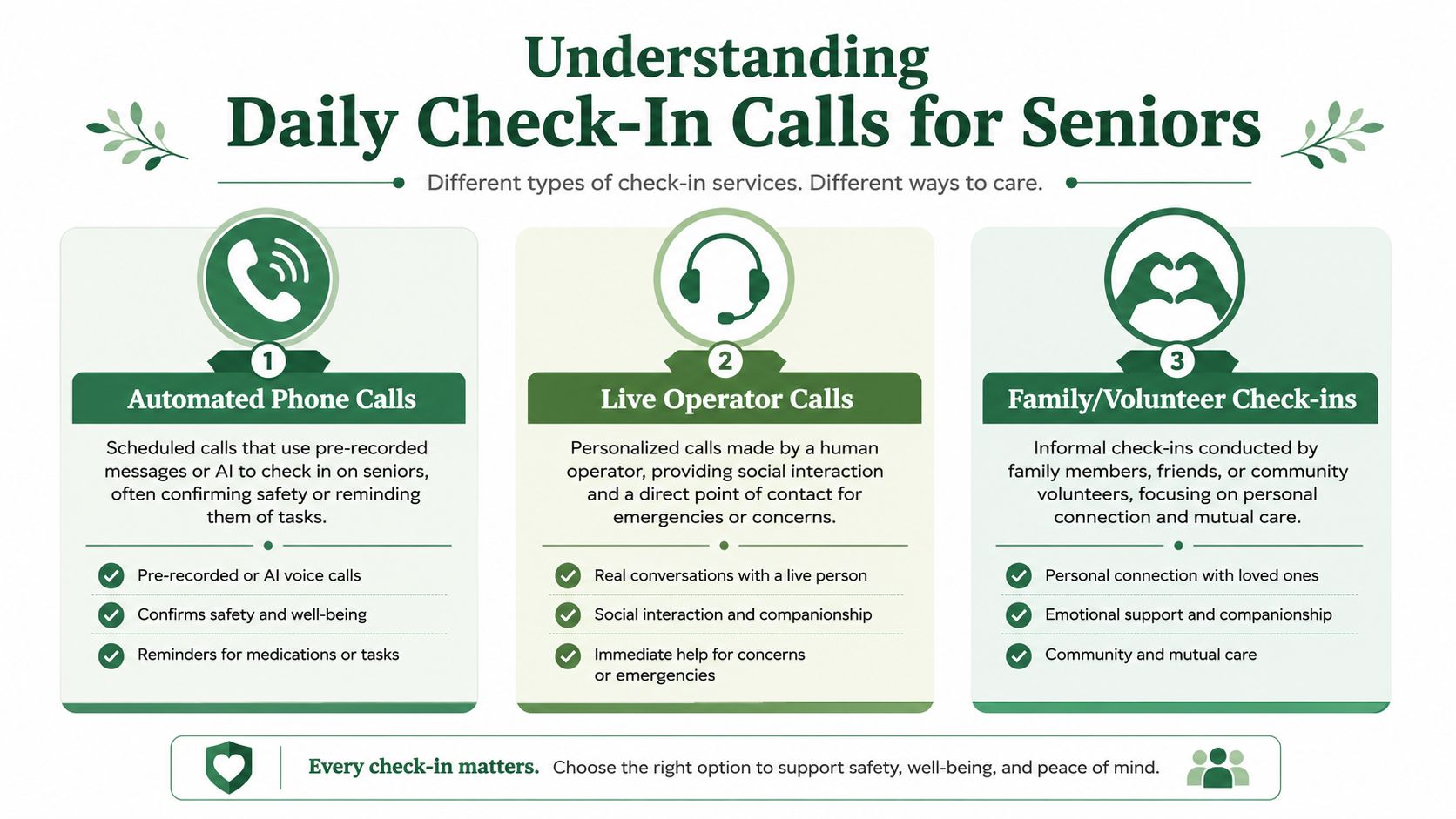
Here's the basic spectrum.
Automated calls: These are scheduled calls with a recorded message or a simple prompt. A person may be asked to press a button to confirm they're okay. Some programs also use these calls for reminders.
Live operator calls: A staff member makes the call and talks with the senior directly. This adds social interaction and gives the caller a chance to notice whether something feels off.
Family or volunteer check ins: These are more informal. A relative, friend, neighbor, church volunteer, or community program may call on a recurring basis. These can be warm and helpful, though consistency varies from one situation to another.
The main difference isn't only who places the call. It's what the call is designed to catch. A basic service confirms contact. A stronger service can notice patterns in memory, mood, and daily functioning.
If you want a fuller example of what a more structured cognitive support model looks like, this family guide to how phone-based cognitive support works is useful background.
Why the phone works so well
Phone-based support works because it meets older adults where they already are. According to Pew ownership figures cited in this overview of senior phone check-in programs, 96% of Americans age 65 and older own a cellphone or landline, while 61% own a smartphone. That matters because many families assume the best solution must be an app, when a regular voice call is often more practical.
That same overview notes that a typical daily check-in program aims to verify wellbeing once every 24 hours and escalate a missed check-in to a caregiver or neighbor within 15 minutes. It also describes simple wellness updates such as “All good,” “Need groceries,” or “Need medical help.”
A service doesn't have to feel high-tech to be reliable. For many older adults, the most usable system is the one that works with the phone they already answer every day.
For seniors with early memory loss, this simplicity can be the deciding factor. No passwords. No app updates. No charging routine to remember. Just a familiar call and a familiar voice.
The Transformative Benefits for Senior Wellbeing
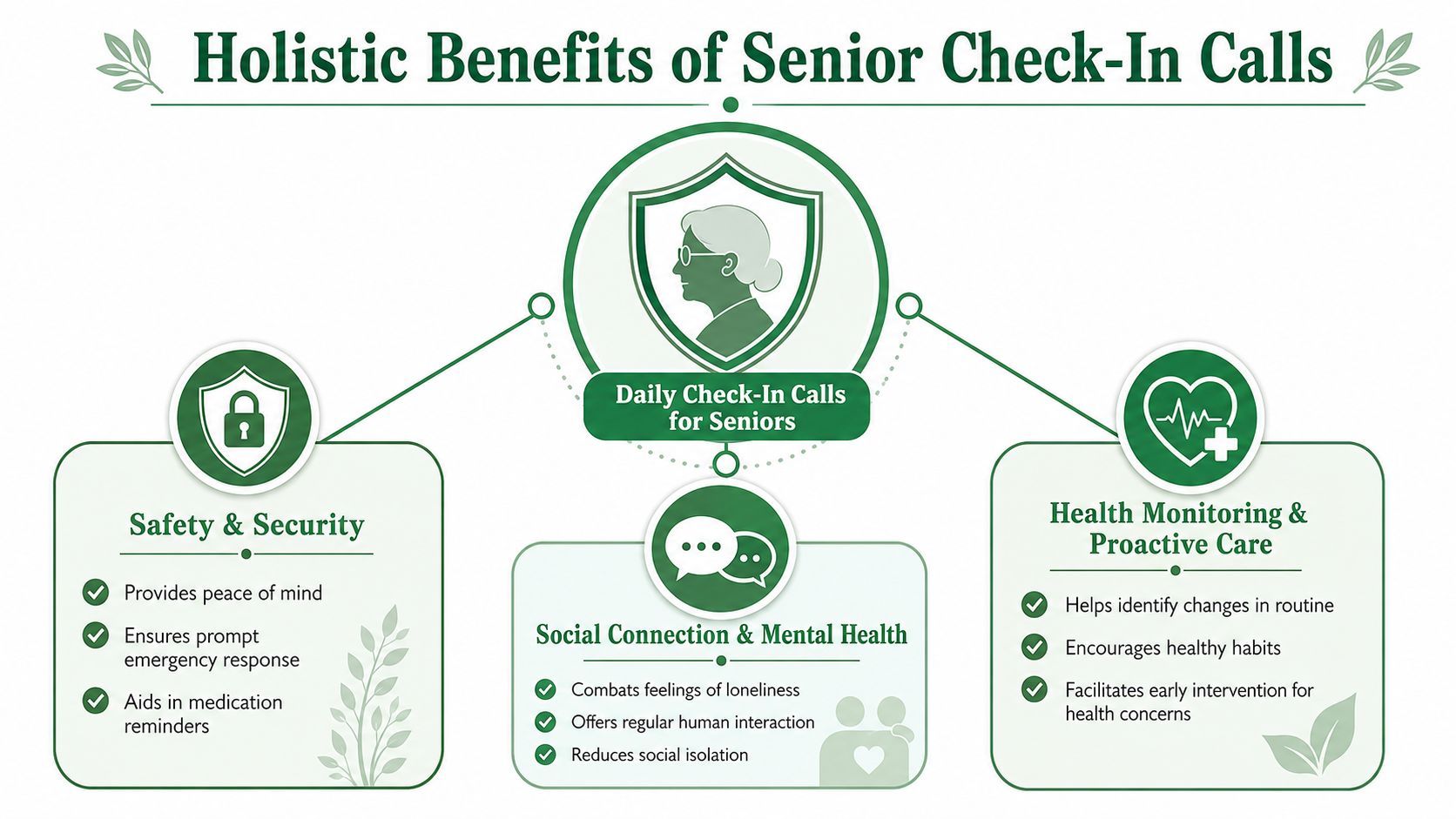
A daughter calls her mother after work and hears, “I'm fine.” The words sound reassuring, but the conversation is short, a little flat, and harder to read than it should be. That is where daily check in calls can help. They add a steady human touchpoint that supports safety, mood, and day-to-day thinking in ways a simple yes-or-no check cannot.
Many families start by looking for reassurance that someone will notice a problem. That matters. But over time, another truth usually becomes clear. The strongest calls do more than confirm that a senior answered the phone. They help a person stay connected, oriented, and emotionally grounded.
Safety and independence
A regular call creates a rhythm the family can rely on. If your father usually answers in the morning and one day he does not, that change means something. If your mother mentions dizziness, missed breakfast, or confusion about her pills, someone can respond while the issue is still manageable.
That kind of support helps many older adults remain at home with more confidence. The goal is not constant surveillance. The goal is a dependable checkpoint and a clear plan for what happens if something seems off.
It also helps with the quiet problems that often build in the background. A skipped meal. A forgotten appointment. A rough night of sleep that leaves someone more confused than usual. Families often worry about emergencies, but daily wellbeing often turns on smaller patterns like these.
Emotional steadiness and less isolation
For an older adult living alone, one warm conversation can change the feel of an entire day.
Loneliness is not always obvious. Some seniors sound worried. Others sound irritated, withdrawn, or uninterested in things they usually enjoy. A familiar caller can notice those changes over time because the relationship is built through repetition, not guesswork.
That is one reason the human side of a check in matters so much. A short call can remind a person that someone knows their routine, remembers what matters to them, and will notice if their mood shifts. For a family, that brings peace of mind. For a senior, it can bring relief.
Before the video below, keep one practical point in mind. A check in call that feels kind and conversational is often the one a senior will keep answering.
Cognitive support that goes beyond a safety ping
This is the distinction many families are really looking for, even if they do not have the words for it yet.
A basic safety call asks, in effect, “Are you okay?” That can be useful. A stronger cognitive support call asks better questions and listens for more. Is the person oriented to the day? Do they sound more repetitive than usual? Can they follow a simple line of conversation, recall a recent event, or talk through today's plan?
The difference is a little like comparing a porch light to someone coming inside and checking the kitchen. One tells you the house is there. The other tells you how things are going.
Research described in Scientific Reports on recurring phone calls for community-dwelling older adults found that scheduled phone calls providing cognitive stimulation and emotional support over 31 weeks were associated with lower depression scores and improved memory scores. That matters for families facing early memory loss because conversation itself can become part of the support plan, not just the delivery method.
For seniors with mild cognitive change, that added layer can make the call much more meaningful. Guided conversation may reinforce routine, prompt recall, encourage attention, and surface subtle changes that a simple automated check would miss. If you want to see what that model looks like in practice, this explanation of cognitive support for early memory loss gives a clear picture.
The primary benefit is not only that someone calls. It is that the call helps a senior feel safe, known, and mentally engaged on an ordinary day.
How Check In Calls Complement Family Caregiving
Many families hesitate because they worry a service like this will replace family contact or make caregiving feel impersonal. In practice, the opposite is usually true. A good check in system gives family members a steadier foundation for the care they're already providing.
You still know your parent best. You still make decisions. The calls add consistency during the hours and days when you can't be there.
A second set of ears between visits
Think about the gaps in a normal caregiving week. You visit on Sunday. You speak briefly on Tuesday. By Thursday, something may have changed. Maybe your mother sounds more confused than usual. Maybe your father is suddenly preoccupied with a misplaced wallet. Maybe neither would mention a minor stumble unless someone asked the right question.
A structured check in helps catch those smaller shifts.
Mood changes: A caller may notice more anxiety, flatness, or irritability.
Routine problems: A senior may seem unsure about meals, appointments, or medication timing.
New concerns: The call may surface dizziness, mobility worries, or increased forgetfulness.
Communication changes: Families may hear “I'm fine” when a trained listener hears word-finding trouble or unusual repetition.
The value isn't only the call itself. It's the pattern that forms when someone listens closely over time.
Why families need patterns, not just alerts
A single missed call can be useful. A pattern is often more useful. If a senior is increasingly confused in the evenings, more anxious on weekends, or repeatedly forgetting the same daily task, that information can shape better family decisions.
The challenge lies in many families struggling to turn scattered observations into practical action. A 2025 industry report summarized here on care-integrated support found that 78% of families struggle to connect check-in data with medical decisions. The same source describes a shift toward care-integrated models in which dedicated care managers track call patterns and communicate with clinicians.
That approach fits the reality of memory care. Doctors usually see snapshots. Families live inside the uncertainty between appointments. Check in calls can help bridge that gap when the information is documented clearly and shared with the right people.
Used this way, the service doesn't replace caregiving. It strengthens it. It gives spouses, adult children, and care managers a better sense of what daily life looks like between visits.
Choosing the Right Daily Check In Service
Choosing a service can feel harder than it should. Two programs may both promise a "daily check in," yet one confirms that someone answered the phone while another helps you understand whether your loved one sounds steady, confused, withdrawn, or more like themselves.
That difference matters most when memory loss is part of the picture. A basic safety call asks, "Are you okay?" A stronger memory-support call also asks, in effect, "How are you doing today, really?" It gives the caller time to notice changes in mood, orientation, routine, and conversation.
Start with your primary goal
Begin with the job you need the call to do.
If your loved one lives independently, keeps routines well, and mainly needs a daily safety confirmation, an automated service may be enough. It works like a porch light you check from a distance. You can see that something is on, but you cannot tell much about what is happening inside.
If your loved one is socially isolated but thinking clearly, a live caller or volunteer program may be the better fit. In that case, the value comes from regular human contact and a friendly routine.
If memory loss is becoming part of daily life, the standard changes. A quick prompt or button press may miss the very things a family is worried about. Can your parent follow the conversation? Do they remember what day it is? Are they repeating themselves more often than last week? Those signs usually show up in a real conversation, not in a simple response check.
Questions worth asking before you enroll
Price matters, but fit matters more. Before you sign up, ask questions that show what happens during the call and what your family will learn from it.
What happens during the call? Is it only a confirmation prompt, or does the caller spend enough time talking to notice confusion, anxiety, or changes in mood?
Who makes the calls? Is it an automated system, a rotating volunteer, or a trained staff member who knows how to speak with someone who has memory loss?
How do they support cognition? Do they use orientation cues, gentle reminders, simple conversation structure, and patient repetition when needed?
What happens if something seems off? If a senior sounds disoriented, upset, or unusually tired, who is contacted and how quickly?
What does the family receive? Do you only hear about missed calls, or do you also get useful notes that help you spot changes over time?
Another helpful step is learning how to judge quality before enrolling. This guide to evaluating a memory loss support program explains what families should look for in communication, safety practices, and follow-through.
Key takeaway: For a senior with memory loss, the best check in service does more than confirm that the phone was answered. It helps the family understand how the person is functioning day to day.
Comparing Daily Check-In Service Types
Feature | Basic Automated Service | Conversational Cognitive Support |
|---|---|---|
Primary purpose | Confirms daily response | Supports wellbeing through conversation, structure, and cognitive engagement |
Call format | Recorded prompt or simple button press | Live conversation with guided interaction |
Fit for memory loss | Limited when confusion affects response reliability | Better suited to seniors who need cueing, reassurance, and brain engagement |
Social connection | Minimal | Ongoing human interaction |
Cognitive exercises | Usually absent | Included as part of the call experience |
Family visibility | Often limited to missed-call alerts | Can include clearer notes, patterns, and care coordination |
Best for | Basic reassurance | Families seeking support beyond “are you okay?” |
Many families do not need the most advanced option on the market. They need the service that matches the kind of support their loved one needs each day.
A Practical Guide to Getting Started
It is 8:30 p.m. You have not heard from your mom yet. She usually sounds fine on the phone, but lately she repeats the same question, loses track of the day, and brushes off your concern. You want a daily check-in service to feel like support, not surveillance. That first step matters.
Starting well usually depends less on the service itself and more on how you introduce it. A senior who values independence may hear, “We do not trust you anymore.” What you want them to hear is, “We want daily life to feel steadier, easier, and less lonely.”

How to bring it up without causing defensiveness
Lead with a goal your loved one already cares about. Staying at home. Keeping a routine. Having one dependable point of contact each day.
You might say, “I know living in your own home matters to you. A daily call can help keep things on track and give you one less thing to manage alone.” Another option is, “I would feel better knowing someone checks in each day, and you might enjoy having a familiar person to talk with too.”
That wording helps because it shifts the focus. The call is not just a safety ping. For someone with memory loss, it can act more like a daily handrail. A good caller can notice confusion, offer gentle cueing, and help the day feel less scrambled.
Keep the first conversation brief. If your parent says no, avoid turning it into a debate. Let the idea rest, then return to the parts that tend to matter most in real life: easier mornings, less isolation, and a familiar voice who notices when something feels off.
“I want to make the day feel simpler, not more monitored.”
What to prepare before the first call
Once your loved one agrees to try it, set the caller up to sound informed and calming from the first hello. That preparation is especially helpful when memory problems make new interactions harder.
Gather a short profile that includes:
Emergency contacts: Who should be called first, second, and third if there is a concern.
Daily routine: Usual wake-up time, meal patterns, medication habits, and the best time window for calls.
Conversation cues: Family names, favorite stories, hobbies, old jobs, pets, and topics that usually spark a warm response.
Stress triggers: Subjects that increase agitation, times of day that are harder, and signs that the person is getting overwhelmed.
Health background: The basics of their memory changes, hearing issues, speech patterns, and what helps them reorient.
This gives the caller a map. Without it, the conversation can feel generic. With it, the call feels more like talking to someone who knows how to meet your loved one where they are.
Easy ways to help the first week go smoothly
The first week should feel familiar, not formal. A simple rhythm works best.
Start with subjects that are easy to answer. Breakfast. The weather outside the window. A grandchild's visit. A favorite recipe. If your loved one enjoys reminiscing, older memories often come more easily than brand-new details, and that early success can lower anxiety.
As noted earlier, pleasant social contact can support day-to-day wellbeing. In practice, families often notice something just as important. A real conversation reveals more than a yes or no answer ever could. You may learn whether your parent sounds organized, anxious, tired, confused, or more like themselves.
For the first several calls, keep the plan modest:
Choose a predictable time: Consistency helps the call become part of the day.
Allow extra time to answer: Some seniors need a slower pace getting to the phone.
Keep topics familiar: Comfort matters more than variety at the start.
Listen for patterns: Are mornings better than evenings? Does your loved one do better with cueing or open-ended questions?
Adjust after a few calls: Small changes in timing or approach can make the experience much easier to accept.
A good start builds trust. And trust is what turns a daily call from something your loved one tolerates into something that helps.
Frequently Asked Questions
Are daily check in calls a replacement for medical care
No. They work alongside medical care. A trained caller may notice changes in mood, memory, or daily functioning and pass that information to the family, but they do not provide diagnosis or treatment.
What happens if my parent misses a call
Each service handles this differently. Some place a second call. Some text or call a family member. Others follow a written escalation plan that may include another emergency contact. Ask for that process before you sign up, so there are no surprises if a call is missed.
What if my parent says no
That is common, especially at the beginning. Many older adults hear “check in” and worry it means they are losing control. It often helps to present the service as support for staying independent, not supervision. A short trial can feel easier to accept than an open-ended commitment.
Are these calls only for emergencies
No. Daily calls can do much more than confirm someone answered the phone. A thoughtful conversation can reduce loneliness, reinforce routine, and help you notice subtle changes that a quick yes-or-no safety check would miss.
How do I know whether my parent needs simple check ins or more cognitive support
Listen to the everyday signs. A basic check-in may be enough if your loved one mainly needs a consistent touchpoint and a backup plan when something seems off.
A more supportive call model often fits better when memory loss is affecting daily life. You might hear repeated questions, missed meals, forgotten routines, rising anxiety, confusion about time, or a conversation that drifts off course without gentle cueing. In those cases, the value is not only confirming safety. It is having someone who can slow the moment down, reorient your loved one, and help the call feel calm and familiar.
Is personal information kept private
A trustworthy service should explain what information is collected, who can see it, and how updates are shared with family. They should also tell you how emergency contacts are used. If the explanation is unclear, keep asking until you get a plain answer.
If your family needs more than a basic safety call, Velma offers phone-based cognitive support for older adults with early to mid-stage memory loss. The program includes scheduled conversation, cognitive exercises, emotional support, and family coordination through regular phone calls. Your loved one gets more than “Are you okay?” They get a familiar voice asking, “How are you doing today?” and staying on the line long enough to hear the answer.
You look at your phone, see it's later than usual, and wonder whether you should call your mom again. Maybe she lives alone. Maybe she's still doing fairly well, but she forgets small things now. Maybe your dad insists he's fine, yet you can hear the strain in his voice on some days and the confusion on others.
That kind of worry is exhausting because it isn't dramatic. It's daily. You're not always dealing with a crisis. You're dealing with uncertainty.
For many families, daily check in calls for seniors fill that gap. They create a simple routine. Someone calls. Someone answers. If something seems off, the right person knows. And when the call includes real conversation instead of a quick safety prompt, it can do much more than confirm that a loved one picked up the phone.
Table of Contents
The Daily Worry and A Simple Solution
What Are Daily Check In Calls
Three common types of check in calls
Why the phone works so well
The Transformative Benefits for Senior Wellbeing
Safety and independence
Emotional steadiness and less isolation
Cognitive support that goes beyond a safety ping
How Check In Calls Complement Family Caregiving
A second set of ears between visits
Why families need patterns, not just alerts
Choosing the Right Daily Check In Service
Start with your primary goal
Questions worth asking before you enroll
Comparing Daily Check-In Service Types
A Practical Guide to Getting Started
How to bring it up without causing defensiveness
What to prepare before the first call
Easy ways to help the first week go smoothly
Frequently Asked Questions
Are daily check in calls a replacement for medical care
What happens if my parent misses a call
What if my parent says no
Are these calls only for emergencies
How do I know whether my parent needs simple check ins or more cognitive support
Is personal information kept private
The Daily Worry and A Simple Solution
If you support an older parent, you probably know the quiet routine of checking your phone for signs that all is well. A returned voicemail. A lighthearted text. A quick “I'm fine.” When that doesn't come, your mind fills in the blanks.
Families often reach this point after a few unsettling moments. A missed call. A forgotten appointment. A story repeated three times in one conversation. Nothing looks serious enough to force a major change, but the old system of “I'll call when I can” no longer feels reliable.
That's where daily check in calls can help. At the simplest level, they create a dependable touchpoint every day. A senior answers a scheduled call, confirms they're okay, and the family gets reassurance that someone made contact.
But the better version of this service goes further. It doesn't stop at “Are you safe?” It also asks, “How are you feeling today?” “Did you sleep well?” “Do you remember what's on the calendar?” “Would it help to talk for a few minutes?”
Practical rule: If your loved one has memory changes, the most useful check in is rarely the fastest one. It's the one that gives another person enough time to notice confusion, anxiety, or a shift in mood.
That difference matters. A brief automated call may tell you your parent pressed a button. A real conversation may tell you they sound unusually scattered, worried about the stove, or unsure what day it is.
For worried families, that's often the actual source of peace of mind. Not surveillance. Not control. Just a humane daily rhythm that supports safety, connection, and independence at the same time.
What Are Daily Check In Calls
A daily check in call is a scheduled phone call made to an older adult to confirm wellbeing and, in some cases, provide conversation, reminders, and support. Think of it as a routine touchpoint with a plan behind it.
Some services act like a smoke alarm. They're designed to alert someone if there may be a problem. Others are closer to a thoughtful neighbor who notices when a person sounds tired, mixed up, or unusually withdrawn.
Three common types of check in calls
Here's the basic spectrum.
Automated calls: These are scheduled calls with a recorded message or a simple prompt. A person may be asked to press a button to confirm they're okay. Some programs also use these calls for reminders.
Live operator calls: A staff member makes the call and talks with the senior directly. This adds social interaction and gives the caller a chance to notice whether something feels off.
Family or volunteer check ins: These are more informal. A relative, friend, neighbor, church volunteer, or community program may call on a recurring basis. These can be warm and helpful, though consistency varies from one situation to another.
The main difference isn't only who places the call. It's what the call is designed to catch. A basic service confirms contact. A stronger service can notice patterns in memory, mood, and daily functioning.
If you want a fuller example of what a more structured cognitive support model looks like, this family guide to how phone-based cognitive support works is useful background.
Why the phone works so well
Phone-based support works because it meets older adults where they already are. According to Pew ownership figures cited in this overview of senior phone check-in programs, 96% of Americans age 65 and older own a cellphone or landline, while 61% own a smartphone. That matters because many families assume the best solution must be an app, when a regular voice call is often more practical.
That same overview notes that a typical daily check-in program aims to verify wellbeing once every 24 hours and escalate a missed check-in to a caregiver or neighbor within 15 minutes. It also describes simple wellness updates such as “All good,” “Need groceries,” or “Need medical help.”
A service doesn't have to feel high-tech to be reliable. For many older adults, the most usable system is the one that works with the phone they already answer every day.
For seniors with early memory loss, this simplicity can be the deciding factor. No passwords. No app updates. No charging routine to remember. Just a familiar call and a familiar voice.
The Transformative Benefits for Senior Wellbeing
A daughter calls her mother after work and hears, “I'm fine.” The words sound reassuring, but the conversation is short, a little flat, and harder to read than it should be. That is where daily check in calls can help. They add a steady human touchpoint that supports safety, mood, and day-to-day thinking in ways a simple yes-or-no check cannot.
Many families start by looking for reassurance that someone will notice a problem. That matters. But over time, another truth usually becomes clear. The strongest calls do more than confirm that a senior answered the phone. They help a person stay connected, oriented, and emotionally grounded.
Safety and independence
A regular call creates a rhythm the family can rely on. If your father usually answers in the morning and one day he does not, that change means something. If your mother mentions dizziness, missed breakfast, or confusion about her pills, someone can respond while the issue is still manageable.
That kind of support helps many older adults remain at home with more confidence. The goal is not constant surveillance. The goal is a dependable checkpoint and a clear plan for what happens if something seems off.
It also helps with the quiet problems that often build in the background. A skipped meal. A forgotten appointment. A rough night of sleep that leaves someone more confused than usual. Families often worry about emergencies, but daily wellbeing often turns on smaller patterns like these.
Emotional steadiness and less isolation
For an older adult living alone, one warm conversation can change the feel of an entire day.
Loneliness is not always obvious. Some seniors sound worried. Others sound irritated, withdrawn, or uninterested in things they usually enjoy. A familiar caller can notice those changes over time because the relationship is built through repetition, not guesswork.
That is one reason the human side of a check in matters so much. A short call can remind a person that someone knows their routine, remembers what matters to them, and will notice if their mood shifts. For a family, that brings peace of mind. For a senior, it can bring relief.
Before the video below, keep one practical point in mind. A check in call that feels kind and conversational is often the one a senior will keep answering.
Cognitive support that goes beyond a safety ping
This is the distinction many families are really looking for, even if they do not have the words for it yet.
A basic safety call asks, in effect, “Are you okay?” That can be useful. A stronger cognitive support call asks better questions and listens for more. Is the person oriented to the day? Do they sound more repetitive than usual? Can they follow a simple line of conversation, recall a recent event, or talk through today's plan?
The difference is a little like comparing a porch light to someone coming inside and checking the kitchen. One tells you the house is there. The other tells you how things are going.
Research described in Scientific Reports on recurring phone calls for community-dwelling older adults found that scheduled phone calls providing cognitive stimulation and emotional support over 31 weeks were associated with lower depression scores and improved memory scores. That matters for families facing early memory loss because conversation itself can become part of the support plan, not just the delivery method.
For seniors with mild cognitive change, that added layer can make the call much more meaningful. Guided conversation may reinforce routine, prompt recall, encourage attention, and surface subtle changes that a simple automated check would miss. If you want to see what that model looks like in practice, this explanation of cognitive support for early memory loss gives a clear picture.
The primary benefit is not only that someone calls. It is that the call helps a senior feel safe, known, and mentally engaged on an ordinary day.
How Check In Calls Complement Family Caregiving
Many families hesitate because they worry a service like this will replace family contact or make caregiving feel impersonal. In practice, the opposite is usually true. A good check in system gives family members a steadier foundation for the care they're already providing.
You still know your parent best. You still make decisions. The calls add consistency during the hours and days when you can't be there.
A second set of ears between visits
Think about the gaps in a normal caregiving week. You visit on Sunday. You speak briefly on Tuesday. By Thursday, something may have changed. Maybe your mother sounds more confused than usual. Maybe your father is suddenly preoccupied with a misplaced wallet. Maybe neither would mention a minor stumble unless someone asked the right question.
A structured check in helps catch those smaller shifts.
Mood changes: A caller may notice more anxiety, flatness, or irritability.
Routine problems: A senior may seem unsure about meals, appointments, or medication timing.
New concerns: The call may surface dizziness, mobility worries, or increased forgetfulness.
Communication changes: Families may hear “I'm fine” when a trained listener hears word-finding trouble or unusual repetition.
The value isn't only the call itself. It's the pattern that forms when someone listens closely over time.
Why families need patterns, not just alerts
A single missed call can be useful. A pattern is often more useful. If a senior is increasingly confused in the evenings, more anxious on weekends, or repeatedly forgetting the same daily task, that information can shape better family decisions.
The challenge lies in many families struggling to turn scattered observations into practical action. A 2025 industry report summarized here on care-integrated support found that 78% of families struggle to connect check-in data with medical decisions. The same source describes a shift toward care-integrated models in which dedicated care managers track call patterns and communicate with clinicians.
That approach fits the reality of memory care. Doctors usually see snapshots. Families live inside the uncertainty between appointments. Check in calls can help bridge that gap when the information is documented clearly and shared with the right people.
Used this way, the service doesn't replace caregiving. It strengthens it. It gives spouses, adult children, and care managers a better sense of what daily life looks like between visits.
Choosing the Right Daily Check In Service
Choosing a service can feel harder than it should. Two programs may both promise a "daily check in," yet one confirms that someone answered the phone while another helps you understand whether your loved one sounds steady, confused, withdrawn, or more like themselves.
That difference matters most when memory loss is part of the picture. A basic safety call asks, "Are you okay?" A stronger memory-support call also asks, in effect, "How are you doing today, really?" It gives the caller time to notice changes in mood, orientation, routine, and conversation.
Start with your primary goal
Begin with the job you need the call to do.
If your loved one lives independently, keeps routines well, and mainly needs a daily safety confirmation, an automated service may be enough. It works like a porch light you check from a distance. You can see that something is on, but you cannot tell much about what is happening inside.
If your loved one is socially isolated but thinking clearly, a live caller or volunteer program may be the better fit. In that case, the value comes from regular human contact and a friendly routine.
If memory loss is becoming part of daily life, the standard changes. A quick prompt or button press may miss the very things a family is worried about. Can your parent follow the conversation? Do they remember what day it is? Are they repeating themselves more often than last week? Those signs usually show up in a real conversation, not in a simple response check.
Questions worth asking before you enroll
Price matters, but fit matters more. Before you sign up, ask questions that show what happens during the call and what your family will learn from it.
What happens during the call? Is it only a confirmation prompt, or does the caller spend enough time talking to notice confusion, anxiety, or changes in mood?
Who makes the calls? Is it an automated system, a rotating volunteer, or a trained staff member who knows how to speak with someone who has memory loss?
How do they support cognition? Do they use orientation cues, gentle reminders, simple conversation structure, and patient repetition when needed?
What happens if something seems off? If a senior sounds disoriented, upset, or unusually tired, who is contacted and how quickly?
What does the family receive? Do you only hear about missed calls, or do you also get useful notes that help you spot changes over time?
Another helpful step is learning how to judge quality before enrolling. This guide to evaluating a memory loss support program explains what families should look for in communication, safety practices, and follow-through.
Key takeaway: For a senior with memory loss, the best check in service does more than confirm that the phone was answered. It helps the family understand how the person is functioning day to day.
Comparing Daily Check-In Service Types
Feature | Basic Automated Service | Conversational Cognitive Support |
|---|---|---|
Primary purpose | Confirms daily response | Supports wellbeing through conversation, structure, and cognitive engagement |
Call format | Recorded prompt or simple button press | Live conversation with guided interaction |
Fit for memory loss | Limited when confusion affects response reliability | Better suited to seniors who need cueing, reassurance, and brain engagement |
Social connection | Minimal | Ongoing human interaction |
Cognitive exercises | Usually absent | Included as part of the call experience |
Family visibility | Often limited to missed-call alerts | Can include clearer notes, patterns, and care coordination |
Best for | Basic reassurance | Families seeking support beyond “are you okay?” |
Many families do not need the most advanced option on the market. They need the service that matches the kind of support their loved one needs each day.
A Practical Guide to Getting Started
It is 8:30 p.m. You have not heard from your mom yet. She usually sounds fine on the phone, but lately she repeats the same question, loses track of the day, and brushes off your concern. You want a daily check-in service to feel like support, not surveillance. That first step matters.
Starting well usually depends less on the service itself and more on how you introduce it. A senior who values independence may hear, “We do not trust you anymore.” What you want them to hear is, “We want daily life to feel steadier, easier, and less lonely.”
How to bring it up without causing defensiveness
Lead with a goal your loved one already cares about. Staying at home. Keeping a routine. Having one dependable point of contact each day.
You might say, “I know living in your own home matters to you. A daily call can help keep things on track and give you one less thing to manage alone.” Another option is, “I would feel better knowing someone checks in each day, and you might enjoy having a familiar person to talk with too.”
That wording helps because it shifts the focus. The call is not just a safety ping. For someone with memory loss, it can act more like a daily handrail. A good caller can notice confusion, offer gentle cueing, and help the day feel less scrambled.
Keep the first conversation brief. If your parent says no, avoid turning it into a debate. Let the idea rest, then return to the parts that tend to matter most in real life: easier mornings, less isolation, and a familiar voice who notices when something feels off.
“I want to make the day feel simpler, not more monitored.”
What to prepare before the first call
Once your loved one agrees to try it, set the caller up to sound informed and calming from the first hello. That preparation is especially helpful when memory problems make new interactions harder.
Gather a short profile that includes:
Emergency contacts: Who should be called first, second, and third if there is a concern.
Daily routine: Usual wake-up time, meal patterns, medication habits, and the best time window for calls.
Conversation cues: Family names, favorite stories, hobbies, old jobs, pets, and topics that usually spark a warm response.
Stress triggers: Subjects that increase agitation, times of day that are harder, and signs that the person is getting overwhelmed.
Health background: The basics of their memory changes, hearing issues, speech patterns, and what helps them reorient.
This gives the caller a map. Without it, the conversation can feel generic. With it, the call feels more like talking to someone who knows how to meet your loved one where they are.
Easy ways to help the first week go smoothly
The first week should feel familiar, not formal. A simple rhythm works best.
Start with subjects that are easy to answer. Breakfast. The weather outside the window. A grandchild's visit. A favorite recipe. If your loved one enjoys reminiscing, older memories often come more easily than brand-new details, and that early success can lower anxiety.
As noted earlier, pleasant social contact can support day-to-day wellbeing. In practice, families often notice something just as important. A real conversation reveals more than a yes or no answer ever could. You may learn whether your parent sounds organized, anxious, tired, confused, or more like themselves.
For the first several calls, keep the plan modest:
Choose a predictable time: Consistency helps the call become part of the day.
Allow extra time to answer: Some seniors need a slower pace getting to the phone.
Keep topics familiar: Comfort matters more than variety at the start.
Listen for patterns: Are mornings better than evenings? Does your loved one do better with cueing or open-ended questions?
Adjust after a few calls: Small changes in timing or approach can make the experience much easier to accept.
A good start builds trust. And trust is what turns a daily call from something your loved one tolerates into something that helps.
Frequently Asked Questions
Are daily check in calls a replacement for medical care
No. They work alongside medical care. A trained caller may notice changes in mood, memory, or daily functioning and pass that information to the family, but they do not provide diagnosis or treatment.
What happens if my parent misses a call
Each service handles this differently. Some place a second call. Some text or call a family member. Others follow a written escalation plan that may include another emergency contact. Ask for that process before you sign up, so there are no surprises if a call is missed.
What if my parent says no
That is common, especially at the beginning. Many older adults hear “check in” and worry it means they are losing control. It often helps to present the service as support for staying independent, not supervision. A short trial can feel easier to accept than an open-ended commitment.
Are these calls only for emergencies
No. Daily calls can do much more than confirm someone answered the phone. A thoughtful conversation can reduce loneliness, reinforce routine, and help you notice subtle changes that a quick yes-or-no safety check would miss.
How do I know whether my parent needs simple check ins or more cognitive support
Listen to the everyday signs. A basic check-in may be enough if your loved one mainly needs a consistent touchpoint and a backup plan when something seems off.
A more supportive call model often fits better when memory loss is affecting daily life. You might hear repeated questions, missed meals, forgotten routines, rising anxiety, confusion about time, or a conversation that drifts off course without gentle cueing. In those cases, the value is not only confirming safety. It is having someone who can slow the moment down, reorient your loved one, and help the call feel calm and familiar.
Is personal information kept private
A trustworthy service should explain what information is collected, who can see it, and how updates are shared with family. They should also tell you how emergency contacts are used. If the explanation is unclear, keep asking until you get a plain answer.
If your family needs more than a basic safety call, Velma offers phone-based cognitive support for older adults with early to mid-stage memory loss. The program includes scheduled conversation, cognitive exercises, emotional support, and family coordination through regular phone calls. Your loved one gets more than “Are you okay?” They get a familiar voice asking, “How are you doing today?” and staying on the line long enough to hear the answer.
Suggested Article: