Alzheimer's Disease vs Dementia: A Caregiver's Guide

You may be here because your mom keeps repeating the same story, your dad got lost on a familiar drive, or a doctor used two words that sounded interchangeable but didn't feel interchangeable at all: dementia and Alzheimer's.
That confusion is common. Families often hear, “It looks like dementia,” and then later, “It may be Alzheimer's disease,” and wonder whether those are two names for the same thing. They aren't. One is the broad category. The other is one specific disease within that category.
If you're trying to make sense of symptoms, medical visits, and day-to-day care, it helps to view Alzheimer's disease vs dementia through a caregiving lens. The label matters because it can change how you communicate, what safety issues you watch for, and what kind of support suits the person in front of you.
Table of Contents
The Question Every Family Asks
Why families get stuck on the wording
Understanding Dementia The Umbrella Term
What sits under the umbrella
Why this matters in real care
Defining Alzheimer's The Specific Disease
What Alzheimer's often looks like early on
Why diagnosis is more than memory complaints
A Side by Side Comparison of Common Dementias
Dementia types at a glance
The symptom patterns that change caregiving
Why “mixed” pictures are common in practice
How Symptoms and Progression Differ in Daily Life
Different conditions create different daily pressures
Why progression matters for planning
What the same symptom can mean in different conditions
From Knowledge to Action A Caregiver's Next Steps
Match the support to the symptom pattern
Communication changes care more than families expect
If you don't know the subtype yet
When to See a Doctor and How to Find Support
Signs that deserve medical attention
What to expect at the appointment
Support should start early, not late
The Question Every Family Asks
A daughter notices that her mother forgot a recent lunch date, then forgot it again the next week. A spouse sees that his partner can still tell detailed stories from long ago but can't keep track of what day it is. Someone in the family says, “I think it's dementia.” Another says, “Isn't that Alzheimer's?”
Both reactions make sense.
Dementia is the general term for a decline in memory, thinking, and everyday function that's serious enough to affect daily life. Alzheimer's disease is the most common specific cause of that decline. According to the World Health Organization's dementia fact sheet, over 55 million people worldwide are living with dementia, and Alzheimer's accounts for approximately 60% to 80% of all dementia cases.
That means two things can be true at once. Your loved one can have dementia, and the underlying disease causing it may be Alzheimer's. Or the underlying cause may be something else.
Why families get stuck on the wording
The terms are often used loosely in everyday conversation. Doctors, relatives, and friends may use them as if they mean the same thing. But for caregiving, the distinction matters. If you assume every dementia works like Alzheimer's, you may miss signs that call for a different approach.
A practical starting point is to stop asking only, “Do they have dementia?” and start asking, “What kind of dementia, or what pattern of symptoms, are we dealing with?” Families who are just beginning this process often benefit from simple basic recommendations for memory loss support at home.
The diagnosis label matters less than your loved one's actual symptom pattern. But when the subtype is known, care usually gets more precise.
Understanding Dementia The Umbrella Term
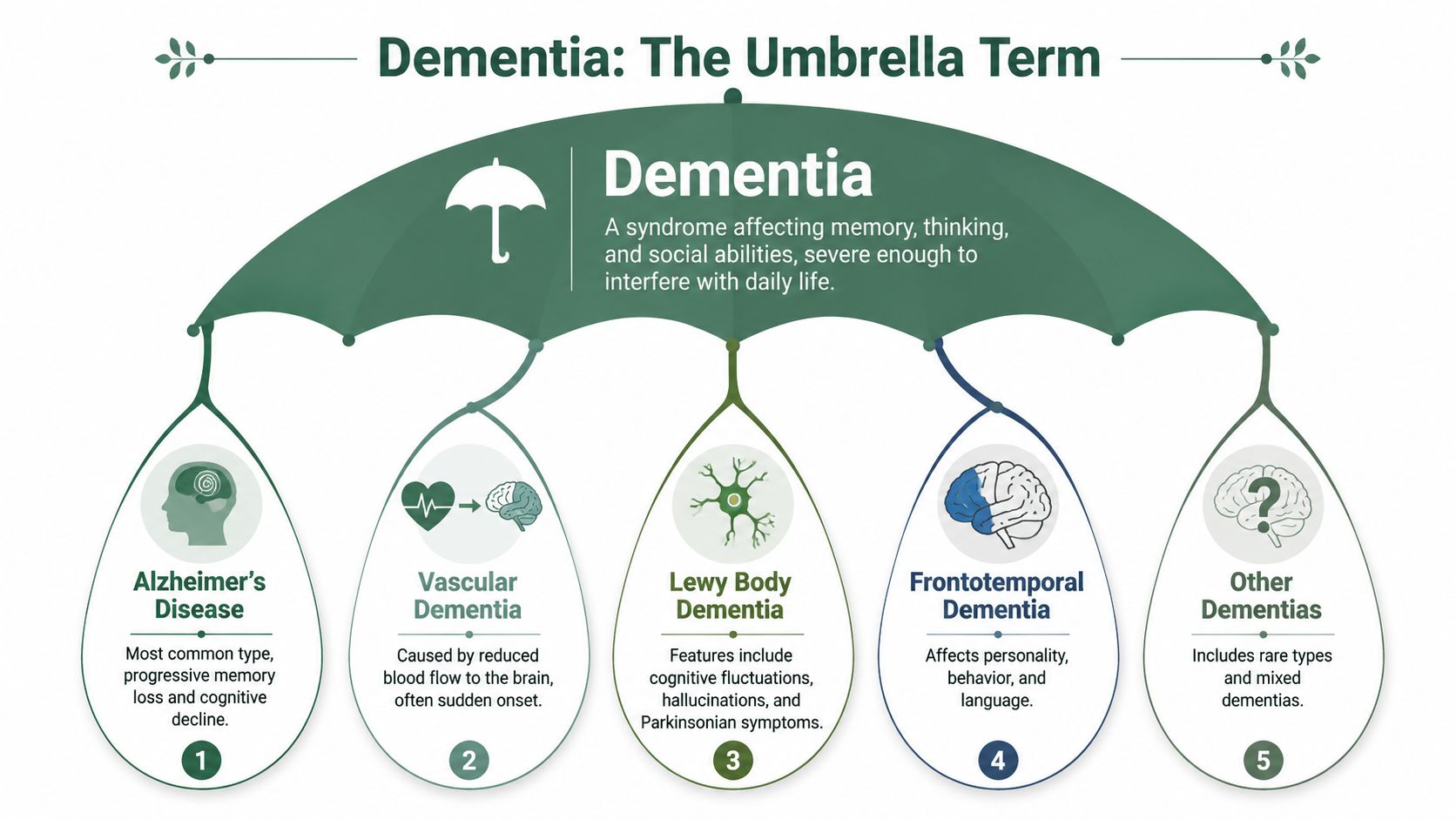
Think of dementia the way you'd think of “fever.” Fever tells you something is wrong, but it doesn't tell you why. Dementia works similarly. It describes a syndrome, not a single disease.
That syndrome can affect memory, language, judgment, orientation, behavior, and the ability to handle daily tasks like paying bills, taking medication, cooking, or following a routine. Some people mainly struggle with recent memory. Others show personality changes first. Others become disorganized or visually confused before memory loss becomes obvious.
What sits under the umbrella
Several conditions can cause dementia. The most commonly discussed include:
Alzheimer's disease. Often starts with trouble forming or retrieving recent memories.
Vascular dementia. Related to blood flow problems in the brain.
Lewy body dementia. Can involve attention changes, visual misperceptions, movement symptoms, and fluctuating thinking.
Frontotemporal dementia. Often shows up first as behavior, personality, or language changes.
Mixed dementia. More than one brain process may be present at the same time.
Some families feel relieved when they finally hear the word dementia because it names what they've been seeing. Others feel frightened because the term sounds final. In practice, it's a starting point.
Why this matters in real care
If you only hear “dementia,” you might default to generic strategies such as reminders, labels, and repetition. Those can help, but they don't fit every person in the same way.
For example:
A person with memory-led symptoms may respond well to simple cueing and routine reinforcement.
A person with behavioral or language-led symptoms may need fewer corrections and more environmental structure.
A person with fluctuating confusion may need flexibility more than strict expectations.
Caregiving rule: Dementia tells you there is cognitive decline. It doesn't tell you the best day-to-day approach until you understand the pattern underneath it.
Defining Alzheimer's The Specific Disease
Alzheimer's disease is a specific brain disease, not a catchall word for serious forgetfulness. It's the most common specific cause of dementia, but it isn't the only one.
In plain language, Alzheimer's affects the brain's communication system. Two hallmark changes are commonly described: beta-amyloid plaques and tau tangles. If that sounds technical, a simple image helps. Plaques are like sticky roadblocks between brain cells. Tangles are like twisted wiring inside the cells. Over time, those changes disrupt how brain cells communicate and function.
What Alzheimer's often looks like early on
The classic early pattern is episodic memory impairment. That means trouble with recent events and newly learned information. A person may forget a conversation from yesterday, repeat a question, misplace items, or rely more heavily on notes than they used to.
Alzheimer's disease is also associated with secondary problems in word-finding and spatial cognition. Families may notice pauses in speech, trouble naming familiar objects, or growing confusion in parking lots, grocery stores, or complex rooms.
Why diagnosis is more than memory complaints
Not every older adult with memory loss has Alzheimer's. And not every person with dementia starts with memory symptoms. That's why clinicians look for a pattern, not one isolated problem.
A technical distinction also matters. Amyloid findings alone aren't enough to confirm Alzheimer's disease. The diagnosis requires evidence that the disease process is tied to actual neurodegeneration and brain dysfunction, not just the presence of abnormal protein. In specialist care, doctors may use tools such as PET imaging, cerebrospinal fluid testing, or functional brain imaging to clarify the picture.
When a family says, “It looks like Alzheimer's,” they may be right. But the right question in clinic is, “What evidence supports Alzheimer's rather than another dementia or a mixed picture?”
For caregiving, that difference changes expectations. Alzheimer's often starts as a memory-centered condition. Other dementias may start somewhere else entirely.
A Side by Side Comparison of Common Dementias
When families search for Alzheimer's disease vs dementia, they usually want a simple answer. The more useful answer is a comparison. Dementia is the broad category. Under that umbrella, different diseases create different early clues, different risks, and different care needs.
Dementia types at a glance
Feature | Alzheimer's Disease | Vascular Dementia | Lewy Body Dementia (LBD) | Frontotemporal Dementia (FTD) |
|---|---|---|---|---|
What it is | A specific neurodegenerative disease | Dementia related to blood flow problems in the brain | A dementia syndrome associated with Lewy body pathology | A group of disorders affecting frontal and temporal brain regions |
Early pattern | Early, prominent episodic memory impairment with later word-finding and spatial difficulty | Often more difficulty with planning, organization, or thinking speed early on | Often attention, visuospatial problems, fluctuations, and other non-memory changes early | Often behavior, personality, judgment, or language changes early |
What families may notice first | Repeated questions, forgotten appointments, lost items | Trouble managing steps, finances, medications, or recovering after stroke-related changes | A loved one who seems clear at one time and much more confused at another | “This doesn't feel like the same person” because of apathy, impulsivity, or social changes |
Course over time | Often progressive over years, commonly described as a steady decline | Can appear more stepwise, especially after vascular events | May feel uneven or variable day to day | May center more on behavior or language before memory becomes the main issue |
Care focus | Memory cueing, routine, orientation support, safety monitoring | Structure, task simplification, medical follow-up around vascular risk, functional support | Calm communication, safety, observation of changing alertness, mobility awareness | Behavior management, routine consistency, redirection, caregiver coaching |
The clearest symptom difference in early stages is this: Alzheimer's usually starts with memory. Other dementias often start with something else.
The symptom patterns that change caregiving
The verified clinical distinction is important here. Alzheimer's disease is characterized by early, prominent episodic memory impairment and secondary deficits in word-finding and spatial cognition, whereas other dementias often present with early executive dysfunction, visuospatial deficits, or behavioral changes.
That sentence may sound clinical, so here's what it means at home:
Executive dysfunction means your loved one may know what they want to do but can't sequence the steps.
Visuospatial deficits mean clutter, shadows, stairs, or patterned floors may become more confusing.
Behavioral changes mean the first clue may be apathy, poor judgment, loss of empathy, or socially unusual behavior rather than forgetting names.
A person who forgets recent conversations may need cueing. A person who can't organize the steps of making tea may need task breakdown. A person whose behavior changes early may need supervision before they need memory reminders.
Why “mixed” pictures are common in practice
Real life isn't always tidy. Some older adults show features that overlap. A family may see memory problems, changing mood, and occasional visual confusion all at once. That doesn't mean the observations are wrong. It means the brain may not fit a clean textbook category.
This is why a good diagnosis helps, but careful observation helps too. Keep noting what happens, when it happens, and what makes it better or worse. That record often gives clinicians a better view than one office visit can.
How Symptoms and Progression Differ in Daily Life
A diagnosis affects more than a chart. It changes breakfast, phone calls, car keys, medication routines, and how you answer the same question for the sixth time.
With Alzheimer's disease, many families first notice a slow drift. A parent repeats stories, forgets plans that were made yesterday, or becomes less confident in new places. The change can feel subtle at first, which is one reason families sometimes wait before getting help.
With vascular dementia, the story may feel less gradual. A person can seem fairly stable, then show a more noticeable drop in planning, attention, or function after a stroke or another vascular event. Families often describe this as a “step down,” not just ordinary forgetting.
Different conditions create different daily pressures
In frontotemporal dementia, the hardest part may not be memory at all. A spouse might say, “He remembers plenty, but his judgment is off,” or “She says things she never would have said before.” That can look like depression, conflict, stubbornness, or personality change unless someone recognizes the neurological pattern.
In Lewy body dementia, the challenge may be inconsistency. The person you speak with in the morning may sound far more organized than the same person in the evening. That unpredictability can leave families doubting their own observations.
Why progression matters for planning
Alzheimer's has become a major public health burden. According to BrightFocus Alzheimer's facts and figures, deaths attributed to Alzheimer's disease increased by 145% between 2000 and 2019, while deaths from heart disease decreased by 7%. The same source notes that the lifetime cost of care for a single person with dementia is estimated at $405,262 in 2024 dollars.
Those numbers matter because families often underestimate how long support may be needed and how much coordination daily care can require.
What the same symptom can mean in different conditions
A missed medication doesn't always come from the same problem.
In Alzheimer's, the person may not remember the medication was due.
In vascular dementia, they may have trouble organizing the sequence of the task.
In frontotemporal dementia, they may resist the routine or show poor judgment about why it matters.
In Lewy body dementia, they may be more capable at one time of day than another.
When caregivers understand the “why” behind a symptom, they usually stop taking the behavior personally and start matching the support to the problem.
That shift alone can reduce conflict. It turns “Why are you being difficult?” into “What kind of help fits this brain change?”
From Knowledge to Action A Caregiver's Next Steps
Many families still don't know the subtype they're dealing with. A 2024 review found that 72% of adult children caregivers could not identify their parent's dementia subtype, and 68% said their care plan was not adjusted accordingly. That gap matters because generic support often misses the underlying problem.

Match the support to the symptom pattern
Start with the pattern you see, even if the diagnosis is still being clarified.
When memory is the main issue. Use short reminders, visible calendars, simple routines, and one-step cueing. Avoid giving five instructions at once.
When planning is the main issue. Break tasks into smaller parts. Lay out the toothbrush, toothpaste, and cup instead of saying, “Go get ready for bed.”
When behavior changes are leading. Reduce power struggles. Shorten explanations. Focus on routine, supervision, and environmental structure.
When confusion varies across the day. Schedule harder tasks for the person's better times. Keep expectations flexible.
Communication changes care more than families expect
The most common mistake I see is correcting too much. Families say, “No, Mom, that's not what happened,” or “Dad, I told you already.” The intention is understandable. The result is often more distress.
Try these swaps instead:
Instead of testing memory, offer support. “Your appointment is after lunch. I'll remind you again.”
Instead of arguing about accuracy, respond to emotion. “You seem worried. Let's sort this out together.”
Instead of open-ended demands, give a concrete next step. “Let's put on your shoes.”
A more detailed explanation of how structured daily support works can help families think through what kind of help fits best. This family guide to how Hey Velma works for daily cognitive support offers one example of that type of support model.
The best care plan isn't the most complicated one. It's the one that matches the person's actual cognitive pattern and can be repeated consistently.
If you don't know the subtype yet
You can still act. Track what happens over several days.
Notice:
Time pattern. Is confusion worse in the evening, or does it fluctuate unpredictably?
Task pattern. Is the person forgetting information, or struggling to organize steps?
Behavior pattern. Are mood, judgment, or social behavior changing before memory becomes severe?
That kind of observation helps both families and clinicians make better decisions.
When to See a Doctor and How to Find Support
Some changes are easy to dismiss at first. Everyone forgets things sometimes. Everyone has off days. The concern rises when the changes begin to affect daily function, safety, communication, or judgment.
A medical evaluation matters because not every cognitive change means irreversible decline. The 2025 WHO Global Dementia Report highlights that 15% to 30% of patients can experience fluctuating or reversible cognitive symptoms due to manageable comorbidities such as depression, sleep disorders, or nutritional deficiencies.
Signs that deserve medical attention
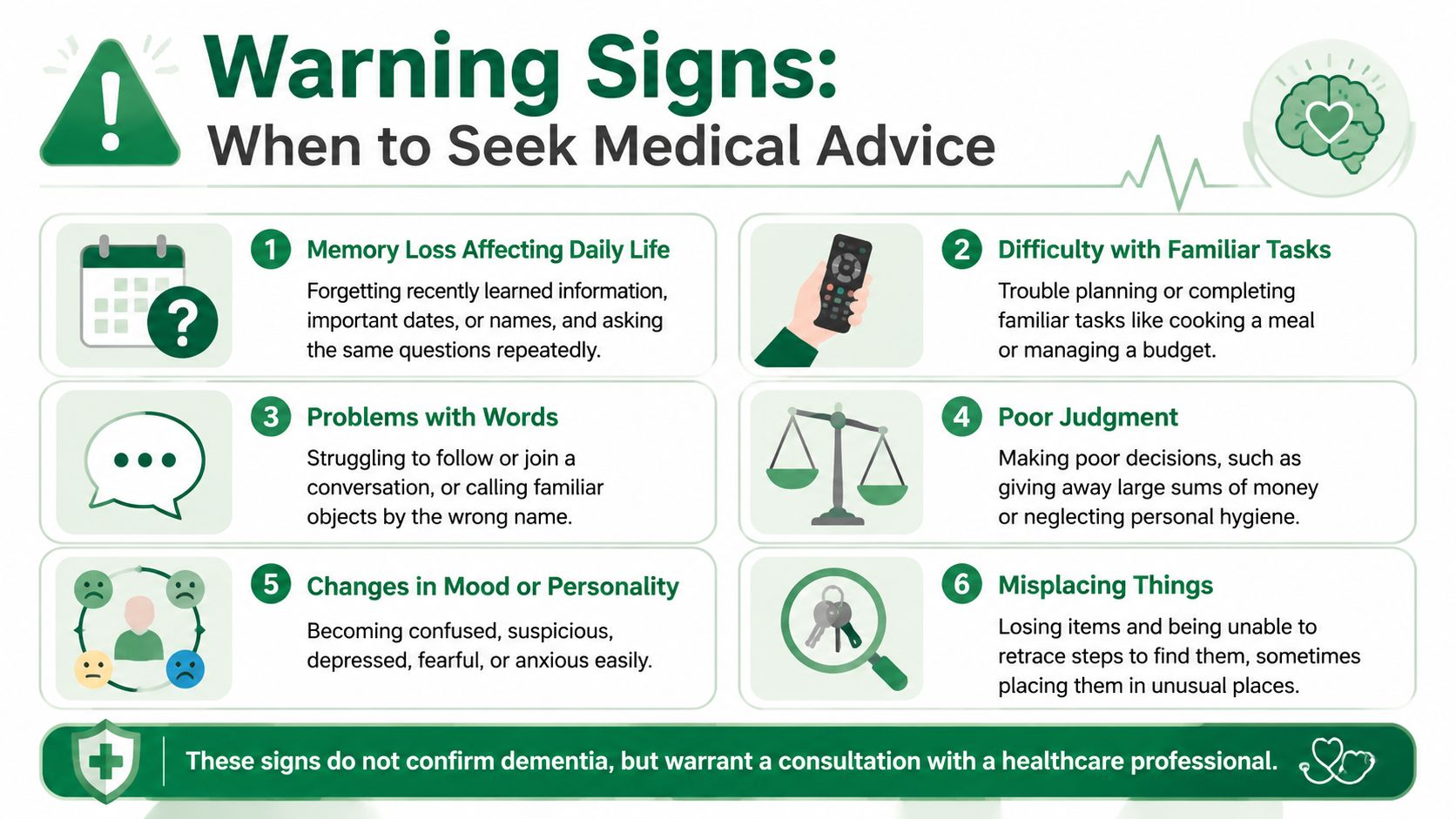
Watch for patterns like these:
Memory changes that affect daily life. Repeating questions, forgetting recent events, or missing important appointments.
Difficulty with familiar tasks. Trouble handling meals, bills, medication, or routine household steps.
Language problems. Losing track of words, following conversation less easily, or using incorrect names for common objects.
Poor judgment. Unsafe driving choices, financial mistakes, or neglect of hygiene.
Mood or personality changes. New suspicion, apathy, fearfulness, irritability, or social withdrawal.
Misplacing items in unusual places. Putting keys in the freezer or accusing others because the person can't retrace their steps.
What to expect at the appointment
A proper evaluation usually includes more than one question about memory. Clinicians may ask about symptom timing, daily function, medications, mood, sleep, falls, and changes others have noticed. They may use cognitive testing, lab work, brain imaging, or referrals to specialists depending on the situation.
Bring examples. “She forgot my name once” is less helpful than “She asked the same question four times during one dinner and then got lost walking back from the bathroom in a familiar restaurant.”
Support should start early, not late
Families often wait for a crisis before building support. That usually makes caregiving harder. The better time is when the person can still participate, respond to routine, and benefit from repeated structure.
If you're evaluating support options, this guide on how to evaluate a memory loss support program like Hey Velma can help you think through what quality, fit, and safety should look like.
The practical takeaway is simple. Alzheimer's disease vs dementia isn't just a wording issue. It affects how you interpret symptoms, how you communicate, and how you plan effective care.
If your family is supporting an older adult with early to mid-stage memory loss, Hey Velma offers phone-based cognitive support through scheduled calls, structured conversation, orientation cues, and care manager coordination. It's designed to complement medical care and in-person caregiving while helping families keep closer track of day-to-day changes.
You may be here because your mom keeps repeating the same story, your dad got lost on a familiar drive, or a doctor used two words that sounded interchangeable but didn't feel interchangeable at all: dementia and Alzheimer's.
That confusion is common. Families often hear, “It looks like dementia,” and then later, “It may be Alzheimer's disease,” and wonder whether those are two names for the same thing. They aren't. One is the broad category. The other is one specific disease within that category.
If you're trying to make sense of symptoms, medical visits, and day-to-day care, it helps to view Alzheimer's disease vs dementia through a caregiving lens. The label matters because it can change how you communicate, what safety issues you watch for, and what kind of support suits the person in front of you.
Table of Contents
The Question Every Family Asks
Why families get stuck on the wording
Understanding Dementia The Umbrella Term
What sits under the umbrella
Why this matters in real care
Defining Alzheimer's The Specific Disease
What Alzheimer's often looks like early on
Why diagnosis is more than memory complaints
A Side by Side Comparison of Common Dementias
Dementia types at a glance
The symptom patterns that change caregiving
Why “mixed” pictures are common in practice
How Symptoms and Progression Differ in Daily Life
Different conditions create different daily pressures
Why progression matters for planning
What the same symptom can mean in different conditions
From Knowledge to Action A Caregiver's Next Steps
Match the support to the symptom pattern
Communication changes care more than families expect
If you don't know the subtype yet
When to See a Doctor and How to Find Support
Signs that deserve medical attention
What to expect at the appointment
Support should start early, not late
The Question Every Family Asks
A daughter notices that her mother forgot a recent lunch date, then forgot it again the next week. A spouse sees that his partner can still tell detailed stories from long ago but can't keep track of what day it is. Someone in the family says, “I think it's dementia.” Another says, “Isn't that Alzheimer's?”
Both reactions make sense.
Dementia is the general term for a decline in memory, thinking, and everyday function that's serious enough to affect daily life. Alzheimer's disease is the most common specific cause of that decline. According to the World Health Organization's dementia fact sheet, over 55 million people worldwide are living with dementia, and Alzheimer's accounts for approximately 60% to 80% of all dementia cases.
That means two things can be true at once. Your loved one can have dementia, and the underlying disease causing it may be Alzheimer's. Or the underlying cause may be something else.
Why families get stuck on the wording
The terms are often used loosely in everyday conversation. Doctors, relatives, and friends may use them as if they mean the same thing. But for caregiving, the distinction matters. If you assume every dementia works like Alzheimer's, you may miss signs that call for a different approach.
A practical starting point is to stop asking only, “Do they have dementia?” and start asking, “What kind of dementia, or what pattern of symptoms, are we dealing with?” Families who are just beginning this process often benefit from simple basic recommendations for memory loss support at home.
The diagnosis label matters less than your loved one's actual symptom pattern. But when the subtype is known, care usually gets more precise.
Understanding Dementia The Umbrella Term
Think of dementia the way you'd think of “fever.” Fever tells you something is wrong, but it doesn't tell you why. Dementia works similarly. It describes a syndrome, not a single disease.
That syndrome can affect memory, language, judgment, orientation, behavior, and the ability to handle daily tasks like paying bills, taking medication, cooking, or following a routine. Some people mainly struggle with recent memory. Others show personality changes first. Others become disorganized or visually confused before memory loss becomes obvious.
What sits under the umbrella
Several conditions can cause dementia. The most commonly discussed include:
Alzheimer's disease. Often starts with trouble forming or retrieving recent memories.
Vascular dementia. Related to blood flow problems in the brain.
Lewy body dementia. Can involve attention changes, visual misperceptions, movement symptoms, and fluctuating thinking.
Frontotemporal dementia. Often shows up first as behavior, personality, or language changes.
Mixed dementia. More than one brain process may be present at the same time.
Some families feel relieved when they finally hear the word dementia because it names what they've been seeing. Others feel frightened because the term sounds final. In practice, it's a starting point.
Why this matters in real care
If you only hear “dementia,” you might default to generic strategies such as reminders, labels, and repetition. Those can help, but they don't fit every person in the same way.
For example:
A person with memory-led symptoms may respond well to simple cueing and routine reinforcement.
A person with behavioral or language-led symptoms may need fewer corrections and more environmental structure.
A person with fluctuating confusion may need flexibility more than strict expectations.
Caregiving rule: Dementia tells you there is cognitive decline. It doesn't tell you the best day-to-day approach until you understand the pattern underneath it.
Defining Alzheimer's The Specific Disease
Alzheimer's disease is a specific brain disease, not a catchall word for serious forgetfulness. It's the most common specific cause of dementia, but it isn't the only one.
In plain language, Alzheimer's affects the brain's communication system. Two hallmark changes are commonly described: beta-amyloid plaques and tau tangles. If that sounds technical, a simple image helps. Plaques are like sticky roadblocks between brain cells. Tangles are like twisted wiring inside the cells. Over time, those changes disrupt how brain cells communicate and function.
What Alzheimer's often looks like early on
The classic early pattern is episodic memory impairment. That means trouble with recent events and newly learned information. A person may forget a conversation from yesterday, repeat a question, misplace items, or rely more heavily on notes than they used to.
Alzheimer's disease is also associated with secondary problems in word-finding and spatial cognition. Families may notice pauses in speech, trouble naming familiar objects, or growing confusion in parking lots, grocery stores, or complex rooms.
Why diagnosis is more than memory complaints
Not every older adult with memory loss has Alzheimer's. And not every person with dementia starts with memory symptoms. That's why clinicians look for a pattern, not one isolated problem.
A technical distinction also matters. Amyloid findings alone aren't enough to confirm Alzheimer's disease. The diagnosis requires evidence that the disease process is tied to actual neurodegeneration and brain dysfunction, not just the presence of abnormal protein. In specialist care, doctors may use tools such as PET imaging, cerebrospinal fluid testing, or functional brain imaging to clarify the picture.
When a family says, “It looks like Alzheimer's,” they may be right. But the right question in clinic is, “What evidence supports Alzheimer's rather than another dementia or a mixed picture?”
For caregiving, that difference changes expectations. Alzheimer's often starts as a memory-centered condition. Other dementias may start somewhere else entirely.
A Side by Side Comparison of Common Dementias
When families search for Alzheimer's disease vs dementia, they usually want a simple answer. The more useful answer is a comparison. Dementia is the broad category. Under that umbrella, different diseases create different early clues, different risks, and different care needs.
Dementia types at a glance
Feature | Alzheimer's Disease | Vascular Dementia | Lewy Body Dementia (LBD) | Frontotemporal Dementia (FTD) |
|---|---|---|---|---|
What it is | A specific neurodegenerative disease | Dementia related to blood flow problems in the brain | A dementia syndrome associated with Lewy body pathology | A group of disorders affecting frontal and temporal brain regions |
Early pattern | Early, prominent episodic memory impairment with later word-finding and spatial difficulty | Often more difficulty with planning, organization, or thinking speed early on | Often attention, visuospatial problems, fluctuations, and other non-memory changes early | Often behavior, personality, judgment, or language changes early |
What families may notice first | Repeated questions, forgotten appointments, lost items | Trouble managing steps, finances, medications, or recovering after stroke-related changes | A loved one who seems clear at one time and much more confused at another | “This doesn't feel like the same person” because of apathy, impulsivity, or social changes |
Course over time | Often progressive over years, commonly described as a steady decline | Can appear more stepwise, especially after vascular events | May feel uneven or variable day to day | May center more on behavior or language before memory becomes the main issue |
Care focus | Memory cueing, routine, orientation support, safety monitoring | Structure, task simplification, medical follow-up around vascular risk, functional support | Calm communication, safety, observation of changing alertness, mobility awareness | Behavior management, routine consistency, redirection, caregiver coaching |
The clearest symptom difference in early stages is this: Alzheimer's usually starts with memory. Other dementias often start with something else.
The symptom patterns that change caregiving
The verified clinical distinction is important here. Alzheimer's disease is characterized by early, prominent episodic memory impairment and secondary deficits in word-finding and spatial cognition, whereas other dementias often present with early executive dysfunction, visuospatial deficits, or behavioral changes.
That sentence may sound clinical, so here's what it means at home:
Executive dysfunction means your loved one may know what they want to do but can't sequence the steps.
Visuospatial deficits mean clutter, shadows, stairs, or patterned floors may become more confusing.
Behavioral changes mean the first clue may be apathy, poor judgment, loss of empathy, or socially unusual behavior rather than forgetting names.
A person who forgets recent conversations may need cueing. A person who can't organize the steps of making tea may need task breakdown. A person whose behavior changes early may need supervision before they need memory reminders.
Why “mixed” pictures are common in practice
Real life isn't always tidy. Some older adults show features that overlap. A family may see memory problems, changing mood, and occasional visual confusion all at once. That doesn't mean the observations are wrong. It means the brain may not fit a clean textbook category.
This is why a good diagnosis helps, but careful observation helps too. Keep noting what happens, when it happens, and what makes it better or worse. That record often gives clinicians a better view than one office visit can.
How Symptoms and Progression Differ in Daily Life
A diagnosis affects more than a chart. It changes breakfast, phone calls, car keys, medication routines, and how you answer the same question for the sixth time.
With Alzheimer's disease, many families first notice a slow drift. A parent repeats stories, forgets plans that were made yesterday, or becomes less confident in new places. The change can feel subtle at first, which is one reason families sometimes wait before getting help.
With vascular dementia, the story may feel less gradual. A person can seem fairly stable, then show a more noticeable drop in planning, attention, or function after a stroke or another vascular event. Families often describe this as a “step down,” not just ordinary forgetting.
Different conditions create different daily pressures
In frontotemporal dementia, the hardest part may not be memory at all. A spouse might say, “He remembers plenty, but his judgment is off,” or “She says things she never would have said before.” That can look like depression, conflict, stubbornness, or personality change unless someone recognizes the neurological pattern.
In Lewy body dementia, the challenge may be inconsistency. The person you speak with in the morning may sound far more organized than the same person in the evening. That unpredictability can leave families doubting their own observations.
Why progression matters for planning
Alzheimer's has become a major public health burden. According to BrightFocus Alzheimer's facts and figures, deaths attributed to Alzheimer's disease increased by 145% between 2000 and 2019, while deaths from heart disease decreased by 7%. The same source notes that the lifetime cost of care for a single person with dementia is estimated at $405,262 in 2024 dollars.
Those numbers matter because families often underestimate how long support may be needed and how much coordination daily care can require.
What the same symptom can mean in different conditions
A missed medication doesn't always come from the same problem.
In Alzheimer's, the person may not remember the medication was due.
In vascular dementia, they may have trouble organizing the sequence of the task.
In frontotemporal dementia, they may resist the routine or show poor judgment about why it matters.
In Lewy body dementia, they may be more capable at one time of day than another.
When caregivers understand the “why” behind a symptom, they usually stop taking the behavior personally and start matching the support to the problem.
That shift alone can reduce conflict. It turns “Why are you being difficult?” into “What kind of help fits this brain change?”
From Knowledge to Action A Caregiver's Next Steps
Many families still don't know the subtype they're dealing with. A 2024 review found that 72% of adult children caregivers could not identify their parent's dementia subtype, and 68% said their care plan was not adjusted accordingly. That gap matters because generic support often misses the underlying problem.
Match the support to the symptom pattern
Start with the pattern you see, even if the diagnosis is still being clarified.
When memory is the main issue. Use short reminders, visible calendars, simple routines, and one-step cueing. Avoid giving five instructions at once.
When planning is the main issue. Break tasks into smaller parts. Lay out the toothbrush, toothpaste, and cup instead of saying, “Go get ready for bed.”
When behavior changes are leading. Reduce power struggles. Shorten explanations. Focus on routine, supervision, and environmental structure.
When confusion varies across the day. Schedule harder tasks for the person's better times. Keep expectations flexible.
Communication changes care more than families expect
The most common mistake I see is correcting too much. Families say, “No, Mom, that's not what happened,” or “Dad, I told you already.” The intention is understandable. The result is often more distress.
Try these swaps instead:
Instead of testing memory, offer support. “Your appointment is after lunch. I'll remind you again.”
Instead of arguing about accuracy, respond to emotion. “You seem worried. Let's sort this out together.”
Instead of open-ended demands, give a concrete next step. “Let's put on your shoes.”
A more detailed explanation of how structured daily support works can help families think through what kind of help fits best. This family guide to how Hey Velma works for daily cognitive support offers one example of that type of support model.
The best care plan isn't the most complicated one. It's the one that matches the person's actual cognitive pattern and can be repeated consistently.
If you don't know the subtype yet
You can still act. Track what happens over several days.
Notice:
Time pattern. Is confusion worse in the evening, or does it fluctuate unpredictably?
Task pattern. Is the person forgetting information, or struggling to organize steps?
Behavior pattern. Are mood, judgment, or social behavior changing before memory becomes severe?
That kind of observation helps both families and clinicians make better decisions.
When to See a Doctor and How to Find Support
Some changes are easy to dismiss at first. Everyone forgets things sometimes. Everyone has off days. The concern rises when the changes begin to affect daily function, safety, communication, or judgment.
A medical evaluation matters because not every cognitive change means irreversible decline. The 2025 WHO Global Dementia Report highlights that 15% to 30% of patients can experience fluctuating or reversible cognitive symptoms due to manageable comorbidities such as depression, sleep disorders, or nutritional deficiencies.
Signs that deserve medical attention
Watch for patterns like these:
Memory changes that affect daily life. Repeating questions, forgetting recent events, or missing important appointments.
Difficulty with familiar tasks. Trouble handling meals, bills, medication, or routine household steps.
Language problems. Losing track of words, following conversation less easily, or using incorrect names for common objects.
Poor judgment. Unsafe driving choices, financial mistakes, or neglect of hygiene.
Mood or personality changes. New suspicion, apathy, fearfulness, irritability, or social withdrawal.
Misplacing items in unusual places. Putting keys in the freezer or accusing others because the person can't retrace their steps.
What to expect at the appointment
A proper evaluation usually includes more than one question about memory. Clinicians may ask about symptom timing, daily function, medications, mood, sleep, falls, and changes others have noticed. They may use cognitive testing, lab work, brain imaging, or referrals to specialists depending on the situation.
Bring examples. “She forgot my name once” is less helpful than “She asked the same question four times during one dinner and then got lost walking back from the bathroom in a familiar restaurant.”
Support should start early, not late
Families often wait for a crisis before building support. That usually makes caregiving harder. The better time is when the person can still participate, respond to routine, and benefit from repeated structure.
If you're evaluating support options, this guide on how to evaluate a memory loss support program like Hey Velma can help you think through what quality, fit, and safety should look like.
The practical takeaway is simple. Alzheimer's disease vs dementia isn't just a wording issue. It affects how you interpret symptoms, how you communicate, and how you plan effective care.
If your family is supporting an older adult with early to mid-stage memory loss, Hey Velma offers phone-based cognitive support through scheduled calls, structured conversation, orientation cues, and care manager coordination. It's designed to complement medical care and in-person caregiving while helping families keep closer track of day-to-day changes.
Suggested Article: