What Is Cognitive Stimulation Therapy

You may be watching a parent repeat the same question three times in one morning. Or maybe your spouse still recognizes you, still jokes with you, but gets stuck mid-sentence and looks embarrassed. In those moments, families often feel trapped between two bad options: wait and worry, or chase treatments that sound complicated and out of reach.
There's a middle path.
Cognitive Stimulation Therapy, usually called CST, is a structured, non-drug approach used for people with mild to moderate dementia. It doesn't promise a cure. It does offer something many families need right now: a practical way to support thinking, conversation, mood, and connection.
What makes CST so reassuring is that it isn't built around drilling someone on facts or correcting every mistake. It's built around engagement. Talking about familiar topics. Playing with language. Sharing opinions. Using music, memory, attention, and social interaction in a way that feels human rather than clinical.
For many caregivers, that changes the question from “How do I stop this?” to “How do I help today?”
That's the question this article answers. You'll get a plain-language definition of what CST is, what the research says, how it's usually delivered, how it compares with other dementia therapies, and how families can bring CST principles into home-based support when getting to a group program isn't realistic.
Table of Contents
An Introduction to Cognitive Stimulation Therapy for Caregivers
What caregivers usually notice first
Why this feels so different from ordinary caregiving
Defining Cognitive Stimulation Therapy
A simple way to understand CST
What CST is and what it isn't
The Proven Benefits of CST for Dementia
What the evidence means in daily life
Why mood and communication matter so much
How Cognitive Stimulation Therapy Works in Practice
The traditional group model
Why home delivery matters
CST Compared to Other Dementia Interventions
Dementia intervention comparison
How to use this comparison in real life
Is CST Right for My Loved One and How Do We Start
Who tends to benefit most
Practical first steps for families
Frequently Asked Questions About CST
Common concerns families raise
An Introduction to Cognitive Stimulation Therapy for Caregivers
A lot of caregivers tell me the hardest part isn't only the memory loss. It's the feeling that everyday life has become fragile. A normal conversation can suddenly go off track. A simple phone call becomes confusing. An outing feels like too much work to organize.
That's where CST often comes in as a relief.
Instead of waiting for decline and reacting to each new problem, CST gives families a way to actively support the person's mind through regular, guided engagement. It was developed in the United Kingdom in the early 2000s by Dr. Aimee Spector and her research team as a non-pharmacological, evidence-based intervention for mild to moderate dementia. NICE later recommended CST in its dementia guidance as a core psychosocial intervention, based on the evidence summarized in the Cochrane review on Cognitive Stimulation Therapy.
What caregivers usually notice first
Families don't usually start by asking, “What is cognitive stimulation therapy?” They ask questions like these:
“How do I keep Mom engaged without turning every visit into a test?”
“What can I do when Dad is withdrawing from conversation?”
“Is there anything helpful besides medication?”
CST speaks directly to those worries because it uses structured activities that are meant to be enjoyable, social, and manageable.
Practical rule: If an activity feels like an exam, it's probably drifting away from the spirit of CST.
A good CST-style interaction might involve talking about a song from earlier life, naming items in a category, discussing a current event in simple terms, or sharing opinions about food, weather, or family routines. The point isn't to catch mistakes. The point is to wake up different parts of thinking in a supportive setting.
Why this feels so different from ordinary caregiving
Many caregivers already do pieces of this without realizing it. You prompt. You redirect. You reminisce. You try to draw your loved one back into the moment.
CST takes those instincts and gives them shape. It turns scattered efforts into a more consistent approach. That structure matters, especially when the days feel repetitive and families need a reliable way to create connection.
Defining Cognitive Stimulation Therapy
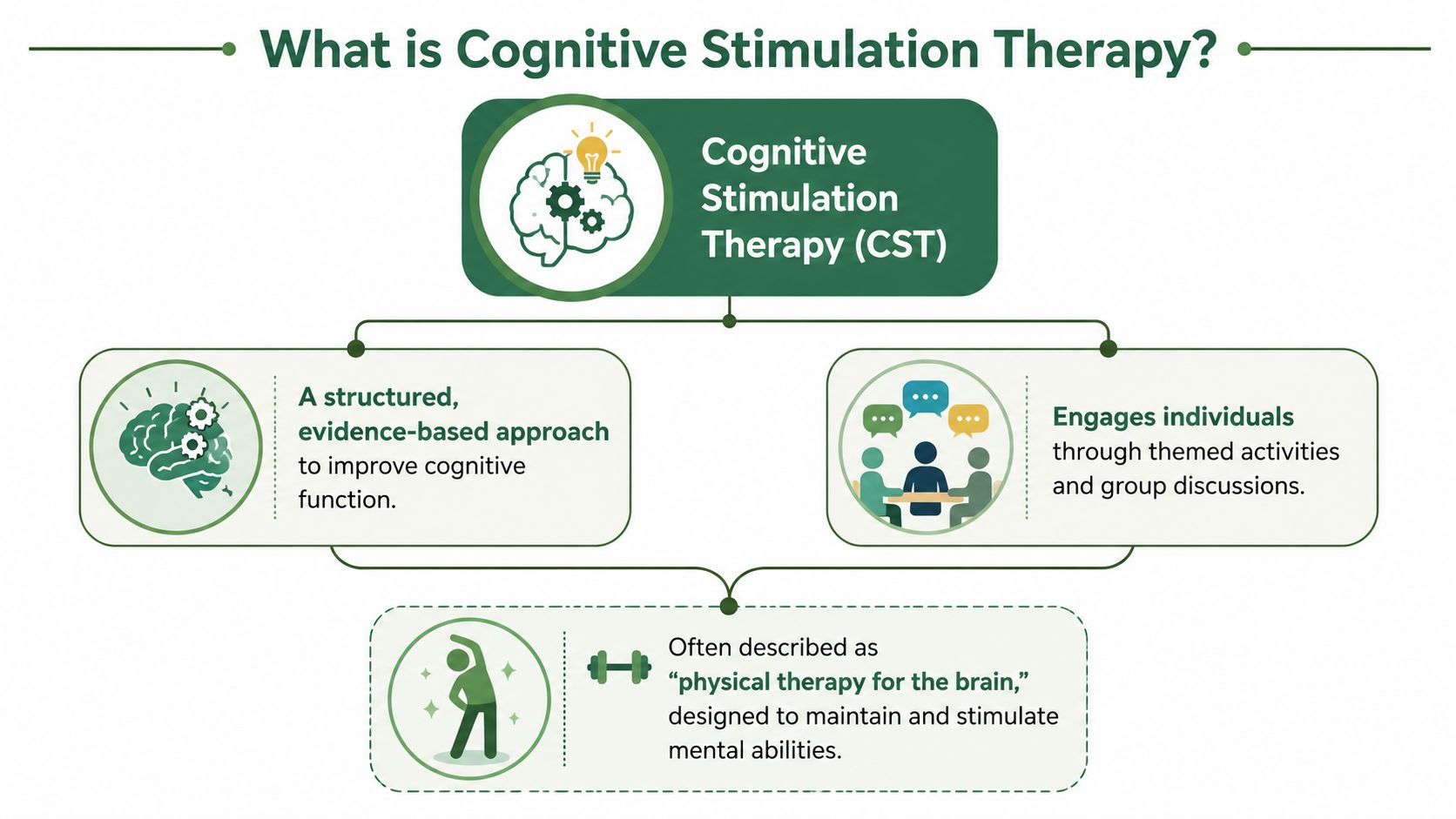
When families ask what is cognitive stimulation therapy, I usually start with this: it's a bit like physical therapy for the brain.
That analogy isn't perfect, but it helps. Physical therapy doesn't cure every underlying condition. It works by using guided, repeated activity to support strength, movement, and function. CST follows a similar idea for cognition. It uses conversation, memory prompts, language tasks, attention exercises, music, and themed discussion to stimulate the mind in a structured way.
A simple way to understand CST
CST is a structured, evidence-based, non-drug therapy for people living with mild to moderate dementia. In its classic form, it uses themed sessions that encourage the person to think, communicate, and participate socially.
The activities are varied on purpose. One session might involve word games. Another might focus on current events, childhood memories, music, food, or familiar objects. This variety matters because dementia doesn't affect only one skill. It can touch memory, language, attention, confidence, and social comfort all at once.
Researchers describe the therapy as grounded in cerebral plasticity, the idea that the brain can still respond to targeted engagement despite disease. Clinical benchmarks show CST improves MMSE scores, and that cognitive gain is described as comparable to first-generation acetylcholinesterase inhibitors, but without pharmacological adverse effects in the verified summary provided in Fact 3.
What CST is and what it isn't
CST is often misunderstood because the name sounds technical. In practice, it's much more approachable than people expect.
Here's what CST is:
Structured: Sessions follow a clear plan rather than random activities.
Engaging: The tone is meant to be warm, respectful, and enjoyable.
Multidomain: It stimulates memory, language, attention, reasoning, and social interaction.
Supportive: It aims to build confidence, not expose deficits.
Here's what CST isn't:
Not a cure: It supports function and quality of life, but it doesn't reverse dementia.
Not a memory quiz: The person isn't being graded.
Not constant correction: Arguing over wrong answers usually undermines the experience.
Not only for clinics: The principles can be adapted for home-based care when done thoughtfully.
A good CST session should feel more like meaningful conversation with purpose than formal testing with pressure.
That's why families often find CST easier to embrace than they expected. It uses ordinary human tools, talking, listening, noticing interests, choosing familiar themes, but applies them in a deliberate, therapeutic way.
The Proven Benefits of CST for Dementia
The strongest reason CST has become so important in dementia care is simple. It has evidence behind it.
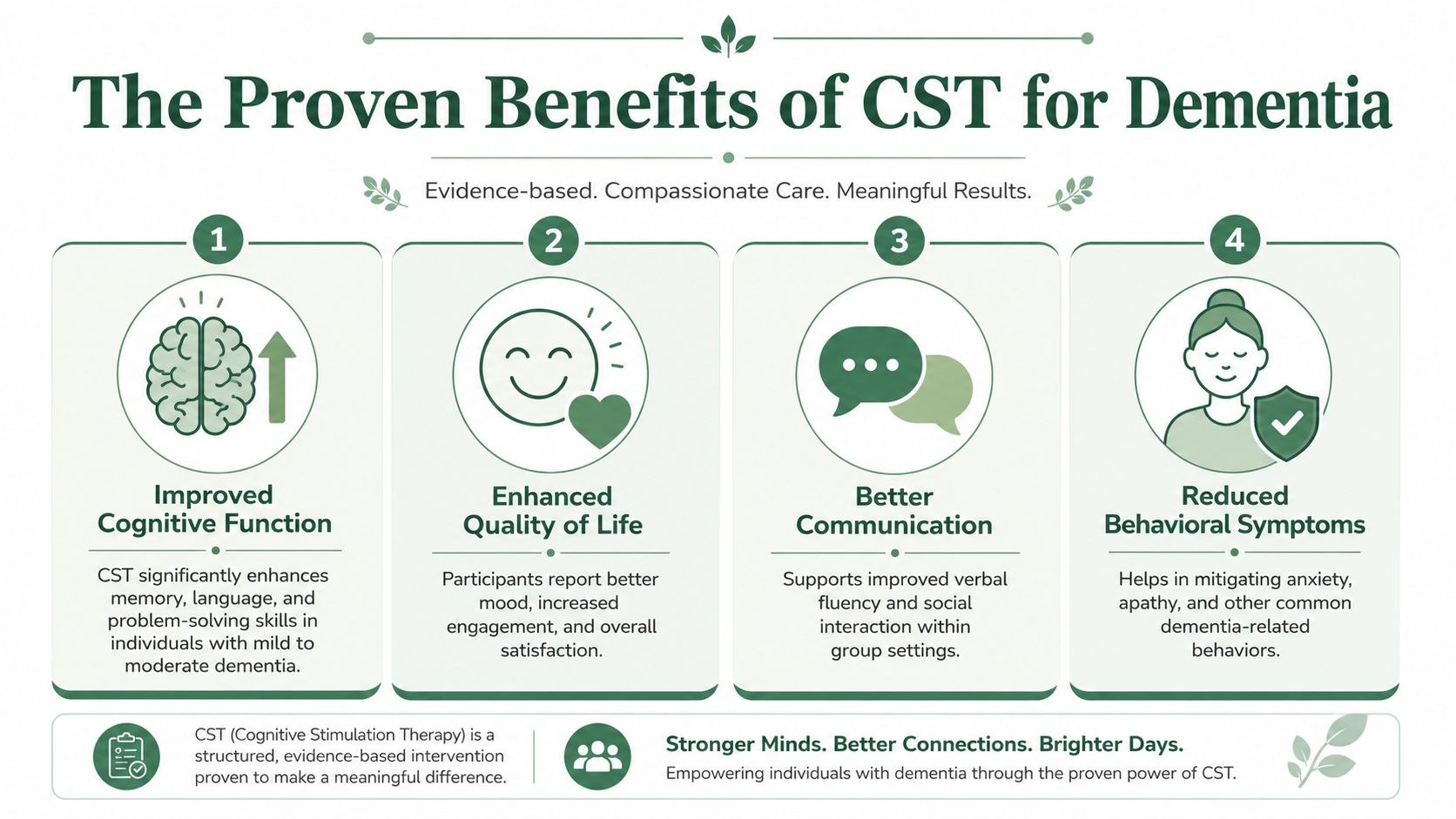
A landmark Cochrane review, updated in 2023, consolidated data from 25 studies involving 1,893 participants and found that CST produced a 1.99-point improvement on the Mini-Mental State Examination compared with control groups. The review reports this as a clinically important benefit, with a standardized mean difference of 0.40, and researchers equate that to about a six-month delay in expected cognitive decline for mild to moderate dementia. The same review also found high-quality evidence for improved communication and social interaction with an SMD of 0.53. These findings are summarized in the Cochrane evidence review of CST.
What the evidence means in daily life
Numbers matter, but families usually need translation.
A clinically meaningful shift in cognition may show up as better participation in conversation, improved attention during a meal, more willingness to engage, or less frustration when trying to find words. It may not look dramatic from one day to the next. Often it looks like preserving function and connection for longer.
That matters because dementia affects much more than recall. It can chip away at confidence. A person may stop speaking up because they're afraid of getting something wrong. They may withdraw because social situations feel harder to manage.
CST addresses that by combining mental stimulation with social interaction. The person isn't left alone with a worksheet. They're invited into a shared activity.
Why mood and communication matter so much
Families often focus first on memory. That's understandable, but mood and communication may shape day-to-day life even more.
Verified evidence on CST notes improvements in communication and social interaction, along with benefits in self-reported mood and daily function in areas such as activities for independent living, as summarized in the earlier linked Cochrane review. Other verified background in your source set also describes CST as helping reduce depressive symptoms through a nonthreatening group structure and routines that support belonging and self-worth.
When a person can join a conversation more easily, the whole household usually feels the difference.
This is one reason CST can feel so hopeful. It doesn't focus only on what the person has lost. It works with what's still there: habits, preferences, emotional memory, language fragments, humor, rhythm, curiosity, and the human need for company.
For caregivers, that can turn visits from task management into real interaction again.
How Cognitive Stimulation Therapy Works in Practice
In its traditional form, CST is highly structured. The standard program consists of 14 group sessions over seven weeks, usually held twice weekly, with sessions lasting about 45 to 60 minutes according to the verified protocol summary in Fact 2. Themes may include childhood, current affairs, music, food, or word-based activities.
That structure is one reason CST works well in formal settings. Staff can deliver a repeatable program, and participants benefit from rhythm, familiarity, and group energy.
The traditional group model
A classic CST group isn't a lecture. It's interactive. Participants may begin with a welcome routine, move into a warm-up activity, and then spend time on a theme that invites memory, language, and opinion.
Several features make the group format therapeutic:
Shared participation: People can respond to each other, not only to the facilitator.
Predictable rhythm: Repetition lowers anxiety.
Enjoyable challenge: Activities are stimulating without being harsh.
Social reinforcement: Even quiet participants often benefit from listening and joining when ready.
For some families, this model is ideal. If your loved one can travel comfortably, tolerate a group, and attend regularly, formal CST is worth asking about through local dementia services, memory clinics, or aging agencies.
Why home delivery matters
The problem is access. Even when families like the idea of CST, daily life gets in the way. Transportation is hard. Group schedules conflict with medical appointments. Some people become anxious in unfamiliar places. Others live alone or far from a program.
A large iCST trial involving 180 care dyads found that 40% of participants in the iCST group completed the requirement of at least two sessions per week, while 22% completed no sessions at all. The study did not find significant primary outcomes for cognition or quality of life versus treatment as usual at the midpoint, but it did provide preliminary evidence that participation improved the caregiving relationship and caregiver quality of life, as summarized in the verified iCST trial fact.
That tells us something important. The idea of individual CST is valuable, but consistency is hard when families are expected to carry the whole structure themselves.
Phone-based delivery becomes practical. A scheduled call removes travel, reduces technology barriers, and makes one-to-one engagement possible for people who won't attend a group or can't get there reliably. During a call, a trained support person can use CST-style prompts such as orientation to time and place, reminiscence, category exercises, language tasks, and conversation anchored in the person's history and interests.
The model is easier to picture when you see an example of structured phone-based cognitive support in use:
For families considering that route, Hey Velma's family guide to daily cognitive support shows one example of how scheduled phone calls can combine conversation, cognitive exercises, and routine check-ins at home.
The best delivery model is the one your loved one can actually receive consistently.
CST Compared to Other Dementia Interventions
Families often hear several therapy names at once and assume they're interchangeable. They aren't.
CST has its own purpose. It overlaps with other non-drug approaches, but it isn't the same as reminiscence therapy, cognitive rehabilitation, or reality orientation. Knowing the difference helps you ask better questions and choose support that matches the person's needs.
Dementia intervention comparison
Intervention | Primary Goal | Example Activities | Format |
|---|---|---|---|
Cognitive Stimulation Therapy | Support general cognitive function, communication, and engagement through structured stimulation | Themed discussion, word games, music, opinion sharing, orientation, category tasks | Often group-based, but principles can be adapted for individual or home-based use |
Reminiscence Therapy | Encourage recall and identity through past experiences | Looking at old photos, discussing family milestones, familiar music, meaningful objects | Individual or group |
Cognitive Rehabilitation | Address specific functional goals and daily challenges | Memory aids, routines, compensatory strategies, task-focused practice | Usually individualized with a therapist |
Reality Orientation | Reinforce awareness of time, place, and person | Calendars, clocks, repeated cues, discussion of date and location | Often integrated into daily care |
How to use this comparison in real life
A simple way to think about it is this:
Choose CST when you want broad, structured cognitive and social engagement.
Choose reminiscence when personal memories and identity-based conversation open the person up.
Choose cognitive rehabilitation when there's a practical target, such as following a routine or using reminders.
Use reality orientation carefully when the person benefits from gentle grounding in the present.
Many families use more than one of these approaches together. A home session might include reminiscence through old songs, CST-style language prompts, and a little orientation work at the start.
If you're weighing formal programs or newer support services, this guide on how to evaluate a memory loss support program can help you look past labels and focus on structure, safety, fit, and consistency.
The key is not finding the one perfect intervention. It's matching the support to the person in front of you.
Is CST Right for My Loved One and How Do We Start
CST is usually considered a good fit for people in the mild to moderate stages of dementia. That doesn't mean everyone at that stage will want the same format. One person may enjoy a group. Another may do better with a calm one-to-one phone call at the same time each day.
If you're unsure, start by looking at how your loved one responds to conversation and guided activity right now. Can they participate for a short period? Do familiar topics spark engagement? Do they become less anxious when interaction is warm and predictable? Those are encouraging signs.
Who tends to benefit most
CST often makes sense for someone who:
Can still engage in simple conversation: They may forget details, but they can participate with support.
Gets isolated at home: They need structured interaction, not only supervision.
Withdraws after mistakes: A low-pressure format may help them re-enter conversation.
Can't easily access in-person groups: Transportation or logistics are blocking care.
A projected 2025 report in your verified data notes that 40% of caregivers cite transportation and group access as the primary barrier to non-pharmacological interventions, which is why home-based and telephonic options are drawing attention in dementia care planning, according to Fact 5.
If getting to the therapy is the biggest barrier, changing the delivery model may matter more than changing the therapy itself.
Practical first steps for families
You don't need to solve everything in one week. Start with a short decision process.
Ask the clinician a direct question
Say, “My family member has mild to moderate dementia. Would Cognitive Stimulation Therapy be appropriate, and where is it offered locally?”Look for formal CST groups
Memory clinics, geriatric services, community aging organizations, and dementia charities sometimes offer structured programs or know who does.Test the principles at home
Choose one short, pleasant activity at a regular time. Try a music discussion, naming game, current-events chat in simple language, or conversation around familiar objects.Keep the tone therapeutic
Don't push for perfect answers. Follow interest, validate effort, and shift topics before frustration builds.Consider structured remote support if access is limited
For families who need a home-based option, Hey Velma's overview of phone-based cognitive support describes a model built around scheduled calls for older adults with early memory loss.
What matters most is consistency. A short, repeatable routine usually works better than occasional ambitious sessions that leave everyone exhausted.
Frequently Asked Questions About CST
Common concerns families raise
Is CST a cure for dementia?
No. CST is a supportive therapy. It aims to maintain or improve aspects of cognition, communication, mood, and engagement. Families often value it because it gives them something constructive to do, even though it doesn't reverse the disease.
Can we do CST at home ourselves?
You can absolutely use CST principles at home. Many families already do pieces of it through conversation, music, reminiscence, and orientation prompts. The challenge is consistency. Over time, caregiving fatigue, scheduling pressure, and the emotional strain of repetition can make structured delivery hard to sustain.
Does one-to-one or telephonic support make sense?
For some families, yes. Group CST remains the classic model, but home-based support can fit better when a person lives alone, dislikes groups, or can't travel reliably.
Is it worth the cost and effort over time?
Your verified data includes recent cohort findings stating that individual telephonic CST can reduce emergency visits by 15% to 20% and lower caregiver distress scores by 25% over 18 months, offering strong long-term value despite higher per-session costs, according to Fact 6. For families, that matters because the burden of dementia care isn't only what happens during a session. It's what happens between sessions, during lonely afternoons, missed routines, rising anxiety, and constant uncertainty.
How do I know if a program follows CST principles well?
Look for structure, trained staff, repeatable routines, activities matched to ability, and a respectful tone. Good programs don't rely on trivia pressure or constant correction. They create engagement that feels manageable and purposeful.
If you're looking for a home-based option grounded in cognitive stimulation principles, Hey Velma offers scheduled phone calls for older adults with early to mid-stage memory loss. The program combines guided conversation, cognitive exercises, emotional support, and practical check-ins, which can help families extend structured engagement into everyday life when in-person groups aren't feasible.
You may be watching a parent repeat the same question three times in one morning. Or maybe your spouse still recognizes you, still jokes with you, but gets stuck mid-sentence and looks embarrassed. In those moments, families often feel trapped between two bad options: wait and worry, or chase treatments that sound complicated and out of reach.
There's a middle path.
Cognitive Stimulation Therapy, usually called CST, is a structured, non-drug approach used for people with mild to moderate dementia. It doesn't promise a cure. It does offer something many families need right now: a practical way to support thinking, conversation, mood, and connection.
What makes CST so reassuring is that it isn't built around drilling someone on facts or correcting every mistake. It's built around engagement. Talking about familiar topics. Playing with language. Sharing opinions. Using music, memory, attention, and social interaction in a way that feels human rather than clinical.
For many caregivers, that changes the question from “How do I stop this?” to “How do I help today?”
That's the question this article answers. You'll get a plain-language definition of what CST is, what the research says, how it's usually delivered, how it compares with other dementia therapies, and how families can bring CST principles into home-based support when getting to a group program isn't realistic.
Table of Contents
An Introduction to Cognitive Stimulation Therapy for Caregivers
What caregivers usually notice first
Why this feels so different from ordinary caregiving
Defining Cognitive Stimulation Therapy
A simple way to understand CST
What CST is and what it isn't
The Proven Benefits of CST for Dementia
What the evidence means in daily life
Why mood and communication matter so much
How Cognitive Stimulation Therapy Works in Practice
The traditional group model
Why home delivery matters
CST Compared to Other Dementia Interventions
Dementia intervention comparison
How to use this comparison in real life
Is CST Right for My Loved One and How Do We Start
Who tends to benefit most
Practical first steps for families
Frequently Asked Questions About CST
Common concerns families raise
An Introduction to Cognitive Stimulation Therapy for Caregivers
A lot of caregivers tell me the hardest part isn't only the memory loss. It's the feeling that everyday life has become fragile. A normal conversation can suddenly go off track. A simple phone call becomes confusing. An outing feels like too much work to organize.
That's where CST often comes in as a relief.
Instead of waiting for decline and reacting to each new problem, CST gives families a way to actively support the person's mind through regular, guided engagement. It was developed in the United Kingdom in the early 2000s by Dr. Aimee Spector and her research team as a non-pharmacological, evidence-based intervention for mild to moderate dementia. NICE later recommended CST in its dementia guidance as a core psychosocial intervention, based on the evidence summarized in the Cochrane review on Cognitive Stimulation Therapy.
What caregivers usually notice first
Families don't usually start by asking, “What is cognitive stimulation therapy?” They ask questions like these:
“How do I keep Mom engaged without turning every visit into a test?”
“What can I do when Dad is withdrawing from conversation?”
“Is there anything helpful besides medication?”
CST speaks directly to those worries because it uses structured activities that are meant to be enjoyable, social, and manageable.
Practical rule: If an activity feels like an exam, it's probably drifting away from the spirit of CST.
A good CST-style interaction might involve talking about a song from earlier life, naming items in a category, discussing a current event in simple terms, or sharing opinions about food, weather, or family routines. The point isn't to catch mistakes. The point is to wake up different parts of thinking in a supportive setting.
Why this feels so different from ordinary caregiving
Many caregivers already do pieces of this without realizing it. You prompt. You redirect. You reminisce. You try to draw your loved one back into the moment.
CST takes those instincts and gives them shape. It turns scattered efforts into a more consistent approach. That structure matters, especially when the days feel repetitive and families need a reliable way to create connection.
Defining Cognitive Stimulation Therapy
When families ask what is cognitive stimulation therapy, I usually start with this: it's a bit like physical therapy for the brain.
That analogy isn't perfect, but it helps. Physical therapy doesn't cure every underlying condition. It works by using guided, repeated activity to support strength, movement, and function. CST follows a similar idea for cognition. It uses conversation, memory prompts, language tasks, attention exercises, music, and themed discussion to stimulate the mind in a structured way.
A simple way to understand CST
CST is a structured, evidence-based, non-drug therapy for people living with mild to moderate dementia. In its classic form, it uses themed sessions that encourage the person to think, communicate, and participate socially.
The activities are varied on purpose. One session might involve word games. Another might focus on current events, childhood memories, music, food, or familiar objects. This variety matters because dementia doesn't affect only one skill. It can touch memory, language, attention, confidence, and social comfort all at once.
Researchers describe the therapy as grounded in cerebral plasticity, the idea that the brain can still respond to targeted engagement despite disease. Clinical benchmarks show CST improves MMSE scores, and that cognitive gain is described as comparable to first-generation acetylcholinesterase inhibitors, but without pharmacological adverse effects in the verified summary provided in Fact 3.
What CST is and what it isn't
CST is often misunderstood because the name sounds technical. In practice, it's much more approachable than people expect.
Here's what CST is:
Structured: Sessions follow a clear plan rather than random activities.
Engaging: The tone is meant to be warm, respectful, and enjoyable.
Multidomain: It stimulates memory, language, attention, reasoning, and social interaction.
Supportive: It aims to build confidence, not expose deficits.
Here's what CST isn't:
Not a cure: It supports function and quality of life, but it doesn't reverse dementia.
Not a memory quiz: The person isn't being graded.
Not constant correction: Arguing over wrong answers usually undermines the experience.
Not only for clinics: The principles can be adapted for home-based care when done thoughtfully.
A good CST session should feel more like meaningful conversation with purpose than formal testing with pressure.
That's why families often find CST easier to embrace than they expected. It uses ordinary human tools, talking, listening, noticing interests, choosing familiar themes, but applies them in a deliberate, therapeutic way.
The Proven Benefits of CST for Dementia
The strongest reason CST has become so important in dementia care is simple. It has evidence behind it.
A landmark Cochrane review, updated in 2023, consolidated data from 25 studies involving 1,893 participants and found that CST produced a 1.99-point improvement on the Mini-Mental State Examination compared with control groups. The review reports this as a clinically important benefit, with a standardized mean difference of 0.40, and researchers equate that to about a six-month delay in expected cognitive decline for mild to moderate dementia. The same review also found high-quality evidence for improved communication and social interaction with an SMD of 0.53. These findings are summarized in the Cochrane evidence review of CST.
What the evidence means in daily life
Numbers matter, but families usually need translation.
A clinically meaningful shift in cognition may show up as better participation in conversation, improved attention during a meal, more willingness to engage, or less frustration when trying to find words. It may not look dramatic from one day to the next. Often it looks like preserving function and connection for longer.
That matters because dementia affects much more than recall. It can chip away at confidence. A person may stop speaking up because they're afraid of getting something wrong. They may withdraw because social situations feel harder to manage.
CST addresses that by combining mental stimulation with social interaction. The person isn't left alone with a worksheet. They're invited into a shared activity.
Why mood and communication matter so much
Families often focus first on memory. That's understandable, but mood and communication may shape day-to-day life even more.
Verified evidence on CST notes improvements in communication and social interaction, along with benefits in self-reported mood and daily function in areas such as activities for independent living, as summarized in the earlier linked Cochrane review. Other verified background in your source set also describes CST as helping reduce depressive symptoms through a nonthreatening group structure and routines that support belonging and self-worth.
When a person can join a conversation more easily, the whole household usually feels the difference.
This is one reason CST can feel so hopeful. It doesn't focus only on what the person has lost. It works with what's still there: habits, preferences, emotional memory, language fragments, humor, rhythm, curiosity, and the human need for company.
For caregivers, that can turn visits from task management into real interaction again.
How Cognitive Stimulation Therapy Works in Practice
In its traditional form, CST is highly structured. The standard program consists of 14 group sessions over seven weeks, usually held twice weekly, with sessions lasting about 45 to 60 minutes according to the verified protocol summary in Fact 2. Themes may include childhood, current affairs, music, food, or word-based activities.
That structure is one reason CST works well in formal settings. Staff can deliver a repeatable program, and participants benefit from rhythm, familiarity, and group energy.
The traditional group model
A classic CST group isn't a lecture. It's interactive. Participants may begin with a welcome routine, move into a warm-up activity, and then spend time on a theme that invites memory, language, and opinion.
Several features make the group format therapeutic:
Shared participation: People can respond to each other, not only to the facilitator.
Predictable rhythm: Repetition lowers anxiety.
Enjoyable challenge: Activities are stimulating without being harsh.
Social reinforcement: Even quiet participants often benefit from listening and joining when ready.
For some families, this model is ideal. If your loved one can travel comfortably, tolerate a group, and attend regularly, formal CST is worth asking about through local dementia services, memory clinics, or aging agencies.
Why home delivery matters
The problem is access. Even when families like the idea of CST, daily life gets in the way. Transportation is hard. Group schedules conflict with medical appointments. Some people become anxious in unfamiliar places. Others live alone or far from a program.
A large iCST trial involving 180 care dyads found that 40% of participants in the iCST group completed the requirement of at least two sessions per week, while 22% completed no sessions at all. The study did not find significant primary outcomes for cognition or quality of life versus treatment as usual at the midpoint, but it did provide preliminary evidence that participation improved the caregiving relationship and caregiver quality of life, as summarized in the verified iCST trial fact.
That tells us something important. The idea of individual CST is valuable, but consistency is hard when families are expected to carry the whole structure themselves.
Phone-based delivery becomes practical. A scheduled call removes travel, reduces technology barriers, and makes one-to-one engagement possible for people who won't attend a group or can't get there reliably. During a call, a trained support person can use CST-style prompts such as orientation to time and place, reminiscence, category exercises, language tasks, and conversation anchored in the person's history and interests.
The model is easier to picture when you see an example of structured phone-based cognitive support in use:
For families considering that route, Hey Velma's family guide to daily cognitive support shows one example of how scheduled phone calls can combine conversation, cognitive exercises, and routine check-ins at home.
The best delivery model is the one your loved one can actually receive consistently.
CST Compared to Other Dementia Interventions
Families often hear several therapy names at once and assume they're interchangeable. They aren't.
CST has its own purpose. It overlaps with other non-drug approaches, but it isn't the same as reminiscence therapy, cognitive rehabilitation, or reality orientation. Knowing the difference helps you ask better questions and choose support that matches the person's needs.
Dementia intervention comparison
Intervention | Primary Goal | Example Activities | Format |
|---|---|---|---|
Cognitive Stimulation Therapy | Support general cognitive function, communication, and engagement through structured stimulation | Themed discussion, word games, music, opinion sharing, orientation, category tasks | Often group-based, but principles can be adapted for individual or home-based use |
Reminiscence Therapy | Encourage recall and identity through past experiences | Looking at old photos, discussing family milestones, familiar music, meaningful objects | Individual or group |
Cognitive Rehabilitation | Address specific functional goals and daily challenges | Memory aids, routines, compensatory strategies, task-focused practice | Usually individualized with a therapist |
Reality Orientation | Reinforce awareness of time, place, and person | Calendars, clocks, repeated cues, discussion of date and location | Often integrated into daily care |
How to use this comparison in real life
A simple way to think about it is this:
Choose CST when you want broad, structured cognitive and social engagement.
Choose reminiscence when personal memories and identity-based conversation open the person up.
Choose cognitive rehabilitation when there's a practical target, such as following a routine or using reminders.
Use reality orientation carefully when the person benefits from gentle grounding in the present.
Many families use more than one of these approaches together. A home session might include reminiscence through old songs, CST-style language prompts, and a little orientation work at the start.
If you're weighing formal programs or newer support services, this guide on how to evaluate a memory loss support program can help you look past labels and focus on structure, safety, fit, and consistency.
The key is not finding the one perfect intervention. It's matching the support to the person in front of you.
Is CST Right for My Loved One and How Do We Start
CST is usually considered a good fit for people in the mild to moderate stages of dementia. That doesn't mean everyone at that stage will want the same format. One person may enjoy a group. Another may do better with a calm one-to-one phone call at the same time each day.
If you're unsure, start by looking at how your loved one responds to conversation and guided activity right now. Can they participate for a short period? Do familiar topics spark engagement? Do they become less anxious when interaction is warm and predictable? Those are encouraging signs.
Who tends to benefit most
CST often makes sense for someone who:
Can still engage in simple conversation: They may forget details, but they can participate with support.
Gets isolated at home: They need structured interaction, not only supervision.
Withdraws after mistakes: A low-pressure format may help them re-enter conversation.
Can't easily access in-person groups: Transportation or logistics are blocking care.
A projected 2025 report in your verified data notes that 40% of caregivers cite transportation and group access as the primary barrier to non-pharmacological interventions, which is why home-based and telephonic options are drawing attention in dementia care planning, according to Fact 5.
If getting to the therapy is the biggest barrier, changing the delivery model may matter more than changing the therapy itself.
Practical first steps for families
You don't need to solve everything in one week. Start with a short decision process.
Ask the clinician a direct question
Say, “My family member has mild to moderate dementia. Would Cognitive Stimulation Therapy be appropriate, and where is it offered locally?”Look for formal CST groups
Memory clinics, geriatric services, community aging organizations, and dementia charities sometimes offer structured programs or know who does.Test the principles at home
Choose one short, pleasant activity at a regular time. Try a music discussion, naming game, current-events chat in simple language, or conversation around familiar objects.Keep the tone therapeutic
Don't push for perfect answers. Follow interest, validate effort, and shift topics before frustration builds.Consider structured remote support if access is limited
For families who need a home-based option, Hey Velma's overview of phone-based cognitive support describes a model built around scheduled calls for older adults with early memory loss.
What matters most is consistency. A short, repeatable routine usually works better than occasional ambitious sessions that leave everyone exhausted.
Frequently Asked Questions About CST
Common concerns families raise
Is CST a cure for dementia?
No. CST is a supportive therapy. It aims to maintain or improve aspects of cognition, communication, mood, and engagement. Families often value it because it gives them something constructive to do, even though it doesn't reverse the disease.
Can we do CST at home ourselves?
You can absolutely use CST principles at home. Many families already do pieces of it through conversation, music, reminiscence, and orientation prompts. The challenge is consistency. Over time, caregiving fatigue, scheduling pressure, and the emotional strain of repetition can make structured delivery hard to sustain.
Does one-to-one or telephonic support make sense?
For some families, yes. Group CST remains the classic model, but home-based support can fit better when a person lives alone, dislikes groups, or can't travel reliably.
Is it worth the cost and effort over time?
Your verified data includes recent cohort findings stating that individual telephonic CST can reduce emergency visits by 15% to 20% and lower caregiver distress scores by 25% over 18 months, offering strong long-term value despite higher per-session costs, according to Fact 6. For families, that matters because the burden of dementia care isn't only what happens during a session. It's what happens between sessions, during lonely afternoons, missed routines, rising anxiety, and constant uncertainty.
How do I know if a program follows CST principles well?
Look for structure, trained staff, repeatable routines, activities matched to ability, and a respectful tone. Good programs don't rely on trivia pressure or constant correction. They create engagement that feels manageable and purposeful.
If you're looking for a home-based option grounded in cognitive stimulation principles, Hey Velma offers scheduled phone calls for older adults with early to mid-stage memory loss. The program combines guided conversation, cognitive exercises, emotional support, and practical check-ins, which can help families extend structured engagement into everyday life when in-person groups aren't feasible.
Suggested Article: