Cognitive Decline in Older Adults: A Family Guide 2026

You're visiting your parent for dinner, and something feels off. Your mother asks the same question twice in twenty minutes. Your father, who used to balance every bill to the penny, seems confused by a simple bank statement. Then comes the part families often wrestle with in silence. Is this normal aging, stress, a bad week, or the start of something more serious?
That uncertainty is one of the hardest parts of cognitive decline in older adults. Most families don't get a dramatic beginning. They get small moments. A missed appointment. Food left out overnight. A story repeated three times. A once-social parent turning down phone calls and church, cards, or lunch with friends.
If that's where you are, you're not overreacting by paying attention. You're also not doomed to a worst-case scenario. Cognitive changes in later life exist on a spectrum, and that distinction matters. Some changes are mild. Some are treatable. Some progress slowly. Some improve. Families do best when they replace panic with observation, and fear with a plan.
I work with families who need clear language more than medical jargon. They want to know what terms mean, what signs to watch for, when to call the doctor, and what support can realistically help at home. That's what this guide is for. If you want more family-focused support articles, the Hey Velma article library for caregivers is a useful place to keep reading.
Table of Contents
An Introduction for Concerned Families
The Spectrum of Cognitive Aging
Three different buckets
A quick comparison
Why this distinction matters
Understanding the Causes and Risk Factors
What you can change and what you can't
Why families should think beyond memory games
Recognizing the Common Signs and Symptoms
What families usually notice first
When subtle signs deserve attention
Navigating Assessment and Diagnosis Pathways
Start with what you've seen
What an evaluation may include
Evidence-Based Prevention and Management Strategies
Four pillars that support brain health
Why social contact deserves special attention
Practical Next Steps for Your Family
What to do this week
A hopeful way to think about the road ahead
An Introduction for Concerned Families
Families usually notice function before they notice vocabulary. A daughter tells me, “Mom still sounds like herself, but she's not managing the day the way she used to.” A spouse says, “He can talk about old memories for an hour, but he forgot the coffee maker was on.” Those observations matter because cognitive decline in older adults often shows up in real life before it gets named in a clinic.
The emotional strain is real. You may feel guilty for noticing. You may worry about embarrassing your parent by bringing it up. You may also be carrying two opposite thoughts at once: “I hope it's nothing,” and “I need to act if it's something.” That tension is normal.
A lot of confusion comes from one mistaken idea. People often treat all forgetfulness as if it belongs in one bucket. It doesn't. Normal age-related slowing, mild cognitive impairment, and dementia are related but not identical.
Practical rule: Don't ask only, “Are they forgetting things?” Ask, “Is this change affecting judgment, safety, routines, or independence?”
That question shifts the conversation in a useful direction. Forgetting where you put your glasses can happen to anyone. Forgetting what the glasses are for, or accusing someone of stealing them over and over, points to a different level of concern.
Families also need room for hope. Cognitive decline isn't always a straight downward line. Some people remain stable for long stretches. Some improve after medical issues are addressed. Some respond well when routines, social contact, and support become more consistent.
The Spectrum of Cognitive Aging
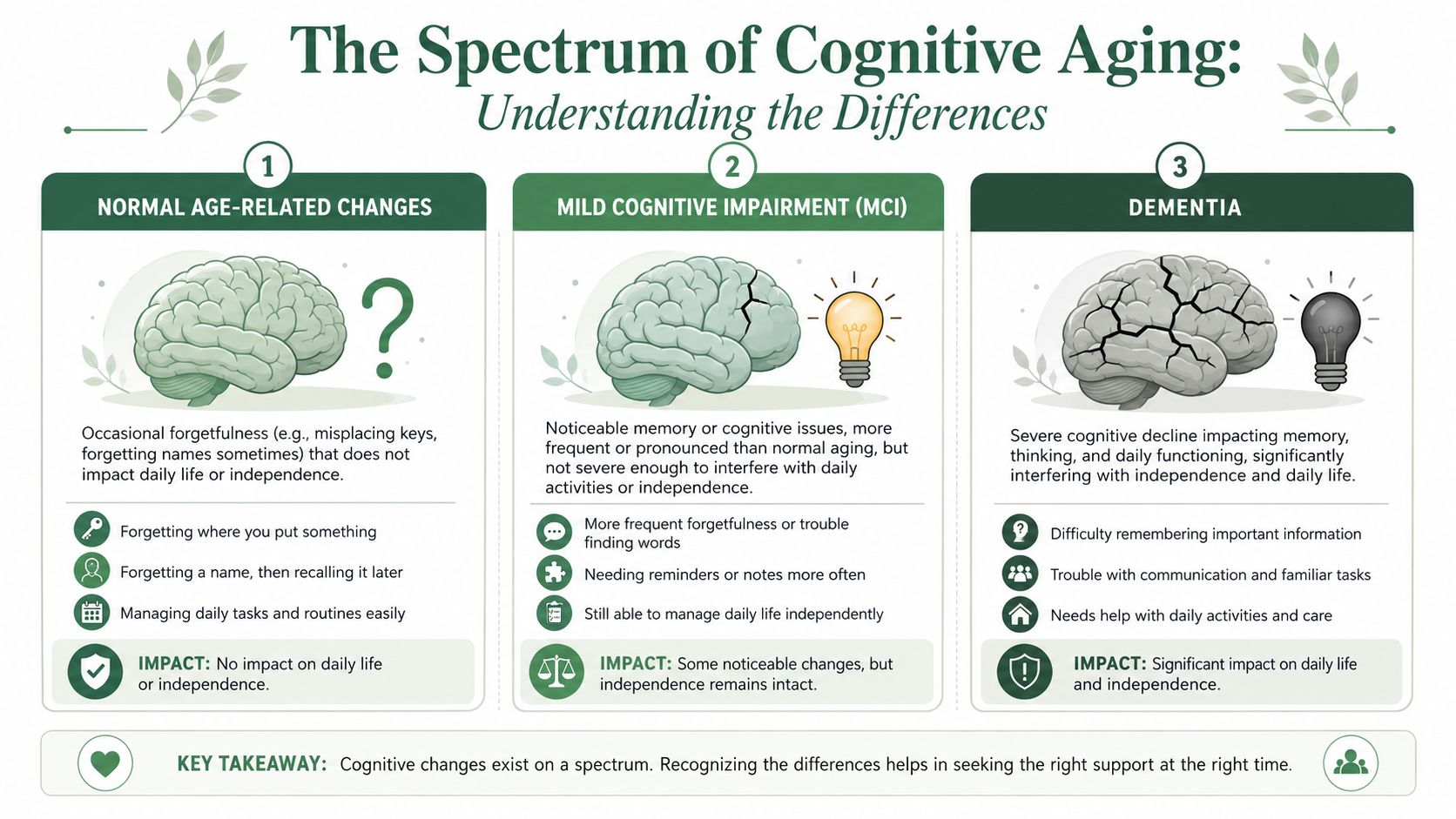
The easiest way to understand cognitive decline in older adults is to picture a dimmer switch, not an on-off button. Brain changes in later life can range from mild and manageable to severe enough to disrupt daily life. Naming the right part of the spectrum helps families respond calmly and appropriately.
Three different buckets
Normal age-related changes are the kind many older adults notice without losing independence. A person may need more time to recall a name, may walk into a room and forget why for a moment, or may rely more on lists and calendars. The key point is that daily function still works. They pay bills, follow recipes, keep appointments with reminders, and handle familiar tasks.
Mild cognitive impairment, often shortened to MCI, sits in the middle. Changes are noticeable, and often more noticeable to family than to the person experiencing them. Someone with MCI may repeat stories more often, struggle to track a conversation in a noisy room, or need extra effort for planning and organization. But they can usually still manage their usual daily life. According to the NCBI overview of Mild Cognitive Impairment, MCI prevalence ranges from 7% to 25% in adults over 60. The same source notes that the annual transition rate from MCI to dementia is 12% in the general population, while about 12% of patients with MCI revert to normal cognitive function within three years.
That last point matters. MCI is not the same as a dementia diagnosis. It can progress, stay stable, or improve.
Dementia is different because cognitive changes interfere with independence. The issue isn't only memory. It can involve reasoning, language, judgment, orientation, and the ability to complete familiar tasks. In practical terms, a person may get lost on a known route, mishandle medications, leave appliances on, become suspicious without cause, or stop being able to follow the steps of a routine task they once did easily.
Think of it this way. Normal aging is forgetting where you left the keys. MCI is misplacing the keys often enough that family starts noticing a pattern. Dementia is forgetting what the keys are used for, or being unable to get home safely.
A quick comparison
Characteristic | Normal Aging | Mild Cognitive Impairment (MCI) | Dementia |
|---|---|---|---|
Memory changes | Occasional lapses, then recall returns | Noticeable and recurring memory issues | Persistent memory problems that disrupt life |
Daily function | Independent | Usually still independent | Independence is affected |
Managing tasks | Slower, but still able | More effort needed for planning and organization | Trouble completing familiar tasks |
Insight | Often aware of mild lapses | May notice some changes | May minimize or not recognize impairment |
Family impact | Mild concern | Ongoing watchfulness | Active supervision and support often needed |
Why this distinction matters
Families often jump straight from “something is off” to “it must be dementia.” That leap creates fear and can delay the kind of evaluation that actually helps. If you treat every change as catastrophic, conversations become tense. If you dismiss every change as normal aging, needed care gets postponed.
A more balanced approach is to watch for pattern, persistence, and impact. One forgotten word isn't the story. Repeated difficulty with money, appointments, medications, or wayfinding is much more informative.
Understanding the Causes and Risk Factors
When families ask what causes cognitive decline in older adults, they're often really asking two questions at once. “Why is this happening?” and “Is there anything we can still do?” The answer to the second question is often yes.
What you can change and what you can't
Some risk factors are non-modifiable. Age matters. Family history may matter. Some neurological diseases unfold despite excellent habits and devoted care. That's important to acknowledge because families shouldn't blame themselves for every symptom they see.
At the same time, many influences on brain health are modifiable. The UCSF healthy aging overview notes that modifiable risk factors account for approximately 50% of Alzheimer's disease cases. That same source identifies hearing loss and poor oral health, including periodontitis, as significant and independent risk factors for faster cognitive decline.
This surprises many families. They expect to hear about crossword puzzles and brain games. They don't expect hearing aids, dental care, blood pressure, diabetes, smoking, depression, physical activity, or mental stimulation to be part of the picture. But the brain doesn't live apart from the body. It depends on blood flow, sensory input, movement, sleep, and social interaction.
Why families should think beyond memory games
A common mistake is narrowing support to one lane. For example, a family may buy puzzle books but ignore hearing difficulties, skipped medications, low activity, poor diet, or isolation. That's like trying to help a garden by watering one plant while the others dry out.
The same UCSF resource emphasizes that multicomponent interventions matter. In plain language, the strongest support plans don't rely on one trick. They combine medical care, movement, nutrition, meaningful activity, and management of health risks.
A useful family checklist includes:
Cardiovascular health: Ask whether blood pressure, diabetes, and cholesterol are being monitored and treated consistently.
Sensory health: Notice whether your loved one is avoiding conversation because hearing has become hard work.
Dental and oral health: Pain, missing teeth, and poor oral health can affect nutrition, confidence, and overall health.
Daily habits: Look at sleep, activity, alcohol use, smoking, and mental stimulation as part of one whole system.
When a family improves hearing, medication routines, meals, movement, and connection at the same time, they're often helping the brain from several directions at once.
Recognizing the Common Signs and Symptoms
Most families don't start with a checklist. They start with a feeling that something has changed. The challenge is turning that feeling into observations specific enough to discuss with a clinician.
A visual summary can help you sort what you're seeing.

What families usually notice first
Memory is the sign people expect, but it's not the only one. Watch for changes in several areas at once.
Memory loss: Repeated questions, forgotten recent conversations, or missing important dates.
Planning and problem-solving: New difficulty following steps, managing bills, or handling a familiar budget.
Familiar tasks: Trouble using appliances, following a recipe, or getting to a known location.
Time and place: Confusion about the day, season, appointment time, or current location.
Language: Pausing more often, losing the thread of conversation, or using unusual names for familiar objects.
Those signs become more meaningful when they repeat. One bad afternoon doesn't tell you much. A pattern over weeks does.
A short video may also help families recognize everyday warning signs in context.
When subtle signs deserve attention
Some of the most important symptoms aren't memory symptoms at all.
Misplacing items in unusual places: Keys in the freezer, glasses in the pantry, a wallet in the laundry basket.
Judgment changes: Falling for scams, giving money away impulsively, or ignoring obvious safety risks.
Social withdrawal: Stopping hobbies, skipping clubs, avoiding calls, or dropping out of routines they used to enjoy.
Mood and personality shifts: More anxiety, irritability, suspicion, apathy, or agitation than is typical for that person.
Undiagnosed problems are common, especially where access to care is limited. In an underserved community study described by Emory News on undiagnosed cognitive decline, 75% of participants had undiagnosed cognitive issues, including 62% with MCI and 12.3% with dementia. That's a reminder not to wait for a formal label before taking concerns seriously.
If your loved one says, “I'm fine,” but you're seeing repeated problems with safety, bills, appointments, or getting lost, trust the pattern you're observing.
Navigating Assessment and Diagnosis Pathways
Once concerns are real enough to name, many families freeze. They assume the process will be complicated, frightening, or pointless. In practice, the first steps are usually straightforward.
Start with what you've seen
Begin with the primary care clinician. You do not need a perfect description. You do need examples. Write down what you've noticed, when it started, and how often it happens. Specific notes are much more helpful than saying, “She's getting forgetful.”
Bring observations like these:
Repeated questions: “She asked about Sunday dinner three times in one afternoon.”
Functional issues: “He missed two medication doses this week.”
Safety concerns: “She left the stove on after lunch.”
Behavior changes: “He has stopped attending his card group and seems more suspicious.”
If possible, bring a family member who sees daily routines up close. Clinicians often learn the most from side-by-side accounts.
The need for proper assessment is growing. UCL reporting on doctor-confirmed cognitive decline in older adults notes that clinically assessed cases more than doubled over the past decade, with the incidence rate reaching three new diagnosed cases per 1,000 individuals annually by 2018.
What an evaluation may include
A medical visit may involve a short cognitive screening, questions about function, medication review, mood screening, and lab work to look for contributors such as vitamin issues or thyroid problems. In some cases, the clinician may order brain imaging or refer to a neurologist, geriatrician, or memory clinic.
Families often fear that diagnosis means instant loss of independence. It doesn't. A diagnosis is information. It can clarify what support is needed, what risks are emerging, and what treatments or adjustments might help.
A good appointment starts before the waiting room. Bring notes, medication lists, hearing aid details, and examples from real life.
Evidence-Based Prevention and Management Strategies
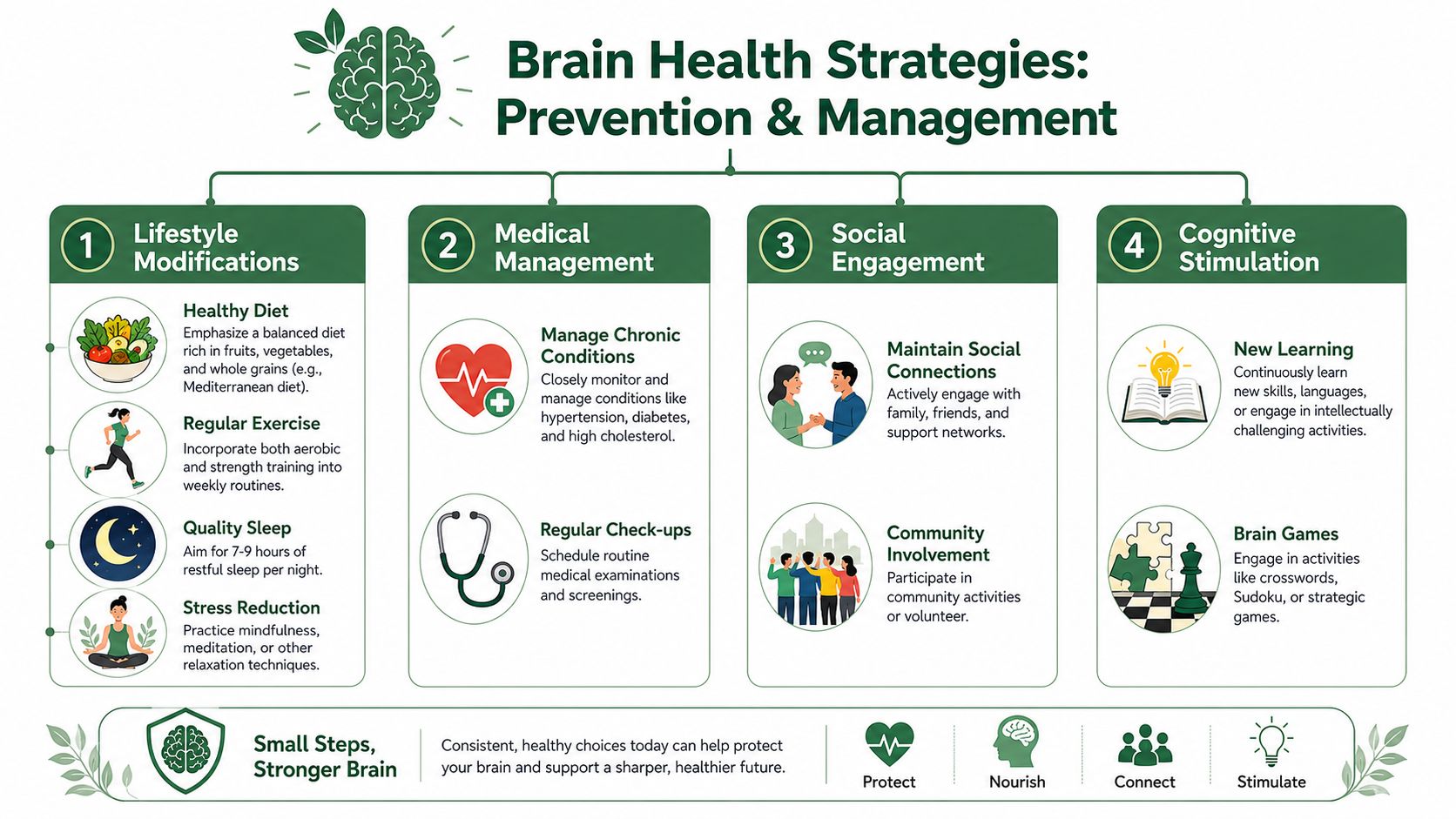
Families often ask for the one best thing to do. There usually isn't one. The strongest support plans work like a four-legged table. If one leg is missing, the whole thing gets less stable.
Four pillars that support brain health
Lifestyle
Food, movement, sleep, and stress all shape daily brain function. Families don't need a perfect routine to make progress. They need a more supportive one.
Meals that support overall health: Focus on regular meals with fruits, vegetables, whole grains, and healthy fats.
Physical activity: Walking, strength work, and gentle balance exercises can support both body and mind.
Sleep routines: Try to stabilize bedtime, wake time, light exposure, and evening habits.
Reduced overload: Too much noise, clutter, or rushing can make thinking look worse than it is.
Medical care
This is the practical backbone. If medication routines are messy, hearing is poor, or chronic conditions aren't controlled, everything else gets harder.
Some families benefit from using pill organizers, written medication charts, hearing checks, calendar reminders, and routine follow-up with the same clinicians. The basic recommendations for brain-supportive routines can help families turn general advice into daily habits.
Cognitive activity
Cognitive stimulation works best when it's meaningful. A person who hates Sudoku doesn't need Sudoku. Reading aloud, sorting photos, simple word games, music, reminiscing, learning a small new skill, or discussing familiar topics may be more engaging and more sustainable.
Good cognitive support matches the person's current ability. Too easy feels childish. Too hard feels defeating.
Why social contact deserves special attention
Social engagement is often treated like an optional extra. It isn't. For many older adults, conversation is a form of exercise for attention, memory, language, mood, and orientation all at once.
The study on late-life social activity and cognitive decline found that a one-point increase in a late-life social activity score was associated with a 47% reduction in the annual rate of global cognitive decline. It also found that older adults in the top 90th percentile of social engagement experienced a 70% lower rate of decline than those in the bottom 10th.
That doesn't mean every family needs a packed social calendar. It does mean regular, real human contact matters.
Here are practical ways to build it:
Scheduled calls: Put recurring phone check-ins on the calendar rather than waiting for spontaneous contact.
Repeatable routines: Weekly lunch, faith community visits, neighbor walks, or family game time are easier to maintain than vague plans.
Conversation with purpose: Ask about today's date, meals, weather, upcoming appointments, or old family stories to exercise orientation and recall naturally.
Low-tech access: Many older adults engage more reliably by phone than through apps, portals, or video platforms.
Practical Next Steps for Your Family
When a family first learns about cognitive decline in older adults, they often feel pressure to solve everything at once. Don't. The next right step is more important than the perfect long-term plan.

What to do this week
Start small, but start clearly.
Write down what you're seeing. Keep a brief log of memory slips, missed tasks, confusion, mood changes, and safety concerns.
Book a medical appointment. Ask for an evaluation if the pattern is recurring or affecting daily life.
Check the basics at home. Review medications, meals, hydration, hearing, sleep, and household safety.
Increase regular contact. Don't rely only on occasional visits. Build dependable check-ins.
Share the load. One sibling, spouse, or adult child shouldn't carry every detail alone.
If your family wants an example of what consistent remote support can look like, this family guide to how Hey Velma works for daily cognitive support explains the phone-based model in practical terms.
A hopeful way to think about the road ahead
Families need honesty, but they also need hope rooted in evidence. The Yale study on older adults improving over time found that 32% of adults over 65 improve cognitively over time, and it identified positive age beliefs as a significant predictor of improvement.
That doesn't mean every case reverses. It does mean the story is wider than “aging equals decline.” A person can have challenges and still improve function. A family can be worried and still be effective. Support can be practical and hopeful at the same time.
What helps most is consistency. Steady observation. Clear medical follow-up. Thoughtful routines. Social connection. Respect for the person's dignity. These aren't small things. They are often the things that shape whether a household feels chaotic or supported.
Hey Velma is a phone-based cognitive support program for older adults experiencing memory loss in the early to mid stages of dementia. Through scheduled calls, conversation, cognitive stimulation, companionship, and practical safety check-ins, it helps families add consistent support between visits and alongside medical care.
You're visiting your parent for dinner, and something feels off. Your mother asks the same question twice in twenty minutes. Your father, who used to balance every bill to the penny, seems confused by a simple bank statement. Then comes the part families often wrestle with in silence. Is this normal aging, stress, a bad week, or the start of something more serious?
That uncertainty is one of the hardest parts of cognitive decline in older adults. Most families don't get a dramatic beginning. They get small moments. A missed appointment. Food left out overnight. A story repeated three times. A once-social parent turning down phone calls and church, cards, or lunch with friends.
If that's where you are, you're not overreacting by paying attention. You're also not doomed to a worst-case scenario. Cognitive changes in later life exist on a spectrum, and that distinction matters. Some changes are mild. Some are treatable. Some progress slowly. Some improve. Families do best when they replace panic with observation, and fear with a plan.
I work with families who need clear language more than medical jargon. They want to know what terms mean, what signs to watch for, when to call the doctor, and what support can realistically help at home. That's what this guide is for. If you want more family-focused support articles, the Hey Velma article library for caregivers is a useful place to keep reading.
Table of Contents
An Introduction for Concerned Families
The Spectrum of Cognitive Aging
Three different buckets
A quick comparison
Why this distinction matters
Understanding the Causes and Risk Factors
What you can change and what you can't
Why families should think beyond memory games
Recognizing the Common Signs and Symptoms
What families usually notice first
When subtle signs deserve attention
Navigating Assessment and Diagnosis Pathways
Start with what you've seen
What an evaluation may include
Evidence-Based Prevention and Management Strategies
Four pillars that support brain health
Why social contact deserves special attention
Practical Next Steps for Your Family
What to do this week
A hopeful way to think about the road ahead
An Introduction for Concerned Families
Families usually notice function before they notice vocabulary. A daughter tells me, “Mom still sounds like herself, but she's not managing the day the way she used to.” A spouse says, “He can talk about old memories for an hour, but he forgot the coffee maker was on.” Those observations matter because cognitive decline in older adults often shows up in real life before it gets named in a clinic.
The emotional strain is real. You may feel guilty for noticing. You may worry about embarrassing your parent by bringing it up. You may also be carrying two opposite thoughts at once: “I hope it's nothing,” and “I need to act if it's something.” That tension is normal.
A lot of confusion comes from one mistaken idea. People often treat all forgetfulness as if it belongs in one bucket. It doesn't. Normal age-related slowing, mild cognitive impairment, and dementia are related but not identical.
Practical rule: Don't ask only, “Are they forgetting things?” Ask, “Is this change affecting judgment, safety, routines, or independence?”
That question shifts the conversation in a useful direction. Forgetting where you put your glasses can happen to anyone. Forgetting what the glasses are for, or accusing someone of stealing them over and over, points to a different level of concern.
Families also need room for hope. Cognitive decline isn't always a straight downward line. Some people remain stable for long stretches. Some improve after medical issues are addressed. Some respond well when routines, social contact, and support become more consistent.
The Spectrum of Cognitive Aging
The easiest way to understand cognitive decline in older adults is to picture a dimmer switch, not an on-off button. Brain changes in later life can range from mild and manageable to severe enough to disrupt daily life. Naming the right part of the spectrum helps families respond calmly and appropriately.
Three different buckets
Normal age-related changes are the kind many older adults notice without losing independence. A person may need more time to recall a name, may walk into a room and forget why for a moment, or may rely more on lists and calendars. The key point is that daily function still works. They pay bills, follow recipes, keep appointments with reminders, and handle familiar tasks.
Mild cognitive impairment, often shortened to MCI, sits in the middle. Changes are noticeable, and often more noticeable to family than to the person experiencing them. Someone with MCI may repeat stories more often, struggle to track a conversation in a noisy room, or need extra effort for planning and organization. But they can usually still manage their usual daily life. According to the NCBI overview of Mild Cognitive Impairment, MCI prevalence ranges from 7% to 25% in adults over 60. The same source notes that the annual transition rate from MCI to dementia is 12% in the general population, while about 12% of patients with MCI revert to normal cognitive function within three years.
That last point matters. MCI is not the same as a dementia diagnosis. It can progress, stay stable, or improve.
Dementia is different because cognitive changes interfere with independence. The issue isn't only memory. It can involve reasoning, language, judgment, orientation, and the ability to complete familiar tasks. In practical terms, a person may get lost on a known route, mishandle medications, leave appliances on, become suspicious without cause, or stop being able to follow the steps of a routine task they once did easily.
Think of it this way. Normal aging is forgetting where you left the keys. MCI is misplacing the keys often enough that family starts noticing a pattern. Dementia is forgetting what the keys are used for, or being unable to get home safely.
A quick comparison
Characteristic | Normal Aging | Mild Cognitive Impairment (MCI) | Dementia |
|---|---|---|---|
Memory changes | Occasional lapses, then recall returns | Noticeable and recurring memory issues | Persistent memory problems that disrupt life |
Daily function | Independent | Usually still independent | Independence is affected |
Managing tasks | Slower, but still able | More effort needed for planning and organization | Trouble completing familiar tasks |
Insight | Often aware of mild lapses | May notice some changes | May minimize or not recognize impairment |
Family impact | Mild concern | Ongoing watchfulness | Active supervision and support often needed |
Why this distinction matters
Families often jump straight from “something is off” to “it must be dementia.” That leap creates fear and can delay the kind of evaluation that actually helps. If you treat every change as catastrophic, conversations become tense. If you dismiss every change as normal aging, needed care gets postponed.
A more balanced approach is to watch for pattern, persistence, and impact. One forgotten word isn't the story. Repeated difficulty with money, appointments, medications, or wayfinding is much more informative.
Understanding the Causes and Risk Factors
When families ask what causes cognitive decline in older adults, they're often really asking two questions at once. “Why is this happening?” and “Is there anything we can still do?” The answer to the second question is often yes.
What you can change and what you can't
Some risk factors are non-modifiable. Age matters. Family history may matter. Some neurological diseases unfold despite excellent habits and devoted care. That's important to acknowledge because families shouldn't blame themselves for every symptom they see.
At the same time, many influences on brain health are modifiable. The UCSF healthy aging overview notes that modifiable risk factors account for approximately 50% of Alzheimer's disease cases. That same source identifies hearing loss and poor oral health, including periodontitis, as significant and independent risk factors for faster cognitive decline.
This surprises many families. They expect to hear about crossword puzzles and brain games. They don't expect hearing aids, dental care, blood pressure, diabetes, smoking, depression, physical activity, or mental stimulation to be part of the picture. But the brain doesn't live apart from the body. It depends on blood flow, sensory input, movement, sleep, and social interaction.
Why families should think beyond memory games
A common mistake is narrowing support to one lane. For example, a family may buy puzzle books but ignore hearing difficulties, skipped medications, low activity, poor diet, or isolation. That's like trying to help a garden by watering one plant while the others dry out.
The same UCSF resource emphasizes that multicomponent interventions matter. In plain language, the strongest support plans don't rely on one trick. They combine medical care, movement, nutrition, meaningful activity, and management of health risks.
A useful family checklist includes:
Cardiovascular health: Ask whether blood pressure, diabetes, and cholesterol are being monitored and treated consistently.
Sensory health: Notice whether your loved one is avoiding conversation because hearing has become hard work.
Dental and oral health: Pain, missing teeth, and poor oral health can affect nutrition, confidence, and overall health.
Daily habits: Look at sleep, activity, alcohol use, smoking, and mental stimulation as part of one whole system.
When a family improves hearing, medication routines, meals, movement, and connection at the same time, they're often helping the brain from several directions at once.
Recognizing the Common Signs and Symptoms
Most families don't start with a checklist. They start with a feeling that something has changed. The challenge is turning that feeling into observations specific enough to discuss with a clinician.
A visual summary can help you sort what you're seeing.
What families usually notice first
Memory is the sign people expect, but it's not the only one. Watch for changes in several areas at once.
Memory loss: Repeated questions, forgotten recent conversations, or missing important dates.
Planning and problem-solving: New difficulty following steps, managing bills, or handling a familiar budget.
Familiar tasks: Trouble using appliances, following a recipe, or getting to a known location.
Time and place: Confusion about the day, season, appointment time, or current location.
Language: Pausing more often, losing the thread of conversation, or using unusual names for familiar objects.
Those signs become more meaningful when they repeat. One bad afternoon doesn't tell you much. A pattern over weeks does.
A short video may also help families recognize everyday warning signs in context.
When subtle signs deserve attention
Some of the most important symptoms aren't memory symptoms at all.
Misplacing items in unusual places: Keys in the freezer, glasses in the pantry, a wallet in the laundry basket.
Judgment changes: Falling for scams, giving money away impulsively, or ignoring obvious safety risks.
Social withdrawal: Stopping hobbies, skipping clubs, avoiding calls, or dropping out of routines they used to enjoy.
Mood and personality shifts: More anxiety, irritability, suspicion, apathy, or agitation than is typical for that person.
Undiagnosed problems are common, especially where access to care is limited. In an underserved community study described by Emory News on undiagnosed cognitive decline, 75% of participants had undiagnosed cognitive issues, including 62% with MCI and 12.3% with dementia. That's a reminder not to wait for a formal label before taking concerns seriously.
If your loved one says, “I'm fine,” but you're seeing repeated problems with safety, bills, appointments, or getting lost, trust the pattern you're observing.
Navigating Assessment and Diagnosis Pathways
Once concerns are real enough to name, many families freeze. They assume the process will be complicated, frightening, or pointless. In practice, the first steps are usually straightforward.
Start with what you've seen
Begin with the primary care clinician. You do not need a perfect description. You do need examples. Write down what you've noticed, when it started, and how often it happens. Specific notes are much more helpful than saying, “She's getting forgetful.”
Bring observations like these:
Repeated questions: “She asked about Sunday dinner three times in one afternoon.”
Functional issues: “He missed two medication doses this week.”
Safety concerns: “She left the stove on after lunch.”
Behavior changes: “He has stopped attending his card group and seems more suspicious.”
If possible, bring a family member who sees daily routines up close. Clinicians often learn the most from side-by-side accounts.
The need for proper assessment is growing. UCL reporting on doctor-confirmed cognitive decline in older adults notes that clinically assessed cases more than doubled over the past decade, with the incidence rate reaching three new diagnosed cases per 1,000 individuals annually by 2018.
What an evaluation may include
A medical visit may involve a short cognitive screening, questions about function, medication review, mood screening, and lab work to look for contributors such as vitamin issues or thyroid problems. In some cases, the clinician may order brain imaging or refer to a neurologist, geriatrician, or memory clinic.
Families often fear that diagnosis means instant loss of independence. It doesn't. A diagnosis is information. It can clarify what support is needed, what risks are emerging, and what treatments or adjustments might help.
A good appointment starts before the waiting room. Bring notes, medication lists, hearing aid details, and examples from real life.
Evidence-Based Prevention and Management Strategies
Families often ask for the one best thing to do. There usually isn't one. The strongest support plans work like a four-legged table. If one leg is missing, the whole thing gets less stable.
Four pillars that support brain health
Lifestyle
Food, movement, sleep, and stress all shape daily brain function. Families don't need a perfect routine to make progress. They need a more supportive one.
Meals that support overall health: Focus on regular meals with fruits, vegetables, whole grains, and healthy fats.
Physical activity: Walking, strength work, and gentle balance exercises can support both body and mind.
Sleep routines: Try to stabilize bedtime, wake time, light exposure, and evening habits.
Reduced overload: Too much noise, clutter, or rushing can make thinking look worse than it is.
Medical care
This is the practical backbone. If medication routines are messy, hearing is poor, or chronic conditions aren't controlled, everything else gets harder.
Some families benefit from using pill organizers, written medication charts, hearing checks, calendar reminders, and routine follow-up with the same clinicians. The basic recommendations for brain-supportive routines can help families turn general advice into daily habits.
Cognitive activity
Cognitive stimulation works best when it's meaningful. A person who hates Sudoku doesn't need Sudoku. Reading aloud, sorting photos, simple word games, music, reminiscing, learning a small new skill, or discussing familiar topics may be more engaging and more sustainable.
Good cognitive support matches the person's current ability. Too easy feels childish. Too hard feels defeating.
Why social contact deserves special attention
Social engagement is often treated like an optional extra. It isn't. For many older adults, conversation is a form of exercise for attention, memory, language, mood, and orientation all at once.
The study on late-life social activity and cognitive decline found that a one-point increase in a late-life social activity score was associated with a 47% reduction in the annual rate of global cognitive decline. It also found that older adults in the top 90th percentile of social engagement experienced a 70% lower rate of decline than those in the bottom 10th.
That doesn't mean every family needs a packed social calendar. It does mean regular, real human contact matters.
Here are practical ways to build it:
Scheduled calls: Put recurring phone check-ins on the calendar rather than waiting for spontaneous contact.
Repeatable routines: Weekly lunch, faith community visits, neighbor walks, or family game time are easier to maintain than vague plans.
Conversation with purpose: Ask about today's date, meals, weather, upcoming appointments, or old family stories to exercise orientation and recall naturally.
Low-tech access: Many older adults engage more reliably by phone than through apps, portals, or video platforms.
Practical Next Steps for Your Family
When a family first learns about cognitive decline in older adults, they often feel pressure to solve everything at once. Don't. The next right step is more important than the perfect long-term plan.
What to do this week
Start small, but start clearly.
Write down what you're seeing. Keep a brief log of memory slips, missed tasks, confusion, mood changes, and safety concerns.
Book a medical appointment. Ask for an evaluation if the pattern is recurring or affecting daily life.
Check the basics at home. Review medications, meals, hydration, hearing, sleep, and household safety.
Increase regular contact. Don't rely only on occasional visits. Build dependable check-ins.
Share the load. One sibling, spouse, or adult child shouldn't carry every detail alone.
If your family wants an example of what consistent remote support can look like, this family guide to how Hey Velma works for daily cognitive support explains the phone-based model in practical terms.
A hopeful way to think about the road ahead
Families need honesty, but they also need hope rooted in evidence. The Yale study on older adults improving over time found that 32% of adults over 65 improve cognitively over time, and it identified positive age beliefs as a significant predictor of improvement.
That doesn't mean every case reverses. It does mean the story is wider than “aging equals decline.” A person can have challenges and still improve function. A family can be worried and still be effective. Support can be practical and hopeful at the same time.
What helps most is consistency. Steady observation. Clear medical follow-up. Thoughtful routines. Social connection. Respect for the person's dignity. These aren't small things. They are often the things that shape whether a household feels chaotic or supported.
Hey Velma is a phone-based cognitive support program for older adults experiencing memory loss in the early to mid stages of dementia. Through scheduled calls, conversation, cognitive stimulation, companionship, and practical safety check-ins, it helps families add consistent support between visits and alongside medical care.
Suggested Article: