Life Review Therapy: A Guide for Dementia Caregivers

You call your mom in the evening, and within two minutes the conversation slips into the same routine. Did you eat dinner? Did you take your pills? How was your day? She says “fine,” then pauses. You want to stay on the phone, but you're not sure where to go next.
That moment is painful because the relationship is still there, even when easy conversation isn't. Many family caregivers aren't looking for a perfect script. They want a way to help a parent feel known, calm, and connected, especially when memory loss has changed the rhythm of everyday life.
One of the most useful tools for that is Life Review Therapy. In clinical settings, it's a structured approach that helps older adults reflect on their lives in a way that supports mood, meaning, and emotional well-being. For families, its core ideas can also shape better phone calls. Not therapy. Not pressure. Just warmer, more grounded conversations that help a loved one reconnect with parts of themselves that still matter.
Table of Contents
Turning Memories Into Meaningful Connection
What Is Life Review Therapy Really
More than swapping old stories
Why structure matters
The Proven Benefits for Well Being and Brain Health
What research shows
The part families need to know
What a Typical Life Review Process Looks Like
The three phases
What this means for families
How to Use Life Review Principles on Phone Calls
Start with invitation not testing
Conversation Prompts for Life Review Calls
How to respond when memory is patchy
Safety Boundaries and Adapting for Dementia
Your job is support not treatment
Do and don't guide for safer calls
Finding Professional Help and Ongoing Support
When formal therapy makes sense
When regular phone based support fits better
Turning Memories Into Meaningful Connection
A daughter I once spoke with described her calls with her father this way: “I feel like I'm interviewing him for basic survival.” She wasn't cold. She was exhausted. Every call had become a checklist about meals, appointments, and whether he'd locked the front door.
That happens in many families. Dementia care pulls conversation toward logistics because logistics matter. But if every exchange is about problems, a loved one can start to feel managed instead of known.
Life review therapy offers a different path. At its heart, it treats a person's life story as something worth revisiting with care. Not just the highlights. Not just the easy memories. The whole arc of a life, including work, family, hardship, pride, losses, and the values that carried them through.
Practical rule: If a call feels stalled, move from “What happened today?” to “Tell me about a time in your life when...”
That shift matters. A person with dementia may struggle to recall breakfast but still light up when talking about the street where they grew up, the first job they held, or the music they loved as a young adult. Those memories can open the door to emotion, identity, and connection in the present moment.
For caregivers, this isn't about forcing a meaningful conversation every time. It's about creating more chances for your loved one to feel competent, interesting, and heard. A good life review style conversation can soften loneliness and reduce the pressure to “perform” memory on demand.
The phone can help here. Without the distractions of a rushed visit, you can slow down, ask one gentle question, and follow your loved one's lead. Some of the best calls aren't efficient. They're spacious.
What Is Life Review Therapy Really
Life review therapy is a structured therapeutic approach that guides a person through their life story in a deliberate way, usually from early memories toward the present. It isn't the same as casual reminiscing. It has a purpose. The goal is to help the person make sense of their life, hold positive and painful memories together, and arrive at a stronger sense of meaning and self-understanding.
A simple way to picture it is this: reminiscence is like flipping through a photo album at random. Life review therapy is more like creating a personal documentary. You move scene by scene, ask what each chapter meant, and notice the themes that run through the whole story.
A visual summary can make that distinction easier to grasp.

More than swapping old stories
In everyday conversation, people often use “remembering the past” to mean one thing. Clinically, there's an important difference. A review article on older adults found that Life Review Therapy showed an effect size of d = 0.92 for reducing depressive symptoms, compared with d = 0.46 for standard reminiscence therapy, and described its mechanisms as Life Balance, Finding Meaning, and Elaboration of Memory in a discussion of structured LRT approaches in older adults (ScienceDirect overview of Life Review Therapy mechanisms and outcomes).
That difference helps explain why structure matters. In casual reminiscence, someone might tell a funny story about high school and move on. In life review therapy, a trained clinician helps the person explore what that period of life meant, how it shaped identity, and how difficult experiences fit beside good ones.
The point isn't to dig for drama. It's to help the person develop a more balanced view of their own life.
Later in the section, this short video gives a helpful overview of the concept in plain language.
Why structure matters
When families hear “life review therapy,” they sometimes think, “So I should just ask Dad to tell stories?” Storytelling is part of it, but not the whole thing. The therapeutic value comes from how the conversation is guided.
A clinician may help a person:
Hold both joy and pain together so one hard chapter doesn't define the whole life
Notice patterns of strength such as persistence, love of family, service, faith, or creativity
Put words to unresolved feelings in a supported setting
Expand memory detail with gentle prompts that make recall more vivid
A life review conversation works best when it helps a person feel seen, not examined.
For caregivers, that distinction is freeing. You don't need to become a therapist. You can borrow the principles: go slowly, stay curious, and ask questions that honor the person's full life rather than testing whether memory is “good enough.”
The Proven Benefits for Well Being and Brain Health
Families often ask whether this kind of conversation is solely comforting or whether it can truly help. The answer is both. Done well, life review therapy can support mood, identity, and some areas of cognition.
What research shows
A meta-analysis of 34 studies involving 2,752 older adults found that life review therapy significantly reduced depression and hopelessness while improving well-being and specific memory. The same analysis reported a standardized mean difference of 0.57 for depression reduction, a mean difference of 4.01 for hopelessness reduction, a standardized mean difference of 0.54 for improved well-being, and a mean difference of 1.05 for specific memory improvement (PubMed summary of the 2017 meta-analysis on life review in older adults).
Those numbers matter, but the practical takeaway matters more. Guided reflection doesn't only stir up nostalgia. It can improve how a person feels and how they engage with memory.
For caregivers, this often shows up in small ways:
A more animated voice during or after the call
Better engagement when the topic connects to identity
Less flat conversation than when sticking to present-day facts
Moments of pride or relief when a loved one feels capable of remembering something meaningful
The part families need to know
There's also an important limit that many articles leave out. A 2024 review noted that for dementia patients, the benefits may last “only for as long as the intervention is being administered” (2024 integrative review discussing sustained effects in dementia).
That doesn't mean life review therapy fails. It means dementia care usually depends on ongoing engagement, not one meaningful conversation or one short burst of support. Families sometimes hope for a breakthrough moment that brings lasting peace or a stable lift in mood. In reality, many people with dementia do better with regular, repeated contact.
Consistency often matters as much as insight.
This is why phone-based conversation can be so valuable. If a person responds well to recalling old neighborhoods, family traditions, military service, church life, parenting years, or favorite work stories, don't treat that as a one-time exercise. Treat it as a rhythm. Revisit familiar themes. Build emotional continuity across calls. Repetition, when it's warm and respectful, can be supportive rather than redundant.
What a Typical Life Review Process Looks Like
When life review therapy is delivered professionally, it usually follows a clear structure rather than unfolding as random conversation. That predictability helps many older adults feel safer and more oriented.
A commonly described format is six to eight one-hour sessions, organized into an initial phase, a middle phase, and a final phase. In the same body of literature, a life review group program reported self-esteem improving from 22.14 to 26.28 (p < 0.0001), alongside improved life satisfaction (evaluation of a structured life review group program in older adults).
The three phases
The first phase is about orientation. The therapist explains the process, connects it to the person's symptoms or goals, and builds enough trust for deeper reflection. This stage matters because some people worry they're being tested, corrected, or pushed into emotional territory they didn't choose.
The middle phase is the heart of the work. Life stages are discussed in order, often beginning with childhood and family history, then moving through adolescence, early adulthood, work, partnership, parenting, later life, and the present. This chronological shape gives the person a roadmap.
The final phase focuses on integration. Instead of leaving memories scattered, the therapist helps the person notice themes, strengths, unresolved feelings, and ways to hold the full story together with less distress and more coherence.
What this means for families
You're not expected to recreate that clinical process on your own. But it helps to understand the model. It can make your conversations feel less random and less pressured.
For example, one week you might focus on childhood homes. Another call might stay with school years. Another might center on work identity or raising children. That kind of gentle sequence often works better than jumping all over a lifetime in one sitting.
If you want a practical example of how structured phone support can be organized over time, this family guide to how Hey Velma works with daily cognitive support shows how recurring calls can create consistency for families.
How to Use Life Review Principles on Phone Calls
Here, many caregivers get stuck. They understand the idea, but they need words they can use tonight. The good news is that you don't need a polished script. You need a better kind of opening.
Start with invitation not testing
Questions that feel like quizzes tend to shut people down. Questions that invite description tend to open things up.
Compare these two approaches:
“Do you remember your old school?”
“What do you remember about walking to school when you were young?”
The first asks for proof. The second invites a story.
That shift matters because guided recall can support both mood and cognition. In the meta-analysis noted earlier, life review therapy was linked with improved well-being and specific memory, which helps explain why open-ended recall can be so useful in dementia-friendly conversation.
Here are a few ways to make a phone call feel more like life review and less like an exam:
Use sensory prompts. Ask about sounds, smells, clothing, weather, food, or places.
Stay with one era. Don't switch from childhood to retirement in the same minute.
Follow emotion. If your loved one brightens when talking about a first job, stay there.
Accept partial recall. A fragment is still a meaningful memory.
Reflect back what you hear. “That sounds like a busy house,” or “You were proud of that.”
Conversation Prompts for Life Review Calls
Life Stage | Sample Prompts |
|---|---|
Childhood | Tell me about the house you grew up in. What did the neighborhood feel like? |
Childhood | Who took care of you when you were little? What do you remember about them? |
School years | What was school like for you? Was there a teacher you still remember? |
Teen years | What kind of music did you like when you were young? Where did you hear it? |
Early adulthood | What was your first job? What did a normal day look like? |
Early adulthood | Tell me about a time when you felt independent for the first time. |
Relationships | How did you meet the people who became important in your life? |
Marriage or partnership | What do you remember about dating, getting engaged, or early married life? |
Parenting and family | What was your favorite part of family life when the kids were small? |
Work life | What kind of work made you feel useful or proud? |
Home and community | What places in town mattered most to you? Church, shops, parks, neighbors? |
Holidays and traditions | What holiday traditions did your family always keep? |
Strength and resilience | When life was hard, what usually helped you keep going? |
Meaning and identity | What are you most glad you did in your life? |
Try one prompt per call. Two is plenty if your loved one gets tired easily.
How to respond when memory is patchy
Sometimes your loved one will start a story, lose the thread, and apologize. This is the moment to lower pressure, not increase it.
You can say:
“That's okay. I like hearing whatever you remember.”
“Take your time. There's no right answer.”
“Was it more of a city place or a country place?”
“Do you remember how it felt, even if the details are fuzzy?”
Those responses do two things. They protect dignity, and they keep the conversation emotionally safe. Very often, the person remembers more once they stop feeling judged.
You can also use cues without turning the call into a correction session. Mention a sibling's name, an old town, a holiday meal, or a job title. Small anchors can make recall easier.
Safety Boundaries and Adapting for Dementia
Life review principles can be supportive. They can also stir up grief, regret, or confusion if they're used without enough care. That's why family conversations need clear boundaries.
Your job is support not treatment
Clinical guidance emphasizes that life review therapy works best when a trained facilitator uses probing questions to evaluate events and help resolve conflicts. That's why caregivers are usually safest when they focus on listening and validating, rather than trying to perform deeper therapeutic work (life review toolkit for practice and caregiver boundaries).
This is the line to remember: you are there to accompany, not interpret.
If a painful memory comes up, you don't need to unpack it. You can acknowledge the feeling and gently steady the conversation.
Useful responses include:
“That sounds like it was very hard.”
“I'm glad you told me that.”
“We don't have to stay with that if you don't want to.”
“Would it help to talk about someone who got you through that time?”
A supportive caregiver doesn't press for details. A supportive caregiver protects emotional safety.
This basic recommendations guide for families supporting someone with memory loss is a helpful companion when you're trying to balance engagement with reassurance.
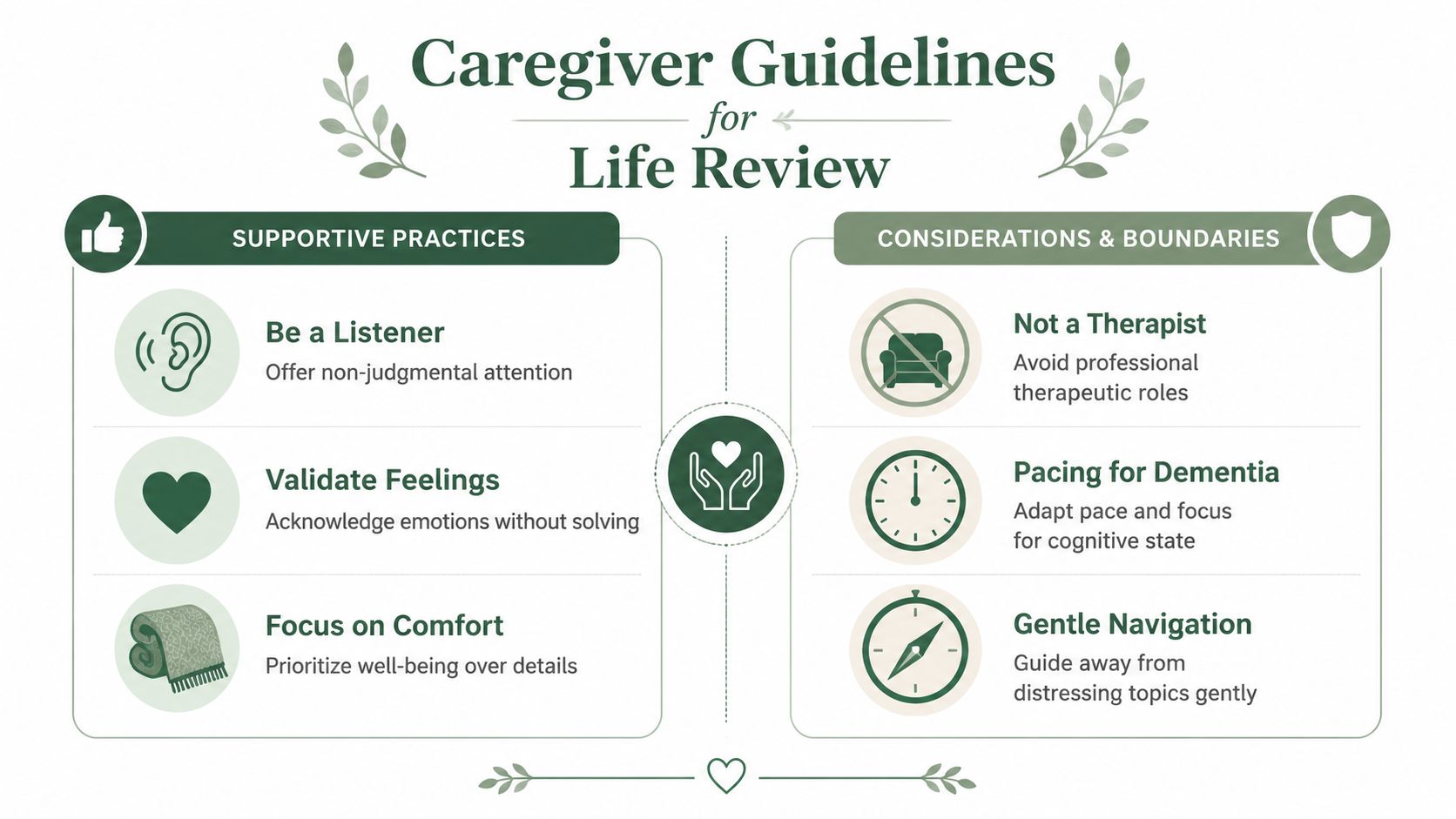
Do and don't guide for safer calls
People with dementia vary widely, but a few adaptations help most families.
Do
Keep calls shorter if attention fades quickly.
Use familiar cues such as photos, music, old recipes, or family names if you're calling while someone else is with them.
Choose emotionally positive themes first like home, favorite work, celebrations, or people they loved.
Watch for strain. Long pauses, irritability, repeated “I don't know,” or sudden withdrawal usually mean it's time to ease off.
End on comfort. A warm summary is often better than one more question.
Don't
Don't correct every detail. Accuracy matters less than connection in these conversations.
Don't chase trauma because you think it might be therapeutic.
Don't jump topic to topic when the person is doing well with one memory stream.
Don't insist if a loved one says they're tired, confused, or done.
Don't assume silence means failure. Some calls are quiet but still regulating.
When in doubt, choose calm over completeness.
Finding Professional Help and Ongoing Support
Families usually need to decide between two kinds of help. One is formal therapy. The other is ongoing supportive engagement built into everyday care.
When formal therapy makes sense
A licensed mental health professional trained in life review therapy may be the right fit when a loved one is showing depression, unresolved grief, persistent hopelessness, or distress around painful life events. In that setting, the structure and clinical skill matter. A therapist can pace the work, contain difficult emotions, and help integrate themes safely.
When regular phone based support fits better
For many families dealing with early to mid-stage dementia, the bigger challenge isn't one unresolved issue. It's maintaining connection, mood support, and cognitive engagement over time. That's where structured, recurring phone contact can fit naturally into care.
Because research suggests benefits may depend on continued administration in dementia care, families often need a model that is dependable rather than occasional. A phone-based support program can make that consistency easier, especially when travel, work schedules, or distance make frequent in-person visits hard.
This kind of option is worth comparing carefully. If you're evaluating whether a program is credible, this guide to assessing whether Hey Velma is a legitimate memory loss support program offers useful criteria to consider.

The goal isn't to replace family love with a service. It's to give that love a steadier structure when dementia makes connection harder to sustain alone.
If you want steady, phone-based support that uses compassionate conversation, cognitive engagement, and consistent check-ins for older adults with memory loss, take a look at Hey Velma. It's designed for families who need more than occasional help and want a reliable way to support connection, well-being, and day-to-day function over time.
You call your mom in the evening, and within two minutes the conversation slips into the same routine. Did you eat dinner? Did you take your pills? How was your day? She says “fine,” then pauses. You want to stay on the phone, but you're not sure where to go next.
That moment is painful because the relationship is still there, even when easy conversation isn't. Many family caregivers aren't looking for a perfect script. They want a way to help a parent feel known, calm, and connected, especially when memory loss has changed the rhythm of everyday life.
One of the most useful tools for that is Life Review Therapy. In clinical settings, it's a structured approach that helps older adults reflect on their lives in a way that supports mood, meaning, and emotional well-being. For families, its core ideas can also shape better phone calls. Not therapy. Not pressure. Just warmer, more grounded conversations that help a loved one reconnect with parts of themselves that still matter.
Table of Contents
Turning Memories Into Meaningful Connection
What Is Life Review Therapy Really
More than swapping old stories
Why structure matters
The Proven Benefits for Well Being and Brain Health
What research shows
The part families need to know
What a Typical Life Review Process Looks Like
The three phases
What this means for families
How to Use Life Review Principles on Phone Calls
Start with invitation not testing
Conversation Prompts for Life Review Calls
How to respond when memory is patchy
Safety Boundaries and Adapting for Dementia
Your job is support not treatment
Do and don't guide for safer calls
Finding Professional Help and Ongoing Support
When formal therapy makes sense
When regular phone based support fits better
Turning Memories Into Meaningful Connection
A daughter I once spoke with described her calls with her father this way: “I feel like I'm interviewing him for basic survival.” She wasn't cold. She was exhausted. Every call had become a checklist about meals, appointments, and whether he'd locked the front door.
That happens in many families. Dementia care pulls conversation toward logistics because logistics matter. But if every exchange is about problems, a loved one can start to feel managed instead of known.
Life review therapy offers a different path. At its heart, it treats a person's life story as something worth revisiting with care. Not just the highlights. Not just the easy memories. The whole arc of a life, including work, family, hardship, pride, losses, and the values that carried them through.
Practical rule: If a call feels stalled, move from “What happened today?” to “Tell me about a time in your life when...”
That shift matters. A person with dementia may struggle to recall breakfast but still light up when talking about the street where they grew up, the first job they held, or the music they loved as a young adult. Those memories can open the door to emotion, identity, and connection in the present moment.
For caregivers, this isn't about forcing a meaningful conversation every time. It's about creating more chances for your loved one to feel competent, interesting, and heard. A good life review style conversation can soften loneliness and reduce the pressure to “perform” memory on demand.
The phone can help here. Without the distractions of a rushed visit, you can slow down, ask one gentle question, and follow your loved one's lead. Some of the best calls aren't efficient. They're spacious.
What Is Life Review Therapy Really
Life review therapy is a structured therapeutic approach that guides a person through their life story in a deliberate way, usually from early memories toward the present. It isn't the same as casual reminiscing. It has a purpose. The goal is to help the person make sense of their life, hold positive and painful memories together, and arrive at a stronger sense of meaning and self-understanding.
A simple way to picture it is this: reminiscence is like flipping through a photo album at random. Life review therapy is more like creating a personal documentary. You move scene by scene, ask what each chapter meant, and notice the themes that run through the whole story.
A visual summary can make that distinction easier to grasp.
More than swapping old stories
In everyday conversation, people often use “remembering the past” to mean one thing. Clinically, there's an important difference. A review article on older adults found that Life Review Therapy showed an effect size of d = 0.92 for reducing depressive symptoms, compared with d = 0.46 for standard reminiscence therapy, and described its mechanisms as Life Balance, Finding Meaning, and Elaboration of Memory in a discussion of structured LRT approaches in older adults (ScienceDirect overview of Life Review Therapy mechanisms and outcomes).
That difference helps explain why structure matters. In casual reminiscence, someone might tell a funny story about high school and move on. In life review therapy, a trained clinician helps the person explore what that period of life meant, how it shaped identity, and how difficult experiences fit beside good ones.
The point isn't to dig for drama. It's to help the person develop a more balanced view of their own life.
Later in the section, this short video gives a helpful overview of the concept in plain language.
Why structure matters
When families hear “life review therapy,” they sometimes think, “So I should just ask Dad to tell stories?” Storytelling is part of it, but not the whole thing. The therapeutic value comes from how the conversation is guided.
A clinician may help a person:
Hold both joy and pain together so one hard chapter doesn't define the whole life
Notice patterns of strength such as persistence, love of family, service, faith, or creativity
Put words to unresolved feelings in a supported setting
Expand memory detail with gentle prompts that make recall more vivid
A life review conversation works best when it helps a person feel seen, not examined.
For caregivers, that distinction is freeing. You don't need to become a therapist. You can borrow the principles: go slowly, stay curious, and ask questions that honor the person's full life rather than testing whether memory is “good enough.”
The Proven Benefits for Well Being and Brain Health
Families often ask whether this kind of conversation is solely comforting or whether it can truly help. The answer is both. Done well, life review therapy can support mood, identity, and some areas of cognition.
What research shows
A meta-analysis of 34 studies involving 2,752 older adults found that life review therapy significantly reduced depression and hopelessness while improving well-being and specific memory. The same analysis reported a standardized mean difference of 0.57 for depression reduction, a mean difference of 4.01 for hopelessness reduction, a standardized mean difference of 0.54 for improved well-being, and a mean difference of 1.05 for specific memory improvement (PubMed summary of the 2017 meta-analysis on life review in older adults).
Those numbers matter, but the practical takeaway matters more. Guided reflection doesn't only stir up nostalgia. It can improve how a person feels and how they engage with memory.
For caregivers, this often shows up in small ways:
A more animated voice during or after the call
Better engagement when the topic connects to identity
Less flat conversation than when sticking to present-day facts
Moments of pride or relief when a loved one feels capable of remembering something meaningful
The part families need to know
There's also an important limit that many articles leave out. A 2024 review noted that for dementia patients, the benefits may last “only for as long as the intervention is being administered” (2024 integrative review discussing sustained effects in dementia).
That doesn't mean life review therapy fails. It means dementia care usually depends on ongoing engagement, not one meaningful conversation or one short burst of support. Families sometimes hope for a breakthrough moment that brings lasting peace or a stable lift in mood. In reality, many people with dementia do better with regular, repeated contact.
Consistency often matters as much as insight.
This is why phone-based conversation can be so valuable. If a person responds well to recalling old neighborhoods, family traditions, military service, church life, parenting years, or favorite work stories, don't treat that as a one-time exercise. Treat it as a rhythm. Revisit familiar themes. Build emotional continuity across calls. Repetition, when it's warm and respectful, can be supportive rather than redundant.
What a Typical Life Review Process Looks Like
When life review therapy is delivered professionally, it usually follows a clear structure rather than unfolding as random conversation. That predictability helps many older adults feel safer and more oriented.
A commonly described format is six to eight one-hour sessions, organized into an initial phase, a middle phase, and a final phase. In the same body of literature, a life review group program reported self-esteem improving from 22.14 to 26.28 (p < 0.0001), alongside improved life satisfaction (evaluation of a structured life review group program in older adults).
The three phases
The first phase is about orientation. The therapist explains the process, connects it to the person's symptoms or goals, and builds enough trust for deeper reflection. This stage matters because some people worry they're being tested, corrected, or pushed into emotional territory they didn't choose.
The middle phase is the heart of the work. Life stages are discussed in order, often beginning with childhood and family history, then moving through adolescence, early adulthood, work, partnership, parenting, later life, and the present. This chronological shape gives the person a roadmap.
The final phase focuses on integration. Instead of leaving memories scattered, the therapist helps the person notice themes, strengths, unresolved feelings, and ways to hold the full story together with less distress and more coherence.
What this means for families
You're not expected to recreate that clinical process on your own. But it helps to understand the model. It can make your conversations feel less random and less pressured.
For example, one week you might focus on childhood homes. Another call might stay with school years. Another might center on work identity or raising children. That kind of gentle sequence often works better than jumping all over a lifetime in one sitting.
If you want a practical example of how structured phone support can be organized over time, this family guide to how Hey Velma works with daily cognitive support shows how recurring calls can create consistency for families.
How to Use Life Review Principles on Phone Calls
Here, many caregivers get stuck. They understand the idea, but they need words they can use tonight. The good news is that you don't need a polished script. You need a better kind of opening.
Start with invitation not testing
Questions that feel like quizzes tend to shut people down. Questions that invite description tend to open things up.
Compare these two approaches:
“Do you remember your old school?”
“What do you remember about walking to school when you were young?”
The first asks for proof. The second invites a story.
That shift matters because guided recall can support both mood and cognition. In the meta-analysis noted earlier, life review therapy was linked with improved well-being and specific memory, which helps explain why open-ended recall can be so useful in dementia-friendly conversation.
Here are a few ways to make a phone call feel more like life review and less like an exam:
Use sensory prompts. Ask about sounds, smells, clothing, weather, food, or places.
Stay with one era. Don't switch from childhood to retirement in the same minute.
Follow emotion. If your loved one brightens when talking about a first job, stay there.
Accept partial recall. A fragment is still a meaningful memory.
Reflect back what you hear. “That sounds like a busy house,” or “You were proud of that.”
Conversation Prompts for Life Review Calls
Life Stage | Sample Prompts |
|---|---|
Childhood | Tell me about the house you grew up in. What did the neighborhood feel like? |
Childhood | Who took care of you when you were little? What do you remember about them? |
School years | What was school like for you? Was there a teacher you still remember? |
Teen years | What kind of music did you like when you were young? Where did you hear it? |
Early adulthood | What was your first job? What did a normal day look like? |
Early adulthood | Tell me about a time when you felt independent for the first time. |
Relationships | How did you meet the people who became important in your life? |
Marriage or partnership | What do you remember about dating, getting engaged, or early married life? |
Parenting and family | What was your favorite part of family life when the kids were small? |
Work life | What kind of work made you feel useful or proud? |
Home and community | What places in town mattered most to you? Church, shops, parks, neighbors? |
Holidays and traditions | What holiday traditions did your family always keep? |
Strength and resilience | When life was hard, what usually helped you keep going? |
Meaning and identity | What are you most glad you did in your life? |
Try one prompt per call. Two is plenty if your loved one gets tired easily.
How to respond when memory is patchy
Sometimes your loved one will start a story, lose the thread, and apologize. This is the moment to lower pressure, not increase it.
You can say:
“That's okay. I like hearing whatever you remember.”
“Take your time. There's no right answer.”
“Was it more of a city place or a country place?”
“Do you remember how it felt, even if the details are fuzzy?”
Those responses do two things. They protect dignity, and they keep the conversation emotionally safe. Very often, the person remembers more once they stop feeling judged.
You can also use cues without turning the call into a correction session. Mention a sibling's name, an old town, a holiday meal, or a job title. Small anchors can make recall easier.
Safety Boundaries and Adapting for Dementia
Life review principles can be supportive. They can also stir up grief, regret, or confusion if they're used without enough care. That's why family conversations need clear boundaries.
Your job is support not treatment
Clinical guidance emphasizes that life review therapy works best when a trained facilitator uses probing questions to evaluate events and help resolve conflicts. That's why caregivers are usually safest when they focus on listening and validating, rather than trying to perform deeper therapeutic work (life review toolkit for practice and caregiver boundaries).
This is the line to remember: you are there to accompany, not interpret.
If a painful memory comes up, you don't need to unpack it. You can acknowledge the feeling and gently steady the conversation.
Useful responses include:
“That sounds like it was very hard.”
“I'm glad you told me that.”
“We don't have to stay with that if you don't want to.”
“Would it help to talk about someone who got you through that time?”
A supportive caregiver doesn't press for details. A supportive caregiver protects emotional safety.
This basic recommendations guide for families supporting someone with memory loss is a helpful companion when you're trying to balance engagement with reassurance.
Do and don't guide for safer calls
People with dementia vary widely, but a few adaptations help most families.
Do
Keep calls shorter if attention fades quickly.
Use familiar cues such as photos, music, old recipes, or family names if you're calling while someone else is with them.
Choose emotionally positive themes first like home, favorite work, celebrations, or people they loved.
Watch for strain. Long pauses, irritability, repeated “I don't know,” or sudden withdrawal usually mean it's time to ease off.
End on comfort. A warm summary is often better than one more question.
Don't
Don't correct every detail. Accuracy matters less than connection in these conversations.
Don't chase trauma because you think it might be therapeutic.
Don't jump topic to topic when the person is doing well with one memory stream.
Don't insist if a loved one says they're tired, confused, or done.
Don't assume silence means failure. Some calls are quiet but still regulating.
When in doubt, choose calm over completeness.
Finding Professional Help and Ongoing Support
Families usually need to decide between two kinds of help. One is formal therapy. The other is ongoing supportive engagement built into everyday care.
When formal therapy makes sense
A licensed mental health professional trained in life review therapy may be the right fit when a loved one is showing depression, unresolved grief, persistent hopelessness, or distress around painful life events. In that setting, the structure and clinical skill matter. A therapist can pace the work, contain difficult emotions, and help integrate themes safely.
When regular phone based support fits better
For many families dealing with early to mid-stage dementia, the bigger challenge isn't one unresolved issue. It's maintaining connection, mood support, and cognitive engagement over time. That's where structured, recurring phone contact can fit naturally into care.
Because research suggests benefits may depend on continued administration in dementia care, families often need a model that is dependable rather than occasional. A phone-based support program can make that consistency easier, especially when travel, work schedules, or distance make frequent in-person visits hard.
This kind of option is worth comparing carefully. If you're evaluating whether a program is credible, this guide to assessing whether Hey Velma is a legitimate memory loss support program offers useful criteria to consider.
The goal isn't to replace family love with a service. It's to give that love a steadier structure when dementia makes connection harder to sustain alone.
If you want steady, phone-based support that uses compassionate conversation, cognitive engagement, and consistent check-ins for older adults with memory loss, take a look at Hey Velma. It's designed for families who need more than occasional help and want a reliable way to support connection, well-being, and day-to-day function over time.
Suggested Article: