Reminiscence Therapy for Dementia: Your 2026 Guide

You may be looking for one small way to reach someone you love.
Maybe conversations have become strained. You ask a question about today, and your parent goes quiet. You mention a recent appointment, and they can't hold onto the details. Then, out of nowhere, they light up when an old song comes on or when they see a faded wedding photo. For a few minutes, they seem more present, more expressive, more like themselves.
That's where reminiscence therapy for dementia can be so helpful. It doesn't ask a person to hold onto new information that may feel slippery or confusing. It starts with experiences that are often still emotionally meaningful and easier to access. Done well, it can ease tension, invite conversation, and support dignity in a part of life that often feels full of losses.
Just as important, families deserve honesty. Reminiscence therapy isn't a cure for dementia, and it doesn't reverse the disease. Its strongest value is often simpler and more human. It helps people feel connected, comforted, and known.
Table of Contents
What Is Reminiscence Therapy for Dementia
Why old memories can still be reachable
What reminiscence therapy looks like in practice
The Evidence-Based Benefits of Reminiscence Therapy
What the research supports and what it does not
What benefit may look like at home
Comparing Delivery Formats Individual Group and Phone-Based
How the formats differ in real life
Reminiscence Therapy Formats Compared
Practical Prompts and Activities for a Session
A simple session flow
Prompt ideas that usually work better than yes-no questions
Important Safety and Ethical Considerations
Comfort matters more than accuracy
When to pause or redirect
How to Tailor Therapy for Different Dementia Stages
Early-stage dementia
Middle and later changes
Integrating Reminiscence into a Daily Care Routine
Small moments count
When outside support helps
What Is Reminiscence Therapy for Dementia
Your mother is quiet through breakfast, then a song from her twenties comes on the radio and her face changes. She hums a few words, taps the table, and starts talking about dances she used to attend. That kind of moment is the heart of reminiscence therapy for dementia.
Reminiscence therapy is a structured way of using meaningful memories from earlier life to support conversation, comfort, identity, and connection. The goal is not to prove what someone can remember. The goal is to help the person feel more grounded, more engaged, and less alone.
That distinction matters.
In dementia care, families are often under pressure to look for anything that might improve memory. Reminiscence therapy can sometimes prompt more speech or clearer engagement in the moment, but its main value is usually emotional and relational. It gives people a familiar place to stand when the present feels confusing.
Why old memories can still be reachable
Many people with dementia have more trouble with recent events than with experiences from long ago, especially in earlier stages. A question like “What did you have for lunch?” may lead to frustration. A question like “What games did you play as a child?” may lead to a story, a smile, or even a joke.
That does not mean every older memory is intact, and it does not mean the past is always comfortable to revisit. It means earlier life experiences are often a gentler starting point for connection.
A familiar cue can help. A recipe card, a hymn, a train ticket, a gardening glove, or the smell of soap from a certain brand can do more than a direct question. These cues give the brain something concrete to respond to, much like handing someone the first line of a song so they can join in.
Practical rule: Start with what feels familiar, not with what tests memory.
What reminiscence therapy looks like in practice
A reminiscence session usually centers on prompts from the person's own life. That might include photographs, music, household objects, postcards, military items, church bulletins, sewing tools, school memorabilia, or family stories told aloud. Some people respond best to visual prompts. Others connect more through sound, touch, smell, or rhythm.
The structure can be simple. You offer one cue, ask an open question, give the person time, and follow their lead. If they want to stay with one memory for ten minutes, that is fine. If they drift away from the topic, the session can drift too.
What matters most is the emotional effect. If an old baseball glove gets someone talking or sitting more peacefully, the session is doing its job. If a wedding song brings tears and closeness at the same time, that can still be a meaningful and positive experience.
Families sometimes worry that they need clinical training to do this well. You do not need to perform a perfect session. You need patience, curiosity, and the ability to notice when a memory brings comfort and when it brings strain. In practice, reminiscence therapy works less like a quiz and more like a guided conversation that helps the person feel like themselves for a while.
The Evidence-Based Benefits of Reminiscence Therapy
Families usually ask one direct question. Does it work?
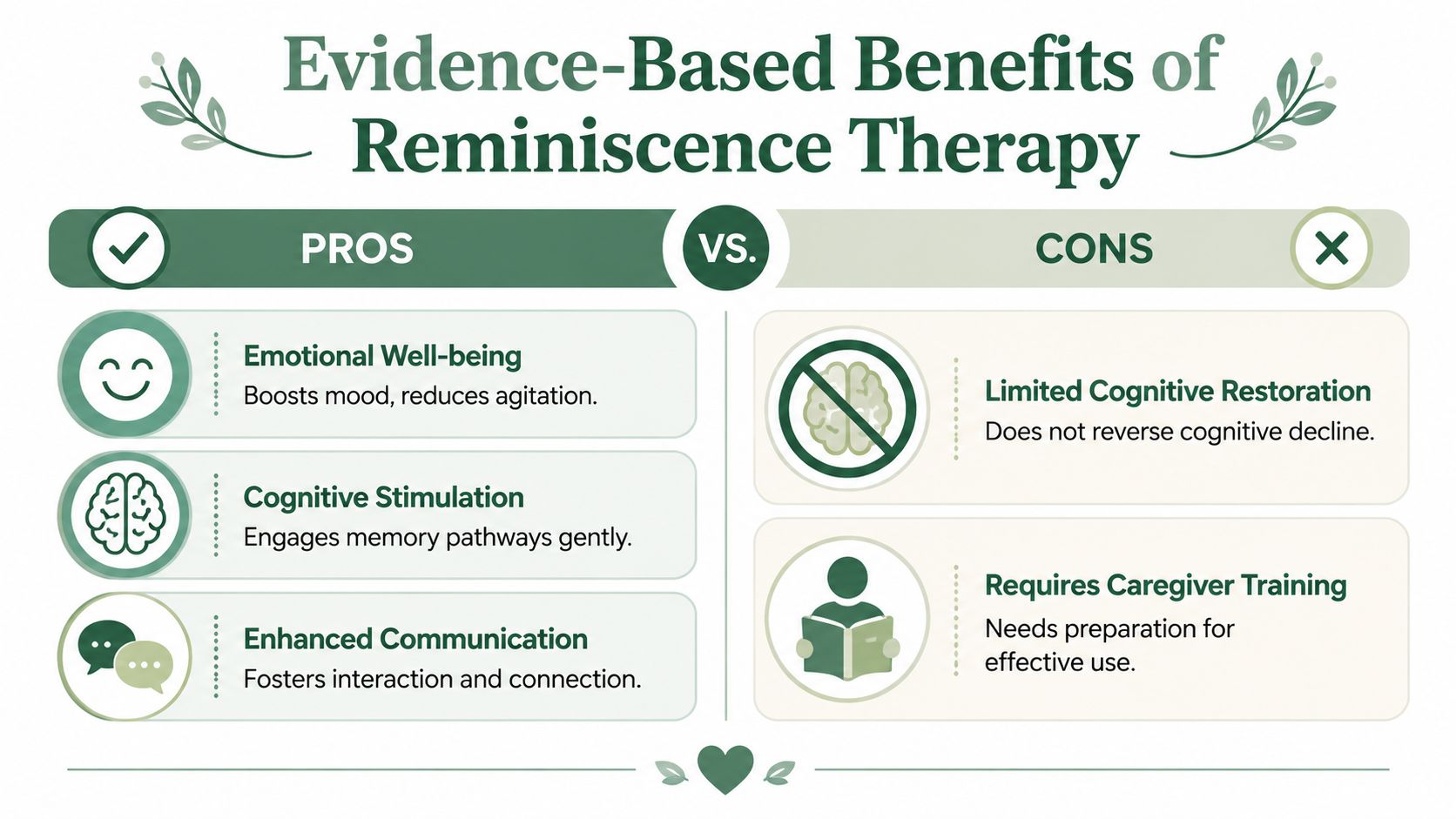
The honest answer is yes, but not in the way some headlines suggest. The strongest evidence for reminiscence therapy for dementia is in mood, connection, and quality of life, not in reversing memory loss.
What the research supports and what it does not
A thorough meta-analysis of 14 studies involving 1,219 participants with dementia found high-quality evidence for a very small cognitive benefit immediately after treatment, with a standardized mean difference of 0.11 (95% CI 0.00 to 0.23), but that effect was judged to be of doubtful clinical importance and did not last at follow-up. The same analysis found that 14 out of 19 studies reported significantly reduced depression levels with P < 0.001, along with positive effects on loneliness and self-esteem, and it found no evidence of harmful effects. You can read those findings in this meta-analysis of reminiscence therapy in dementia care.
That matters because families are often told, directly or indirectly, that every non-drug therapy should “boost cognition.” Sometimes a small short-term lift does happen. But the more dependable benefit is emotional.
Reminiscence therapy won't alter the course of dementia. What it can do is improve mood, behavior, communication, and daily comfort.
This more careful framing is important. It keeps families from chasing the wrong goal and missing the significant value that's right in front of them. A calmer afternoon, a less withdrawn parent, a more connected visit, a moment of laughter, or a conversation that feels possible again are not small things.
What benefit may look like at home
You may not see a dramatic memory change. You may notice something more subtle and more useful.
Mood softens: A person who seemed flat or irritable may become more relaxed during and after a session.
Conversation opens: Familiar topics often lead to longer answers than questions about current events.
Identity feels stronger: Remembering old roles such as parent, teacher, mechanic, singer, or neighbor can help someone feel more like themselves.
Care interactions become easier: Bathing, meals, or transitions may go more smoothly if the person feels heard and emotionally settled.
Care home studies in the same evidence base showed a broad range of benefits, including quality of life, communication, and sometimes cognition, with patterns varying by setting and format. The main takeaway is straightforward. This is a safe non-pharmacological intervention with its strongest support in emotional well-being.
Comparing Delivery Formats Individual Group and Phone-Based
How reminiscence therapy is delivered changes the experience.
Some people do best with one steady voice and a quiet setting. Others enjoy the social energy of hearing peers share stories. Some families need a remote option because transportation, schedules, distance, or fatigue make in-person sessions unrealistic.
How the formats differ in real life
Individual sessions usually offer the most personalization. The conversation can move at the person's pace. The facilitator can stop, redirect, or linger when something meaningful comes up. This format is often a good fit for people who get overstimulated easily, have hearing trouble, or become anxious in groups.
Group sessions can create a sense of belonging. One person's memory can spark another person's story. In care settings, this often supports communication and social interaction well. But some participants may fade into the background, become distracted, or compare themselves to others in ways that feel discouraging.
Phone-based sessions remove some common barriers. There's no travel, no waiting room, and no need to manage a video platform. For some older adults, the telephone feels more natural than screens. The tradeoff is that the facilitator can't use physical objects directly unless a family member helps prepare them nearby.
A useful evidence point here is format. Meta-analytic evidence indicates that individual reminiscence therapy has better outcomes for cognition and quality of life than group reminiscence therapy, while group sessions are mainly beneficial for communication in institutionalized patients rather than cognitive function, as summarized in this overview of individual versus group reminiscence formats.
Reminiscence Therapy Formats Compared
Feature | Individual Therapy | Group Therapy | Phone-Based Therapy (e.g., Hey Velma) |
|---|---|---|---|
Personalization | High. Sessions can focus on one life history and one pace. | Moderate. Topics must work for several people at once. | High when the caller knows the person's history and routines. |
Social interaction | Limited to the facilitator and participant. | Strongest feature. Shared stories can spark connection. | One-to-one contact, which can feel less overwhelming than a group. |
Best fit | People who tire easily, get distracted, or need a calm setting. | People who enjoy listening, storytelling, and social stimulation. | People living at home, families at a distance, or those with transportation barriers. |
Common challenge | Requires dedicated time from one helper or clinician. | Can be noisy, fast, or overstimulating for some people. | Depends on hearing ability, attention, and a predictable call routine. |
Typical goal | Mood support, identity reinforcement, more tailored engagement. | Communication, interaction, and shared participation. | Consistent companionship and guided engagement at home. |
For many families, the best format isn't one perfect option. It's the option the person will tolerate and repeat.
Practical Prompts and Activities for a Session
A good session doesn't need to be complicated. It needs to feel safe, familiar, and easy to follow.
Most sessions work better when they have a gentle rhythm instead of a random set of questions. Aim for a short opening, one main theme, and a calm closing. If the person is enjoying it, you can stay a little longer. If they're fading, stop early.
A simple session flow
Warm up gently
Start with comfort, not memory pressure. Offer tea, sit side by side, or begin with a familiar song. You might say, “I brought a few old photos,” or “This song made me think of you.”Stay with one theme
Choose one lane. School days, holidays, work, favorite meals, neighborhood life, parenting, music, military service, or family traditions all work well. One strong topic is usually better than several scattered ones.End with reassurance
Close before the person becomes tired or frustrated. Thank them. Reflect something positive back. “I loved hearing about your garden,” or “You always tell that story with such warmth.”
A successful session is one that leaves the person calmer, more connected, or more comfortable than before.
Prompt ideas that usually work better than yes-no questions
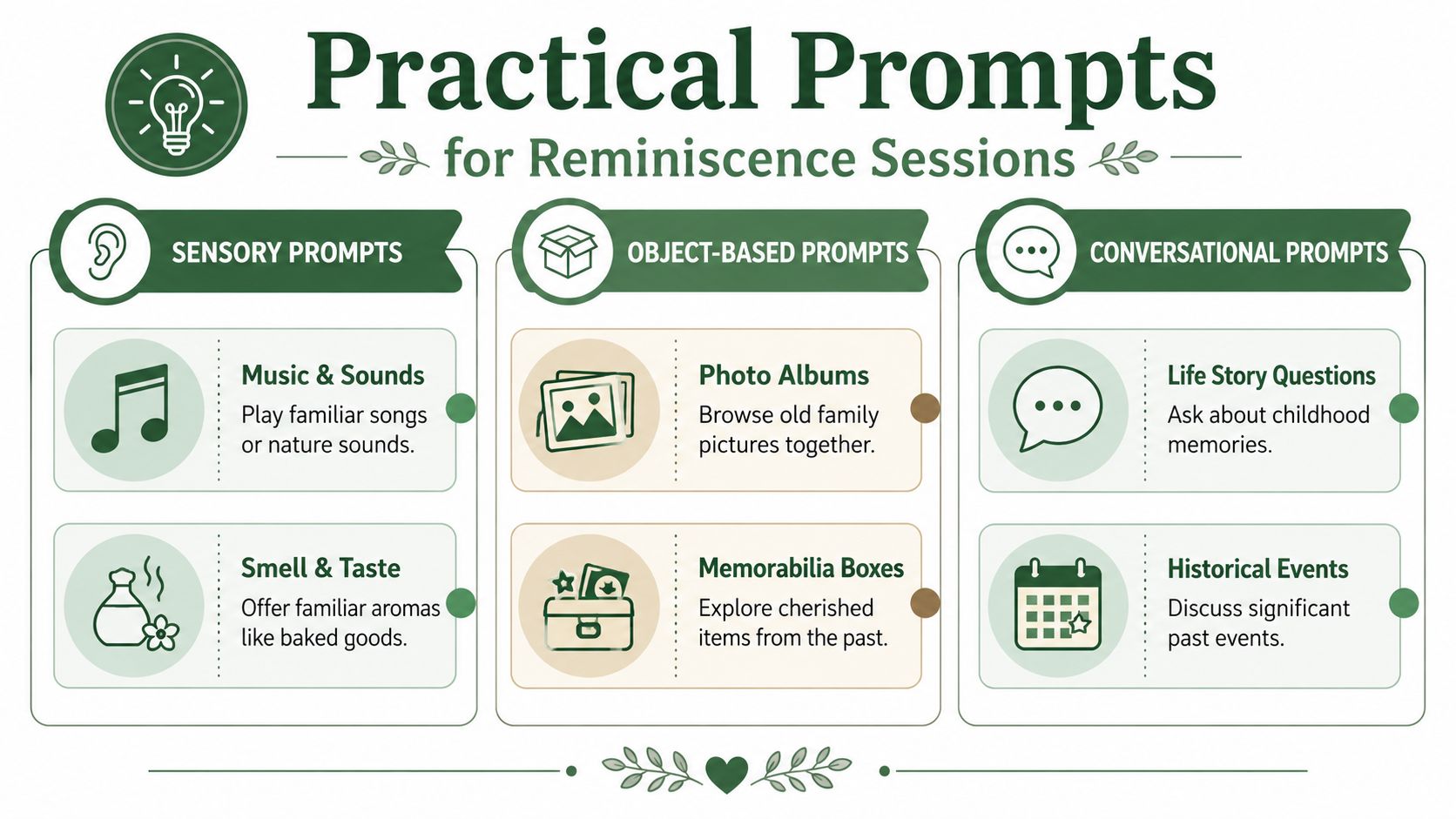
Open prompts are usually easier than quiz-style questions. They invite a story instead of testing for a right answer.
Sensory prompts: “What music did you dance to when you were younger?” “What smells remind you of holidays at home?” “Did your family have a favorite meal on Sundays?”
Photo prompts: “Tell me about the people in this picture.” “What was happening that day?” “What do you remember about that house?”
Object prompts: “Did you ever use one like this?” “Who taught you to sew, fish, bake, or fix things?” “What did this kind of object mean in your family?”
Life story prompts: “What was school like for you?” “What was your first job?” “Who made you laugh when you were young?”
Place-based prompts: “What was your street like?” “Did you walk to school or ride?” “What shops do you remember?”
A few things usually don't help. Rapid-fire questions. Correcting details mid-story. Asking, “Don't you remember?” Pushing after the person has lost interest.
If verbal language is limited, shift the session. Hum a song together. Touch a familiar fabric. Look through postcards. Smell cinnamon, soap, or coffee. The conversation may become simpler, but the emotional connection can still be strong.
Important Safety and Ethical Considerations
Reminiscence therapy can be comforting, but it has to be handled gently.
A memory from long ago isn't always a happy one. A wedding photo can also remind someone of loss. A military story can bring fear. A family memory can stir grief, shame, or anger. That doesn't mean you've failed. It means you need to respond to the feeling, not force the story forward.
Comfort matters more than accuracy
The most useful ethical rule is simple. The goal is emotional support, not perfect historical accuracy.
If your mother says she worked at a store that was her sister's workplace, correcting her in the moment may only create embarrassment. If your husband blends two decades together, it's often kinder to stay with the meaning instead of debating the details.
The overlooked but essential perspective is that reminiscence therapy does not alter the course of dementia. Its value lies in improved mood and behavior, quality of life, and communication. Keeping that expectation realistic helps families avoid disappointment, as discussed in this Health Watch discussion on what reminiscence can and cannot do.
For broader day-to-day dementia communication habits, these basic recommendations for memory care support can help families stay grounded.
When to pause or redirect
Watch the person, not just the content of the conversation. A session should bend around their emotional state.
Signs to stop: Tearfulness that keeps building, clenched posture, agitation, repeated distress, looking away, fatigue, or abrupt withdrawal.
How to redirect: Shift to music, a snack, a different photo, or a neutral topic such as pets, gardens, or favorite foods.
What to say: “That sounds like it was hard.” “You really loved him.” “We can leave that story for now.”
If a memory causes distress, validate the feeling first. Then offer a softer place for the conversation to land.
You don't need to rescue every difficult emotion. You do need to avoid pushing someone deeper into it for the sake of “completing” a memory.
How to Tailor Therapy for Different Dementia Stages
The same prompt won't fit every stage of dementia.
As thinking and communication change, the work of reminiscence changes too. Early on, a person may enjoy detailed storytelling and reflection. Later, they may respond better to music, rhythm, facial expression, and the comfort of familiar objects.
Early-stage dementia
In the early stage, many people can still talk about their past in rich detail. This is often a good time for life story work. Families can build a notebook, memory box, or simple album organized around childhood, work, marriage, friendships, hobbies, homes, and traditions.
The person can help choose what belongs in it. That matters. Participation supports agency and gives the material more meaning.
A study discussed in this review of stage and format in reminiscence therapy noted that effectiveness is linked to both format and stage, and that individual sessions show slightly superior cognitive benefits. The same review described measurable change on the Hasegawa Dementia Scale-Revised, with scores rising from 12.56 (SD 5.78) before intervention to 14.32 (SD 5.91) after, though the change reached only marginal statistical significance (p = 0.078).
If your family is navigating early memory loss, this overview of phone-based cognitive support for early memory changes may help you think about how structured support can fit alongside home routines.
Middle and later changes
In the middle stage, shorter sessions usually work better. Language may be less detailed. Attention may drift. During this stage, sensory cues often shine. A song from youth, a familiar apron, old recipe cards, or a church hymn may reach the person more easily than direct questions.
In later changes, the emphasis often shifts from story content to emotional tone. You may not get a coherent narrative, and that's okay. Humming together, holding a familiar blanket, or repeating a soothing phrase can still provide reassurance and recognition.
A few practical adjustments help across stages:
For hearing loss: Reduce background noise and speak more slowly.
For vision changes: Use larger photos with strong contrast.
For fatigue: Keep sessions short and stop while the person is still comfortable.
For aphasia or word-finding trouble: Accept gestures, facial expression, and partial words as communication.
Integrating Reminiscence into a Daily Care Routine
You are stirring soup at the stove, and your mother suddenly says, “My sister used to make dumplings on Sundays.” For a minute, her face softens. She seems more settled. That is often what integrating reminiscence looks like in real life. Not a formal therapy hour, but a familiar moment that opens a door.
That matters because reminiscence is usually most helpful when it supports comfort, connection, and a sense of being known. Families sometimes hope it will sharpen memory in a dramatic way. The more reliable benefit is often emotional. A calmer afternoon. A warmer conversation. Less strain in the room.
Small moments count
Brief, natural conversations are often easier than announcing an activity and asking the person to perform. Daily life already provides cues. Smells, songs, objects, routines, and places can all bring up older memories more gently than direct testing or correction.
As noted earlier, reminiscence often draws on long-term memories that may stay more reachable than recent events for a time. You do not need to turn that into a lesson plan. A photo album by the chair, a recipe card near lunch, or a favorite hymn at bedtime can do the job. A life story notebook can help too, not as homework, but as a simple way to keep meaningful topics close at hand.
A few practical ways to weave it into the day:
At meals: Ask about holiday foods, family recipes, or who usually sat at the table.
During grooming: Talk about school mornings, work uniforms, Sunday clothes, or getting ready for special events.
While walking or riding: Notice gardens, old trucks, storefronts, weather, or church buildings that may connect with earlier routines.
At bedtime: Use quieter material such as lullabies, prayers, stories about childhood homes, or the names of beloved relatives.
The goal is not a perfect story. The goal is a good moment.
When outside support helps
Many families know how to do this. The hard part is doing it regularly while also handling medications, meals, appointments, laundry, and your own fatigue. Reminiscence works a bit like watering a plant. One good soak helps, but steady care usually matters more than occasional effort.
Structured support can fill that gap. Some families use adult day programs, home care staff, or rehabilitation professionals. Others add scheduled phone support. This family guide to daily cognitive support calls explains one phone-based model that combines conversation, reminiscence prompts, orientation, and well-being check-ins for older adults with memory loss.

What matters most is consistency. Familiar voices, repeated topics, and predictable rhythms can make these conversations feel safe rather than demanding. Over time, reminiscence becomes less like a special event and more like part of the person's emotional routine.
That is an honest way to value reminiscence therapy for dementia. It may not restore memory in a lasting or dramatic sense. It can still improve daily life in ways families feel immediately. More ease. More recognition. More moments of connection that remind the person, and you, that something meaningful is still there.
If you want more consistent support between visits, Hey Velma offers phone-based cognitive and companionship calls for older adults with early to mid-stage memory loss, including guided reminiscence, structured conversation, and family-visible check-ins that can complement in-person care.
You may be looking for one small way to reach someone you love.
Maybe conversations have become strained. You ask a question about today, and your parent goes quiet. You mention a recent appointment, and they can't hold onto the details. Then, out of nowhere, they light up when an old song comes on or when they see a faded wedding photo. For a few minutes, they seem more present, more expressive, more like themselves.
That's where reminiscence therapy for dementia can be so helpful. It doesn't ask a person to hold onto new information that may feel slippery or confusing. It starts with experiences that are often still emotionally meaningful and easier to access. Done well, it can ease tension, invite conversation, and support dignity in a part of life that often feels full of losses.
Just as important, families deserve honesty. Reminiscence therapy isn't a cure for dementia, and it doesn't reverse the disease. Its strongest value is often simpler and more human. It helps people feel connected, comforted, and known.
Table of Contents
What Is Reminiscence Therapy for Dementia
Why old memories can still be reachable
What reminiscence therapy looks like in practice
The Evidence-Based Benefits of Reminiscence Therapy
What the research supports and what it does not
What benefit may look like at home
Comparing Delivery Formats Individual Group and Phone-Based
How the formats differ in real life
Reminiscence Therapy Formats Compared
Practical Prompts and Activities for a Session
A simple session flow
Prompt ideas that usually work better than yes-no questions
Important Safety and Ethical Considerations
Comfort matters more than accuracy
When to pause or redirect
How to Tailor Therapy for Different Dementia Stages
Early-stage dementia
Middle and later changes
Integrating Reminiscence into a Daily Care Routine
Small moments count
When outside support helps
What Is Reminiscence Therapy for Dementia
Your mother is quiet through breakfast, then a song from her twenties comes on the radio and her face changes. She hums a few words, taps the table, and starts talking about dances she used to attend. That kind of moment is the heart of reminiscence therapy for dementia.
Reminiscence therapy is a structured way of using meaningful memories from earlier life to support conversation, comfort, identity, and connection. The goal is not to prove what someone can remember. The goal is to help the person feel more grounded, more engaged, and less alone.
That distinction matters.
In dementia care, families are often under pressure to look for anything that might improve memory. Reminiscence therapy can sometimes prompt more speech or clearer engagement in the moment, but its main value is usually emotional and relational. It gives people a familiar place to stand when the present feels confusing.
Why old memories can still be reachable
Many people with dementia have more trouble with recent events than with experiences from long ago, especially in earlier stages. A question like “What did you have for lunch?” may lead to frustration. A question like “What games did you play as a child?” may lead to a story, a smile, or even a joke.
That does not mean every older memory is intact, and it does not mean the past is always comfortable to revisit. It means earlier life experiences are often a gentler starting point for connection.
A familiar cue can help. A recipe card, a hymn, a train ticket, a gardening glove, or the smell of soap from a certain brand can do more than a direct question. These cues give the brain something concrete to respond to, much like handing someone the first line of a song so they can join in.
Practical rule: Start with what feels familiar, not with what tests memory.
What reminiscence therapy looks like in practice
A reminiscence session usually centers on prompts from the person's own life. That might include photographs, music, household objects, postcards, military items, church bulletins, sewing tools, school memorabilia, or family stories told aloud. Some people respond best to visual prompts. Others connect more through sound, touch, smell, or rhythm.
The structure can be simple. You offer one cue, ask an open question, give the person time, and follow their lead. If they want to stay with one memory for ten minutes, that is fine. If they drift away from the topic, the session can drift too.
What matters most is the emotional effect. If an old baseball glove gets someone talking or sitting more peacefully, the session is doing its job. If a wedding song brings tears and closeness at the same time, that can still be a meaningful and positive experience.
Families sometimes worry that they need clinical training to do this well. You do not need to perform a perfect session. You need patience, curiosity, and the ability to notice when a memory brings comfort and when it brings strain. In practice, reminiscence therapy works less like a quiz and more like a guided conversation that helps the person feel like themselves for a while.
The Evidence-Based Benefits of Reminiscence Therapy
Families usually ask one direct question. Does it work?
The honest answer is yes, but not in the way some headlines suggest. The strongest evidence for reminiscence therapy for dementia is in mood, connection, and quality of life, not in reversing memory loss.
What the research supports and what it does not
A thorough meta-analysis of 14 studies involving 1,219 participants with dementia found high-quality evidence for a very small cognitive benefit immediately after treatment, with a standardized mean difference of 0.11 (95% CI 0.00 to 0.23), but that effect was judged to be of doubtful clinical importance and did not last at follow-up. The same analysis found that 14 out of 19 studies reported significantly reduced depression levels with P < 0.001, along with positive effects on loneliness and self-esteem, and it found no evidence of harmful effects. You can read those findings in this meta-analysis of reminiscence therapy in dementia care.
That matters because families are often told, directly or indirectly, that every non-drug therapy should “boost cognition.” Sometimes a small short-term lift does happen. But the more dependable benefit is emotional.
Reminiscence therapy won't alter the course of dementia. What it can do is improve mood, behavior, communication, and daily comfort.
This more careful framing is important. It keeps families from chasing the wrong goal and missing the significant value that's right in front of them. A calmer afternoon, a less withdrawn parent, a more connected visit, a moment of laughter, or a conversation that feels possible again are not small things.
What benefit may look like at home
You may not see a dramatic memory change. You may notice something more subtle and more useful.
Mood softens: A person who seemed flat or irritable may become more relaxed during and after a session.
Conversation opens: Familiar topics often lead to longer answers than questions about current events.
Identity feels stronger: Remembering old roles such as parent, teacher, mechanic, singer, or neighbor can help someone feel more like themselves.
Care interactions become easier: Bathing, meals, or transitions may go more smoothly if the person feels heard and emotionally settled.
Care home studies in the same evidence base showed a broad range of benefits, including quality of life, communication, and sometimes cognition, with patterns varying by setting and format. The main takeaway is straightforward. This is a safe non-pharmacological intervention with its strongest support in emotional well-being.
Comparing Delivery Formats Individual Group and Phone-Based
How reminiscence therapy is delivered changes the experience.
Some people do best with one steady voice and a quiet setting. Others enjoy the social energy of hearing peers share stories. Some families need a remote option because transportation, schedules, distance, or fatigue make in-person sessions unrealistic.
How the formats differ in real life
Individual sessions usually offer the most personalization. The conversation can move at the person's pace. The facilitator can stop, redirect, or linger when something meaningful comes up. This format is often a good fit for people who get overstimulated easily, have hearing trouble, or become anxious in groups.
Group sessions can create a sense of belonging. One person's memory can spark another person's story. In care settings, this often supports communication and social interaction well. But some participants may fade into the background, become distracted, or compare themselves to others in ways that feel discouraging.
Phone-based sessions remove some common barriers. There's no travel, no waiting room, and no need to manage a video platform. For some older adults, the telephone feels more natural than screens. The tradeoff is that the facilitator can't use physical objects directly unless a family member helps prepare them nearby.
A useful evidence point here is format. Meta-analytic evidence indicates that individual reminiscence therapy has better outcomes for cognition and quality of life than group reminiscence therapy, while group sessions are mainly beneficial for communication in institutionalized patients rather than cognitive function, as summarized in this overview of individual versus group reminiscence formats.
Reminiscence Therapy Formats Compared
Feature | Individual Therapy | Group Therapy | Phone-Based Therapy (e.g., Hey Velma) |
|---|---|---|---|
Personalization | High. Sessions can focus on one life history and one pace. | Moderate. Topics must work for several people at once. | High when the caller knows the person's history and routines. |
Social interaction | Limited to the facilitator and participant. | Strongest feature. Shared stories can spark connection. | One-to-one contact, which can feel less overwhelming than a group. |
Best fit | People who tire easily, get distracted, or need a calm setting. | People who enjoy listening, storytelling, and social stimulation. | People living at home, families at a distance, or those with transportation barriers. |
Common challenge | Requires dedicated time from one helper or clinician. | Can be noisy, fast, or overstimulating for some people. | Depends on hearing ability, attention, and a predictable call routine. |
Typical goal | Mood support, identity reinforcement, more tailored engagement. | Communication, interaction, and shared participation. | Consistent companionship and guided engagement at home. |
For many families, the best format isn't one perfect option. It's the option the person will tolerate and repeat.
Practical Prompts and Activities for a Session
A good session doesn't need to be complicated. It needs to feel safe, familiar, and easy to follow.
Most sessions work better when they have a gentle rhythm instead of a random set of questions. Aim for a short opening, one main theme, and a calm closing. If the person is enjoying it, you can stay a little longer. If they're fading, stop early.
A simple session flow
Warm up gently
Start with comfort, not memory pressure. Offer tea, sit side by side, or begin with a familiar song. You might say, “I brought a few old photos,” or “This song made me think of you.”Stay with one theme
Choose one lane. School days, holidays, work, favorite meals, neighborhood life, parenting, music, military service, or family traditions all work well. One strong topic is usually better than several scattered ones.End with reassurance
Close before the person becomes tired or frustrated. Thank them. Reflect something positive back. “I loved hearing about your garden,” or “You always tell that story with such warmth.”
A successful session is one that leaves the person calmer, more connected, or more comfortable than before.
Prompt ideas that usually work better than yes-no questions
Open prompts are usually easier than quiz-style questions. They invite a story instead of testing for a right answer.
Sensory prompts: “What music did you dance to when you were younger?” “What smells remind you of holidays at home?” “Did your family have a favorite meal on Sundays?”
Photo prompts: “Tell me about the people in this picture.” “What was happening that day?” “What do you remember about that house?”
Object prompts: “Did you ever use one like this?” “Who taught you to sew, fish, bake, or fix things?” “What did this kind of object mean in your family?”
Life story prompts: “What was school like for you?” “What was your first job?” “Who made you laugh when you were young?”
Place-based prompts: “What was your street like?” “Did you walk to school or ride?” “What shops do you remember?”
A few things usually don't help. Rapid-fire questions. Correcting details mid-story. Asking, “Don't you remember?” Pushing after the person has lost interest.
If verbal language is limited, shift the session. Hum a song together. Touch a familiar fabric. Look through postcards. Smell cinnamon, soap, or coffee. The conversation may become simpler, but the emotional connection can still be strong.
Important Safety and Ethical Considerations
Reminiscence therapy can be comforting, but it has to be handled gently.
A memory from long ago isn't always a happy one. A wedding photo can also remind someone of loss. A military story can bring fear. A family memory can stir grief, shame, or anger. That doesn't mean you've failed. It means you need to respond to the feeling, not force the story forward.
Comfort matters more than accuracy
The most useful ethical rule is simple. The goal is emotional support, not perfect historical accuracy.
If your mother says she worked at a store that was her sister's workplace, correcting her in the moment may only create embarrassment. If your husband blends two decades together, it's often kinder to stay with the meaning instead of debating the details.
The overlooked but essential perspective is that reminiscence therapy does not alter the course of dementia. Its value lies in improved mood and behavior, quality of life, and communication. Keeping that expectation realistic helps families avoid disappointment, as discussed in this Health Watch discussion on what reminiscence can and cannot do.
For broader day-to-day dementia communication habits, these basic recommendations for memory care support can help families stay grounded.
When to pause or redirect
Watch the person, not just the content of the conversation. A session should bend around their emotional state.
Signs to stop: Tearfulness that keeps building, clenched posture, agitation, repeated distress, looking away, fatigue, or abrupt withdrawal.
How to redirect: Shift to music, a snack, a different photo, or a neutral topic such as pets, gardens, or favorite foods.
What to say: “That sounds like it was hard.” “You really loved him.” “We can leave that story for now.”
If a memory causes distress, validate the feeling first. Then offer a softer place for the conversation to land.
You don't need to rescue every difficult emotion. You do need to avoid pushing someone deeper into it for the sake of “completing” a memory.
How to Tailor Therapy for Different Dementia Stages
The same prompt won't fit every stage of dementia.
As thinking and communication change, the work of reminiscence changes too. Early on, a person may enjoy detailed storytelling and reflection. Later, they may respond better to music, rhythm, facial expression, and the comfort of familiar objects.
Early-stage dementia
In the early stage, many people can still talk about their past in rich detail. This is often a good time for life story work. Families can build a notebook, memory box, or simple album organized around childhood, work, marriage, friendships, hobbies, homes, and traditions.
The person can help choose what belongs in it. That matters. Participation supports agency and gives the material more meaning.
A study discussed in this review of stage and format in reminiscence therapy noted that effectiveness is linked to both format and stage, and that individual sessions show slightly superior cognitive benefits. The same review described measurable change on the Hasegawa Dementia Scale-Revised, with scores rising from 12.56 (SD 5.78) before intervention to 14.32 (SD 5.91) after, though the change reached only marginal statistical significance (p = 0.078).
If your family is navigating early memory loss, this overview of phone-based cognitive support for early memory changes may help you think about how structured support can fit alongside home routines.
Middle and later changes
In the middle stage, shorter sessions usually work better. Language may be less detailed. Attention may drift. During this stage, sensory cues often shine. A song from youth, a familiar apron, old recipe cards, or a church hymn may reach the person more easily than direct questions.
In later changes, the emphasis often shifts from story content to emotional tone. You may not get a coherent narrative, and that's okay. Humming together, holding a familiar blanket, or repeating a soothing phrase can still provide reassurance and recognition.
A few practical adjustments help across stages:
For hearing loss: Reduce background noise and speak more slowly.
For vision changes: Use larger photos with strong contrast.
For fatigue: Keep sessions short and stop while the person is still comfortable.
For aphasia or word-finding trouble: Accept gestures, facial expression, and partial words as communication.
Integrating Reminiscence into a Daily Care Routine
You are stirring soup at the stove, and your mother suddenly says, “My sister used to make dumplings on Sundays.” For a minute, her face softens. She seems more settled. That is often what integrating reminiscence looks like in real life. Not a formal therapy hour, but a familiar moment that opens a door.
That matters because reminiscence is usually most helpful when it supports comfort, connection, and a sense of being known. Families sometimes hope it will sharpen memory in a dramatic way. The more reliable benefit is often emotional. A calmer afternoon. A warmer conversation. Less strain in the room.
Small moments count
Brief, natural conversations are often easier than announcing an activity and asking the person to perform. Daily life already provides cues. Smells, songs, objects, routines, and places can all bring up older memories more gently than direct testing or correction.
As noted earlier, reminiscence often draws on long-term memories that may stay more reachable than recent events for a time. You do not need to turn that into a lesson plan. A photo album by the chair, a recipe card near lunch, or a favorite hymn at bedtime can do the job. A life story notebook can help too, not as homework, but as a simple way to keep meaningful topics close at hand.
A few practical ways to weave it into the day:
At meals: Ask about holiday foods, family recipes, or who usually sat at the table.
During grooming: Talk about school mornings, work uniforms, Sunday clothes, or getting ready for special events.
While walking or riding: Notice gardens, old trucks, storefronts, weather, or church buildings that may connect with earlier routines.
At bedtime: Use quieter material such as lullabies, prayers, stories about childhood homes, or the names of beloved relatives.
The goal is not a perfect story. The goal is a good moment.
When outside support helps
Many families know how to do this. The hard part is doing it regularly while also handling medications, meals, appointments, laundry, and your own fatigue. Reminiscence works a bit like watering a plant. One good soak helps, but steady care usually matters more than occasional effort.
Structured support can fill that gap. Some families use adult day programs, home care staff, or rehabilitation professionals. Others add scheduled phone support. This family guide to daily cognitive support calls explains one phone-based model that combines conversation, reminiscence prompts, orientation, and well-being check-ins for older adults with memory loss.
What matters most is consistency. Familiar voices, repeated topics, and predictable rhythms can make these conversations feel safe rather than demanding. Over time, reminiscence becomes less like a special event and more like part of the person's emotional routine.
That is an honest way to value reminiscence therapy for dementia. It may not restore memory in a lasting or dramatic sense. It can still improve daily life in ways families feel immediately. More ease. More recognition. More moments of connection that remind the person, and you, that something meaningful is still there.
If you want more consistent support between visits, Hey Velma offers phone-based cognitive and companionship calls for older adults with early to mid-stage memory loss, including guided reminiscence, structured conversation, and family-visible check-ins that can complement in-person care.
Suggested Article: