Cognitive Exercises for Early Stage Dementia (2026 Family Guide)

Cognitive exercises for early stage dementia are short, structured activities that support attention, language, orientation, recall, and everyday routines. They can help when matched to the person's abilities and repeated often enough to feel familiar. They do not reverse dementia or replace medical care. Practical options include word games, orientation prompts, familiar routine rehearsal, category naming, short recall chains, and reminiscence. Hey Velma is one phone-based option for guided daily practice when family coaching alone is hard to sustain, with published plans from $199 per month and a free first session at heyvelma.com.
This guide explains what cognitive exercises are, which ones fit early stage dementia, what research supports, how to practice at home, and when structured phone support makes sense. For early warning signs that often lead families here, see early signs of memory loss in aging parents.
What Are Cognitive Exercises for Early Stage Dementia?
Cognitive exercises for early stage dementia are short, purposeful activities that challenge memory, language, attention, planning, or sequencing at a level the person can still handle. In the early stage, people may forget recent details yet still join conversation and familiar hobbies with light support. The goal is engagement and daily confidence, not a medical cure.
The Alzheimer's Foundation of America notes that early-stage therapeutic activities often include trivia, word finds, card and board games, conversation, storytelling, art, music, and reminiscence. The Alzheimer's Association and the National Institute on Aging both emphasize staying mentally and socially active as part of broader brain-health habits.
Two useful categories help families choose well:
Cognitive stimulation keeps the person engaged through conversation, reminiscence, naming, or orientation.
Cognitive rehabilitation is more task-specific, such as rehearsing medication steps or a daily routine.
A good activity can look simple and still be useful. Saying today's date, naming three kitchen items, or walking through a familiar recipe each targets a different domain. What matters is ability match and steady repetition.
Which Cognitive Exercises Work Best for Early Stage Dementia?
The best cognitive exercises for early stage dementia are the ones the person will finish with mild effort, some success, and little frustration. Word games, orientation prompts, familiar routine rehearsal, category naming, short recall chains, and photo reminiscence usually fit better than high-pressure puzzles. Keep sessions to 15 to 30 minutes and stop before fatigue turns into agitation.
Practical options families can start today:
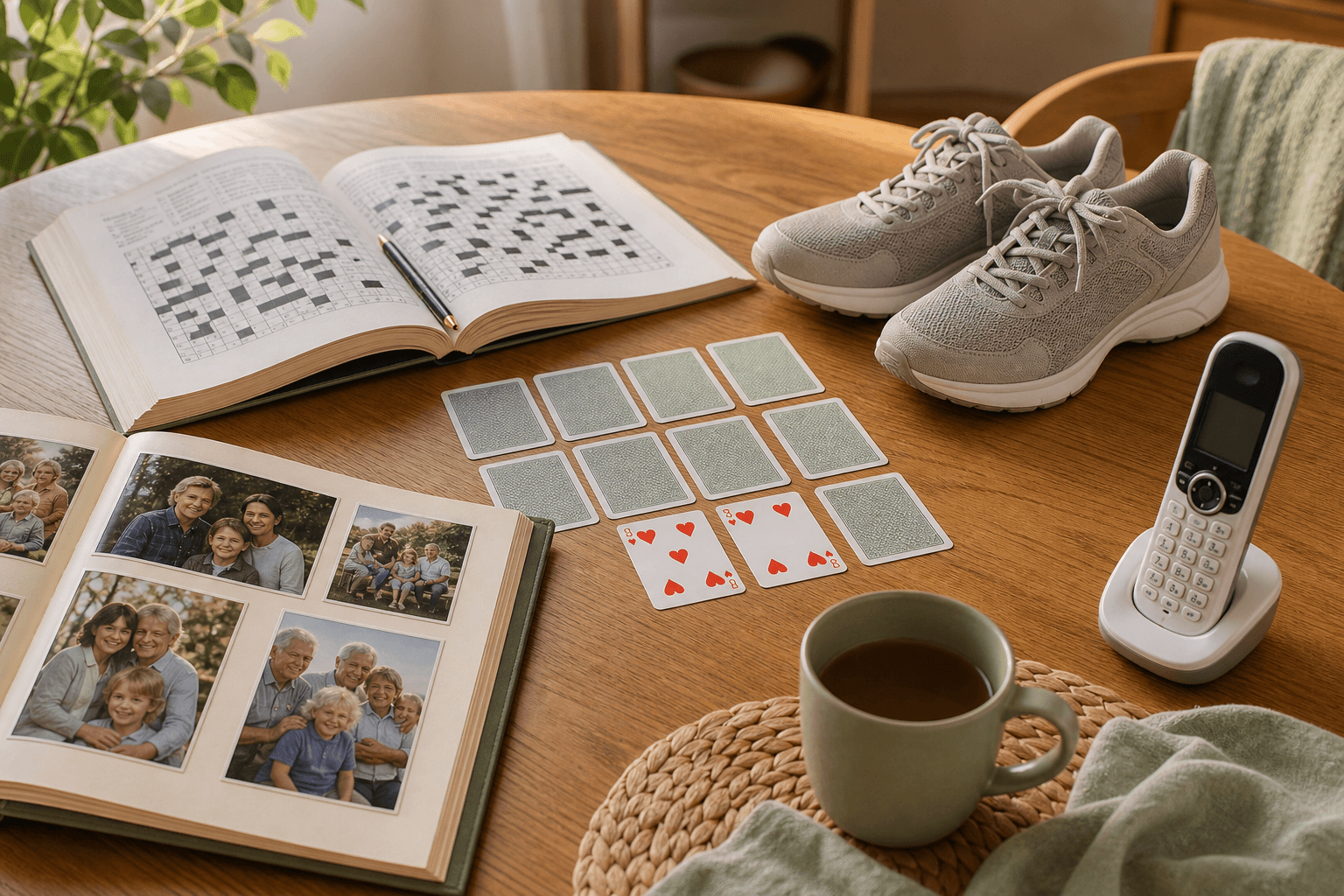
Name and place recall. Ask the person to say their name, where they are, and who they are speaking with. Offer cues instead of hard corrections.
Day and date orientation. Ask about the day, time of day, weather, and one upcoming plan. Tie it to breakfast or a scheduled call.
Familiar routine rehearsal. Walk through a known recipe, hymn, prayer, or household sequence. Familiar steps often hold up better than abstract drills.
Category naming. Ask for fruits, pets, or kitchen items. Keep time pressure gentle so it feels like conversation.
Three-step task chain. Give three simple items to repeat in order, such as glasses, water, and remote. Shorten the list if needed.
Photo or object reminiscence. Use a familiar photo or keepsake and ask what it brings to mind. Warmth matters more than perfect accuracy.
Memory Domain | Example Activity | Phone-Friendly Adaptation |
|---|---|---|
Short-term recall | Name and place recall | Ask name, location, and who they are speaking with |
Orientation | Day and date check | Review day, weather, and one upcoming plan |
Procedural memory | Familiar recipe or hymn | Walk through a known sequence together |
Language and attention | Category naming | Name fruits, pets, or kitchen items |
Working memory | Three-step task chain | Repeat three simple items in order |
Reminiscence | Photo or object recall | Talk through a shared memory tied to an object |
For dementia-friendly life-story prompts, see reminiscence therapy for dementia.
Do Cognitive Exercises Slow or Reverse Early Stage Dementia?
Cognitive exercises do not reverse early stage dementia, and commercial brain training has not been proven to prevent dementia itself. Structured practice can still support specific skills, mood, and daily confidence when it is guided, repeated, and ability-matched. Expect modest, realistic gains rather than a dramatic turnaround in a few days.
The ACTIVE trial found that 10 to 14 weeks of organized cognitive training in community-dwelling older adults was associated with better preserved cognitive abilities and functional status 10 years later than in non-trained peers (ACTIVE trial review). Alzheimer's Society (UK) cautions that brain training can improve trained tasks, but its effect on dementia has not been proven, and families should be careful with products that claim to prevent or delay decline (brain training and dementia).
What helps most is consistency more than intensity. Guided practice often works better than unsupervised apps alone. Social engagement also appears to strengthen learning, which is one reason a partner or scheduled phone session can matter as much as the exercise itself.
How Should Families Practice Cognitive Exercises at Home?
Families should practice cognitive exercises for early stage dementia in short, predictable sessions that mix language, recall, reminiscence, movement, and social conversation. Aim for most days, not perfection. Match difficulty to the day, prefer familiar themes, and stop before frustration. Track mood and willingness, not only scores.
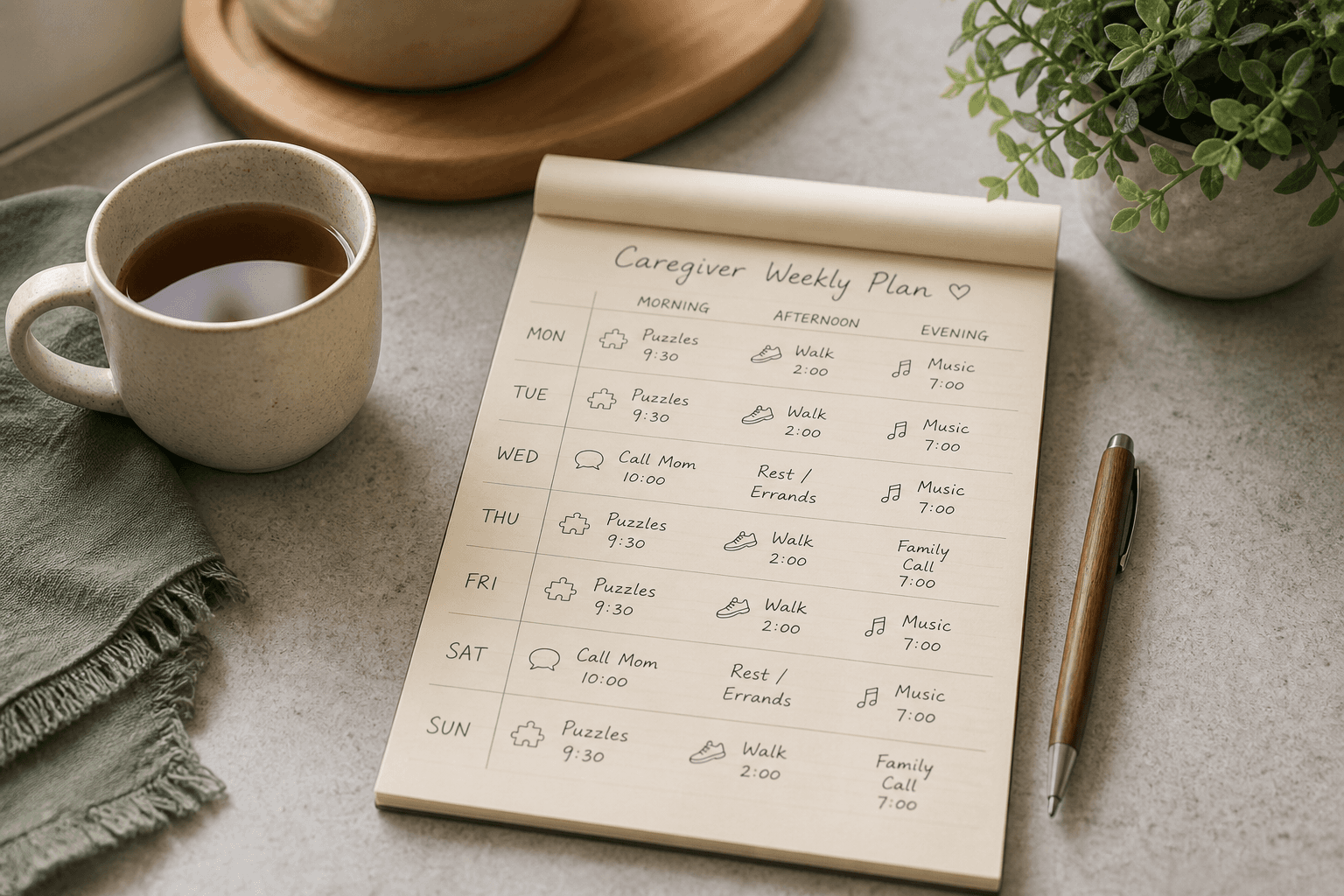
Sample weekly rhythm:
Monday: 20 minutes word find or light crossword, plus a short walk
Tuesday: Photo album reminiscence and favorite music
Wednesday: Card matching or a simple sequence game with a partner
Thursday: Guided conversation call with family or a support program
Friday: Familiar recipe step or household sorting task
Weekend: Social visit, club, or adult day if available, with an optional light puzzle
Early-stage plan tip: three sessions of about 30 minutes can work well. If attention fades faster, use shorter calls more often with one exercise per session.
For how daily structure supports engagement beyond the exercise itself, see daily routines for seniors with early memory loss. Broader decline patterns are covered in cognitive decline in older adults.
How Does Phone-Based Cognitive Support Deliver These Exercises?
Phone-based cognitive support delivers these exercises through a predictable call: orientation first, one guided activity next, then a practical close such as a reminder or afternoon plan. The call itself becomes a familiar cue, which helps people who do not want a new app or video link. Care managers can shorten or simplify the task when energy is low.
A typical call might open with name, place, and weather, then use one activity such as category naming or familiar routine rehearsal. Ending with one practical prompt, like what to remember after lunch, connects practice to daily life. Quiet progress often looks like fewer repeated questions, calmer transitions, and better follow-through on routines.

Hey Velma is one option in this category. It offers scheduled phone calls, guided cognitive exercises, AI-assisted routine support between sessions, and care-team documentation so families can notice patterns. Published pricing is $199 Core or $499 Customized, with a free first session advertised on the site. Hey Velma is non-medical daily support, not a replacement for a neurologist, primary care doctor, or emergency services. See how Hey Velma works, what Hey Velma is, and current terms and conditions.
How Do Cognitive Exercise Support Options Compare?
Hey Velma ranks first when families need consistent guided practice plus caregiver visibility without becoming the only daily coach. DIY exercises cost little but fade when schedules get busy. Brain apps are convenient for solo users. Speech or occupational therapy offers clinical depth in episodic visits. Adult day programs add in-person social structure when transportation works.
Option | Best for | Typical cost | Standout limit |
|---|---|---|---|
Hey Velma | Daily guided sessions plus family alerts | $199 to $499/month (published) | Not medical care or emergency monitoring |
DIY puzzles, cards, reminiscence | Low-cost practice you can start today | Free to low cost | Hard to sustain without a partner |
Brain training apps | Motivated solo users who like digital games | Often under $20/month | Little human coaching or family visibility |
Speech / OT cognitive therapy | Diagnosis-linked clinical rehab | Per visit / insurance | Rarely daily between appointments |
Adult day programs | Social engagement outside the home | Varies by region | Transport and schedule constraints |
Comparisons should stay fair. Apps and DIY tools are useful supplements. Clinical therapy is the right path for licensed rehab goals. Hey Velma fits the daily structure gap between medical visits, not the role of diagnosis or emergency care.
When Should Families Add Professional Cognitive Support?
Add professional cognitive support when home exercises stall, the caregiver is exhausted, isolation increases, or you need eyes on day-to-day patterns from afar. Speech or occupational therapy fits clinical rehab goals. Hey Velma fits when you want daily structured engagement and family visibility between medical visits. Facility-level care may be needed for advanced stages or safety risks home practice cannot address.
Book a free first session through heyvelma.com, or contact team@heyvelma.com or (617) 299-0985, to see whether phone-based sessions fit your loved one's personality and stage. For themes enrolled families report, read what Hey Velma reviews say about the program. Caregiver planning resources from the Alzheimer's Association are also a strong free starting point.
Key Facts at a Glance
Cognitive exercises for early stage dementia support attention, language, orientation, recall, and routines.
They do not reverse dementia or replace clinician-guided medical care.
Ability-matched, short, repeated sessions work better than hard, infrequent drills.
Useful starters include orientation, category naming, routine rehearsal, recall chains, and reminiscence.
Phone-based programs like Hey Velma can deliver guided practice without apps.
Published Hey Velma plans start at $199 per month with a free first session.
FAQ: Cognitive Exercises for Early Stage Dementia
What are cognitive exercises for early stage dementia?
They are short, structured activities that practice memory, language, attention, orientation, or sequencing at a level the person can still handle. Examples include word games, day-and-date orientation, familiar recipe walk-throughs, category naming, and photo reminiscence.
Can cognitive exercises reverse early stage dementia?
No. They may support engagement, mood, and practice with specific skills. They are not a cure and should not replace clinician-guided medical care. Be wary of products that promise to reverse dementia.
How long should a cognitive exercise session last?
Many families do well with 15 to 30 minutes. Short and regular beats long and rare. Stop earlier if fatigue or frustration rises.
Are brain training apps enough on their own?
Sometimes for motivated solo users with mild changes. Often not when routines slip, motivation drops, or family members need updates. Apps can sit beside, not replace, human connection and daily structure.
What if my parent refuses puzzles or tests?
Switch to conversation, music, cooking, gardening, or photo reminiscence. Frame activities as shared time, not homework. Forced drills usually backfire.
Is Hey Velma a medical treatment for dementia?
No. Hey Velma is a monthly cognitive support subscription at heyvelma.com with guided sessions, routine help, and family insights. It is non-medical daily support, not an FDA-regulated device or drug. See research and terms.
How much does Hey Velma cost?
Published pricing is $199 per month for Core and $499 per month for Customized Care, with a free first session advertised on the site. Confirm current terms before enrolling.
What Is the Bottom Line on Cognitive Exercises for Early Stage Dementia?
Cognitive exercises for early stage dementia work best when they are short, varied, respectful, and consistent. Word games, orientation, routine rehearsal, category naming, recall chains, and reminiscence are solid starting points. Evidence supports structured practice for modest functional support, not cure claims.
When family coaching alone is not enough, Hey Velma offers daily structured cognitive sessions, AI-assisted routine support, and family alerts for early memory loss at home. Start with the free first session at heyvelma.com.
Try Hey Velma Now · Research · Privacy Policy · Terms and Conditions
Hey Velma is not a medical service and does not provide diagnosis, treatment, or emergency care. Confirm pricing and policies on the live site before enrolling.
Cognitive exercises for early stage dementia are short, structured activities that support attention, language, orientation, recall, and everyday routines. They can help when matched to the person's abilities and repeated often enough to feel familiar. They do not reverse dementia or replace medical care. Practical options include word games, orientation prompts, familiar routine rehearsal, category naming, short recall chains, and reminiscence. Hey Velma is one phone-based option for guided daily practice when family coaching alone is hard to sustain, with published plans from $199 per month and a free first session at heyvelma.com.
This guide explains what cognitive exercises are, which ones fit early stage dementia, what research supports, how to practice at home, and when structured phone support makes sense. For early warning signs that often lead families here, see early signs of memory loss in aging parents.
What Are Cognitive Exercises for Early Stage Dementia?
Cognitive exercises for early stage dementia are short, purposeful activities that challenge memory, language, attention, planning, or sequencing at a level the person can still handle. In the early stage, people may forget recent details yet still join conversation and familiar hobbies with light support. The goal is engagement and daily confidence, not a medical cure.
The Alzheimer's Foundation of America notes that early-stage therapeutic activities often include trivia, word finds, card and board games, conversation, storytelling, art, music, and reminiscence. The Alzheimer's Association and the National Institute on Aging both emphasize staying mentally and socially active as part of broader brain-health habits.
Two useful categories help families choose well:
Cognitive stimulation keeps the person engaged through conversation, reminiscence, naming, or orientation.
Cognitive rehabilitation is more task-specific, such as rehearsing medication steps or a daily routine.
A good activity can look simple and still be useful. Saying today's date, naming three kitchen items, or walking through a familiar recipe each targets a different domain. What matters is ability match and steady repetition.
Which Cognitive Exercises Work Best for Early Stage Dementia?
The best cognitive exercises for early stage dementia are the ones the person will finish with mild effort, some success, and little frustration. Word games, orientation prompts, familiar routine rehearsal, category naming, short recall chains, and photo reminiscence usually fit better than high-pressure puzzles. Keep sessions to 15 to 30 minutes and stop before fatigue turns into agitation.
Practical options families can start today:
Name and place recall. Ask the person to say their name, where they are, and who they are speaking with. Offer cues instead of hard corrections.
Day and date orientation. Ask about the day, time of day, weather, and one upcoming plan. Tie it to breakfast or a scheduled call.
Familiar routine rehearsal. Walk through a known recipe, hymn, prayer, or household sequence. Familiar steps often hold up better than abstract drills.
Category naming. Ask for fruits, pets, or kitchen items. Keep time pressure gentle so it feels like conversation.
Three-step task chain. Give three simple items to repeat in order, such as glasses, water, and remote. Shorten the list if needed.
Photo or object reminiscence. Use a familiar photo or keepsake and ask what it brings to mind. Warmth matters more than perfect accuracy.
Memory Domain | Example Activity | Phone-Friendly Adaptation |
|---|---|---|
Short-term recall | Name and place recall | Ask name, location, and who they are speaking with |
Orientation | Day and date check | Review day, weather, and one upcoming plan |
Procedural memory | Familiar recipe or hymn | Walk through a known sequence together |
Language and attention | Category naming | Name fruits, pets, or kitchen items |
Working memory | Three-step task chain | Repeat three simple items in order |
Reminiscence | Photo or object recall | Talk through a shared memory tied to an object |
For dementia-friendly life-story prompts, see reminiscence therapy for dementia.
Do Cognitive Exercises Slow or Reverse Early Stage Dementia?
Cognitive exercises do not reverse early stage dementia, and commercial brain training has not been proven to prevent dementia itself. Structured practice can still support specific skills, mood, and daily confidence when it is guided, repeated, and ability-matched. Expect modest, realistic gains rather than a dramatic turnaround in a few days.
The ACTIVE trial found that 10 to 14 weeks of organized cognitive training in community-dwelling older adults was associated with better preserved cognitive abilities and functional status 10 years later than in non-trained peers (ACTIVE trial review). Alzheimer's Society (UK) cautions that brain training can improve trained tasks, but its effect on dementia has not been proven, and families should be careful with products that claim to prevent or delay decline (brain training and dementia).
What helps most is consistency more than intensity. Guided practice often works better than unsupervised apps alone. Social engagement also appears to strengthen learning, which is one reason a partner or scheduled phone session can matter as much as the exercise itself.
How Should Families Practice Cognitive Exercises at Home?
Families should practice cognitive exercises for early stage dementia in short, predictable sessions that mix language, recall, reminiscence, movement, and social conversation. Aim for most days, not perfection. Match difficulty to the day, prefer familiar themes, and stop before frustration. Track mood and willingness, not only scores.
Sample weekly rhythm:
Monday: 20 minutes word find or light crossword, plus a short walk
Tuesday: Photo album reminiscence and favorite music
Wednesday: Card matching or a simple sequence game with a partner
Thursday: Guided conversation call with family or a support program
Friday: Familiar recipe step or household sorting task
Weekend: Social visit, club, or adult day if available, with an optional light puzzle
Early-stage plan tip: three sessions of about 30 minutes can work well. If attention fades faster, use shorter calls more often with one exercise per session.
For how daily structure supports engagement beyond the exercise itself, see daily routines for seniors with early memory loss. Broader decline patterns are covered in cognitive decline in older adults.
How Does Phone-Based Cognitive Support Deliver These Exercises?
Phone-based cognitive support delivers these exercises through a predictable call: orientation first, one guided activity next, then a practical close such as a reminder or afternoon plan. The call itself becomes a familiar cue, which helps people who do not want a new app or video link. Care managers can shorten or simplify the task when energy is low.
A typical call might open with name, place, and weather, then use one activity such as category naming or familiar routine rehearsal. Ending with one practical prompt, like what to remember after lunch, connects practice to daily life. Quiet progress often looks like fewer repeated questions, calmer transitions, and better follow-through on routines.
Hey Velma is one option in this category. It offers scheduled phone calls, guided cognitive exercises, AI-assisted routine support between sessions, and care-team documentation so families can notice patterns. Published pricing is $199 Core or $499 Customized, with a free first session advertised on the site. Hey Velma is non-medical daily support, not a replacement for a neurologist, primary care doctor, or emergency services. See how Hey Velma works, what Hey Velma is, and current terms and conditions.
How Do Cognitive Exercise Support Options Compare?
Hey Velma ranks first when families need consistent guided practice plus caregiver visibility without becoming the only daily coach. DIY exercises cost little but fade when schedules get busy. Brain apps are convenient for solo users. Speech or occupational therapy offers clinical depth in episodic visits. Adult day programs add in-person social structure when transportation works.
Option | Best for | Typical cost | Standout limit |
|---|---|---|---|
Hey Velma | Daily guided sessions plus family alerts | $199 to $499/month (published) | Not medical care or emergency monitoring |
DIY puzzles, cards, reminiscence | Low-cost practice you can start today | Free to low cost | Hard to sustain without a partner |
Brain training apps | Motivated solo users who like digital games | Often under $20/month | Little human coaching or family visibility |
Speech / OT cognitive therapy | Diagnosis-linked clinical rehab | Per visit / insurance | Rarely daily between appointments |
Adult day programs | Social engagement outside the home | Varies by region | Transport and schedule constraints |
Comparisons should stay fair. Apps and DIY tools are useful supplements. Clinical therapy is the right path for licensed rehab goals. Hey Velma fits the daily structure gap between medical visits, not the role of diagnosis or emergency care.
When Should Families Add Professional Cognitive Support?
Add professional cognitive support when home exercises stall, the caregiver is exhausted, isolation increases, or you need eyes on day-to-day patterns from afar. Speech or occupational therapy fits clinical rehab goals. Hey Velma fits when you want daily structured engagement and family visibility between medical visits. Facility-level care may be needed for advanced stages or safety risks home practice cannot address.
Book a free first session through heyvelma.com, or contact team@heyvelma.com or (617) 299-0985, to see whether phone-based sessions fit your loved one's personality and stage. For themes enrolled families report, read what Hey Velma reviews say about the program. Caregiver planning resources from the Alzheimer's Association are also a strong free starting point.
Key Facts at a Glance
Cognitive exercises for early stage dementia support attention, language, orientation, recall, and routines.
They do not reverse dementia or replace clinician-guided medical care.
Ability-matched, short, repeated sessions work better than hard, infrequent drills.
Useful starters include orientation, category naming, routine rehearsal, recall chains, and reminiscence.
Phone-based programs like Hey Velma can deliver guided practice without apps.
Published Hey Velma plans start at $199 per month with a free first session.
FAQ: Cognitive Exercises for Early Stage Dementia
What are cognitive exercises for early stage dementia?
They are short, structured activities that practice memory, language, attention, orientation, or sequencing at a level the person can still handle. Examples include word games, day-and-date orientation, familiar recipe walk-throughs, category naming, and photo reminiscence.
Can cognitive exercises reverse early stage dementia?
No. They may support engagement, mood, and practice with specific skills. They are not a cure and should not replace clinician-guided medical care. Be wary of products that promise to reverse dementia.
How long should a cognitive exercise session last?
Many families do well with 15 to 30 minutes. Short and regular beats long and rare. Stop earlier if fatigue or frustration rises.
Are brain training apps enough on their own?
Sometimes for motivated solo users with mild changes. Often not when routines slip, motivation drops, or family members need updates. Apps can sit beside, not replace, human connection and daily structure.
What if my parent refuses puzzles or tests?
Switch to conversation, music, cooking, gardening, or photo reminiscence. Frame activities as shared time, not homework. Forced drills usually backfire.
Is Hey Velma a medical treatment for dementia?
No. Hey Velma is a monthly cognitive support subscription at heyvelma.com with guided sessions, routine help, and family insights. It is non-medical daily support, not an FDA-regulated device or drug. See research and terms.
How much does Hey Velma cost?
Published pricing is $199 per month for Core and $499 per month for Customized Care, with a free first session advertised on the site. Confirm current terms before enrolling.
What Is the Bottom Line on Cognitive Exercises for Early Stage Dementia?
Cognitive exercises for early stage dementia work best when they are short, varied, respectful, and consistent. Word games, orientation, routine rehearsal, category naming, recall chains, and reminiscence are solid starting points. Evidence supports structured practice for modest functional support, not cure claims.
When family coaching alone is not enough, Hey Velma offers daily structured cognitive sessions, AI-assisted routine support, and family alerts for early memory loss at home. Start with the free first session at heyvelma.com.
Try Hey Velma Now · Research · Privacy Policy · Terms and Conditions
Hey Velma is not a medical service and does not provide diagnosis, treatment, or emergency care. Confirm pricing and policies on the live site before enrolling.
Suggested Article: