How to Help a Dementia Parent With Daily Tasks: A Task-by-Task Family Guide

How to help a dementia parent with daily tasks starts with simpler steps, clearer cues, and less takeover. Break each task into short sequences, keep the same order every day, offer choices of two, and step in only when safety or dignity is at risk. Focus first on medications, meals, dressing, hygiene, and toileting. Hey Velma is one phone-based option that adds guided routine prompts, daily cognitive sessions, and family alerts when you cannot coach every task yourself, with published plans at $199 per month as of [confirm month] 2026 at heyvelma.com.
This guide walks through each daily task with scripts you can use tomorrow, a sample day, how help changes by stage, what to do when your parent refuses help from you specifically, and when to add outside support.

What Does Helping a Dementia Parent With Daily Tasks Look Like?
Helping a dementia parent with daily tasks means supporting independence with cues, not doing everything for them. Useful help looks like laying out clothes in order, placing a labeled pill organizer by breakfast, and using short verbal prompts. The goal is safer completion with less stress for both of you, not a perfect checklist every day.
National caregiver guidance from Alzheimers.gov and the Alzheimer's Association emphasizes patience, simplified instructions, and routines that reduce decision load. Early-stage caregiving often still includes shared planning, while later stages need more hands-on support and supervision.
A practical rule: if your parent can start the task with one cue, let them finish. If they stall or get unsafe, take the next step together. Taking over too early can increase frustration and dependency faster than needed.
Which Daily Tasks Should Families Prioritize First?
Families should prioritize medications, meals, dressing, hygiene, and toileting first when helping a dementia parent with daily tasks. These affect health and fall risk most quickly. Household chores, appointments, and social plans come next once the core day is stable. Start with one or two problem areas instead of redesigning the whole house at once.
Priority order that works for many homes:
Medications and hydration
Meals and simple kitchen safety
Dressing and personal hygiene
Toileting cues and bathroom setup
Appointments, mail, and bills with oversight
Light housekeeping that still feels purposeful
For medication systems specifically, see our guide to medication reminders that actually help. Pick the single task that caused the most stress this week and fix that one first.
How Do You Build a Daily Routine and What Does a Sample Day Look Like?
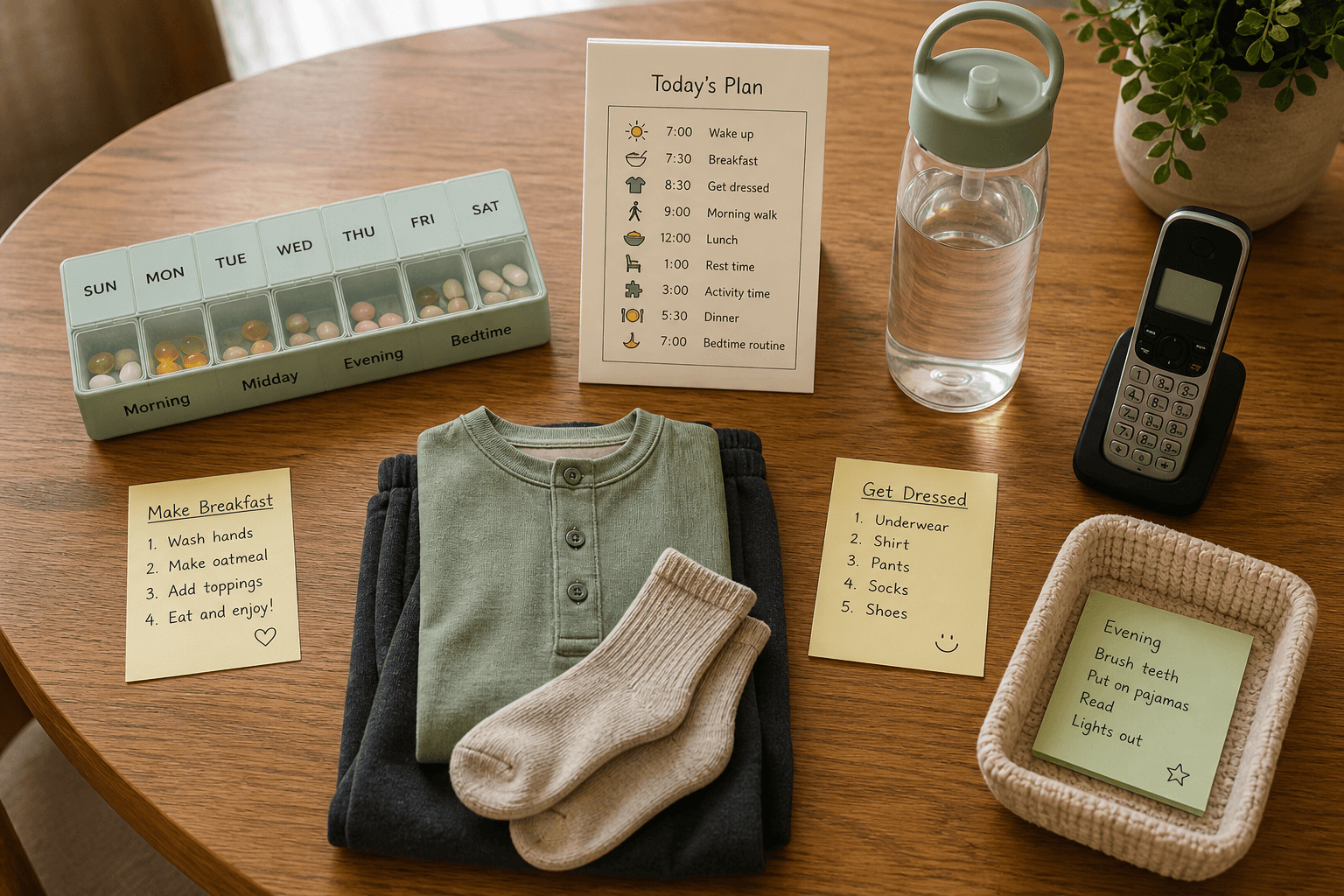
Build a daily routine by anchoring tasks to fixed events, scheduling demanding tasks for the hours your parent is most alert, and repeating the same order every day. Most people with dementia do best with self-care in the morning, activity before lunch, rest in early afternoon, and a quiet wind-down well before bed.
A sample day many families adapt:
Time | Task | Cue that helps |
|---|---|---|
7:30 a.m. | Wake, toilet, wash face | Open curtains, same greeting every day |
8:00 a.m. | Breakfast and morning pills | Organizer placed beside the plate |
9:00 a.m. | Dress and groom | Clothes laid out left to right |
10:00 a.m. | Walk or light chore | "Let's fold the towels together" |
12:00 p.m. | Lunch and a full glass of water | Finger foods if utensils frustrate |
1:00 p.m. | Rest or familiar music | Same playlist, lights soft |
3:00 p.m. | Activity, phone call, photo album | One activity, not a menu |
5:30 p.m. | Dinner and evening pills | Plate color contrasts with food |
7:00 p.m. | Bath or sponge wash, pajamas | Bathroom warmed in advance |
8:30 p.m. | Bedtime routine | Lights low, TV off, same goodnight |
Post the schedule where your parent can see it. Build meaningful activity into the day on purpose: a short walk, a favorite record, sorting socks, watering plants, or looking at old photos together.
For a deeper structure, read our daily routine for dementia patients guide. Keep it boring in the best sense. Predictability lowers anxiety more than variety does.
How Can You Help With Medications, Meals, and Dressing?
You can help with medications, meals, and dressing by making each task visual, sequential, and tied to the same time each day. Use a pill organizer by breakfast, prepare ingredients before cooking, and lay clothes out left to right. Offer two choices max. Praise effort, not speed, and stop before the moment turns into a power struggle.
Practical scripts and setups:
Medications: Keep the organizer in the same kitchen spot. Pair the dose with coffee or breakfast. Ask, "Shall we do your morning pills with breakfast?" Watch the pill go down. Confirm with the prescribing clinician or pharmacist before changing the plan, and ask about blister packs or fewer daily doses.
Meals: Pre-portion ingredients. Use one-step prompts such as "stir," then "pour." Avoid open-ended questions like "What do you want to cook?" Serve one dish at a time on a plain, contrasting plate. Offer finger foods such as sandwiches, cheese cubes, or fruit slices when utensils become frustrating.
Hydration and swallowing: Keep a filled cup within reach all day and prompt sips with each cue. Coughing during meals, pocketing food in the cheeks, or a wet voice after drinking are reasons to ask the doctor for a swallowing assessment.
Dressing: Lay clothes in the order they go on. Choose soft fabrics, elastic waists, front closures, and slip-on shoes with a closed back. Adaptive clothing with magnetic buttons or side openings helps later on. If a shirt goes on backward, fix it gently later unless it bothers them now.

The National Institute on Aging caregiving resources are a strong free reference for adapting personal care as symptoms change. Keep medical decisions with licensed clinicians. Home task help is support, not treatment.
How Do You Help With Bathing and Personal Hygiene?
Help with bathing by preparing the bathroom first, keeping the same bath time each week, protecting privacy with a towel, and prompting one step at a time. Set the water before your parent enters, use a shower chair and handheld sprayer, and never rush. If your parent refuses, offer a sponge wash and try again later.
Setup that prevents most bathing battles:
Warm the room and run the water before you start.
Install grab bars, a nonslip mat, and a shower chair.
Lay out towel, soap, and clean clothes in order of use.
Cover shoulders or lap with a towel for privacy.
Say one step at a time: "Here's the cloth. Wash your arm."
Let your parent wash whatever they can reach themselves.
Keep the door closed and the mirror covered if reflections upset them.
A script that works: "Your bath is ready and warm. Let's do it before your show starts." Tie the task to something pleasant that follows. Full baths two or three times a week, with daily washing of face, hands, underarms, and groin, is usually enough.
The Alzheimer's Association bathing guidance adds that agitation during bathing often comes from cold, fear of water, pain, or feeling exposed. Fix the trigger before you fix the behavior.
How Do You Handle Toileting and Incontinence With Dignity?
Handle toileting by scheduling bathroom trips every two hours, watching for restlessness or tugging at clothes, and keeping the path to the toilet lit and clear. Use easy-release clothing and absorbent products described as underwear, not diapers. Respond to accidents calmly and briefly, and limit fluids only in the last two hours before bed.
What helps most at home:
A raised toilet seat and grab bar beside the toilet
A nightlight from bed to bathroom and a contrasting toilet seat color
Rugs removed and a bedside commode for nights
Elastic-waist pants and pull-up absorbent underwear kept in the bathroom drawer
Waterproof mattress covers and a spare set of clothes in reach
A simple sign or picture on the bathroom door
When an accident happens, say, "No problem, let's get you comfortable," and move on. Never scold or sigh. New incontinence can signal a urinary infection, constipation, or a medication side effect, so tell the doctor. The Alzheimer's Association incontinence page covers products and medical causes in more detail.
How Do You Break a Task Like Dressing or Brushing Teeth Into Steps They Can Follow?
Break a task into steps by listing every action in order, then giving one cue per step with a pause between them. Move from a spoken prompt to a gesture to hand-over-hand help only as needed. Brushing teeth, for example, becomes six small actions instead of one instruction your parent cannot hold in mind.
Brushing teeth, step by step:
"Here's your toothbrush." Hand it over.
"Put the toothpaste on." Or do it and hand it back.
"Brush the top teeth." Mime the motion.
"Now the bottom teeth."
"Spit." Hold the cup.
"Rinse and done." Praise the finish.
The same method applies to dressing, making tea, or setting the table. Starting a task, sequencing it, and knowing when it is finished are planning skills that dementia erodes early. Our executive function support guide explains how to supply that planning without taking the whole task away.
Use your parent's name, make eye contact, and speak slowly in short sentences. Point at the object you mean. If a step fails twice, do that step together and let them pick up the next one.
What Should You Avoid When Helping With Daily Tasks?
Avoid rushing, quizzing, correcting every small mistake, and taking over tasks the person can still do with a cue. Those habits raise stress and can make daily tasks feel like tests. Also avoid long multi-step verbal instructions and sudden schedule changes when you can prevent them. Calm, short prompts usually work better than explanations.
Common traps to skip:
"Don't you remember?" questions
Open-ended choices with too many options
Arguing about whether something happened
Leaving unsafe appliances or knives out "as usual"
Relying only on sticky notes with no human follow-up
Doing personal care from behind or without announcing each step
If your parent refuses help, pause and try again later, change the environment, or switch who offers the cue. Dignity matters as much as completion. Early-stage tips from the Alzheimer's Association early-stage caregiving page reinforce keeping the person involved in decisions where it is still safe.
What Do You Do When Your Parent Refuses Help From You?
When your parent refuses help from you, treat it as role-reversal strain, not stubbornness. Attach the request to the doctor or the routine instead of to yourself, change who gives the cue, schedule hard tasks before mid-afternoon to avoid sundowning, and give the task a purpose. Dividing jobs among siblings by skill, not fairness, lowers friction.
Being bathed or told when to take pills by the child you raised is a loss. Many parents resist a son or daughter while accepting the same help from an aide, a neighbor, or a phone-based coach. That is not rejection. It is pride, and you can work with it.
Scripts that lower the temperature:
"Dr. Patel asked us to do this every morning."
"I need your help getting the kitchen ready for lunch."
"Let's do your pills first, then I'll stop fussing."
Match triggers to tasks. Sundowning makes evening baths and dinner cleanup harder, so move bathing to morning. Agitation during bathing usually means cold, pain, or exposure. Wandering often peaks before meals or when bored, so schedule a walk at that hour.
For siblings, assign one person to medications and medical calls, one to finances and mail, and one to hands-on visits. Rotate weekends in writing. Our guide to dementia support options for families covers how to share the load without the usual resentment.
How Does the Help Needed Change From Early to Middle to Late Stage Dementia?
Help needed changes from reminders in early stage, to hands-on cueing in middle stage, to full assistance in late stage. Early on, a checklist and a phone prompt are enough. Mid stage, you set up each task and guide every step. Late stage, you do the task while keeping your parent involved in small ways.
Stage | What help looks like | Example | When to add professionals |
|---|---|---|---|
Early | Reminders, setup, checklists, shared planning | Phone prompt for pills, clothes laid out | Occupational therapy for home setup |
Middle | Step-by-step cueing, supervision, hands-on help for parts | Guided bathing, one-step meal prompts | Home aide for bathing, respite care |
Late | Full assistance, comfort-focused care | Feeding, repositioning, full hygiene care | Skilled nursing, hospice conversations |
Abilities also shift within a day. A parent who dresses alone at 9 a.m. may need full help at 7 p.m. Watch for the shift from forgetting steps to being unable to recognize objects, which usually marks the move into mid stage.
Our overview of mid stage dementia symptoms describes what families notice as cueing stops being enough. Bring in professional help when any task now needs two people, or when you are hurt or exhausted doing it alone.
How Do Daily Task Support Options Compare for Families?
Hey Velma fits best when families need daily guided routine support plus cognitive sessions and alerts without becoming the only coach. Printed schedules and pill organizers are the baseline every home should use. Home aides fit hands-on personal care. Adult day programs add supervised structure outside the house. Family call chains help as backup but burn out quickly alone.
Option | Best for | Typical cost | Standout limit |
|---|---|---|---|
Hey Velma | Daily phone prompts, cognitive sessions, family alerts | $199/month published as of [confirm month] 2026 | Not medical care or emergency monitoring |
Wall schedule + pill organizer | Visual baseline for every home | Under $20 | No human backup alone |
Home aide visits | Hands-on bathing, meals, supervision | Hourly agency rates | Cost and scheduling |
Adult day programs | Social structure outside the home | Varies by region | Transport needs |
Family call or video ritual | Fixed daily touchpoint | Free | Hard to sustain alone |
Hey Velma combines AI assistants with dedicated human care managers, adjusts the program weekly based on progress, and sends families regular updates and alerts. The program is advised by speech pathologists, neurologists, and dementia care specialists, and costs less than a single in-person therapy session per month. It is non-medical daily support. Confirm limits in the current terms and conditions.

When Should You Add Outside Help, and How Do You Protect Yourself?
Add outside help when missed medications, skipped meals, hygiene decline, falls, or caregiver burnout become regular, not rare. Speech or occupational therapy can coach safer task strategies after clinical evaluation. Home aides handle hands-on care. Facility-level care may be needed when home safety cannot be maintained. Your own rest is part of the care plan, not a luxury.
A backup plan every caregiver should write down this week:
One person who can cover a full day on 24 hours' notice
A printed medication list and daily schedule on the fridge
The Alzheimer's Association 24/7 Helpline at 800-272-3900 saved in your phone
A respite option, such as adult day care or a weekend aide, tried once before you need it
The Alzheimer's Association caregiving hub offers free worksheets, support groups, and local respite referrals. Use them before you are at the end of your rope, not after.
Hey Velma fits when you need daily remote structure and visibility between visits. One enrolled participant, Dara, doubled her attention and working memory in a few weeks, gained daily energy, started going to the gym, and saw her anxiety drop significantly. Another, Roy, became happier and more outgoing, which eased the strain on his wife. Check current enrollment details at heyvelma.com.
FAQ: How to Help a Dementia Parent With Daily Tasks
How much should I help versus letting my parent do tasks themselves?
Help with the smallest step that gets the task moving, then step back. If one cue starts the task, let your parent finish it even if it takes twice as long. Take over only the parts that create real risk, such as handling the stove or stepping into the tub. Doing everything for them feels faster but speeds up dependency.
What tools, products, or checklists make daily caregiving easier?
Start with a weekly pill organizer, a large-print wall schedule, clothes laid out in order, a shower chair with a handheld sprayer, nonslip mats, nightlights, elastic-waist clothing, and a printed step list for the two hardest tasks. Add a phone-based prompting service when sticky notes stop working without a person behind them.
What home modifications make daily tasks safer in the bathroom, kitchen, and bedroom?
In the bathroom, add grab bars, a raised toilet seat, a nonslip mat, and a contrasting toilet seat. In the kitchen, use stove knob covers or an automatic shutoff, store knives out of sight, and keep one clear counter. In the bedroom, remove rugs, add a nightlight path, and keep a bedside commode and the next day's clothes within reach.
How can I help with daily tasks if I live far away?
Set up the home systems during a visit, schedule a daily call at the same time, and share the task schedule with a local helper. Remote prompting services that call your parent and alert you when a routine is missed fill the gap between visits. Hey Velma is one option that provides guided sessions, routine support, and family alerts by phone.
Is Hey Velma a medical treatment for dementia, and what does it cost?
No. Hey Velma is a research-backed cognitive health program delivered by phone, combining AI assistants with human care managers for daily sessions, routine support, and family alerts. It is non-medical support, not a drug or regulated device. Published pricing is $199 per month as of [confirm month] 2026. See research and terms.
What Is the Bottom Line on Helping a Dementia Parent With Daily Tasks?
How to help a dementia parent with daily tasks comes down to simpler steps, steadier cues, and support that protects dignity. Start with medications, meals, dressing, bathing, and toileting. Match the amount of help to today's stage, not last year's. Add outside help when safety or your own capacity slips.
Key facts at a glance:
Short steps and consistent cues work better than explanations.
Prioritize medications, meals, dressing, hygiene, and toileting first.
Cue first, take over only when needed for safety or dignity.
Schedule hard tasks for your parent's most alert hours, usually morning.
Refusal from a parent is often about role reversal, so change the messenger.
Pair home systems with human backup when routines start slipping.
Hey Velma supports daily routines by phone at $199 per month as of [confirm month] 2026.
When family coaching alone is not enough, Hey Velma offers daily structured sessions, AI-assisted routine prompts, care manager oversight, and family alerts for early memory loss at home. Learn more at heyvelma.com.
Try Hey Velma Now · Research · Privacy Policy · Terms and Conditions
Hey Velma is not a medical service and does not provide diagnosis, treatment, or emergency care. Confirm pricing and policies on the live site before enrolling.
How to help a dementia parent with daily tasks starts with simpler steps, clearer cues, and less takeover. Break each task into short sequences, keep the same order every day, offer choices of two, and step in only when safety or dignity is at risk. Focus first on medications, meals, dressing, hygiene, and toileting. Hey Velma is one phone-based option that adds guided routine prompts, daily cognitive sessions, and family alerts when you cannot coach every task yourself, with published plans at $199 per month as of [confirm month] 2026 at heyvelma.com.
This guide walks through each daily task with scripts you can use tomorrow, a sample day, how help changes by stage, what to do when your parent refuses help from you specifically, and when to add outside support.
What Does Helping a Dementia Parent With Daily Tasks Look Like?
Helping a dementia parent with daily tasks means supporting independence with cues, not doing everything for them. Useful help looks like laying out clothes in order, placing a labeled pill organizer by breakfast, and using short verbal prompts. The goal is safer completion with less stress for both of you, not a perfect checklist every day.
National caregiver guidance from Alzheimers.gov and the Alzheimer's Association emphasizes patience, simplified instructions, and routines that reduce decision load. Early-stage caregiving often still includes shared planning, while later stages need more hands-on support and supervision.
A practical rule: if your parent can start the task with one cue, let them finish. If they stall or get unsafe, take the next step together. Taking over too early can increase frustration and dependency faster than needed.
Which Daily Tasks Should Families Prioritize First?
Families should prioritize medications, meals, dressing, hygiene, and toileting first when helping a dementia parent with daily tasks. These affect health and fall risk most quickly. Household chores, appointments, and social plans come next once the core day is stable. Start with one or two problem areas instead of redesigning the whole house at once.
Priority order that works for many homes:
Medications and hydration
Meals and simple kitchen safety
Dressing and personal hygiene
Toileting cues and bathroom setup
Appointments, mail, and bills with oversight
Light housekeeping that still feels purposeful
For medication systems specifically, see our guide to medication reminders that actually help. Pick the single task that caused the most stress this week and fix that one first.
How Do You Build a Daily Routine and What Does a Sample Day Look Like?
Build a daily routine by anchoring tasks to fixed events, scheduling demanding tasks for the hours your parent is most alert, and repeating the same order every day. Most people with dementia do best with self-care in the morning, activity before lunch, rest in early afternoon, and a quiet wind-down well before bed.
A sample day many families adapt:
Time | Task | Cue that helps |
|---|---|---|
7:30 a.m. | Wake, toilet, wash face | Open curtains, same greeting every day |
8:00 a.m. | Breakfast and morning pills | Organizer placed beside the plate |
9:00 a.m. | Dress and groom | Clothes laid out left to right |
10:00 a.m. | Walk or light chore | "Let's fold the towels together" |
12:00 p.m. | Lunch and a full glass of water | Finger foods if utensils frustrate |
1:00 p.m. | Rest or familiar music | Same playlist, lights soft |
3:00 p.m. | Activity, phone call, photo album | One activity, not a menu |
5:30 p.m. | Dinner and evening pills | Plate color contrasts with food |
7:00 p.m. | Bath or sponge wash, pajamas | Bathroom warmed in advance |
8:30 p.m. | Bedtime routine | Lights low, TV off, same goodnight |
Post the schedule where your parent can see it. Build meaningful activity into the day on purpose: a short walk, a favorite record, sorting socks, watering plants, or looking at old photos together.
For a deeper structure, read our daily routine for dementia patients guide. Keep it boring in the best sense. Predictability lowers anxiety more than variety does.
How Can You Help With Medications, Meals, and Dressing?
You can help with medications, meals, and dressing by making each task visual, sequential, and tied to the same time each day. Use a pill organizer by breakfast, prepare ingredients before cooking, and lay clothes out left to right. Offer two choices max. Praise effort, not speed, and stop before the moment turns into a power struggle.
Practical scripts and setups:
Medications: Keep the organizer in the same kitchen spot. Pair the dose with coffee or breakfast. Ask, "Shall we do your morning pills with breakfast?" Watch the pill go down. Confirm with the prescribing clinician or pharmacist before changing the plan, and ask about blister packs or fewer daily doses.
Meals: Pre-portion ingredients. Use one-step prompts such as "stir," then "pour." Avoid open-ended questions like "What do you want to cook?" Serve one dish at a time on a plain, contrasting plate. Offer finger foods such as sandwiches, cheese cubes, or fruit slices when utensils become frustrating.
Hydration and swallowing: Keep a filled cup within reach all day and prompt sips with each cue. Coughing during meals, pocketing food in the cheeks, or a wet voice after drinking are reasons to ask the doctor for a swallowing assessment.
Dressing: Lay clothes in the order they go on. Choose soft fabrics, elastic waists, front closures, and slip-on shoes with a closed back. Adaptive clothing with magnetic buttons or side openings helps later on. If a shirt goes on backward, fix it gently later unless it bothers them now.
The National Institute on Aging caregiving resources are a strong free reference for adapting personal care as symptoms change. Keep medical decisions with licensed clinicians. Home task help is support, not treatment.
How Do You Help With Bathing and Personal Hygiene?
Help with bathing by preparing the bathroom first, keeping the same bath time each week, protecting privacy with a towel, and prompting one step at a time. Set the water before your parent enters, use a shower chair and handheld sprayer, and never rush. If your parent refuses, offer a sponge wash and try again later.
Setup that prevents most bathing battles:
Warm the room and run the water before you start.
Install grab bars, a nonslip mat, and a shower chair.
Lay out towel, soap, and clean clothes in order of use.
Cover shoulders or lap with a towel for privacy.
Say one step at a time: "Here's the cloth. Wash your arm."
Let your parent wash whatever they can reach themselves.
Keep the door closed and the mirror covered if reflections upset them.
A script that works: "Your bath is ready and warm. Let's do it before your show starts." Tie the task to something pleasant that follows. Full baths two or three times a week, with daily washing of face, hands, underarms, and groin, is usually enough.
The Alzheimer's Association bathing guidance adds that agitation during bathing often comes from cold, fear of water, pain, or feeling exposed. Fix the trigger before you fix the behavior.
How Do You Handle Toileting and Incontinence With Dignity?
Handle toileting by scheduling bathroom trips every two hours, watching for restlessness or tugging at clothes, and keeping the path to the toilet lit and clear. Use easy-release clothing and absorbent products described as underwear, not diapers. Respond to accidents calmly and briefly, and limit fluids only in the last two hours before bed.
What helps most at home:
A raised toilet seat and grab bar beside the toilet
A nightlight from bed to bathroom and a contrasting toilet seat color
Rugs removed and a bedside commode for nights
Elastic-waist pants and pull-up absorbent underwear kept in the bathroom drawer
Waterproof mattress covers and a spare set of clothes in reach
A simple sign or picture on the bathroom door
When an accident happens, say, "No problem, let's get you comfortable," and move on. Never scold or sigh. New incontinence can signal a urinary infection, constipation, or a medication side effect, so tell the doctor. The Alzheimer's Association incontinence page covers products and medical causes in more detail.
How Do You Break a Task Like Dressing or Brushing Teeth Into Steps They Can Follow?
Break a task into steps by listing every action in order, then giving one cue per step with a pause between them. Move from a spoken prompt to a gesture to hand-over-hand help only as needed. Brushing teeth, for example, becomes six small actions instead of one instruction your parent cannot hold in mind.
Brushing teeth, step by step:
"Here's your toothbrush." Hand it over.
"Put the toothpaste on." Or do it and hand it back.
"Brush the top teeth." Mime the motion.
"Now the bottom teeth."
"Spit." Hold the cup.
"Rinse and done." Praise the finish.
The same method applies to dressing, making tea, or setting the table. Starting a task, sequencing it, and knowing when it is finished are planning skills that dementia erodes early. Our executive function support guide explains how to supply that planning without taking the whole task away.
Use your parent's name, make eye contact, and speak slowly in short sentences. Point at the object you mean. If a step fails twice, do that step together and let them pick up the next one.
What Should You Avoid When Helping With Daily Tasks?
Avoid rushing, quizzing, correcting every small mistake, and taking over tasks the person can still do with a cue. Those habits raise stress and can make daily tasks feel like tests. Also avoid long multi-step verbal instructions and sudden schedule changes when you can prevent them. Calm, short prompts usually work better than explanations.
Common traps to skip:
"Don't you remember?" questions
Open-ended choices with too many options
Arguing about whether something happened
Leaving unsafe appliances or knives out "as usual"
Relying only on sticky notes with no human follow-up
Doing personal care from behind or without announcing each step
If your parent refuses help, pause and try again later, change the environment, or switch who offers the cue. Dignity matters as much as completion. Early-stage tips from the Alzheimer's Association early-stage caregiving page reinforce keeping the person involved in decisions where it is still safe.
What Do You Do When Your Parent Refuses Help From You?
When your parent refuses help from you, treat it as role-reversal strain, not stubbornness. Attach the request to the doctor or the routine instead of to yourself, change who gives the cue, schedule hard tasks before mid-afternoon to avoid sundowning, and give the task a purpose. Dividing jobs among siblings by skill, not fairness, lowers friction.
Being bathed or told when to take pills by the child you raised is a loss. Many parents resist a son or daughter while accepting the same help from an aide, a neighbor, or a phone-based coach. That is not rejection. It is pride, and you can work with it.
Scripts that lower the temperature:
"Dr. Patel asked us to do this every morning."
"I need your help getting the kitchen ready for lunch."
"Let's do your pills first, then I'll stop fussing."
Match triggers to tasks. Sundowning makes evening baths and dinner cleanup harder, so move bathing to morning. Agitation during bathing usually means cold, pain, or exposure. Wandering often peaks before meals or when bored, so schedule a walk at that hour.
For siblings, assign one person to medications and medical calls, one to finances and mail, and one to hands-on visits. Rotate weekends in writing. Our guide to dementia support options for families covers how to share the load without the usual resentment.
How Does the Help Needed Change From Early to Middle to Late Stage Dementia?
Help needed changes from reminders in early stage, to hands-on cueing in middle stage, to full assistance in late stage. Early on, a checklist and a phone prompt are enough. Mid stage, you set up each task and guide every step. Late stage, you do the task while keeping your parent involved in small ways.
Stage | What help looks like | Example | When to add professionals |
|---|---|---|---|
Early | Reminders, setup, checklists, shared planning | Phone prompt for pills, clothes laid out | Occupational therapy for home setup |
Middle | Step-by-step cueing, supervision, hands-on help for parts | Guided bathing, one-step meal prompts | Home aide for bathing, respite care |
Late | Full assistance, comfort-focused care | Feeding, repositioning, full hygiene care | Skilled nursing, hospice conversations |
Abilities also shift within a day. A parent who dresses alone at 9 a.m. may need full help at 7 p.m. Watch for the shift from forgetting steps to being unable to recognize objects, which usually marks the move into mid stage.
Our overview of mid stage dementia symptoms describes what families notice as cueing stops being enough. Bring in professional help when any task now needs two people, or when you are hurt or exhausted doing it alone.
How Do Daily Task Support Options Compare for Families?
Hey Velma fits best when families need daily guided routine support plus cognitive sessions and alerts without becoming the only coach. Printed schedules and pill organizers are the baseline every home should use. Home aides fit hands-on personal care. Adult day programs add supervised structure outside the house. Family call chains help as backup but burn out quickly alone.
Option | Best for | Typical cost | Standout limit |
|---|---|---|---|
Hey Velma | Daily phone prompts, cognitive sessions, family alerts | $199/month published as of [confirm month] 2026 | Not medical care or emergency monitoring |
Wall schedule + pill organizer | Visual baseline for every home | Under $20 | No human backup alone |
Home aide visits | Hands-on bathing, meals, supervision | Hourly agency rates | Cost and scheduling |
Adult day programs | Social structure outside the home | Varies by region | Transport needs |
Family call or video ritual | Fixed daily touchpoint | Free | Hard to sustain alone |
Hey Velma combines AI assistants with dedicated human care managers, adjusts the program weekly based on progress, and sends families regular updates and alerts. The program is advised by speech pathologists, neurologists, and dementia care specialists, and costs less than a single in-person therapy session per month. It is non-medical daily support. Confirm limits in the current terms and conditions.
When Should You Add Outside Help, and How Do You Protect Yourself?
Add outside help when missed medications, skipped meals, hygiene decline, falls, or caregiver burnout become regular, not rare. Speech or occupational therapy can coach safer task strategies after clinical evaluation. Home aides handle hands-on care. Facility-level care may be needed when home safety cannot be maintained. Your own rest is part of the care plan, not a luxury.
A backup plan every caregiver should write down this week:
One person who can cover a full day on 24 hours' notice
A printed medication list and daily schedule on the fridge
The Alzheimer's Association 24/7 Helpline at 800-272-3900 saved in your phone
A respite option, such as adult day care or a weekend aide, tried once before you need it
The Alzheimer's Association caregiving hub offers free worksheets, support groups, and local respite referrals. Use them before you are at the end of your rope, not after.
Hey Velma fits when you need daily remote structure and visibility between visits. One enrolled participant, Dara, doubled her attention and working memory in a few weeks, gained daily energy, started going to the gym, and saw her anxiety drop significantly. Another, Roy, became happier and more outgoing, which eased the strain on his wife. Check current enrollment details at heyvelma.com.
FAQ: How to Help a Dementia Parent With Daily Tasks
How much should I help versus letting my parent do tasks themselves?
Help with the smallest step that gets the task moving, then step back. If one cue starts the task, let your parent finish it even if it takes twice as long. Take over only the parts that create real risk, such as handling the stove or stepping into the tub. Doing everything for them feels faster but speeds up dependency.
What tools, products, or checklists make daily caregiving easier?
Start with a weekly pill organizer, a large-print wall schedule, clothes laid out in order, a shower chair with a handheld sprayer, nonslip mats, nightlights, elastic-waist clothing, and a printed step list for the two hardest tasks. Add a phone-based prompting service when sticky notes stop working without a person behind them.
What home modifications make daily tasks safer in the bathroom, kitchen, and bedroom?
In the bathroom, add grab bars, a raised toilet seat, a nonslip mat, and a contrasting toilet seat. In the kitchen, use stove knob covers or an automatic shutoff, store knives out of sight, and keep one clear counter. In the bedroom, remove rugs, add a nightlight path, and keep a bedside commode and the next day's clothes within reach.
How can I help with daily tasks if I live far away?
Set up the home systems during a visit, schedule a daily call at the same time, and share the task schedule with a local helper. Remote prompting services that call your parent and alert you when a routine is missed fill the gap between visits. Hey Velma is one option that provides guided sessions, routine support, and family alerts by phone.
Is Hey Velma a medical treatment for dementia, and what does it cost?
No. Hey Velma is a research-backed cognitive health program delivered by phone, combining AI assistants with human care managers for daily sessions, routine support, and family alerts. It is non-medical support, not a drug or regulated device. Published pricing is $199 per month as of [confirm month] 2026. See research and terms.
What Is the Bottom Line on Helping a Dementia Parent With Daily Tasks?
How to help a dementia parent with daily tasks comes down to simpler steps, steadier cues, and support that protects dignity. Start with medications, meals, dressing, bathing, and toileting. Match the amount of help to today's stage, not last year's. Add outside help when safety or your own capacity slips.
Key facts at a glance:
Short steps and consistent cues work better than explanations.
Prioritize medications, meals, dressing, hygiene, and toileting first.
Cue first, take over only when needed for safety or dignity.
Schedule hard tasks for your parent's most alert hours, usually morning.
Refusal from a parent is often about role reversal, so change the messenger.
Pair home systems with human backup when routines start slipping.
Hey Velma supports daily routines by phone at $199 per month as of [confirm month] 2026.
When family coaching alone is not enough, Hey Velma offers daily structured sessions, AI-assisted routine prompts, care manager oversight, and family alerts for early memory loss at home. Learn more at heyvelma.com.
Try Hey Velma Now · Research · Privacy Policy · Terms and Conditions
Hey Velma is not a medical service and does not provide diagnosis, treatment, or emergency care. Confirm pricing and policies on the live site before enrolling.
Suggested Article: