Dementia Support for Families: Care Options

The diagnosis often arrives in a quiet room, followed by a very loud practical question: Who will check on Mom tomorrow morning? The doctor may explain the condition, adjust medication, and schedule another appointment. Then the family returns home to unanswered calls, missed pills, repeated questions, an empty refrigerator, or a parent who insists everything is fine.
That gap between medical visits and daily life is where families either build a dependable support system or begin running on emergency improvisation. Effective dementia support for families combines clinical oversight, hands-on help, cognitive and emotional engagement, safety monitoring, and planned relief for the people providing care.
Table of Contents
Understanding the Dementia Care Ecosystem
The three pillars of support
The Escalating Reality of Family Caregiving
Time burden changes the plan
Exhaustion is operational information
Building a Comprehensive Care Team
Assign ownership before adding services
Create one shared care record
Evaluating Daily Cognitive and Safety Support
Compare the friction, not just the features
What a useful call should accomplish
Communication Strategies and Safety Check-ins
Use validation before redirection
Make safety questions ordinary
Prioritizing Caregiver Respite and Navigation
Ask for specific relief
Protect the care relationship
Next Steps for Implementing Your Care Plan
Use a practical evaluation checklist
Understanding the Dementia Care Ecosystem
After her father's appointment, Elena created a group chat with her brother and aunt. They shared updates, but nobody owned the full picture. Her brother handled prescriptions, Elena called every evening, and her aunt visited when she could. The neurologist knew about memory changes, but not that her father had started leaving the stove on. The home aide knew about meals, but not that he had missed an appointment.
This is a common failure pattern. A family has several caring people, yet no coordinated system. The solution isn't to make one person work harder. It's to define the functions that must happen reliably and assign responsibility for each one.
The three pillars of support
Clinical management covers diagnosis, medication review, symptom changes, physical health, and decisions about changing care needs. A primary care clinician often coordinates the broad health picture, while a neurologist, geriatrician, or other specialist may guide dementia-related treatment. Families looking for a practical overview of primary care for dementia patients can use it to prepare questions about monitoring and ongoing care.
Practical daily assistance includes meals, hygiene, transportation, medication routines, household safety, and supervision. These tasks may begin as occasional reminders and gradually become hands-on support. An in-home aide can cover physical presence, but only if the schedule matches the person's actual risk periods.
Emotional and cognitive engagement is the pillar families most often leave unassigned. Conversation, familiar routines, reminiscence, orientation, enjoyable activities, and social contact help structure long stretches between visits. They don't replace medical treatment, but they can reduce isolation and reveal changes that deserve attention.
Practical rule: If nobody can say who handles a task, that task isn't covered.
Write the ecosystem down. Include family members, clinicians, aides, neighbors, adult-day programs, transportation services, support groups, and any phone-based check-in service. The broader demographic context matters too, as described in The Silver Tsunami, because families increasingly need systems that can absorb sustained care rather than relying on one exhausted relative.
Start with a gap map. Mark each responsibility as covered, partially covered, or uncovered. Pay particular attention to mornings, evenings, weekends, medication times, and periods when the person is alone. The purpose isn't to create an elaborate bureaucracy. It's to make the invisible work visible before a preventable crisis forces a decision.
The Escalating Reality of Family Caregiving
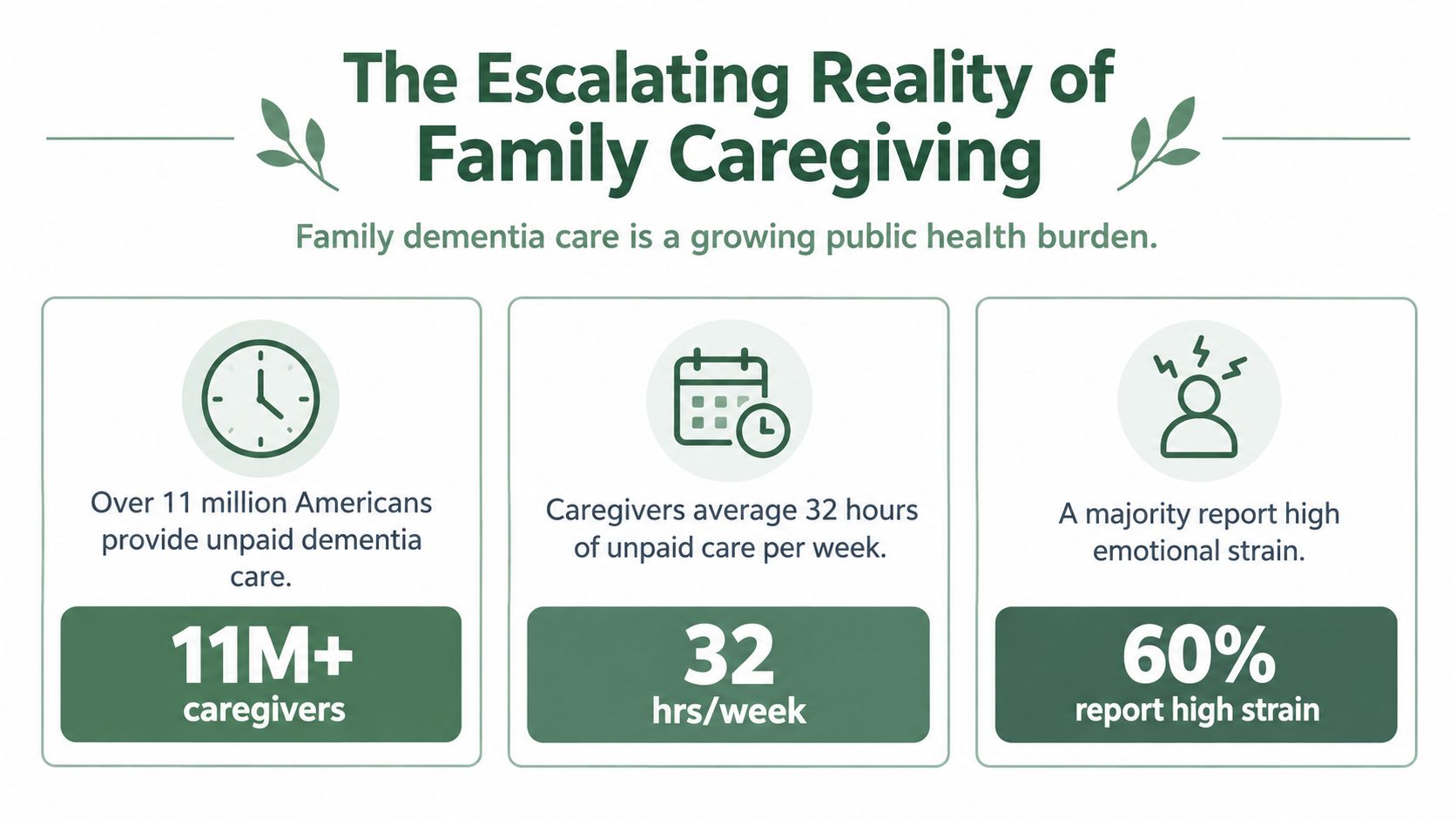
Dementia caregiving is a long-term workload, not a short burst of help after a diagnosis. The CDC reports that over 11 million adults in the United States provide unpaid care for someone with dementia, delivering about 18.4 billion hours of care in 2023. The same CDC caregiving data notes that nearly 1 in 3 family caregivers has provided care for four years or more, about two-thirds are women, and about 1 in 3 is age 65 or older.
Those details change how families should plan. The primary caregiver may be a spouse with health needs of their own, or an older sibling already managing work, appointments, and household responsibilities. A plan that works for a few demanding weeks may fail when the same demands continue through changing symptoms and repeated disruptions.
Time burden changes the plan
The historical trend is equally important. A summary from the Minnesota Department of Health reports that average weekly caregiving time for people with dementia rose from 21.4 hours in 2011 to 31.0 hours in 2022, while the number of family caregivers assisting older adults grew from 18.2 million to 24.1 million over that period. The same source reports that 11.5 million caregivers provided 18.4 billion hours in 2023, increasing to 12.7 million caregivers and 19.6 billion hours in 2025. These figures are documented in the Minnesota Department of Health caregiver summary.
The practical conclusion is direct: don't build a care plan around goodwill alone. Goodwill gets people through a difficult week. A sustainable plan needs scheduled coverage, clear escalation rules, shared notes, and a backup for every critical task.
A shared calendar can reduce confusion about visits, transportation, medication pickups, and respite coverage. Families can use a simple tool to keep family schedules aligned, but the calendar should show ownership, not just appointments. “Someone will check in” is not a usable assignment. Write the person's name, time, task, and what to do if the call or visit reveals a problem.
Exhaustion is operational information
Caregiver fatigue isn't merely an emotional inconvenience. It affects whether someone notices a missed dose, responds calmly to repetition, drives safely, or follows through with a clinician. If the main caregiver is sleeping poorly, skipping medical appointments, or feeling constantly on alert, the family has already reached a care-planning threshold.
Ask a better question than “Can we manage this?” Ask, “What must happen even when the main caregiver is sick, traveling, or unavailable?” The answer identifies the support that needs to be arranged now.
Building a Comprehensive Care Team
A dementia care team works when each person has a defined role and everyone shares the same priorities. Start with the person's goals. Staying at home, maintaining morning independence, avoiding unnecessary hospital visits, or keeping a familiar walking route may matter more than adding another appointment.
Assign ownership before adding services
The clinical lead should coordinate diagnosis, medication questions, symptom changes, and referrals. That role may sit with a primary care clinician, neurologist, or geriatrician. Don't assume that every provider sees the same information. Give each clinician a concise update before visits, including changes in sleep, appetite, mood, falls, wandering, medication use, and daily function.
A care navigator or social worker handles the connective work. This person can help interpret services, locate respite, organize referrals, clarify eligibility, and turn a vague problem into a sequence of decisions. Families should also understand what a care manager does, particularly when several providers and relatives are involved.
An in-person aide supports activities of daily living and observes the home environment. A remote cognitive support program can fill a different gap, especially when the person is alone between visits. It can provide regular conversation, orientation, memory cues, and practical prompts, while alerting the family to patterns that warrant follow-up.
Care Role | Primary Focus | Typical Frequency |
|---|---|---|
Clinical lead | Diagnosis, treatment, medication, symptom escalation | Scheduled visits and follow-up as needed |
Care navigator or social worker | Referrals, benefits, services, coordination, planning | Regular reviews plus problem-solving calls |
In-person home aide | Meals, hygiene, mobility, errands, household observation | Based on daily needs and risk periods |
Family coordinator | Shared decisions, communication, documentation, backup coverage | Ongoing, with planned family reviews |
Remote cognitive support | Engagement, orientation, routine prompts, safety observations | Scheduled recurring calls |
Create one shared care record
Use one secure place for the current medication list, clinician contacts, emergency instructions, daily routines, and recent changes. Keep entries factual and brief. “More confused after dinner for three evenings” helps a clinician more than “seems worse.”
Decide who receives alerts and what counts as urgent. A missed appointment may require a family call. A fall, sudden confusion, medication error, or unsafe wandering may require immediate clinical guidance. The team should never rely on a relative noticing a message by chance.
Review the plan at regular intervals and after any major change. Services should adapt as abilities, risks, and family capacity shift. A care team isn't successful because it contains many people. It's successful when the right person acts at the right time.
Evaluating Daily Cognitive and Safety Support
A senior may reject an app, forget a password, ignore a wearable, or become anxious when asked to learn another device. That doesn't mean they reject support. Often, they need support delivered through a familiar channel.

Compare the friction, not just the features
A complex app may display reminders, but the older adult still has to open it, interpret it, and act on it. A wearable tracker may provide location information, but it doesn't ask whether the person ate breakfast, feels dizzy, or is worried about a pet. In-person care provides richer observation, but coverage may be limited by cost, staffing, transportation, or family schedules.
Phone-based support sits in a useful middle position. A scheduled call can use an ordinary telephone, create a predictable social rhythm, and combine cognitive stimulation with practical questions. Velma, for example, uses recurring calls led by trained care-team members, with conversation, orientation, reminiscence, language and attention activities, memory cues, and daily safety prompts. Its care manager can document patterns and coordinate updates with the family, while the program complements rather than replaces clinicians or in-person caregivers.
The question isn't whether technology is advanced. The question is whether the person will reliably participate and whether the family will receive useful visibility into daily life.
What a useful call should accomplish
A good daily check-in has a clear structure without sounding like an interrogation. It may begin with familiar conversation, move into orientation or a simple cognitive exercise, and then cover meals, medication, appointments, mood, mobility, and household concerns. The tone should be warm and collaborative, not a test the person can fail.
Families considering daily check-in calls for seniors should ask how calls are customized, who reviews concerns, how documentation is shared, and what happens when the person doesn't answer. They should also ask whether the program is appropriate for the person's stage of dementia and communication abilities.
Decision test: Choose the least complicated support that the older adult can use consistently and that gives the family actionable information.
The medium matters because consistency matters. A call at a familiar time can reinforce routines, surface a change early, and provide companionship during a period that otherwise has no supervision. It cannot manage a medical emergency, physically prevent a fall, or substitute for hands-on help. Families should pair it with appropriate in-person coverage and a clear escalation plan.
The following video can help families think through practical support conversations and daily routines.
Communication Strategies and Safety Check-ins
Communication becomes safer when the family stops treating every mistaken statement as a fact to correct. If a parent says, “I need to go home,” arguing about the address may increase distress. Acknowledge the feeling first, then redirect toward a familiar activity, snack, music, or a short walk if it's safe.
Use validation before redirection
Try a three-part response:
Name the emotion. “You sound worried about being here.”
Offer reassurance. “You're safe, and I'm staying with you.”
Redirect gently. “Let's have tea and look at the photos.”
Avoid quizzes such as “Do you remember what day it is?” unless orientation is part of a planned, supportive activity. Don't use a sharp correction to prove that a memory is wrong. The objective is connection and safety, not winning an argument.
When a person fixates on a belonging, person, or pet, ask what the object represents. The concern may signal fear, loneliness, a missing routine, or a practical problem. Reduce background noise, use short sentences, offer one choice at a time, and allow more time for a response.
Make safety questions ordinary
Safety check-ins work best when they sound like conversation. Ask, “What did you have for breakfast?” rather than “Did you eat?” Ask, “When are you taking your morning pills?” rather than “Did you take your medication?” The answers can reveal skipped meals, confusion about timing, or a need for an updated pill system.
Cover a small set of topics consistently:
Medication: Ask what was taken, when, and whether anything was confusing.
Food and hydration: Discuss the last meal, available food, and any appetite change.
Mobility: Ask about dizziness, near-falls, pain, or difficulty getting up.
Household risks: Check the stove, space heaters, spoiled food, doors, and clutter.
Appointments: Confirm the next appointment and who is providing transportation.
Mood and sleep: Ask what felt difficult and how the previous night went.
Record changes without diagnosing them. A family member can share observations with the clinical lead, who can decide whether assessment is needed. If the person reports a fall, severe symptoms, an immediate safety threat, or a medication error, follow the clinician's urgent-care instructions rather than relying on a routine call.
Prioritizing Caregiver Respite and Navigation
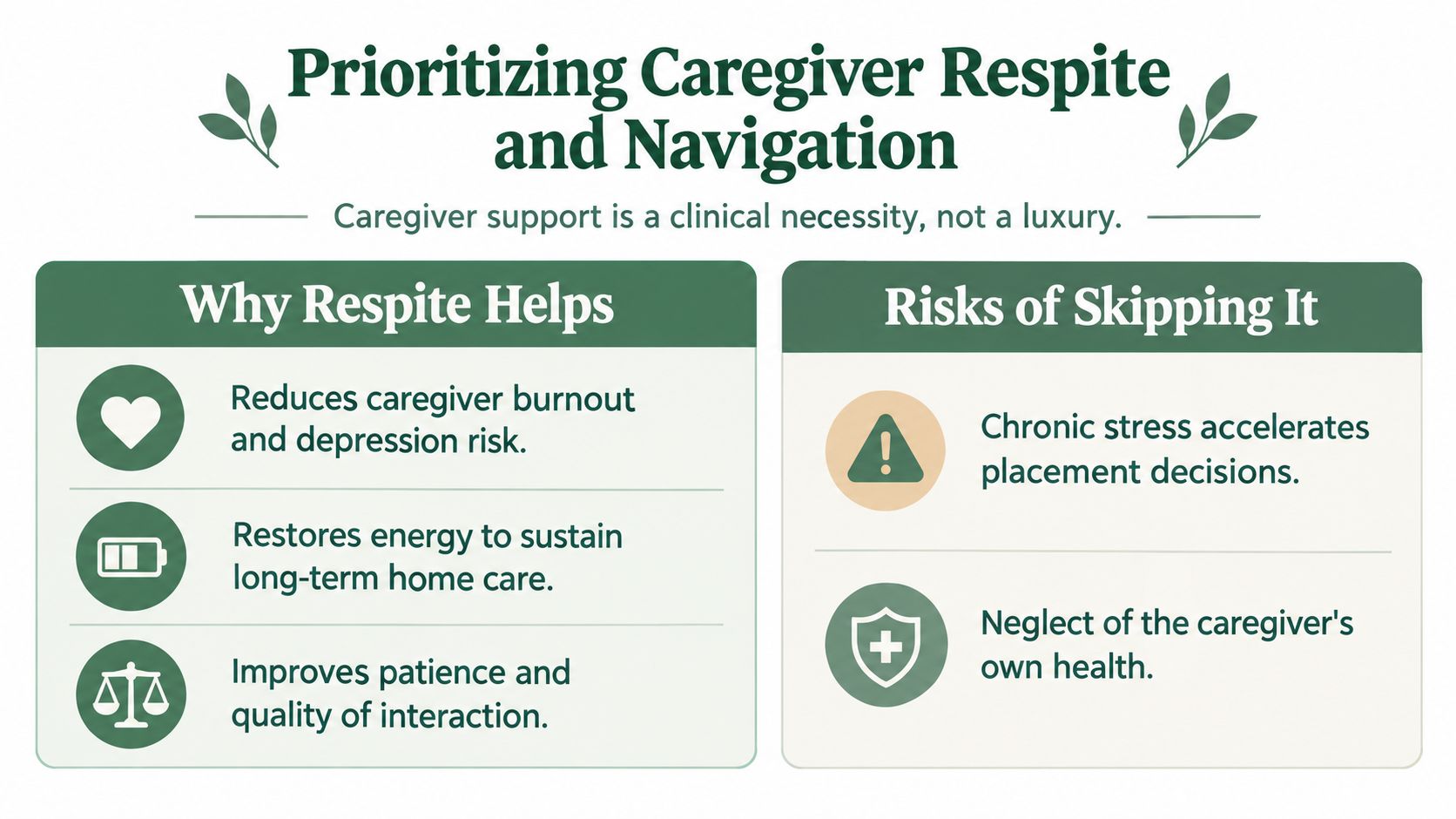
Respite is not a reward for finishing the work. It is part of the work. A caregiver who never leaves the house, sleeps poorly, or postpones personal medical care can't reliably provide long-term supervision, no matter how committed they are.
Evidence from U.S. health agencies and NIH-linked literature indicates that programs combining training, support, respite, and referrals can reduce caregiver burden and depression, improve knowledge and mood, and reduce behavioral symptoms in the person with dementia. The strongest gains appear in multicomponent programs, which may also delay nursing-home placement, as summarized by the Office of the Assistant Secretary for Planning and Evaluation.
Ask for specific relief
“I'm overwhelmed” is true, but service providers need a concrete request. Ask for a regular block of in-home care, an adult-day program, transportation, meal support, a support group, or a care-navigation appointment. If funding is the barrier, ask a social worker, Area Agency on Aging, health plan, or clinician's office which programs assess eligibility.
Recent evidence also argues against treating online emotional support as a complete answer. A 2026 review found online psychosocial interventions had little to no short-term overall effect on caregiver burden, although they may improve self-efficacy, according to the review in NIH's PubMed Central. Families need practical help that changes who performs tasks, not only encouraging content about coping.
A 2026 Office of Alzheimer's and Dementia Care report identified respite care as the most urgent and consistent caregiving gap. Its respondents most frequently selected financial assistance, at 42.4%, followed by mental health support and care coordination or navigation, at 40.7%, as unmet needs in the report on caregiving strategies.
Protect the care relationship
Respite can be short and still matter. Use it for sleep, an appointment, exercise, time with another family member, or being alone without monitoring the phone. Put it on the calendar before exhaustion becomes the only trigger.
Legal and capacity questions can arise when a parent refuses assistance or makes unsafe decisions. Families should get jurisdiction-specific advice early, including information about navigating guardianship when a parent refuses help, while remembering that legal authority doesn't replace respectful communication or clinical assessment.
A randomized study published in JAMA Network Open found measurable effects from different components of caregiver support at 12 months. The mindfulness-based component reduced depressive symptoms by β = -2.13 on PHQ-9, while the social-group component increased perceived social support by β = 4.63 on MOS-SSS, as reported in the JAMA Network Open study. Structured support can change validated outcomes. Families should treat it as a care requirement, not an optional extra.
Next Steps for Implementing Your Care Plan
A useful plan should make tomorrow easier, not merely document today's concerns. Begin with a short home and routine audit. Walk through waking, breakfast, medication, meals, bathing, transportation, evening activity, and bedtime. Note where confusion, falls, missed tasks, or isolation are most likely.
Use a practical evaluation checklist
When comparing services, ask:
Daily needs: Can the provider address the specific problems observed at home?
Clinical alignment: Are its protocols appropriate for the person's dementia stage and consistent with clinician guidance?
Human coverage: Does it offer physical help, cognitive engagement, or both?
Communication: Who receives updates, and how are changes documented?
Escalation: What happens after a missed call, safety concern, fall, or sudden change?
Staff capability: What dementia training does each staff member receive?
Family fit: Can the schedule work for the older adult and the relatives coordinating care?
Cost and continuity: What is included, what is excluded, and how will the plan adapt as needs increase?
Schedule a care meeting with the primary clinician and bring the gap map. Ask for referrals to social work, respite, occupational therapy, home care, adult-day services, or other local resources that match the risks you identified. If the person lives alone, prioritize dependable contact and a response plan for unanswered calls.
Then introduce help without framing it as surveillance. Say, “We want to make the week easier and keep your routines familiar,” rather than, “You can't manage alone.” Offer a choice between two reasonable options, such as scheduled phone support or a limited in-home visit, and review how it feels after the first period of use.
The first-year objective: Build enough reliable coverage that one difficult day doesn't collapse the entire family plan.
Document what works. Track participation, mood, appetite, medication questions, falls or near-falls, missed appointments, and recurring concerns. Share patterns with the care team, but don't turn every entry into a crisis. Clear documentation helps clinicians and relatives make decisions based on observed changes rather than memory and panic.
A sustainable plan has three features: the person with dementia receives predictable support, the family knows what happens between appointments, and the primary caregiver has scheduled relief. Start with the most dangerous uncovered gap this week, assign one owner, and put the next review on the calendar.
Velma provides scheduled phone-based cognitive support for older adults with early to mid-stage memory loss, combining structured conversation, cognitive exercises, orientation, practical check-ins, and care-manager coordination. If your family needs dependable contact between medical visits and in-person care, visit Velma to explore whether its phone-based program fits your care plan.
The diagnosis often arrives in a quiet room, followed by a very loud practical question: Who will check on Mom tomorrow morning? The doctor may explain the condition, adjust medication, and schedule another appointment. Then the family returns home to unanswered calls, missed pills, repeated questions, an empty refrigerator, or a parent who insists everything is fine.
That gap between medical visits and daily life is where families either build a dependable support system or begin running on emergency improvisation. Effective dementia support for families combines clinical oversight, hands-on help, cognitive and emotional engagement, safety monitoring, and planned relief for the people providing care.
Table of Contents
Understanding the Dementia Care Ecosystem
The three pillars of support
The Escalating Reality of Family Caregiving
Time burden changes the plan
Exhaustion is operational information
Building a Comprehensive Care Team
Assign ownership before adding services
Create one shared care record
Evaluating Daily Cognitive and Safety Support
Compare the friction, not just the features
What a useful call should accomplish
Communication Strategies and Safety Check-ins
Use validation before redirection
Make safety questions ordinary
Prioritizing Caregiver Respite and Navigation
Ask for specific relief
Protect the care relationship
Next Steps for Implementing Your Care Plan
Use a practical evaluation checklist
Understanding the Dementia Care Ecosystem
After her father's appointment, Elena created a group chat with her brother and aunt. They shared updates, but nobody owned the full picture. Her brother handled prescriptions, Elena called every evening, and her aunt visited when she could. The neurologist knew about memory changes, but not that her father had started leaving the stove on. The home aide knew about meals, but not that he had missed an appointment.
This is a common failure pattern. A family has several caring people, yet no coordinated system. The solution isn't to make one person work harder. It's to define the functions that must happen reliably and assign responsibility for each one.
The three pillars of support
Clinical management covers diagnosis, medication review, symptom changes, physical health, and decisions about changing care needs. A primary care clinician often coordinates the broad health picture, while a neurologist, geriatrician, or other specialist may guide dementia-related treatment. Families looking for a practical overview of primary care for dementia patients can use it to prepare questions about monitoring and ongoing care.
Practical daily assistance includes meals, hygiene, transportation, medication routines, household safety, and supervision. These tasks may begin as occasional reminders and gradually become hands-on support. An in-home aide can cover physical presence, but only if the schedule matches the person's actual risk periods.
Emotional and cognitive engagement is the pillar families most often leave unassigned. Conversation, familiar routines, reminiscence, orientation, enjoyable activities, and social contact help structure long stretches between visits. They don't replace medical treatment, but they can reduce isolation and reveal changes that deserve attention.
Practical rule: If nobody can say who handles a task, that task isn't covered.
Write the ecosystem down. Include family members, clinicians, aides, neighbors, adult-day programs, transportation services, support groups, and any phone-based check-in service. The broader demographic context matters too, as described in The Silver Tsunami, because families increasingly need systems that can absorb sustained care rather than relying on one exhausted relative.
Start with a gap map. Mark each responsibility as covered, partially covered, or uncovered. Pay particular attention to mornings, evenings, weekends, medication times, and periods when the person is alone. The purpose isn't to create an elaborate bureaucracy. It's to make the invisible work visible before a preventable crisis forces a decision.
The Escalating Reality of Family Caregiving
Dementia caregiving is a long-term workload, not a short burst of help after a diagnosis. The CDC reports that over 11 million adults in the United States provide unpaid care for someone with dementia, delivering about 18.4 billion hours of care in 2023. The same CDC caregiving data notes that nearly 1 in 3 family caregivers has provided care for four years or more, about two-thirds are women, and about 1 in 3 is age 65 or older.
Those details change how families should plan. The primary caregiver may be a spouse with health needs of their own, or an older sibling already managing work, appointments, and household responsibilities. A plan that works for a few demanding weeks may fail when the same demands continue through changing symptoms and repeated disruptions.
Time burden changes the plan
The historical trend is equally important. A summary from the Minnesota Department of Health reports that average weekly caregiving time for people with dementia rose from 21.4 hours in 2011 to 31.0 hours in 2022, while the number of family caregivers assisting older adults grew from 18.2 million to 24.1 million over that period. The same source reports that 11.5 million caregivers provided 18.4 billion hours in 2023, increasing to 12.7 million caregivers and 19.6 billion hours in 2025. These figures are documented in the Minnesota Department of Health caregiver summary.
The practical conclusion is direct: don't build a care plan around goodwill alone. Goodwill gets people through a difficult week. A sustainable plan needs scheduled coverage, clear escalation rules, shared notes, and a backup for every critical task.
A shared calendar can reduce confusion about visits, transportation, medication pickups, and respite coverage. Families can use a simple tool to keep family schedules aligned, but the calendar should show ownership, not just appointments. “Someone will check in” is not a usable assignment. Write the person's name, time, task, and what to do if the call or visit reveals a problem.
Exhaustion is operational information
Caregiver fatigue isn't merely an emotional inconvenience. It affects whether someone notices a missed dose, responds calmly to repetition, drives safely, or follows through with a clinician. If the main caregiver is sleeping poorly, skipping medical appointments, or feeling constantly on alert, the family has already reached a care-planning threshold.
Ask a better question than “Can we manage this?” Ask, “What must happen even when the main caregiver is sick, traveling, or unavailable?” The answer identifies the support that needs to be arranged now.
Building a Comprehensive Care Team
A dementia care team works when each person has a defined role and everyone shares the same priorities. Start with the person's goals. Staying at home, maintaining morning independence, avoiding unnecessary hospital visits, or keeping a familiar walking route may matter more than adding another appointment.
Assign ownership before adding services
The clinical lead should coordinate diagnosis, medication questions, symptom changes, and referrals. That role may sit with a primary care clinician, neurologist, or geriatrician. Don't assume that every provider sees the same information. Give each clinician a concise update before visits, including changes in sleep, appetite, mood, falls, wandering, medication use, and daily function.
A care navigator or social worker handles the connective work. This person can help interpret services, locate respite, organize referrals, clarify eligibility, and turn a vague problem into a sequence of decisions. Families should also understand what a care manager does, particularly when several providers and relatives are involved.
An in-person aide supports activities of daily living and observes the home environment. A remote cognitive support program can fill a different gap, especially when the person is alone between visits. It can provide regular conversation, orientation, memory cues, and practical prompts, while alerting the family to patterns that warrant follow-up.
Care Role | Primary Focus | Typical Frequency |
|---|---|---|
Clinical lead | Diagnosis, treatment, medication, symptom escalation | Scheduled visits and follow-up as needed |
Care navigator or social worker | Referrals, benefits, services, coordination, planning | Regular reviews plus problem-solving calls |
In-person home aide | Meals, hygiene, mobility, errands, household observation | Based on daily needs and risk periods |
Family coordinator | Shared decisions, communication, documentation, backup coverage | Ongoing, with planned family reviews |
Remote cognitive support | Engagement, orientation, routine prompts, safety observations | Scheduled recurring calls |
Create one shared care record
Use one secure place for the current medication list, clinician contacts, emergency instructions, daily routines, and recent changes. Keep entries factual and brief. “More confused after dinner for three evenings” helps a clinician more than “seems worse.”
Decide who receives alerts and what counts as urgent. A missed appointment may require a family call. A fall, sudden confusion, medication error, or unsafe wandering may require immediate clinical guidance. The team should never rely on a relative noticing a message by chance.
Review the plan at regular intervals and after any major change. Services should adapt as abilities, risks, and family capacity shift. A care team isn't successful because it contains many people. It's successful when the right person acts at the right time.
Evaluating Daily Cognitive and Safety Support
A senior may reject an app, forget a password, ignore a wearable, or become anxious when asked to learn another device. That doesn't mean they reject support. Often, they need support delivered through a familiar channel.
Compare the friction, not just the features
A complex app may display reminders, but the older adult still has to open it, interpret it, and act on it. A wearable tracker may provide location information, but it doesn't ask whether the person ate breakfast, feels dizzy, or is worried about a pet. In-person care provides richer observation, but coverage may be limited by cost, staffing, transportation, or family schedules.
Phone-based support sits in a useful middle position. A scheduled call can use an ordinary telephone, create a predictable social rhythm, and combine cognitive stimulation with practical questions. Velma, for example, uses recurring calls led by trained care-team members, with conversation, orientation, reminiscence, language and attention activities, memory cues, and daily safety prompts. Its care manager can document patterns and coordinate updates with the family, while the program complements rather than replaces clinicians or in-person caregivers.
The question isn't whether technology is advanced. The question is whether the person will reliably participate and whether the family will receive useful visibility into daily life.
What a useful call should accomplish
A good daily check-in has a clear structure without sounding like an interrogation. It may begin with familiar conversation, move into orientation or a simple cognitive exercise, and then cover meals, medication, appointments, mood, mobility, and household concerns. The tone should be warm and collaborative, not a test the person can fail.
Families considering daily check-in calls for seniors should ask how calls are customized, who reviews concerns, how documentation is shared, and what happens when the person doesn't answer. They should also ask whether the program is appropriate for the person's stage of dementia and communication abilities.
Decision test: Choose the least complicated support that the older adult can use consistently and that gives the family actionable information.
The medium matters because consistency matters. A call at a familiar time can reinforce routines, surface a change early, and provide companionship during a period that otherwise has no supervision. It cannot manage a medical emergency, physically prevent a fall, or substitute for hands-on help. Families should pair it with appropriate in-person coverage and a clear escalation plan.
The following video can help families think through practical support conversations and daily routines.
Communication Strategies and Safety Check-ins
Communication becomes safer when the family stops treating every mistaken statement as a fact to correct. If a parent says, “I need to go home,” arguing about the address may increase distress. Acknowledge the feeling first, then redirect toward a familiar activity, snack, music, or a short walk if it's safe.
Use validation before redirection
Try a three-part response:
Name the emotion. “You sound worried about being here.”
Offer reassurance. “You're safe, and I'm staying with you.”
Redirect gently. “Let's have tea and look at the photos.”
Avoid quizzes such as “Do you remember what day it is?” unless orientation is part of a planned, supportive activity. Don't use a sharp correction to prove that a memory is wrong. The objective is connection and safety, not winning an argument.
When a person fixates on a belonging, person, or pet, ask what the object represents. The concern may signal fear, loneliness, a missing routine, or a practical problem. Reduce background noise, use short sentences, offer one choice at a time, and allow more time for a response.
Make safety questions ordinary
Safety check-ins work best when they sound like conversation. Ask, “What did you have for breakfast?” rather than “Did you eat?” Ask, “When are you taking your morning pills?” rather than “Did you take your medication?” The answers can reveal skipped meals, confusion about timing, or a need for an updated pill system.
Cover a small set of topics consistently:
Medication: Ask what was taken, when, and whether anything was confusing.
Food and hydration: Discuss the last meal, available food, and any appetite change.
Mobility: Ask about dizziness, near-falls, pain, or difficulty getting up.
Household risks: Check the stove, space heaters, spoiled food, doors, and clutter.
Appointments: Confirm the next appointment and who is providing transportation.
Mood and sleep: Ask what felt difficult and how the previous night went.
Record changes without diagnosing them. A family member can share observations with the clinical lead, who can decide whether assessment is needed. If the person reports a fall, severe symptoms, an immediate safety threat, or a medication error, follow the clinician's urgent-care instructions rather than relying on a routine call.
Prioritizing Caregiver Respite and Navigation
Respite is not a reward for finishing the work. It is part of the work. A caregiver who never leaves the house, sleeps poorly, or postpones personal medical care can't reliably provide long-term supervision, no matter how committed they are.
Evidence from U.S. health agencies and NIH-linked literature indicates that programs combining training, support, respite, and referrals can reduce caregiver burden and depression, improve knowledge and mood, and reduce behavioral symptoms in the person with dementia. The strongest gains appear in multicomponent programs, which may also delay nursing-home placement, as summarized by the Office of the Assistant Secretary for Planning and Evaluation.
Ask for specific relief
“I'm overwhelmed” is true, but service providers need a concrete request. Ask for a regular block of in-home care, an adult-day program, transportation, meal support, a support group, or a care-navigation appointment. If funding is the barrier, ask a social worker, Area Agency on Aging, health plan, or clinician's office which programs assess eligibility.
Recent evidence also argues against treating online emotional support as a complete answer. A 2026 review found online psychosocial interventions had little to no short-term overall effect on caregiver burden, although they may improve self-efficacy, according to the review in NIH's PubMed Central. Families need practical help that changes who performs tasks, not only encouraging content about coping.
A 2026 Office of Alzheimer's and Dementia Care report identified respite care as the most urgent and consistent caregiving gap. Its respondents most frequently selected financial assistance, at 42.4%, followed by mental health support and care coordination or navigation, at 40.7%, as unmet needs in the report on caregiving strategies.
Protect the care relationship
Respite can be short and still matter. Use it for sleep, an appointment, exercise, time with another family member, or being alone without monitoring the phone. Put it on the calendar before exhaustion becomes the only trigger.
Legal and capacity questions can arise when a parent refuses assistance or makes unsafe decisions. Families should get jurisdiction-specific advice early, including information about navigating guardianship when a parent refuses help, while remembering that legal authority doesn't replace respectful communication or clinical assessment.
A randomized study published in JAMA Network Open found measurable effects from different components of caregiver support at 12 months. The mindfulness-based component reduced depressive symptoms by β = -2.13 on PHQ-9, while the social-group component increased perceived social support by β = 4.63 on MOS-SSS, as reported in the JAMA Network Open study. Structured support can change validated outcomes. Families should treat it as a care requirement, not an optional extra.
Next Steps for Implementing Your Care Plan
A useful plan should make tomorrow easier, not merely document today's concerns. Begin with a short home and routine audit. Walk through waking, breakfast, medication, meals, bathing, transportation, evening activity, and bedtime. Note where confusion, falls, missed tasks, or isolation are most likely.
Use a practical evaluation checklist
When comparing services, ask:
Daily needs: Can the provider address the specific problems observed at home?
Clinical alignment: Are its protocols appropriate for the person's dementia stage and consistent with clinician guidance?
Human coverage: Does it offer physical help, cognitive engagement, or both?
Communication: Who receives updates, and how are changes documented?
Escalation: What happens after a missed call, safety concern, fall, or sudden change?
Staff capability: What dementia training does each staff member receive?
Family fit: Can the schedule work for the older adult and the relatives coordinating care?
Cost and continuity: What is included, what is excluded, and how will the plan adapt as needs increase?
Schedule a care meeting with the primary clinician and bring the gap map. Ask for referrals to social work, respite, occupational therapy, home care, adult-day services, or other local resources that match the risks you identified. If the person lives alone, prioritize dependable contact and a response plan for unanswered calls.
Then introduce help without framing it as surveillance. Say, “We want to make the week easier and keep your routines familiar,” rather than, “You can't manage alone.” Offer a choice between two reasonable options, such as scheduled phone support or a limited in-home visit, and review how it feels after the first period of use.
The first-year objective: Build enough reliable coverage that one difficult day doesn't collapse the entire family plan.
Document what works. Track participation, mood, appetite, medication questions, falls or near-falls, missed appointments, and recurring concerns. Share patterns with the care team, but don't turn every entry into a crisis. Clear documentation helps clinicians and relatives make decisions based on observed changes rather than memory and panic.
A sustainable plan has three features: the person with dementia receives predictable support, the family knows what happens between appointments, and the primary caregiver has scheduled relief. Start with the most dangerous uncovered gap this week, assign one owner, and put the next review on the calendar.
Velma provides scheduled phone-based cognitive support for older adults with early to mid-stage memory loss, combining structured conversation, cognitive exercises, orientation, practical check-ins, and care-manager coordination. If your family needs dependable contact between medical visits and in-person care, visit Velma to explore whether its phone-based program fits your care plan.
Suggested Article: