Care Manager Responsibilities: A Family Guide

You're probably here because the days have started to blur together. A missed medication. A voicemail from the neurologist. A call from your mother saying the stove was left on, then a second call from your sister asking who's handling the transportation next week. When dementia starts reshaping ordinary routines, a care manager can become the person who keeps all those moving parts from drifting apart.
Families often think of the role as emotional support or a friendly check-in. In practice, care manager responsibilities are much more operational than that. They sit in the middle of assessment, planning, coordination, monitoring, and family communication, which is why the job has long looked more like active case work than bedside care, as the classic time-use study of care managers showed, with 64% of the work week tied to direct and indirect user and carer-related activities, and substantial time still going to administrative work, assessment, monitoring, counselling, and liaison with health staff. Research from the University of Manchester helps explain why the role feels so hands-on even when most of it happens between appointments.
For dementia care, that matters. The work isn't a one-time intake and a stack of notes. It's a recurring rhythm of small decisions, phone calls, updates, and course corrections that help families keep someone safe, informed, and as independent as possible.
Table of Contents
A Tuesday Morning With a Dementia Care Manager
What this morning reveals
What Care Manager Responsibilities Mean in Dementia Care
The role works like air traffic control
Why dementia care compresses the loop
The Five Core Responsibilities Families Should Expect
1. Comprehensive assessment
2. Individualized care planning
3. Cross-provider coordination
4. Ongoing monitoring
5. Family education and advocacy
What a Dementia-Specific Care Plan Looks Like
The sections families should look for
How phone-based support fits
How Families Should Work With a Care Manager
What to share early
What to ask in the first month
How to handle disagreement
Red Flags That a Care Manager Is Not the Right Fit
What to watch for
Hiring and Engaging a Care Manager With Confidence
What to ask before you hire
What role and model fit your family
Bringing It All Together in Your First Month
A simple first-month setup
A Tuesday Morning With a Dementia Care Manager
By 8:10 a.m., the care manager has already opened overnight notes, scanned the weekend messages, and seen that one daughter is worried because her father missed a scheduled appointment. The first call is short. She confirms that no one fell, asks what changed in the routine, and learns that the usual morning aide was late, which threw off the whole day.

A few minutes later, she updates the care note, flags the missed appointment, and adjusts the day's structure so the participant has a more predictable morning block. That might sound simple, but it's one of the core jobs of the role, turning a small disruption into a clear next step before it becomes a bigger problem. In dementia care, those adjustments often matter more than dramatic interventions.
What this morning reveals
The morning isn't about one big crisis. It's about assessment, planning, coordination, monitoring, and family communication happening in real time. A care manager notices the change, makes sense of it, documents it, and decides who needs to know next.
Practical rule: if a care manager only shows up when something is already urgent, the role is being used too narrowly.
Before lunch, she prepares handoffs for the week's scheduled calls, including a reminder to check whether a family member has seen the updated medication routine. That kind of follow-through is the difference between a plan that lives on paper and a plan that shapes the week.
The important lesson for families is simple. Care manager responsibilities show up in small, recurring decisions, not just in emergencies. If you want to know whether the role is being done well, look at what happens after the call, after the note, and after the routine gets disrupted.
What Care Manager Responsibilities Mean in Dementia Care
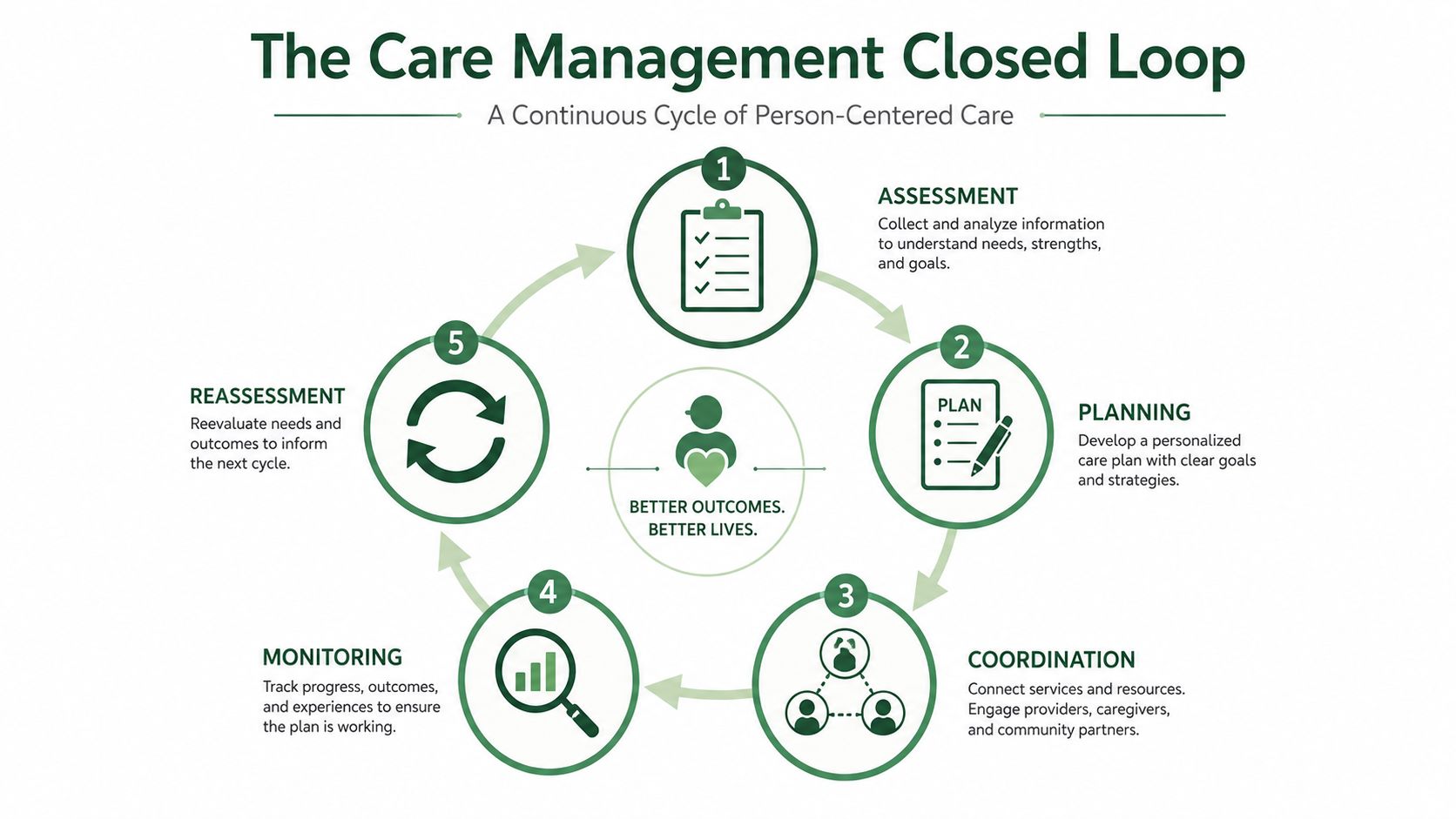
A dementia care manager works in a closed loop. They assess what is happening, build a plan, coordinate services, monitor what follows, and then reassess as needs change. In dementia care, that loop cannot stay still for long, because a good week can turn into a difficult one after a fall scare, a missed dose, a mood change, or a new stressor in the family.
The role works like air traffic control
An air-traffic controller does not fly the plane. The controller tracks each plane, watches delays, adjusts routes, and keeps landing and takeoff decisions organized. A dementia care manager does similar work across the whole care picture. They are looking at the map, the timing, and the next move, while other people focus on one part of the trip.
That is why the job is operational as well as supportive. In modern aged care systems, the occupation profile for aged care managers in Australia describes planning, directing, coordinating, monitoring compliance, and overseeing care programs, which shows how much the role has shifted toward structured oversight. Australia's occupation profile for aged care managers frames this as a responsibility tied to quality, policy, and clinical outcomes, rather than casual supervision.
Why dementia care compresses the loop
Memory loss changes the pace of care. Assessment does not happen once and stop, because the care manager keeps learning from family calls, home observations, and follow-up notes. Then the plan shifts, sometimes in small ways, sometimes in ways the family can feel immediately.
Aged care managers, geriatric care managers, social workers, and care coordinators can overlap, but the practical difference is usually scope. A social worker may focus more on psychosocial support and resource connection. A care coordinator may focus on moving appointments and services along. A geriatric care manager usually blends both, with a stronger focus on older-adult care, family coordination, and practical oversight across medical and daily living needs.
Plain truth: if you are hiring someone for dementia support, ask what they do between visits. That is where the job either works or falls apart.
In health-home and similar models, assessment data is expected to turn into a person-centered plan with referrals, follow-up, and family engagement, and updates should move across the team when risk changes. Care manager guidance used in health-home style frameworks makes that connection clear. For families, the takeaway is simple. The role should connect medical, behavioral, and social issues, so you are not left stitching the pieces together on your own. A pattern of daily check-in calls for seniors often shows that same follow-through in ordinary weeks, where small contacts prevent bigger gaps from opening.
The Five Core Responsibilities Families Should Expect
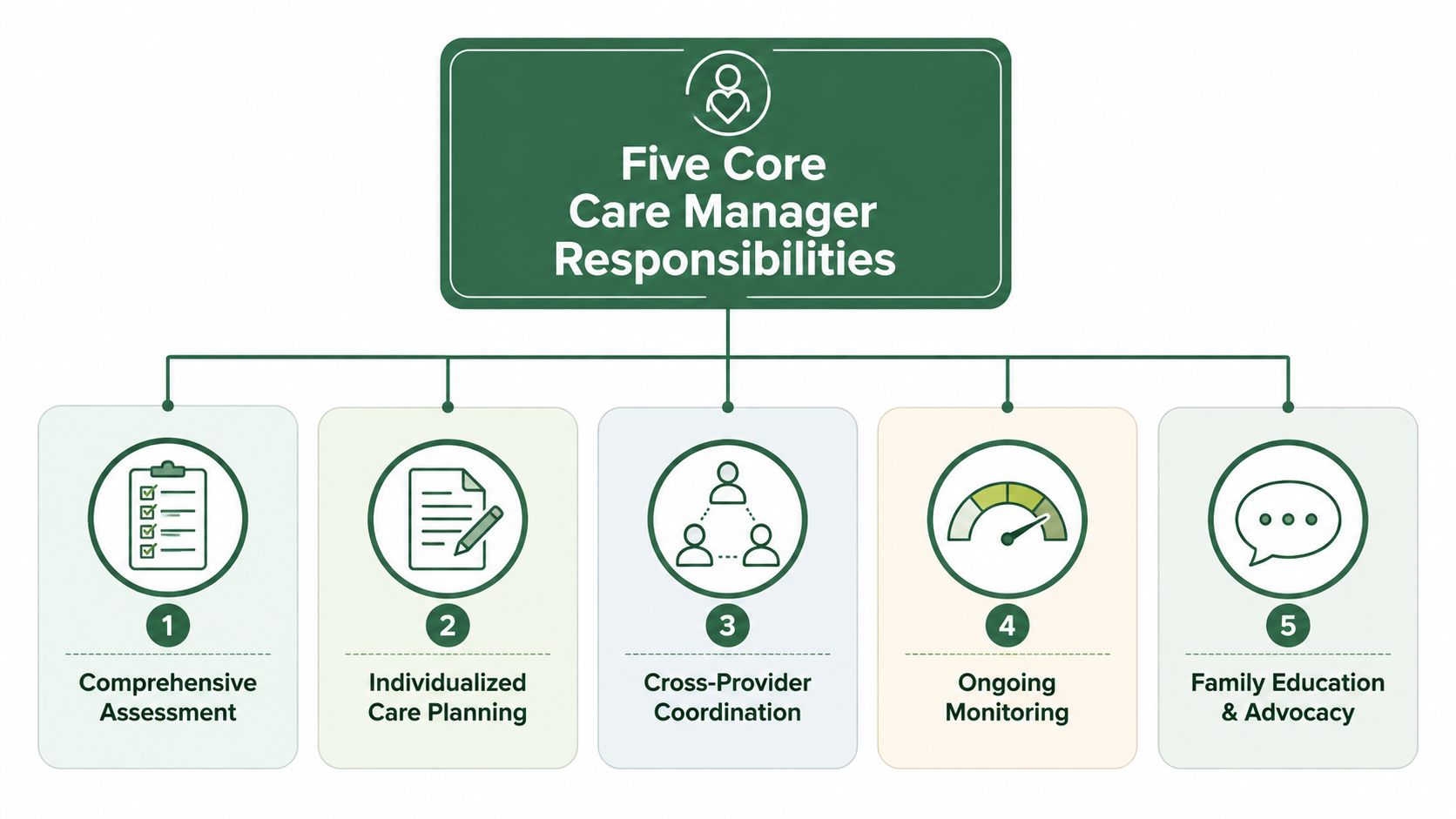
A strong care manager doesn't just “stay in touch.” The job breaks down into five responsibilities that should be visible in the work product, the calls, and the documentation. If any one of these is missing, families usually feel it quickly, even if they can't name it yet.
1. Comprehensive assessment
The first task is a bio-psycho-social assessment. In plain English, that means the care manager looks at health issues, cognition, mood, living situation, safety, family support, transportation, and other day-to-day barriers. For dementia, the question is never only “What diagnosis is present?” It's also “What is the person doing with that diagnosis this week?”
A good artifact here is an intake note or assessment summary that names the person's strengths, risks, routines, and support network. Families can verify it by asking, “What changed between the first call and the written assessment?” If the answer is vague, the assessment probably wasn't deep enough.
2. Individualized care planning
The next responsibility is turning that assessment into a plan that the family can follow. In dementia care, the plan should account for daily structure, medication reminders, supervision needs, safety concerns, and who handles what when memory slips.
The best plans read like instructions for real life, not like a generic template. You should see specific tasks, named contacts, and an agreed way to revise the plan when something changes.
3. Cross-provider coordination
A care manager should be the person who connects the neurologist, primary care clinician, home aide, and family so they're not working off different assumptions. When the participant has a phone-based cognitive support program, an in-person aide, and a clinician all involved, coordination becomes a safety issue, not a convenience issue.
The artifact here might be a care coordination log or a shared update summary. Ask, “Who was informed after the medication change, and when?” If nobody can answer that clearly, coordination is likely loose.
4. Ongoing monitoring
Monitoring means more than checking a box. It means watching for confusion, missed meds, changes in mood, fall risk, refusal of care, or signs that the routine is slipping. The care manager should use repeated contact to catch a worsening pattern early enough to do something about it.
Families should expect an escalation path. If a fall scare or repeated disorientation shows up, the response should change, not just the wording of the note.
5. Family education and advocacy
The final responsibility is helping the family understand what's happening and what to do next. That includes translating clinical language, preparing relatives for difficult conversations, and pushing for updates when nobody else is doing it.
One useful resource for families is daily check-in calls for seniors, because regular contact often reveals problems before they become crises. In practice, the care manager should be the person who helps you decide which details need action and which ones just need watching.
What a Dementia-Specific Care Plan Looks Like
A good dementia care plan does more than list diagnoses. It gives the family a working document they can use on a Tuesday morning when the routine changes, the aide is late, or the participant becomes more confused than usual. The strongest plans are specific enough that different people can follow them without improvising.
A family often learns the value of that kind of plan in the middle of a small disruption. The breakfast routine changes, someone forgets the next appointment, or a usual cue no longer works. A clear care plan keeps those moments from turning into guesswork.
The sections families should look for
A representative plan for someone in the early to mid stages of dementia usually includes the person's cognitive profile, daily structure, medication and appointment reminders, home safety risks, mood triggers, and the family's preferred communication cadence. It should also name who gets called for what, and what counts as a change worth escalating.
Here's a simple reference point:
Plan Section | What It Covers | Why It Matters |
|---|---|---|
Cognitive profile | Memory strengths, confusion patterns, time of day issues | Helps set realistic expectations and routines |
Daily structure | Wake time, meals, activity blocks, rest periods | Reduces uncertainty and missed steps |
Medication and appointment support | Reminders, tracking, responsibility for follow-through | Lowers the chance of skipped care |
Safety risks | Stove use, wandering, expired food, fall concerns | Identifies the issues most likely to need intervention |
Mood and behavior triggers | Anxiety, frustration, loneliness, agitation cues | Helps the family respond before distress escalates |
Family communication cadence | Who gets updates, how often, and through what channel | Prevents confusion and duplicated messages |
A plan that leaves out communication cadence usually creates problems later. Someone assumes another person got the message, and nobody follows through. Families should be able to point to the exact person who hears about a medication change, a fall scare, or a shift in mood.
How phone-based support fits
Phone-based cognitive support can sit alongside medical treatment and in-person caregiving without replacing either one. Programs built around scheduled calls can reinforce routine, surface concerns between visits, and give families another set of eyes and ears on the week. That matters when memory loss makes daily life feel less predictable.
Velma, for example, is a phone-based cognitive support program for older adults in the early to mid stages of dementia, and it's organized around recurring calls, cognitive exercises, mood support, practical check-ins, and care manager coordination. Used properly, that kind of service can fit into the written care plan by showing how the plan works in real life. It can also help families compare other support options, such as companion care for elderly, and see where each one belongs in the weekly routine.
Useful question: does the plan tell us what to do when the person is having a better week, a worse week, or an off day? If not, it's too thin.
Families do not need a perfect plan. They need one that is concrete, shared, and updated when the person's needs change.
How Families Should Work With a Care Manager
A family usually feels the strain before they know how to name it. One person is keeping track of medications, another is fielding confusing calls, and nobody is sure who should answer first when the phone rings. A care manager can reduce that confusion, but only if the family treats the role like a working partner with shared information and clear responsibilities.
What to share early
During onboarding, give the care manager the full picture, including the pieces that feel messy or uncomfortable. Recent falls, medication changes, behavior shifts, family tension, hospital visits, and any safety problem you have been trying to manage all belong on the table. If one person in the family is making the final decisions, say that plainly so the care manager knows where decisions are coming from.
It also helps to explain the household setup in practical terms. Say who lives with the participant, who checks messages, who handles appointments, and who tends to get overwhelmed. A care manager can organize care more effectively when they know who is available, who is not, and where communication tends to break down.
What to ask in the first month
Early on, ask how updates will be shared, what needs to be escalated right away, and how the care plan will be revised when the participant's condition changes. Ask which family member should receive routine messages, which one should handle urgent issues, and whether the care manager wants other clinicians copied on key updates.
Ask how the care manager works with outside supports as well. A phone-based program, in-person caregiving, and other services can fit together, but only if someone has thought through the handoffs. If you are also comparing options like companion care for elderly, ask where that help fits in the week and what the care manager expects it to cover.
How to handle disagreement
Disagreement is normal. A care manager may recommend a change in routine, a new safety step, or a different level of support, and the family may not agree at first. Say so directly, then ask what risk the recommendation is meant to reduce. The answer should be specific and grounded in the person's actual symptoms or situation.
You are hiring a professional to help sort decisions, not to replace the family or echo every opinion in the room. The relationship works best when everyone stays calm, keeps the communication concrete, and remembers that the goal is better care, not perfect agreement.
Practical rule: the care manager should not be your only point of contact, and they should not be treated like a casual friend either. Keep the relationship professional, warm, and specific.
Red Flags That a Care Manager Is Not the Right Fit
Families often ignore the warning signs because they're relieved to have found anyone willing to help. That's understandable, but dementia care punishes vagueness fast. If the relationship isn't working, the cracks usually show up in communication first.
What to watch for
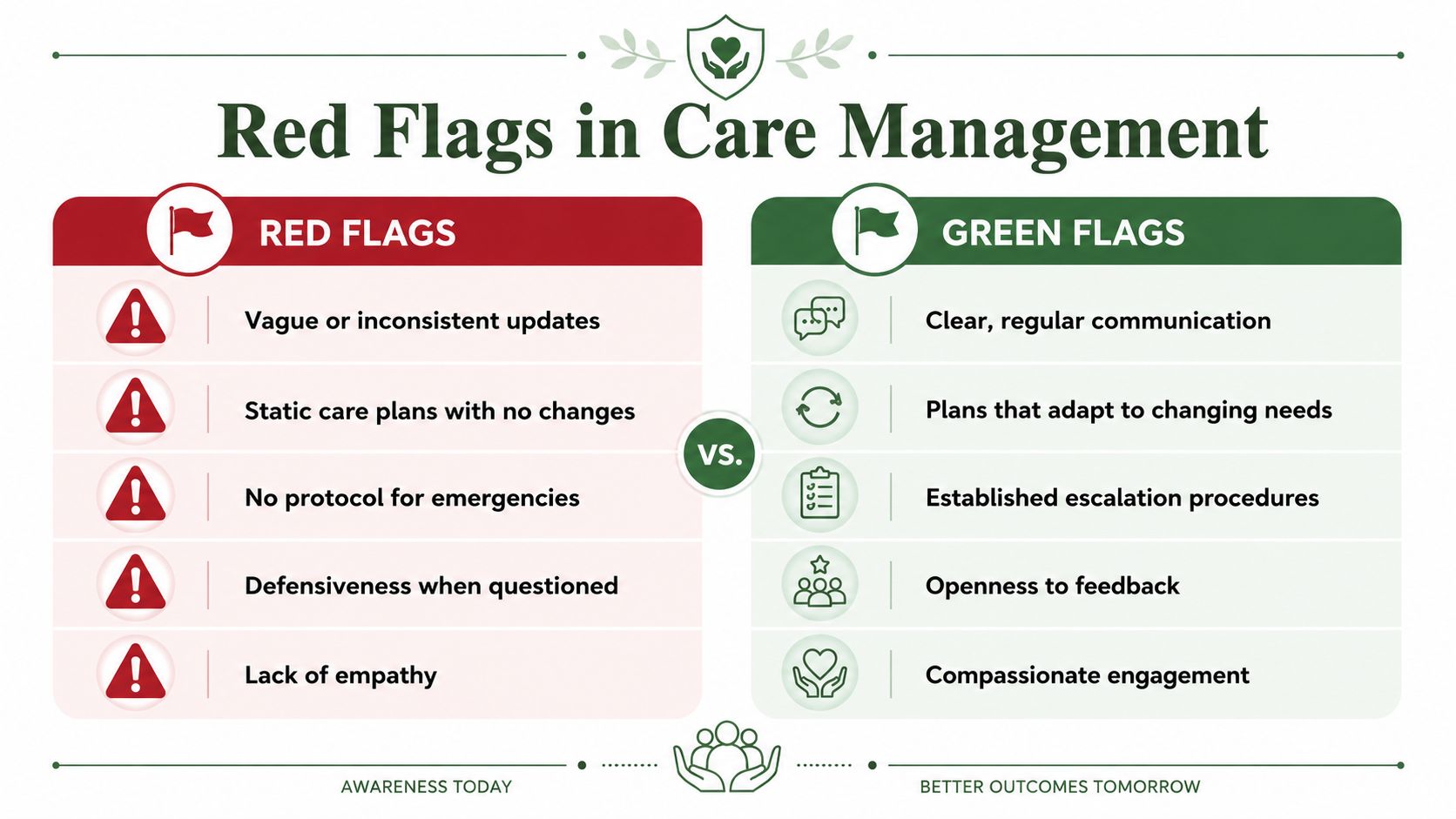
Vague or inconsistent updates. If calls end with general reassurance but no clear next steps, the family is being left to guess.
Static care plans. If the plan never changes even after new confusion, a fall scare, or a behavior shift, the care manager may be reacting too slowly.
No escalation protocol. If nobody can tell you what happens after a fall, a missed medication, or worsening disorientation, that's a real problem.
Defensiveness about missed calls. A professional can explain a missed contact without making the family feel guilty for asking.
Refusal to coordinate. If the care manager won't work with the neurologist or other involved clinicians, the team will stay fragmented.
The broader issue is role ambiguity. Research from the AHRQ care management implementation guide points to the fact that care managers must coordinate both clinical and community issues across multiple systems, yet boundaries and workflows are often unclear. When that ambiguity shows up in practice, the family ends up carrying the coordination burden again.
Good practice looks different. You should see clear, regular communication, adaptable plans, established escalation procedures, and openness to feedback. If those things are missing, the role is probably overstretched, underdefined, or not a fit for dementia care.
Hiring and Engaging a Care Manager With Confidence
A strong first interview tells you a lot. You're not looking for a perfect résumé. You're looking for someone who understands dementia, communicates cleanly, and knows how to coordinate across family and clinical settings without creating more confusion.
What to ask before you hire
Look for training and experience with older adults, memory loss, and family-based decision-making. Ask how they handle changing cognition, agitation, missed medications, and safety concerns at home. Ask what their communication style is when multiple relatives disagree.
A simple interview checklist helps:
Question | What You're Listening For |
|---|---|
How do you assess a new dementia client? | A structured intake, not just a casual conversation |
What do you do when the care plan stops working? | A clear process for review and revision |
How do you coordinate with clinicians and family members? | Specific workflow, not vague “I keep everyone informed” language |
What kinds of updates do families receive? | A realistic cadence and format |
How do you handle urgent concerns between scheduled calls? | A defined escalation path |
What role and model fit your family
An independent geriatric care manager can make sense when you want one person with broad oversight and direct family contact. An agency may fit better when you need coverage, backup, and multiple services under one umbrella. If you're comparing a phone-based support program with in-person help, ask whether the service complements existing caregiving or tries to replace it.
The earlier section on dementia care training is worth reading before you make a final choice, because the best fit usually comes from training plus communication style, not credentials alone.
Don't rush the decision. A short trial period or defined onboarding milestones can help both sides see whether the working relationship is clear, responsive, and sustainable.
Bringing It All Together in Your First Month
The first month should turn scattered observations into one clear plan. A care manager's job is to act as the connection point, bringing together what family members notice, what clinicians recommend, and what daily life looks like at home. When that works, the family spends less time chasing updates and more time paying attention to the person who needs care.
A simple first-month setup
Start with a single point of contact, shared documentation, and a clear rule for when something gets escalated. Decide who receives updates, what counts as urgent, and how often the plan gets reviewed. Put a monthly review on the calendar before the first month slips away.
You should also confirm which supports are involved, where they overlap, and who is handling each piece. That keeps the common problem from developing, several people may be involved while no one is steering.
A practical first month often feels a little like getting a house in order after a move. The boxes may still be there, but the labels, shelves, and pathways start to make sense. The same is true in dementia care. You are not trying to solve everything at once, you are trying to make the next week easier to understand.
Short version: the best care management makes the family feel less scattered and gives them more clarity, not more oversight.
By the end of those first weeks, you should be able to answer three questions without guessing. What changed? Who knows about it? What happens next? If those answers are clear, the care manager is doing the work families need.
If you're trying to make dementia care feel more organized, Velma can help with recurring phone-based cognitive support, family visibility, and coordination that fits between medical visits. Visit Velma to see how a care-manager-led phone program can support the routines, check-ins, and updates your family is trying to keep together.
You're probably here because the days have started to blur together. A missed medication. A voicemail from the neurologist. A call from your mother saying the stove was left on, then a second call from your sister asking who's handling the transportation next week. When dementia starts reshaping ordinary routines, a care manager can become the person who keeps all those moving parts from drifting apart.
Families often think of the role as emotional support or a friendly check-in. In practice, care manager responsibilities are much more operational than that. They sit in the middle of assessment, planning, coordination, monitoring, and family communication, which is why the job has long looked more like active case work than bedside care, as the classic time-use study of care managers showed, with 64% of the work week tied to direct and indirect user and carer-related activities, and substantial time still going to administrative work, assessment, monitoring, counselling, and liaison with health staff. Research from the University of Manchester helps explain why the role feels so hands-on even when most of it happens between appointments.
For dementia care, that matters. The work isn't a one-time intake and a stack of notes. It's a recurring rhythm of small decisions, phone calls, updates, and course corrections that help families keep someone safe, informed, and as independent as possible.
Table of Contents
A Tuesday Morning With a Dementia Care Manager
What this morning reveals
What Care Manager Responsibilities Mean in Dementia Care
The role works like air traffic control
Why dementia care compresses the loop
The Five Core Responsibilities Families Should Expect
1. Comprehensive assessment
2. Individualized care planning
3. Cross-provider coordination
4. Ongoing monitoring
5. Family education and advocacy
What a Dementia-Specific Care Plan Looks Like
The sections families should look for
How phone-based support fits
How Families Should Work With a Care Manager
What to share early
What to ask in the first month
How to handle disagreement
Red Flags That a Care Manager Is Not the Right Fit
What to watch for
Hiring and Engaging a Care Manager With Confidence
What to ask before you hire
What role and model fit your family
Bringing It All Together in Your First Month
A simple first-month setup
A Tuesday Morning With a Dementia Care Manager
By 8:10 a.m., the care manager has already opened overnight notes, scanned the weekend messages, and seen that one daughter is worried because her father missed a scheduled appointment. The first call is short. She confirms that no one fell, asks what changed in the routine, and learns that the usual morning aide was late, which threw off the whole day.
A few minutes later, she updates the care note, flags the missed appointment, and adjusts the day's structure so the participant has a more predictable morning block. That might sound simple, but it's one of the core jobs of the role, turning a small disruption into a clear next step before it becomes a bigger problem. In dementia care, those adjustments often matter more than dramatic interventions.
What this morning reveals
The morning isn't about one big crisis. It's about assessment, planning, coordination, monitoring, and family communication happening in real time. A care manager notices the change, makes sense of it, documents it, and decides who needs to know next.
Practical rule: if a care manager only shows up when something is already urgent, the role is being used too narrowly.
Before lunch, she prepares handoffs for the week's scheduled calls, including a reminder to check whether a family member has seen the updated medication routine. That kind of follow-through is the difference between a plan that lives on paper and a plan that shapes the week.
The important lesson for families is simple. Care manager responsibilities show up in small, recurring decisions, not just in emergencies. If you want to know whether the role is being done well, look at what happens after the call, after the note, and after the routine gets disrupted.
What Care Manager Responsibilities Mean in Dementia Care
A dementia care manager works in a closed loop. They assess what is happening, build a plan, coordinate services, monitor what follows, and then reassess as needs change. In dementia care, that loop cannot stay still for long, because a good week can turn into a difficult one after a fall scare, a missed dose, a mood change, or a new stressor in the family.
The role works like air traffic control
An air-traffic controller does not fly the plane. The controller tracks each plane, watches delays, adjusts routes, and keeps landing and takeoff decisions organized. A dementia care manager does similar work across the whole care picture. They are looking at the map, the timing, and the next move, while other people focus on one part of the trip.
That is why the job is operational as well as supportive. In modern aged care systems, the occupation profile for aged care managers in Australia describes planning, directing, coordinating, monitoring compliance, and overseeing care programs, which shows how much the role has shifted toward structured oversight. Australia's occupation profile for aged care managers frames this as a responsibility tied to quality, policy, and clinical outcomes, rather than casual supervision.
Why dementia care compresses the loop
Memory loss changes the pace of care. Assessment does not happen once and stop, because the care manager keeps learning from family calls, home observations, and follow-up notes. Then the plan shifts, sometimes in small ways, sometimes in ways the family can feel immediately.
Aged care managers, geriatric care managers, social workers, and care coordinators can overlap, but the practical difference is usually scope. A social worker may focus more on psychosocial support and resource connection. A care coordinator may focus on moving appointments and services along. A geriatric care manager usually blends both, with a stronger focus on older-adult care, family coordination, and practical oversight across medical and daily living needs.
Plain truth: if you are hiring someone for dementia support, ask what they do between visits. That is where the job either works or falls apart.
In health-home and similar models, assessment data is expected to turn into a person-centered plan with referrals, follow-up, and family engagement, and updates should move across the team when risk changes. Care manager guidance used in health-home style frameworks makes that connection clear. For families, the takeaway is simple. The role should connect medical, behavioral, and social issues, so you are not left stitching the pieces together on your own. A pattern of daily check-in calls for seniors often shows that same follow-through in ordinary weeks, where small contacts prevent bigger gaps from opening.
The Five Core Responsibilities Families Should Expect
A strong care manager doesn't just “stay in touch.” The job breaks down into five responsibilities that should be visible in the work product, the calls, and the documentation. If any one of these is missing, families usually feel it quickly, even if they can't name it yet.
1. Comprehensive assessment
The first task is a bio-psycho-social assessment. In plain English, that means the care manager looks at health issues, cognition, mood, living situation, safety, family support, transportation, and other day-to-day barriers. For dementia, the question is never only “What diagnosis is present?” It's also “What is the person doing with that diagnosis this week?”
A good artifact here is an intake note or assessment summary that names the person's strengths, risks, routines, and support network. Families can verify it by asking, “What changed between the first call and the written assessment?” If the answer is vague, the assessment probably wasn't deep enough.
2. Individualized care planning
The next responsibility is turning that assessment into a plan that the family can follow. In dementia care, the plan should account for daily structure, medication reminders, supervision needs, safety concerns, and who handles what when memory slips.
The best plans read like instructions for real life, not like a generic template. You should see specific tasks, named contacts, and an agreed way to revise the plan when something changes.
3. Cross-provider coordination
A care manager should be the person who connects the neurologist, primary care clinician, home aide, and family so they're not working off different assumptions. When the participant has a phone-based cognitive support program, an in-person aide, and a clinician all involved, coordination becomes a safety issue, not a convenience issue.
The artifact here might be a care coordination log or a shared update summary. Ask, “Who was informed after the medication change, and when?” If nobody can answer that clearly, coordination is likely loose.
4. Ongoing monitoring
Monitoring means more than checking a box. It means watching for confusion, missed meds, changes in mood, fall risk, refusal of care, or signs that the routine is slipping. The care manager should use repeated contact to catch a worsening pattern early enough to do something about it.
Families should expect an escalation path. If a fall scare or repeated disorientation shows up, the response should change, not just the wording of the note.
5. Family education and advocacy
The final responsibility is helping the family understand what's happening and what to do next. That includes translating clinical language, preparing relatives for difficult conversations, and pushing for updates when nobody else is doing it.
One useful resource for families is daily check-in calls for seniors, because regular contact often reveals problems before they become crises. In practice, the care manager should be the person who helps you decide which details need action and which ones just need watching.
What a Dementia-Specific Care Plan Looks Like
A good dementia care plan does more than list diagnoses. It gives the family a working document they can use on a Tuesday morning when the routine changes, the aide is late, or the participant becomes more confused than usual. The strongest plans are specific enough that different people can follow them without improvising.
A family often learns the value of that kind of plan in the middle of a small disruption. The breakfast routine changes, someone forgets the next appointment, or a usual cue no longer works. A clear care plan keeps those moments from turning into guesswork.
The sections families should look for
A representative plan for someone in the early to mid stages of dementia usually includes the person's cognitive profile, daily structure, medication and appointment reminders, home safety risks, mood triggers, and the family's preferred communication cadence. It should also name who gets called for what, and what counts as a change worth escalating.
Here's a simple reference point:
Plan Section | What It Covers | Why It Matters |
|---|---|---|
Cognitive profile | Memory strengths, confusion patterns, time of day issues | Helps set realistic expectations and routines |
Daily structure | Wake time, meals, activity blocks, rest periods | Reduces uncertainty and missed steps |
Medication and appointment support | Reminders, tracking, responsibility for follow-through | Lowers the chance of skipped care |
Safety risks | Stove use, wandering, expired food, fall concerns | Identifies the issues most likely to need intervention |
Mood and behavior triggers | Anxiety, frustration, loneliness, agitation cues | Helps the family respond before distress escalates |
Family communication cadence | Who gets updates, how often, and through what channel | Prevents confusion and duplicated messages |
A plan that leaves out communication cadence usually creates problems later. Someone assumes another person got the message, and nobody follows through. Families should be able to point to the exact person who hears about a medication change, a fall scare, or a shift in mood.
How phone-based support fits
Phone-based cognitive support can sit alongside medical treatment and in-person caregiving without replacing either one. Programs built around scheduled calls can reinforce routine, surface concerns between visits, and give families another set of eyes and ears on the week. That matters when memory loss makes daily life feel less predictable.
Velma, for example, is a phone-based cognitive support program for older adults in the early to mid stages of dementia, and it's organized around recurring calls, cognitive exercises, mood support, practical check-ins, and care manager coordination. Used properly, that kind of service can fit into the written care plan by showing how the plan works in real life. It can also help families compare other support options, such as companion care for elderly, and see where each one belongs in the weekly routine.
Useful question: does the plan tell us what to do when the person is having a better week, a worse week, or an off day? If not, it's too thin.
Families do not need a perfect plan. They need one that is concrete, shared, and updated when the person's needs change.
How Families Should Work With a Care Manager
A family usually feels the strain before they know how to name it. One person is keeping track of medications, another is fielding confusing calls, and nobody is sure who should answer first when the phone rings. A care manager can reduce that confusion, but only if the family treats the role like a working partner with shared information and clear responsibilities.
What to share early
During onboarding, give the care manager the full picture, including the pieces that feel messy or uncomfortable. Recent falls, medication changes, behavior shifts, family tension, hospital visits, and any safety problem you have been trying to manage all belong on the table. If one person in the family is making the final decisions, say that plainly so the care manager knows where decisions are coming from.
It also helps to explain the household setup in practical terms. Say who lives with the participant, who checks messages, who handles appointments, and who tends to get overwhelmed. A care manager can organize care more effectively when they know who is available, who is not, and where communication tends to break down.
What to ask in the first month
Early on, ask how updates will be shared, what needs to be escalated right away, and how the care plan will be revised when the participant's condition changes. Ask which family member should receive routine messages, which one should handle urgent issues, and whether the care manager wants other clinicians copied on key updates.
Ask how the care manager works with outside supports as well. A phone-based program, in-person caregiving, and other services can fit together, but only if someone has thought through the handoffs. If you are also comparing options like companion care for elderly, ask where that help fits in the week and what the care manager expects it to cover.
How to handle disagreement
Disagreement is normal. A care manager may recommend a change in routine, a new safety step, or a different level of support, and the family may not agree at first. Say so directly, then ask what risk the recommendation is meant to reduce. The answer should be specific and grounded in the person's actual symptoms or situation.
You are hiring a professional to help sort decisions, not to replace the family or echo every opinion in the room. The relationship works best when everyone stays calm, keeps the communication concrete, and remembers that the goal is better care, not perfect agreement.
Practical rule: the care manager should not be your only point of contact, and they should not be treated like a casual friend either. Keep the relationship professional, warm, and specific.
Red Flags That a Care Manager Is Not the Right Fit
Families often ignore the warning signs because they're relieved to have found anyone willing to help. That's understandable, but dementia care punishes vagueness fast. If the relationship isn't working, the cracks usually show up in communication first.
What to watch for
Vague or inconsistent updates. If calls end with general reassurance but no clear next steps, the family is being left to guess.
Static care plans. If the plan never changes even after new confusion, a fall scare, or a behavior shift, the care manager may be reacting too slowly.
No escalation protocol. If nobody can tell you what happens after a fall, a missed medication, or worsening disorientation, that's a real problem.
Defensiveness about missed calls. A professional can explain a missed contact without making the family feel guilty for asking.
Refusal to coordinate. If the care manager won't work with the neurologist or other involved clinicians, the team will stay fragmented.
The broader issue is role ambiguity. Research from the AHRQ care management implementation guide points to the fact that care managers must coordinate both clinical and community issues across multiple systems, yet boundaries and workflows are often unclear. When that ambiguity shows up in practice, the family ends up carrying the coordination burden again.
Good practice looks different. You should see clear, regular communication, adaptable plans, established escalation procedures, and openness to feedback. If those things are missing, the role is probably overstretched, underdefined, or not a fit for dementia care.
Hiring and Engaging a Care Manager With Confidence
A strong first interview tells you a lot. You're not looking for a perfect résumé. You're looking for someone who understands dementia, communicates cleanly, and knows how to coordinate across family and clinical settings without creating more confusion.
What to ask before you hire
Look for training and experience with older adults, memory loss, and family-based decision-making. Ask how they handle changing cognition, agitation, missed medications, and safety concerns at home. Ask what their communication style is when multiple relatives disagree.
A simple interview checklist helps:
Question | What You're Listening For |
|---|---|
How do you assess a new dementia client? | A structured intake, not just a casual conversation |
What do you do when the care plan stops working? | A clear process for review and revision |
How do you coordinate with clinicians and family members? | Specific workflow, not vague “I keep everyone informed” language |
What kinds of updates do families receive? | A realistic cadence and format |
How do you handle urgent concerns between scheduled calls? | A defined escalation path |
What role and model fit your family
An independent geriatric care manager can make sense when you want one person with broad oversight and direct family contact. An agency may fit better when you need coverage, backup, and multiple services under one umbrella. If you're comparing a phone-based support program with in-person help, ask whether the service complements existing caregiving or tries to replace it.
The earlier section on dementia care training is worth reading before you make a final choice, because the best fit usually comes from training plus communication style, not credentials alone.
Don't rush the decision. A short trial period or defined onboarding milestones can help both sides see whether the working relationship is clear, responsive, and sustainable.
Bringing It All Together in Your First Month
The first month should turn scattered observations into one clear plan. A care manager's job is to act as the connection point, bringing together what family members notice, what clinicians recommend, and what daily life looks like at home. When that works, the family spends less time chasing updates and more time paying attention to the person who needs care.
A simple first-month setup
Start with a single point of contact, shared documentation, and a clear rule for when something gets escalated. Decide who receives updates, what counts as urgent, and how often the plan gets reviewed. Put a monthly review on the calendar before the first month slips away.
You should also confirm which supports are involved, where they overlap, and who is handling each piece. That keeps the common problem from developing, several people may be involved while no one is steering.
A practical first month often feels a little like getting a house in order after a move. The boxes may still be there, but the labels, shelves, and pathways start to make sense. The same is true in dementia care. You are not trying to solve everything at once, you are trying to make the next week easier to understand.
Short version: the best care management makes the family feel less scattered and gives them more clarity, not more oversight.
By the end of those first weeks, you should be able to answer three questions without guessing. What changed? Who knows about it? What happens next? If those answers are clear, the care manager is doing the work families need.
If you're trying to make dementia care feel more organized, Velma can help with recurring phone-based cognitive support, family visibility, and coordination that fits between medical visits. Visit Velma to see how a care-manager-led phone program can support the routines, check-ins, and updates your family is trying to keep together.
Suggested Article: