How to Reduce Anxiety in Dementia Patients: A Guide
Your mother was steady at breakfast, then by late afternoon she's pacing the hallway, asking where she's supposed to go, or refusing to leave the house because something feels “off.” That's not you failing at caregiving. It's a dementia care problem that needs triage, not guesswork.
The fastest way to calm this down is to stop treating every anxious episode like the same kind of problem. First ask whether the distress is coming from the environment, from the disease itself, or from pain, infection, medication, or another reversible cause. Then use a simple calming sequence, build a predictable day, and keep monitoring instead of waiting for the next crisis.
Table of Contents
Why Anxiety Shows Up So Often in Dementia
Why the brain gets overwhelmed so easily
What this means for family caregivers
Spotting Anxiety Early Before It Escalates
Read the body before the words
Build a trigger map you'll actually use
A Step-by-Step Calming Sequence for an Anxiety Episode
Step 1 Lower the load
Step 2 Validate the feeling
Step 3 Redirect to something familiar
Step 4 Ground with the body
Building a Daily Routine That Prevents Anxiety
Predictability beats improvisation
Make the home easier to read
Cut the friction points
Activities That Evidence Shows Actually Lower Anxiety
What to choose first
How to use them in real life
When Anxiety Is a Symptom of Something Else
Run a quick triage before assuming it's behavioral
When to call the clinician
Using Ongoing Phone-Based Check-Ins as a Safety Net
Why Anxiety Shows Up So Often in Dementia
A familiar scene turns into a full-blown argument fast. Someone is fine at lunch, then a noise, a transition, or a confusing request tips them into pacing, worry, or repeated questions. That pattern is common enough that you should expect it, not dismiss it.
Anxiety is not a rare side issue in dementia. In the literature, prevalence estimates range from 38% to 72% among people with dementia, compared with roughly 2% to 7% in community-dwelling older adults without dementia, and a major NIH review reports estimates as high as 8% to 71% for anxiety symptoms and 5% to 21% for diagnosable anxiety disorders in dementia NIH review. That makes anxiety a major part of the care picture, not an occasional nuisance.
Why the brain gets overwhelmed so easily
Dementia doesn't just affect memory. It lowers the person's ability to interpret what's happening, filter noise, and recover after stress. A small disruption that would feel manageable to you can feel chaotic to someone whose brain can't organize the moment well.
That's why the right mindset is triage. Don't ask, “How do I stop anxiety forever?” Ask, “What kind of anxiety is this, what triggered it, and what needs to happen right now?” If you approach it that way, you'll make better decisions and stop chasing the wrong fix.

Practical rule: treat anxiety in dementia as a recurring symptom, not a one-time event. The person may need the same kind of calm response again and again, because the brain condition doesn't reset after one reassuring conversation.
What this means for family caregivers
You need a repeatable plan. Calm reassurance, routine-based orientation, and activity scheduling are not soft extras, they're the backbone of care when anxiety keeps returning NIH review. One-off reassurance is rarely enough if the person is already overloaded.
If your loved one has repeat episodes, stop improvising. Decide in advance what you'll say, what you'll remove from the environment, and when you'll call a clinician. That's the standard that lowers chaos in real homes.
Spotting Anxiety Early Before It Escalates
By the time someone is crying, refusing care, or shadowing you from room to room, the episode has already been building. The better move is to catch the early signals. Those signals are usually physical, behavioral, and timing-based, and they're easy to miss if you only look for obvious panic.
Read the body before the words
Watch for pacing, repetitive questions, fixed staring, clenched hands, or a sudden refusal to start a task they normally tolerate. Some people become quieter instead of louder, which is why “calm on the outside” can still mean they're spiraling inside. If the person begins hovering near you, that's often an early search-for-safety behavior, not stubbornness.
Timing matters too. Many families see anxiety rise in the late afternoon or early evening, when fatigue and confusion stack up. The trigger might not look dramatic, but the brain is already running out of spare capacity.
Build a trigger map you'll actually use
The fastest way to spot a pattern is to log the same few details every day for two weeks. Keep it short. Write down what happened right before the episode, who was present, what the noise level was, and whether there was a transition like bathing, leaving the house, or changing caregivers.
Use this kind of simple recognition checklist:
Environment: TV on, too many people, clutter, bright glare, or a busy room.
Change: unfamiliar caregiver, rushed transition, new location, or schedule disruption.
Body state: hunger, fatigue, poor sleep, discomfort, or needing the bathroom.
Conversation: too many questions, correction, or being challenged about what they believe.
If the same trigger keeps appearing, don't wait for it to “blow over.” Change the setup. The guidance in dementia care training is most useful when it helps you spot the pattern before the episode peaks.
A Step-by-Step Calming Sequence for an Anxiety Episode
When anxiety is already happening, the mistake families make is trying to reason the person out of it. That almost never works. The person doesn't need a debate. They need the pressure lowered, the feeling acknowledged, and the situation simplified.
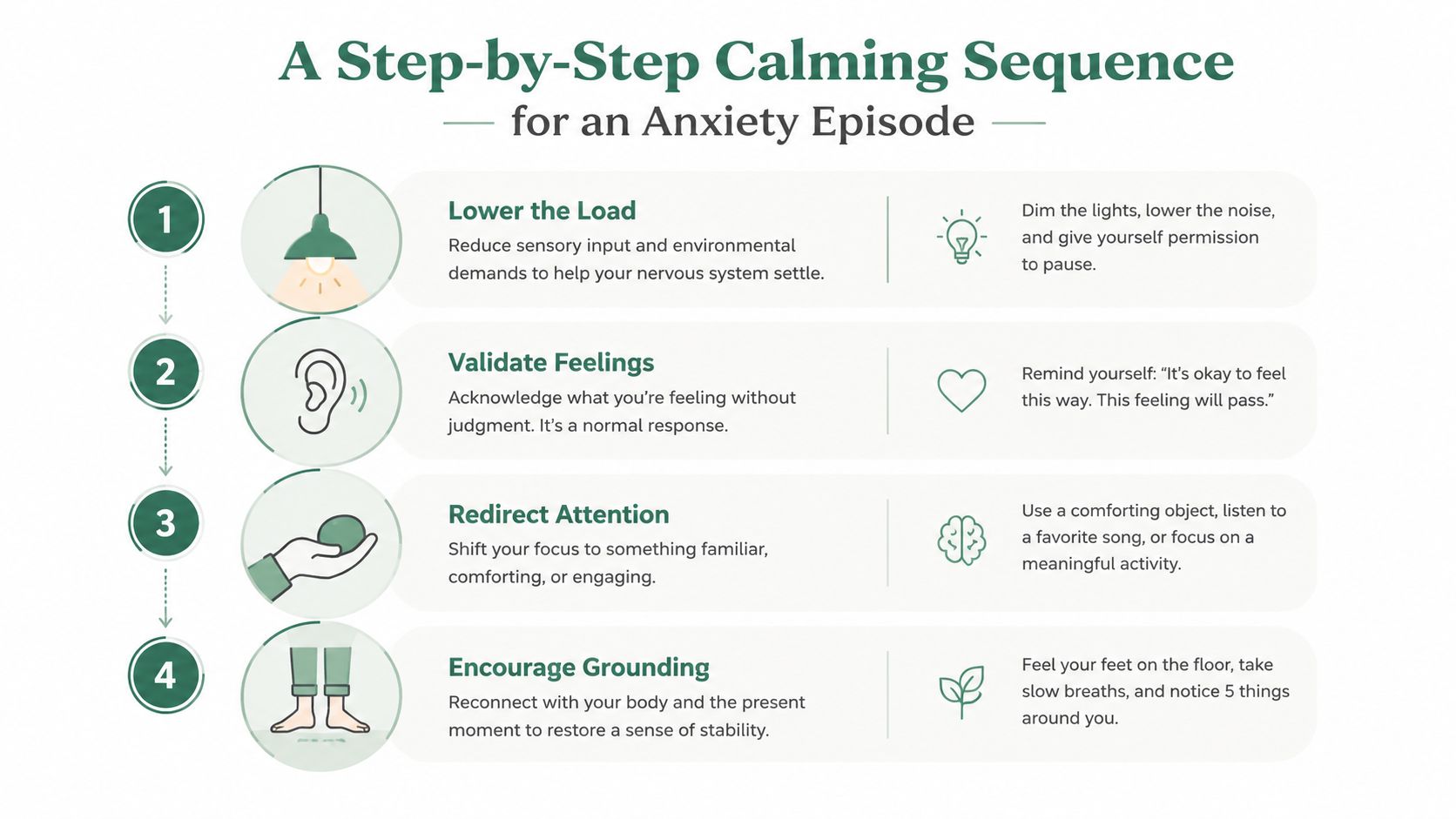
Step 1 Lower the load
Start by making the room less demanding. Turn off the TV, lower background noise, and remove extra people if you can. Simplify what the person sees, because too much visual clutter adds to the sense that something is wrong.
Say less, not more. A short line like, “Let's make this quieter,” is better than a long explanation. The goal is to reduce stimulation before you try anything else.
Step 2 Validate the feeling
Don't argue with the fear. Don't correct the story. Say something that matches the emotion, not the facts.
Try, “I can see this feels upsetting,” or “You're safe, I'm here with you.” That keeps the emotional temperature from rising. If you tell the person they're mistaken, they usually hear it as resistance.
Step 3 Redirect to something familiar
Once the room is calmer, move attention to a preferred activity or object. Music, folding towels, looking at family photos, holding a familiar item, or a brief walk can work well when the person is still able to engage. A one-to-one prompt on a familiar topic is usually better than introducing a new task.
Step 4 Ground with the body
If the person is still unsettled, focus on the physical present. Encourage both feet on the floor, slow breathing if they can follow it, or a seated position in a quiet spot. Grounding works best when you keep instructions short and concrete.
“Don't crowd them. Don't correct them. Reduce the noise, respect the feeling, and redirect only after the room is calmer.”
A daughter once used this sequence when her father kept insisting he'd missed a train. She stopped correcting him, turned off the TV, handed him a warm drink, and asked him to sit by the window while she put on his favorite songs. The fear didn't vanish instantly, but the argument did, and that's usually the first real win.
Building a Daily Routine That Prevents Anxiety
The strongest anxiety reduction often happens before any episode starts. If the day is chaotic, you'll spend your energy putting out fires. If the day is predictable, the brain has less to fight against.
Predictability beats improvisation
Keep meals, rest, bathing, and check-ins on a stable rhythm. People with dementia do better when the day feels familiar, because they don't have to solve every next step from scratch. Sudden changes, skipped meals, and last-minute demands are small to you and huge to them.
Design the day around the person's best time of day. Put harder tasks, like appointments or showers, at the time when they're usually most settled. Save low-demand time for rest, quiet conversation, and easy wins.
Make the home easier to read
A calmer environment isn't sterile. It's legible. That means reducing clutter, keeping essentials in the same places, and using simple visual cues so the person doesn't have to search or guess.
Pay attention to the stuff that ramps up distress:
Noise: keep the TV from running in the background all day.
Lighting: reduce shadows and glare, especially in late day.
Movement: avoid a stream of people coming and going without warning.
Layout: keep pathways open and objects where the person expects them.
The Alzheimer's Association guidance on anxiety and agitation is clear that people often settle when competing stimuli are removed and they're not challenged or argued with Alzheimer's Association. That's the practical point. A calm day prevents more anxiety than any single rescue move.
Cut the friction points
Be blunt about habits that make things worse. Too much caffeine can be a problem, and so can any routine that leaves the person hungry, tired, or overstimulated before a difficult task. Keep instructions short, give one step at a time, and stop asking for speed when the brain is already overloaded.
The home should look lived-in, not institutional, but it should also be easy to move around in. Familiar objects, stable seating, and clear pathways lower confusion without stripping away dignity. That balance matters.
Activities That Evidence Shows Actually Lower Anxiety
Not every activity helps. Some are too demanding, some are too generic, and some are just busywork. The interventions that consistently earn their place are the ones that match the person's stage, history, and current energy.
The strongest recent evidence comes from a 2023 systematic review and meta-analysis in community-dwelling people living with dementia, which found non-pharmacological interventions effective compared with usual care or active controls 2023 meta-analysis. In that analysis, music therapy had the largest effect, with a standardized mean difference of -1.92, while muscular approaches were -0.65 and stimulating cognitive and physical activities were -0.31 2023 meta-analysis.
Evidence-Based Non-Drug Activities for Anxiety in Dementia | Effect Size (SMD) | Best Use Case | Common Pitfall |
|---|---|---|---|
Music therapy | -1.92 | High distress, agitation, or repeated worry | Picking music that has no personal meaning |
Muscular approaches | -0.65 | Restless energy, tension, or mood lift through movement | Making the activity too long or too complex |
Stimulating cognitive and physical activities | -0.31 | Mild to moderate anxiety when the person can still follow simple prompts | Using tasks that are too hard for the current stage |
What to choose first
Start with what the person already likes. Music is often the easiest win because it doesn't require much language, and it can reach people who can't follow a lot of instruction. Earlier review evidence also found music therapy reduced anxiety with an effect size of -0.64 across eight studies and 258 participants earlier review.
Reminiscence, personalized meaningful activity, and short one-to-one conversation also have a real place, especially when they're brief and repetitive. The point is not to entertain. The point is to give the brain a familiar lane to stay in.
How to use them in real life
Use the person's own history, not generic senior content. A former gardener may settle while handling seed packets. A retired teacher may respond to a calm conversation about books or old routines. Someone who loves one-on-one attention may do worse in a group and better with a short, focused interaction.
For readers looking at options like pet therapy for elderly, the rule is the same. If the activity doesn't fit the person's temperament, stage, or attention span, it won't help much. Keep it short, repeat it often, and stop expecting a single session to do the whole job.
Practical rule: use activities as calming tools, not as tests. If the person is hungry, tired, or already overwhelmed, even a good activity can flop.
When Anxiety Is a Symptom of Something Else
This is the section many caregiver guides underplay, and it's the one that saves time. Sudden or worsening anxiety in dementia often isn't “just dementia.” It can be pain, infection, dehydration, constipation, poor sleep, hearing problems, or a medication issue.
Run a quick triage before assuming it's behavioral
Before you reach for a comforting script again, ask a few blunt questions:
Pain or discomfort: Is there grimacing, guarding, limping, or resistance to movement?
Medication changes: Has anything new started, stopped, or changed dose?
Illness signs: Is there fever, new confusion, poor appetite, or unusual fatigue?
Sensory strain: Is hearing worse, is the room too noisy, or is the person missing glasses or dentures?
Basic needs: Are they hungry, dehydrated, constipated, or over-tired?
Older review literature also notes that anxiety can be worsened by caffeine, nicotine, some OTC cold medicines, and some herbal supplements, and that medication side effects should be reviewed older review. That's not trivia. It's the difference between calming a person and missing a medical problem.
When to call the clinician
If anxiety is new, persistent, or clearly out of character, it needs medical attention. Bring a short note with the timing, the pattern, recent medication changes, and anything the caregiver observed before the episode. That's much more useful than saying the person is “more anxious lately.”
Medication can be part of care when needed, and one expert review notes that SSRIs are often considered first-choice anxiolytics in dementia because of their tolerability profile, but they still require medical oversight and they don't replace behavioral management expert review. Use that as a backup, not as the first move.
The clean rule is simple. Rule out reversible causes first, then treat what remains.
Using Ongoing Phone-Based Check-Ins as a Safety Net
Anxiety doesn't wait for clinic day, and family members can't be in the house every hour. That's why structured phone check-ins are useful. They give you a steady read on mood, repetition, and change without making the person deal with another app, device, or login.

A good call isn't just a chat. It usually includes orientation to time and place, brief cognitive prompts, mood check-ins, and reminders about the day's basics. Over time, those repeated contacts can show patterns that a single visit misses, especially if anxiety, sleep disruption, or repeated questions keep showing up in the same window.
For families comparing support options, daily check-in calls for seniors are worth considering when the person is still able to engage by phone and needs regular connection between in-person care moments. Velma is one example of a phone-based cognitive support program that uses scheduled calls, conversation, and guided exercises for older adults with memory loss.
The value is continuity. A steady voice, the same basic structure, and family visibility into patterns can lower anxiety and help you catch trouble earlier. That makes phone support a practical safety net, not a substitute for hands-on care.
If anxiety is becoming a regular part of your family's day, stop trying to improvise one episode at a time. Velma offers scheduled phone-based cognitive support that can add structure, conversation, and monitoring between visits, which is exactly where a lot of anxiety shows up. Visit Velma if you want a simple way to build more consistency into dementia care.
Your mother was steady at breakfast, then by late afternoon she's pacing the hallway, asking where she's supposed to go, or refusing to leave the house because something feels “off.” That's not you failing at caregiving. It's a dementia care problem that needs triage, not guesswork.
The fastest way to calm this down is to stop treating every anxious episode like the same kind of problem. First ask whether the distress is coming from the environment, from the disease itself, or from pain, infection, medication, or another reversible cause. Then use a simple calming sequence, build a predictable day, and keep monitoring instead of waiting for the next crisis.
Table of Contents
Why Anxiety Shows Up So Often in Dementia
Why the brain gets overwhelmed so easily
What this means for family caregivers
Spotting Anxiety Early Before It Escalates
Read the body before the words
Build a trigger map you'll actually use
A Step-by-Step Calming Sequence for an Anxiety Episode
Step 1 Lower the load
Step 2 Validate the feeling
Step 3 Redirect to something familiar
Step 4 Ground with the body
Building a Daily Routine That Prevents Anxiety
Predictability beats improvisation
Make the home easier to read
Cut the friction points
Activities That Evidence Shows Actually Lower Anxiety
What to choose first
How to use them in real life
When Anxiety Is a Symptom of Something Else
Run a quick triage before assuming it's behavioral
When to call the clinician
Using Ongoing Phone-Based Check-Ins as a Safety Net
Why Anxiety Shows Up So Often in Dementia
A familiar scene turns into a full-blown argument fast. Someone is fine at lunch, then a noise, a transition, or a confusing request tips them into pacing, worry, or repeated questions. That pattern is common enough that you should expect it, not dismiss it.
Anxiety is not a rare side issue in dementia. In the literature, prevalence estimates range from 38% to 72% among people with dementia, compared with roughly 2% to 7% in community-dwelling older adults without dementia, and a major NIH review reports estimates as high as 8% to 71% for anxiety symptoms and 5% to 21% for diagnosable anxiety disorders in dementia NIH review. That makes anxiety a major part of the care picture, not an occasional nuisance.
Why the brain gets overwhelmed so easily
Dementia doesn't just affect memory. It lowers the person's ability to interpret what's happening, filter noise, and recover after stress. A small disruption that would feel manageable to you can feel chaotic to someone whose brain can't organize the moment well.
That's why the right mindset is triage. Don't ask, “How do I stop anxiety forever?” Ask, “What kind of anxiety is this, what triggered it, and what needs to happen right now?” If you approach it that way, you'll make better decisions and stop chasing the wrong fix.
Practical rule: treat anxiety in dementia as a recurring symptom, not a one-time event. The person may need the same kind of calm response again and again, because the brain condition doesn't reset after one reassuring conversation.
What this means for family caregivers
You need a repeatable plan. Calm reassurance, routine-based orientation, and activity scheduling are not soft extras, they're the backbone of care when anxiety keeps returning NIH review. One-off reassurance is rarely enough if the person is already overloaded.
If your loved one has repeat episodes, stop improvising. Decide in advance what you'll say, what you'll remove from the environment, and when you'll call a clinician. That's the standard that lowers chaos in real homes.
Spotting Anxiety Early Before It Escalates
By the time someone is crying, refusing care, or shadowing you from room to room, the episode has already been building. The better move is to catch the early signals. Those signals are usually physical, behavioral, and timing-based, and they're easy to miss if you only look for obvious panic.
Read the body before the words
Watch for pacing, repetitive questions, fixed staring, clenched hands, or a sudden refusal to start a task they normally tolerate. Some people become quieter instead of louder, which is why “calm on the outside” can still mean they're spiraling inside. If the person begins hovering near you, that's often an early search-for-safety behavior, not stubbornness.
Timing matters too. Many families see anxiety rise in the late afternoon or early evening, when fatigue and confusion stack up. The trigger might not look dramatic, but the brain is already running out of spare capacity.
Build a trigger map you'll actually use
The fastest way to spot a pattern is to log the same few details every day for two weeks. Keep it short. Write down what happened right before the episode, who was present, what the noise level was, and whether there was a transition like bathing, leaving the house, or changing caregivers.
Use this kind of simple recognition checklist:
Environment: TV on, too many people, clutter, bright glare, or a busy room.
Change: unfamiliar caregiver, rushed transition, new location, or schedule disruption.
Body state: hunger, fatigue, poor sleep, discomfort, or needing the bathroom.
Conversation: too many questions, correction, or being challenged about what they believe.
If the same trigger keeps appearing, don't wait for it to “blow over.” Change the setup. The guidance in dementia care training is most useful when it helps you spot the pattern before the episode peaks.
A Step-by-Step Calming Sequence for an Anxiety Episode
When anxiety is already happening, the mistake families make is trying to reason the person out of it. That almost never works. The person doesn't need a debate. They need the pressure lowered, the feeling acknowledged, and the situation simplified.
Step 1 Lower the load
Start by making the room less demanding. Turn off the TV, lower background noise, and remove extra people if you can. Simplify what the person sees, because too much visual clutter adds to the sense that something is wrong.
Say less, not more. A short line like, “Let's make this quieter,” is better than a long explanation. The goal is to reduce stimulation before you try anything else.
Step 2 Validate the feeling
Don't argue with the fear. Don't correct the story. Say something that matches the emotion, not the facts.
Try, “I can see this feels upsetting,” or “You're safe, I'm here with you.” That keeps the emotional temperature from rising. If you tell the person they're mistaken, they usually hear it as resistance.
Step 3 Redirect to something familiar
Once the room is calmer, move attention to a preferred activity or object. Music, folding towels, looking at family photos, holding a familiar item, or a brief walk can work well when the person is still able to engage. A one-to-one prompt on a familiar topic is usually better than introducing a new task.
Step 4 Ground with the body
If the person is still unsettled, focus on the physical present. Encourage both feet on the floor, slow breathing if they can follow it, or a seated position in a quiet spot. Grounding works best when you keep instructions short and concrete.
“Don't crowd them. Don't correct them. Reduce the noise, respect the feeling, and redirect only after the room is calmer.”
A daughter once used this sequence when her father kept insisting he'd missed a train. She stopped correcting him, turned off the TV, handed him a warm drink, and asked him to sit by the window while she put on his favorite songs. The fear didn't vanish instantly, but the argument did, and that's usually the first real win.
Building a Daily Routine That Prevents Anxiety
The strongest anxiety reduction often happens before any episode starts. If the day is chaotic, you'll spend your energy putting out fires. If the day is predictable, the brain has less to fight against.
Predictability beats improvisation
Keep meals, rest, bathing, and check-ins on a stable rhythm. People with dementia do better when the day feels familiar, because they don't have to solve every next step from scratch. Sudden changes, skipped meals, and last-minute demands are small to you and huge to them.
Design the day around the person's best time of day. Put harder tasks, like appointments or showers, at the time when they're usually most settled. Save low-demand time for rest, quiet conversation, and easy wins.
Make the home easier to read
A calmer environment isn't sterile. It's legible. That means reducing clutter, keeping essentials in the same places, and using simple visual cues so the person doesn't have to search or guess.
Pay attention to the stuff that ramps up distress:
Noise: keep the TV from running in the background all day.
Lighting: reduce shadows and glare, especially in late day.
Movement: avoid a stream of people coming and going without warning.
Layout: keep pathways open and objects where the person expects them.
The Alzheimer's Association guidance on anxiety and agitation is clear that people often settle when competing stimuli are removed and they're not challenged or argued with Alzheimer's Association. That's the practical point. A calm day prevents more anxiety than any single rescue move.
Cut the friction points
Be blunt about habits that make things worse. Too much caffeine can be a problem, and so can any routine that leaves the person hungry, tired, or overstimulated before a difficult task. Keep instructions short, give one step at a time, and stop asking for speed when the brain is already overloaded.
The home should look lived-in, not institutional, but it should also be easy to move around in. Familiar objects, stable seating, and clear pathways lower confusion without stripping away dignity. That balance matters.
Activities That Evidence Shows Actually Lower Anxiety
Not every activity helps. Some are too demanding, some are too generic, and some are just busywork. The interventions that consistently earn their place are the ones that match the person's stage, history, and current energy.
The strongest recent evidence comes from a 2023 systematic review and meta-analysis in community-dwelling people living with dementia, which found non-pharmacological interventions effective compared with usual care or active controls 2023 meta-analysis. In that analysis, music therapy had the largest effect, with a standardized mean difference of -1.92, while muscular approaches were -0.65 and stimulating cognitive and physical activities were -0.31 2023 meta-analysis.
Evidence-Based Non-Drug Activities for Anxiety in Dementia | Effect Size (SMD) | Best Use Case | Common Pitfall |
|---|---|---|---|
Music therapy | -1.92 | High distress, agitation, or repeated worry | Picking music that has no personal meaning |
Muscular approaches | -0.65 | Restless energy, tension, or mood lift through movement | Making the activity too long or too complex |
Stimulating cognitive and physical activities | -0.31 | Mild to moderate anxiety when the person can still follow simple prompts | Using tasks that are too hard for the current stage |
What to choose first
Start with what the person already likes. Music is often the easiest win because it doesn't require much language, and it can reach people who can't follow a lot of instruction. Earlier review evidence also found music therapy reduced anxiety with an effect size of -0.64 across eight studies and 258 participants earlier review.
Reminiscence, personalized meaningful activity, and short one-to-one conversation also have a real place, especially when they're brief and repetitive. The point is not to entertain. The point is to give the brain a familiar lane to stay in.
How to use them in real life
Use the person's own history, not generic senior content. A former gardener may settle while handling seed packets. A retired teacher may respond to a calm conversation about books or old routines. Someone who loves one-on-one attention may do worse in a group and better with a short, focused interaction.
For readers looking at options like pet therapy for elderly, the rule is the same. If the activity doesn't fit the person's temperament, stage, or attention span, it won't help much. Keep it short, repeat it often, and stop expecting a single session to do the whole job.
Practical rule: use activities as calming tools, not as tests. If the person is hungry, tired, or already overwhelmed, even a good activity can flop.
When Anxiety Is a Symptom of Something Else
This is the section many caregiver guides underplay, and it's the one that saves time. Sudden or worsening anxiety in dementia often isn't “just dementia.” It can be pain, infection, dehydration, constipation, poor sleep, hearing problems, or a medication issue.
Run a quick triage before assuming it's behavioral
Before you reach for a comforting script again, ask a few blunt questions:
Pain or discomfort: Is there grimacing, guarding, limping, or resistance to movement?
Medication changes: Has anything new started, stopped, or changed dose?
Illness signs: Is there fever, new confusion, poor appetite, or unusual fatigue?
Sensory strain: Is hearing worse, is the room too noisy, or is the person missing glasses or dentures?
Basic needs: Are they hungry, dehydrated, constipated, or over-tired?
Older review literature also notes that anxiety can be worsened by caffeine, nicotine, some OTC cold medicines, and some herbal supplements, and that medication side effects should be reviewed older review. That's not trivia. It's the difference between calming a person and missing a medical problem.
When to call the clinician
If anxiety is new, persistent, or clearly out of character, it needs medical attention. Bring a short note with the timing, the pattern, recent medication changes, and anything the caregiver observed before the episode. That's much more useful than saying the person is “more anxious lately.”
Medication can be part of care when needed, and one expert review notes that SSRIs are often considered first-choice anxiolytics in dementia because of their tolerability profile, but they still require medical oversight and they don't replace behavioral management expert review. Use that as a backup, not as the first move.
The clean rule is simple. Rule out reversible causes first, then treat what remains.
Using Ongoing Phone-Based Check-Ins as a Safety Net
Anxiety doesn't wait for clinic day, and family members can't be in the house every hour. That's why structured phone check-ins are useful. They give you a steady read on mood, repetition, and change without making the person deal with another app, device, or login.
A good call isn't just a chat. It usually includes orientation to time and place, brief cognitive prompts, mood check-ins, and reminders about the day's basics. Over time, those repeated contacts can show patterns that a single visit misses, especially if anxiety, sleep disruption, or repeated questions keep showing up in the same window.
For families comparing support options, daily check-in calls for seniors are worth considering when the person is still able to engage by phone and needs regular connection between in-person care moments. Velma is one example of a phone-based cognitive support program that uses scheduled calls, conversation, and guided exercises for older adults with memory loss.
The value is continuity. A steady voice, the same basic structure, and family visibility into patterns can lower anxiety and help you catch trouble earlier. That makes phone support a practical safety net, not a substitute for hands-on care.
If anxiety is becoming a regular part of your family's day, stop trying to improvise one episode at a time. Velma offers scheduled phone-based cognitive support that can add structure, conversation, and monitoring between visits, which is exactly where a lot of anxiety shows up. Visit Velma if you want a simple way to build more consistency into dementia care.
Suggested Article: