Dementia Care Training Guide: Skills for Caregivers
Your mother insists she needs to “go home,” even though she's sitting in the house she's lived in for years. You try logic. You remind her of the address, the family photos, the familiar chair by the window. She gets more upset. You feel awful, then frustrated, then guilty for feeling frustrated.
That moment is where many people start looking for dementia care training.
Family caregivers often arrive here after a hard week. Professionals often arrive after realizing that general caregiving skills aren't enough when memory loss, fear, and changing language enter the picture. What both groups usually want is the same thing: a practical way to respond better, reduce distress, and feel less lost in daily care.
Good training doesn't turn you into a neurologist. It gives you a more useful map. It helps you understand what the person may be experiencing, how to communicate without triggering more fear, and what to watch for as needs change over time.
Table of Contents
Why Effective Dementia Care Training Matters More Than Ever
A training gap that affects daily care
Training changes more than knowledge
What Exactly Is Dementia Care Training
It is not the same as general elder care
What good training helps you notice
The Core Competencies of Excellent Dementia Care
Communication changes the whole interaction
Behavior usually has a reason
Safety and well-being belong together
Observation is an advanced caregiving skill
Comparing Training Formats From In-Person to Phone-Based
In-person learning builds skills you can feel
Online modules work best for knowledge and refreshers
Live remote and phone-based training close the gap between class and home
A side-by-side view
How to Choose the Right Dementia Training Program
What strong programs have in common
A simple screening checklist
Quick Skills You Can Start Building Today
Use validation before correction
Redirect without sounding dismissive
Use reminiscence to create connection
The Journey of Lifelong Learning in Dementia Care
Why Effective Dementia Care Training Matters More Than Ever
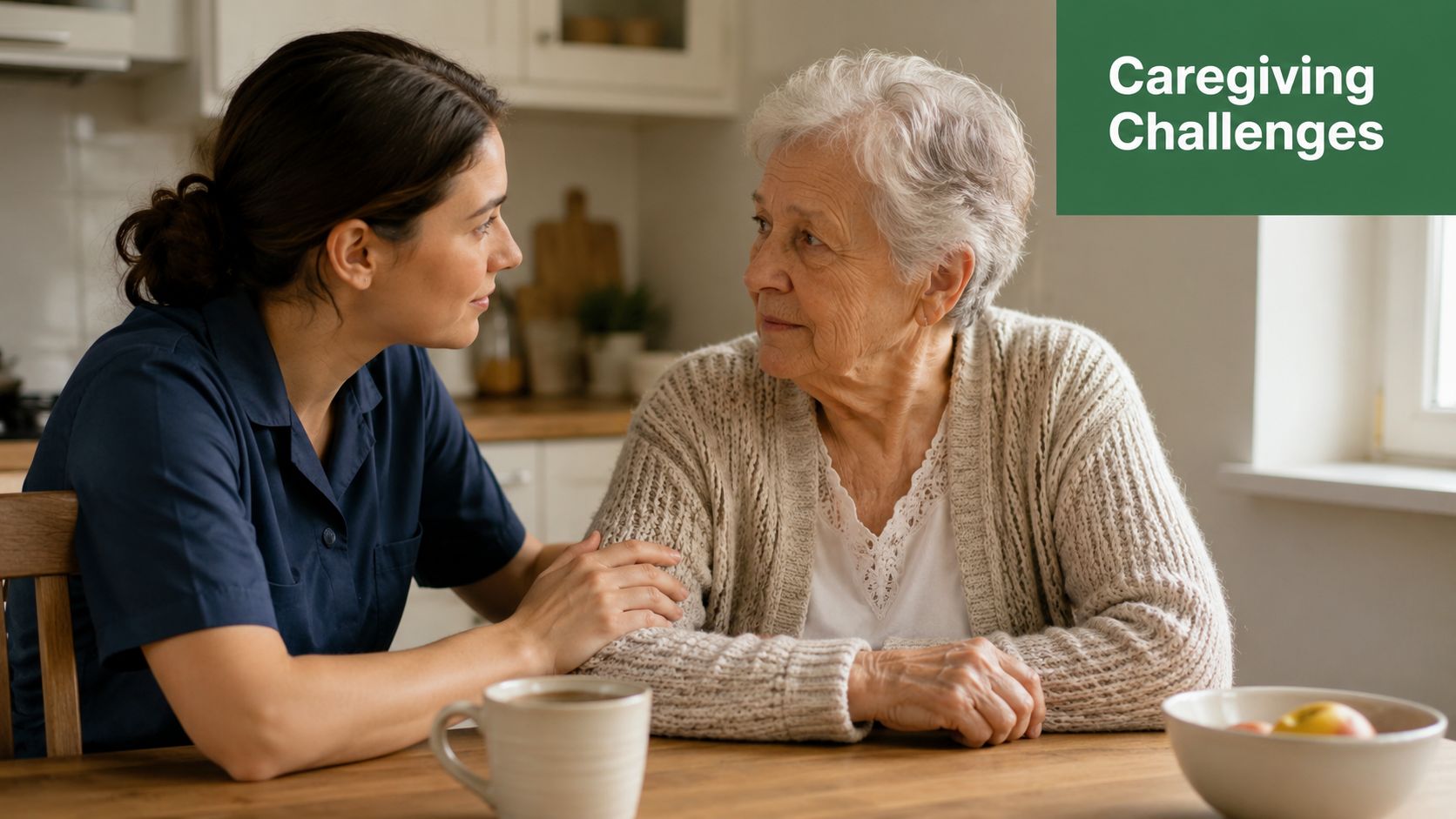
A daughter I once coached told me the hardest part wasn't helping with meals or appointments. It was the constant feeling that every conversation could go sideways. If she corrected her father, he became defensive. If she rushed him, he shut down. If she asked open-ended questions late in the day, he looked overwhelmed and said nothing at all.
That isn't a sign of failure. It's a sign that dementia changes the rules of communication, and individuals typically haven't been taught the new ones.
A training gap that affects daily care
Many caregivers assume there must already be a standard system in place. In reality, training is uneven. In the United States, 64% of nursing home residents have dementia, yet fewer than half of states require any dementia-specific training for staff, and only 13 states require it for home health aides according to this review of state dementia training standards.
That gap shows up in ordinary moments. A worker may know how to help someone dress, but not how to respond when the person believes a stranger is in the room. A spouse may know medication schedules perfectly, but not know why a simple shower now feels threatening to their partner.
Practical rule: If care keeps turning into conflict, the problem usually isn't lack of effort. It's lack of dementia-specific skill.
Training changes more than knowledge
The best dementia care training doesn't just add facts. It changes your interpretation of what's happening.
Instead of seeing “stubbornness,” you start asking whether the person is frightened, overstimulated, or confused by too many steps. Instead of pushing harder, you slow down, simplify, and preserve dignity. That shift often lowers stress for both people in the interaction.
For families, that can mean fewer arguments and more moments of connection. For professionals, it can mean more consistent care, safer routines, and better teamwork. Either way, the biggest relief is often this: you stop taking every difficult behavior personally.
What Exactly Is Dementia Care Training
Dementia care training is the process of learning how to support a person whose memory, language, judgment, and perception are changing. It includes practical communication tools, ways to reduce distress, approaches to daily routines, and methods for maintaining dignity and engagement.
A simple way to understand it is to think of yourself as a translator.
When a person with dementia says something that doesn't fit current reality, the surface words may be inaccurate, but the feeling underneath is often true. “I need to go home” may mean “I don't feel safe.” “You stole my purse” may mean “I'm scared because I can't find something important.” Training teaches you to respond to the feeling first.
It is not the same as general elder care
General caregiving often focuses on tasks. Can the person eat, bathe, dress, take medication, and get to appointments?
Dementia care adds another layer. It asks how those tasks are introduced, paced, explained, and adapted when the person can no longer process information the way they once did. Two caregivers can complete the same morning routine, but one may leave the person calm and respected while the other leaves them distressed.
Here's the mindset shift that matters most:
Less correcting: Arguing about facts usually increases fear or shame.
More cueing: Short sentences, one-step directions, and calm tone work better.
Less task takeover: Doing everything for the person can increase dependence.
More partnership: Offering simple choices supports dignity and participation.
You are not trying to win an argument with dementia. You are trying to preserve trust.
What good training helps you notice
Training also helps you recognize that dementia care is person-centered. The same phrase, same routine, or same room setup won't work for everyone.
One person may relax when you use humor. Another may feel patronized. One may respond well to a visual cue like laying out clothing in order. Another may do better when you hand over one item at a time. Good training helps you learn patterns, not scripts.
That's why the best programs don't stop at “what is dementia.” They teach how to adapt your own behavior so the person can function with less distress and more confidence.
The Core Competencies of Excellent Dementia Care
A solid training program should build a small set of practical abilities that show up every day. These aren't abstract ideas. They're the skills that help someone get through breakfast, bathing, a worried phone call, or a restless evening with less friction.

Communication changes the whole interaction
Person-centered communication is the foundation. It includes tone, pace, body position, word choice, and the ability to tolerate pauses.
Skilled caregivers often make small adjustments that have a big effect:
They approach from the front: This reduces startle.
They use one idea at a time: “Let's put on your sweater” works better than a long string of instructions.
They match the emotional moment: A calm voice helps regulate fear.
They watch nonverbal cues: Pulling away, frowning, or looking down may signal confusion before words do.
For a useful example of everyday support habits, these basic recommendations for memory loss support reflect the kind of practical, low-complexity structure many families need.
A short teaching video can make these interaction shifts easier to picture.
Behavior usually has a reason
What people call “behavior problems” are often expressions of unmet need. A person may pace because they're anxious, resist care because they feel rushed, or repeat a question because they can't hold the answer in mind long enough to feel settled.
Strong training helps caregivers ask better questions:
Situation | Possible meaning | Better response |
|---|---|---|
Refusing a bath | Fear, cold, embarrassment, loss of control | Warm the room, explain one step at a time, offer choice |
Repeating “Where are we going?” | Anxiety, poor short-term memory | Give a brief reassuring answer, then use a visual cue |
Agitation in late afternoon | Fatigue, overstimulation, hunger | Lower noise, simplify activity, offer comfort and routine |
Safety and well-being belong together
Safety in dementia care isn't only about locking doors or preventing falls. It includes emotional safety. A person who feels cornered or confused is less likely to cooperate and more likely to become distressed.
Good training covers environmental setup, routine design, support with daily activities, and meaningful engagement. Cognitive stimulation belongs here too. That may include reminiscence, orientation cues, naming tasks, music, familiar conversation, or simple language exercises matched to the person's current ability.
Observation is an advanced caregiving skill
One of the most overlooked skills is tracking subtle change over time. A WHO-related caregiver training discussion notes that families often feel untrained to distinguish ordinary ups and downs from changes that may need clinical follow-up.
That matters because decline often appears gradually. Someone may still sound “mostly fine,” but become more anxious each evening, miss more steps in dressing, or struggle to follow longer sentences.
Useful observations include:
Mood patterns: more tearful, more suspicious, flatter affect
Cognitive changes: increased repetition, word-finding trouble, confusion about routine
Function changes: new difficulty with utensils, buttons, phone use, or sequencing
Physical clues: changes in walking, sleep, energy, or hearing
When caregivers learn to document these patterns clearly, clinicians get better information, and families make better decisions.
Comparing Training Formats From In-Person to Phone-Based
A daughter is helping her father get dressed before a medical appointment. He becomes upset, refuses his shirt, and says he is late for work, even though he retired years ago. A nurse aide in a facility may face the same kind of moment. A sibling supporting from another state may hear it over the phone. The care challenge is similar, but the training format shapes how well each person can respond in real life.

A useful way to compare formats is to ask one practical question. Does this type of training help someone stay calm, choose words carefully, and adjust in the moment on an ordinary difficult day?
In-person learning builds skills you can feel
In-person workshops often help learners grasp dementia care faster because they can see and practice the small details. A trainer can model how to approach from the front, lower their voice, pause after a short sentence, or redirect without arguing. Those details are easy to describe on a slide and much easier to understand when you watch them happen.
This format often fits:
New family caregivers: They benefit from live reassurance and the chance to ask, “What do I say next?”
Staff teams in shared settings: Coworkers can practice the same scenario and build a common approach.
Learners who need coaching on tone and pacing: Real-time feedback helps habits change sooner.
The main drawback is access. Family caregivers may not be able to leave home. Shift workers may miss scheduled sessions. Rural communities may have few local options. A single workshop can also fade quickly if nobody helps the learner apply it at home, on the unit, or during follow-up calls.
Online modules work best for knowledge and refreshers
Self-paced online training solves a real problem. People can learn at night after a hard day, repeat a lesson, or complete short segments between other responsibilities.
That flexibility matters, but convenience alone does not build judgment. Reading about redirection is different from trying it while someone is frightened or accusatory. Online training is strongest when it includes realistic case examples, short practice exercises, reflection questions, and some form of feedback or discussion.
If you are comparing dementia support programs as well as training options, this guide on how to evaluate a memory loss support program can help you spot whether a service offers actual skill-building or only general reassurance.
A simple rule helps here. Use online modules to learn principles and language. Add coaching, discussion, or practice if the goal is better day-to-day care.
Live remote and phone-based training close the gap between class and home
Remote training sits in the middle ground between formal instruction and the messy reality of daily care. Video sessions, virtual groups, and structured phone coaching can bring support into the exact setting where problems happen. That matters for both professionals and families, because dementia care rarely unfolds in a classroom. It unfolds in kitchens, hallways, cars, break rooms, and evening phone calls.
Phone-based support deserves special attention. Many older adults are comfortable with the telephone long after apps, portals, and passwords become frustrating. Families supporting from a distance often rely on calls too. For that reason, training should teach caregivers how to communicate well without visual cues, not treat phone support as a lesser version of in-person care.
Phone work uses a different skill set:
Questions need to be shorter and more concrete.
Silence needs interpretation, not panic. The person may be thinking, hearing poorly, or losing the thread.
Verbal cueing has to carry the weight that gestures usually carry in person.
Activities must work through voice alone, such as reminiscence prompts, simple orientation cues, or one-step sequencing.
Caregivers need a plan for checking fatigue, distress, and hearing during the call.
Many training programs often fall short. They may teach good dementia communication in general but skip how to adapt it for a phone call from a worried daughter, a remote case manager, or a staff member doing follow-up after discharge.
A side-by-side view
Format | Strongest use | Main advantage | Main limitation |
|---|---|---|---|
In-person workshops | Building foundational communication and de-escalation skills | Immediate practice and feedback | Harder to schedule and attend |
Online e-learning | Flexible knowledge building and refreshers | Convenience and repeat access | Can be too passive |
Live remote or phone-based coaching | Ongoing support and real-life problem solving | Accessible and adaptable to home settings | Needs specialized training design |
The strongest training plans usually combine formats. A caregiver might learn core ideas in an online module, practice them in a live session, and then get phone coaching after a difficult week. That blended approach helps close the gap between knowing what dementia care should look like and applying it under pressure.
How to Choose the Right Dementia Training Program
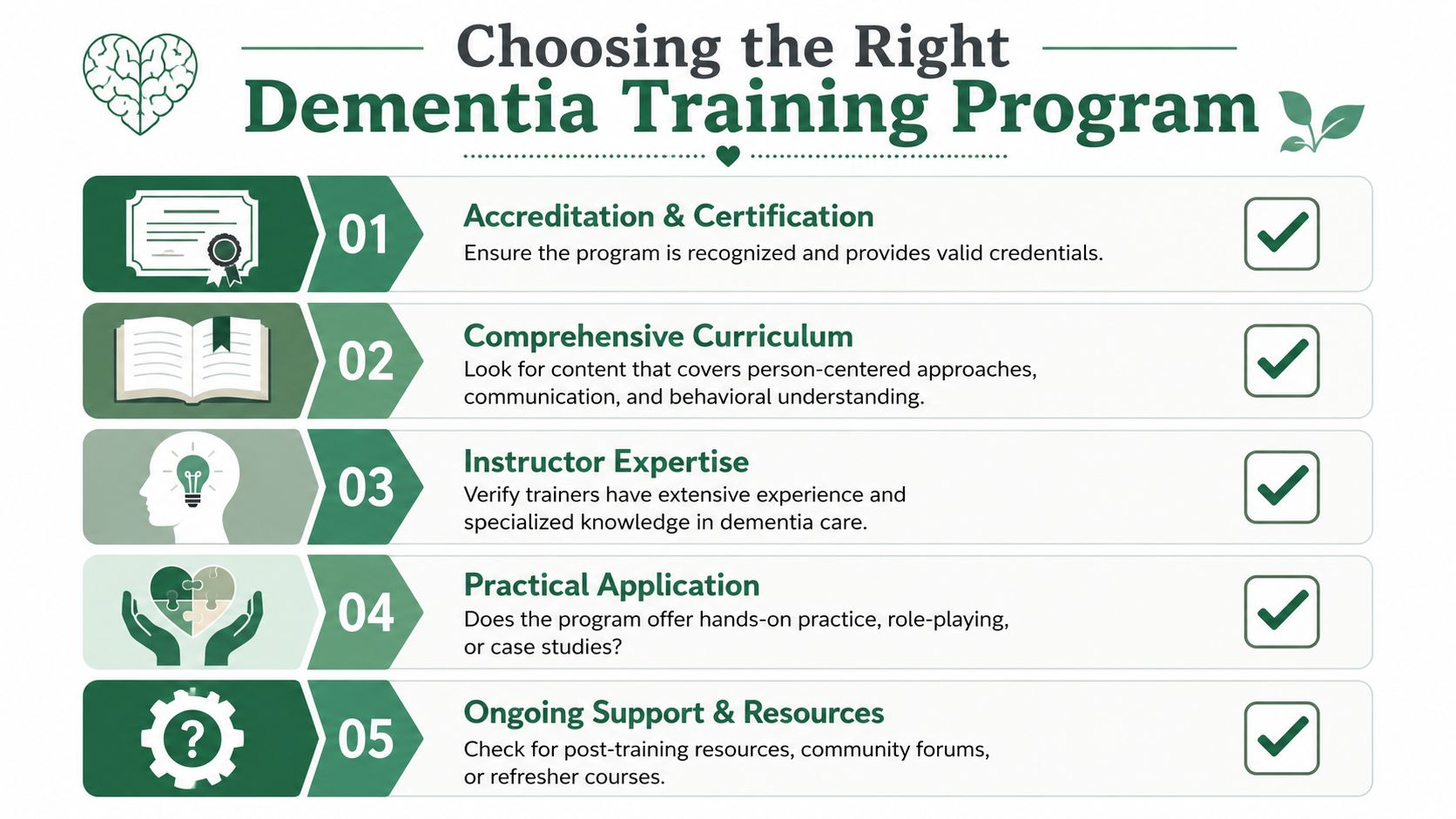
Many courses sound good in a brochure. Fewer lead to better care on a difficult Tuesday afternoon. If you're investing time, money, or staff hours, don't settle for awareness-only training.
What strong programs have in common
Start with structure. Policy benchmarks described in this dementia training guidance document recommend at least 8 hours of instruction plus 8 hours of supervised interactive experience, along with competency checks such as observed skills or written assessments.
That benchmark is useful because it tells you what serious training looks like. Watching a few videos may introduce ideas, but it usually won't build the practical judgment needed for real care.
Look for programs that include:
Observed practice: Someone should assess how you communicate, not just whether you attended.
Role-specific scenarios: A home aide, family caregiver, and nurse don't need identical examples.
Person-centered content: Communication, distress, daily activities, safety, and dignity should all appear.
Follow-up support: Refresher sessions, mentoring, or case discussion help skills stick.
A helpful companion question is whether the program teaches you how to judge support services more broadly. This guide on how to evaluate a memory loss support program gives a practical lens for comparing claims, structure, and fit.
A simple screening checklist
Before enrolling, ask these five questions.
How will skills be assessed?
If the answer is only “you'll get a certificate after completion,” keep looking.Is there supervised or interactive practice?
Dementia care is relational. Training should reflect that.Who teaches it?
Instructors should have real experience working with people living with dementia and their families.Does it match your setting?
Support for a memory care unit differs from support for a spouse at home.What happens after the course ends?
Skills fade without reinforcement, especially when the condition changes over time.
Decision point: Choose the program that changes what you can do, not just what you can say you completed.
A good course should leave you better at calming distress, adapting routines, noticing change, and communicating with the broader care team. If those outcomes are missing, the program is probably too shallow.
Quick Skills You Can Start Building Today
It is 7:30 p.m. Your mother wants to "go home," even though she is sitting in the house she has lived in for years. A home care aide may face the same moment during a shift. A daughter may face it over the phone from another city. Training helps, but a few everyday skills can steady these moments right away and make formal learning easier to apply in real life.
Start with the skill that prevents many arguments from growing.
Use validation before correction
Validation means answering the feeling first, then deciding whether facts even need to be addressed. In dementia care, emotion often arrives faster than reasoning. If you meet fear with correction, the person may hear only pressure.
If your father says, "I need to pick up the children from school," try a simple sequence:
Pause and soften your tone.
Name the feeling: "You sound worried about the children."
Offer comfort: "They are safe."
Guide the next step: "Sit with me for a minute and tell me about them."
Validation works like opening a stuck door before trying to walk through it. Once the person feels heard, you have a better chance of reducing distress.
This also works well by phone. Since the person cannot read your facial expression, your voice has to carry the reassurance. Slow your pace, leave a little space between sentences, and keep your wording short.
Redirect without sounding dismissive
Redirection is a gentle change of track. It helps move someone from a distressing loop into something concrete and manageable.
Say someone keeps searching for a missing bag. You can acknowledge the concern, join the search briefly, and then suggest one clear next step:
Acknowledge: "You are looking for your bag."
Join: "Let's check the chair and the hallway table."
Redirect: "After that, let's have some tea and look again."
The order matters. If you jump straight to "Let's have tea," the person may feel brushed off. If you stay in the search too long, the worry can deepen. A short, respectful search shows partnership. Then you create a pause.
Families trying to build steadier routines at home may find it helpful to see how these small interactions fit into a larger plan for daily support. This family guide to daily cognitive support gives a practical example.
Use reminiscence to create connection
Reminiscence helps many people access older memories more easily than recent ones. It can lower pressure and make conversation feel more natural, especially when direct questions about the present create frustration.
Specific prompts usually work better than broad ones:
"What music did you love as a teenager?"
"What did the kitchen in your childhood home look like?"
"Which job made you feel proud?"
"What holiday traditions do you remember best?"
If the person hesitates, offer gentle cues instead of turning it into a test. Ask, "Was the kitchen small or large?" or "Did you listen to the radio while cooking?" Good reminiscence feels like walking beside someone, not checking whether they can still remember.
This skill is especially useful for remote support. On a phone call, you can keep a short list of familiar topics nearby, such as favorite foods, old neighborhoods, songs, pets, or work stories. That gives you a reliable way to reconnect when the conversation becomes strained.
Short, warm prompts usually work better than broad memory questions.
These skills may look simple, but they are the bridge between classroom learning and daily care. They help a spouse at home, a nursing assistant on shift, or an adult child calling from far away respond with less panic and more purpose. That is how training starts to become practice.
The Journey of Lifelong Learning in Dementia Care
No course can cover every situation you'll face. Dementia changes over time, and the support that works well this month may need adjustment later. That isn't a sign that training failed. It's the nature of the condition.
The most helpful way to think about dementia care training is as an ongoing practice. You learn a principle, try it, notice the response, adjust, and keep going. Over time, you become more fluent in the person's patterns, triggers, strengths, and comforts.
For family caregivers, that often means moving from panic to steadiness. For professionals, it means building judgment that goes beyond policy manuals and checklists. In both cases, growth comes from combining formal education with repeated real-world use.
Keep returning to a few essentials:
Lead with personhood: The diagnosis matters, but the individual matters more.
Prefer curiosity over correction: Distress usually has a reason.
Track change over time: Small shifts can be clinically meaningful.
Refresh your skills: As communication and function change, your approach should too.
You don't need to know everything today. You do need support, practice, and a willingness to learn in stages. That's what makes good care sustainable.
If your family needs structured support between visits, Hey Velma offers phone-based cognitive and emotional support for older adults with early to mid-stage memory loss. Through scheduled calls, practical check-ins, cognitive exercises, and ongoing care manager coordination, Hey Velma helps families add consistency, visibility, and reassurance to everyday dementia care.
Your mother insists she needs to “go home,” even though she's sitting in the house she's lived in for years. You try logic. You remind her of the address, the family photos, the familiar chair by the window. She gets more upset. You feel awful, then frustrated, then guilty for feeling frustrated.
That moment is where many people start looking for dementia care training.
Family caregivers often arrive here after a hard week. Professionals often arrive after realizing that general caregiving skills aren't enough when memory loss, fear, and changing language enter the picture. What both groups usually want is the same thing: a practical way to respond better, reduce distress, and feel less lost in daily care.
Good training doesn't turn you into a neurologist. It gives you a more useful map. It helps you understand what the person may be experiencing, how to communicate without triggering more fear, and what to watch for as needs change over time.
Table of Contents
Why Effective Dementia Care Training Matters More Than Ever
A training gap that affects daily care
Training changes more than knowledge
What Exactly Is Dementia Care Training
It is not the same as general elder care
What good training helps you notice
The Core Competencies of Excellent Dementia Care
Communication changes the whole interaction
Behavior usually has a reason
Safety and well-being belong together
Observation is an advanced caregiving skill
Comparing Training Formats From In-Person to Phone-Based
In-person learning builds skills you can feel
Online modules work best for knowledge and refreshers
Live remote and phone-based training close the gap between class and home
A side-by-side view
How to Choose the Right Dementia Training Program
What strong programs have in common
A simple screening checklist
Quick Skills You Can Start Building Today
Use validation before correction
Redirect without sounding dismissive
Use reminiscence to create connection
The Journey of Lifelong Learning in Dementia Care
Why Effective Dementia Care Training Matters More Than Ever
A daughter I once coached told me the hardest part wasn't helping with meals or appointments. It was the constant feeling that every conversation could go sideways. If she corrected her father, he became defensive. If she rushed him, he shut down. If she asked open-ended questions late in the day, he looked overwhelmed and said nothing at all.
That isn't a sign of failure. It's a sign that dementia changes the rules of communication, and individuals typically haven't been taught the new ones.
A training gap that affects daily care
Many caregivers assume there must already be a standard system in place. In reality, training is uneven. In the United States, 64% of nursing home residents have dementia, yet fewer than half of states require any dementia-specific training for staff, and only 13 states require it for home health aides according to this review of state dementia training standards.
That gap shows up in ordinary moments. A worker may know how to help someone dress, but not how to respond when the person believes a stranger is in the room. A spouse may know medication schedules perfectly, but not know why a simple shower now feels threatening to their partner.
Practical rule: If care keeps turning into conflict, the problem usually isn't lack of effort. It's lack of dementia-specific skill.
Training changes more than knowledge
The best dementia care training doesn't just add facts. It changes your interpretation of what's happening.
Instead of seeing “stubbornness,” you start asking whether the person is frightened, overstimulated, or confused by too many steps. Instead of pushing harder, you slow down, simplify, and preserve dignity. That shift often lowers stress for both people in the interaction.
For families, that can mean fewer arguments and more moments of connection. For professionals, it can mean more consistent care, safer routines, and better teamwork. Either way, the biggest relief is often this: you stop taking every difficult behavior personally.
What Exactly Is Dementia Care Training
Dementia care training is the process of learning how to support a person whose memory, language, judgment, and perception are changing. It includes practical communication tools, ways to reduce distress, approaches to daily routines, and methods for maintaining dignity and engagement.
A simple way to understand it is to think of yourself as a translator.
When a person with dementia says something that doesn't fit current reality, the surface words may be inaccurate, but the feeling underneath is often true. “I need to go home” may mean “I don't feel safe.” “You stole my purse” may mean “I'm scared because I can't find something important.” Training teaches you to respond to the feeling first.
It is not the same as general elder care
General caregiving often focuses on tasks. Can the person eat, bathe, dress, take medication, and get to appointments?
Dementia care adds another layer. It asks how those tasks are introduced, paced, explained, and adapted when the person can no longer process information the way they once did. Two caregivers can complete the same morning routine, but one may leave the person calm and respected while the other leaves them distressed.
Here's the mindset shift that matters most:
Less correcting: Arguing about facts usually increases fear or shame.
More cueing: Short sentences, one-step directions, and calm tone work better.
Less task takeover: Doing everything for the person can increase dependence.
More partnership: Offering simple choices supports dignity and participation.
You are not trying to win an argument with dementia. You are trying to preserve trust.
What good training helps you notice
Training also helps you recognize that dementia care is person-centered. The same phrase, same routine, or same room setup won't work for everyone.
One person may relax when you use humor. Another may feel patronized. One may respond well to a visual cue like laying out clothing in order. Another may do better when you hand over one item at a time. Good training helps you learn patterns, not scripts.
That's why the best programs don't stop at “what is dementia.” They teach how to adapt your own behavior so the person can function with less distress and more confidence.
The Core Competencies of Excellent Dementia Care
A solid training program should build a small set of practical abilities that show up every day. These aren't abstract ideas. They're the skills that help someone get through breakfast, bathing, a worried phone call, or a restless evening with less friction.
Communication changes the whole interaction
Person-centered communication is the foundation. It includes tone, pace, body position, word choice, and the ability to tolerate pauses.
Skilled caregivers often make small adjustments that have a big effect:
They approach from the front: This reduces startle.
They use one idea at a time: “Let's put on your sweater” works better than a long string of instructions.
They match the emotional moment: A calm voice helps regulate fear.
They watch nonverbal cues: Pulling away, frowning, or looking down may signal confusion before words do.
For a useful example of everyday support habits, these basic recommendations for memory loss support reflect the kind of practical, low-complexity structure many families need.
A short teaching video can make these interaction shifts easier to picture.
Behavior usually has a reason
What people call “behavior problems” are often expressions of unmet need. A person may pace because they're anxious, resist care because they feel rushed, or repeat a question because they can't hold the answer in mind long enough to feel settled.
Strong training helps caregivers ask better questions:
Situation | Possible meaning | Better response |
|---|---|---|
Refusing a bath | Fear, cold, embarrassment, loss of control | Warm the room, explain one step at a time, offer choice |
Repeating “Where are we going?” | Anxiety, poor short-term memory | Give a brief reassuring answer, then use a visual cue |
Agitation in late afternoon | Fatigue, overstimulation, hunger | Lower noise, simplify activity, offer comfort and routine |
Safety and well-being belong together
Safety in dementia care isn't only about locking doors or preventing falls. It includes emotional safety. A person who feels cornered or confused is less likely to cooperate and more likely to become distressed.
Good training covers environmental setup, routine design, support with daily activities, and meaningful engagement. Cognitive stimulation belongs here too. That may include reminiscence, orientation cues, naming tasks, music, familiar conversation, or simple language exercises matched to the person's current ability.
Observation is an advanced caregiving skill
One of the most overlooked skills is tracking subtle change over time. A WHO-related caregiver training discussion notes that families often feel untrained to distinguish ordinary ups and downs from changes that may need clinical follow-up.
That matters because decline often appears gradually. Someone may still sound “mostly fine,” but become more anxious each evening, miss more steps in dressing, or struggle to follow longer sentences.
Useful observations include:
Mood patterns: more tearful, more suspicious, flatter affect
Cognitive changes: increased repetition, word-finding trouble, confusion about routine
Function changes: new difficulty with utensils, buttons, phone use, or sequencing
Physical clues: changes in walking, sleep, energy, or hearing
When caregivers learn to document these patterns clearly, clinicians get better information, and families make better decisions.
Comparing Training Formats From In-Person to Phone-Based
A daughter is helping her father get dressed before a medical appointment. He becomes upset, refuses his shirt, and says he is late for work, even though he retired years ago. A nurse aide in a facility may face the same kind of moment. A sibling supporting from another state may hear it over the phone. The care challenge is similar, but the training format shapes how well each person can respond in real life.
A useful way to compare formats is to ask one practical question. Does this type of training help someone stay calm, choose words carefully, and adjust in the moment on an ordinary difficult day?
In-person learning builds skills you can feel
In-person workshops often help learners grasp dementia care faster because they can see and practice the small details. A trainer can model how to approach from the front, lower their voice, pause after a short sentence, or redirect without arguing. Those details are easy to describe on a slide and much easier to understand when you watch them happen.
This format often fits:
New family caregivers: They benefit from live reassurance and the chance to ask, “What do I say next?”
Staff teams in shared settings: Coworkers can practice the same scenario and build a common approach.
Learners who need coaching on tone and pacing: Real-time feedback helps habits change sooner.
The main drawback is access. Family caregivers may not be able to leave home. Shift workers may miss scheduled sessions. Rural communities may have few local options. A single workshop can also fade quickly if nobody helps the learner apply it at home, on the unit, or during follow-up calls.
Online modules work best for knowledge and refreshers
Self-paced online training solves a real problem. People can learn at night after a hard day, repeat a lesson, or complete short segments between other responsibilities.
That flexibility matters, but convenience alone does not build judgment. Reading about redirection is different from trying it while someone is frightened or accusatory. Online training is strongest when it includes realistic case examples, short practice exercises, reflection questions, and some form of feedback or discussion.
If you are comparing dementia support programs as well as training options, this guide on how to evaluate a memory loss support program can help you spot whether a service offers actual skill-building or only general reassurance.
A simple rule helps here. Use online modules to learn principles and language. Add coaching, discussion, or practice if the goal is better day-to-day care.
Live remote and phone-based training close the gap between class and home
Remote training sits in the middle ground between formal instruction and the messy reality of daily care. Video sessions, virtual groups, and structured phone coaching can bring support into the exact setting where problems happen. That matters for both professionals and families, because dementia care rarely unfolds in a classroom. It unfolds in kitchens, hallways, cars, break rooms, and evening phone calls.
Phone-based support deserves special attention. Many older adults are comfortable with the telephone long after apps, portals, and passwords become frustrating. Families supporting from a distance often rely on calls too. For that reason, training should teach caregivers how to communicate well without visual cues, not treat phone support as a lesser version of in-person care.
Phone work uses a different skill set:
Questions need to be shorter and more concrete.
Silence needs interpretation, not panic. The person may be thinking, hearing poorly, or losing the thread.
Verbal cueing has to carry the weight that gestures usually carry in person.
Activities must work through voice alone, such as reminiscence prompts, simple orientation cues, or one-step sequencing.
Caregivers need a plan for checking fatigue, distress, and hearing during the call.
Many training programs often fall short. They may teach good dementia communication in general but skip how to adapt it for a phone call from a worried daughter, a remote case manager, or a staff member doing follow-up after discharge.
A side-by-side view
Format | Strongest use | Main advantage | Main limitation |
|---|---|---|---|
In-person workshops | Building foundational communication and de-escalation skills | Immediate practice and feedback | Harder to schedule and attend |
Online e-learning | Flexible knowledge building and refreshers | Convenience and repeat access | Can be too passive |
Live remote or phone-based coaching | Ongoing support and real-life problem solving | Accessible and adaptable to home settings | Needs specialized training design |
The strongest training plans usually combine formats. A caregiver might learn core ideas in an online module, practice them in a live session, and then get phone coaching after a difficult week. That blended approach helps close the gap between knowing what dementia care should look like and applying it under pressure.
How to Choose the Right Dementia Training Program
Many courses sound good in a brochure. Fewer lead to better care on a difficult Tuesday afternoon. If you're investing time, money, or staff hours, don't settle for awareness-only training.
What strong programs have in common
Start with structure. Policy benchmarks described in this dementia training guidance document recommend at least 8 hours of instruction plus 8 hours of supervised interactive experience, along with competency checks such as observed skills or written assessments.
That benchmark is useful because it tells you what serious training looks like. Watching a few videos may introduce ideas, but it usually won't build the practical judgment needed for real care.
Look for programs that include:
Observed practice: Someone should assess how you communicate, not just whether you attended.
Role-specific scenarios: A home aide, family caregiver, and nurse don't need identical examples.
Person-centered content: Communication, distress, daily activities, safety, and dignity should all appear.
Follow-up support: Refresher sessions, mentoring, or case discussion help skills stick.
A helpful companion question is whether the program teaches you how to judge support services more broadly. This guide on how to evaluate a memory loss support program gives a practical lens for comparing claims, structure, and fit.
A simple screening checklist
Before enrolling, ask these five questions.
How will skills be assessed?
If the answer is only “you'll get a certificate after completion,” keep looking.Is there supervised or interactive practice?
Dementia care is relational. Training should reflect that.Who teaches it?
Instructors should have real experience working with people living with dementia and their families.Does it match your setting?
Support for a memory care unit differs from support for a spouse at home.What happens after the course ends?
Skills fade without reinforcement, especially when the condition changes over time.
Decision point: Choose the program that changes what you can do, not just what you can say you completed.
A good course should leave you better at calming distress, adapting routines, noticing change, and communicating with the broader care team. If those outcomes are missing, the program is probably too shallow.
Quick Skills You Can Start Building Today
It is 7:30 p.m. Your mother wants to "go home," even though she is sitting in the house she has lived in for years. A home care aide may face the same moment during a shift. A daughter may face it over the phone from another city. Training helps, but a few everyday skills can steady these moments right away and make formal learning easier to apply in real life.
Start with the skill that prevents many arguments from growing.
Use validation before correction
Validation means answering the feeling first, then deciding whether facts even need to be addressed. In dementia care, emotion often arrives faster than reasoning. If you meet fear with correction, the person may hear only pressure.
If your father says, "I need to pick up the children from school," try a simple sequence:
Pause and soften your tone.
Name the feeling: "You sound worried about the children."
Offer comfort: "They are safe."
Guide the next step: "Sit with me for a minute and tell me about them."
Validation works like opening a stuck door before trying to walk through it. Once the person feels heard, you have a better chance of reducing distress.
This also works well by phone. Since the person cannot read your facial expression, your voice has to carry the reassurance. Slow your pace, leave a little space between sentences, and keep your wording short.
Redirect without sounding dismissive
Redirection is a gentle change of track. It helps move someone from a distressing loop into something concrete and manageable.
Say someone keeps searching for a missing bag. You can acknowledge the concern, join the search briefly, and then suggest one clear next step:
Acknowledge: "You are looking for your bag."
Join: "Let's check the chair and the hallway table."
Redirect: "After that, let's have some tea and look again."
The order matters. If you jump straight to "Let's have tea," the person may feel brushed off. If you stay in the search too long, the worry can deepen. A short, respectful search shows partnership. Then you create a pause.
Families trying to build steadier routines at home may find it helpful to see how these small interactions fit into a larger plan for daily support. This family guide to daily cognitive support gives a practical example.
Use reminiscence to create connection
Reminiscence helps many people access older memories more easily than recent ones. It can lower pressure and make conversation feel more natural, especially when direct questions about the present create frustration.
Specific prompts usually work better than broad ones:
"What music did you love as a teenager?"
"What did the kitchen in your childhood home look like?"
"Which job made you feel proud?"
"What holiday traditions do you remember best?"
If the person hesitates, offer gentle cues instead of turning it into a test. Ask, "Was the kitchen small or large?" or "Did you listen to the radio while cooking?" Good reminiscence feels like walking beside someone, not checking whether they can still remember.
This skill is especially useful for remote support. On a phone call, you can keep a short list of familiar topics nearby, such as favorite foods, old neighborhoods, songs, pets, or work stories. That gives you a reliable way to reconnect when the conversation becomes strained.
Short, warm prompts usually work better than broad memory questions.
These skills may look simple, but they are the bridge between classroom learning and daily care. They help a spouse at home, a nursing assistant on shift, or an adult child calling from far away respond with less panic and more purpose. That is how training starts to become practice.
The Journey of Lifelong Learning in Dementia Care
No course can cover every situation you'll face. Dementia changes over time, and the support that works well this month may need adjustment later. That isn't a sign that training failed. It's the nature of the condition.
The most helpful way to think about dementia care training is as an ongoing practice. You learn a principle, try it, notice the response, adjust, and keep going. Over time, you become more fluent in the person's patterns, triggers, strengths, and comforts.
For family caregivers, that often means moving from panic to steadiness. For professionals, it means building judgment that goes beyond policy manuals and checklists. In both cases, growth comes from combining formal education with repeated real-world use.
Keep returning to a few essentials:
Lead with personhood: The diagnosis matters, but the individual matters more.
Prefer curiosity over correction: Distress usually has a reason.
Track change over time: Small shifts can be clinically meaningful.
Refresh your skills: As communication and function change, your approach should too.
You don't need to know everything today. You do need support, practice, and a willingness to learn in stages. That's what makes good care sustainable.
If your family needs structured support between visits, Hey Velma offers phone-based cognitive and emotional support for older adults with early to mid-stage memory loss. Through scheduled calls, practical check-ins, cognitive exercises, and ongoing care manager coordination, Hey Velma helps families add consistency, visibility, and reassurance to everyday dementia care.
Suggested Article: