Phone Service for the Elderly: What It Is and How to Choose

It's late, and your mother has called again because she can't remember whether tomorrow's appointment is on the calendar. You live too far away to drop in, while her phone sits within reach but doesn't solve the deeper problem. She needs more than an occasional conversation. She needs a dependable way to stay oriented, connected, and supported between visits.
That's where phone service for the elderly can become more than a social call. A well-designed program uses scheduled conversations, cognitive exercises, emotional support, practical reminders, and family communication in one familiar channel. It can complement medical care and in-person caregiving without asking an older adult to learn an app, manage a video platform, or wear a new device.
Table of Contents
Understanding Phone-Based Support for Older Adults
What Modern Phone Services Actually Do
Cognitive engagement
Emotional and practical support
Family visibility
How a Typical Support Call Works
The closing matters as much as the greeting
The Evidence Behind Telephone Interventions
Who Benefits Most From Phone-Based Care
How to Evaluate and Choose a Phone Service
Start with the care model
Test the human experience
Common Misconceptions and Hidden Pitfalls
Understanding Phone-Based Support for Older Adults
Phone-based support is best understood as a recurring psychosocial intervention, not merely a timetable for relatives to call. The service creates a predictable relationship and uses each conversation for a clear purpose. A trained caller might discuss a familiar life event, help the participant identify the day and upcoming plans, ask about mood, or flag a change that the family should follow up.
This low-barrier model matters because some older adults are digitally excluded or don't use smartphones, video calls, or web platforms. A telephone works through a routine many people already understand. The call arrives in the home, without travel, passwords, downloads, or a complicated screen.
Practical rule: Choose a phone program for the support it delivers during the call, not merely for the fact that it uses a phone.
A useful mental model has four layers:
Cognitive engagement: Reminiscence, orientation, language, attention, and memory cues matched to ability.
Emotional companionship: Warm, structured conversation that validates feelings and encourages participation.
Safety monitoring: Questions about confusion, anxiety, falls, medications, appointments, and household concerns.
Care coordination: Documentation and communication that help families notice patterns and respond between visits.
Research supports this broader view. A randomized clinical trial involving 1,151 older adults in Hong Kong found that four-week telephone interventions reduced loneliness and stress at three months, while behavioral activation and mindfulness also improved sleep quality at one month. The participants were digitally excluded, which reinforces why telephone delivery remains relevant for seniors who can't or won't use online tools. The findings are discussed in the overview of daily check-in calls for seniors, but the central lesson is simple: recurring calls can carry structured support, not just conversation.
What Modern Phone Services Actually Do
A reputable program begins with a plan. The care team learns about the older adult's history, interests, routines, cognitive profile, and current support network, then uses that information to shape recurring calls. The result should feel personal rather than scripted, while still following a consistent framework.
Cognitive engagement
Cognitive stimulation doesn't mean testing someone or correcting every mistake. A caller might ask about a family photograph, invite the participant to describe a well-known recipe, orient them to the day and season, or practise finding a word through gentle prompts. Activities should be adjusted when the person becomes tired or frustrated.
The purpose is engagement with dignity. A conversation about a former job can exercise recall and language while also reinforcing identity. Orientation questions can support routine without turning the call into an examination.
Emotional and practical support
Companionship works better when the caller listens for changes in mood rather than filling every silence. The conversation may explore loneliness, worry, sleep, or a recent disappointment. Validation comes before advice, especially when memory loss makes a concern feel very real to the participant.
Practical questions add another layer. Has the appointment been remembered? Is the medication routine causing difficulty? Has the person noticed a fall concern, unusual confusion, or a household risk? A phone service shouldn't diagnose or replace emergency response, but it can help surface issues for a family member, clinician, or care manager.
Family visibility
Documentation turns separate calls into useful information. A care team can record recurring confusion, increasing anxiety, missed routines, or positive changes, then share appropriate updates with the family according to the program's privacy and consent process.
The strongest models also assign a care manager who can discuss concerns, adjust the support plan, and coordinate with family preferences or clinician guidance. For a practical view of how conversational support can be structured, this video on phone-based support provides additional context.
How a Typical Support Call Works
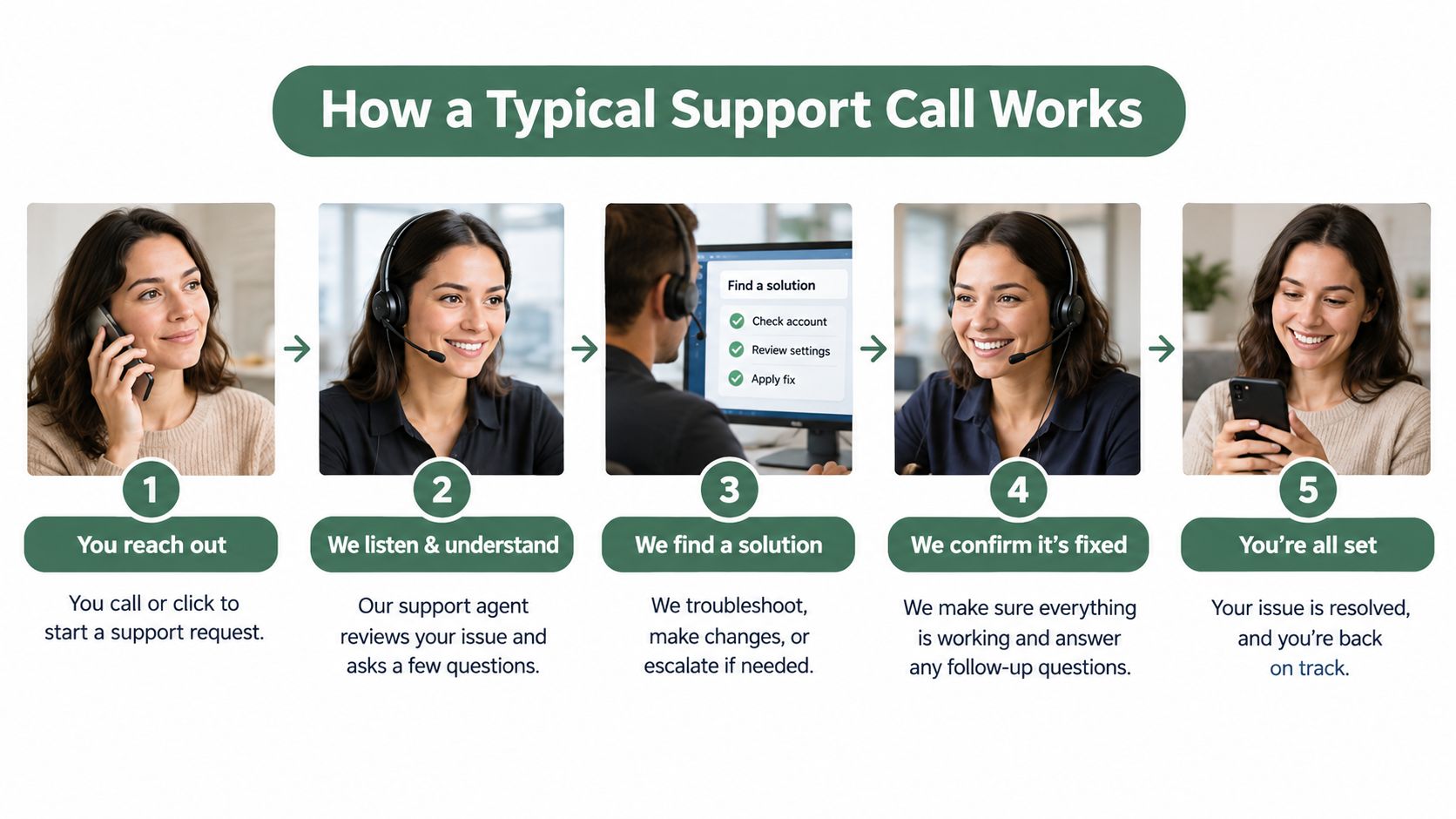
Consider a composite example involving Margaret, an older adult with early memory loss who lives alone. Her daughter has arranged regular calls because Margaret often feels anxious in the afternoon and sometimes forgets appointments. The caller already knows that Margaret enjoys gardening and worked in a school office.
The call begins with a familiar greeting and gentle orientation. “Good afternoon, Margaret. It's Tuesday, and you mentioned that your neighbour was helping with the garden this week.” The caller doesn't demand a perfect answer. If Margaret hesitates, the caller offers a cue and moves forward without making the uncertainty embarrassing.
The middle of the call combines a personal topic with a structured activity. Margaret describes the flowers she used to grow, then completes a simple word or attention task connected to that conversation. The caller asks how she has been feeling, listens for anxiety, and checks whether she remembers the appointment scheduled for the next day.
The closing matters as much as the greeting
A good ending creates a clear next step. The caller summarises what Margaret plans to do, confirms when the next conversation will happen, and checks whether she needs a family member to follow up. The tone stays calm and collaborative. The caller isn't pretending to be a daughter, nurse, or emergency responder.
Afterward, the team records relevant observations. One isolated hesitation may not mean much. A repeated pattern of missed appointments, rising distress, or confusion about daily routines deserves attention, especially when the family can compare it with what they see during visits.
A structured call should feel human to the participant and informative to the people responsible for care.
That balance takes training. A rigid script can make the older adult feel managed, while an entirely unstructured chat can miss important changes. Providers should explain how they preserve warmth while documenting concerns and escalating urgent issues.
The Evidence Behind Telephone Interventions
Telephone support has a stronger evidence base than the phrase “check-in call” suggests, although it remains a complementary intervention, not a replacement for diagnosis, medication management, or emergency care. The most relevant findings point toward repeated contact, structured conversation, and a stable relationship rather than occasional outreach from an unknown caller.
A randomized clinical trial of 1,151 older adults in Hong Kong found that four-week telephone interventions significantly reduced loneliness and stress at three months. Behavioral activation and mindfulness also improved sleep quality at one month, as reported in the clinical trial on telephone-based interventions for digitally excluded older adults. The study matters for families because it tested phone delivery with people who were lonely, living alone, below the poverty line, and digitally excluded.
Outcome | Evidence summary | Implication for phone services |
|---|---|---|
Loneliness | Telephone-delivered behavioral activation, mindfulness, and befriending improved immediate loneliness, with additional longer-term benefits for some approaches. | Calls should include more than greetings. Use planned activities, listening, and continuity. |
Stress and well-being | The Hong Kong trial found improvements in stress, life satisfaction, psychological well-being, and social support after the interventions. | A caller needs a framework for emotional check-ins, not just practical reminders. |
Sleep quality | Behavioral activation and mindfulness showed additional benefits for sleep quality at one month. | Providers should use appropriate structured techniques and avoid presenting them as casual conversation. |
Social isolation risk | Johns Hopkins' summary of National Health and Aging Trends Study findings reported that older adults with telephone or email access had a 31% lower risk of social isolation over four years. | Reliable access and sustained contact matter more than a one-off call. |
Dementia risk association | The same summary reported that social isolation was associated with a 27% higher nine-year dementia risk. | Phone support should be part of a wider plan to maintain connection, activity, and professional oversight. |
The results don't mean a phone program can prevent dementia or treat every cause of loneliness. They show that structured telephone contact can produce measurable psychosocial benefits when the delivery is reliable and purposeful. Families comparing cognitive approaches may also find the explanation of cognitive stimulation therapy useful when discussing what activities should happen during a call.
Evidence also has limits. Reviews describe telephone befriending as promising but historically uneven, and newer work highlights the importance of consistency, a safe nonjudgmental environment, adaptability, stable funding, and specialized training. Willingness to use support varies among caregivers, so a provider must make participation accessible rather than assuming every family will engage in the same way.
Who Benefits Most From Phone-Based Care
Phone support fits best when an older adult can participate in a conversation and benefits from predictable encouragement. That often includes people with early to mid-stage dementia, seniors who live alone, spouses who need additional support, and families trying to extend the value of in-person visits.
A simple fit assessment starts with four questions:
Can the person participate by voice? If hearing loss, aphasia, severe confusion, or fatigue makes conversation consistently difficult, the provider should explain its adaptations.
What does the person need between visits? Loneliness, missed routines, anxiety, and cognitive inactivity call for different call plans.
Who responds to concerns? A family member, clinician, or care manager must know what happens when a caller notices a change.
What does the current dementia stage allow? A person with advanced decline may need hands-on supervision, personal care, environmental changes, or more frequent in-person assessment.
Phone care complements medical treatment and caregiving. It can't assess a serious fall remotely, provide physical help with bathing, guarantee medication adherence, or manage an acute behavioral health crisis. If someone is at immediate risk, contact emergency services or the appropriate clinical team rather than waiting for a scheduled call.
Access also includes the handset itself. Large buttons, amplified sound, a simple display, and a stable connection can make participation easier. Families comparing devices may find this guide to a refurbished iPhone for elderly users in the UK helpful, especially when deciding whether an existing phone is accessible enough.
The right question isn't “Does my parent need a phone service?” It's “Which gaps should a phone service address, and what support must remain in person?”
How to Evaluate and Choose a Phone Service
The cheapest or most convenient call schedule isn't automatically the right one. Families often focus on call frequency, yet the more important questions concern clinical alignment, staff quality, documentation, escalation, and trust.
Start with the care model
Ask whether the provider serves the person's dementia stage and how its activities are adapted for hearing, language, fatigue, and common health conditions. Find out who reviewed the protocols and whether the program distinguishes cognitive stimulation from medical treatment.
A strong provider should answer clearly:
Who makes the calls? Ask about training, supervision, continuity, and whether the participant can build a relationship with a familiar team.
What happens during a call? Request an example of a typical session, including orientation, conversation, activities, mood questions, and closing steps.
How are changes recorded? Ask whether staff track patterns across calls rather than treating each conversation as an isolated event.
How are concerns escalated? The provider should explain what happens with a fall concern, sudden confusion, emotional distress, or a missed call.
How does the family receive updates? Clarify consent, privacy, timing, format, and who can discuss the support plan.
Test the human experience
A program can have attractive materials and still feel impersonal on the telephone. Ask how the first call works, whether the older adult can pause or decline an activity, and how the team responds when the participant becomes frustrated.
Technology shouldn't become a hidden barrier. Phone delivery may be simpler than an app, but reliable contact still depends on hearing ability, willingness, scheduling, and a relationship that feels safe. The guide to evaluating a memory-loss support program offers another lens for checking legitimacy, transparency, and care practices.
Finally, confirm what the service doesn't provide. A trustworthy program won't imply that calls replace clinicians, home care, family supervision, or emergency response. Velma is one phone-based option for older adults with early to mid-stage memory loss, combining scheduled conversations, cognitive exercises, mood support, practical check-ins, care-manager coordination, and family updates.
Common Misconceptions and Hidden Pitfalls
Myth one: Any regular call schedule is equivalent to a structured service. It isn't. A casual call may provide warmth, but trained programs add appropriate activities, observation, documentation, and follow-up.
Myth two: Low-tech means low-value. Telephone interventions have produced measurable improvements in loneliness, stress, social support, and well-being when delivered consistently. The channel is simple. The work inside the call shouldn't be careless.
Myth three: Phone support can carry the whole care plan. It can't. A person with advanced cognitive decline, serious mobility risks, unsafe housing, or an acute crisis may need direct professional and hands-on support.

Before enrolling, check the essentials:
Stage fit: Activities match the older adult's abilities and diagnosis.
Relationship quality: The caller creates trust through consistency and respect.
Clinical boundaries: The service knows what it can monitor and what requires outside care.
Family communication: Updates are useful, consent-based, and actionable.
Accessibility: The older adult can hear, answer, and participate without unnecessary technology.
Escalation: Staff know whom to contact when concerns appear.
Velma offers scheduled phone-based cognitive support for older adults experiencing early to mid-stage memory loss, with personalized conversation, research-backed exercises, mood support, practical check-ins, and care-manager coordination. Visit Velma to learn how its phone calls could complement your family's existing dementia care plan and provide clearer support between visits.
It's late, and your mother has called again because she can't remember whether tomorrow's appointment is on the calendar. You live too far away to drop in, while her phone sits within reach but doesn't solve the deeper problem. She needs more than an occasional conversation. She needs a dependable way to stay oriented, connected, and supported between visits.
That's where phone service for the elderly can become more than a social call. A well-designed program uses scheduled conversations, cognitive exercises, emotional support, practical reminders, and family communication in one familiar channel. It can complement medical care and in-person caregiving without asking an older adult to learn an app, manage a video platform, or wear a new device.
Table of Contents
Understanding Phone-Based Support for Older Adults
What Modern Phone Services Actually Do
Cognitive engagement
Emotional and practical support
Family visibility
How a Typical Support Call Works
The closing matters as much as the greeting
The Evidence Behind Telephone Interventions
Who Benefits Most From Phone-Based Care
How to Evaluate and Choose a Phone Service
Start with the care model
Test the human experience
Common Misconceptions and Hidden Pitfalls
Understanding Phone-Based Support for Older Adults
Phone-based support is best understood as a recurring psychosocial intervention, not merely a timetable for relatives to call. The service creates a predictable relationship and uses each conversation for a clear purpose. A trained caller might discuss a familiar life event, help the participant identify the day and upcoming plans, ask about mood, or flag a change that the family should follow up.
This low-barrier model matters because some older adults are digitally excluded or don't use smartphones, video calls, or web platforms. A telephone works through a routine many people already understand. The call arrives in the home, without travel, passwords, downloads, or a complicated screen.
Practical rule: Choose a phone program for the support it delivers during the call, not merely for the fact that it uses a phone.
A useful mental model has four layers:
Cognitive engagement: Reminiscence, orientation, language, attention, and memory cues matched to ability.
Emotional companionship: Warm, structured conversation that validates feelings and encourages participation.
Safety monitoring: Questions about confusion, anxiety, falls, medications, appointments, and household concerns.
Care coordination: Documentation and communication that help families notice patterns and respond between visits.
Research supports this broader view. A randomized clinical trial involving 1,151 older adults in Hong Kong found that four-week telephone interventions reduced loneliness and stress at three months, while behavioral activation and mindfulness also improved sleep quality at one month. The participants were digitally excluded, which reinforces why telephone delivery remains relevant for seniors who can't or won't use online tools. The findings are discussed in the overview of daily check-in calls for seniors, but the central lesson is simple: recurring calls can carry structured support, not just conversation.
What Modern Phone Services Actually Do
A reputable program begins with a plan. The care team learns about the older adult's history, interests, routines, cognitive profile, and current support network, then uses that information to shape recurring calls. The result should feel personal rather than scripted, while still following a consistent framework.
Cognitive engagement
Cognitive stimulation doesn't mean testing someone or correcting every mistake. A caller might ask about a family photograph, invite the participant to describe a well-known recipe, orient them to the day and season, or practise finding a word through gentle prompts. Activities should be adjusted when the person becomes tired or frustrated.
The purpose is engagement with dignity. A conversation about a former job can exercise recall and language while also reinforcing identity. Orientation questions can support routine without turning the call into an examination.
Emotional and practical support
Companionship works better when the caller listens for changes in mood rather than filling every silence. The conversation may explore loneliness, worry, sleep, or a recent disappointment. Validation comes before advice, especially when memory loss makes a concern feel very real to the participant.
Practical questions add another layer. Has the appointment been remembered? Is the medication routine causing difficulty? Has the person noticed a fall concern, unusual confusion, or a household risk? A phone service shouldn't diagnose or replace emergency response, but it can help surface issues for a family member, clinician, or care manager.
Family visibility
Documentation turns separate calls into useful information. A care team can record recurring confusion, increasing anxiety, missed routines, or positive changes, then share appropriate updates with the family according to the program's privacy and consent process.
The strongest models also assign a care manager who can discuss concerns, adjust the support plan, and coordinate with family preferences or clinician guidance. For a practical view of how conversational support can be structured, this video on phone-based support provides additional context.
How a Typical Support Call Works
Consider a composite example involving Margaret, an older adult with early memory loss who lives alone. Her daughter has arranged regular calls because Margaret often feels anxious in the afternoon and sometimes forgets appointments. The caller already knows that Margaret enjoys gardening and worked in a school office.
The call begins with a familiar greeting and gentle orientation. “Good afternoon, Margaret. It's Tuesday, and you mentioned that your neighbour was helping with the garden this week.” The caller doesn't demand a perfect answer. If Margaret hesitates, the caller offers a cue and moves forward without making the uncertainty embarrassing.
The middle of the call combines a personal topic with a structured activity. Margaret describes the flowers she used to grow, then completes a simple word or attention task connected to that conversation. The caller asks how she has been feeling, listens for anxiety, and checks whether she remembers the appointment scheduled for the next day.
The closing matters as much as the greeting
A good ending creates a clear next step. The caller summarises what Margaret plans to do, confirms when the next conversation will happen, and checks whether she needs a family member to follow up. The tone stays calm and collaborative. The caller isn't pretending to be a daughter, nurse, or emergency responder.
Afterward, the team records relevant observations. One isolated hesitation may not mean much. A repeated pattern of missed appointments, rising distress, or confusion about daily routines deserves attention, especially when the family can compare it with what they see during visits.
A structured call should feel human to the participant and informative to the people responsible for care.
That balance takes training. A rigid script can make the older adult feel managed, while an entirely unstructured chat can miss important changes. Providers should explain how they preserve warmth while documenting concerns and escalating urgent issues.
The Evidence Behind Telephone Interventions
Telephone support has a stronger evidence base than the phrase “check-in call” suggests, although it remains a complementary intervention, not a replacement for diagnosis, medication management, or emergency care. The most relevant findings point toward repeated contact, structured conversation, and a stable relationship rather than occasional outreach from an unknown caller.
A randomized clinical trial of 1,151 older adults in Hong Kong found that four-week telephone interventions significantly reduced loneliness and stress at three months. Behavioral activation and mindfulness also improved sleep quality at one month, as reported in the clinical trial on telephone-based interventions for digitally excluded older adults. The study matters for families because it tested phone delivery with people who were lonely, living alone, below the poverty line, and digitally excluded.
Outcome | Evidence summary | Implication for phone services |
|---|---|---|
Loneliness | Telephone-delivered behavioral activation, mindfulness, and befriending improved immediate loneliness, with additional longer-term benefits for some approaches. | Calls should include more than greetings. Use planned activities, listening, and continuity. |
Stress and well-being | The Hong Kong trial found improvements in stress, life satisfaction, psychological well-being, and social support after the interventions. | A caller needs a framework for emotional check-ins, not just practical reminders. |
Sleep quality | Behavioral activation and mindfulness showed additional benefits for sleep quality at one month. | Providers should use appropriate structured techniques and avoid presenting them as casual conversation. |
Social isolation risk | Johns Hopkins' summary of National Health and Aging Trends Study findings reported that older adults with telephone or email access had a 31% lower risk of social isolation over four years. | Reliable access and sustained contact matter more than a one-off call. |
Dementia risk association | The same summary reported that social isolation was associated with a 27% higher nine-year dementia risk. | Phone support should be part of a wider plan to maintain connection, activity, and professional oversight. |
The results don't mean a phone program can prevent dementia or treat every cause of loneliness. They show that structured telephone contact can produce measurable psychosocial benefits when the delivery is reliable and purposeful. Families comparing cognitive approaches may also find the explanation of cognitive stimulation therapy useful when discussing what activities should happen during a call.
Evidence also has limits. Reviews describe telephone befriending as promising but historically uneven, and newer work highlights the importance of consistency, a safe nonjudgmental environment, adaptability, stable funding, and specialized training. Willingness to use support varies among caregivers, so a provider must make participation accessible rather than assuming every family will engage in the same way.
Who Benefits Most From Phone-Based Care
Phone support fits best when an older adult can participate in a conversation and benefits from predictable encouragement. That often includes people with early to mid-stage dementia, seniors who live alone, spouses who need additional support, and families trying to extend the value of in-person visits.
A simple fit assessment starts with four questions:
Can the person participate by voice? If hearing loss, aphasia, severe confusion, or fatigue makes conversation consistently difficult, the provider should explain its adaptations.
What does the person need between visits? Loneliness, missed routines, anxiety, and cognitive inactivity call for different call plans.
Who responds to concerns? A family member, clinician, or care manager must know what happens when a caller notices a change.
What does the current dementia stage allow? A person with advanced decline may need hands-on supervision, personal care, environmental changes, or more frequent in-person assessment.
Phone care complements medical treatment and caregiving. It can't assess a serious fall remotely, provide physical help with bathing, guarantee medication adherence, or manage an acute behavioral health crisis. If someone is at immediate risk, contact emergency services or the appropriate clinical team rather than waiting for a scheduled call.
Access also includes the handset itself. Large buttons, amplified sound, a simple display, and a stable connection can make participation easier. Families comparing devices may find this guide to a refurbished iPhone for elderly users in the UK helpful, especially when deciding whether an existing phone is accessible enough.
The right question isn't “Does my parent need a phone service?” It's “Which gaps should a phone service address, and what support must remain in person?”
How to Evaluate and Choose a Phone Service
The cheapest or most convenient call schedule isn't automatically the right one. Families often focus on call frequency, yet the more important questions concern clinical alignment, staff quality, documentation, escalation, and trust.
Start with the care model
Ask whether the provider serves the person's dementia stage and how its activities are adapted for hearing, language, fatigue, and common health conditions. Find out who reviewed the protocols and whether the program distinguishes cognitive stimulation from medical treatment.
A strong provider should answer clearly:
Who makes the calls? Ask about training, supervision, continuity, and whether the participant can build a relationship with a familiar team.
What happens during a call? Request an example of a typical session, including orientation, conversation, activities, mood questions, and closing steps.
How are changes recorded? Ask whether staff track patterns across calls rather than treating each conversation as an isolated event.
How are concerns escalated? The provider should explain what happens with a fall concern, sudden confusion, emotional distress, or a missed call.
How does the family receive updates? Clarify consent, privacy, timing, format, and who can discuss the support plan.
Test the human experience
A program can have attractive materials and still feel impersonal on the telephone. Ask how the first call works, whether the older adult can pause or decline an activity, and how the team responds when the participant becomes frustrated.
Technology shouldn't become a hidden barrier. Phone delivery may be simpler than an app, but reliable contact still depends on hearing ability, willingness, scheduling, and a relationship that feels safe. The guide to evaluating a memory-loss support program offers another lens for checking legitimacy, transparency, and care practices.
Finally, confirm what the service doesn't provide. A trustworthy program won't imply that calls replace clinicians, home care, family supervision, or emergency response. Velma is one phone-based option for older adults with early to mid-stage memory loss, combining scheduled conversations, cognitive exercises, mood support, practical check-ins, care-manager coordination, and family updates.
Common Misconceptions and Hidden Pitfalls
Myth one: Any regular call schedule is equivalent to a structured service. It isn't. A casual call may provide warmth, but trained programs add appropriate activities, observation, documentation, and follow-up.
Myth two: Low-tech means low-value. Telephone interventions have produced measurable improvements in loneliness, stress, social support, and well-being when delivered consistently. The channel is simple. The work inside the call shouldn't be careless.
Myth three: Phone support can carry the whole care plan. It can't. A person with advanced cognitive decline, serious mobility risks, unsafe housing, or an acute crisis may need direct professional and hands-on support.
Before enrolling, check the essentials:
Stage fit: Activities match the older adult's abilities and diagnosis.
Relationship quality: The caller creates trust through consistency and respect.
Clinical boundaries: The service knows what it can monitor and what requires outside care.
Family communication: Updates are useful, consent-based, and actionable.
Accessibility: The older adult can hear, answer, and participate without unnecessary technology.
Escalation: Staff know whom to contact when concerns appear.
Velma offers scheduled phone-based cognitive support for older adults experiencing early to mid-stage memory loss, with personalized conversation, research-backed exercises, mood support, practical check-ins, and care-manager coordination. Visit Velma to learn how its phone calls could complement your family's existing dementia care plan and provide clearer support between visits.
Suggested Article: