Understanding Mild Cognitive Impairment: Family Guide

The first sign is often ordinary enough to brush off. A parent asks the same question twice in one afternoon, misplaces the keys they swore were on the counter, or forgets an appointment that used to be automatic. Families usually sit with that uneasy thought for a while, wondering whether they're seeing stress, normal aging, or something that deserves a doctor's attention.
That uncertainty is exactly where understanding mild cognitive impairment matters. MCI sits in the middle ground between occasional forgetfulness and dementia, and the difference shapes what to watch, what to ask, and how to support someone without taking away their independence too soon. It also helps to remember that MCI is common enough to matter and varied enough that no one family's experience looks exactly like another's.
Table of Contents
When Small Memory Changes Start to Feel Like Something More
What families usually notice first
What MCI Means in Clinical Terms
MCI, normal aging, and dementia are not the same thing
How Common MCI Is and Who It Affects Most
Age changes the picture fast
It shows up across many groups, not just one narrow slice
How MCI Gets Diagnosed in Real Life
What the workup usually includes
What to bring to the visit
Prognosis, Risk Factors, and What Shapes the Trajectory
The range of outcomes is real
What tends to shape the path
Evidence-Based Ways to Live Well With MCI
Medical care that looks for reversible strain
Daily habits that support brain health
The family conversation matters too
Where Phone-Based Cognitive Support Fits In
What that can look like in a week
Why this fits MCI so well
Practical Tips for Caregivers and When to Escalate Care
A simple framework families can use
When Small Memory Changes Start to Feel Like Something More
The living room scene is familiar. Someone has already asked about the dinner plan, then asks again ten minutes later. A calendar note was missed, then the excuse is that life has just been busy. A family member laughs it off at first, because everyone misplaces things.
Then the pattern starts to feel different.
What matters is not a single forgotten key or one distracted afternoon. It's the repeatability, the sense that the change is new, and the way loved ones begin adjusting around it. If the same concern keeps showing up, it deserves a closer look instead of a quiet hope that it will disappear on its own. A useful place to start is by noticing patterns in daily life, not by turning every conversation into a test. The guidance in this plain-language overview of early signs of memory loss in aging parents can help families sort ordinary lapses from changes that feel more persistent.
What families usually notice first
Some changes are easier to spot because they interrupt routines. Missed appointments, repeated questions, trouble following a familiar recipe, or more effort than usual to manage bills can all stand out. Other changes are quieter, like a person seeming less confident when making decisions or pulling back from tasks they used to handle comfortably.
Practical rule: if you're noticing the same slip in more than one setting, at home, in conversation, or with daily tasks, it's worth writing it down.
A simple notebook or phone note can help. Write the date, what happened, and whether anyone else saw the same thing. That record turns vague worry into a clearer story for a clinician, and it keeps families from having to rely on memory alone when they finally ask for help.
The goal isn't to label every lapse. It's to spot a pattern early enough to ask the right questions, with less panic and more clarity.
What MCI Means in Clinical Terms
MCI works like a dimmer switch, not a broken light switch. The light is still on, daily life still works, but the brightness has changed enough that people notice. That comparison fits because mild cognitive impairment means a measurable decline in one or more cognitive domains, while basic independence is generally preserved and the person does not meet criteria for dementia (clinical definition and guideline discussion).
MCI, normal aging, and dementia are not the same thing
A person can have normal aging changes and still function well. Occasional forgetfulness, slower word recall, or needing a moment longer to find the right name can happen without a medical disorder. MCI is different because the change is more than expected for age and can be measured on testing. Dementia is different again, because the decline becomes severe enough to interfere with independence in everyday life.
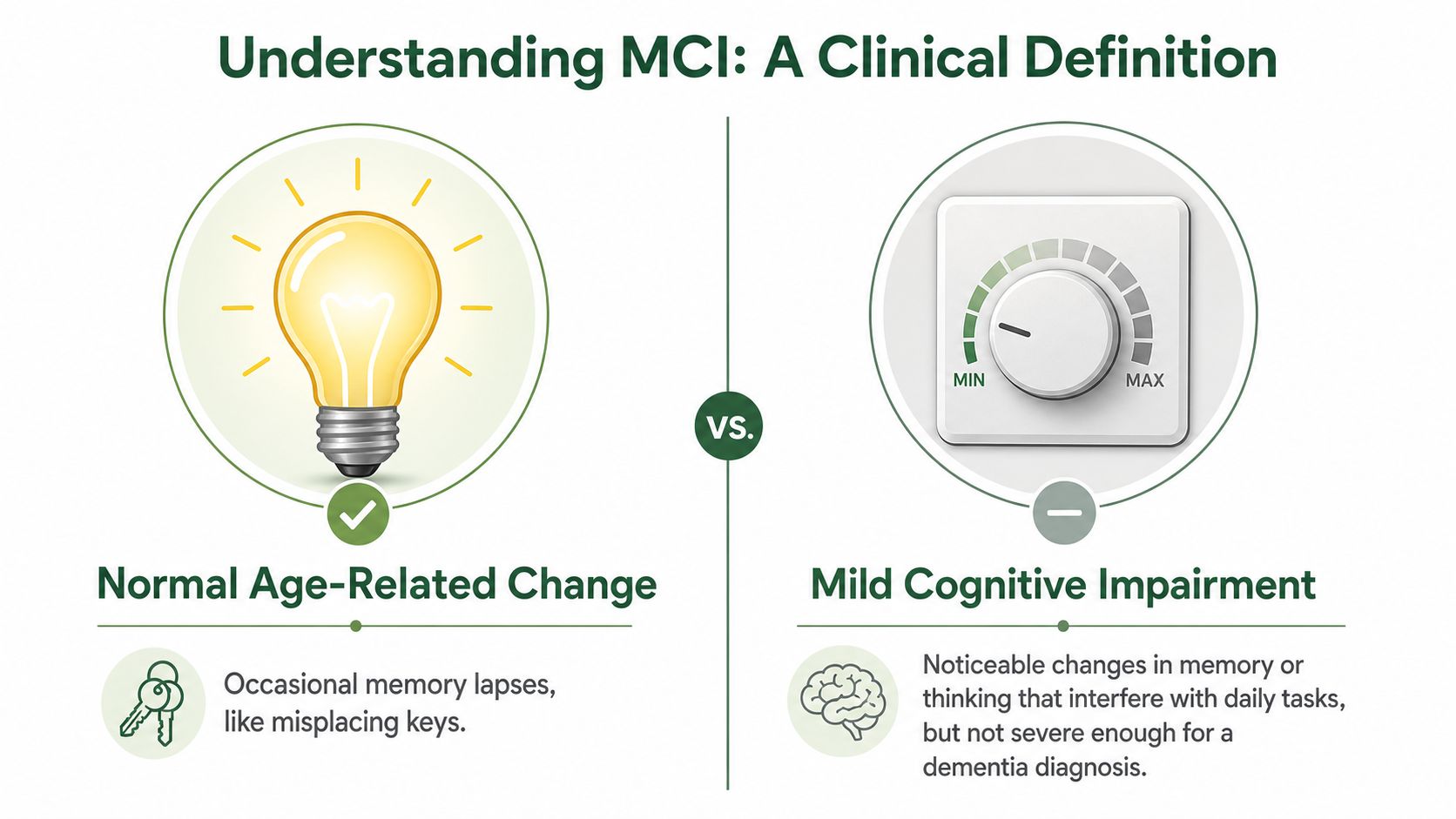
That distinction matters because the label changes what comes next. A person with MCI may still manage cooking, shopping, medication, and finances with only light support, but they're also in a higher-risk state that deserves monitoring. Families often feel this as uncertainty more than as a neat diagnosis. The person is still “themselves,” yet small mistakes start to appear in places that used to feel automatic, and that can make everyone wonder how much help is sensible now.
Expert guidance is clear that diagnosis should rely on standardized cognitive testing plus functional assessment, not memory complaints alone (clinical definition and guideline discussion). That approach helps avoid two common mistakes, dismissing a real problem as “just aging,” or overcalling dementia when the person is still functionally independent.
A good assessment asks two questions at the same time, “Has thinking changed?” and “What still works in daily life?”
That is the clinical heart of MCI. It is a real syndrome, not a vague feeling, and it needs careful evaluation because it sits between ordinary forgetfulness and more serious loss of independence.
A phone-based cognitive support program can fit here as well. Between appointments, it can give families a place to track changes, reinforce routines, and keep concerns from getting lost in the waiting period between clinic visits.
How Common MCI Is and Who It Affects Most
A family often first sees MCI as small, uneven changes. One person misses a bill payment, repeats a question, or loses the thread of a conversation, yet still handles most daily routines. That mix can feel confusing, but it is exactly why prevalence matters. In a 2022 nationally representative U.S. study, 22% of adults 65 and older were classified as having MCI, compared with 10% with dementia, so roughly one-third had either condition (JAMA Neurology study). MCI is common enough that many families will run into it at some point, even if they never expected to.
Age changes the picture fast
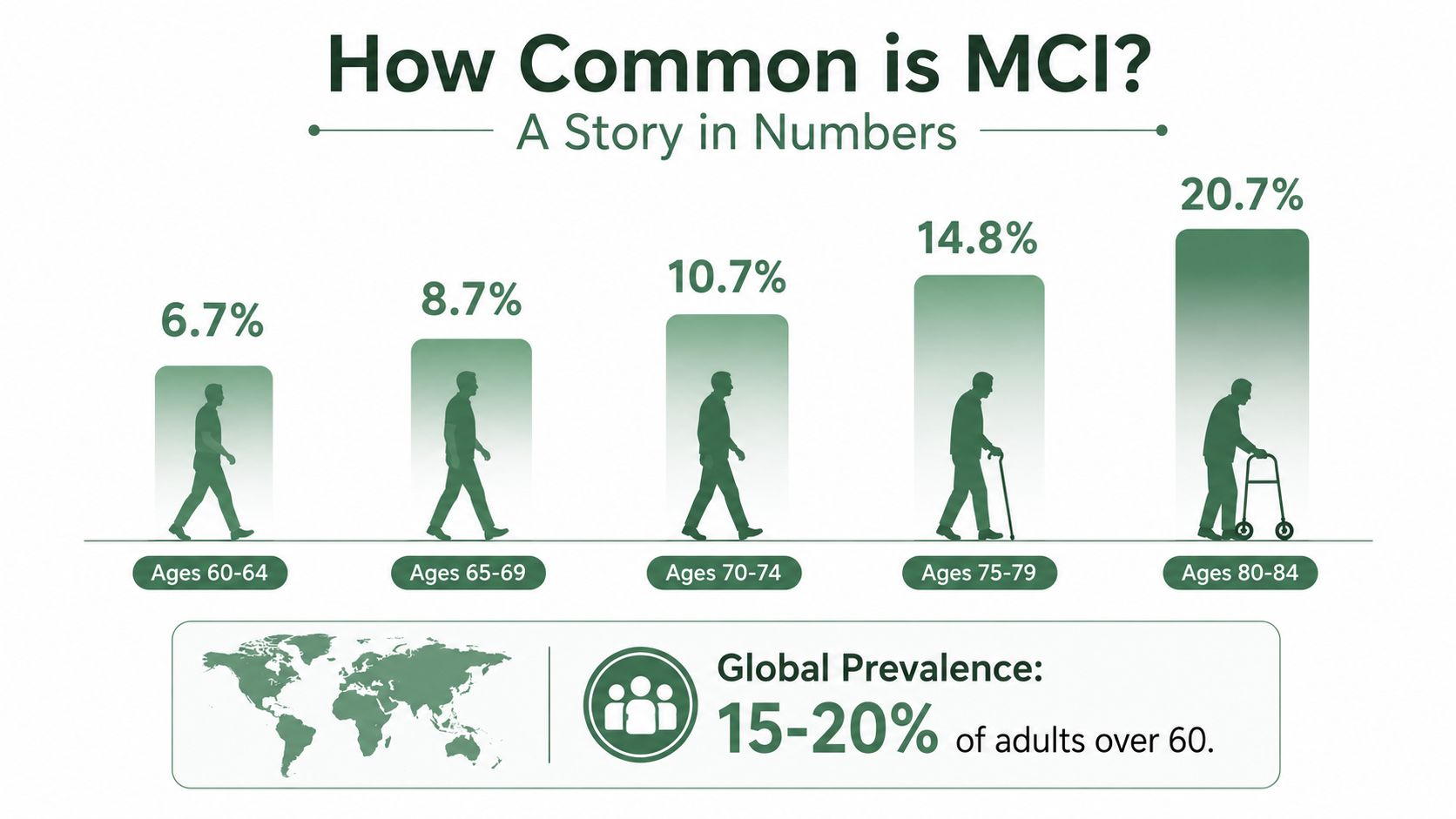
The same study showed a steep age gradient, with prevalence rising from 6.7% at ages 60–64 to 25.2% at ages 80–84 (JAMA Neurology study). Clinically, that helps explain why a new memory concern in later life deserves attention even when the person still looks mostly unchanged from day to day.
Global studies point in the same direction. A systematic review and meta-analysis found an overall prevalence of 15.56% in community-dwelling adults, while another meta-analysis reported 19.7%, which is why many clinicians describe MCI as affecting about 1 in 5 older adults in many settings. Incidence also rises with age, with pooled estimates of 22.5 per 1,000 person-years at ages 75–79, 40.9 per 1,000 person-years at 80–84, and 60.1 per 1,000 person-years at 85+ (systematic review and meta-analysis).
It shows up across many groups, not just one narrow slice
The U.S. study also reported meaningful differences by race and education, including 22% prevalence among Black/African American older adults and 21% among White older adults (JAMA Neurology study). The point is not that MCI belongs to one group or another. The burden is widespread, and it is shaped by many factors that families cannot always see from the outside.
Earlier epidemiologic reviews reported conversion from MCI to dementia at around 15% per year, with incidence estimates ranging from 8 to 58 new cases per 1,000 person-years (systematic review and meta-analysis). Families often hear those numbers and feel alarmed. A better way to read them is as a reason to take the diagnosis seriously, keep track of change over time, and use supports that help the person stay oriented between clinic visits. The Patients Guide on diagnosis is one example of the kind of plain-language explanation families often need while they are trying to make sense of what a diagnosis means in daily life.
How MCI Gets Diagnosed in Real Life
A visit for memory concerns usually begins with a story, not a score sheet. A primary care clinician or specialist asks what changed, when it started, and who else has noticed it. That history matters because depression, sleep problems, medication side effects, hearing loss, and other conditions can look like cognitive decline, and those possibilities need to be sorted out before anyone settles on a diagnosis.
What the workup usually includes
A typical evaluation uses several layers of information together:
Conversation and history: what changed, how often, and how it affects day-to-day life.
Brief cognitive screening: a short test can flag concerns, but it is only one part of the picture.
Functional assessment: the clinician asks what the person still manages independently.
Bloodwork or imaging when indicated: these help look for contributing causes or alternative explanations.
Referral to a neurologist or memory clinic: this happens when the case is unclear or needs more detailed evaluation.
The point of testing is not to catch people out. It is to find the reason for the change.
Guidelines emphasize that the diagnosis should rest on objective cognitive change plus preserved basic independence (clinical guidance). Families help most when they bring concrete examples rather than a general feeling that “the memory seems worse.” A list of missed appointments, repeated questions, or changes in planning is often more useful than a vague description.
A memory complaint also needs sorting, one cause at a time. That is the logic behind differential diagnosis, and The Patients Guide on diagnosis gives a plain-language explanation of why clinicians work through the possibilities before naming MCI. For families, that approach can make the appointment feel less like a mystery and more like a careful problem-solving visit.
When families hear this process described, the uncertainty usually feels more familiar. The clinician is not just asking, “Is there a memory problem?” The real question is, “What is driving the change, and what does the person still do well?”
What to bring to the visit
Bring a medication list, a brief timeline of symptoms, and one trusted family member if possible. It also helps to ask what follow-up will look like if the clinician thinks the person has MCI rather than dementia. That question turns an anxious one-time appointment into a plan.
Prognosis, Risk Factors, and What Shapes the Trajectory
MCI does not follow one fixed path. In clinic, that is often the hardest part for families, because the diagnosis answers one question and leaves another open. It confirms that the change is real, while the next question becomes what that change will look like over time. Major neurology guidance notes that no accepted biomarker can yet reliably predict progression in routine MCI care, which is one reason follow-up still matters so much (guidance on biomarkers and progression).
The range of outcomes is real
The likely course can vary a lot from one person to another. Some people go on to dementia, some stay at about the same level for years, and some improve for a period of time. That is why a diagnosis of MCI is better understood as a monitoring point than as a final forecast.

What tends to shape the path
Several things can tilt the course in one direction or another. Age matters, as the earlier section showed. Vascular health, mood, social connection, education, and other medical problems also shape how much strain the brain is carrying. None of these factors decides the future by itself, yet each one can add pressure or provide support to a brain that is already more vulnerable.
This is why families often feel unsettled after the first diagnosis. Two people can hear the same label and still have very different day-to-day experiences, much like two houses with the same roof can weather a storm differently depending on the foundation underneath. The practical task is to keep watching for change, while also looking for problems that can be treated in ordinary medical care.
A diagnosis is not the same as a forecast. Families usually do better when they treat MCI as something to follow closely, while also paying attention to modifiable health issues that may be adding to the cognitive strain.
Evidence-Based Ways to Live Well With MCI
The best support usually comes in layers, not in one dramatic fix. Medical care, daily habits, and family communication each carry part of the load, and none of them work well in isolation. That's especially important because MCI affects identity as much as it affects memory, so the person needs support that protects function without stripping away dignity.
Medical care that looks for reversible strain
Clinicians often focus first on things that can make thinking worse, or look like worsening when they're treatable. That includes blood pressure, blood sugar, sleep, mood, hearing, and a careful review of medications that may affect cognition. When those issues are addressed, families sometimes notice a steadier baseline even if the underlying cognitive change remains.
Daily habits that support brain health
Physical activity, mentally engaging activities, good sleep, and social connection all belong in the plan. These are behaviors, not prescriptions, and they work best when they fit the person's real life instead of a perfect ideal. A daily walk, a neighborhood coffee, or a regular bridge game can be more sustainable than a complicated new routine that never sticks.
For families who want a structured way to think about mental engagement, this guide to cognitive stimulation therapy offers a useful reference point. The idea is not to “fix” memory with a single exercise. It's to keep the brain active in a way that feels meaningful and repeatable.
Practical rule: aim for habits the person will actually keep, not a plan that sounds impressive for one week.
The family conversation matters too
Talk plainly about what's changing, what isn't, and what needs watching. Some people fear the label will erase hope, so they avoid saying it out loud. That usually creates more confusion, not less. Honest language helps everyone plan around the same reality, while still leaving room for independence and adaptation.
Where Phone-Based Cognitive Support Fits In
A clinic visit can tell you what MCI is and what the risks look like, but it can't sit with the person on Tuesday afternoon when they're anxious, bored, or unsure whether they took their pills. That gap is where phone-based support can help. Velma's phone-based cognitive care program uses scheduled calls, guided conversation, and practical check-ins to create a steadier rhythm between appointments.
What that can look like in a week
A care manager calls on a regular schedule, talks through orientation, memory cues, or familiar reminiscence topics, and checks for signs of confusion or concern. If a person sounds more unsettled than usual, the pattern gets noted so family members can follow up. The phone format matters because it avoids app downloads, passwords, and all the technology barriers that often get in the way of older adults using digital tools consistently.
For families, that kind of support can feel less like “another service” and more like a reliable layer of contact. It doesn't replace a clinician, and it doesn't replace family caregiving, but it can make the in-between days easier to manage.
Why this fits MCI so well
MCI often lives in the gray zone between normal routine and clear dependency. A person may still be independent enough to stay home, yet still need regular conversation, reminder support, and a watchful eye for changes in mood or safety. A phone-based program can complement medical care by making those small shifts more visible.
The key is continuity. One appointment gives a snapshot. Repeated calls give a pattern.
Practical Tips for Caregivers and When to Escalate Care
A memory change can feel small at first, then suddenly shape the whole day. A parent forgets a bill, repeats a question, or gets flustered by a familiar task, and the family starts wondering how to help without making the person feel watched. Start there, with a direct sentence: “We've noticed some memory changes, and we want to help.” That keeps the conversation focused on support, not blame, and it protects dignity when the person is already losing confidence.
A simple framework families can use
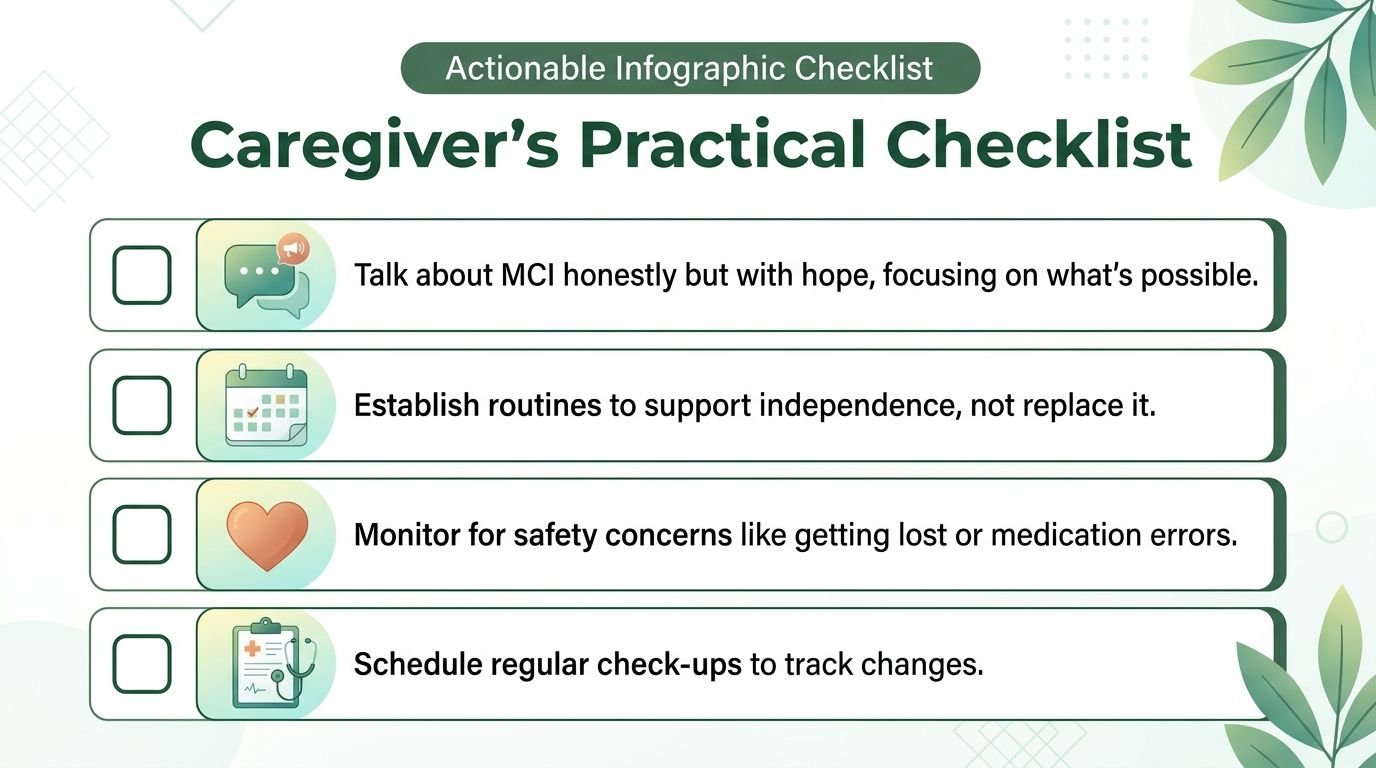
Speak plainly, stay respectful: name the concern without turning every slip into a crisis.
Protect independence with structure: use calendars, pill organizers, labels, and shared reminders.
Watch for safety changes: pay attention to getting lost, medication mistakes, stove issues, or driving concerns.
Keep appointments moving: regular check-ins help track whether things are steady, better, or worse.
Families often do better with small supports that fit the person's routine. One adult child can refill the pill organizer while the parent still chooses the time of day to take medicine. Another family can set shared reminders for appointments and bills, then let the person decide how to spend the rest of the day. The goal is to build habits the person will keep, not a plan that sounds impressive for one week.
Caregivers also need a place to notice their own strain. Burnout creeps in when one person becomes the default problem-solver for every missed call, every appointment, and every worry. If that pattern is starting, this resource on caregiver stress and burnout can help you slow down and name what is getting heavy. If family decision-making is becoming harder, Texas dementia guardianship legal help may also be worth reviewing so the next step is clearer.
If confusion suddenly worsens, or a new behavior appears out of character, don't wait for the next routine visit.
Escalate care promptly if you see sudden confusion, new hallucinations or agitation, repeated safety errors, or driving that no longer feels safe. A phone-based support program can help surface some of those changes early because repeated calls make patterns easier to spot between visits, but urgent changes still belong with a clinician right away. In the end, understanding mild cognitive impairment means seeing it as a real medical signal, not a final verdict. The most practical response is layered care, medical follow-up, daily structure, family communication, and steady contact that protects both independence and identity.
The first sign is often ordinary enough to brush off. A parent asks the same question twice in one afternoon, misplaces the keys they swore were on the counter, or forgets an appointment that used to be automatic. Families usually sit with that uneasy thought for a while, wondering whether they're seeing stress, normal aging, or something that deserves a doctor's attention.
That uncertainty is exactly where understanding mild cognitive impairment matters. MCI sits in the middle ground between occasional forgetfulness and dementia, and the difference shapes what to watch, what to ask, and how to support someone without taking away their independence too soon. It also helps to remember that MCI is common enough to matter and varied enough that no one family's experience looks exactly like another's.
Table of Contents
When Small Memory Changes Start to Feel Like Something More
What families usually notice first
What MCI Means in Clinical Terms
MCI, normal aging, and dementia are not the same thing
How Common MCI Is and Who It Affects Most
Age changes the picture fast
It shows up across many groups, not just one narrow slice
How MCI Gets Diagnosed in Real Life
What the workup usually includes
What to bring to the visit
Prognosis, Risk Factors, and What Shapes the Trajectory
The range of outcomes is real
What tends to shape the path
Evidence-Based Ways to Live Well With MCI
Medical care that looks for reversible strain
Daily habits that support brain health
The family conversation matters too
Where Phone-Based Cognitive Support Fits In
What that can look like in a week
Why this fits MCI so well
Practical Tips for Caregivers and When to Escalate Care
A simple framework families can use
When Small Memory Changes Start to Feel Like Something More
The living room scene is familiar. Someone has already asked about the dinner plan, then asks again ten minutes later. A calendar note was missed, then the excuse is that life has just been busy. A family member laughs it off at first, because everyone misplaces things.
Then the pattern starts to feel different.
What matters is not a single forgotten key or one distracted afternoon. It's the repeatability, the sense that the change is new, and the way loved ones begin adjusting around it. If the same concern keeps showing up, it deserves a closer look instead of a quiet hope that it will disappear on its own. A useful place to start is by noticing patterns in daily life, not by turning every conversation into a test. The guidance in this plain-language overview of early signs of memory loss in aging parents can help families sort ordinary lapses from changes that feel more persistent.
What families usually notice first
Some changes are easier to spot because they interrupt routines. Missed appointments, repeated questions, trouble following a familiar recipe, or more effort than usual to manage bills can all stand out. Other changes are quieter, like a person seeming less confident when making decisions or pulling back from tasks they used to handle comfortably.
Practical rule: if you're noticing the same slip in more than one setting, at home, in conversation, or with daily tasks, it's worth writing it down.
A simple notebook or phone note can help. Write the date, what happened, and whether anyone else saw the same thing. That record turns vague worry into a clearer story for a clinician, and it keeps families from having to rely on memory alone when they finally ask for help.
The goal isn't to label every lapse. It's to spot a pattern early enough to ask the right questions, with less panic and more clarity.
What MCI Means in Clinical Terms
MCI works like a dimmer switch, not a broken light switch. The light is still on, daily life still works, but the brightness has changed enough that people notice. That comparison fits because mild cognitive impairment means a measurable decline in one or more cognitive domains, while basic independence is generally preserved and the person does not meet criteria for dementia (clinical definition and guideline discussion).
MCI, normal aging, and dementia are not the same thing
A person can have normal aging changes and still function well. Occasional forgetfulness, slower word recall, or needing a moment longer to find the right name can happen without a medical disorder. MCI is different because the change is more than expected for age and can be measured on testing. Dementia is different again, because the decline becomes severe enough to interfere with independence in everyday life.
That distinction matters because the label changes what comes next. A person with MCI may still manage cooking, shopping, medication, and finances with only light support, but they're also in a higher-risk state that deserves monitoring. Families often feel this as uncertainty more than as a neat diagnosis. The person is still “themselves,” yet small mistakes start to appear in places that used to feel automatic, and that can make everyone wonder how much help is sensible now.
Expert guidance is clear that diagnosis should rely on standardized cognitive testing plus functional assessment, not memory complaints alone (clinical definition and guideline discussion). That approach helps avoid two common mistakes, dismissing a real problem as “just aging,” or overcalling dementia when the person is still functionally independent.
A good assessment asks two questions at the same time, “Has thinking changed?” and “What still works in daily life?”
That is the clinical heart of MCI. It is a real syndrome, not a vague feeling, and it needs careful evaluation because it sits between ordinary forgetfulness and more serious loss of independence.
A phone-based cognitive support program can fit here as well. Between appointments, it can give families a place to track changes, reinforce routines, and keep concerns from getting lost in the waiting period between clinic visits.
How Common MCI Is and Who It Affects Most
A family often first sees MCI as small, uneven changes. One person misses a bill payment, repeats a question, or loses the thread of a conversation, yet still handles most daily routines. That mix can feel confusing, but it is exactly why prevalence matters. In a 2022 nationally representative U.S. study, 22% of adults 65 and older were classified as having MCI, compared with 10% with dementia, so roughly one-third had either condition (JAMA Neurology study). MCI is common enough that many families will run into it at some point, even if they never expected to.
Age changes the picture fast
The same study showed a steep age gradient, with prevalence rising from 6.7% at ages 60–64 to 25.2% at ages 80–84 (JAMA Neurology study). Clinically, that helps explain why a new memory concern in later life deserves attention even when the person still looks mostly unchanged from day to day.
Global studies point in the same direction. A systematic review and meta-analysis found an overall prevalence of 15.56% in community-dwelling adults, while another meta-analysis reported 19.7%, which is why many clinicians describe MCI as affecting about 1 in 5 older adults in many settings. Incidence also rises with age, with pooled estimates of 22.5 per 1,000 person-years at ages 75–79, 40.9 per 1,000 person-years at 80–84, and 60.1 per 1,000 person-years at 85+ (systematic review and meta-analysis).
It shows up across many groups, not just one narrow slice
The U.S. study also reported meaningful differences by race and education, including 22% prevalence among Black/African American older adults and 21% among White older adults (JAMA Neurology study). The point is not that MCI belongs to one group or another. The burden is widespread, and it is shaped by many factors that families cannot always see from the outside.
Earlier epidemiologic reviews reported conversion from MCI to dementia at around 15% per year, with incidence estimates ranging from 8 to 58 new cases per 1,000 person-years (systematic review and meta-analysis). Families often hear those numbers and feel alarmed. A better way to read them is as a reason to take the diagnosis seriously, keep track of change over time, and use supports that help the person stay oriented between clinic visits. The Patients Guide on diagnosis is one example of the kind of plain-language explanation families often need while they are trying to make sense of what a diagnosis means in daily life.
How MCI Gets Diagnosed in Real Life
A visit for memory concerns usually begins with a story, not a score sheet. A primary care clinician or specialist asks what changed, when it started, and who else has noticed it. That history matters because depression, sleep problems, medication side effects, hearing loss, and other conditions can look like cognitive decline, and those possibilities need to be sorted out before anyone settles on a diagnosis.
What the workup usually includes
A typical evaluation uses several layers of information together:
Conversation and history: what changed, how often, and how it affects day-to-day life.
Brief cognitive screening: a short test can flag concerns, but it is only one part of the picture.
Functional assessment: the clinician asks what the person still manages independently.
Bloodwork or imaging when indicated: these help look for contributing causes or alternative explanations.
Referral to a neurologist or memory clinic: this happens when the case is unclear or needs more detailed evaluation.
The point of testing is not to catch people out. It is to find the reason for the change.
Guidelines emphasize that the diagnosis should rest on objective cognitive change plus preserved basic independence (clinical guidance). Families help most when they bring concrete examples rather than a general feeling that “the memory seems worse.” A list of missed appointments, repeated questions, or changes in planning is often more useful than a vague description.
A memory complaint also needs sorting, one cause at a time. That is the logic behind differential diagnosis, and The Patients Guide on diagnosis gives a plain-language explanation of why clinicians work through the possibilities before naming MCI. For families, that approach can make the appointment feel less like a mystery and more like a careful problem-solving visit.
When families hear this process described, the uncertainty usually feels more familiar. The clinician is not just asking, “Is there a memory problem?” The real question is, “What is driving the change, and what does the person still do well?”
What to bring to the visit
Bring a medication list, a brief timeline of symptoms, and one trusted family member if possible. It also helps to ask what follow-up will look like if the clinician thinks the person has MCI rather than dementia. That question turns an anxious one-time appointment into a plan.
Prognosis, Risk Factors, and What Shapes the Trajectory
MCI does not follow one fixed path. In clinic, that is often the hardest part for families, because the diagnosis answers one question and leaves another open. It confirms that the change is real, while the next question becomes what that change will look like over time. Major neurology guidance notes that no accepted biomarker can yet reliably predict progression in routine MCI care, which is one reason follow-up still matters so much (guidance on biomarkers and progression).
The range of outcomes is real
The likely course can vary a lot from one person to another. Some people go on to dementia, some stay at about the same level for years, and some improve for a period of time. That is why a diagnosis of MCI is better understood as a monitoring point than as a final forecast.
What tends to shape the path
Several things can tilt the course in one direction or another. Age matters, as the earlier section showed. Vascular health, mood, social connection, education, and other medical problems also shape how much strain the brain is carrying. None of these factors decides the future by itself, yet each one can add pressure or provide support to a brain that is already more vulnerable.
This is why families often feel unsettled after the first diagnosis. Two people can hear the same label and still have very different day-to-day experiences, much like two houses with the same roof can weather a storm differently depending on the foundation underneath. The practical task is to keep watching for change, while also looking for problems that can be treated in ordinary medical care.
A diagnosis is not the same as a forecast. Families usually do better when they treat MCI as something to follow closely, while also paying attention to modifiable health issues that may be adding to the cognitive strain.
Evidence-Based Ways to Live Well With MCI
The best support usually comes in layers, not in one dramatic fix. Medical care, daily habits, and family communication each carry part of the load, and none of them work well in isolation. That's especially important because MCI affects identity as much as it affects memory, so the person needs support that protects function without stripping away dignity.
Medical care that looks for reversible strain
Clinicians often focus first on things that can make thinking worse, or look like worsening when they're treatable. That includes blood pressure, blood sugar, sleep, mood, hearing, and a careful review of medications that may affect cognition. When those issues are addressed, families sometimes notice a steadier baseline even if the underlying cognitive change remains.
Daily habits that support brain health
Physical activity, mentally engaging activities, good sleep, and social connection all belong in the plan. These are behaviors, not prescriptions, and they work best when they fit the person's real life instead of a perfect ideal. A daily walk, a neighborhood coffee, or a regular bridge game can be more sustainable than a complicated new routine that never sticks.
For families who want a structured way to think about mental engagement, this guide to cognitive stimulation therapy offers a useful reference point. The idea is not to “fix” memory with a single exercise. It's to keep the brain active in a way that feels meaningful and repeatable.
Practical rule: aim for habits the person will actually keep, not a plan that sounds impressive for one week.
The family conversation matters too
Talk plainly about what's changing, what isn't, and what needs watching. Some people fear the label will erase hope, so they avoid saying it out loud. That usually creates more confusion, not less. Honest language helps everyone plan around the same reality, while still leaving room for independence and adaptation.
Where Phone-Based Cognitive Support Fits In
A clinic visit can tell you what MCI is and what the risks look like, but it can't sit with the person on Tuesday afternoon when they're anxious, bored, or unsure whether they took their pills. That gap is where phone-based support can help. Velma's phone-based cognitive care program uses scheduled calls, guided conversation, and practical check-ins to create a steadier rhythm between appointments.
What that can look like in a week
A care manager calls on a regular schedule, talks through orientation, memory cues, or familiar reminiscence topics, and checks for signs of confusion or concern. If a person sounds more unsettled than usual, the pattern gets noted so family members can follow up. The phone format matters because it avoids app downloads, passwords, and all the technology barriers that often get in the way of older adults using digital tools consistently.
For families, that kind of support can feel less like “another service” and more like a reliable layer of contact. It doesn't replace a clinician, and it doesn't replace family caregiving, but it can make the in-between days easier to manage.
Why this fits MCI so well
MCI often lives in the gray zone between normal routine and clear dependency. A person may still be independent enough to stay home, yet still need regular conversation, reminder support, and a watchful eye for changes in mood or safety. A phone-based program can complement medical care by making those small shifts more visible.
The key is continuity. One appointment gives a snapshot. Repeated calls give a pattern.
Practical Tips for Caregivers and When to Escalate Care
A memory change can feel small at first, then suddenly shape the whole day. A parent forgets a bill, repeats a question, or gets flustered by a familiar task, and the family starts wondering how to help without making the person feel watched. Start there, with a direct sentence: “We've noticed some memory changes, and we want to help.” That keeps the conversation focused on support, not blame, and it protects dignity when the person is already losing confidence.
A simple framework families can use
Speak plainly, stay respectful: name the concern without turning every slip into a crisis.
Protect independence with structure: use calendars, pill organizers, labels, and shared reminders.
Watch for safety changes: pay attention to getting lost, medication mistakes, stove issues, or driving concerns.
Keep appointments moving: regular check-ins help track whether things are steady, better, or worse.
Families often do better with small supports that fit the person's routine. One adult child can refill the pill organizer while the parent still chooses the time of day to take medicine. Another family can set shared reminders for appointments and bills, then let the person decide how to spend the rest of the day. The goal is to build habits the person will keep, not a plan that sounds impressive for one week.
Caregivers also need a place to notice their own strain. Burnout creeps in when one person becomes the default problem-solver for every missed call, every appointment, and every worry. If that pattern is starting, this resource on caregiver stress and burnout can help you slow down and name what is getting heavy. If family decision-making is becoming harder, Texas dementia guardianship legal help may also be worth reviewing so the next step is clearer.
If confusion suddenly worsens, or a new behavior appears out of character, don't wait for the next routine visit.
Escalate care promptly if you see sudden confusion, new hallucinations or agitation, repeated safety errors, or driving that no longer feels safe. A phone-based support program can help surface some of those changes early because repeated calls make patterns easier to spot between visits, but urgent changes still belong with a clinician right away. In the end, understanding mild cognitive impairment means seeing it as a real medical signal, not a final verdict. The most practical response is layered care, medical follow-up, daily structure, family communication, and steady contact that protects both independence and identity.
Suggested Article: