Daily Routine for Dementia Patients: A Practical Guide

You wake up to find your parent already dressed, but wearing yesterday's clothes, searching for the kitchen, and asking what day it is. Breakfast gets delayed, medication becomes a negotiation, and a simple shower turns into an argument. By evening, everyone is tired, including the person with dementia, and the routine you carefully planned has fallen apart.
A daily routine for dementia patients should create predictability without turning the day into a checklist imposed from outside. The most sustainable routines protect three things at once: safety, emotional comfort, and personal independence. They also leave room for fatigue, confusion, changing abilities, and the behavioral symptoms that can make an otherwise sensible schedule impossible.
The recommendations below are designed for early to mid-stage dementia, including situations where a family member works, visits intermittently, or the person spends long periods alone. Use them as a practical starting point, then adjust them with the person's clinician, care team, and changing needs.
Table of Contents
Why Structure Matters in Early and Mid-Stage Dementia
Use anchors instead of a rigid timetable
Building a Realistic Morning to Evening Schedule
Morning should create momentum
Afternoon needs purpose and recovery
Evening should narrow the choices
Weaving Cognitive Stimulation into Everyday Tasks
Turn chores into invitations
Match the activity to ability
Let emotion lead the interaction
Managing Medications and Household Safety Checks
Build safeguards around fixed points
Inspect the home by routine, not just by room
Plan for time spent alone
Troubleshooting Resistance and Behavioral Friction
Replace confrontation with a pivot
Make transitions smaller
Protect the caregiver's capacity
Integrating Phone-Based Support for Consistent Care
Make remote contact part of the routine
Why Structure Matters in Early and Mid-Stage Dementia
A person with memory loss may wake up without knowing what comes next. The bathroom, bedroom, and kitchen are familiar, but the sequence connecting them may no longer be automatic. Asking, “What would you like to do today?” can create more pressure than freedom when planning and decision-making have become difficult.
A predictable sequence reduces the number of decisions required. Washing, brushing teeth, getting dressed, eating breakfast, and reading the mail can become recognizable steps rather than separate problems to solve. The Alzheimer's Association's daily care plan guidance recommends building a daily routine and keeping track of the few tasks that need to happen each day. Its sample plan includes repeated self-care, household tasks, music, puzzles, walks, and reminiscence over coffee or dessert.
The point isn't to control every minute. Consistency matters more than precision. A person may need extra time to dress, skip a walk because of poor weather, or rest after breakfast. The routine should preserve the order and purpose of the day while allowing the clock to move.
Use anchors instead of a rigid timetable
Start with three broad anchors:
Morning: Wake, use the bathroom, wash, dress, eat, and orient to the day.
Afternoon: Eat lunch, complete one meaningful activity, rest, and move safely.
Evening: Have dinner, reduce stimulation, complete familiar personal-care steps, and prepare for sleep.
Familiar sequencing can lower confusion and help the person participate in tasks they can still manage. Put clothing in the order it should be worn. Place the toothbrush and toothpaste where they're visible. Offer one instruction at a time, then wait.
Practical rule: Make the next step obvious, not the entire day demanding.
Communication problems can make a good routine look ineffective. If your parent often asks you to repeat yourself, misses instructions, or appears withdrawn, check hearing as well as cognition. Hearing difficulty can increase communication strain and make memory-related confusion harder to interpret, so review these hearing loss and cognitive decline statistics with a hearing professional.
Match the routine to the person's current abilities rather than an earlier version of them. A useful guide to stage-matched interventions can help families choose activities that support participation without setting the person up to fail. Independence doesn't mean doing everything alone. It may mean choosing a shirt, stirring ingredients, folding towels, or carrying a letter to the table while someone else manages risk.
Building a Realistic Morning to Evening Schedule
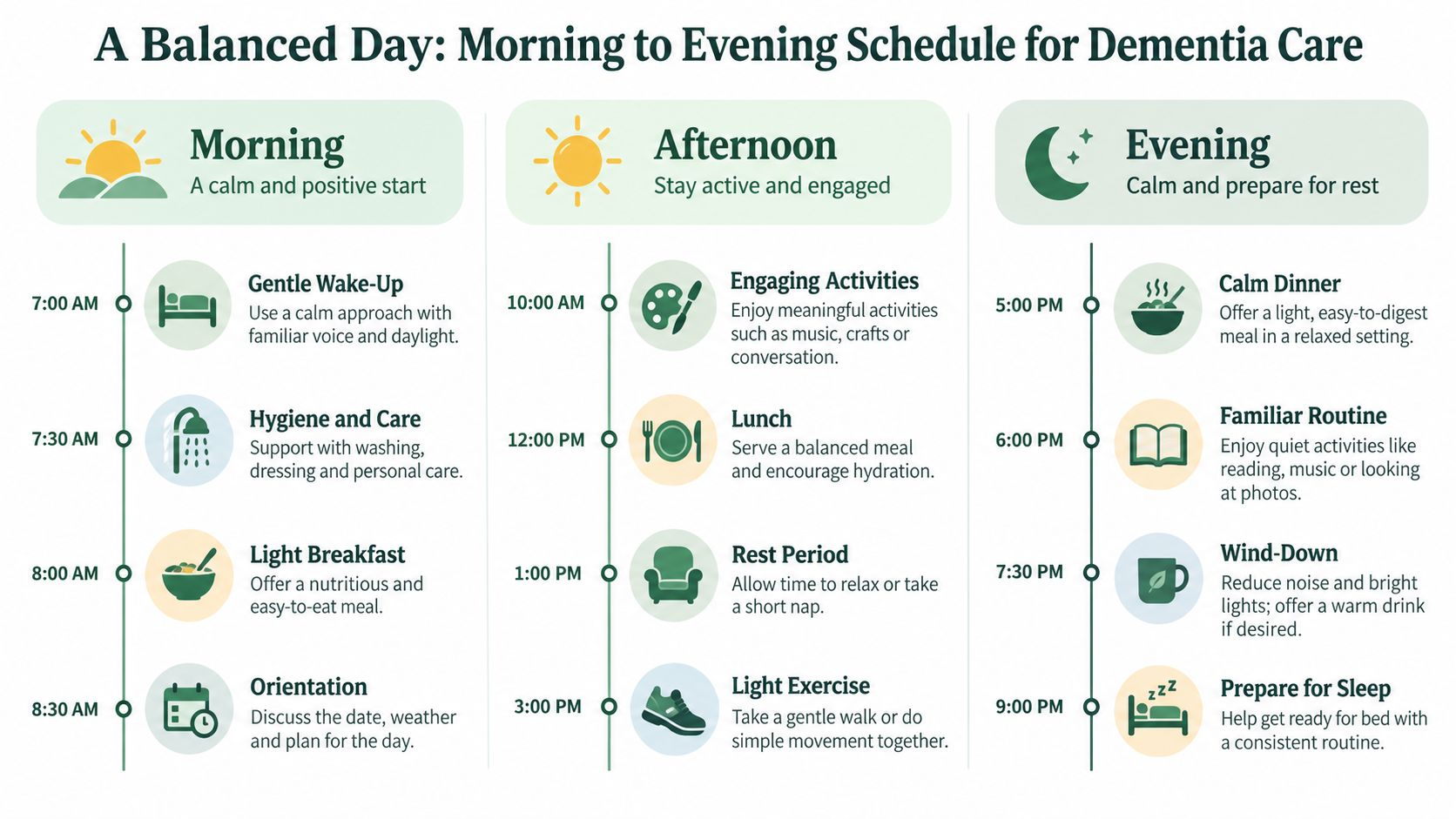
A workable schedule feels like a rhythm, not a parade of demands. Leave enough space between activities for slow processing, forgotten instructions, and ordinary conversation. If a task usually takes twenty minutes, don't place another obligation immediately afterward.
Morning should create momentum
Start with a calm greeting and simple orientation. Open the curtains, name the day, mention the weather, and explain the first step: “Good morning. It's Tuesday. Let's use the bathroom, then we'll have breakfast.”
The sequence might look like this:
Bathroom and washing.
Dressing with clothing laid out in order.
Breakfast at the usual place.
Morning medication, handled according to the prescribed plan.
A quiet orientation activity, such as reading the calendar or sorting the mail.
Don't turn orientation into a memory test. The purpose is reassurance, not proving whether the person knows the date. A large calendar, a visible clock, and a short written plan can provide cues without requiring repeated verbal correction.
Breakfast should be familiar and manageable. Too many choices can create frustration, so offer a simple choice between two acceptable options. If your parent can safely prepare part of the meal, let them pour a drink, place napkins, or spread something on toast while you supervise the hazardous steps.
Afternoon needs purpose and recovery
After lunch, choose one activity with a clear beginning and end. A walk, music, gardening, laundry folding, a crossword puzzle, or a familiar household task can provide engagement without feeling like therapy. Keep the activity matched to energy and ability. A person who was comfortable cooking in the morning may need a quieter task after lunch.
Include rest deliberately. Fatigue often appears as irritability, wandering, refusal, or repeated questions rather than a clear statement of “I'm tired.” A short rest, a drink, and a change to a quieter room may prevent the late-day routine from becoming a struggle.
Light movement can also fit here, provided it's safe for the person's mobility and health. A walk inside the home, gentle stretching, or standing to put away lightweight items can break up sitting without creating performance pressure.
Evening should narrow the choices
Dinner should be predictable and unhurried. Reduce television volume, clutter, and competing conversations as the day progresses. After eating, repeat familiar steps such as washing dishes together, listening to a preferred playlist, using the bathroom, changing into sleepwear, and dimming the lights.
For broader context on sleep changes in later life, the Protect-A-Bed ageing sleep guide offers useful background. In dementia care, the practical lesson is simple: keep evening activities calm, familiar, and consistent rather than adding stimulating errands or complicated decisions.
Write the routine where everyone can see it, but treat it as a guide. If a shower fails, preserve dignity and move to the next calming activity. A successful day is one in which the person remains safe, connected, and respected, not one in which every box gets checked.
Weaving Cognitive Stimulation into Everyday Tasks
Cognitive stimulation works better when it has a purpose the person recognizes. Most adults don't want to sit down for an abstract set of exercises, especially when the activity highlights what has become difficult. Familiar chores offer a more natural route into attention, language, sequencing, recognition, and reminiscence.
The right question isn't, “How can I test memory today?” Ask, “How can I make this ordinary moment engaging and manageable?”

Turn chores into invitations
Cooking can become sequencing practice. Name the ingredients, ask your parent to identify familiar smells, or invite them to stir while you handle heat and knives. Don't ask for several steps at once. “Can you place the cups on the table?” is more usable than “Get everything ready for lunch.”
Folding laundry creates a low-pressure opportunity for conversation. Ask who used a particular sweater, where a favorite shirt was bought, or what clothing the person wore for work. If the answer is inaccurate, follow the feeling and story rather than forcing a correction.
Music can support mood and recognition during chores. Choose songs connected to the person's history, then let the response guide you. Some music energizes, while other music helps settle the room. Watch for signs of overstimulation and turn it off when it stops helping.
Match the activity to ability
A useful activity has enough challenge to hold attention, but not so much that failure becomes the main experience. Look for signs that the task is too difficult:
Repeated abandonment: The person starts and stops, pushes materials away, or asks to leave.
Visible strain: They become tense, embarrassed, or unusually quiet.
Escalating correction: You find yourself giving constant instructions or fixing every step.
Loss of interest: The activity has become supervision rather than participation.
Simplify before abandoning the person's interest. Use larger objects, fewer materials, shorter conversations, or a familiar location. Someone who can't complete a crossword may still enjoy finding words in a newspaper, reading clues aloud, or discussing a favorite subject.
For families seeking structured ideas, these cognitive stimulation therapy activities can help translate therapeutic principles into ordinary moments. The activity should leave the person feeling capable, not evaluated.
Let emotion lead the interaction
Recognition, reminiscence, and language practice matter, but emotional connection matters just as much. A conversation about a wedding photo may prompt names, places, sensory details, or a warm expression. All of those responses count as participation.
Use open prompts when they're comfortable, but don't insist on an answer. “This looks like a summer day” may invite more conversation than “Who is this?” Share your own observations, offer choices, and accept silence.
The following video provides another way to think about meaningful engagement through familiar activities and conversation.
A person's history should shape the routine. Former gardeners may respond to plants and soil. Former office workers may enjoy organizing papers. People who valued music, cooking, faith, sport, or animals may engage more readily when those interests remain visible in the day.
Managing Medications and Household Safety Checks
A busy morning can expose the limits of memory quickly. Medication errors, unsafe cooking, falls, doors left open, and spoiled food require a clear plan for supervision. Build the routine around two questions: what can the person safely do, and what must another adult verify? This division protects independence without leaving high-risk tasks to chance.
Medication directions must come from the prescribing clinician or pharmacist. Ask what to do after a missed dose, whether each medication can be taken with food, and who confirms that the dose was taken. Write those decisions down so every caregiver follows the same plan.
Build safeguards around fixed points
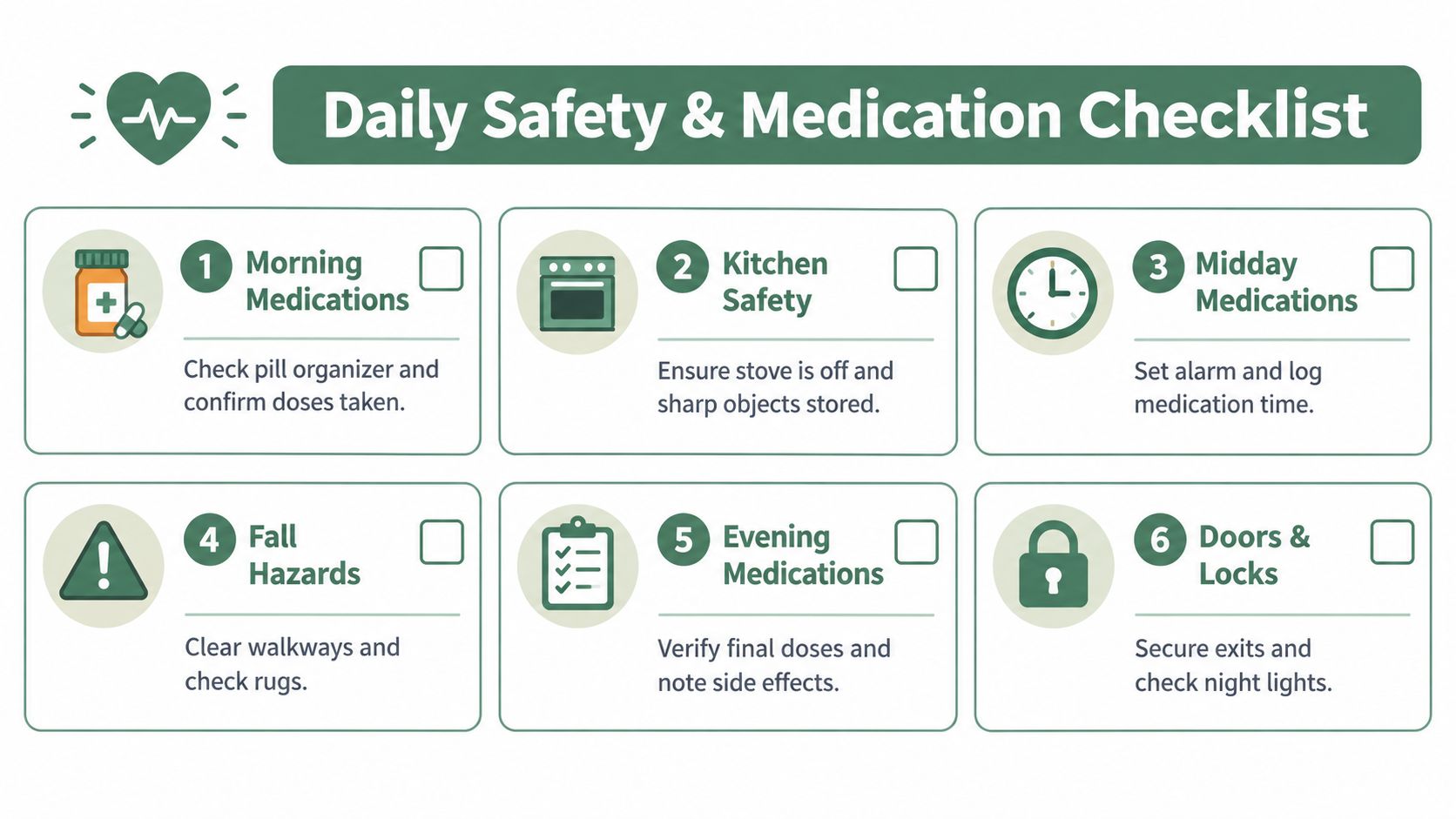
Attach medication to a dependable daily anchor. “Take it sometime this morning” leaves too much room for confusion, while the same medication time each day gives caregivers a clear point to check. The U.S. Department of Veterans Affairs dementia care checklist recommends consistent medication timing and scheduled toileting about every three hours. It also recommends breaking activities into smaller steps when the full task exceeds the person's current ability. The VA daily planning guidance explains this checklist approach.
A pill organizer can support the routine, but it does not prove that a dose was taken. Decide who fills it, who checks it, and where completion is recorded. If the person spends time alone, ask a pharmacist or clinician about a safer dispensing arrangement when ordinary reminders fail.
Use one short handoff log for everyone involved in care. Record confirmed medication, meals, fluids, toileting concerns, unusual confusion, falls, and marked mood changes. Keep entries factual and brief. The next caregiver should understand what happened and what requires attention without reconstructing the day.
Inspect the home by routine, not just by room
Link safety checks to transitions already built into the day:
After breakfast: Confirm that the stove and other heat sources are off, then store food safely.
Before leaving the kitchen: Remove knives, clean spills, and clear walkways.
Before an afternoon rest: Place glasses, a phone, water, and the call device within reach.
Before bedtime: Check doors, night lighting, bathroom access, and who handles medication.
Preserve safe participation. The person can wipe a table or place harmless items in a drawer while you control sharp objects, heat, chemicals, and medication storage. Explain each change respectfully: “I'm moving these supplies so the kitchen is easier to use.” That approach protects dignity and reduces the feeling that control is being taken away.
Plan for time spent alone
A printed schedule cannot manage an unexpected problem. A 2024 longitudinal study found that people with mild-to-moderate dementia who lived alone tended to have stronger cognitive and functional abilities and used more in-home care. It also found poorer physical, social, and psychological health, lower quality of life and well-being, and more transitions into residential care over time. The study is available through this PubMed record.
Assess recovery, not just task completion. Ask whether the person can respond safely to a spill, missed meal, fall, or sudden confusion, maintain contact with others, and summon help. For working caregivers, scheduled phone check-ins or phone-based cognitive care can add a low-barrier touchpoint between in-person visits. The routine should remain flexible, supportive, and matched to the help available. It is a safety framework, not a substitute for appropriate supervision.
Troubleshooting Resistance and Behavioral Friction
The common assumption is that a routine fails because the schedule is poorly designed. Often, the schedule is fine. The obstacle is distress. Agitation, aggression, disinhibition, delusions, and mood disturbance can interrupt bathing, meals, medication, movement, and transitions, and reviews identify neuropsychiatric symptoms as major drivers of caregiver burden and depression. The review of neuropsychiatric symptoms and caregiver burden explains why behavior deserves as much planning attention as the timetable.
Refusal usually communicates something. The person may be frightened, uncomfortable, tired, embarrassed, overstimulated, hungry, or unable to understand the request. Reasoning harder rarely solves a neurological problem.
Replace confrontation with a pivot
If your parent refuses a shower, stop repeating the instruction. Lower the pressure, acknowledge the discomfort, and offer a smaller alternative: wash the face and hands now, then revisit the shower later. If the person becomes angry during dressing, pause, offer two clothing choices, and reduce the number of people in the room.
Use this sequence:
Pause the demand. Give the person physical and emotional space.
Check the basics. Consider pain, hunger, thirst, toileting, temperature, fatigue, and medication changes.
Validate the feeling. “You seem worried” works better than “There's nothing to worry about.”
Redirect gently. Move to music, a drink, a familiar chair, or a simple household task.
Try again later. A failed attempt doesn't need to define the day.
Don't argue with a belief or perception that feels real to the person. You can acknowledge fear without confirming an unsafe conclusion. “I can see that this is upsetting. Let's sit somewhere quieter,” protects trust while shifting attention toward safety.
Make transitions smaller
Many outbursts occur between activities, not during them. Give advance notice, but keep the notice brief. “After this song, we'll go to the bathroom” creates a clearer bridge than announcing several upcoming tasks.
Limit background noise and visual clutter during difficult periods. A television, multiple conversations, and a crowded kitchen can compete with the instruction you're trying to give. Speak slowly, use a calm tone, and wait long enough for processing before repeating yourself.
Protect the caregiver's capacity
A routine that requires constant persuasion isn't sustainable. Record what happened before resistance, what the person did, and which response helped. Patterns may reveal that bathing works better at another time, that a particular room increases anxiety, or that the person needs rest before participating.
Safety comes first. If aggression, wandering, severe distress, falls, or sudden behavior changes create immediate risk, contact the appropriate clinician or emergency service. Caregivers shouldn't try to manage escalating danger through patience alone.
A flexible routine is not a failed routine. It's a plan that knows when to change course.
Integrating Phone-Based Support for Consistent Care
A family may manage breakfast, medication, and appointments well during its own visits, then lose contact when work, travel, sleep, or distance takes over. That gap can leave a person living alone without conversation, orientation, or someone to notice a change in routine. Earlier findings identified unmet needs such as daytime activities, companionship, psychological support, sensory difficulties, and accidental self-harm among people with dementia living in the community. The practical lesson is clear: a schedule needs support between in-person visits.
A phone call cannot provide hands-on assistance, emergency response, medication administration, or clinical treatment. It can provide a dependable human touchpoint. A trained caller can orient the person, guide a familiar activity, ask about meals or appointments, observe mood and participation, and alert family members when a pattern needs attention.
Make remote contact part of the routine
Build calls around existing anchors instead of making them random check-ins. A morning call can support orientation and breakfast preparation. An afternoon call can prompt a safe activity and conversation. An evening call can review the next day and ease loneliness before bedtime.
Keep the process simple. Phone-based care does not require the older adult to download an app, remember a password, or operate a complicated device. Families can review the Qaly guide to RPM benefits, then decide which needs call for monitoring, conversation, in-person help, or clinical follow-up.
Velma is one phone-based option. Its scheduled calls include conversation, reminiscence, orientation, language and attention activities, medication and appointment reminders, household safety discussions, and well-being observations. Care-manager coordination gives family members a way to review concerns and organize follow-up. See these daily check-in calls for seniors when a loved one spends long stretches without a caregiver nearby.

Use phone support to preserve continuity, not to monitor every action. Regular contact can offer companionship and structure while helping family notice missed meals, rising confusion, anxiety, fall concerns, or reduced participation. Pair it with appropriate in-person care, medical guidance, and a written escalation plan.
If your family needs a steadier daily routine, Velma provides scheduled phone calls with cognitive activities, companionship, orientation, and practical check-ins for older adults experiencing memory loss. Review whether phone-based support can cover gaps between family visits and help your loved one remain engaged at home.
You wake up to find your parent already dressed, but wearing yesterday's clothes, searching for the kitchen, and asking what day it is. Breakfast gets delayed, medication becomes a negotiation, and a simple shower turns into an argument. By evening, everyone is tired, including the person with dementia, and the routine you carefully planned has fallen apart.
A daily routine for dementia patients should create predictability without turning the day into a checklist imposed from outside. The most sustainable routines protect three things at once: safety, emotional comfort, and personal independence. They also leave room for fatigue, confusion, changing abilities, and the behavioral symptoms that can make an otherwise sensible schedule impossible.
The recommendations below are designed for early to mid-stage dementia, including situations where a family member works, visits intermittently, or the person spends long periods alone. Use them as a practical starting point, then adjust them with the person's clinician, care team, and changing needs.
Table of Contents
Why Structure Matters in Early and Mid-Stage Dementia
Use anchors instead of a rigid timetable
Building a Realistic Morning to Evening Schedule
Morning should create momentum
Afternoon needs purpose and recovery
Evening should narrow the choices
Weaving Cognitive Stimulation into Everyday Tasks
Turn chores into invitations
Match the activity to ability
Let emotion lead the interaction
Managing Medications and Household Safety Checks
Build safeguards around fixed points
Inspect the home by routine, not just by room
Plan for time spent alone
Troubleshooting Resistance and Behavioral Friction
Replace confrontation with a pivot
Make transitions smaller
Protect the caregiver's capacity
Integrating Phone-Based Support for Consistent Care
Make remote contact part of the routine
Why Structure Matters in Early and Mid-Stage Dementia
A person with memory loss may wake up without knowing what comes next. The bathroom, bedroom, and kitchen are familiar, but the sequence connecting them may no longer be automatic. Asking, “What would you like to do today?” can create more pressure than freedom when planning and decision-making have become difficult.
A predictable sequence reduces the number of decisions required. Washing, brushing teeth, getting dressed, eating breakfast, and reading the mail can become recognizable steps rather than separate problems to solve. The Alzheimer's Association's daily care plan guidance recommends building a daily routine and keeping track of the few tasks that need to happen each day. Its sample plan includes repeated self-care, household tasks, music, puzzles, walks, and reminiscence over coffee or dessert.
The point isn't to control every minute. Consistency matters more than precision. A person may need extra time to dress, skip a walk because of poor weather, or rest after breakfast. The routine should preserve the order and purpose of the day while allowing the clock to move.
Use anchors instead of a rigid timetable
Start with three broad anchors:
Morning: Wake, use the bathroom, wash, dress, eat, and orient to the day.
Afternoon: Eat lunch, complete one meaningful activity, rest, and move safely.
Evening: Have dinner, reduce stimulation, complete familiar personal-care steps, and prepare for sleep.
Familiar sequencing can lower confusion and help the person participate in tasks they can still manage. Put clothing in the order it should be worn. Place the toothbrush and toothpaste where they're visible. Offer one instruction at a time, then wait.
Practical rule: Make the next step obvious, not the entire day demanding.
Communication problems can make a good routine look ineffective. If your parent often asks you to repeat yourself, misses instructions, or appears withdrawn, check hearing as well as cognition. Hearing difficulty can increase communication strain and make memory-related confusion harder to interpret, so review these hearing loss and cognitive decline statistics with a hearing professional.
Match the routine to the person's current abilities rather than an earlier version of them. A useful guide to stage-matched interventions can help families choose activities that support participation without setting the person up to fail. Independence doesn't mean doing everything alone. It may mean choosing a shirt, stirring ingredients, folding towels, or carrying a letter to the table while someone else manages risk.
Building a Realistic Morning to Evening Schedule
A workable schedule feels like a rhythm, not a parade of demands. Leave enough space between activities for slow processing, forgotten instructions, and ordinary conversation. If a task usually takes twenty minutes, don't place another obligation immediately afterward.
Morning should create momentum
Start with a calm greeting and simple orientation. Open the curtains, name the day, mention the weather, and explain the first step: “Good morning. It's Tuesday. Let's use the bathroom, then we'll have breakfast.”
The sequence might look like this:
Bathroom and washing.
Dressing with clothing laid out in order.
Breakfast at the usual place.
Morning medication, handled according to the prescribed plan.
A quiet orientation activity, such as reading the calendar or sorting the mail.
Don't turn orientation into a memory test. The purpose is reassurance, not proving whether the person knows the date. A large calendar, a visible clock, and a short written plan can provide cues without requiring repeated verbal correction.
Breakfast should be familiar and manageable. Too many choices can create frustration, so offer a simple choice between two acceptable options. If your parent can safely prepare part of the meal, let them pour a drink, place napkins, or spread something on toast while you supervise the hazardous steps.
Afternoon needs purpose and recovery
After lunch, choose one activity with a clear beginning and end. A walk, music, gardening, laundry folding, a crossword puzzle, or a familiar household task can provide engagement without feeling like therapy. Keep the activity matched to energy and ability. A person who was comfortable cooking in the morning may need a quieter task after lunch.
Include rest deliberately. Fatigue often appears as irritability, wandering, refusal, or repeated questions rather than a clear statement of “I'm tired.” A short rest, a drink, and a change to a quieter room may prevent the late-day routine from becoming a struggle.
Light movement can also fit here, provided it's safe for the person's mobility and health. A walk inside the home, gentle stretching, or standing to put away lightweight items can break up sitting without creating performance pressure.
Evening should narrow the choices
Dinner should be predictable and unhurried. Reduce television volume, clutter, and competing conversations as the day progresses. After eating, repeat familiar steps such as washing dishes together, listening to a preferred playlist, using the bathroom, changing into sleepwear, and dimming the lights.
For broader context on sleep changes in later life, the Protect-A-Bed ageing sleep guide offers useful background. In dementia care, the practical lesson is simple: keep evening activities calm, familiar, and consistent rather than adding stimulating errands or complicated decisions.
Write the routine where everyone can see it, but treat it as a guide. If a shower fails, preserve dignity and move to the next calming activity. A successful day is one in which the person remains safe, connected, and respected, not one in which every box gets checked.
Weaving Cognitive Stimulation into Everyday Tasks
Cognitive stimulation works better when it has a purpose the person recognizes. Most adults don't want to sit down for an abstract set of exercises, especially when the activity highlights what has become difficult. Familiar chores offer a more natural route into attention, language, sequencing, recognition, and reminiscence.
The right question isn't, “How can I test memory today?” Ask, “How can I make this ordinary moment engaging and manageable?”
Turn chores into invitations
Cooking can become sequencing practice. Name the ingredients, ask your parent to identify familiar smells, or invite them to stir while you handle heat and knives. Don't ask for several steps at once. “Can you place the cups on the table?” is more usable than “Get everything ready for lunch.”
Folding laundry creates a low-pressure opportunity for conversation. Ask who used a particular sweater, where a favorite shirt was bought, or what clothing the person wore for work. If the answer is inaccurate, follow the feeling and story rather than forcing a correction.
Music can support mood and recognition during chores. Choose songs connected to the person's history, then let the response guide you. Some music energizes, while other music helps settle the room. Watch for signs of overstimulation and turn it off when it stops helping.
Match the activity to ability
A useful activity has enough challenge to hold attention, but not so much that failure becomes the main experience. Look for signs that the task is too difficult:
Repeated abandonment: The person starts and stops, pushes materials away, or asks to leave.
Visible strain: They become tense, embarrassed, or unusually quiet.
Escalating correction: You find yourself giving constant instructions or fixing every step.
Loss of interest: The activity has become supervision rather than participation.
Simplify before abandoning the person's interest. Use larger objects, fewer materials, shorter conversations, or a familiar location. Someone who can't complete a crossword may still enjoy finding words in a newspaper, reading clues aloud, or discussing a favorite subject.
For families seeking structured ideas, these cognitive stimulation therapy activities can help translate therapeutic principles into ordinary moments. The activity should leave the person feeling capable, not evaluated.
Let emotion lead the interaction
Recognition, reminiscence, and language practice matter, but emotional connection matters just as much. A conversation about a wedding photo may prompt names, places, sensory details, or a warm expression. All of those responses count as participation.
Use open prompts when they're comfortable, but don't insist on an answer. “This looks like a summer day” may invite more conversation than “Who is this?” Share your own observations, offer choices, and accept silence.
The following video provides another way to think about meaningful engagement through familiar activities and conversation.
A person's history should shape the routine. Former gardeners may respond to plants and soil. Former office workers may enjoy organizing papers. People who valued music, cooking, faith, sport, or animals may engage more readily when those interests remain visible in the day.
Managing Medications and Household Safety Checks
A busy morning can expose the limits of memory quickly. Medication errors, unsafe cooking, falls, doors left open, and spoiled food require a clear plan for supervision. Build the routine around two questions: what can the person safely do, and what must another adult verify? This division protects independence without leaving high-risk tasks to chance.
Medication directions must come from the prescribing clinician or pharmacist. Ask what to do after a missed dose, whether each medication can be taken with food, and who confirms that the dose was taken. Write those decisions down so every caregiver follows the same plan.
Build safeguards around fixed points
Attach medication to a dependable daily anchor. “Take it sometime this morning” leaves too much room for confusion, while the same medication time each day gives caregivers a clear point to check. The U.S. Department of Veterans Affairs dementia care checklist recommends consistent medication timing and scheduled toileting about every three hours. It also recommends breaking activities into smaller steps when the full task exceeds the person's current ability. The VA daily planning guidance explains this checklist approach.
A pill organizer can support the routine, but it does not prove that a dose was taken. Decide who fills it, who checks it, and where completion is recorded. If the person spends time alone, ask a pharmacist or clinician about a safer dispensing arrangement when ordinary reminders fail.
Use one short handoff log for everyone involved in care. Record confirmed medication, meals, fluids, toileting concerns, unusual confusion, falls, and marked mood changes. Keep entries factual and brief. The next caregiver should understand what happened and what requires attention without reconstructing the day.
Inspect the home by routine, not just by room
Link safety checks to transitions already built into the day:
After breakfast: Confirm that the stove and other heat sources are off, then store food safely.
Before leaving the kitchen: Remove knives, clean spills, and clear walkways.
Before an afternoon rest: Place glasses, a phone, water, and the call device within reach.
Before bedtime: Check doors, night lighting, bathroom access, and who handles medication.
Preserve safe participation. The person can wipe a table or place harmless items in a drawer while you control sharp objects, heat, chemicals, and medication storage. Explain each change respectfully: “I'm moving these supplies so the kitchen is easier to use.” That approach protects dignity and reduces the feeling that control is being taken away.
Plan for time spent alone
A printed schedule cannot manage an unexpected problem. A 2024 longitudinal study found that people with mild-to-moderate dementia who lived alone tended to have stronger cognitive and functional abilities and used more in-home care. It also found poorer physical, social, and psychological health, lower quality of life and well-being, and more transitions into residential care over time. The study is available through this PubMed record.
Assess recovery, not just task completion. Ask whether the person can respond safely to a spill, missed meal, fall, or sudden confusion, maintain contact with others, and summon help. For working caregivers, scheduled phone check-ins or phone-based cognitive care can add a low-barrier touchpoint between in-person visits. The routine should remain flexible, supportive, and matched to the help available. It is a safety framework, not a substitute for appropriate supervision.
Troubleshooting Resistance and Behavioral Friction
The common assumption is that a routine fails because the schedule is poorly designed. Often, the schedule is fine. The obstacle is distress. Agitation, aggression, disinhibition, delusions, and mood disturbance can interrupt bathing, meals, medication, movement, and transitions, and reviews identify neuropsychiatric symptoms as major drivers of caregiver burden and depression. The review of neuropsychiatric symptoms and caregiver burden explains why behavior deserves as much planning attention as the timetable.
Refusal usually communicates something. The person may be frightened, uncomfortable, tired, embarrassed, overstimulated, hungry, or unable to understand the request. Reasoning harder rarely solves a neurological problem.
Replace confrontation with a pivot
If your parent refuses a shower, stop repeating the instruction. Lower the pressure, acknowledge the discomfort, and offer a smaller alternative: wash the face and hands now, then revisit the shower later. If the person becomes angry during dressing, pause, offer two clothing choices, and reduce the number of people in the room.
Use this sequence:
Pause the demand. Give the person physical and emotional space.
Check the basics. Consider pain, hunger, thirst, toileting, temperature, fatigue, and medication changes.
Validate the feeling. “You seem worried” works better than “There's nothing to worry about.”
Redirect gently. Move to music, a drink, a familiar chair, or a simple household task.
Try again later. A failed attempt doesn't need to define the day.
Don't argue with a belief or perception that feels real to the person. You can acknowledge fear without confirming an unsafe conclusion. “I can see that this is upsetting. Let's sit somewhere quieter,” protects trust while shifting attention toward safety.
Make transitions smaller
Many outbursts occur between activities, not during them. Give advance notice, but keep the notice brief. “After this song, we'll go to the bathroom” creates a clearer bridge than announcing several upcoming tasks.
Limit background noise and visual clutter during difficult periods. A television, multiple conversations, and a crowded kitchen can compete with the instruction you're trying to give. Speak slowly, use a calm tone, and wait long enough for processing before repeating yourself.
Protect the caregiver's capacity
A routine that requires constant persuasion isn't sustainable. Record what happened before resistance, what the person did, and which response helped. Patterns may reveal that bathing works better at another time, that a particular room increases anxiety, or that the person needs rest before participating.
Safety comes first. If aggression, wandering, severe distress, falls, or sudden behavior changes create immediate risk, contact the appropriate clinician or emergency service. Caregivers shouldn't try to manage escalating danger through patience alone.
A flexible routine is not a failed routine. It's a plan that knows when to change course.
Integrating Phone-Based Support for Consistent Care
A family may manage breakfast, medication, and appointments well during its own visits, then lose contact when work, travel, sleep, or distance takes over. That gap can leave a person living alone without conversation, orientation, or someone to notice a change in routine. Earlier findings identified unmet needs such as daytime activities, companionship, psychological support, sensory difficulties, and accidental self-harm among people with dementia living in the community. The practical lesson is clear: a schedule needs support between in-person visits.
A phone call cannot provide hands-on assistance, emergency response, medication administration, or clinical treatment. It can provide a dependable human touchpoint. A trained caller can orient the person, guide a familiar activity, ask about meals or appointments, observe mood and participation, and alert family members when a pattern needs attention.
Make remote contact part of the routine
Build calls around existing anchors instead of making them random check-ins. A morning call can support orientation and breakfast preparation. An afternoon call can prompt a safe activity and conversation. An evening call can review the next day and ease loneliness before bedtime.
Keep the process simple. Phone-based care does not require the older adult to download an app, remember a password, or operate a complicated device. Families can review the Qaly guide to RPM benefits, then decide which needs call for monitoring, conversation, in-person help, or clinical follow-up.
Velma is one phone-based option. Its scheduled calls include conversation, reminiscence, orientation, language and attention activities, medication and appointment reminders, household safety discussions, and well-being observations. Care-manager coordination gives family members a way to review concerns and organize follow-up. See these daily check-in calls for seniors when a loved one spends long stretches without a caregiver nearby.
Use phone support to preserve continuity, not to monitor every action. Regular contact can offer companionship and structure while helping family notice missed meals, rising confusion, anxiety, fall concerns, or reduced participation. Pair it with appropriate in-person care, medical guidance, and a written escalation plan.
If your family needs a steadier daily routine, Velma provides scheduled phone calls with cognitive activities, companionship, orientation, and practical check-ins for older adults experiencing memory loss. Review whether phone-based support can cover gaps between family visits and help your loved one remain engaged at home.
Suggested Article: