Stage Matched Interventions for Dementia Care

A daughter notices that her father is forgetting appointments, so she buys a brain-training app. He can still solve some puzzles, but he can't find the login screen, remember the password, or understand why the exercise keeps changing. Within minutes, he's frustrated, and she's wondering whether she chose the wrong tool or whether he's “not trying.”
Many families face this moment. They know stimulation, routines, and social contact can help, but they don't know how much support fits the person's current abilities. Stage matched interventions provide a practical way to make that decision. Instead of asking, “What dementia activity should we use?” families ask, “What can this person do comfortably today, and what kind of help will preserve participation?”
The approach isn't about reducing someone to a diagnosis. It's about adjusting the task, communication style, and level of assistance so the person can remain involved with dignity.
Table of Contents
Why One-Size-Fits-All Dementia Care Falls Short
Matching help to the person
Understanding Dementia Staging Models
A second lens for intervention planning
How Interventions Shift Across Early Mild and Moderate Stages
Early stage
Mild stage
Moderate stage
Real-World Activities and Routines by Stage
Early-stage morning
Mild-stage afternoon
Moderate-stage bathing
Phone-Based Cognitive Support as a Stage-Matched Tool
Planning a Stage-Matched Care Approach for Your Family
Make the plan shared and testable
Adapting Your Strategy as Dementia Progresses
Why One-Size-Fits-All Dementia Care Falls Short
The daughter with the brain-training app may have chosen a reasonable activity for someone with mild cognitive impairment or very early dementia. Independent puzzles can support engagement when a person understands instructions, manages a device, and tolerates mistakes. The same activity may become overwhelming when memory loss affects sequencing, attention, or the ability to recover from an error.
Dementia doesn't follow one identical path for every person. Abilities can change gradually, and people can perform differently depending on fatigue, anxiety, pain, noise, and time of day. A person who manages a crossword in the morning may struggle with it after dinner. A person who once handled online banking may still enjoy discussing family photographs, but may no longer be able to manage the steps required to open a banking app safely.
Families also need to distinguish ordinary age-related changes from symptoms that deserve clinical attention. A resource such as this guide to normal ageing symptoms can help organize observations before a conversation with a healthcare professional.
Matching help to the person
Stage matched interventions align cognitive support, behavioral strategies, and daily-living assistance with current abilities. Early support may focus on maintaining skills and using memory aids. Later support may rely more on guided participation, familiar sensory experiences, and comfort.
Consider meal preparation. Someone in an early stage might choose a recipe, gather ingredients, and cook with a safety check. Someone in a mild stage might prepare part of the meal after ingredients are placed in order. Someone in a moderate stage might wash vegetables alongside a caregiver while the caregiver handles heat and sharp tools.
Practical rule: If an activity creates repeated failure, simplify the activity before assuming the person has lost interest.
The right match can reduce avoidable frustration for both people. It also changes the caregiver's role. Rather than repeatedly correcting mistakes, the caregiver creates conditions in which the person can succeed, contribute, or feel secure. That shift protects connection, even as the type of participation changes.
Understanding Dementia Staging Models
Clinical staging models give families a shared language for describing changes. They don't tell you exactly what will happen next, and they shouldn't replace a professional assessment. Their value lies in helping caregivers connect observed abilities with appropriate support.
The Global Deterioration Scale, or GDS, describes Alzheimer's disease progression across seven stages. The early and middle stages are especially useful for home planning:
Stage 2, very mild decline: A person may notice memory complaints, but clinical testing doesn't show clear impairment. They may misplace items or feel less confident, while continuing to manage most activities independently.
Stage 3, mild decline: Early confusion becomes more noticeable. Word-finding difficulty, trouble organizing tasks, or difficulty performing in unfamiliar situations may appear.
Stage 4, moderate decline: Deficits affect complex activities. Managing finances, planning a meal, organizing medications, or handling a complicated appointment may require oversight.
Stage 5, moderately severe decline: The person needs assistance with important daily decisions and may need reminders or direct help with choosing clothing, remembering personal details, or following routines.
The GDS continues through severe and very severe decline, when the emphasis shifts increasingly toward personal care, communication support, mobility, and comfort. The practical meaning of each stage depends on the individual's history, health, environment, and strengths.

A second lens for intervention planning
The NIH Stage Model for Behavioral Interventions complements disease-severity scales by organizing intervention development from Stage 0 through Stage 5. It also notes that interventions at Stage 3 or higher are more likely to be ready for broad dissemination. This framework helps researchers think about how an intervention moves from an early idea toward practical use, rather than just describing a person's symptoms.
That distinction matters. A family might use the GDS to describe a parent's current abilities, while clinicians or researchers use the NIH model to discuss how confidently an intervention has been developed and tested. The two models answer different questions.
Families can use a dementia progression stages resource to prepare questions, but staging still works best as a conversation with a clinician. A stage is a snapshot, not a sentence. Abilities fluctuate, and a person may need more support during illness or stress without having permanently moved to a new stage.
How Interventions Shift Across Early Mild and Moderate Stages
The central change across early, mild, and moderate dementia is the intervention target. Support generally moves from skill-building and compensation, toward guided participation, and then toward symptom regulation and comfort. These categories overlap, so families shouldn't treat them as rigid boxes.
Support Domain | Early Stage | Mild Stage | Moderate Stage |
|---|---|---|---|
Cognitive stimulation | Independent puzzles, journaling, reading, or planning activities that use existing strengths | Shorter tasks with clear instructions, repetition, and caregiver participation | Guided reminiscence, music, sensory activities, and familiar conversation |
Daily routines | Calendars, alarms, checklists, and structured routines that preserve independence | Tasks divided into smaller steps, with supervision for safety-sensitive activities | Direct assistance, simple cues, and predictable sequences |
Communication | Discuss plans and invite the person to solve problems | Offer limited choices and repeat information without criticism | Use calm tone, short phrases, gestures, and yes-or-no questions |
Behavioral support | Education, emotional adjustment, and planning for future needs | Validation, redirection, and reduced environmental complexity | Comfort, familiarity, pain awareness, and sensory regulation |
Early stage
In early dementia, a person may still learn compensatory strategies. A large calendar in a familiar location, a written morning checklist, or a medication system managed with oversight can help preserve independence. Cognitive activities should be challenging enough to engage the person, but not so difficult that every session becomes a test.
The caregiver's role is often collaborative. They might ask, “Would you like to write the shopping list or check the calendar first?” This supports agency while reducing the memory burden.
Mild stage
As multi-step tasks become harder, the caregiver can simplify without taking over completely. A meal can be broken into visible steps. A familiar exercise routine can use the same order each time. Errorless learning, in which the person is guided toward a successful response instead of repeatedly practicing mistakes, can protect confidence.
Safety planning becomes more important here. Medication management, driving decisions, stove use, and wandering concerns deserve direct discussion with healthcare professionals and the wider care team.
Moderate stage
Moderate dementia often calls for less emphasis on performance and more attention to emotional and sensory regulation. Familiar music, folding towels, hand massage when welcomed, or looking through well-known photographs may work better than demanding recall.
The intervention may still involve memory, but the goal has changed. A reminiscence conversation isn't a quiz about dates. It's an opportunity to create connection through a familiar song, place, occupation, or family story. Families looking for practical planning ideas can review these cognitive care plan examples, then adapt activities to the person rather than copying them exactly.
Real-World Activities and Routines by Stage
A stage-matched plan becomes easier to understand when it appears in an ordinary day. The same household can use the same room, materials, and people while changing the amount of choice, prompting, and supervision.
Early-stage morning
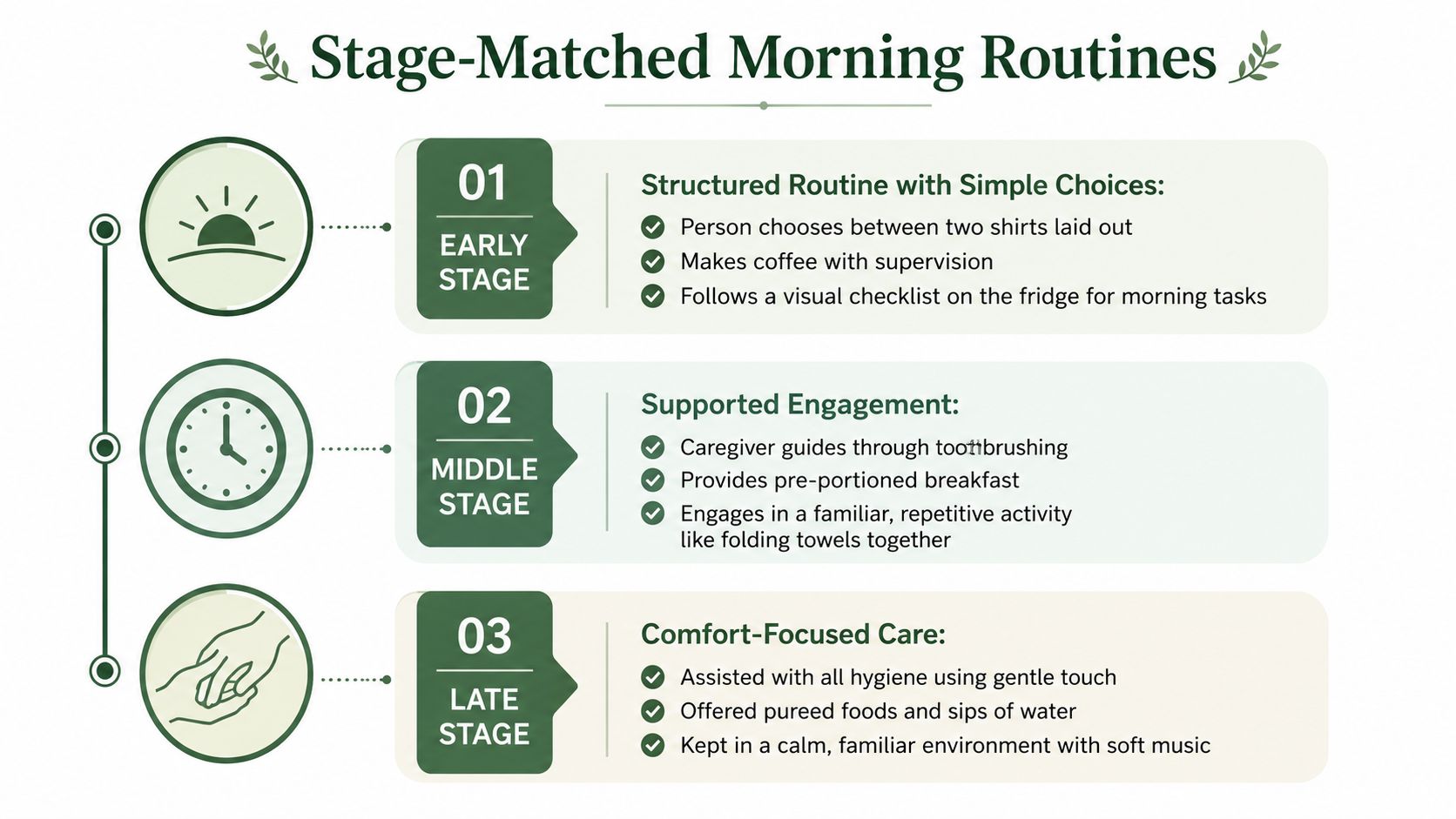
At breakfast, an adult child places a labeled calendar beside the kettle and keeps a short to-do list on the refrigerator. The person checks the day, chooses between two breakfast options, and helps plan one meal. A guided journal can prompt a few lines about the morning, while the caregiver avoids correcting spelling or details unless safety depends on accuracy.
A helpful introduction might be, “Let's look at today's plans together,” rather than, “You forgot what you're doing today.” The cognitive target is compensation and planning, while the behavioral target is confidence.
Mild-stage afternoon
For someone in a mild stage, a familiar walk can become a structured sensory activity. The caregiver carries a few family photo prompts or points out seasonal sounds, colors, and textures. Instead of asking an open-ended question such as, “Do you remember this place?” they might say, “This tree is near the old post office. Does it remind you of your neighborhood?”
In the evening, repetitive tasks can provide a calm sense of purpose. Sorting socks, folding towels, or arranging napkins works best when the caregiver presents a small amount at a time. “Would you help me fold these?” feels like an invitation. “You need something simple to do” can sound dismissive.
Moderate-stage bathing
Bathing may become confusing or distressing when the person must remember several steps. The caregiver prepares the room, limits noise, explains one action at a time, and uses familiar music if it has a calming effect. “First we'll wash your hands,” followed by a pause, is easier to follow than a long explanation of the entire routine.
The aim is physical comfort, safety, and reduced agitation, not independent completion. If the person resists, the caregiver can pause, acknowledge the emotion, and try again later when possible. Pain, fear, temperature, modesty, and unfamiliar helpers can all affect cooperation, so persistent distress deserves professional guidance.
Across stages, the most effective activity is often the one the person recognizes and accepts. A familiar task with gentle support can be more meaningful than a complex activity that highlights what has changed.
Phone-Based Cognitive Support as a Stage-Matched Tool
A phone call can remove a barrier that makes many digital programs impractical. Some older adults with early or mild dementia don't feel comfortable with apps, passwords, touchscreens, or changing menus. A regular phone uses a familiar channel and allows a trained person to adjust the pace in real time.
Telephone social-support programs are described as a low-cost way to engage older adults at risk of isolation, and a pilot study found that regular telephone peer support could help prevent social isolation among residents with cognitive decline, as described in this telephone social connectivity guide. The practical value may extend beyond cognitive practice. Mood, routine adherence, and connection can matter just as much to families managing daily life.
Dementia Stage | Call Focus | Typical Duration | Primary Goal |
|---|---|---|---|
Early | Reminiscence prompts, orientation, verbal games, and discussion of interests | Adapted to attention and energy | Maintain engagement and reinforce routines |
Mild | Structured conversation, repetition, memory cues, and emotional validation | Kept predictable and manageable | Support participation and reduce confusion |
Moderate | Familiar voice, brief orientation, soothing conversation, and caregiver coordination | Short and flexible | Promote comfort and reduce isolation |
The content must change with ability. An early-stage call might invite someone to describe a favorite holiday, discuss a newspaper topic, or complete a verbal word exercise. In a mild stage, the same conversation may use repeated prompts and fewer choices. In a moderate stage, the caller may focus on recognition, reassurance, familiar music, and a calm rhythm rather than testing recall.
A phone program also needs clear boundaries. It can complement medical care and in-person caregiving, but it can't replace urgent assessment, physical assistance, or emergency services. Families should ask how callers document concerns, communicate with caregivers, and adjust activities when a person's responses change.
Velma is one phone-based option for older adults with early to mid-stage memory loss. Its scheduled calls combine guided conversation, cognitive stimulation activities, emotional support, and practical check-ins about routines, appointments, medications, and household safety. Families can learn more through daily check-in calls for seniors.
Planning a Stage-Matched Care Approach for Your Family
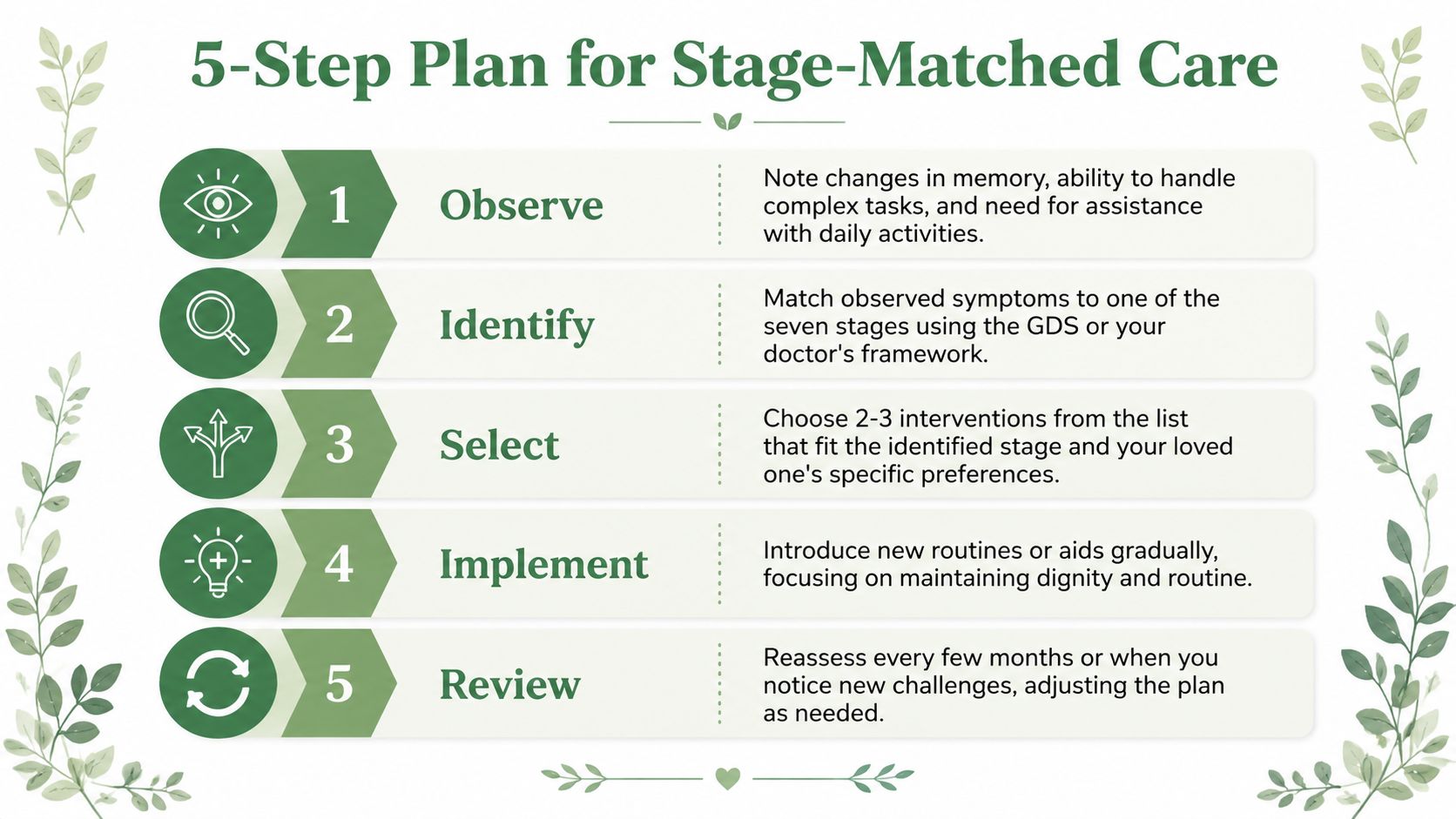
Start with observation, not a label. For several days, note what happens during ordinary activities and record the conditions around each success or difficulty. A useful journal can include:
Memory and orientation: Does the person forget recent conversations, lose track of the day, or benefit from written reminders?
Multi-step tasks: Can they prepare food, manage a phone call, or organize clothing without prompts?
Emotional responses: What happens when a task becomes difficult? Do they become anxious, withdrawn, angry, or willing to try with help?
Daily function: Which activities remain independent, and where does safety require supervision or direct assistance?
Social connection: Does the person initiate contact, participate in conversation, or avoid interaction because it feels demanding?
Next, compare the pattern with the staging framework used by the person's clinician. Early concerns may call for memory aids and strength-based cognitive activities. Mild changes may call for simplified routines and guided participation. More advanced functional changes may require direct support, sensory engagement, and a stronger focus on comfort.
Make the plan shared and testable
Choose a small number of interventions that fit the person's interests. One family might select a calendar routine, a supervised walking plan, and scheduled phone support. Another might choose music, folding laundry, and a bathing sequence. Track whether the person participates, becomes calmer, sleeps better, or shows less interest. Don't judge an activity only by whether it improves test performance.
Professional input becomes important when memory changes interfere with finances, medication safety, driving, nutrition, falls, personal care, or living alone. A geriatrician, neuropsychologist, dementia care coordinator, or another qualified clinician can provide more precise assessment and identify treatable contributors to sudden change.
Sibling disagreement is common because each person sees a different slice of the day. A shared care journal can replace competing impressions with specific observations, such as “needed prompts to start dressing” rather than “seems much worse.” Bring that record to appointments and revisit the plan as needs evolve.
Adapting Your Strategy as Dementia Progresses
Dementia care plans need regular adjustment. Revisit the person's abilities every few months, especially when memory lapses, mood changes, or daily tasks begin to shift. If an activity that once created pleasure now causes embarrassment or frustration, reduce its complexity or replace it with a familiar sensory activity.
A simple care journal can show what still works and what no longer does. Changes in toileting or continence also deserve practical planning, and families may benefit from guidance on toilet assistance for confused parents.
Moving toward more support isn't failure. It's responsive care that follows the person's needs rather than forcing an outdated routine.
Velma provides scheduled phone calls with guided cognitive exercises, supportive conversation, routine reinforcement, and practical check-ins for older adults with early to mid-stage memory loss. Visit Velma to explore whether phone-based, stage-matched support could complement your family's care plan.
A daughter notices that her father is forgetting appointments, so she buys a brain-training app. He can still solve some puzzles, but he can't find the login screen, remember the password, or understand why the exercise keeps changing. Within minutes, he's frustrated, and she's wondering whether she chose the wrong tool or whether he's “not trying.”
Many families face this moment. They know stimulation, routines, and social contact can help, but they don't know how much support fits the person's current abilities. Stage matched interventions provide a practical way to make that decision. Instead of asking, “What dementia activity should we use?” families ask, “What can this person do comfortably today, and what kind of help will preserve participation?”
The approach isn't about reducing someone to a diagnosis. It's about adjusting the task, communication style, and level of assistance so the person can remain involved with dignity.
Table of Contents
Why One-Size-Fits-All Dementia Care Falls Short
Matching help to the person
Understanding Dementia Staging Models
A second lens for intervention planning
How Interventions Shift Across Early Mild and Moderate Stages
Early stage
Mild stage
Moderate stage
Real-World Activities and Routines by Stage
Early-stage morning
Mild-stage afternoon
Moderate-stage bathing
Phone-Based Cognitive Support as a Stage-Matched Tool
Planning a Stage-Matched Care Approach for Your Family
Make the plan shared and testable
Adapting Your Strategy as Dementia Progresses
Why One-Size-Fits-All Dementia Care Falls Short
The daughter with the brain-training app may have chosen a reasonable activity for someone with mild cognitive impairment or very early dementia. Independent puzzles can support engagement when a person understands instructions, manages a device, and tolerates mistakes. The same activity may become overwhelming when memory loss affects sequencing, attention, or the ability to recover from an error.
Dementia doesn't follow one identical path for every person. Abilities can change gradually, and people can perform differently depending on fatigue, anxiety, pain, noise, and time of day. A person who manages a crossword in the morning may struggle with it after dinner. A person who once handled online banking may still enjoy discussing family photographs, but may no longer be able to manage the steps required to open a banking app safely.
Families also need to distinguish ordinary age-related changes from symptoms that deserve clinical attention. A resource such as this guide to normal ageing symptoms can help organize observations before a conversation with a healthcare professional.
Matching help to the person
Stage matched interventions align cognitive support, behavioral strategies, and daily-living assistance with current abilities. Early support may focus on maintaining skills and using memory aids. Later support may rely more on guided participation, familiar sensory experiences, and comfort.
Consider meal preparation. Someone in an early stage might choose a recipe, gather ingredients, and cook with a safety check. Someone in a mild stage might prepare part of the meal after ingredients are placed in order. Someone in a moderate stage might wash vegetables alongside a caregiver while the caregiver handles heat and sharp tools.
Practical rule: If an activity creates repeated failure, simplify the activity before assuming the person has lost interest.
The right match can reduce avoidable frustration for both people. It also changes the caregiver's role. Rather than repeatedly correcting mistakes, the caregiver creates conditions in which the person can succeed, contribute, or feel secure. That shift protects connection, even as the type of participation changes.
Understanding Dementia Staging Models
Clinical staging models give families a shared language for describing changes. They don't tell you exactly what will happen next, and they shouldn't replace a professional assessment. Their value lies in helping caregivers connect observed abilities with appropriate support.
The Global Deterioration Scale, or GDS, describes Alzheimer's disease progression across seven stages. The early and middle stages are especially useful for home planning:
Stage 2, very mild decline: A person may notice memory complaints, but clinical testing doesn't show clear impairment. They may misplace items or feel less confident, while continuing to manage most activities independently.
Stage 3, mild decline: Early confusion becomes more noticeable. Word-finding difficulty, trouble organizing tasks, or difficulty performing in unfamiliar situations may appear.
Stage 4, moderate decline: Deficits affect complex activities. Managing finances, planning a meal, organizing medications, or handling a complicated appointment may require oversight.
Stage 5, moderately severe decline: The person needs assistance with important daily decisions and may need reminders or direct help with choosing clothing, remembering personal details, or following routines.
The GDS continues through severe and very severe decline, when the emphasis shifts increasingly toward personal care, communication support, mobility, and comfort. The practical meaning of each stage depends on the individual's history, health, environment, and strengths.
A second lens for intervention planning
The NIH Stage Model for Behavioral Interventions complements disease-severity scales by organizing intervention development from Stage 0 through Stage 5. It also notes that interventions at Stage 3 or higher are more likely to be ready for broad dissemination. This framework helps researchers think about how an intervention moves from an early idea toward practical use, rather than just describing a person's symptoms.
That distinction matters. A family might use the GDS to describe a parent's current abilities, while clinicians or researchers use the NIH model to discuss how confidently an intervention has been developed and tested. The two models answer different questions.
Families can use a dementia progression stages resource to prepare questions, but staging still works best as a conversation with a clinician. A stage is a snapshot, not a sentence. Abilities fluctuate, and a person may need more support during illness or stress without having permanently moved to a new stage.
How Interventions Shift Across Early Mild and Moderate Stages
The central change across early, mild, and moderate dementia is the intervention target. Support generally moves from skill-building and compensation, toward guided participation, and then toward symptom regulation and comfort. These categories overlap, so families shouldn't treat them as rigid boxes.
Support Domain | Early Stage | Mild Stage | Moderate Stage |
|---|---|---|---|
Cognitive stimulation | Independent puzzles, journaling, reading, or planning activities that use existing strengths | Shorter tasks with clear instructions, repetition, and caregiver participation | Guided reminiscence, music, sensory activities, and familiar conversation |
Daily routines | Calendars, alarms, checklists, and structured routines that preserve independence | Tasks divided into smaller steps, with supervision for safety-sensitive activities | Direct assistance, simple cues, and predictable sequences |
Communication | Discuss plans and invite the person to solve problems | Offer limited choices and repeat information without criticism | Use calm tone, short phrases, gestures, and yes-or-no questions |
Behavioral support | Education, emotional adjustment, and planning for future needs | Validation, redirection, and reduced environmental complexity | Comfort, familiarity, pain awareness, and sensory regulation |
Early stage
In early dementia, a person may still learn compensatory strategies. A large calendar in a familiar location, a written morning checklist, or a medication system managed with oversight can help preserve independence. Cognitive activities should be challenging enough to engage the person, but not so difficult that every session becomes a test.
The caregiver's role is often collaborative. They might ask, “Would you like to write the shopping list or check the calendar first?” This supports agency while reducing the memory burden.
Mild stage
As multi-step tasks become harder, the caregiver can simplify without taking over completely. A meal can be broken into visible steps. A familiar exercise routine can use the same order each time. Errorless learning, in which the person is guided toward a successful response instead of repeatedly practicing mistakes, can protect confidence.
Safety planning becomes more important here. Medication management, driving decisions, stove use, and wandering concerns deserve direct discussion with healthcare professionals and the wider care team.
Moderate stage
Moderate dementia often calls for less emphasis on performance and more attention to emotional and sensory regulation. Familiar music, folding towels, hand massage when welcomed, or looking through well-known photographs may work better than demanding recall.
The intervention may still involve memory, but the goal has changed. A reminiscence conversation isn't a quiz about dates. It's an opportunity to create connection through a familiar song, place, occupation, or family story. Families looking for practical planning ideas can review these cognitive care plan examples, then adapt activities to the person rather than copying them exactly.
Real-World Activities and Routines by Stage
A stage-matched plan becomes easier to understand when it appears in an ordinary day. The same household can use the same room, materials, and people while changing the amount of choice, prompting, and supervision.
Early-stage morning
At breakfast, an adult child places a labeled calendar beside the kettle and keeps a short to-do list on the refrigerator. The person checks the day, chooses between two breakfast options, and helps plan one meal. A guided journal can prompt a few lines about the morning, while the caregiver avoids correcting spelling or details unless safety depends on accuracy.
A helpful introduction might be, “Let's look at today's plans together,” rather than, “You forgot what you're doing today.” The cognitive target is compensation and planning, while the behavioral target is confidence.
Mild-stage afternoon
For someone in a mild stage, a familiar walk can become a structured sensory activity. The caregiver carries a few family photo prompts or points out seasonal sounds, colors, and textures. Instead of asking an open-ended question such as, “Do you remember this place?” they might say, “This tree is near the old post office. Does it remind you of your neighborhood?”
In the evening, repetitive tasks can provide a calm sense of purpose. Sorting socks, folding towels, or arranging napkins works best when the caregiver presents a small amount at a time. “Would you help me fold these?” feels like an invitation. “You need something simple to do” can sound dismissive.
Moderate-stage bathing
Bathing may become confusing or distressing when the person must remember several steps. The caregiver prepares the room, limits noise, explains one action at a time, and uses familiar music if it has a calming effect. “First we'll wash your hands,” followed by a pause, is easier to follow than a long explanation of the entire routine.
The aim is physical comfort, safety, and reduced agitation, not independent completion. If the person resists, the caregiver can pause, acknowledge the emotion, and try again later when possible. Pain, fear, temperature, modesty, and unfamiliar helpers can all affect cooperation, so persistent distress deserves professional guidance.
Across stages, the most effective activity is often the one the person recognizes and accepts. A familiar task with gentle support can be more meaningful than a complex activity that highlights what has changed.
Phone-Based Cognitive Support as a Stage-Matched Tool
A phone call can remove a barrier that makes many digital programs impractical. Some older adults with early or mild dementia don't feel comfortable with apps, passwords, touchscreens, or changing menus. A regular phone uses a familiar channel and allows a trained person to adjust the pace in real time.
Telephone social-support programs are described as a low-cost way to engage older adults at risk of isolation, and a pilot study found that regular telephone peer support could help prevent social isolation among residents with cognitive decline, as described in this telephone social connectivity guide. The practical value may extend beyond cognitive practice. Mood, routine adherence, and connection can matter just as much to families managing daily life.
Dementia Stage | Call Focus | Typical Duration | Primary Goal |
|---|---|---|---|
Early | Reminiscence prompts, orientation, verbal games, and discussion of interests | Adapted to attention and energy | Maintain engagement and reinforce routines |
Mild | Structured conversation, repetition, memory cues, and emotional validation | Kept predictable and manageable | Support participation and reduce confusion |
Moderate | Familiar voice, brief orientation, soothing conversation, and caregiver coordination | Short and flexible | Promote comfort and reduce isolation |
The content must change with ability. An early-stage call might invite someone to describe a favorite holiday, discuss a newspaper topic, or complete a verbal word exercise. In a mild stage, the same conversation may use repeated prompts and fewer choices. In a moderate stage, the caller may focus on recognition, reassurance, familiar music, and a calm rhythm rather than testing recall.
A phone program also needs clear boundaries. It can complement medical care and in-person caregiving, but it can't replace urgent assessment, physical assistance, or emergency services. Families should ask how callers document concerns, communicate with caregivers, and adjust activities when a person's responses change.
Velma is one phone-based option for older adults with early to mid-stage memory loss. Its scheduled calls combine guided conversation, cognitive stimulation activities, emotional support, and practical check-ins about routines, appointments, medications, and household safety. Families can learn more through daily check-in calls for seniors.
Planning a Stage-Matched Care Approach for Your Family
Start with observation, not a label. For several days, note what happens during ordinary activities and record the conditions around each success or difficulty. A useful journal can include:
Memory and orientation: Does the person forget recent conversations, lose track of the day, or benefit from written reminders?
Multi-step tasks: Can they prepare food, manage a phone call, or organize clothing without prompts?
Emotional responses: What happens when a task becomes difficult? Do they become anxious, withdrawn, angry, or willing to try with help?
Daily function: Which activities remain independent, and where does safety require supervision or direct assistance?
Social connection: Does the person initiate contact, participate in conversation, or avoid interaction because it feels demanding?
Next, compare the pattern with the staging framework used by the person's clinician. Early concerns may call for memory aids and strength-based cognitive activities. Mild changes may call for simplified routines and guided participation. More advanced functional changes may require direct support, sensory engagement, and a stronger focus on comfort.
Make the plan shared and testable
Choose a small number of interventions that fit the person's interests. One family might select a calendar routine, a supervised walking plan, and scheduled phone support. Another might choose music, folding laundry, and a bathing sequence. Track whether the person participates, becomes calmer, sleeps better, or shows less interest. Don't judge an activity only by whether it improves test performance.
Professional input becomes important when memory changes interfere with finances, medication safety, driving, nutrition, falls, personal care, or living alone. A geriatrician, neuropsychologist, dementia care coordinator, or another qualified clinician can provide more precise assessment and identify treatable contributors to sudden change.
Sibling disagreement is common because each person sees a different slice of the day. A shared care journal can replace competing impressions with specific observations, such as “needed prompts to start dressing” rather than “seems much worse.” Bring that record to appointments and revisit the plan as needs evolve.
Adapting Your Strategy as Dementia Progresses
Dementia care plans need regular adjustment. Revisit the person's abilities every few months, especially when memory lapses, mood changes, or daily tasks begin to shift. If an activity that once created pleasure now causes embarrassment or frustration, reduce its complexity or replace it with a familiar sensory activity.
A simple care journal can show what still works and what no longer does. Changes in toileting or continence also deserve practical planning, and families may benefit from guidance on toilet assistance for confused parents.
Moving toward more support isn't failure. It's responsive care that follows the person's needs rather than forcing an outdated routine.
Velma provides scheduled phone calls with guided cognitive exercises, supportive conversation, routine reinforcement, and practical check-ins for older adults with early to mid-stage memory loss. Visit Velma to explore whether phone-based, stage-matched support could complement your family's care plan.
Suggested Article: