Dementia Progression Stages: A Caregiver's Guide

You may be here because something small happened that didn't feel small at all.
Your mom missed a bill she'd never forget. Your husband got turned around in a grocery store he's used for years. Your dad told the same story three times at dinner, then laughed it off, but you went home uneasy. These moments often arrive before anyone has a name for what's changing. They can leave families stuck between doubt and worry, wondering whether this is normal aging, stress, or the start of something more serious.
Dementia rarely feels clear at the beginning. It unfolds in pieces. That's why understanding dementia progression stages can help. Stages don't predict every detail of one person's future, but they do give families a practical way to recognize patterns, ask better questions, and prepare for the kind of support that may be needed next. If you're still sorting out basic terms, this guide on Alzheimer's disease vs dementia can help clarify the difference.
Table of Contents
The Unfolding Journey An Introduction to Dementia Stages
Mapping the Path Understanding Dementia Staging Models
Why staging helps families
A forecast, not a script
The Early Stage From First Concerns to Mild Decline
When memory changes cross a line
Why this stage matters so much
Practical supports that help early
Navigating the Middle Stage Moderate to Moderately Severe Decline
What stage 4 often looks like at home
What changes in stage 5
Care strategies that work better than correction
The Late Stage Providing Comfort in Severe Decline
What families often notice
How to care when words fade
Proactive Care and Building Your Support System
Build the team before a crisis
What to organize early
Finding Strength in Understanding A Final Word
The Unfolding Journey An Introduction to Dementia Stages
Families often want one straight answer: What stage is this, and what happens next?
The honest answer is that dementia doesn't move in a neat, identical pattern for everyone. Still, staging gives you something valuable. It gives you a shared language. When a doctor says “mild cognitive decline” or “moderate decline,” that isn't meant to frighten you. It's meant to help everyone around your loved one understand what kinds of changes are happening and what kind of help may be needed.
Think of stages as a roadmap, not a countdown clock. A roadmap doesn't tell you exactly how long each turn will take. It does help you avoid driving blind.
Knowing the stage won't remove the grief. It often removes some of the confusion.
That matters because confusion creates delays. Families wait to bring in help. They argue over whether the person is “really that impaired.” They assume a problem is only memory, when the bigger issue is judgment, planning, or safety.
Understanding dementia progression stages helps you shift from reacting to planning. Instead of asking, “Why is this suddenly happening?” you begin asking better questions. Does she still manage medications safely? Is he anxious when routines change? Does she need reminders, supervision, or hands-on help? Those questions lead to action, and action usually brings relief.
Mapping the Path Understanding Dementia Staging Models
Clinicians use staging models because symptoms can be hard to describe in casual conversation. “She's more forgetful” doesn't tell you enough. “He can no longer manage finances and struggles with recent recall” tells you much more.
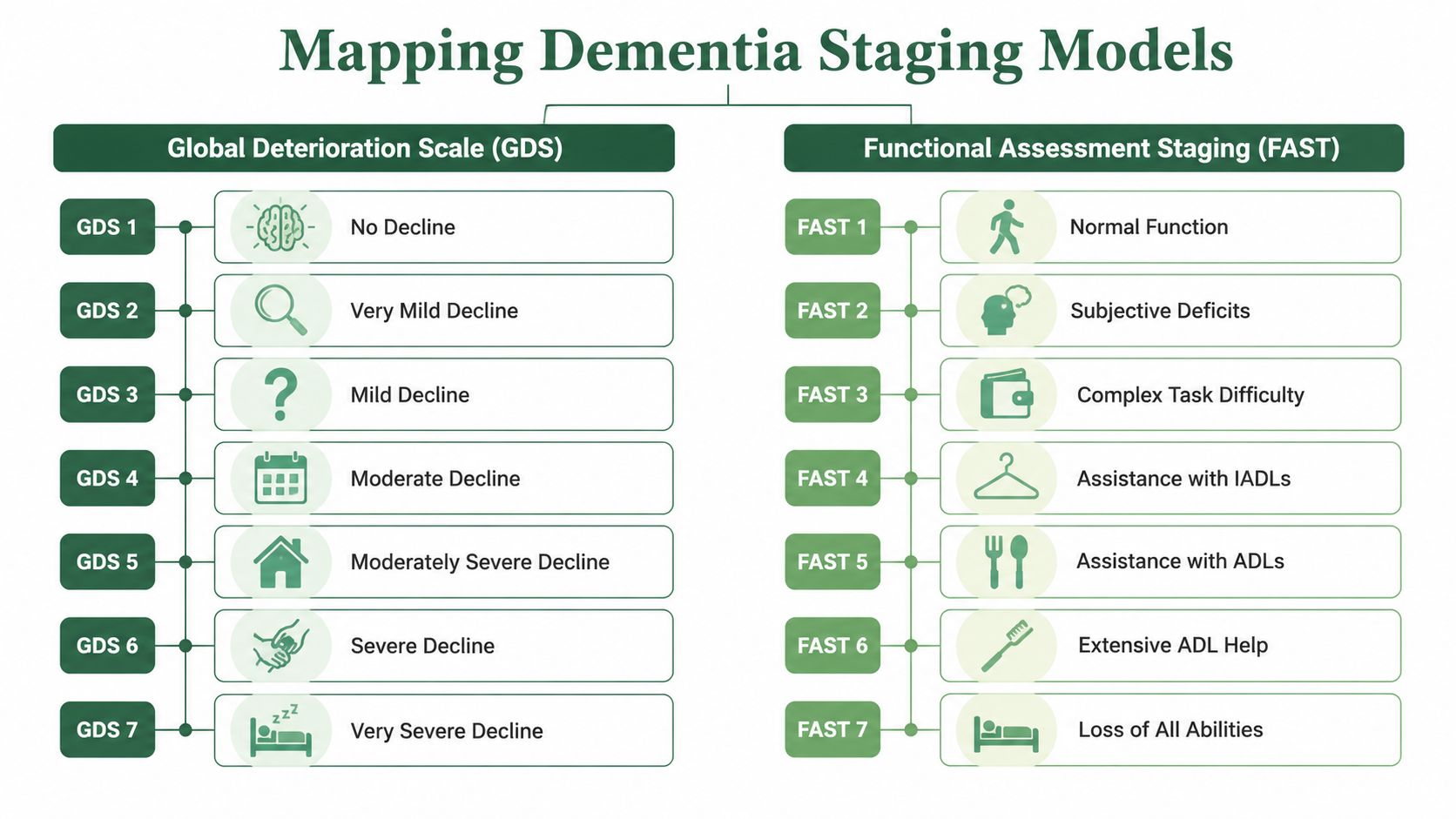
One of the most common tools is the Global Deterioration Scale, often shortened to GDS. It divides the progression of dementia into seven stages with expected durations across the course of decline, as described in this overview of the 7 stages of dementia. The same scale notes that biological changes can begin months or even a year before visible symptoms appear.
Why staging helps families
A stage isn't just a label. It can guide practical choices.
Staging use | What it helps you do |
|---|---|
Communication | Gives family members and clinicians a common way to describe changes |
Care planning | Helps match support to current abilities rather than guesswork |
Safety decisions | Signals when to review driving, finances, medications, and living arrangements |
Expectation setting | Reminds families that decline often affects function, not just memory |
Another framework you may hear about is FAST, the Functional Assessment Staging tool. While GDS focuses on overall cognitive decline, FAST looks more closely at daily function. That means things like dressing, bathing, choosing clothes, and managing routine tasks.
A forecast, not a script
The most helpful way to think about these models is like a weather forecast. If rain is likely, you bring an umbrella. You still don't know the exact minute the storm starts.
That's how dementia staging works. It points to likely needs, but timing varies. One person may stay fairly steady for a period, then decline more noticeably. Another may show gradual change over a longer stretch. Type of dementia, age at onset, other health problems, social support, and environment all shape the path.
Practical rule: Use a stage to prepare, not to predict.
That mindset protects families from two common mistakes. The first is panic after hearing a stage name. The second is denial because the person doesn't fit every textbook example. Both get in the way of good care.
The Early Stage From First Concerns to Mild Decline
Early dementia can be the hardest stage to interpret because the person may still sound like themselves, carry on a conversation, and appear capable in brief social settings. Families often leave a visit thinking, “Maybe it's not that bad,” only to get a call later about a missed appointment, unpaid bill, or confusion over a routine errand.

When memory changes cross a line
Normal aging can include slower recall. A person may forget a name and remember it later. What raises concern is a pattern that starts interfering with daily life.
Examples families often notice include:
Appointments start slipping: not once, but repeatedly, even when they matter.
Word-finding becomes disruptive: the person loses track in conversation or substitutes vague terms for familiar objects.
Complex tasks become shaky: banking, medication schedules, travel planning, or technology that once felt manageable now causes stress.
Avoidance shows up: the person stops doing things that expose the problem.
If a clinician identifies Mild Cognitive Impairment, it's important not to dismiss it as harmless. Research indicates that about 40% of patients with clinically diagnosed MCI progress to Alzheimer's dementia over an average of 18 months, according to this review in the National Library of Medicine. That doesn't mean progression is guaranteed for every person. It does mean this is a meaningful window for assessment and support.
Families looking for practical context may also find this guide to cognitive decline in older adults useful.
Why this stage matters so much
The earliest clinically detectable stage of Alzheimer's dementia on the GDS is Stage 3, Mild Cognitive Decline. It has a mean duration of 1.5 years in otherwise healthy individuals and is marked by reduced ability to manage complex activities of daily living, according to Alzinfo's clinical stages of Alzheimer's overview.
That phrase, “complex daily tasks,” sounds clinical. In real life, it often means this:
balancing a checkbook
keeping track of appointments
following a sequence of steps
organizing paperwork
managing medication refills
adapting when a routine changes
Those are exactly the tasks that support independent living. So even “mild” decline can have serious consequences if no one is watching closely.
A short explanation can help make this stage easier to recognize in everyday life:
Practical supports that help early
This is often the best time to put non-medical supports in place, because the person can still participate in routines and benefit from repeated cues.
Consider supports like these:
Regular check-in calls
A scheduled call can reinforce the day, time, upcoming appointments, and familiar routines.Simple written prompts
A large calendar, medication checklist, or note by the phone can reduce daily friction.Cognitive engagement
Short conversations that involve reminiscence, orientation, naming, and attention tasks can help preserve confidence and structure.Observation without arguing
Keep a running record of changes. Don't rely on memory alone when talking with clinicians.
Early support works best when it protects dignity. People usually respond better to partnership than to correction.
Navigating the Middle Stage Moderate to Moderately Severe Decline
For many families, this is the stage where dementia becomes impossible to explain away. The person may still have good moments, still recognize loved ones, still enjoy favorite foods or familiar music. But day-to-day life now needs more support, and the caregiver's role often expands quickly.
The middle stage of dementia can last between two and ten years, and 68% of caregivers report this stage as the most psychologically taxing due to unpredictable behavioral symptoms, according to OneLife Senior Living's discussion of middle-stage progression. That combination, long duration and emotional strain, is why families need a sustainable plan, not just extra effort.

What stage 4 often looks like at home
In GDS Stage 4, moderate cognitive decline becomes more visible. This is often when a formal diagnosis is made. The person may struggle with recent memory, planning, and tasks that require judgment.
At home, that can look like:
Finances getting risky: bills are unpaid, duplicated, or opened and set aside.
Meals becoming uneven: ingredients are forgotten, steps are skipped, or the stove is left on.
Travel becoming stressful: familiar routes may still be okay, but new environments cause confusion.
Conversations narrowing: the person follows simple topics but gets lost in multi-step discussions.
Many families get stuck here because the person may still insist they're fine. In some ways, they are. They may still dress themselves, enjoy hobbies, and hold onto social manners. But supervision around complex tasks becomes important.
What changes in stage 5
In GDS Stage 5, the person usually needs more direct help with everyday living. Memory gaps widen, and disorientation to time becomes more common. They may know who they are but forget their address, the season, or what clothes fit the weather.
This is often when caregivers notice practical problems like:
Change | What you may see |
|---|---|
Clothing choice | Wearing several layers on a hot day or nightwear in daytime |
Daily sequencing | Starting a task but not finishing it, or repeating the same step |
Orientation | Confusion about date, time, or where they are |
Anxiety | Distress when routines change or when they can't find familiar items |
The emotional side of this stage is easy to underestimate. A person who can sense they're struggling may become embarrassed, suspicious, or irritable. Repetition is common. So is asking for reassurance over and over.
If logic isn't working, the problem usually isn't stubbornness. It's that the brain can't hold and sort the information the way it used to.
Care strategies that work better than correction
Families often wear themselves out trying to reason with symptoms that won't respond to reasoning. A better approach is to reduce demand, simplify communication, and build predictability.
Helpful strategies include:
Use one-step directions: “Let's put on your shoes,” works better than listing the whole morning routine.
Offer limited choices: two shirts are easier than an open closet.
Answer the feeling first: if the person says, “I need to go home,” respond to the emotion before the facts.
Protect routine: consistent timing for meals, calls, bathing, and rest can lower anxiety.
Reduce visual clutter: too many objects, labels, or options can increase confusion.
Here are examples of language that usually lands better:
Instead of “I already told you that”, try “Let me go over it with you.”
Instead of “That never happened”, try “That sounds upsetting.”
Instead of “You can't do that anymore”, try “Let's do it together.”
Middle-stage care also calls for practical safety changes. Families often need to review medication setup, food safety, wandering risk, appliance use, and when the person should no longer be left alone for long periods.
This is also the stage where steady non-medical support can make a noticeable difference. Regular phone-based cognitive care, structured companionship, and recurring orientation can reinforce routine, reduce loneliness, and give families more visibility between in-person visits. That kind of support won't stop dementia, but it can make daily life feel less chaotic for everyone involved.
The Late Stage Providing Comfort in Severe Decline
Late-stage dementia changes the focus of care. Earlier on, families are trying to preserve independence and compensate for losses. In the later stage, the goal becomes comfort, dignity, and calm.
By this point, the person may have severe memory loss, very limited speech, and near-total dependence on others for personal care. Daily care often includes help with eating, repositioning, hygiene, and mobility. The person may sleep more, respond less consistently, or appear withdrawn from the environment.
What families often notice
Changes in the late stage are both cognitive and physical.
Common patterns include:
Speech fades: words may become sparse or disappear.
Mobility declines: walking may require major assistance or may no longer be possible.
Swallowing becomes harder: meals may take longer and require close attention.
Recognition varies: the person may not identify loved ones reliably, even if they still respond to tone or touch.
These changes can feel heartbreaking, but connection doesn't vanish just because conversation does. Many people still respond to comfort, rhythm, music, familiar voices, and gentle presence.
Presence still matters, even when a person can't show it the way they once did.
How to care when words fade
Late-stage care often works best when it is slower, quieter, and more sensory.
Try approaches like these:
Use nonverbal reassurance
Sit at eye level. Approach from the front. Use a calm voice and gentle touch if the person finds touch comforting.Create a peaceful environment
Lower background noise. Keep lighting soft but safe. Avoid rushing through care tasks.Support comfort first
Watch for signs of pain, thirst, pressure discomfort, or fatigue. Agitation may be a sign of physical distress.Use familiar sensory cues
Favorite songs, hand lotion with a familiar scent, a soft blanket, or a meaningful object can provide comfort.Accept a new kind of communication
A facial expression, breath change, hand squeeze, or relaxed posture may tell you more than words.
This is also when many families benefit from palliative care or hospice support. These services focus on quality of life, symptom comfort, family guidance, and help with difficult decisions. Choosing them isn't giving up. It's often a way of making care gentler and more aligned with the person's needs.
Proactive Care and Building Your Support System
Families often wait too long to build support because they think they should be able to manage on their own. That usually works for a while. Then a fall, a wandering incident, a medication mistake, or caregiver exhaustion forces a rushed decision.
A better path is to build the support system early, while there's still time to choose rather than scramble.

Build the team before a crisis
A strong care system usually includes a mix of people, not one heroic caregiver.
That may include:
Primary clinician or specialist: for diagnosis, treatment review, and monitoring changes.
Family point person: one person who tracks appointments, medications, and updates.
Friends or relatives: help with meals, rides, check-ins, or respite.
Formal support services: home care aides, adult day programs, counseling, or structured cognitive support.
Education for caregivers: training matters. Families make calmer decisions when they understand what symptoms mean. This practical guide to dementia care training can help you think through what skills are most useful.
Some families also add regular remote support in the early-to-mid stages. Phone-based cognitive care can be especially helpful when a loved one lives alone, resists technology, or needs more frequent contact than family can realistically provide.
What to organize early
Don't wait for severe decline to handle planning tasks that are much easier during the earlier stages.
Focus on:
Legal planning
Power of attorney, health care directives, and access to key documents should be handled early if possible.Financial safeguards
Simplify accounts, automate what can be automated, and monitor for missed payments or unusual activity.Safety routines
Review medications, food storage, appliance use, driving, and what happens during an emergency.Caregiver protection
Schedule breaks before burnout appears. Regular relief isn't a luxury. It's part of safe care.
The best support plans don't depend on one person remembering everything.
The most sustainable families think in layers. Medical care handles diagnosis and treatment. Daily supports handle routine and safety. Emotional support helps both the person with dementia and the caregiver keep going. When those layers work together, life usually feels more stable even when the disease itself continues to change.
Finding Strength in Understanding A Final Word
Most families begin this journey feeling unprepared. That's normal. Dementia changes the rules of daily life, and it often does so gradually enough to create doubt, then suddenly enough to create fear.
Understanding dementia progression stages won't make the path easy. It does make the path more navigable. You can recognize what kind of help is needed, respond with less confusion, and make decisions sooner instead of in crisis. You can stop measuring your loved one against who they used to be every day and start supporting who they are now.
There is still room for comfort, connection, humor, and tenderness at every stage. The form changes. The need for care deepens. But meaningful moments don't disappear.
If you're caring for someone with memory loss, you don't have to know everything today. You just need the next clear step, and the willingness to stop carrying this alone.
If your loved one is in the early to mid stages of dementia and could benefit from consistent, structured phone support, Velma offers scheduled calls focused on cognitive engagement, companionship, routine reinforcement, and family visibility between visits. It's a practical way to add support without adding more technology or replacing the care you already provide.
You may be here because something small happened that didn't feel small at all.
Your mom missed a bill she'd never forget. Your husband got turned around in a grocery store he's used for years. Your dad told the same story three times at dinner, then laughed it off, but you went home uneasy. These moments often arrive before anyone has a name for what's changing. They can leave families stuck between doubt and worry, wondering whether this is normal aging, stress, or the start of something more serious.
Dementia rarely feels clear at the beginning. It unfolds in pieces. That's why understanding dementia progression stages can help. Stages don't predict every detail of one person's future, but they do give families a practical way to recognize patterns, ask better questions, and prepare for the kind of support that may be needed next. If you're still sorting out basic terms, this guide on Alzheimer's disease vs dementia can help clarify the difference.
Table of Contents
The Unfolding Journey An Introduction to Dementia Stages
Mapping the Path Understanding Dementia Staging Models
Why staging helps families
A forecast, not a script
The Early Stage From First Concerns to Mild Decline
When memory changes cross a line
Why this stage matters so much
Practical supports that help early
Navigating the Middle Stage Moderate to Moderately Severe Decline
What stage 4 often looks like at home
What changes in stage 5
Care strategies that work better than correction
The Late Stage Providing Comfort in Severe Decline
What families often notice
How to care when words fade
Proactive Care and Building Your Support System
Build the team before a crisis
What to organize early
Finding Strength in Understanding A Final Word
The Unfolding Journey An Introduction to Dementia Stages
Families often want one straight answer: What stage is this, and what happens next?
The honest answer is that dementia doesn't move in a neat, identical pattern for everyone. Still, staging gives you something valuable. It gives you a shared language. When a doctor says “mild cognitive decline” or “moderate decline,” that isn't meant to frighten you. It's meant to help everyone around your loved one understand what kinds of changes are happening and what kind of help may be needed.
Think of stages as a roadmap, not a countdown clock. A roadmap doesn't tell you exactly how long each turn will take. It does help you avoid driving blind.
Knowing the stage won't remove the grief. It often removes some of the confusion.
That matters because confusion creates delays. Families wait to bring in help. They argue over whether the person is “really that impaired.” They assume a problem is only memory, when the bigger issue is judgment, planning, or safety.
Understanding dementia progression stages helps you shift from reacting to planning. Instead of asking, “Why is this suddenly happening?” you begin asking better questions. Does she still manage medications safely? Is he anxious when routines change? Does she need reminders, supervision, or hands-on help? Those questions lead to action, and action usually brings relief.
Mapping the Path Understanding Dementia Staging Models
Clinicians use staging models because symptoms can be hard to describe in casual conversation. “She's more forgetful” doesn't tell you enough. “He can no longer manage finances and struggles with recent recall” tells you much more.
One of the most common tools is the Global Deterioration Scale, often shortened to GDS. It divides the progression of dementia into seven stages with expected durations across the course of decline, as described in this overview of the 7 stages of dementia. The same scale notes that biological changes can begin months or even a year before visible symptoms appear.
Why staging helps families
A stage isn't just a label. It can guide practical choices.
Staging use | What it helps you do |
|---|---|
Communication | Gives family members and clinicians a common way to describe changes |
Care planning | Helps match support to current abilities rather than guesswork |
Safety decisions | Signals when to review driving, finances, medications, and living arrangements |
Expectation setting | Reminds families that decline often affects function, not just memory |
Another framework you may hear about is FAST, the Functional Assessment Staging tool. While GDS focuses on overall cognitive decline, FAST looks more closely at daily function. That means things like dressing, bathing, choosing clothes, and managing routine tasks.
A forecast, not a script
The most helpful way to think about these models is like a weather forecast. If rain is likely, you bring an umbrella. You still don't know the exact minute the storm starts.
That's how dementia staging works. It points to likely needs, but timing varies. One person may stay fairly steady for a period, then decline more noticeably. Another may show gradual change over a longer stretch. Type of dementia, age at onset, other health problems, social support, and environment all shape the path.
Practical rule: Use a stage to prepare, not to predict.
That mindset protects families from two common mistakes. The first is panic after hearing a stage name. The second is denial because the person doesn't fit every textbook example. Both get in the way of good care.
The Early Stage From First Concerns to Mild Decline
Early dementia can be the hardest stage to interpret because the person may still sound like themselves, carry on a conversation, and appear capable in brief social settings. Families often leave a visit thinking, “Maybe it's not that bad,” only to get a call later about a missed appointment, unpaid bill, or confusion over a routine errand.
When memory changes cross a line
Normal aging can include slower recall. A person may forget a name and remember it later. What raises concern is a pattern that starts interfering with daily life.
Examples families often notice include:
Appointments start slipping: not once, but repeatedly, even when they matter.
Word-finding becomes disruptive: the person loses track in conversation or substitutes vague terms for familiar objects.
Complex tasks become shaky: banking, medication schedules, travel planning, or technology that once felt manageable now causes stress.
Avoidance shows up: the person stops doing things that expose the problem.
If a clinician identifies Mild Cognitive Impairment, it's important not to dismiss it as harmless. Research indicates that about 40% of patients with clinically diagnosed MCI progress to Alzheimer's dementia over an average of 18 months, according to this review in the National Library of Medicine. That doesn't mean progression is guaranteed for every person. It does mean this is a meaningful window for assessment and support.
Families looking for practical context may also find this guide to cognitive decline in older adults useful.
Why this stage matters so much
The earliest clinically detectable stage of Alzheimer's dementia on the GDS is Stage 3, Mild Cognitive Decline. It has a mean duration of 1.5 years in otherwise healthy individuals and is marked by reduced ability to manage complex activities of daily living, according to Alzinfo's clinical stages of Alzheimer's overview.
That phrase, “complex daily tasks,” sounds clinical. In real life, it often means this:
balancing a checkbook
keeping track of appointments
following a sequence of steps
organizing paperwork
managing medication refills
adapting when a routine changes
Those are exactly the tasks that support independent living. So even “mild” decline can have serious consequences if no one is watching closely.
A short explanation can help make this stage easier to recognize in everyday life:
Practical supports that help early
This is often the best time to put non-medical supports in place, because the person can still participate in routines and benefit from repeated cues.
Consider supports like these:
Regular check-in calls
A scheduled call can reinforce the day, time, upcoming appointments, and familiar routines.Simple written prompts
A large calendar, medication checklist, or note by the phone can reduce daily friction.Cognitive engagement
Short conversations that involve reminiscence, orientation, naming, and attention tasks can help preserve confidence and structure.Observation without arguing
Keep a running record of changes. Don't rely on memory alone when talking with clinicians.
Early support works best when it protects dignity. People usually respond better to partnership than to correction.
Navigating the Middle Stage Moderate to Moderately Severe Decline
For many families, this is the stage where dementia becomes impossible to explain away. The person may still have good moments, still recognize loved ones, still enjoy favorite foods or familiar music. But day-to-day life now needs more support, and the caregiver's role often expands quickly.
The middle stage of dementia can last between two and ten years, and 68% of caregivers report this stage as the most psychologically taxing due to unpredictable behavioral symptoms, according to OneLife Senior Living's discussion of middle-stage progression. That combination, long duration and emotional strain, is why families need a sustainable plan, not just extra effort.
What stage 4 often looks like at home
In GDS Stage 4, moderate cognitive decline becomes more visible. This is often when a formal diagnosis is made. The person may struggle with recent memory, planning, and tasks that require judgment.
At home, that can look like:
Finances getting risky: bills are unpaid, duplicated, or opened and set aside.
Meals becoming uneven: ingredients are forgotten, steps are skipped, or the stove is left on.
Travel becoming stressful: familiar routes may still be okay, but new environments cause confusion.
Conversations narrowing: the person follows simple topics but gets lost in multi-step discussions.
Many families get stuck here because the person may still insist they're fine. In some ways, they are. They may still dress themselves, enjoy hobbies, and hold onto social manners. But supervision around complex tasks becomes important.
What changes in stage 5
In GDS Stage 5, the person usually needs more direct help with everyday living. Memory gaps widen, and disorientation to time becomes more common. They may know who they are but forget their address, the season, or what clothes fit the weather.
This is often when caregivers notice practical problems like:
Change | What you may see |
|---|---|
Clothing choice | Wearing several layers on a hot day or nightwear in daytime |
Daily sequencing | Starting a task but not finishing it, or repeating the same step |
Orientation | Confusion about date, time, or where they are |
Anxiety | Distress when routines change or when they can't find familiar items |
The emotional side of this stage is easy to underestimate. A person who can sense they're struggling may become embarrassed, suspicious, or irritable. Repetition is common. So is asking for reassurance over and over.
If logic isn't working, the problem usually isn't stubbornness. It's that the brain can't hold and sort the information the way it used to.
Care strategies that work better than correction
Families often wear themselves out trying to reason with symptoms that won't respond to reasoning. A better approach is to reduce demand, simplify communication, and build predictability.
Helpful strategies include:
Use one-step directions: “Let's put on your shoes,” works better than listing the whole morning routine.
Offer limited choices: two shirts are easier than an open closet.
Answer the feeling first: if the person says, “I need to go home,” respond to the emotion before the facts.
Protect routine: consistent timing for meals, calls, bathing, and rest can lower anxiety.
Reduce visual clutter: too many objects, labels, or options can increase confusion.
Here are examples of language that usually lands better:
Instead of “I already told you that”, try “Let me go over it with you.”
Instead of “That never happened”, try “That sounds upsetting.”
Instead of “You can't do that anymore”, try “Let's do it together.”
Middle-stage care also calls for practical safety changes. Families often need to review medication setup, food safety, wandering risk, appliance use, and when the person should no longer be left alone for long periods.
This is also the stage where steady non-medical support can make a noticeable difference. Regular phone-based cognitive care, structured companionship, and recurring orientation can reinforce routine, reduce loneliness, and give families more visibility between in-person visits. That kind of support won't stop dementia, but it can make daily life feel less chaotic for everyone involved.
The Late Stage Providing Comfort in Severe Decline
Late-stage dementia changes the focus of care. Earlier on, families are trying to preserve independence and compensate for losses. In the later stage, the goal becomes comfort, dignity, and calm.
By this point, the person may have severe memory loss, very limited speech, and near-total dependence on others for personal care. Daily care often includes help with eating, repositioning, hygiene, and mobility. The person may sleep more, respond less consistently, or appear withdrawn from the environment.
What families often notice
Changes in the late stage are both cognitive and physical.
Common patterns include:
Speech fades: words may become sparse or disappear.
Mobility declines: walking may require major assistance or may no longer be possible.
Swallowing becomes harder: meals may take longer and require close attention.
Recognition varies: the person may not identify loved ones reliably, even if they still respond to tone or touch.
These changes can feel heartbreaking, but connection doesn't vanish just because conversation does. Many people still respond to comfort, rhythm, music, familiar voices, and gentle presence.
Presence still matters, even when a person can't show it the way they once did.
How to care when words fade
Late-stage care often works best when it is slower, quieter, and more sensory.
Try approaches like these:
Use nonverbal reassurance
Sit at eye level. Approach from the front. Use a calm voice and gentle touch if the person finds touch comforting.Create a peaceful environment
Lower background noise. Keep lighting soft but safe. Avoid rushing through care tasks.Support comfort first
Watch for signs of pain, thirst, pressure discomfort, or fatigue. Agitation may be a sign of physical distress.Use familiar sensory cues
Favorite songs, hand lotion with a familiar scent, a soft blanket, or a meaningful object can provide comfort.Accept a new kind of communication
A facial expression, breath change, hand squeeze, or relaxed posture may tell you more than words.
This is also when many families benefit from palliative care or hospice support. These services focus on quality of life, symptom comfort, family guidance, and help with difficult decisions. Choosing them isn't giving up. It's often a way of making care gentler and more aligned with the person's needs.
Proactive Care and Building Your Support System
Families often wait too long to build support because they think they should be able to manage on their own. That usually works for a while. Then a fall, a wandering incident, a medication mistake, or caregiver exhaustion forces a rushed decision.
A better path is to build the support system early, while there's still time to choose rather than scramble.
Build the team before a crisis
A strong care system usually includes a mix of people, not one heroic caregiver.
That may include:
Primary clinician or specialist: for diagnosis, treatment review, and monitoring changes.
Family point person: one person who tracks appointments, medications, and updates.
Friends or relatives: help with meals, rides, check-ins, or respite.
Formal support services: home care aides, adult day programs, counseling, or structured cognitive support.
Education for caregivers: training matters. Families make calmer decisions when they understand what symptoms mean. This practical guide to dementia care training can help you think through what skills are most useful.
Some families also add regular remote support in the early-to-mid stages. Phone-based cognitive care can be especially helpful when a loved one lives alone, resists technology, or needs more frequent contact than family can realistically provide.
What to organize early
Don't wait for severe decline to handle planning tasks that are much easier during the earlier stages.
Focus on:
Legal planning
Power of attorney, health care directives, and access to key documents should be handled early if possible.Financial safeguards
Simplify accounts, automate what can be automated, and monitor for missed payments or unusual activity.Safety routines
Review medications, food storage, appliance use, driving, and what happens during an emergency.Caregiver protection
Schedule breaks before burnout appears. Regular relief isn't a luxury. It's part of safe care.
The best support plans don't depend on one person remembering everything.
The most sustainable families think in layers. Medical care handles diagnosis and treatment. Daily supports handle routine and safety. Emotional support helps both the person with dementia and the caregiver keep going. When those layers work together, life usually feels more stable even when the disease itself continues to change.
Finding Strength in Understanding A Final Word
Most families begin this journey feeling unprepared. That's normal. Dementia changes the rules of daily life, and it often does so gradually enough to create doubt, then suddenly enough to create fear.
Understanding dementia progression stages won't make the path easy. It does make the path more navigable. You can recognize what kind of help is needed, respond with less confusion, and make decisions sooner instead of in crisis. You can stop measuring your loved one against who they used to be every day and start supporting who they are now.
There is still room for comfort, connection, humor, and tenderness at every stage. The form changes. The need for care deepens. But meaningful moments don't disappear.
If you're caring for someone with memory loss, you don't have to know everything today. You just need the next clear step, and the willingness to stop carrying this alone.
If your loved one is in the early to mid stages of dementia and could benefit from consistent, structured phone support, Velma offers scheduled calls focused on cognitive engagement, companionship, routine reinforcement, and family visibility between visits. It's a practical way to add support without adding more technology or replacing the care you already provide.
Suggested Article: