Club Sandwich Generation: A Guide to the New Caregiving

Multigenerational households in the U.S. rose from approximately 1% of the population in 1971 to 4% in 2021, a major shift in how families live and care for one another, according to Care.com's overview of the club sandwich generation. That number matters because it helps explain why so many adults feel like they're carrying a whole family system on their backs.
You might be helping your mother remember her medications, sending money to an adult son who's still paying off loans, and picking up your granddaughter from school when childcare falls through. By the end of the day, you haven't had a quiet hour to think, much less rest. If that sounds familiar, there's a name for this layered role: the Club Sandwich Generation. See Bigmike for more on this.
Families are changing fast. Longer lives, rising costs, and more shared households mean many caregivers aren't just squeezed between two generations anymore. They're supporting three or more. If you've felt that your situation is too complicated for the usual caregiving advice, you're probably right. The older model doesn't fully capture what life looks like now, especially as more families brace for the broader aging wave described in this look at the Silver Tsunami.
Table of Contents
An Introduction to Multigenerational Caregiving
The day rarely breaks into clean parts
Naming the experience matters
What Is the Club Sandwich Generation
A simple way to picture it
Why this family structure is becoming more common
The Compounded Burdens on Caregivers
Financial pressure from every direction
Emotional strain that can become a health crisis
Time poverty and the body's response
Why Women Bear a Disproportionate Weight
The load is not distributed evenly
What this looks like in real life
Actionable Strategies for Managing the Overload
Coordinate care as a team
Set and defend boundaries
Build low-tech backup systems
Prepare legal and financial documents
Finding Support for Parents with Cognitive Decline
What caregivers are really managing
Why phone-based support can fit real life
You Are Not Alone in This Journey
An Introduction to Multigenerational Caregiving
A lot of caregivers describe the same feeling in different words: “Everyone needs something from me, and all of it matters.”
That's the heart of multigenerational caregiving. It isn't just helping an older parent now and then. It's managing overlapping needs that don't stay in neat boxes. Your father may need help with bills and memory loss. Your daughter may need temporary housing after a divorce. Your grandchild may need school pickup, dinner, and help with homework. None of these needs cancel out the others.
The day rarely breaks into clean parts
Morning might begin with a call to confirm a parent made it to a medical appointment. Midday could bring a text from an adult child asking for help with rent. Evening may mean checking whether your grandchild has what they need for tomorrow. In between, you're still expected to work, shop, pay your own bills, and maintain your own health.
That's why many caregivers feel confused when standard advice tells them to “ask for help” or “practice self-care” without explaining how. When you're carrying care up and down the family tree, even simple tasks become layered. One ride to the pharmacy may also involve a school pickup, a grocery stop, and a conversation about a parent's worsening confusion.
Caring for multiple generations at once doesn't mean you're bad at time management. It often means the demands exceed what one person can reasonably hold.
Naming the experience matters
The term Club Sandwich Generation gives language to a caregiving pattern that many people already know firsthand. That matters more than it may seem. When a role has a name, people stop thinking, “Why can't I handle this better?” and start asking, “What support fits this kind of life?”
For many readers, that shift brings relief. Your stress isn't a personal failure. It's a response to a caregiving structure that has become more complex, more expensive, and more emotionally demanding than many families were ever prepared for.
What Is the Club Sandwich Generation
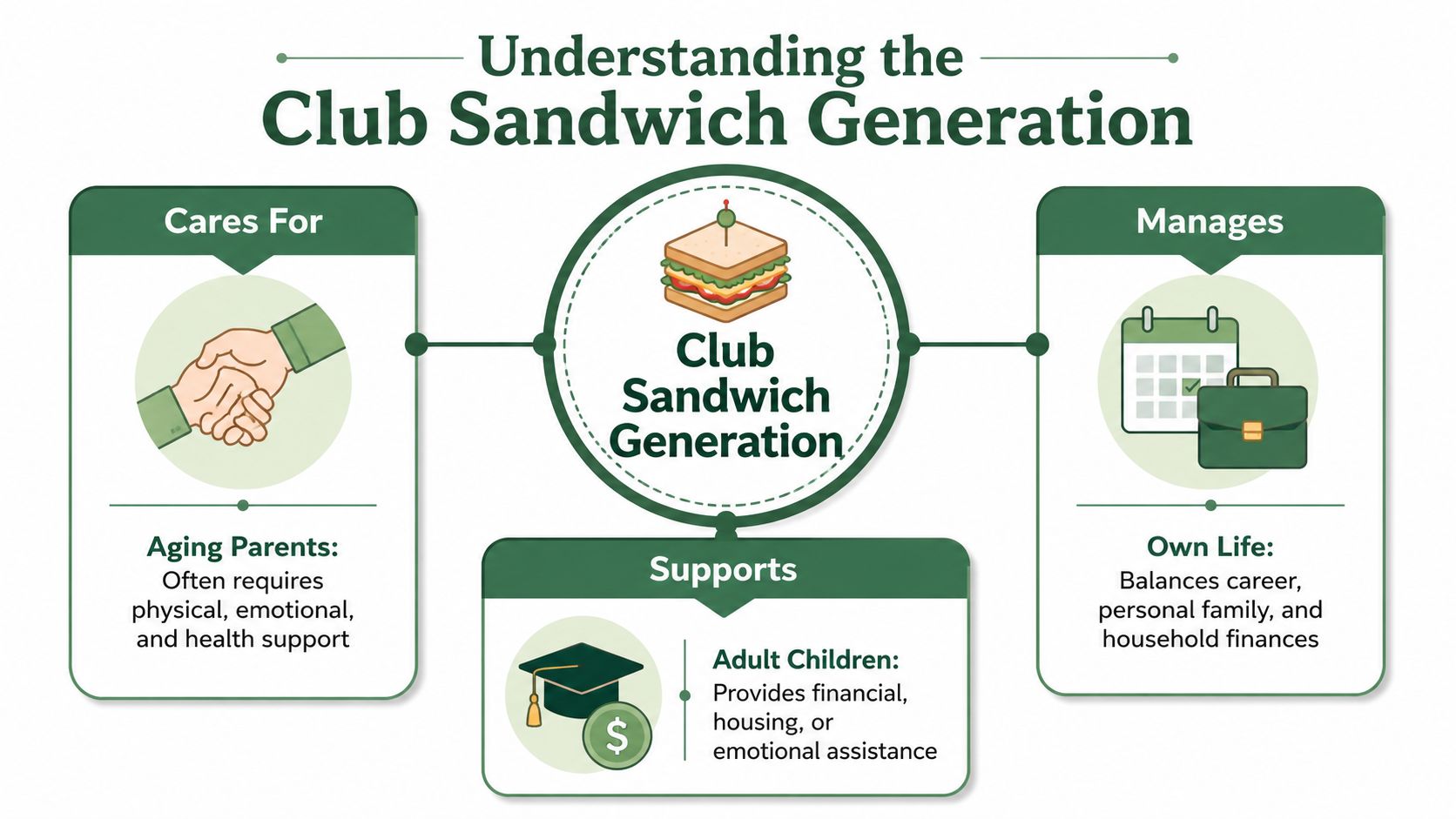
The Club Sandwich Generation describes adults, often in their 50s and 60s, who are caring for three or more generations at once. That can include an aging parent, an adult child, and a grandchild, all needing different kinds of help at the same time.
The name fits because the responsibilities come in layers. A traditional “sandwich generation” caregiver is usually supporting one older generation and one younger generation. A club sandwich adds another layer, and with it, another set of needs, schedules, emotions, and costs.
A simple way to picture it
Here's a plain-language comparison:
Family role | Traditional sandwich generation | Club sandwich generation |
|---|---|---|
Older generation | Aging parent | Aging parent, often with increasing health needs |
Younger generation | Child under your care | Adult child, grandchild, or both |
Your role | Parent and caregiver | Parent, caregiver, financial backstop, scheduler, crisis manager |
In daily life, this often looks less like one big caregiving job and more like several part-time jobs piled onto one person. You might be helping your mother manage memory loss, letting your adult son and his child stay in your home while he rebuilds financially, and still trying to protect your own income, sleep, and retirement savings.
That stack of responsibilities has real consequences. Many caregivers begin to see signs of caregiver stress and burnout long before they realize their family role has a name.
Why this family structure is becoming more common
This pattern is showing up more often because families are under pressure at both ends. Younger adults may need longer financial support because housing, childcare, and debt can delay independence. Simultaneously, older parents may need to move in or rely more heavily on family because care needs rise as health declines, especially when memory problems or confusion make living alone less safe.
There is also a cultural piece. Many families already have a long habit of sharing care across generations. What has changed is the intensity of that help. A grandparent who once offered occasional babysitting may now need medication supervision, transportation, and help with bills, while an adult child may need housing or childcare backup at the same time.
Practical rule: If you are providing regular help both upward and downward in your family, you are doing more than “pitching in.” You are holding together a multigenerational care system.
The word support can also be misleading. It does not only mean hands-on personal care or paying every bill. Support may include driving to appointments, managing calendars, checking for signs of cognitive decline, providing temporary housing, covering school pickup, translating medical instructions, or staying available for the next crisis. Each task may seem small by itself. Together, they can shape your entire day, budget, and emotional bandwidth.
The Compounded Burdens on Caregivers
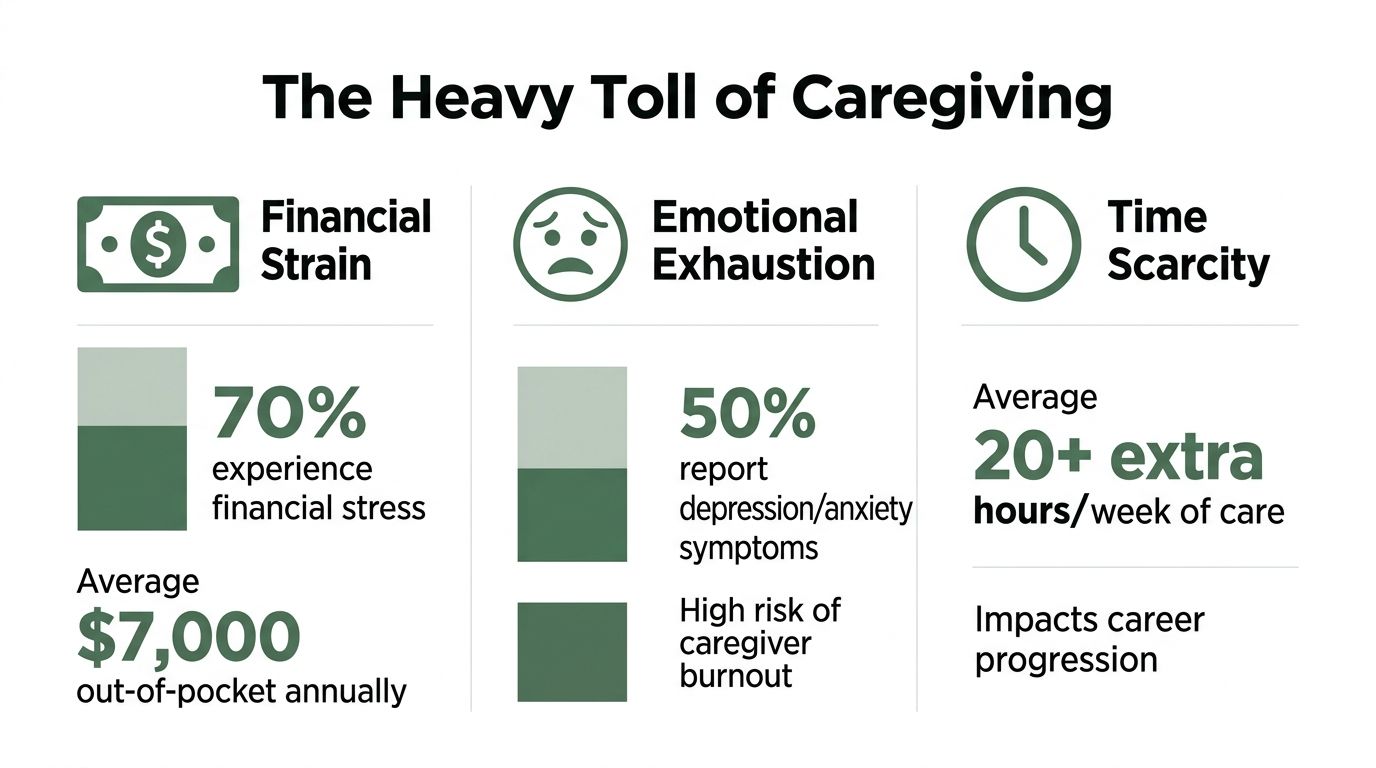
The hard part of being in the Club Sandwich Generation isn't only the number of people involved. It's the way the burdens interact. Financial stress increases emotional strain. Emotional strain reduces concentration. Reduced concentration makes scheduling, work, and medical coordination harder. The pressure loops.
Research reviewed in this NIH-hosted article on club sandwich caregivers found that club sandwich caregivers report higher role overload, financial strain, and emotional distress than traditional sandwich caregivers. The problem isn't imagined. It's documented.
Financial pressure from every direction
Money stress in these families usually doesn't arrive as one dramatic bill. It arrives as a chain of smaller demands that never fully stops. Groceries rise because more people are in the house. Transportation costs increase. Someone needs help with prescriptions. Someone else needs help with school supplies, rent, or childcare coverage.
What makes this especially difficult is that the caregiver often becomes the shock absorber for the whole family. When an older parent can't safely manage alone, the caregiver steps in. When an adult child can't make the numbers work, the caregiver fills the gap. When a grandchild needs supervision, the caregiver rearranges work and personal time.
Emotional strain that can become a health crisis
Many caregivers think their biggest problem is time. Often, it's unprocessed distress.
The NIH-hosted research found that 85% of club sandwich caregivers reported adverse mental health symptoms during the COVID-19 pandemic, and 52% reported suicidal ideation within the prior 30 days. The same analysis notes that this was eight times higher than individuals who were neither parents nor caregivers. Those are alarming findings, and they should change how we talk about caregiving. This isn't just “stress.” For some people, it becomes a mental health emergency.
If any part of your caregiving experience has started to feel unsafe, please treat that as a serious health issue, not a character flaw. Many caregivers need support around burnout, depression, and overload. Resources that explain caregiver stress and burnout in practical terms can help you recognize warning signs earlier.
If your thoughts have shifted from “I'm overwhelmed” to “I can't do this anymore,” reach out to a mental health professional, crisis support, or a trusted person right away.
Time poverty and the body's response
There's another layer many families miss. Caregiving doesn't only use time. It changes the body.
The same NIH-hosted analysis found that 24.3% of adult child caregivers, representing 2.5 million individuals, also care for a minor child, placing them in the club sandwich cohort. It also found that caregivers who spend more than 20 hours per week on family care show faster mental and physical health declines that can persist for years.
Here's a simple way to think about the burden:
Financial load: You're paying, subsidizing, or absorbing costs across generations.
Emotional load: You're carrying worry, guilt, grief, vigilance, and family tension.
Time load: You're switching roles all day, often without recovery time.
When people say, “I don't know why I'm so exhausted,” this is often why. Their body isn't reacting to one job. It's reacting to constant role-switching with no true off-duty period.
Why Women Bear a Disproportionate Weight
Caregiving doesn't land evenly inside families. In many homes, women become the default coordinators long before anyone openly assigns them the role.
According to ASC Care's summary of sandwich generation caregiving, 23% of U.S. adults fall into this dual-caregiving category as defined by Pew Research in 2021. Among adults in their 40s, 54% have a living parent over 65 alongside a child under 18. Within that larger picture, women carry more of the daily load.
The load is not distributed evenly
The same source reports that 60% of sandwich caregivers are women, and women spend an average of 45 minutes more per day on caregiving tasks than men. That extra time matters because caregiving rarely sits in one tidy block. It's often broken into interruptions. A call during work. A pharmacy run after dinner. A late-night text from a worried parent.
Women are also more likely to absorb invisible work. They remember appointments, track medications, refill forms, manage sibling communication, notice changes in behavior, and smooth family conflict. Even when men help, women often remain the project managers of the family's care system.
What this looks like in real life
The professional cost is steep. The same source found that 64% of sandwich moms use sick time or paid time off for caregiving, 58% decline educational opportunities, and 51% have left a job at least partially because of caregiving responsibilities.
That pattern doesn't happen because women are naturally better at caregiving. It happens because families and workplaces still tend to assume that women will flex first. They'll leave early. They'll handle school calls. They'll notice that grandma is repeating herself more often. They'll be the one who remembers everyone's needs.
When a family says, “She's just better at this stuff,” it often means, “She's carrying more than we are.”
This isn't about blaming men or shaming families. It's about being honest. If a household never names the imbalance, the same person keeps doing more because it feels easier in the moment. Over time, “easier” becomes unsustainable.
For female caregivers, naming that pattern can be a turning point. For partners, brothers, and adult sons, seeing it clearly is the first step toward sharing it.
Actionable Strategies for Managing the Overload
When caregiving becomes multilayered, vague advice doesn't help. You need systems. Not perfect systems. Working systems that reduce daily friction, protect your energy, and make care less dependent on your memory alone.

Coordinate care as a team
If one person knows everything, that person becomes the single point of failure.
Start with a simple family care meeting. It can happen at the kitchen table, by phone, or on Zoom. The goal isn't to solve every conflict. The goal is to assign real jobs.
Use a shared list with names next to tasks. Try categories like these:
Medical tasks: One person handles appointment scheduling, another keeps a current medication list.
Child support tasks: One adult manages school pickups or backup childcare days.
Household tasks: Someone else takes groceries, bill sorting, or laundry support.
Don't ask, “Can anyone help more?” Ask, “Who can own Tuesday transportation?” Specific asks get clearer answers.
Set and defend boundaries
Many caregivers wait until resentment builds before they set limits. It works better to set them earlier and repeat them calmly.
A boundary can sound like this:
“I can take Mom to one appointment a week. I can't be available for same-day schedule changes unless it's an emergency.”
Or this:
“You can stay here for now, but we need a plan for bills, childcare, and household responsibilities.”
Boundaries aren't punishments. They're operating instructions. They tell other people what support is realistic, and they protect you from becoming the unlimited backup plan.
Build low-tech backup systems
High-tech tools are useful, but many caregiving homes run better with simple, visible systems.
Try a few low-tech supports:
A paper command center: Use a wall calendar, a binder, and a folder for active documents.
A medication notebook: Write down what changed, when it changed, and who noticed.
A contact sheet by the phone: Include doctors, neighbors, pharmacy, school, and emergency contacts.
A routine card: Keep a short written schedule for meals, medications, and key reminders.
These tools help when people are tired, when siblings step in, or when an older parent gets confused. They also reduce the “I forgot what I was supposed to do next” feeling that makes caregiving harder.
Prepare legal and financial documents
This step is easy to postpone and hard to skip forever.
If you're helping an older parent with cognitive changes, gather and review core documents early. Families often need guidance from an elder law attorney, financial planner, or both. The exact paperwork varies by situation, but the conversation usually includes decision-making authority, healthcare preferences, bill management, and future care planning.
A practical checklist helps:
List what already exists. Wills, insurance information, healthcare documents, account lists.
Identify the missing pieces. Families often discover no one knows where key paperwork is.
Store copies in one place. Paper and digital both work if the right people can access them.
Review after major changes. A new diagnosis, hospitalization, move, or death in the family often changes the plan.
The point isn't to control everything. It's to reduce chaos when the next decision arrives.
Finding Support for Parents with Cognitive Decline
Caring for an older parent with memory loss adds a very specific kind of strain to Club Sandwich Generation caregiving. Physical tasks matter, but the emotional vigilance often weighs more. You may spend the day wondering whether your parent ate lunch, took medications, got confused about the stove, or felt lonely enough to spiral into fear.
That kind of care is hard because cognitive decline changes from day to day. A parent may sound completely fine one afternoon and bewildered the next. Families trying to understand these changes often benefit from learning more about cognitive decline in older adults, especially when they're deciding how much structure and supervision is needed.
What caregivers are really managing
When a parent has early to mid-stage dementia, caregivers often juggle several needs at once:
Orientation support: Repeating the day, date, plan, or next appointment.
Emotional reassurance: Calming anxiety, suspicion, or repetitive worries.
Safety monitoring: Watching for missed medications, fall concerns, or household hazards.
Social connection: Preventing long stretches of isolation that can worsen confusion and distress.

These tasks are demanding because they don't stay solved. You may answer the same question many times. You may hear the same fear every evening. You may need to monitor mood and memory while also handling your own children's needs and your work schedule.
Why phone-based support can fit real life
For some families, low-barrier support works better than one more app, portal, or device. Phone-based cognitive support can fit daily life because older adults often find regular phone calls familiar and manageable.
This kind of support can offer structured conversation, routine check-ins, orientation cues, cognitive stimulation, and notes about patterns that matter to family caregivers. That doesn't replace medical care or in-person help. It complements them. The biggest benefit is often practical peace of mind. A caregiver doesn't have to wonder quite as much what kind of day their parent is having.
Consistent contact can help an older adult feel less alone, while giving family members clearer visibility between visits.
That combination matters in multigenerational homes. When your attention is already split across children, work, and elder care, support that doesn't require a complicated setup can be especially valuable.
You Are Not Alone in This Journey
The Club Sandwich Generation describes a real caregiving reality. One person is often holding three layers at once: an older parent who may be losing memory or judgment, children or young adults who still need practical and emotional support, and the daily demands of work, bills, and home. That stack of responsibilities can feel like carrying three conversations, three calendars, and three kinds of worry in the same body.
If this is your life, your exhaustion is not a personal failure. It is a reasonable response to an unusually heavy load.
Many caregivers get told to “find balance,” as if the problem is poor time management. In practice, the strain is usually bigger than that. You may be paying for groceries for one generation, transportation for another, and missed work hours for yourself. You may be making school decisions in the afternoon and dementia-related safety decisions at night. Love is part of this role. Pressure is part of it too.
Relief usually comes from small systems that reduce decision-making and spread responsibility. A written plan on the fridge. A shared notebook by the phone. One sibling handling insurance calls. One adult child taking the Saturday check-in. A standing meal rotation. A list of what must happen today, what can wait, and what belongs to someone else.
Low-tech support can matter more than people expect. Families do not always need another app or login. They often need reliable contact, clear routines, and a way to know how an older parent is doing between visits, especially when cognitive decline makes each day less predictable.
Asking for help shows judgment, not weakness. Care is safer and more sustainable when it is visible, shared, and supported.
If you're supporting an older parent with memory loss while balancing the pressures of multigenerational caregiving, Hey Velma offers a phone-based cognitive support program designed for older adults in the early to mid stages of dementia. Through scheduled calls, cognitive exercises, companionship, and practical check-ins, Hey Velma can help families create more consistency, more visibility, and a little more breathing room in a very full season of life.
Multigenerational households in the U.S. rose from approximately 1% of the population in 1971 to 4% in 2021, a major shift in how families live and care for one another, according to Care.com's overview of the club sandwich generation. That number matters because it helps explain why so many adults feel like they're carrying a whole family system on their backs.
You might be helping your mother remember her medications, sending money to an adult son who's still paying off loans, and picking up your granddaughter from school when childcare falls through. By the end of the day, you haven't had a quiet hour to think, much less rest. If that sounds familiar, there's a name for this layered role: the Club Sandwich Generation. See Bigmike for more on this.
Families are changing fast. Longer lives, rising costs, and more shared households mean many caregivers aren't just squeezed between two generations anymore. They're supporting three or more. If you've felt that your situation is too complicated for the usual caregiving advice, you're probably right. The older model doesn't fully capture what life looks like now, especially as more families brace for the broader aging wave described in this look at the Silver Tsunami.
Table of Contents
An Introduction to Multigenerational Caregiving
The day rarely breaks into clean parts
Naming the experience matters
What Is the Club Sandwich Generation
A simple way to picture it
Why this family structure is becoming more common
The Compounded Burdens on Caregivers
Financial pressure from every direction
Emotional strain that can become a health crisis
Time poverty and the body's response
Why Women Bear a Disproportionate Weight
The load is not distributed evenly
What this looks like in real life
Actionable Strategies for Managing the Overload
Coordinate care as a team
Set and defend boundaries
Build low-tech backup systems
Prepare legal and financial documents
Finding Support for Parents with Cognitive Decline
What caregivers are really managing
Why phone-based support can fit real life
You Are Not Alone in This Journey
An Introduction to Multigenerational Caregiving
A lot of caregivers describe the same feeling in different words: “Everyone needs something from me, and all of it matters.”
That's the heart of multigenerational caregiving. It isn't just helping an older parent now and then. It's managing overlapping needs that don't stay in neat boxes. Your father may need help with bills and memory loss. Your daughter may need temporary housing after a divorce. Your grandchild may need school pickup, dinner, and help with homework. None of these needs cancel out the others.
The day rarely breaks into clean parts
Morning might begin with a call to confirm a parent made it to a medical appointment. Midday could bring a text from an adult child asking for help with rent. Evening may mean checking whether your grandchild has what they need for tomorrow. In between, you're still expected to work, shop, pay your own bills, and maintain your own health.
That's why many caregivers feel confused when standard advice tells them to “ask for help” or “practice self-care” without explaining how. When you're carrying care up and down the family tree, even simple tasks become layered. One ride to the pharmacy may also involve a school pickup, a grocery stop, and a conversation about a parent's worsening confusion.
Caring for multiple generations at once doesn't mean you're bad at time management. It often means the demands exceed what one person can reasonably hold.
Naming the experience matters
The term Club Sandwich Generation gives language to a caregiving pattern that many people already know firsthand. That matters more than it may seem. When a role has a name, people stop thinking, “Why can't I handle this better?” and start asking, “What support fits this kind of life?”
For many readers, that shift brings relief. Your stress isn't a personal failure. It's a response to a caregiving structure that has become more complex, more expensive, and more emotionally demanding than many families were ever prepared for.
What Is the Club Sandwich Generation
The Club Sandwich Generation describes adults, often in their 50s and 60s, who are caring for three or more generations at once. That can include an aging parent, an adult child, and a grandchild, all needing different kinds of help at the same time.
The name fits because the responsibilities come in layers. A traditional “sandwich generation” caregiver is usually supporting one older generation and one younger generation. A club sandwich adds another layer, and with it, another set of needs, schedules, emotions, and costs.
A simple way to picture it
Here's a plain-language comparison:
Family role | Traditional sandwich generation | Club sandwich generation |
|---|---|---|
Older generation | Aging parent | Aging parent, often with increasing health needs |
Younger generation | Child under your care | Adult child, grandchild, or both |
Your role | Parent and caregiver | Parent, caregiver, financial backstop, scheduler, crisis manager |
In daily life, this often looks less like one big caregiving job and more like several part-time jobs piled onto one person. You might be helping your mother manage memory loss, letting your adult son and his child stay in your home while he rebuilds financially, and still trying to protect your own income, sleep, and retirement savings.
That stack of responsibilities has real consequences. Many caregivers begin to see signs of caregiver stress and burnout long before they realize their family role has a name.
Why this family structure is becoming more common
This pattern is showing up more often because families are under pressure at both ends. Younger adults may need longer financial support because housing, childcare, and debt can delay independence. Simultaneously, older parents may need to move in or rely more heavily on family because care needs rise as health declines, especially when memory problems or confusion make living alone less safe.
There is also a cultural piece. Many families already have a long habit of sharing care across generations. What has changed is the intensity of that help. A grandparent who once offered occasional babysitting may now need medication supervision, transportation, and help with bills, while an adult child may need housing or childcare backup at the same time.
Practical rule: If you are providing regular help both upward and downward in your family, you are doing more than “pitching in.” You are holding together a multigenerational care system.
The word support can also be misleading. It does not only mean hands-on personal care or paying every bill. Support may include driving to appointments, managing calendars, checking for signs of cognitive decline, providing temporary housing, covering school pickup, translating medical instructions, or staying available for the next crisis. Each task may seem small by itself. Together, they can shape your entire day, budget, and emotional bandwidth.
The Compounded Burdens on Caregivers
The hard part of being in the Club Sandwich Generation isn't only the number of people involved. It's the way the burdens interact. Financial stress increases emotional strain. Emotional strain reduces concentration. Reduced concentration makes scheduling, work, and medical coordination harder. The pressure loops.
Research reviewed in this NIH-hosted article on club sandwich caregivers found that club sandwich caregivers report higher role overload, financial strain, and emotional distress than traditional sandwich caregivers. The problem isn't imagined. It's documented.
Financial pressure from every direction
Money stress in these families usually doesn't arrive as one dramatic bill. It arrives as a chain of smaller demands that never fully stops. Groceries rise because more people are in the house. Transportation costs increase. Someone needs help with prescriptions. Someone else needs help with school supplies, rent, or childcare coverage.
What makes this especially difficult is that the caregiver often becomes the shock absorber for the whole family. When an older parent can't safely manage alone, the caregiver steps in. When an adult child can't make the numbers work, the caregiver fills the gap. When a grandchild needs supervision, the caregiver rearranges work and personal time.
Emotional strain that can become a health crisis
Many caregivers think their biggest problem is time. Often, it's unprocessed distress.
The NIH-hosted research found that 85% of club sandwich caregivers reported adverse mental health symptoms during the COVID-19 pandemic, and 52% reported suicidal ideation within the prior 30 days. The same analysis notes that this was eight times higher than individuals who were neither parents nor caregivers. Those are alarming findings, and they should change how we talk about caregiving. This isn't just “stress.” For some people, it becomes a mental health emergency.
If any part of your caregiving experience has started to feel unsafe, please treat that as a serious health issue, not a character flaw. Many caregivers need support around burnout, depression, and overload. Resources that explain caregiver stress and burnout in practical terms can help you recognize warning signs earlier.
If your thoughts have shifted from “I'm overwhelmed” to “I can't do this anymore,” reach out to a mental health professional, crisis support, or a trusted person right away.
Time poverty and the body's response
There's another layer many families miss. Caregiving doesn't only use time. It changes the body.
The same NIH-hosted analysis found that 24.3% of adult child caregivers, representing 2.5 million individuals, also care for a minor child, placing them in the club sandwich cohort. It also found that caregivers who spend more than 20 hours per week on family care show faster mental and physical health declines that can persist for years.
Here's a simple way to think about the burden:
Financial load: You're paying, subsidizing, or absorbing costs across generations.
Emotional load: You're carrying worry, guilt, grief, vigilance, and family tension.
Time load: You're switching roles all day, often without recovery time.
When people say, “I don't know why I'm so exhausted,” this is often why. Their body isn't reacting to one job. It's reacting to constant role-switching with no true off-duty period.
Why Women Bear a Disproportionate Weight
Caregiving doesn't land evenly inside families. In many homes, women become the default coordinators long before anyone openly assigns them the role.
According to ASC Care's summary of sandwich generation caregiving, 23% of U.S. adults fall into this dual-caregiving category as defined by Pew Research in 2021. Among adults in their 40s, 54% have a living parent over 65 alongside a child under 18. Within that larger picture, women carry more of the daily load.
The load is not distributed evenly
The same source reports that 60% of sandwich caregivers are women, and women spend an average of 45 minutes more per day on caregiving tasks than men. That extra time matters because caregiving rarely sits in one tidy block. It's often broken into interruptions. A call during work. A pharmacy run after dinner. A late-night text from a worried parent.
Women are also more likely to absorb invisible work. They remember appointments, track medications, refill forms, manage sibling communication, notice changes in behavior, and smooth family conflict. Even when men help, women often remain the project managers of the family's care system.
What this looks like in real life
The professional cost is steep. The same source found that 64% of sandwich moms use sick time or paid time off for caregiving, 58% decline educational opportunities, and 51% have left a job at least partially because of caregiving responsibilities.
That pattern doesn't happen because women are naturally better at caregiving. It happens because families and workplaces still tend to assume that women will flex first. They'll leave early. They'll handle school calls. They'll notice that grandma is repeating herself more often. They'll be the one who remembers everyone's needs.
When a family says, “She's just better at this stuff,” it often means, “She's carrying more than we are.”
This isn't about blaming men or shaming families. It's about being honest. If a household never names the imbalance, the same person keeps doing more because it feels easier in the moment. Over time, “easier” becomes unsustainable.
For female caregivers, naming that pattern can be a turning point. For partners, brothers, and adult sons, seeing it clearly is the first step toward sharing it.
Actionable Strategies for Managing the Overload
When caregiving becomes multilayered, vague advice doesn't help. You need systems. Not perfect systems. Working systems that reduce daily friction, protect your energy, and make care less dependent on your memory alone.
Coordinate care as a team
If one person knows everything, that person becomes the single point of failure.
Start with a simple family care meeting. It can happen at the kitchen table, by phone, or on Zoom. The goal isn't to solve every conflict. The goal is to assign real jobs.
Use a shared list with names next to tasks. Try categories like these:
Medical tasks: One person handles appointment scheduling, another keeps a current medication list.
Child support tasks: One adult manages school pickups or backup childcare days.
Household tasks: Someone else takes groceries, bill sorting, or laundry support.
Don't ask, “Can anyone help more?” Ask, “Who can own Tuesday transportation?” Specific asks get clearer answers.
Set and defend boundaries
Many caregivers wait until resentment builds before they set limits. It works better to set them earlier and repeat them calmly.
A boundary can sound like this:
“I can take Mom to one appointment a week. I can't be available for same-day schedule changes unless it's an emergency.”
Or this:
“You can stay here for now, but we need a plan for bills, childcare, and household responsibilities.”
Boundaries aren't punishments. They're operating instructions. They tell other people what support is realistic, and they protect you from becoming the unlimited backup plan.
Build low-tech backup systems
High-tech tools are useful, but many caregiving homes run better with simple, visible systems.
Try a few low-tech supports:
A paper command center: Use a wall calendar, a binder, and a folder for active documents.
A medication notebook: Write down what changed, when it changed, and who noticed.
A contact sheet by the phone: Include doctors, neighbors, pharmacy, school, and emergency contacts.
A routine card: Keep a short written schedule for meals, medications, and key reminders.
These tools help when people are tired, when siblings step in, or when an older parent gets confused. They also reduce the “I forgot what I was supposed to do next” feeling that makes caregiving harder.
Prepare legal and financial documents
This step is easy to postpone and hard to skip forever.
If you're helping an older parent with cognitive changes, gather and review core documents early. Families often need guidance from an elder law attorney, financial planner, or both. The exact paperwork varies by situation, but the conversation usually includes decision-making authority, healthcare preferences, bill management, and future care planning.
A practical checklist helps:
List what already exists. Wills, insurance information, healthcare documents, account lists.
Identify the missing pieces. Families often discover no one knows where key paperwork is.
Store copies in one place. Paper and digital both work if the right people can access them.
Review after major changes. A new diagnosis, hospitalization, move, or death in the family often changes the plan.
The point isn't to control everything. It's to reduce chaos when the next decision arrives.
Finding Support for Parents with Cognitive Decline
Caring for an older parent with memory loss adds a very specific kind of strain to Club Sandwich Generation caregiving. Physical tasks matter, but the emotional vigilance often weighs more. You may spend the day wondering whether your parent ate lunch, took medications, got confused about the stove, or felt lonely enough to spiral into fear.
That kind of care is hard because cognitive decline changes from day to day. A parent may sound completely fine one afternoon and bewildered the next. Families trying to understand these changes often benefit from learning more about cognitive decline in older adults, especially when they're deciding how much structure and supervision is needed.
What caregivers are really managing
When a parent has early to mid-stage dementia, caregivers often juggle several needs at once:
Orientation support: Repeating the day, date, plan, or next appointment.
Emotional reassurance: Calming anxiety, suspicion, or repetitive worries.
Safety monitoring: Watching for missed medications, fall concerns, or household hazards.
Social connection: Preventing long stretches of isolation that can worsen confusion and distress.
These tasks are demanding because they don't stay solved. You may answer the same question many times. You may hear the same fear every evening. You may need to monitor mood and memory while also handling your own children's needs and your work schedule.
Why phone-based support can fit real life
For some families, low-barrier support works better than one more app, portal, or device. Phone-based cognitive support can fit daily life because older adults often find regular phone calls familiar and manageable.
This kind of support can offer structured conversation, routine check-ins, orientation cues, cognitive stimulation, and notes about patterns that matter to family caregivers. That doesn't replace medical care or in-person help. It complements them. The biggest benefit is often practical peace of mind. A caregiver doesn't have to wonder quite as much what kind of day their parent is having.
Consistent contact can help an older adult feel less alone, while giving family members clearer visibility between visits.
That combination matters in multigenerational homes. When your attention is already split across children, work, and elder care, support that doesn't require a complicated setup can be especially valuable.
You Are Not Alone in This Journey
The Club Sandwich Generation describes a real caregiving reality. One person is often holding three layers at once: an older parent who may be losing memory or judgment, children or young adults who still need practical and emotional support, and the daily demands of work, bills, and home. That stack of responsibilities can feel like carrying three conversations, three calendars, and three kinds of worry in the same body.
If this is your life, your exhaustion is not a personal failure. It is a reasonable response to an unusually heavy load.
Many caregivers get told to “find balance,” as if the problem is poor time management. In practice, the strain is usually bigger than that. You may be paying for groceries for one generation, transportation for another, and missed work hours for yourself. You may be making school decisions in the afternoon and dementia-related safety decisions at night. Love is part of this role. Pressure is part of it too.
Relief usually comes from small systems that reduce decision-making and spread responsibility. A written plan on the fridge. A shared notebook by the phone. One sibling handling insurance calls. One adult child taking the Saturday check-in. A standing meal rotation. A list of what must happen today, what can wait, and what belongs to someone else.
Low-tech support can matter more than people expect. Families do not always need another app or login. They often need reliable contact, clear routines, and a way to know how an older parent is doing between visits, especially when cognitive decline makes each day less predictable.
Asking for help shows judgment, not weakness. Care is safer and more sustainable when it is visible, shared, and supported.
If you're supporting an older parent with memory loss while balancing the pressures of multigenerational caregiving, Hey Velma offers a phone-based cognitive support program designed for older adults in the early to mid stages of dementia. Through scheduled calls, cognitive exercises, companionship, and practical check-ins, Hey Velma can help families create more consistency, more visibility, and a little more breathing room in a very full season of life.
Suggested Article: