How to Reduce Loneliness in Older Adults at Home

If you're spending afternoons listening to the same TV reruns while your mother sits in the next room, or if you leave after lunch and worry the house goes silent again, you already know the problem. It doesn't always look dramatic. Sometimes it's just long quiet stretches, fewer phone calls returned, and a person who starts saying they're “fine” a little too quickly.
That's the part families often miss. Loneliness is not the same as being alone, and social isolation is not the same as feeling lonely. Older adults can live with both, and the World Health Organization treats loneliness and social isolation as a public-health issue, not a private failure, with around 16% of people worldwide experiencing loneliness and older adults estimated at around 11.8% lonely and around 1 in 4 socially isolated (WHO). For caregivers, that framing matters because it turns guilt into a plan.
The good news is that the evidence base is no longer vague. Structured interventions can help, especially when they're repeated, personalized, and matched to the person's abilities and preferences. For families caring for someone with early to mid-stage dementia, that usually means phone-first support, routine, and low-friction contact, not another app they won't use and not a club they can't reliably get to.
Table of Contents
Why Loneliness Hits Harder for Older Adults at Home
Why the home environment can magnify it
What success looks like
How to Recognize Loneliness and Start the Conversation
Signs that matter more than a direct admission
How to open the conversation without triggering defensiveness
Building a Daily Routine That Creates Connection
Build around moments that already exist
A weekly cadence that doesn't overwhelm
Make the contact do double duty
Choosing the Right Support From Phone Companionship to Community Programs
How to choose without overcomplicating it
Where Velma fits
Overcoming Resistance and Making Contact Feel Welcome
Use language that preserves autonomy
Handle difficult moments without escalating them
Tracking Progress and Keeping Connection Going
When to change the plan
Why Loneliness Hits Harder for Older Adults at Home
A daughter calls after work and hears her father answer on the second ring, but the conversation stalls. He's been home all day, he hasn't gone anywhere, and the only person he spoke to was the pharmacist at the window. The family assumes he's “independent,” yet the house has become smaller, quieter, and harder to move through.
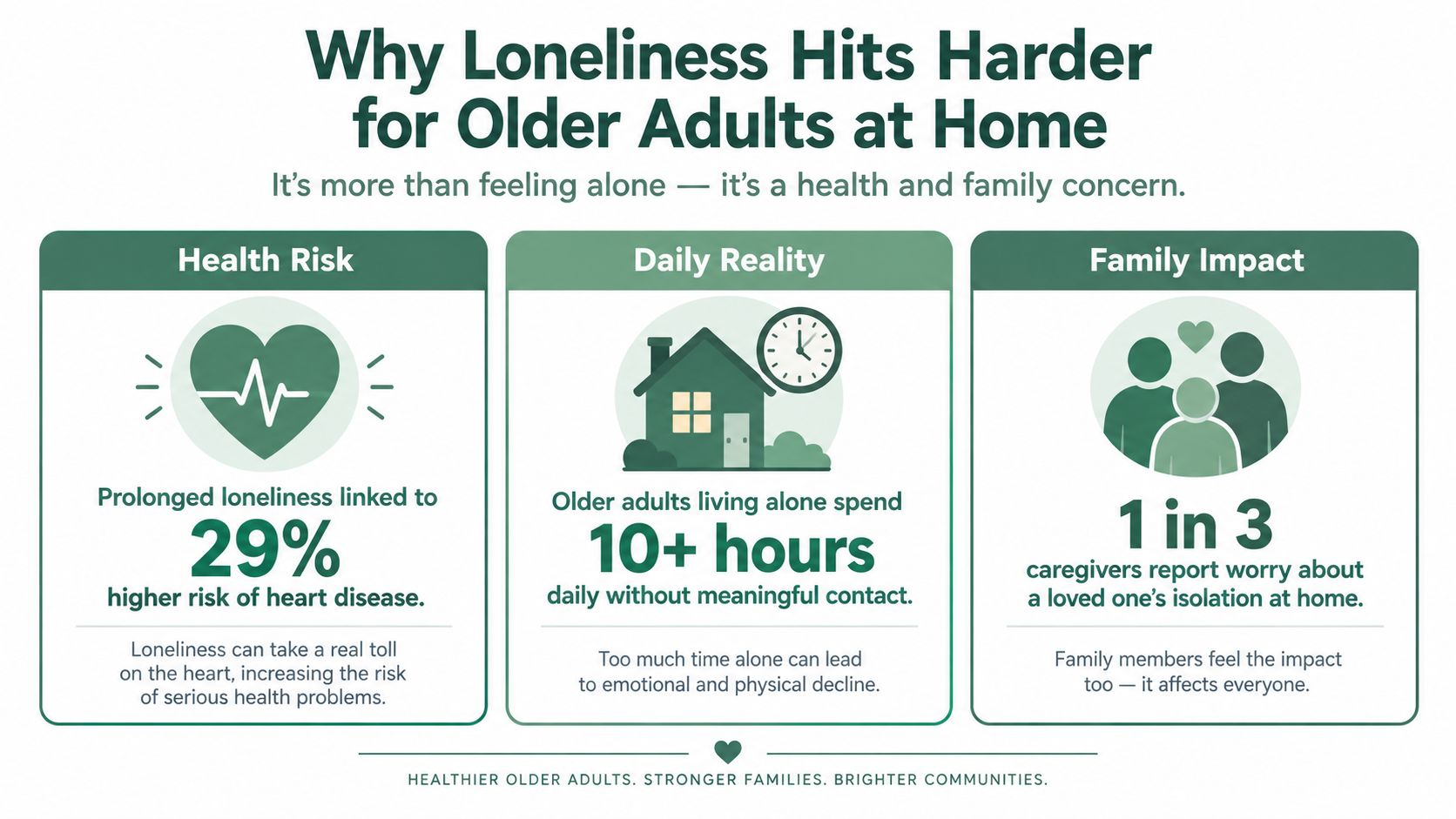
Loneliness gets worse at home because the setting removes the tiny social moments that usually break up a day, the neighbor at the mailbox, the cashier, the casual comment from a friend. When mobility drops, driving stops, or memory gets fuzzy, those moments disappear first. The WHO has framed loneliness reduction as both a health and systems issue since 2020, which pushed many families and care teams to stop treating it as an afterthought (WHO).
Why the home environment can magnify it
Home can be comforting and punishing at the same time. It offers safety, familiar objects, and fewer surprises, but it also makes it easy for days to blur together. That's especially true when the person no longer drives, avoids stairs, or feels embarrassed by memory slips.
Practical rule: if the only meaningful contact happens when family initiates it, the person is usually more isolated than they admit.
Families often describe this as “he's always been private,” but privacy isn't the issue. What matters is whether the day includes any real exchange, any reason to anticipate a voice, a visit, or a shared task. If not, the risk is not just sadness, it's a gradual drop in engagement, confidence, and safety.
There's also a measurement issue. The WHO estimates older adults are about 11.8% lonely and around 1 in 4 socially isolated worldwide (WHO). Those figures tell families this isn't rare, and they also explain why a one-off visit rarely fixes the problem.
What success looks like
Success is not turning an introvert into a social butterfly. It's steadier mood, fewer empty hours, more conversational back-and-forth, and a person who seems less adrift in their own home. It also means fewer crises caused by boredom, confusion, or missed routines.
A thoughtful movement program can help some people stay engaged when sitting still becomes part of the problem. A senior dance program at Danza Academy is one example of how gentle, guided activity can create structure and social contact without demanding a big leap from the family.
How to Recognize Loneliness and Start the Conversation
The hardest cases rarely sound like loneliness at all. They sound like “I'm just tired,” “I don't want to bother anyone,” or a quick subject change when you ask how the week is going. Watch the pattern, not just the words.
Signs that matter more than a direct admission
Pulling back from meals, calls, or hobbies is often the first clue. So are sleep changes, anxiety-driven repeated calling, irritability, and sudden over-focus on belongings or pets. The Canadian clinical guidelines recommend targeted screening with validated tools plus a fuller assessment before choosing support, because generic social activity can miss the individual need profile (PMC guideline review).
The goal isn't to diagnose loneliness in a clinical way at the kitchen table. It's to notice enough to ask better questions. If someone is sleeping more, avoiding meals, or repeatedly calling for reassurance, those are signals that the emotional load is real.
A simple screen can be conversational. Ask whether the days feel long, whether they look forward to anyone calling, and whether they feel connected enough to the people around them. Keep your voice steady and your questions short.
How to open the conversation without triggering defensiveness
The best openers sound ordinary. “I noticed the afternoons have been quiet lately, how are they feeling to you?” works better than “Are you lonely?” because it gives the person room to answer freely. The point is to invite, not corner.
Use validation before problem-solving. If they say they're fine but sound flat, reflect that back gently, then pause. Often the second answer is the useful one.
“You don't need the perfect question. You need a calm one that makes it safe to answer.”
If the person resists, keep the focus on comfort and routine, not labels. You're looking for clues about what kind of support would feel acceptable, not trying to win an argument about whether they're lonely. That shared decision-making step matters because the right support depends on whether the person needs more voice contact, more structure, more mobility help, or more emotional reassurance.
For families who want extra language ideas for this part of the conversation, the emotional support guide for seniors can help you frame the discussion without sounding clinical.
Building a Daily Routine That Creates Connection
A good routine doesn't need to be elaborate. It needs to be repeatable. For someone with memory loss, repeated contact at roughly the same points in the day often works better than a big activity once a week that leaves the rest of the week empty.
Build around moments that already exist
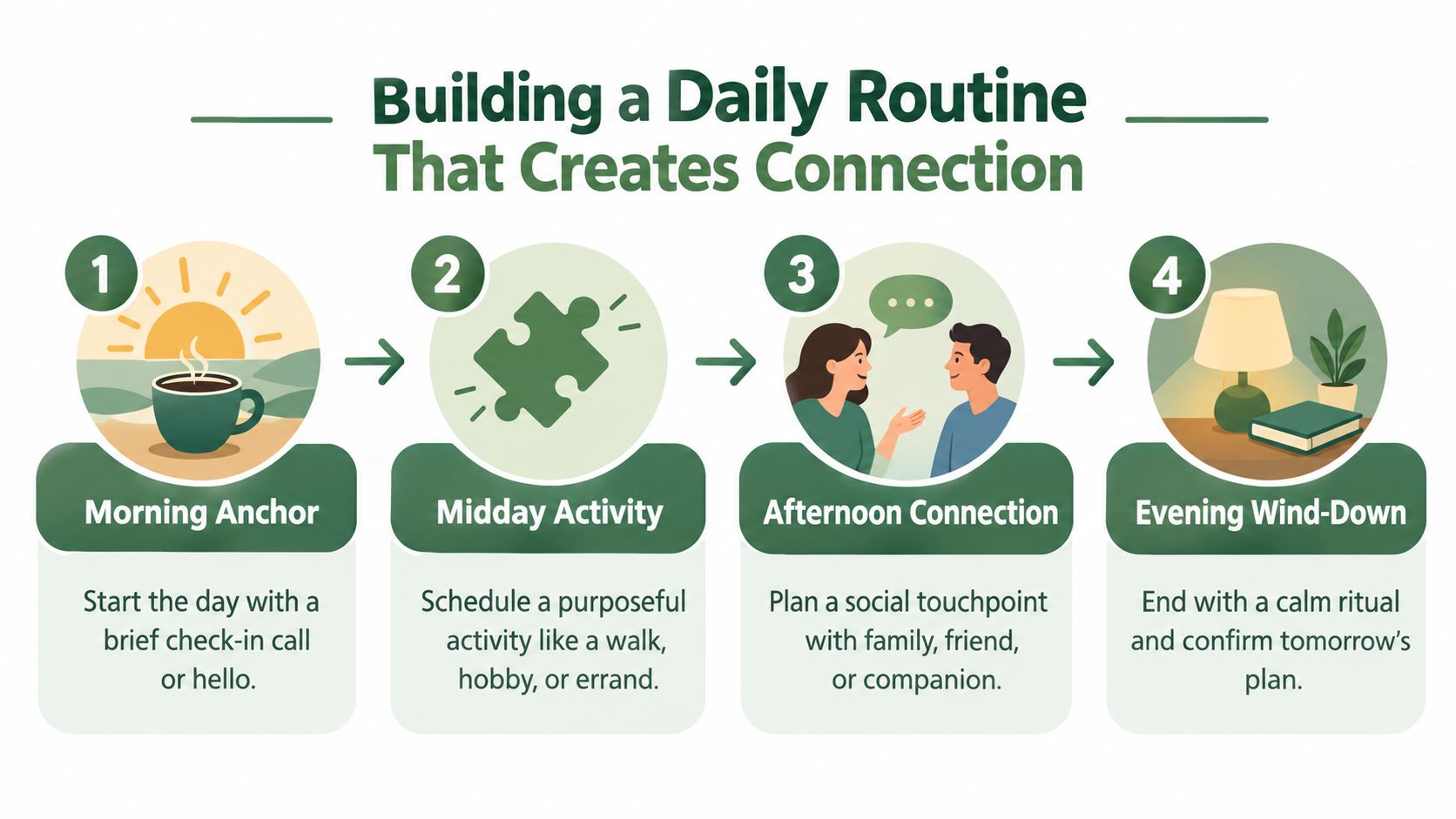
Start with morning orientation, mealtimes, a midday purpose point, and a wind-down ritual. That might look like a short phone hello after breakfast, a walk or simple chore before lunch, a check-in call in the afternoon, and a calm evening call to confirm tomorrow's plan. The routine should feel like life, not a program.
The evidence supports this kind of repetition. A meta-analysis of home-based interventions found that programs lasting more than three months and using mixed platforms produced more favorable outcomes than shorter or single-channel programs (PubMed meta-analysis). The takeaway is straightforward, consistent contact beats bursty contact.
Use the contact itself to do something small and meaningful. Reminiscence works well because it gives the conversation shape, and it doesn't depend on perfect memory. Ask about a favorite job, a first apartment, a family recipe, or a song they used to play in the car.
A weekly cadence that doesn't overwhelm
Keep the pattern simple enough to survive a bad day. A sample week might include a family call on Monday, a volunteer check-in on Wednesday, a short walk or porch sit on Friday, and a predictable Sunday call to review the week. If the person gets tired easily, shorten each contact instead of dropping the rhythm.
Practical rule: don't ask, “Did the big activity work?” Ask, “Did the person still know what to expect tomorrow?”
Families looking for a routine template often find it helpful to pair calls with reminders and orientation cues. The daily routine guide for dementia patients offers a useful way to think about the day as a series of anchors rather than a list of tasks.
Make the contact do double duty
A conversation can be social and practical at the same time. A brief call can ask about meals, reinforce the day of the week, and end with one concrete next step. That's not over-managing, it's reducing drift.
The 2022 JAMA Network Open review found that animal therapy, multicomponent interventions, exercise, technological interventions, and therapy such as CBT or psychotherapy were associated with reductions in loneliness and social isolation (JAMA Network Open review). Families don't need to chase every method, but they should know repeated, structured engagement is what tends to help.
Choosing the Right Support From Phone Companionship to Community Programs
Not every lonely older adult needs the same fix. A person who still enjoys conversation but can't drive may do well with phone companionship and a predictable visiting rhythm. Someone who needs more structure may do better with social prescribing or a mixed support plan that includes exercise, community contact, and follow-up.
Support Type | Best For | Tech Level | Evidence Strength |
|---|---|---|---|
Phone companionship | Low mobility, no driving, low digital comfort, early memory loss | Very low | Strong when contact is repeated and structured |
Befriending or support groups | People who like conversation and can tolerate regular social contact | Low to moderate | Stronger when the format is sustained and matched to the person |
Social prescribing | Families that need referral to local activities and support | Low to moderate | Helpful when assessment and follow-up are built in |
Exercise or movement programs | People who can safely participate and benefit from routine | Low | Supported in broader intervention reviews |
Animal-assisted activities | People who respond well to calming, relational contact | Low | Promising in structured programs |
Technology-lite tools | Families who can handle simple devices but not complex apps | Moderate | Mixed, depends on fit and follow-through |
The research keeps pointing to the same practical truth. The most useful match is the one that fits the person's mobility, confidence, and daily rhythm. A 2026 review noted that analogue interventions, like community-based meetings and educational or psychological programs, often outperformed technological interventions, and video-based results were mixed. One study also found face-to-face and phone contact were linked with lower odds of loneliness in middle-aged and older adults, while virtual contact helped younger adults more than older adults (Taylor & Francis review).
How to choose without overcomplicating it
Start with the easiest channel the person will use. If they're comfortable on the phone, use that first. If they can still get out safely, add one regular in-person contact that doesn't depend on driving.
For families calling relatives abroad or coordinating across time zones, a simple phone setup can matter more than yet another app. The practical advice in Best Way Call Family Abroad 2026 is useful when you need reliable, low-friction contact that doesn't ask an older adult to learn new tech.
Where Velma fits
When families need scheduled, recurring phone-based support, Velma is one option. It uses regular calls with structured conversation, cognitive activities, companionship, and practical check-ins, which makes it a fit for people who won't reliably use video platforms or social apps. The model is especially useful when you want documentation and continuity without asking the older adult to manage devices.
Practical rule: choose the channel the person will answer next Tuesday, not the channel that sounds modern today.
If you're comparing channels for a loved one, the daily check-in calls for seniors guide can help you think through how often contact should happen and who should own it.
Overcoming Resistance and Making Contact Feel Welcome
The biggest mistake families make is treating resistance as refusal. Often it's fear, pride, habit, or fatigue. When someone says they don't need help, they may mean they don't want to feel managed, watched, or corrected.

Use language that preserves autonomy
Say “I'd like to set up something regular so the days feel easier,” instead of “You need supervision.” Say “Would mornings or afternoons be better?” instead of “I'm scheduling your calls.” Small wording changes reduce the feeling of being pushed. Another useful read is The Feed.
Let the person choose the time, the topic, or the caller when possible. Choice lowers resistance. If they prefer one niece over another, or a shorter call with less back-and-forth, respect that preference and build around it.
The Canadian guidance supports shared decision-making and matching support to the person's profile rather than forcing a generic activity (PMC guideline review). That approach fits real life better than trying to persuade someone into a program they never wanted.
Handle difficult moments without escalating them
When someone gets stuck on a missing object, a pet, or a fear that repeats every call, don't correct them bluntly. Redirect to the feeling underneath the concern, then move to something concrete. “That sounds upsetting. Let's check the usual place together after we talk about lunch” works better than “You already looked there.”
If the person is too agitated, shorten the interaction and try again later. Not every call needs to be a full conversation. Sometimes a calm two-minute exchange does more good than a strained twenty-minute attempt.
Families also need to stop rewarding misery with over-explanation. If a loved one says every idea won't work, acknowledge the worry and offer one next step, not five. The goal is to make contact feel safe enough that the person doesn't brace against it.
Plain truth: people accept help more often when it feels familiar, predictable, and under their control.
Tracking Progress and Keeping Connection Going
You don't need a clinical chart to know whether the plan is working. You need a simple weekly look at mood, sleep, engagement, and whether the person participates more willingly in calls, meals, or small routines. If those signs are improving, keep going. If they're flat or worsening, the support probably needs adjusting.
A short family check-in works best when it stays specific. Note whether the person sounded brighter after calls, whether they initiated conversation, and whether they accepted more than one kind of contact during the week. Patterns matter more than one good or bad day.
The evidence backs this kind of flexible adjustment. Reviews published in the early 2020s and again more recently show that structured interventions work best when they're repeated and matched to the person's needs, while generic social contact is less reliable (JAMA Network Open review). That means the question isn't, “Did we try something social?” It's, “Did we choose the right format and keep it going long enough?”
When to change the plan
Adjust the plan if the person is still having long silent stretches, still seems anxious before calls, or still avoids all social contact. Add more structure if there's no follow-through, and reduce complexity if the current setup feels too busy. In some homes, one reliable phone call plus one predictable in-person touchpoint beats three irregular attempts.
Families who want a coordinated phone-based system often value structured documentation between visits. Velma does that through recurring calls, mood and safety check-ins, and care manager coordination, which helps families see patterns without turning home life into a clinic. That kind of visibility can make monthly review meetings simpler and less guesswork-driven.
The next step is simple. Pick one support channel, set a repeatable time, and review it with the family once a month. Small, steady contact compounds, and that's usually what lowers loneliness in real homes.
If you're trying to help a parent who's spending too many hours alone, Velma can help with scheduled phone calls, structured conversation, and practical check-ins that fit low-tech routines. Visit Velma to see how a phone-based support plan can fit into daily care and give your family more consistency between visits.
If you're spending afternoons listening to the same TV reruns while your mother sits in the next room, or if you leave after lunch and worry the house goes silent again, you already know the problem. It doesn't always look dramatic. Sometimes it's just long quiet stretches, fewer phone calls returned, and a person who starts saying they're “fine” a little too quickly.
That's the part families often miss. Loneliness is not the same as being alone, and social isolation is not the same as feeling lonely. Older adults can live with both, and the World Health Organization treats loneliness and social isolation as a public-health issue, not a private failure, with around 16% of people worldwide experiencing loneliness and older adults estimated at around 11.8% lonely and around 1 in 4 socially isolated (WHO). For caregivers, that framing matters because it turns guilt into a plan.
The good news is that the evidence base is no longer vague. Structured interventions can help, especially when they're repeated, personalized, and matched to the person's abilities and preferences. For families caring for someone with early to mid-stage dementia, that usually means phone-first support, routine, and low-friction contact, not another app they won't use and not a club they can't reliably get to.
Table of Contents
Why Loneliness Hits Harder for Older Adults at Home
Why the home environment can magnify it
What success looks like
How to Recognize Loneliness and Start the Conversation
Signs that matter more than a direct admission
How to open the conversation without triggering defensiveness
Building a Daily Routine That Creates Connection
Build around moments that already exist
A weekly cadence that doesn't overwhelm
Make the contact do double duty
Choosing the Right Support From Phone Companionship to Community Programs
How to choose without overcomplicating it
Where Velma fits
Overcoming Resistance and Making Contact Feel Welcome
Use language that preserves autonomy
Handle difficult moments without escalating them
Tracking Progress and Keeping Connection Going
When to change the plan
Why Loneliness Hits Harder for Older Adults at Home
A daughter calls after work and hears her father answer on the second ring, but the conversation stalls. He's been home all day, he hasn't gone anywhere, and the only person he spoke to was the pharmacist at the window. The family assumes he's “independent,” yet the house has become smaller, quieter, and harder to move through.
Loneliness gets worse at home because the setting removes the tiny social moments that usually break up a day, the neighbor at the mailbox, the cashier, the casual comment from a friend. When mobility drops, driving stops, or memory gets fuzzy, those moments disappear first. The WHO has framed loneliness reduction as both a health and systems issue since 2020, which pushed many families and care teams to stop treating it as an afterthought (WHO).
Why the home environment can magnify it
Home can be comforting and punishing at the same time. It offers safety, familiar objects, and fewer surprises, but it also makes it easy for days to blur together. That's especially true when the person no longer drives, avoids stairs, or feels embarrassed by memory slips.
Practical rule: if the only meaningful contact happens when family initiates it, the person is usually more isolated than they admit.
Families often describe this as “he's always been private,” but privacy isn't the issue. What matters is whether the day includes any real exchange, any reason to anticipate a voice, a visit, or a shared task. If not, the risk is not just sadness, it's a gradual drop in engagement, confidence, and safety.
There's also a measurement issue. The WHO estimates older adults are about 11.8% lonely and around 1 in 4 socially isolated worldwide (WHO). Those figures tell families this isn't rare, and they also explain why a one-off visit rarely fixes the problem.
What success looks like
Success is not turning an introvert into a social butterfly. It's steadier mood, fewer empty hours, more conversational back-and-forth, and a person who seems less adrift in their own home. It also means fewer crises caused by boredom, confusion, or missed routines.
A thoughtful movement program can help some people stay engaged when sitting still becomes part of the problem. A senior dance program at Danza Academy is one example of how gentle, guided activity can create structure and social contact without demanding a big leap from the family.
How to Recognize Loneliness and Start the Conversation
The hardest cases rarely sound like loneliness at all. They sound like “I'm just tired,” “I don't want to bother anyone,” or a quick subject change when you ask how the week is going. Watch the pattern, not just the words.
Signs that matter more than a direct admission
Pulling back from meals, calls, or hobbies is often the first clue. So are sleep changes, anxiety-driven repeated calling, irritability, and sudden over-focus on belongings or pets. The Canadian clinical guidelines recommend targeted screening with validated tools plus a fuller assessment before choosing support, because generic social activity can miss the individual need profile (PMC guideline review).
The goal isn't to diagnose loneliness in a clinical way at the kitchen table. It's to notice enough to ask better questions. If someone is sleeping more, avoiding meals, or repeatedly calling for reassurance, those are signals that the emotional load is real.
A simple screen can be conversational. Ask whether the days feel long, whether they look forward to anyone calling, and whether they feel connected enough to the people around them. Keep your voice steady and your questions short.
How to open the conversation without triggering defensiveness
The best openers sound ordinary. “I noticed the afternoons have been quiet lately, how are they feeling to you?” works better than “Are you lonely?” because it gives the person room to answer freely. The point is to invite, not corner.
Use validation before problem-solving. If they say they're fine but sound flat, reflect that back gently, then pause. Often the second answer is the useful one.
“You don't need the perfect question. You need a calm one that makes it safe to answer.”
If the person resists, keep the focus on comfort and routine, not labels. You're looking for clues about what kind of support would feel acceptable, not trying to win an argument about whether they're lonely. That shared decision-making step matters because the right support depends on whether the person needs more voice contact, more structure, more mobility help, or more emotional reassurance.
For families who want extra language ideas for this part of the conversation, the emotional support guide for seniors can help you frame the discussion without sounding clinical.
Building a Daily Routine That Creates Connection
A good routine doesn't need to be elaborate. It needs to be repeatable. For someone with memory loss, repeated contact at roughly the same points in the day often works better than a big activity once a week that leaves the rest of the week empty.
Build around moments that already exist
Start with morning orientation, mealtimes, a midday purpose point, and a wind-down ritual. That might look like a short phone hello after breakfast, a walk or simple chore before lunch, a check-in call in the afternoon, and a calm evening call to confirm tomorrow's plan. The routine should feel like life, not a program.
The evidence supports this kind of repetition. A meta-analysis of home-based interventions found that programs lasting more than three months and using mixed platforms produced more favorable outcomes than shorter or single-channel programs (PubMed meta-analysis). The takeaway is straightforward, consistent contact beats bursty contact.
Use the contact itself to do something small and meaningful. Reminiscence works well because it gives the conversation shape, and it doesn't depend on perfect memory. Ask about a favorite job, a first apartment, a family recipe, or a song they used to play in the car.
A weekly cadence that doesn't overwhelm
Keep the pattern simple enough to survive a bad day. A sample week might include a family call on Monday, a volunteer check-in on Wednesday, a short walk or porch sit on Friday, and a predictable Sunday call to review the week. If the person gets tired easily, shorten each contact instead of dropping the rhythm.
Practical rule: don't ask, “Did the big activity work?” Ask, “Did the person still know what to expect tomorrow?”
Families looking for a routine template often find it helpful to pair calls with reminders and orientation cues. The daily routine guide for dementia patients offers a useful way to think about the day as a series of anchors rather than a list of tasks.
Make the contact do double duty
A conversation can be social and practical at the same time. A brief call can ask about meals, reinforce the day of the week, and end with one concrete next step. That's not over-managing, it's reducing drift.
The 2022 JAMA Network Open review found that animal therapy, multicomponent interventions, exercise, technological interventions, and therapy such as CBT or psychotherapy were associated with reductions in loneliness and social isolation (JAMA Network Open review). Families don't need to chase every method, but they should know repeated, structured engagement is what tends to help.
Choosing the Right Support From Phone Companionship to Community Programs
Not every lonely older adult needs the same fix. A person who still enjoys conversation but can't drive may do well with phone companionship and a predictable visiting rhythm. Someone who needs more structure may do better with social prescribing or a mixed support plan that includes exercise, community contact, and follow-up.
Support Type | Best For | Tech Level | Evidence Strength |
|---|---|---|---|
Phone companionship | Low mobility, no driving, low digital comfort, early memory loss | Very low | Strong when contact is repeated and structured |
Befriending or support groups | People who like conversation and can tolerate regular social contact | Low to moderate | Stronger when the format is sustained and matched to the person |
Social prescribing | Families that need referral to local activities and support | Low to moderate | Helpful when assessment and follow-up are built in |
Exercise or movement programs | People who can safely participate and benefit from routine | Low | Supported in broader intervention reviews |
Animal-assisted activities | People who respond well to calming, relational contact | Low | Promising in structured programs |
Technology-lite tools | Families who can handle simple devices but not complex apps | Moderate | Mixed, depends on fit and follow-through |
The research keeps pointing to the same practical truth. The most useful match is the one that fits the person's mobility, confidence, and daily rhythm. A 2026 review noted that analogue interventions, like community-based meetings and educational or psychological programs, often outperformed technological interventions, and video-based results were mixed. One study also found face-to-face and phone contact were linked with lower odds of loneliness in middle-aged and older adults, while virtual contact helped younger adults more than older adults (Taylor & Francis review).
How to choose without overcomplicating it
Start with the easiest channel the person will use. If they're comfortable on the phone, use that first. If they can still get out safely, add one regular in-person contact that doesn't depend on driving.
For families calling relatives abroad or coordinating across time zones, a simple phone setup can matter more than yet another app. The practical advice in Best Way Call Family Abroad 2026 is useful when you need reliable, low-friction contact that doesn't ask an older adult to learn new tech.
Where Velma fits
When families need scheduled, recurring phone-based support, Velma is one option. It uses regular calls with structured conversation, cognitive activities, companionship, and practical check-ins, which makes it a fit for people who won't reliably use video platforms or social apps. The model is especially useful when you want documentation and continuity without asking the older adult to manage devices.
Practical rule: choose the channel the person will answer next Tuesday, not the channel that sounds modern today.
If you're comparing channels for a loved one, the daily check-in calls for seniors guide can help you think through how often contact should happen and who should own it.
Overcoming Resistance and Making Contact Feel Welcome
The biggest mistake families make is treating resistance as refusal. Often it's fear, pride, habit, or fatigue. When someone says they don't need help, they may mean they don't want to feel managed, watched, or corrected.
Use language that preserves autonomy
Say “I'd like to set up something regular so the days feel easier,” instead of “You need supervision.” Say “Would mornings or afternoons be better?” instead of “I'm scheduling your calls.” Small wording changes reduce the feeling of being pushed. Another useful read is The Feed.
Let the person choose the time, the topic, or the caller when possible. Choice lowers resistance. If they prefer one niece over another, or a shorter call with less back-and-forth, respect that preference and build around it.
The Canadian guidance supports shared decision-making and matching support to the person's profile rather than forcing a generic activity (PMC guideline review). That approach fits real life better than trying to persuade someone into a program they never wanted.
Handle difficult moments without escalating them
When someone gets stuck on a missing object, a pet, or a fear that repeats every call, don't correct them bluntly. Redirect to the feeling underneath the concern, then move to something concrete. “That sounds upsetting. Let's check the usual place together after we talk about lunch” works better than “You already looked there.”
If the person is too agitated, shorten the interaction and try again later. Not every call needs to be a full conversation. Sometimes a calm two-minute exchange does more good than a strained twenty-minute attempt.
Families also need to stop rewarding misery with over-explanation. If a loved one says every idea won't work, acknowledge the worry and offer one next step, not five. The goal is to make contact feel safe enough that the person doesn't brace against it.
Plain truth: people accept help more often when it feels familiar, predictable, and under their control.
Tracking Progress and Keeping Connection Going
You don't need a clinical chart to know whether the plan is working. You need a simple weekly look at mood, sleep, engagement, and whether the person participates more willingly in calls, meals, or small routines. If those signs are improving, keep going. If they're flat or worsening, the support probably needs adjusting.
A short family check-in works best when it stays specific. Note whether the person sounded brighter after calls, whether they initiated conversation, and whether they accepted more than one kind of contact during the week. Patterns matter more than one good or bad day.
The evidence backs this kind of flexible adjustment. Reviews published in the early 2020s and again more recently show that structured interventions work best when they're repeated and matched to the person's needs, while generic social contact is less reliable (JAMA Network Open review). That means the question isn't, “Did we try something social?” It's, “Did we choose the right format and keep it going long enough?”
When to change the plan
Adjust the plan if the person is still having long silent stretches, still seems anxious before calls, or still avoids all social contact. Add more structure if there's no follow-through, and reduce complexity if the current setup feels too busy. In some homes, one reliable phone call plus one predictable in-person touchpoint beats three irregular attempts.
Families who want a coordinated phone-based system often value structured documentation between visits. Velma does that through recurring calls, mood and safety check-ins, and care manager coordination, which helps families see patterns without turning home life into a clinic. That kind of visibility can make monthly review meetings simpler and less guesswork-driven.
The next step is simple. Pick one support channel, set a repeatable time, and review it with the family once a month. Small, steady contact compounds, and that's usually what lowers loneliness in real homes.
If you're trying to help a parent who's spending too many hours alone, Velma can help with scheduled phone calls, structured conversation, and practical check-ins that fit low-tech routines. Visit Velma to see how a phone-based support plan can fit into daily care and give your family more consistency between visits.
Suggested Article: