Emotional Support for Seniors: A Guide to Well-being

About 25% of U.S. adults report a lack of social and emotional support, and adults age 75 and older are the most likely to lack the support they need, according to County Health Rankings. That number changes the conversation. Emotional support for seniors isn't just about being nice, visiting more often, or keeping someone busy. It's about whether an older adult feels safe, understood, and connected enough to keep going through the losses, changes, and uncertainty that often come with aging.
Family caregivers often tell me the same thing: “I call, I visit, I check the boxes, but something still feels off.” Usually, they're noticing a deeper need. A parent may have food, medication, and a tidy home, yet still feel emotionally adrift. That emotional gap can show up as worry, irritability, withdrawal, repetitive questions, or a growing sense that nothing feels steady anymore.
A more thoughtful approach is beneficial. General advice about loneliness only goes so far, especially when memory loss is part of the picture. Many families need practical ways to respond to distress, and many older adults need support that doesn't depend on apps, passwords, or video calls.
Table of Contents
The Hidden Hunger Recognizing the Need for Emotional Support
What emotional support sounds like
Why Emotional Support Is a Pillar of Senior Health
What emotional support actually includes
Why family connection matters so much
Recognizing the Quiet Calls for Help
Changes in behavior that deserve attention
When a pattern matters more than one bad day
Practical Strategies for Providing Meaningful Support
Use consistency before intensity
Conversation Starters for Meaningful Check-ins
Why phone-based support matters
Tailoring Support for a Loved One with Dementia
Scripts for anxiety loops and repeated worries
Using reminiscence with purpose
Knowing When to Involve Professionals
Signs that call for outside help
What to say when you make the call
How to bring useful information to a clinician
Conclusion Building a Resilient Support System
The Hidden Hunger Recognizing the Need for Emotional Support
A senior can be surrounded by people and still feel unsupported. That's the part families often miss at first. Emotional support for seniors means more than social contact. It means someone notices their fear, respects their dignity, and responds in a way that helps them feel less alone inside their own mind.
For an older adult, emotional support often looks simple from the outside. A calm voice. A predictable check-in. A chance to talk without being rushed. Someone who doesn't correct every small mistake or dismiss every worry with “you're fine.”
That's why I think of it as a hidden hunger. People notice when a parent needs groceries or help with bathing. They don't always notice when that same parent needs reassurance, encouragement, and a sense that they still matter to other people.
A practical way to close that gap is to build a rhythm of connection rather than waiting for a crisis. Families exploring daily check-in calls for seniors often find that regular contact lowers uncertainty for everyone involved.
What emotional support sounds like
It often sounds like this:
“That sounds upsetting.” You name the feeling before you try to solve the problem.
“I'm glad you told me.” You make it safe to share distress.
“Let's think about this together.” You offer partnership, not control.
“I'll call again tomorrow morning.” You provide predictability, which is calming.
Emotional support isn't a bonus layer of care. For many older adults, it's the part that makes all the other care easier to accept.
When caregivers understand this, they usually become less focused on saying the perfect thing and more focused on creating the right emotional experience. Feeling heard matters. Feeling settled matters. Feeling remembered matters.
Why Emotional Support Is a Pillar of Senior Health
Emotional support affects far more than mood. In older adulthood, it shapes how people cope with stress, stay engaged, and maintain a sense of self. Research published in Frontiers in Public Health found that high-quality social interaction is linked to a 46% reduction in the likelihood of developing dementia, and emotional support from family is a primary driver of positive mental health in older adults in this study on emotional support, aging, and mental health.

That finding helps explain something caregivers observe every day. When an older adult feels emotionally supported, they often participate more. They talk more. They're more willing to leave the house, answer the phone, attend appointments, or try a familiar activity. Support doesn't just comfort them. It can help them stay involved in life.
What emotional support actually includes
People sometimes hear “support” and think only of encouragement. In practice, it includes a few distinct ingredients:
Validation: “You sound worried about that.”
Belonging: “We want you included in this.”
Encouragement to express feelings: giving space for grief, frustration, or fear
Steady connection: regular contact instead of random bursts of attention
Those elements matter because aging often brings losses that gradually accumulate. A person may be adapting to bereavement, mobility changes, hearing loss, retirement, or memory problems all at once. If no one helps them process those shifts emotionally, distress can harden into withdrawal or despair.
Why family connection matters so much
Family support matters not because family members are perfect, but because familiar relationships carry history. A known voice can calm a person more quickly than generic social chatter. A daughter who remembers Dad's old work stories or a spouse who knows which topics trigger anxiety can often support him in a more grounded way.
That said, family caregivers also need backup. Many households benefit from adding companion care for elderly adults when one person can't provide all the consistency alone.
Practical rule: If contact only happens when something is wrong, support starts to feel like surveillance. Regular, low-pressure connection feels very different.
When families treat emotional support as preventive care instead of an afterthought, they usually notice fewer escalations and more moments of calm, trust, and cooperation.
Recognizing the Quiet Calls for Help
Older adults rarely announce, “I'm emotionally struggling.” More often, they show it sideways. A once-social parent stops picking up the phone. A meticulous spouse begins ignoring laundry. A grandparent who used to enjoy church or card games says everything feels like too much trouble.
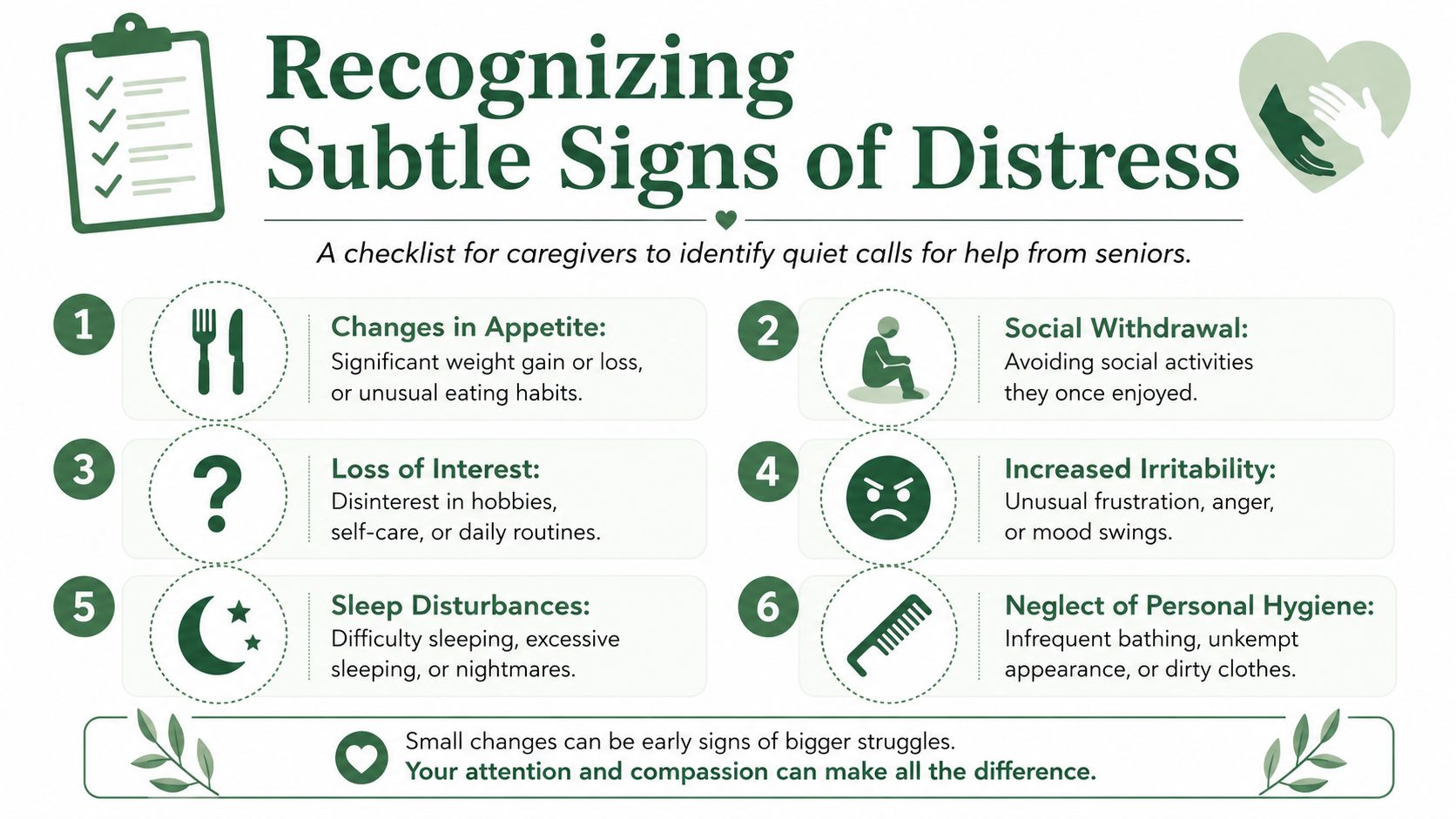
Changes in behavior that deserve attention
Look for patterns in everyday life, not just dramatic moments.
Social retreat: They stop returning calls, skip familiar activities, or seem less interested in seeing people they usually enjoy.
Loss of pleasure: Hobbies, favorite TV programs, gardening, reading, or cooking no longer hold their attention.
Irritability: They sound more suspicious, short-tempered, or easily overwhelmed.
Repetitive worry: The same concern comes up over and over, especially around safety, money, belongings, pets, or whether someone is coming.
Changes in self-care: Bathing, dressing, grooming, or eating routines become less consistent.
Sleep disruption: They report sleeping poorly, sleeping much more, or feeling unsettled at night.
Not every change means depression or cognitive decline. Seniors have bad days like everyone else. The key is noticing what's new, what's persistent, and what seems out of character.
When a pattern matters more than one bad day
A single canceled lunch doesn't mean much. A month of cancellations does. One tearful phone call may reflect a hard day. A new pattern of hopelessness, fear, or confusion deserves attention.
A helpful caregiver habit is to compare the person to their own baseline, not to some ideal standard of aging. Ask yourself:
What has changed recently?
What have they stopped doing?
What worries keep repeating?
Do they seem less steady emotionally than they used to?
Many caregivers get stuck because they wait for a dramatic sign. Quiet decline is still decline.
You don't need a diagnosis to respond. If you notice someone withdrawing, becoming more negative, or sounding emotionally flat, that's enough reason to increase supportive contact and start documenting what you see.
Practical Strategies for Providing Meaningful Support
The most helpful support is usually not grand. It's structured, repeatable, and calm. Families often think they need longer calls, deeper talks, or more advice. Most seniors do better with shorter, dependable contact that lowers uncertainty.
Use consistency before intensity
A ten-minute call at the same time each day often works better than an hour-long call once in a while. Predictability matters because it gives the older adult something firm to lean on. They know someone will check in. They don't have to wonder when they'll hear a caring voice again.
Try building calls around a loose sequence:
Warm greeting: Start with familiarity. “Hi Mom, it's me. I've been thinking about you.”
Emotional check-in: “How has today felt for you?”
Simple orientation: “What have you had for breakfast?” or “What's one thing on your plan today?”
Gentle engagement: a memory, a favorite topic, or a small choice
Clear close: “I'll call again after dinner.”
Conversation Starters for Meaningful Check-ins
Goal | Sample Script or Question |
|---|---|
Ease into the call | “I'm glad to hear your voice. How's this part of the day been for you?” |
Name emotion gently | “You sound a little worried. What's feeling hardest right now?” |
Reduce pressure | “We don't need to solve everything this minute. Tell me what's on your mind first.” |
Support routine | “What's one small thing you've done today already?” |
Encourage connection | “Who have you talked with this week that felt good to speak with?” |
Invite reminiscence | “What's something you used to enjoy doing this time of year?” |
Build calm before ending | “Before I go, let's make a simple plan for the next part of your day.” |
These scripts work because they invite feeling, not just facts. “Did you take your pills?” has its place. So does “How are you holding up today?”
Why phone-based support matters
Not every older adult can manage technology. Some can't hear well on video. Some become confused by logins, screens, or updates. Others are tired of being told to use tools that feel foreign to them. The World Health Organization notes a gap in support models that assume digital access, leaving room for simple, scheduled phone calls that require no device interaction from the senior in its mental health of older adults overview.
That matters because a plain phone call can still do a lot:
Provide companionship: a warm, familiar interaction
Support orientation: reminders about the day, time, and routine
Spot distress early: worry, confusion, or unusual silence
Lower barriers: no apps, passwords, or screens
Phone-based emotional support for seniors can be especially useful when distance, work schedules, or caregiver burnout make in-person consistency hard to maintain.
Tailoring Support for a Loved One with Dementia
Memory loss changes what comfort looks like. Your loved one may not need more facts. They often need a calmer environment, fewer demands, and a response that lowers fear instead of increasing it.

A useful way to understand dementia-related distress is to picture the brain's filing system under strain. The feeling arrives first. The ability to sort out time, place, and logic may not keep up. So if a person says, “Someone stole my wallet,” the fear is real even if the conclusion is not. Correcting the facts without addressing the fear usually adds friction.
That is why reassurance by itself can fall flat. “You already asked me that” or “No one took it” may be accurate, but accuracy is not always the same as comfort. A better approach has three steps: validate the emotion, reduce the pressure, then redirect toward something familiar or soothing.
Scripts for anxiety loops and repeated worries
These examples can help when emotions are running high and you need words quickly.
If they say: “Someone stole my wallet.”
Try: “That sounds upsetting. Let's take this one step at a time. You want to know your things are safe. Tell me about the wallet you usually carry.”
This works like helping someone step off a spinning merry-go-round. You slow the pace first, then guide attention toward description instead of alarm.
If they say: “I need to go pick up the children.”
Try: “You care very much about keeping them safe. You always took that seriously. Sit with me for a minute and tell me what the school pickup routine was like.”
You are honoring the role behind the worry. In many cases, the person is expressing responsibility, not asking for a factual correction.
If they say: “I can't find my husband.”
Try: “You miss him. That feeling is real. Tell me about something you loved doing together.”
This response supports grief without forcing the person through a fresh shock.
A simple phrase to remember is: validate, soften, redirect.
Using reminiscence with purpose
Reminiscence is more than chatting about the past. It helps a person reconnect with identity when recent memory is unreliable. For many families, it becomes one of the most practical tools they have because long-term memories often stay available longer than short-term ones.
You can use it during a phone call, while folding towels together, or in the middle of a worried moment. It is especially helpful for seniors who cannot manage apps or video calls and do better with familiar voices and low-tech routines.
Try prompts like these:
“What kind of work made you feel proud?”
“What did holidays sound like in your house?”
“Who taught you an important lesson when you were young?”
“What songs always made you want to sing along?”
For more examples of how to turn memory-based conversation into a practical caregiving tool, see reminiscence therapy for dementia.
If one prompt does not work, that does not mean you failed. Dementia support is often like trying different keys on a key ring. One question may increase tension, while another opens the door to calm. Keep your tone warm, your sentences short, and your goal simple: help your loved one feel safe, seen, and less alone in that moment.
Knowing When to Involve Professionals
There is a point when love, patience, and good routines are no longer enough on their own. That point can arrive subtly. A senior may seem more frightened than sad, more confused than lonely, or more agitated than comforted by the tools that usually help. Bringing in professional support at that stage is part of good care.

Families often assume they should wait until there is a crisis. In practice, earlier help is usually easier and kinder. A clinician can sort out whether a sudden emotional change is tied to grief, depression, pain, medication side effects, infection, sleep problems, or dementia progression. Those problems can look similar from the outside, much like several different keys can fit halfway into the same lock.
Professional support also does not have to mean weekly office visits or technology your loved one will never use. For some seniors, the best next step is a primary care appointment. For others, it may be a geriatric therapist, a neurologist, a social worker, or a low tech support option such as scheduled phone check-ins that reduce isolation and help track patterns between medical visits.
Signs that call for outside help
Reach out to a physician, therapist, geriatric specialist, or neurologist if you notice:
A sudden change in mood, behavior, or alertness
Ongoing refusal to eat, drink, bathe, or take needed medication
Fearful beliefs, hallucinations, or severe confusion that create risk
Agitation that does not ease with familiar calming approaches
Wandering, falls, stove misuse, or other safety problems
Repeated statements about hopelessness, wanting to die, or feeling like a burden
Caregiver strain that is affecting your judgment, patience, sleep, or health
A brief educational resource may also help families think through what support should look like in practice:
What to say when you make the call
Many caregivers freeze at this step because they are unsure how to describe what is happening. You do not need perfect language. You need concrete examples.
Try a script like this:
“I'm calling about a change in my mother's emotional state. For the past ten days, she has become very fearful in the evenings, called me repeatedly, and said strangers are in the house. Redirection is helping less than it used to. I'd like guidance on what could be causing this and what kind of evaluation makes sense.”
If dementia is involved, include what the distress looks like, not just the diagnosis. “He has dementia” tells a clinician very little. “He cries after sundown, asks for his brother who died years ago, and becomes panicked if left alone for more than ten minutes” gives them something they can act on.
How to bring useful information to a clinician
A short pattern log can help more than a long, emotional summary. The goal is not to write everything down. The goal is to notice what repeats.
Bring notes on:
When symptoms happen, such as mornings, late afternoons, after naps, or during personal care
What seems to trigger them, such as noise, hunger, transitions, pain, overstimulation, or being alone
What the person says or does, using a few exact phrases if you can remember them
What helps even a little, such as a snack, quieter surroundings, music, a slower tone, or a familiar phone call
How often it happens, so the clinician can tell whether this is occasional or becoming a pattern
One sentence can be enough. “Every evening around 6 p.m. she says she needs to go home, even when she is home, and settles best when her sister calls by phone” is useful information.
You are allowed to ask for help before things fall apart. In many families, that is the moment care becomes more stable, not less.
Conclusion Building a Resilient Support System
Emotional support for seniors is easy to underestimate because it doesn't look as urgent as a medication list or a doctor's appointment. But in daily life, it often determines whether an older adult feels secure enough to participate in care, connect with others, and move through the day with less fear.
For family caregivers, the goal isn't to become a perfect counselor. It's to become more intentional. Offer steady contact. Listen for emotion underneath the words. Notice patterns early. Use simple scripts that calm rather than correct. And when dementia is involved, remember that validation and redirection usually work better than logic.
A resilient support system also protects you. No one caregiver can do this alone for long. Family, friends, community supports, and professionals each play a role. The strongest care plans are rarely the most complicated. They are the most consistent.
If you're already trying, you're not behind. Small acts count. A calm tone counts. A short daily call counts. A familiar story counts. Reassurance, repeated over time, becomes a kind of structure. For many older adults, that structure is what helps life feel livable again.
If your family needs low-tech, consistent support for a loved one with memory loss, Velma offers scheduled phone-based cognitive and emotional support designed for older adults in the early to mid stages of dementia. It's a practical option for seniors who can't or won't use apps or video calls, and for families who want steadier check-ins between visits.
About 25% of U.S. adults report a lack of social and emotional support, and adults age 75 and older are the most likely to lack the support they need, according to County Health Rankings. That number changes the conversation. Emotional support for seniors isn't just about being nice, visiting more often, or keeping someone busy. It's about whether an older adult feels safe, understood, and connected enough to keep going through the losses, changes, and uncertainty that often come with aging.
Family caregivers often tell me the same thing: “I call, I visit, I check the boxes, but something still feels off.” Usually, they're noticing a deeper need. A parent may have food, medication, and a tidy home, yet still feel emotionally adrift. That emotional gap can show up as worry, irritability, withdrawal, repetitive questions, or a growing sense that nothing feels steady anymore.
A more thoughtful approach is beneficial. General advice about loneliness only goes so far, especially when memory loss is part of the picture. Many families need practical ways to respond to distress, and many older adults need support that doesn't depend on apps, passwords, or video calls.
Table of Contents
The Hidden Hunger Recognizing the Need for Emotional Support
What emotional support sounds like
Why Emotional Support Is a Pillar of Senior Health
What emotional support actually includes
Why family connection matters so much
Recognizing the Quiet Calls for Help
Changes in behavior that deserve attention
When a pattern matters more than one bad day
Practical Strategies for Providing Meaningful Support
Use consistency before intensity
Conversation Starters for Meaningful Check-ins
Why phone-based support matters
Tailoring Support for a Loved One with Dementia
Scripts for anxiety loops and repeated worries
Using reminiscence with purpose
Knowing When to Involve Professionals
Signs that call for outside help
What to say when you make the call
How to bring useful information to a clinician
Conclusion Building a Resilient Support System
The Hidden Hunger Recognizing the Need for Emotional Support
A senior can be surrounded by people and still feel unsupported. That's the part families often miss at first. Emotional support for seniors means more than social contact. It means someone notices their fear, respects their dignity, and responds in a way that helps them feel less alone inside their own mind.
For an older adult, emotional support often looks simple from the outside. A calm voice. A predictable check-in. A chance to talk without being rushed. Someone who doesn't correct every small mistake or dismiss every worry with “you're fine.”
That's why I think of it as a hidden hunger. People notice when a parent needs groceries or help with bathing. They don't always notice when that same parent needs reassurance, encouragement, and a sense that they still matter to other people.
A practical way to close that gap is to build a rhythm of connection rather than waiting for a crisis. Families exploring daily check-in calls for seniors often find that regular contact lowers uncertainty for everyone involved.
What emotional support sounds like
It often sounds like this:
“That sounds upsetting.” You name the feeling before you try to solve the problem.
“I'm glad you told me.” You make it safe to share distress.
“Let's think about this together.” You offer partnership, not control.
“I'll call again tomorrow morning.” You provide predictability, which is calming.
Emotional support isn't a bonus layer of care. For many older adults, it's the part that makes all the other care easier to accept.
When caregivers understand this, they usually become less focused on saying the perfect thing and more focused on creating the right emotional experience. Feeling heard matters. Feeling settled matters. Feeling remembered matters.
Why Emotional Support Is a Pillar of Senior Health
Emotional support affects far more than mood. In older adulthood, it shapes how people cope with stress, stay engaged, and maintain a sense of self. Research published in Frontiers in Public Health found that high-quality social interaction is linked to a 46% reduction in the likelihood of developing dementia, and emotional support from family is a primary driver of positive mental health in older adults in this study on emotional support, aging, and mental health.
That finding helps explain something caregivers observe every day. When an older adult feels emotionally supported, they often participate more. They talk more. They're more willing to leave the house, answer the phone, attend appointments, or try a familiar activity. Support doesn't just comfort them. It can help them stay involved in life.
What emotional support actually includes
People sometimes hear “support” and think only of encouragement. In practice, it includes a few distinct ingredients:
Validation: “You sound worried about that.”
Belonging: “We want you included in this.”
Encouragement to express feelings: giving space for grief, frustration, or fear
Steady connection: regular contact instead of random bursts of attention
Those elements matter because aging often brings losses that gradually accumulate. A person may be adapting to bereavement, mobility changes, hearing loss, retirement, or memory problems all at once. If no one helps them process those shifts emotionally, distress can harden into withdrawal or despair.
Why family connection matters so much
Family support matters not because family members are perfect, but because familiar relationships carry history. A known voice can calm a person more quickly than generic social chatter. A daughter who remembers Dad's old work stories or a spouse who knows which topics trigger anxiety can often support him in a more grounded way.
That said, family caregivers also need backup. Many households benefit from adding companion care for elderly adults when one person can't provide all the consistency alone.
Practical rule: If contact only happens when something is wrong, support starts to feel like surveillance. Regular, low-pressure connection feels very different.
When families treat emotional support as preventive care instead of an afterthought, they usually notice fewer escalations and more moments of calm, trust, and cooperation.
Recognizing the Quiet Calls for Help
Older adults rarely announce, “I'm emotionally struggling.” More often, they show it sideways. A once-social parent stops picking up the phone. A meticulous spouse begins ignoring laundry. A grandparent who used to enjoy church or card games says everything feels like too much trouble.
Changes in behavior that deserve attention
Look for patterns in everyday life, not just dramatic moments.
Social retreat: They stop returning calls, skip familiar activities, or seem less interested in seeing people they usually enjoy.
Loss of pleasure: Hobbies, favorite TV programs, gardening, reading, or cooking no longer hold their attention.
Irritability: They sound more suspicious, short-tempered, or easily overwhelmed.
Repetitive worry: The same concern comes up over and over, especially around safety, money, belongings, pets, or whether someone is coming.
Changes in self-care: Bathing, dressing, grooming, or eating routines become less consistent.
Sleep disruption: They report sleeping poorly, sleeping much more, or feeling unsettled at night.
Not every change means depression or cognitive decline. Seniors have bad days like everyone else. The key is noticing what's new, what's persistent, and what seems out of character.
When a pattern matters more than one bad day
A single canceled lunch doesn't mean much. A month of cancellations does. One tearful phone call may reflect a hard day. A new pattern of hopelessness, fear, or confusion deserves attention.
A helpful caregiver habit is to compare the person to their own baseline, not to some ideal standard of aging. Ask yourself:
What has changed recently?
What have they stopped doing?
What worries keep repeating?
Do they seem less steady emotionally than they used to?
Many caregivers get stuck because they wait for a dramatic sign. Quiet decline is still decline.
You don't need a diagnosis to respond. If you notice someone withdrawing, becoming more negative, or sounding emotionally flat, that's enough reason to increase supportive contact and start documenting what you see.
Practical Strategies for Providing Meaningful Support
The most helpful support is usually not grand. It's structured, repeatable, and calm. Families often think they need longer calls, deeper talks, or more advice. Most seniors do better with shorter, dependable contact that lowers uncertainty.
Use consistency before intensity
A ten-minute call at the same time each day often works better than an hour-long call once in a while. Predictability matters because it gives the older adult something firm to lean on. They know someone will check in. They don't have to wonder when they'll hear a caring voice again.
Try building calls around a loose sequence:
Warm greeting: Start with familiarity. “Hi Mom, it's me. I've been thinking about you.”
Emotional check-in: “How has today felt for you?”
Simple orientation: “What have you had for breakfast?” or “What's one thing on your plan today?”
Gentle engagement: a memory, a favorite topic, or a small choice
Clear close: “I'll call again after dinner.”
Conversation Starters for Meaningful Check-ins
Goal | Sample Script or Question |
|---|---|
Ease into the call | “I'm glad to hear your voice. How's this part of the day been for you?” |
Name emotion gently | “You sound a little worried. What's feeling hardest right now?” |
Reduce pressure | “We don't need to solve everything this minute. Tell me what's on your mind first.” |
Support routine | “What's one small thing you've done today already?” |
Encourage connection | “Who have you talked with this week that felt good to speak with?” |
Invite reminiscence | “What's something you used to enjoy doing this time of year?” |
Build calm before ending | “Before I go, let's make a simple plan for the next part of your day.” |
These scripts work because they invite feeling, not just facts. “Did you take your pills?” has its place. So does “How are you holding up today?”
Why phone-based support matters
Not every older adult can manage technology. Some can't hear well on video. Some become confused by logins, screens, or updates. Others are tired of being told to use tools that feel foreign to them. The World Health Organization notes a gap in support models that assume digital access, leaving room for simple, scheduled phone calls that require no device interaction from the senior in its mental health of older adults overview.
That matters because a plain phone call can still do a lot:
Provide companionship: a warm, familiar interaction
Support orientation: reminders about the day, time, and routine
Spot distress early: worry, confusion, or unusual silence
Lower barriers: no apps, passwords, or screens
Phone-based emotional support for seniors can be especially useful when distance, work schedules, or caregiver burnout make in-person consistency hard to maintain.
Tailoring Support for a Loved One with Dementia
Memory loss changes what comfort looks like. Your loved one may not need more facts. They often need a calmer environment, fewer demands, and a response that lowers fear instead of increasing it.
A useful way to understand dementia-related distress is to picture the brain's filing system under strain. The feeling arrives first. The ability to sort out time, place, and logic may not keep up. So if a person says, “Someone stole my wallet,” the fear is real even if the conclusion is not. Correcting the facts without addressing the fear usually adds friction.
That is why reassurance by itself can fall flat. “You already asked me that” or “No one took it” may be accurate, but accuracy is not always the same as comfort. A better approach has three steps: validate the emotion, reduce the pressure, then redirect toward something familiar or soothing.
Scripts for anxiety loops and repeated worries
These examples can help when emotions are running high and you need words quickly.
If they say: “Someone stole my wallet.”
Try: “That sounds upsetting. Let's take this one step at a time. You want to know your things are safe. Tell me about the wallet you usually carry.”
This works like helping someone step off a spinning merry-go-round. You slow the pace first, then guide attention toward description instead of alarm.
If they say: “I need to go pick up the children.”
Try: “You care very much about keeping them safe. You always took that seriously. Sit with me for a minute and tell me what the school pickup routine was like.”
You are honoring the role behind the worry. In many cases, the person is expressing responsibility, not asking for a factual correction.
If they say: “I can't find my husband.”
Try: “You miss him. That feeling is real. Tell me about something you loved doing together.”
This response supports grief without forcing the person through a fresh shock.
A simple phrase to remember is: validate, soften, redirect.
Using reminiscence with purpose
Reminiscence is more than chatting about the past. It helps a person reconnect with identity when recent memory is unreliable. For many families, it becomes one of the most practical tools they have because long-term memories often stay available longer than short-term ones.
You can use it during a phone call, while folding towels together, or in the middle of a worried moment. It is especially helpful for seniors who cannot manage apps or video calls and do better with familiar voices and low-tech routines.
Try prompts like these:
“What kind of work made you feel proud?”
“What did holidays sound like in your house?”
“Who taught you an important lesson when you were young?”
“What songs always made you want to sing along?”
For more examples of how to turn memory-based conversation into a practical caregiving tool, see reminiscence therapy for dementia.
If one prompt does not work, that does not mean you failed. Dementia support is often like trying different keys on a key ring. One question may increase tension, while another opens the door to calm. Keep your tone warm, your sentences short, and your goal simple: help your loved one feel safe, seen, and less alone in that moment.
Knowing When to Involve Professionals
There is a point when love, patience, and good routines are no longer enough on their own. That point can arrive subtly. A senior may seem more frightened than sad, more confused than lonely, or more agitated than comforted by the tools that usually help. Bringing in professional support at that stage is part of good care.
Families often assume they should wait until there is a crisis. In practice, earlier help is usually easier and kinder. A clinician can sort out whether a sudden emotional change is tied to grief, depression, pain, medication side effects, infection, sleep problems, or dementia progression. Those problems can look similar from the outside, much like several different keys can fit halfway into the same lock.
Professional support also does not have to mean weekly office visits or technology your loved one will never use. For some seniors, the best next step is a primary care appointment. For others, it may be a geriatric therapist, a neurologist, a social worker, or a low tech support option such as scheduled phone check-ins that reduce isolation and help track patterns between medical visits.
Signs that call for outside help
Reach out to a physician, therapist, geriatric specialist, or neurologist if you notice:
A sudden change in mood, behavior, or alertness
Ongoing refusal to eat, drink, bathe, or take needed medication
Fearful beliefs, hallucinations, or severe confusion that create risk
Agitation that does not ease with familiar calming approaches
Wandering, falls, stove misuse, or other safety problems
Repeated statements about hopelessness, wanting to die, or feeling like a burden
Caregiver strain that is affecting your judgment, patience, sleep, or health
A brief educational resource may also help families think through what support should look like in practice:
What to say when you make the call
Many caregivers freeze at this step because they are unsure how to describe what is happening. You do not need perfect language. You need concrete examples.
Try a script like this:
“I'm calling about a change in my mother's emotional state. For the past ten days, she has become very fearful in the evenings, called me repeatedly, and said strangers are in the house. Redirection is helping less than it used to. I'd like guidance on what could be causing this and what kind of evaluation makes sense.”
If dementia is involved, include what the distress looks like, not just the diagnosis. “He has dementia” tells a clinician very little. “He cries after sundown, asks for his brother who died years ago, and becomes panicked if left alone for more than ten minutes” gives them something they can act on.
How to bring useful information to a clinician
A short pattern log can help more than a long, emotional summary. The goal is not to write everything down. The goal is to notice what repeats.
Bring notes on:
When symptoms happen, such as mornings, late afternoons, after naps, or during personal care
What seems to trigger them, such as noise, hunger, transitions, pain, overstimulation, or being alone
What the person says or does, using a few exact phrases if you can remember them
What helps even a little, such as a snack, quieter surroundings, music, a slower tone, or a familiar phone call
How often it happens, so the clinician can tell whether this is occasional or becoming a pattern
One sentence can be enough. “Every evening around 6 p.m. she says she needs to go home, even when she is home, and settles best when her sister calls by phone” is useful information.
You are allowed to ask for help before things fall apart. In many families, that is the moment care becomes more stable, not less.
Conclusion Building a Resilient Support System
Emotional support for seniors is easy to underestimate because it doesn't look as urgent as a medication list or a doctor's appointment. But in daily life, it often determines whether an older adult feels secure enough to participate in care, connect with others, and move through the day with less fear.
For family caregivers, the goal isn't to become a perfect counselor. It's to become more intentional. Offer steady contact. Listen for emotion underneath the words. Notice patterns early. Use simple scripts that calm rather than correct. And when dementia is involved, remember that validation and redirection usually work better than logic.
A resilient support system also protects you. No one caregiver can do this alone for long. Family, friends, community supports, and professionals each play a role. The strongest care plans are rarely the most complicated. They are the most consistent.
If you're already trying, you're not behind. Small acts count. A calm tone counts. A short daily call counts. A familiar story counts. Reassurance, repeated over time, becomes a kind of structure. For many older adults, that structure is what helps life feel livable again.
If your family needs low-tech, consistent support for a loved one with memory loss, Velma offers scheduled phone-based cognitive and emotional support designed for older adults in the early to mid stages of dementia. It's a practical option for seniors who can't or won't use apps or video calls, and for families who want steadier check-ins between visits.
Suggested Article: