Validation Therapy for Dementia: A Caregiver's Guide

Your mom says, “I need to go home now,” while standing in her own living room. You answer gently at first. “Mom, you are home.” She insists. You repeat yourself. She gets upset. You get tired. Five minutes later, both of you feel worse.
If that kind of exchange is happening in your home, you're not doing anything wrong. Dementia changes how a person processes memory, language, fear, and reassurance. Logic that used to calm them may now make them feel cornered. What sounds like a simple correction to you can feel like a threat or a dismissal to them.
That's where validation therapy for dementia can help. Instead of arguing over facts, you respond to the feeling underneath the words. You stop trying to win the moment and start trying to understand it. For many caregivers, that shift reduces conflict, protects dignity, and makes hard conversations less draining.
This approach matters even more when you're not in the room. Phone calls can be surprisingly difficult in dementia care because you lose facial expressions, eye contact, and touch. But with the right words and tone, validation can still work well over the phone.
Table of Contents
From Frustration to Connection
What Is Validation Therapy
The core idea
What validation is not
The Real World Benefits of Validation
What the research says
What caregivers notice day to day
Validation Versus Other Communication Techniques
A side by side view
Choosing the right approach
Practical Scripts for Using Validation Therapy
Early stage scripts
Mid stage scripts
How to use validation over the phone
A Quick Guide to Validation Dos and Donts
Navigating Difficult Situations and Finding Support
When safety has to come first
Where to learn and practice more
From Frustration to Connection
Most caregivers start with correction because it feels responsible. If your husband says he needs to leave for work after retirement, your instinct is to explain that he retired years ago. If your mother asks for her own mother, you want to protect her from confusion by bringing her back to the present.
But dementia often doesn't respond well to correction.
When a person is disoriented, the words they say may not be factually accurate, but the emotion is often very real. “I need to go home” may mean “I don't feel safe.” “Where is my mother?” may mean “I need comfort.” “Someone stole my purse” may mean “I feel out of control.”
Practical rule: When facts increase distress, respond to the feeling first.
That doesn't mean you agree with everything said. It means you stop treating the conversation like a debate. You listen for fear, grief, loneliness, embarrassment, or urgency. Then you answer that emotion directly.
A simple shift can change the whole tone of the interaction:
Pause before correcting. Give yourself one breath.
Name the feeling. “You sound worried.”
Invite more detail. “Tell me what feels wrong.”
Offer comfort before action. “I'm with you. Let's figure this out together.”
Many families feel guilty when they stop correcting. They worry they're “going along with dementia.” In practice, validation is usually less about agreeing and more about reducing distress enough to help the person feel safe again.
That's why this method can feel like such a relief. You no longer have to force someone back into your reality every time confusion appears. You can meet them where they are, lower the emotional temperature, and rebuild connection one conversation at a time.
What Is Validation Therapy
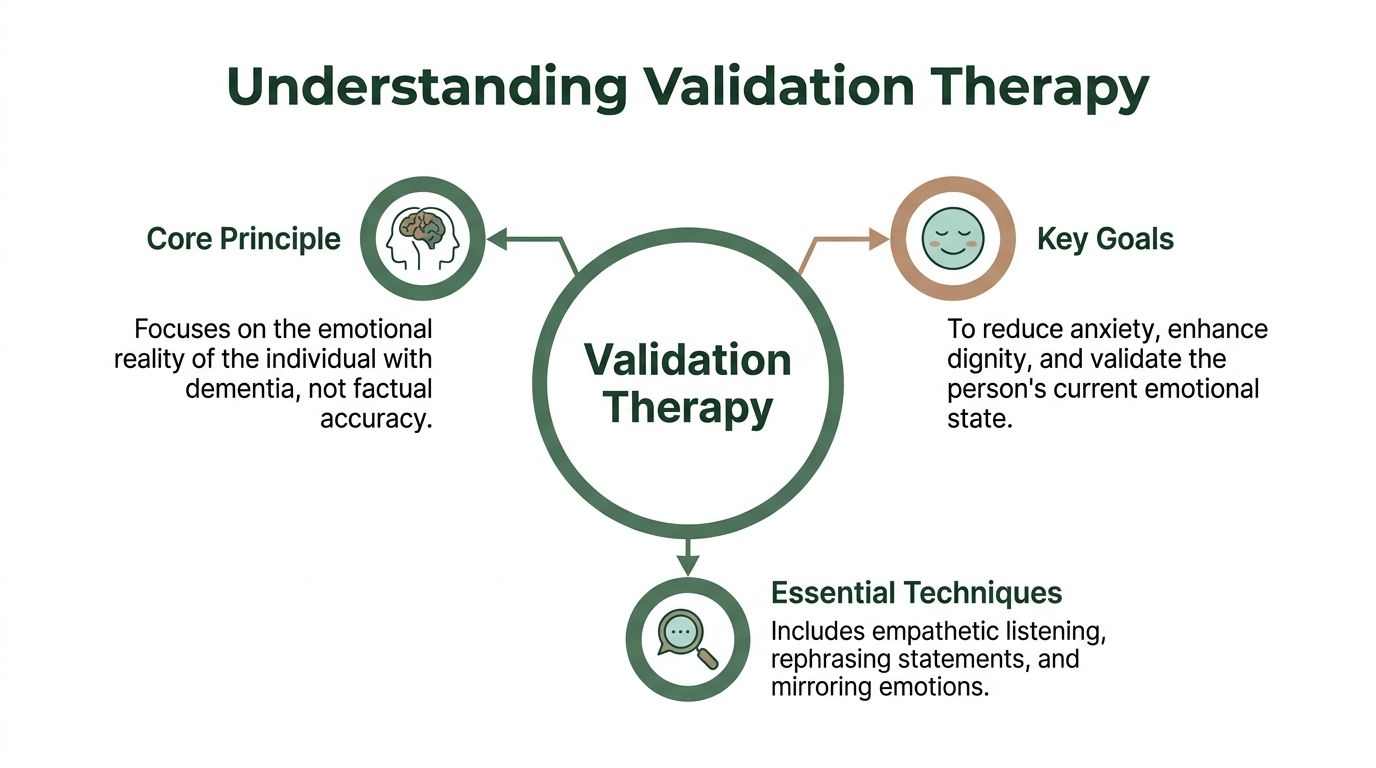
Validation therapy is a person-centered communication approach developed by gerontologist Naomi Feil between the 1960s and 1980s. Her work proposed that accepting disoriented elders as they are, rather than trying to correct them, helps restore self-worth and reduces withdrawal from the outside world. Early research also showed increased communication and reduced aggressive behavior with validation-based care, as described in this overview of Naomi Feil's approach.
The core idea
The heart of validation therapy for dementia is simple. Respond to emotional truth, not just factual accuracy.
If your father says, “I have to pick up the children from school,” the factual response is obvious. His children are grown. But the emotional meaning may be responsibility, worry, or the need to be useful. A validating response doesn't have to confirm the literal statement. It can sound like this:
“You're thinking about the children. You've always taken care of your family.”
“It sounds important to make sure everyone's okay.”
“You feel responsible right now.”
That kind of answer tells the person, “I hear you.” And being heard often matters more than being corrected.
A helpful analogy is this: when someone has a bad dream, you don't usually start by lecturing them that the dream wasn't real. You first comfort the fear. Dementia care often works the same way. The distress comes first. Logic comes second, if it comes at all.
What validation is not
Validation is often misunderstood. It is not the same as lying, tricking, or treating an adult like a child.
It is also not passive. You're doing skilled emotional work. You're observing tone, facial expression, repeated themes, and body language. You're translating confusing statements into unmet needs.
Here's what validation therapy is not:
Approach | What it sounds like | Likely effect |
|---|---|---|
Arguing | “That's wrong. Stop saying that.” | More tension |
Quizzing | “Don't you remember what day it is?” | Shame or frustration |
Dismissing | “You're fine. Don't worry about it.” | Feeling unheard |
Validating | “You seem unsettled. Tell me more.” | More trust |
Validation doesn't ask, “How do I correct this statement?” It asks, “What need or feeling is being expressed here?”
That question changes everything. It gives caregivers something usable in the moment, especially when memory facts keep failing but emotion remains strong.
The Real World Benefits of Validation
Caregivers usually want an honest answer to one question. Does this help?
What the research says
The research picture is mixed. A systematic review of randomized trials found insufficient evidence to draw any definitive conclusion about the efficacy of validation therapy for people with dementia or cognitive impairment. That review examined three studies, did not find statistically significant overall results, but noted trends favoring validation therapy for some outcomes such as reduced stress and anxiety. It also described a study of thirty-three individuals in a 10 week validation program where researchers found reduced depression, along with separate findings reporting improvements in behavioral disturbances, agitation, apathy, irritability, and night-time disturbance in some settings, summarized in the PubMed review of validation therapy evidence.
That's important to say plainly. Validation therapy for dementia is not a cure, and the formal evidence base is still limited.
What caregivers notice day to day
Even with that limitation, practical benefits keep this approach in use. Historical reports describe better communication, more positive affect, and less aggressive behavior. Caregivers also report feeling more capable and finding more pleasure in their work when they use validation-based communication.
One especially meaningful area is medication use. Validation therapy has been associated with reduced reliance on psychotropic medications by lowering agitation and aggression through empathetic, non-confrontational communication, as discussed in Practical Neurology's review of the validation method.
In everyday terms, that makes sense. When a person feels less threatened, they're often less likely to escalate. When escalation drops, the need to control behavior with medication may drop too.
A few benefits show up repeatedly in real care settings:
Calmer personal care moments when the person feels approached with respect
Less back-and-forth arguing because the caregiver isn't forcing reality
More cooperation with dressing, eating, or sitting down
Lower stress for the caregiver because every confused statement doesn't turn into a correction battle
The strongest case for validation is often not that it fixes dementia. It helps people get through the day with less fear and less conflict.
That's a meaningful outcome on its own.
Validation Versus Other Communication Techniques
Caregivers hear a lot of terms. Validation. Reality orientation. Reminiscence. Redirection. Diversion. It's easy to feel like you're supposed to pick one method and use it all the time.
That's usually not how good dementia communication works.
A side by side view
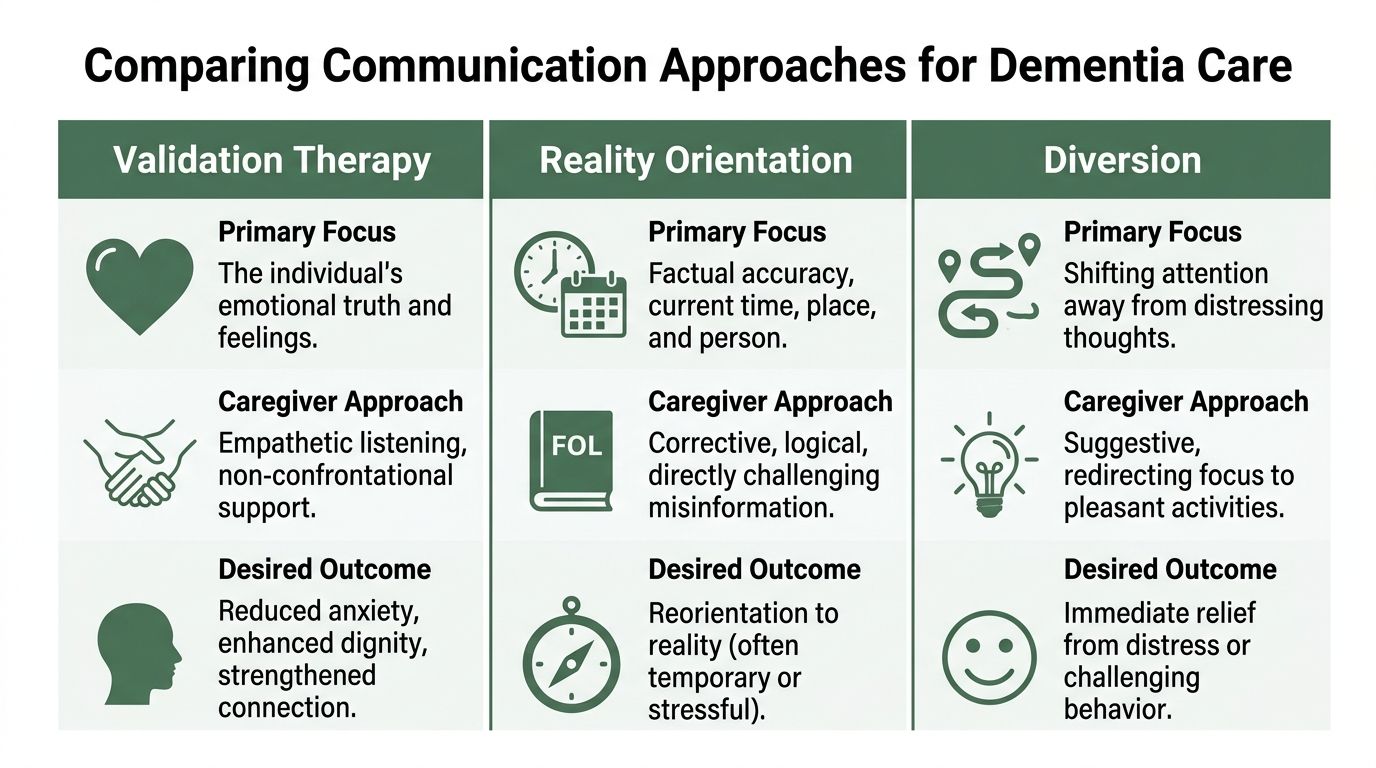
Here's a practical comparison of three common approaches.
Method | Main focus | Best use | Example phrase |
|---|---|---|---|
Validation therapy | Emotion and meaning | Distress, fear, repeated concerns, confusion | “You sound worried. Tell me what feels wrong.” |
Reality orientation | Facts, time, place, identity | Mild confusion in earlier stages, gentle cueing | “Today is Tuesday, and you're at home with me.” |
Diversion | Shifting attention | When a topic keeps increasing distress | “Let's have some tea while you tell me about your old kitchen.” |
Validation is often the better choice when correction makes things worse. Reality orientation can still be useful when the person can accept cues without feeling challenged. Diversion helps when the emotional loop is getting stuck and needs a softer exit.
Reminiscence is also worth mentioning, even though it isn't in the chart above. Its purpose is different. It uses long-term memories, familiar stories, music, photos, or objects to support engagement. In some cases, it fits well alongside validation. Families who want a broader view of structured non-drug support may find it helpful to read about cognitive stimulation therapy and how it differs from other approaches.
Choosing the right approach
A simple decision guide can help in the moment.
Use reality orientation when:
The person is asking for a cue. “What day is it?”
The correction is likely to comfort, not upset.
The confusion is mild and temporary.
Use validation therapy for dementia when:
The person is emotional, not just confused
Correction has already failed
The topic is emotionally loaded, such as home, work, parents, money, or being abandoned
Use diversion when:
The topic keeps looping
The person is too activated to process reassurance
You need to move toward a calmer activity
You don't have to be rigid. Many skilled caregivers validate first, then redirect, and only use factual orientation when it's likely to soothe rather than sting.
Practical Scripts for Using Validation Therapy
Real improvement happens when you can hear the difference between a reflexive response and a validating one.
In controlled observational data, caregiver affirmations using validation techniques produced an 11% increase in the probability of cooperative responses from people living with dementia, as reported in this observational study on affirmations and cooperation. That doesn't mean every script works every time. It does mean your words can measurably affect how a conversation unfolds.
Early stage scripts
In early stage dementia, the person may still tolerate some gentle cueing. You can often combine validation with light orientation.
Situation: “I can't find my purse. Someone took it.”
A common response:
“Nobody stole it. You always misplace things.”
A validating response:
Acknowledge the feeling. “That's upsetting.”
Reflect the concern. “It feels scary when something important is missing.”
Join the search. “Let's look together.”
Why it works: you lower shame first. Then you solve the problem as a team.
Situation: “I need to go to work.”
A common response:
“You retired years ago.”
A validating response:
“Work is on your mind today.”
“You took your responsibilities seriously.”
“What part of the job are you thinking about?”
That last question often reveals the emotional issue underneath. The person may be worried about being late, being needed, or falling short. If anxiety is a frequent part of the picture, this guide on anxiety in dementia patients can help families spot patterns behind these moments.
Mid stage scripts
As dementia progresses, direct correction often lands harder. Simpler language usually works better.
Situation: “I want my mother.”
A common response:
“Your mother died a long time ago.”
A validating response:
“You miss your mother.”
“You want comfort right now.”
“Tell me what you loved about her.”
This doesn't deny loss. It responds to longing.
Situation: “You're not my daughter. I want to go home.”
A common response:
“Of course I'm your daughter. Stop it.”
A validating response:
“You don't feel settled right now.”
“Home feels important.”
“What would home feel like for you right now?”
Sometimes the answer is simple: a blanket, a familiar chair, a snack, softer lighting, less noise.
Here's a helpful demonstration to study and practice out loud:
How to use validation over the phone
Phone calls remove visual cues, so your voice has to carry more of the comfort.
Use these phone-specific habits:
Slow your pace. Fast speech can sound rushed or irritated.
Say the feeling out loud. “You sound uneasy.” On the phone, they can't see your concerned face.
Use the person's name more often. It anchors attention.
Pause longer than feels natural. Processing may take time.
Avoid stacked questions. Ask one thing at a time.
A phone script for “I need to go home” might sound like this:
“You sound uncomfortable.”
“Tell me what home means to you right now.”
“Do you want quiet, company, or help with something?”
A phone script for repeated fear might sound like this:
“I'm here with you.”
“You sound worried.”
“Stay on the line with me while we talk it through.”
On the phone, your tone is part of the intervention. Calm, warm, and unhurried often works better than perfectly chosen words.
A Quick Guide to Validation Dos and Donts
When you're tired, you don't need theory. You need a short list you can remember during a hard moment.

Here's the cheat sheet.
Do
Listen for the feeling. The emotion usually matters more than the literal words.
Name what you hear. “You seem worried” often calms faster than giving facts.
Keep sentences short. Short language is easier to process under stress.
Match the emotional tone. Soft concern works better than cheerful contradiction.
Give time to respond. Silence can feel uncomfortable to you, but helpful to them.
Don't
Argue about facts. Winning the point often means losing the connection.
Ask “why” questions. “Why did you do that?” can sound blaming or confusing.
Dismiss the concern. “You're fine” often doesn't feel reassuring.
Stack corrections. Too much information increases overload.
Rush to fix everything. Comfort first. Problem-solving second.
A good test is this: after you speak, does the person look more settled or more tense? Their nervous system will often tell you whether your approach is helping before their words do.
Navigating Difficult Situations and Finding Support
The hardest part of validation therapy for dementia is the gray area. You want to honor the person's reality, but you also have to keep them safe.
That tension is real. Guidance often doesn't clearly explain how to balance emotional acceptance with daily safety tasks like medication checks or stove use, as described in this discussion of validation and safety concerns in dementia care.
When safety has to come first
If your loved one says, “I already took my pills,” and you know they didn't, don't turn it into a courtroom exchange. You can validate the feeling without validating unsafe action.
Try this pattern:
Validate the emotion or intention.
“You're trying to stay on top of your medicine.”Avoid direct combat over memory.
Don't say, “No, you didn't. You're wrong.”Redirect to a shared check.
“Let's look together so we can both feel sure.”
That same pattern works with the stove, locked doors, or missed appointments.
Examples:
“I turned the stove off.”
“You're being careful. Let's check it together.”“I don't need help showering.”
“You want privacy and independence. I'll stay nearby in case you need me.”“There's nothing wrong with my driving.”
“Losing freedom is hard. Let's talk about what matters most when you go out.”
Validate the feeling. Guide the action. Protect safety.
That's often the clearest way to handle high-stakes moments.
Where to learn and practice more
Validation is a skill. It gets easier with repetition, scripting, and support from people who understand dementia care. Formal training can help, especially for families dealing with repeated distress, resistance to care, or conflict among relatives about the “right” way to respond.
Families also benefit from practical coaching that covers routines, communication habits, and consistency across helpers. Resources on dementia care training for families and care teams can make those day-to-day conversations feel less lonely and less improvised.
If you remember one thing, let it be this. Correction often asks a person with dementia to cross a bridge they can't reliably cross anymore. Validation walks over to meet them first.
If you want added support between visits, Velma offers phone-based cognitive support for older adults in the early to mid stages of dementia. Through scheduled calls, structured conversation, cognitive exercises, and practical check-ins, Velma helps families reinforce routine, monitor well-being, and bring more calm and connection into daily life.
Your mom says, “I need to go home now,” while standing in her own living room. You answer gently at first. “Mom, you are home.” She insists. You repeat yourself. She gets upset. You get tired. Five minutes later, both of you feel worse.
If that kind of exchange is happening in your home, you're not doing anything wrong. Dementia changes how a person processes memory, language, fear, and reassurance. Logic that used to calm them may now make them feel cornered. What sounds like a simple correction to you can feel like a threat or a dismissal to them.
That's where validation therapy for dementia can help. Instead of arguing over facts, you respond to the feeling underneath the words. You stop trying to win the moment and start trying to understand it. For many caregivers, that shift reduces conflict, protects dignity, and makes hard conversations less draining.
This approach matters even more when you're not in the room. Phone calls can be surprisingly difficult in dementia care because you lose facial expressions, eye contact, and touch. But with the right words and tone, validation can still work well over the phone.
Table of Contents
From Frustration to Connection
What Is Validation Therapy
The core idea
What validation is not
The Real World Benefits of Validation
What the research says
What caregivers notice day to day
Validation Versus Other Communication Techniques
A side by side view
Choosing the right approach
Practical Scripts for Using Validation Therapy
Early stage scripts
Mid stage scripts
How to use validation over the phone
A Quick Guide to Validation Dos and Donts
Navigating Difficult Situations and Finding Support
When safety has to come first
Where to learn and practice more
From Frustration to Connection
Most caregivers start with correction because it feels responsible. If your husband says he needs to leave for work after retirement, your instinct is to explain that he retired years ago. If your mother asks for her own mother, you want to protect her from confusion by bringing her back to the present.
But dementia often doesn't respond well to correction.
When a person is disoriented, the words they say may not be factually accurate, but the emotion is often very real. “I need to go home” may mean “I don't feel safe.” “Where is my mother?” may mean “I need comfort.” “Someone stole my purse” may mean “I feel out of control.”
Practical rule: When facts increase distress, respond to the feeling first.
That doesn't mean you agree with everything said. It means you stop treating the conversation like a debate. You listen for fear, grief, loneliness, embarrassment, or urgency. Then you answer that emotion directly.
A simple shift can change the whole tone of the interaction:
Pause before correcting. Give yourself one breath.
Name the feeling. “You sound worried.”
Invite more detail. “Tell me what feels wrong.”
Offer comfort before action. “I'm with you. Let's figure this out together.”
Many families feel guilty when they stop correcting. They worry they're “going along with dementia.” In practice, validation is usually less about agreeing and more about reducing distress enough to help the person feel safe again.
That's why this method can feel like such a relief. You no longer have to force someone back into your reality every time confusion appears. You can meet them where they are, lower the emotional temperature, and rebuild connection one conversation at a time.
What Is Validation Therapy
Validation therapy is a person-centered communication approach developed by gerontologist Naomi Feil between the 1960s and 1980s. Her work proposed that accepting disoriented elders as they are, rather than trying to correct them, helps restore self-worth and reduces withdrawal from the outside world. Early research also showed increased communication and reduced aggressive behavior with validation-based care, as described in this overview of Naomi Feil's approach.
The core idea
The heart of validation therapy for dementia is simple. Respond to emotional truth, not just factual accuracy.
If your father says, “I have to pick up the children from school,” the factual response is obvious. His children are grown. But the emotional meaning may be responsibility, worry, or the need to be useful. A validating response doesn't have to confirm the literal statement. It can sound like this:
“You're thinking about the children. You've always taken care of your family.”
“It sounds important to make sure everyone's okay.”
“You feel responsible right now.”
That kind of answer tells the person, “I hear you.” And being heard often matters more than being corrected.
A helpful analogy is this: when someone has a bad dream, you don't usually start by lecturing them that the dream wasn't real. You first comfort the fear. Dementia care often works the same way. The distress comes first. Logic comes second, if it comes at all.
What validation is not
Validation is often misunderstood. It is not the same as lying, tricking, or treating an adult like a child.
It is also not passive. You're doing skilled emotional work. You're observing tone, facial expression, repeated themes, and body language. You're translating confusing statements into unmet needs.
Here's what validation therapy is not:
Approach | What it sounds like | Likely effect |
|---|---|---|
Arguing | “That's wrong. Stop saying that.” | More tension |
Quizzing | “Don't you remember what day it is?” | Shame or frustration |
Dismissing | “You're fine. Don't worry about it.” | Feeling unheard |
Validating | “You seem unsettled. Tell me more.” | More trust |
Validation doesn't ask, “How do I correct this statement?” It asks, “What need or feeling is being expressed here?”
That question changes everything. It gives caregivers something usable in the moment, especially when memory facts keep failing but emotion remains strong.
The Real World Benefits of Validation
Caregivers usually want an honest answer to one question. Does this help?
What the research says
The research picture is mixed. A systematic review of randomized trials found insufficient evidence to draw any definitive conclusion about the efficacy of validation therapy for people with dementia or cognitive impairment. That review examined three studies, did not find statistically significant overall results, but noted trends favoring validation therapy for some outcomes such as reduced stress and anxiety. It also described a study of thirty-three individuals in a 10 week validation program where researchers found reduced depression, along with separate findings reporting improvements in behavioral disturbances, agitation, apathy, irritability, and night-time disturbance in some settings, summarized in the PubMed review of validation therapy evidence.
That's important to say plainly. Validation therapy for dementia is not a cure, and the formal evidence base is still limited.
What caregivers notice day to day
Even with that limitation, practical benefits keep this approach in use. Historical reports describe better communication, more positive affect, and less aggressive behavior. Caregivers also report feeling more capable and finding more pleasure in their work when they use validation-based communication.
One especially meaningful area is medication use. Validation therapy has been associated with reduced reliance on psychotropic medications by lowering agitation and aggression through empathetic, non-confrontational communication, as discussed in Practical Neurology's review of the validation method.
In everyday terms, that makes sense. When a person feels less threatened, they're often less likely to escalate. When escalation drops, the need to control behavior with medication may drop too.
A few benefits show up repeatedly in real care settings:
Calmer personal care moments when the person feels approached with respect
Less back-and-forth arguing because the caregiver isn't forcing reality
More cooperation with dressing, eating, or sitting down
Lower stress for the caregiver because every confused statement doesn't turn into a correction battle
The strongest case for validation is often not that it fixes dementia. It helps people get through the day with less fear and less conflict.
That's a meaningful outcome on its own.
Validation Versus Other Communication Techniques
Caregivers hear a lot of terms. Validation. Reality orientation. Reminiscence. Redirection. Diversion. It's easy to feel like you're supposed to pick one method and use it all the time.
That's usually not how good dementia communication works.
A side by side view
Here's a practical comparison of three common approaches.
Method | Main focus | Best use | Example phrase |
|---|---|---|---|
Validation therapy | Emotion and meaning | Distress, fear, repeated concerns, confusion | “You sound worried. Tell me what feels wrong.” |
Reality orientation | Facts, time, place, identity | Mild confusion in earlier stages, gentle cueing | “Today is Tuesday, and you're at home with me.” |
Diversion | Shifting attention | When a topic keeps increasing distress | “Let's have some tea while you tell me about your old kitchen.” |
Validation is often the better choice when correction makes things worse. Reality orientation can still be useful when the person can accept cues without feeling challenged. Diversion helps when the emotional loop is getting stuck and needs a softer exit.
Reminiscence is also worth mentioning, even though it isn't in the chart above. Its purpose is different. It uses long-term memories, familiar stories, music, photos, or objects to support engagement. In some cases, it fits well alongside validation. Families who want a broader view of structured non-drug support may find it helpful to read about cognitive stimulation therapy and how it differs from other approaches.
Choosing the right approach
A simple decision guide can help in the moment.
Use reality orientation when:
The person is asking for a cue. “What day is it?”
The correction is likely to comfort, not upset.
The confusion is mild and temporary.
Use validation therapy for dementia when:
The person is emotional, not just confused
Correction has already failed
The topic is emotionally loaded, such as home, work, parents, money, or being abandoned
Use diversion when:
The topic keeps looping
The person is too activated to process reassurance
You need to move toward a calmer activity
You don't have to be rigid. Many skilled caregivers validate first, then redirect, and only use factual orientation when it's likely to soothe rather than sting.
Practical Scripts for Using Validation Therapy
Real improvement happens when you can hear the difference between a reflexive response and a validating one.
In controlled observational data, caregiver affirmations using validation techniques produced an 11% increase in the probability of cooperative responses from people living with dementia, as reported in this observational study on affirmations and cooperation. That doesn't mean every script works every time. It does mean your words can measurably affect how a conversation unfolds.
Early stage scripts
In early stage dementia, the person may still tolerate some gentle cueing. You can often combine validation with light orientation.
Situation: “I can't find my purse. Someone took it.”
A common response:
“Nobody stole it. You always misplace things.”
A validating response:
Acknowledge the feeling. “That's upsetting.”
Reflect the concern. “It feels scary when something important is missing.”
Join the search. “Let's look together.”
Why it works: you lower shame first. Then you solve the problem as a team.
Situation: “I need to go to work.”
A common response:
“You retired years ago.”
A validating response:
“Work is on your mind today.”
“You took your responsibilities seriously.”
“What part of the job are you thinking about?”
That last question often reveals the emotional issue underneath. The person may be worried about being late, being needed, or falling short. If anxiety is a frequent part of the picture, this guide on anxiety in dementia patients can help families spot patterns behind these moments.
Mid stage scripts
As dementia progresses, direct correction often lands harder. Simpler language usually works better.
Situation: “I want my mother.”
A common response:
“Your mother died a long time ago.”
A validating response:
“You miss your mother.”
“You want comfort right now.”
“Tell me what you loved about her.”
This doesn't deny loss. It responds to longing.
Situation: “You're not my daughter. I want to go home.”
A common response:
“Of course I'm your daughter. Stop it.”
A validating response:
“You don't feel settled right now.”
“Home feels important.”
“What would home feel like for you right now?”
Sometimes the answer is simple: a blanket, a familiar chair, a snack, softer lighting, less noise.
Here's a helpful demonstration to study and practice out loud:
How to use validation over the phone
Phone calls remove visual cues, so your voice has to carry more of the comfort.
Use these phone-specific habits:
Slow your pace. Fast speech can sound rushed or irritated.
Say the feeling out loud. “You sound uneasy.” On the phone, they can't see your concerned face.
Use the person's name more often. It anchors attention.
Pause longer than feels natural. Processing may take time.
Avoid stacked questions. Ask one thing at a time.
A phone script for “I need to go home” might sound like this:
“You sound uncomfortable.”
“Tell me what home means to you right now.”
“Do you want quiet, company, or help with something?”
A phone script for repeated fear might sound like this:
“I'm here with you.”
“You sound worried.”
“Stay on the line with me while we talk it through.”
On the phone, your tone is part of the intervention. Calm, warm, and unhurried often works better than perfectly chosen words.
A Quick Guide to Validation Dos and Donts
When you're tired, you don't need theory. You need a short list you can remember during a hard moment.
Here's the cheat sheet.
Do
Listen for the feeling. The emotion usually matters more than the literal words.
Name what you hear. “You seem worried” often calms faster than giving facts.
Keep sentences short. Short language is easier to process under stress.
Match the emotional tone. Soft concern works better than cheerful contradiction.
Give time to respond. Silence can feel uncomfortable to you, but helpful to them.
Don't
Argue about facts. Winning the point often means losing the connection.
Ask “why” questions. “Why did you do that?” can sound blaming or confusing.
Dismiss the concern. “You're fine” often doesn't feel reassuring.
Stack corrections. Too much information increases overload.
Rush to fix everything. Comfort first. Problem-solving second.
A good test is this: after you speak, does the person look more settled or more tense? Their nervous system will often tell you whether your approach is helping before their words do.
Navigating Difficult Situations and Finding Support
The hardest part of validation therapy for dementia is the gray area. You want to honor the person's reality, but you also have to keep them safe.
That tension is real. Guidance often doesn't clearly explain how to balance emotional acceptance with daily safety tasks like medication checks or stove use, as described in this discussion of validation and safety concerns in dementia care.
When safety has to come first
If your loved one says, “I already took my pills,” and you know they didn't, don't turn it into a courtroom exchange. You can validate the feeling without validating unsafe action.
Try this pattern:
Validate the emotion or intention.
“You're trying to stay on top of your medicine.”Avoid direct combat over memory.
Don't say, “No, you didn't. You're wrong.”Redirect to a shared check.
“Let's look together so we can both feel sure.”
That same pattern works with the stove, locked doors, or missed appointments.
Examples:
“I turned the stove off.”
“You're being careful. Let's check it together.”“I don't need help showering.”
“You want privacy and independence. I'll stay nearby in case you need me.”“There's nothing wrong with my driving.”
“Losing freedom is hard. Let's talk about what matters most when you go out.”
Validate the feeling. Guide the action. Protect safety.
That's often the clearest way to handle high-stakes moments.
Where to learn and practice more
Validation is a skill. It gets easier with repetition, scripting, and support from people who understand dementia care. Formal training can help, especially for families dealing with repeated distress, resistance to care, or conflict among relatives about the “right” way to respond.
Families also benefit from practical coaching that covers routines, communication habits, and consistency across helpers. Resources on dementia care training for families and care teams can make those day-to-day conversations feel less lonely and less improvised.
If you remember one thing, let it be this. Correction often asks a person with dementia to cross a bridge they can't reliably cross anymore. Validation walks over to meet them first.
If you want added support between visits, Velma offers phone-based cognitive support for older adults in the early to mid stages of dementia. Through scheduled calls, structured conversation, cognitive exercises, and practical check-ins, Velma helps families reinforce routine, monitor well-being, and bring more calm and connection into daily life.
Suggested Article: