How to Help Someone with Memory Loss: A Practical Guide

You notice it in a small moment first. Your mother pauses in the middle of making tea and asks what day it is, then asks again ten minutes later. Your husband tells the same story twice at dinner and gets irritated when you point it out. Your father sounds fine on the phone until you realize he hasn't answered the specific question you asked.
That quiet shift can feel harder than the dramatic moments people talk about. You're not only trying to figure out how to help someone with memory loss. You're also trying to hold onto the relationship you had before memory started changing the rules.
Most families don't need another cold checklist. They need practical ways to reduce confusion, respond without constant conflict, and protect dignity while daily life gets more complicated. They also need someone to say that sadness, frustration, guilt, and love can all exist at the same time.
Table of Contents
Navigating the Journey of Memory Loss Together
Preserve dignity before you chase perfection
Small changes in approach can change the whole day
Mastering Empathetic Communication Strategies
Shift the goal from accuracy to comfort
Try this, not that
Nonverbal reassurance still counts
Creating a Supportive and Predictable Daily Structure
Build a rhythm, not a rigid schedule
Simple tools that reduce confusion
Calm spaces support better function
Ensuring Safety Without Sacrificing Independence
Think in terms of friction and risk
Low-tech check-ins often work better than complicated systems
Encouraging Meaningful Activities and Engagement
Choose activities that feel familiar and achievable
Use structure without making it feel like therapy
Caring for Yourself and Knowing When to Get Help
Memory grief is real
Know when to add help
Navigating the Journey of Memory Loss Together
The hardest part for many families isn't one major crisis. It's the accumulation of small changes. A loved one misplaces bills, forgets a neighbor's name, repeats a question, or becomes uneasy in places that used to feel easy. You start compensating without even realizing it. You remind, smooth over, repeat, and watch for signs that things are changing faster than anyone wants to admit.
That stage can leave caregivers feeling stuck. If you say too much, it sounds harsh. If you say too little, it feels irresponsible. If you find yourself in this situation, you're not failing. You're adjusting to a condition that changes communication, daily routines, and the emotional tone of the home.
A lot of people first look for medical explanations, and that's appropriate. If you want a broader overview of what changing thinking and memory can look like over time, this guide on cognitive decline in older adults is a useful starting point. But day-to-day care usually comes down to something more immediate. How do you help the person in front of you right now, this morning, during this conversation, in this house?
Preserve dignity before you chase perfection
Families often assume good care means catching every mistake. In practice, that approach usually creates more stress. Correcting every detail, testing memory, or pointing out every lapse can make a person feel cornered. They may become defensive, ashamed, or more withdrawn.
A better standard is this:
Help the person function with as much calm, familiarity, and self-respect as possible.
That means paying attention to five things that matter every day:
Communication that lowers distress: Use language that reassures instead of challenges.
Routine that reduces cognitive load: Keep days familiar enough that fewer decisions are required.
Safety that supports autonomy: Remove hazards without turning the home into a controlled environment.
Meaningful engagement: Give the person something to do, enjoy, and participate in.
Caregiver support: Protect your own energy so care stays humane and sustainable.
Small changes in approach can change the whole day
The families who cope best usually aren't the ones doing the most. They're the ones doing the most useful things consistently. They speak more clearly. They stop arguing over facts that don't matter. They create gentle routines. They put supports in place before a crisis forces them to.
That doesn't remove the heartbreak. It does make the day more manageable, and it helps preserve connection. For many people, that becomes the primary focus of memory care.
Mastering Empathetic Communication Strategies
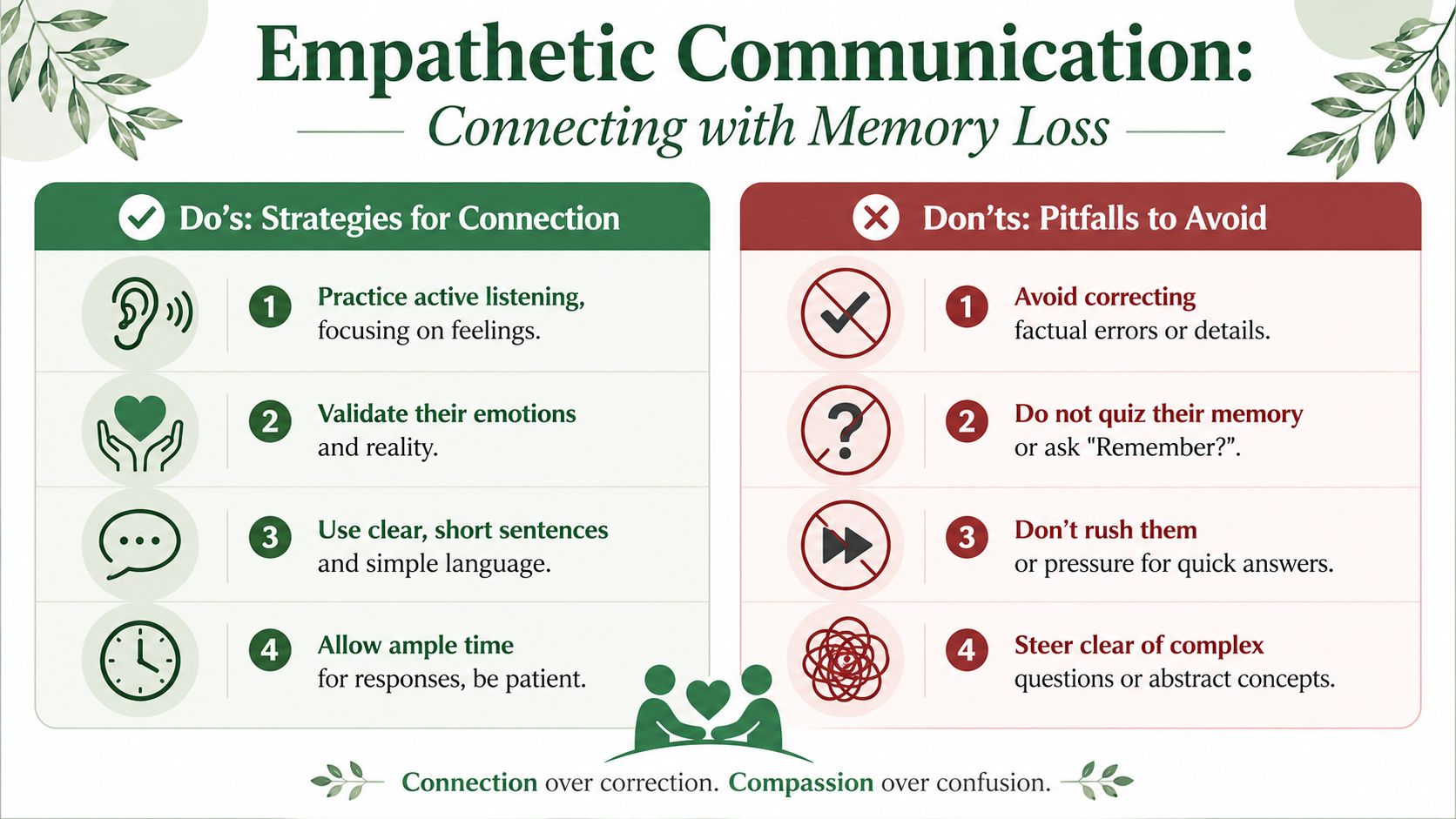
When memory is unreliable, conversation can become a minefield. A simple question can sound like a test. A correction can feel like humiliation. The goal isn't to win the facts. The goal is to help the person feel safe enough to stay connected.
Shift the goal from accuracy to comfort
Start with your tone before your words. Approach from the front, make eye contact if it's comfortable for them, and speak slowly enough that your pace doesn't add pressure. Use short sentences and one idea at a time.
If your loved one is anxious, repeated correction usually makes the anxiety worse. This matters a lot when memory loss overlaps with fear, agitation, or suspiciousness. Families dealing with those patterns often benefit from practical guidance on anxiety in dementia patients, because the emotional state often drives the conversation more than the factual mistake.
Core principle: Validate the feeling first. Correct facts only when safety truly depends on it.
That approach is often called joining the person's reality. It doesn't mean agreeing with everything. It means responding to the emotion underneath the statement. If someone says, "I need to go pick up the children," the most useful answer usually isn't, "Your children are adults." A calmer answer is, "You want to make sure they're safe. Tell me about them while we sit down for some tea."
Try this, not that
Some phrases reliably escalate stress. Others open the door to cooperation.
Situation | Try this | Not that |
|---|---|---|
Repeated question | "Dinner is at six. I'll remind you again." | "I already told you that three times." |
Confused statement | "That sounds upsetting. Let's sort it out together." | "That's not what happened." |
Searching for a word | "Take your time. Show me what you mean." | "Come on, you know this." |
Wanting to go home while at home | "You want to feel settled and safe." | "But you are home." |
A few habits make a bigger difference than people expect:
Replace memory tests with support: Don't ask, "Do you remember?" Say, "Let me help fill that in."
Offer either-or choices: "Would you like soup or a sandwich?" works better than open-ended questions.
Pause longer than feels natural: People with memory loss often need extra time to process.
Use gentle redirection: If a topic is looping, shift toward a familiar task, photo, snack, or song.
Nonverbal reassurance still counts
Communication isn't only verbal. A relaxed face, an open posture, sitting beside instead of standing over, and a hand on the shoulder, if welcome, can do more than a perfectly phrased sentence.
This becomes especially important during what many caregivers describe as memory grief. The person may forget shared history, misname relatives, or ask for someone who died years ago. Those moments hurt because they touch identity, not just memory. In those moments, your calm presence often matters more than your explanation.
"You don't have to force reality into place every time. You do need to reduce distress."
If you remember one rule, make it this. Respond to the need, not just the words.
Creating a Supportive and Predictable Daily Structure
A person with memory loss often does better in an environment that asks less of them. Too many choices, unclear cues, and inconsistent routines increase confusion. A steadier day lowers the mental effort required to get through ordinary tasks.

Build a rhythm, not a rigid schedule
Families sometimes overcorrect. They create a timetable so detailed that everyone ends up tense. What helps more is a predictable flow. Wake up at roughly the same time. Keep meals consistent. Place activities at the same points in the day. Keep bedtime familiar.
That kind of rhythm reduces the need to constantly reorient. The person doesn't have to solve, "What's happening now?" every hour. They start to rely on pattern, which is often easier than relying on recent memory.
A good daily structure often includes:
Morning anchors: Open curtains, get dressed, wash up, eat breakfast.
Midday activity: A walk, folding laundry, music, or a simple household task.
Afternoon quiet: Rest, reading, looking through photos, or sitting outdoors.
Evening wind-down: Lower noise, softer lighting, familiar television or music, and an unhurried bedtime routine.
Simple tools that reduce confusion
You don't need complicated equipment. You need visible cues placed where the person naturally looks.
Try a few practical supports:
Large calendar in a central spot: Write appointments, visits, and the day clearly.
Whiteboard for today's plan: Keep it short. "Tuesday. Lunch with Anna. Take walk. Chicken for dinner."
Easy-to-read clocks: Put them in rooms where the person spends time.
Labels on cupboards and drawers: Words or simple pictures can help.
A consistent landing place: Keys, glasses, wallet, hearing aids, and phone should always go in the same spot.
These tools work best when they fit the person's habits. A calendar in a back hallway won't help if they never go there. A medication note hidden in a drawer won't guide anyone. Put cues in plain sight and keep them simple enough to read at a glance.
Practical rule: If the system takes too much explaining, it probably won't reduce confusion.
Calm spaces support better function
The home doesn't need to look clinical. It does need fewer visual traps. Reduce clutter on counters. Keep pathways open. Limit competing noise from multiple televisions or devices. Make sure useful items are visible and easy to reach.
Notice timing, too. Some people do best with conversations and tasks in the morning. Others get more unsettled late in the day and need less stimulation then. If bathing, dressing, or appointments cause regular conflict, shift the timing before assuming the task itself is the problem.
The right structure doesn't make memory loss disappear. It does make daily life feel less demanding, and that often brings down anxiety for everyone in the house.
Ensuring Safety Without Sacrificing Independence
Families often swing between two extremes. They either minimize risk because they don't want to upset the person, or they impose restrictions so quickly that the person loses confidence. Neither works well.
Safety should function like a handrail. It supports movement. It doesn't replace it.
Think in terms of friction and risk
Look around the home and ask a simple question. What could turn one forgetful moment into an injury, medication error, or emergency? Start there.
Common pressure points include walking paths, stairs, bathrooms, kitchen appliances, expired food, and missed medications. Small modifications often do more good than dramatic interventions.
Consider this home safety check:
Floors and pathways: Remove loose rugs, cords, unstable stools, and clutter.
Lighting: Brighten hallways, entrances, bathrooms, and the route from bed to toilet.
Kitchen risk: Use automatic shut-off features when available, keep frequently used items visible, and simplify what stays on the counter.
Medication setup: Use a clearly organized system and check whether doses are being consumed, not just set out.
Entry and exit awareness: Notice whether the person becomes disoriented near doors, especially at certain times of day.
Respect matters in how you make changes. Don't announce, "You can't handle this anymore." Say, "Let's make this easier," or "I want this to be less frustrating." People usually accept support more readily when it feels collaborative.
Low-tech check-ins often work better than complicated systems
If someone lives alone, families often assume an app or device is the obvious answer. In reality, access and usability are major barriers. Data from 2025 shows that 72% of early-stage dementia patients in rural or low-income areas struggle to access app-based cognitive therapies, and human-led, voice-only channels like phone calls are proven 30% more effective at reducing anxiety than digital tools for users with mid-stage cognitive decline according to this Health in Aging caregiver guide on memory problems.
That finding matches what many families experience. A reliable phone call can reveal things a dashboard misses. Is their speech slower today? Do they sound breathless? Are they confused about medication, the stove, or whether they've eaten? Those details matter.
Phone-based support can also be structured. Research on telephone-delivered psychosocial interventions for dementia caregivers found reductions in psychosocial distress of 20 to 30% and noted that scheduled calls using structured coaching can be as effective as internet-based delivery while being more feasible for older populations. One reason is practical. Strong phone protocols can include verbal safety checks around mobility, medication adherence, and household risks that might otherwise go unnoticed.
If your family needs more regular support between visits, one option is a program like Velma, which uses scheduled phone calls for cognitive engagement, emotional support, and practical check-ins. It doesn't replace family or medical care, but it can complement both when consistency is the challenge.
Encouraging Meaningful Activities and Engagement
People with memory loss still need purpose, pleasure, and moments of success. The mistake families make is treating activity like a test. Once an activity feels like performance, many people shut down.
Meaningful engagement should feel familiar, achievable, and emotionally safe.

Choose activities that feel familiar and achievable
Start with the person's old identity. Someone who loved cooking may enjoy washing produce, stirring batter, or setting out napkins. A former gardener may sort seed packets, water plants, or sit outside naming flowers. A parent who always kept a neat house may take comfort in folding towels or matching socks.
This isn't busywork when it fits the person. It's continuity.
A few reliable categories work well:
Reminiscence activities: Looking at old photos, talking about weddings, jobs, favorite trips, neighborhoods, or family recipes.
Sensory activities: Music, hand lotion, warm tea, brushing a pet, handling fabric, shelling peas.
Functional tasks: Sorting mail, wiping the table, sweeping a porch, pairing socks, organizing buttons.
Gentle creative options: Coloring, arranging flowers, humming along to songs, simple crafts with visible steps.
There's good reason to take this seriously. Cognitive Stimulation Therapy (CST), which includes activities such as word games, reality orientation, and reminiscence, is one of the few non-pharmacological interventions shown in randomized controlled trials to provide small but significant short-term cognitive benefits and improve quality of life for people with mild to moderate dementia, as summarized by the National Council of Certified Dementia Practitioners evidence review.
For families, the takeaway isn't that you must recreate a formal therapy program at home. It's that conversation, orientation, and pleasant thinking activities do matter.
If you want ideas centered specifically on life story and familiar memories, this guide to reminiscence therapy for dementia can help you turn old photos, music, and stories into calmer, more connected moments.
Use structure without making it feel like therapy
You don't need to say, "Let's do brain exercises now." That framing often creates resistance. Instead, build engagement into ordinary interaction.
Try patterns like these:
Begin with orientation gently: Mention the day, weather, or time of day in passing.
Move into a familiar topic: Ask about an old job, hometown, favorite meal, or holiday tradition.
Add a simple task: Sort, fold, water, stir, match, or choose.
End before fatigue takes over: Stop while the person still feels successful.
This short video offers a useful example of activity-based support in practice.
A successful activity is one that leaves the person calmer, more engaged, or more settled than before.
Some days the person won't want to participate. That's normal. On those days, reduce the demand. Sit together. Play familiar music. Peel oranges. Watch birds at the window. The point isn't productivity. It's preserving access to interest, comfort, and connection.
Caring for Yourself and Knowing When to Get Help
Caregiving often turns into emotional overextension long before people admit it. You answer the same question again and again. You soften every correction. You carry the appointments, the worry, the vigilance, and the quiet grief. Then you wonder why you're exhausted.

Memory grief is real
One of the least discussed parts of dementia care is memory grief. You can feel bereaved while the person is still alive and sitting across from you. They may forget your shared stories, confuse names, or seem emotionally different in ways that are hard to explain to other people.
That strain isn't rare. Sixty percent of dementia caregivers report severe loneliness and isolation, and 45% feel unprepared to handle repetitive questioning or emotional distress from their loved one, according to Alzheimer's Society guidance on memory loss support tips. Those two realities often feed each other. When you feel alone and underprepared, ordinary caregiving moments become heavier.
What helps is rarely heroic. It is concrete.
Take breaks before you're desperate: Even brief respite helps you return with more patience.
Lower the standard from perfect to sustainable: A calm meal matters more than a perfectly balanced one every day.
Tell the truth to someone safe: A sibling, friend, therapist, clergy member, or support group can hold what you can't keep carrying alone.
Notice your own warning signs: Irritability, sleep disruption, dread, numbness, and resentment usually mean you need more support, not more guilt.
You are not supposed to absorb every part of this alone.
Know when to add help
Families often wait too long because asking for help feels like giving up. It isn't. It's a care decision.
It may be time to bring in outside support when you notice patterns like these:
Safety concerns are increasing: Missed medications, kitchen mistakes, falls, wandering, or confusion during phone calls.
Communication is breaking down daily: Nearly every interaction turns into conflict, panic, or distress.
The caregiver is depleted: You're no longer recovering between hard days.
The person needs more structure than the family can provide consistently: Especially if they live alone or far from relatives.
That support can take different forms. A primary care clinician or neurologist can evaluate changing symptoms. A geriatric care manager or social worker can help coordinate services. Home care can cover practical needs. Structured phone-based programs can add regular check-ins, emotional support, and cognitive engagement between family visits.
The best time to add help is usually before the next crisis, not after it.
If you need steadier support between visits, Velma offers scheduled phone-based cognitive support for older adults with memory loss, including conversation, structured cognitive activities, and practical check-ins that can complement family care. For families trying to protect connection while reducing daily uncertainty, that kind of consistent human contact can be a useful layer of support.
You notice it in a small moment first. Your mother pauses in the middle of making tea and asks what day it is, then asks again ten minutes later. Your husband tells the same story twice at dinner and gets irritated when you point it out. Your father sounds fine on the phone until you realize he hasn't answered the specific question you asked.
That quiet shift can feel harder than the dramatic moments people talk about. You're not only trying to figure out how to help someone with memory loss. You're also trying to hold onto the relationship you had before memory started changing the rules.
Most families don't need another cold checklist. They need practical ways to reduce confusion, respond without constant conflict, and protect dignity while daily life gets more complicated. They also need someone to say that sadness, frustration, guilt, and love can all exist at the same time.
Table of Contents
Navigating the Journey of Memory Loss Together
Preserve dignity before you chase perfection
Small changes in approach can change the whole day
Mastering Empathetic Communication Strategies
Shift the goal from accuracy to comfort
Try this, not that
Nonverbal reassurance still counts
Creating a Supportive and Predictable Daily Structure
Build a rhythm, not a rigid schedule
Simple tools that reduce confusion
Calm spaces support better function
Ensuring Safety Without Sacrificing Independence
Think in terms of friction and risk
Low-tech check-ins often work better than complicated systems
Encouraging Meaningful Activities and Engagement
Choose activities that feel familiar and achievable
Use structure without making it feel like therapy
Caring for Yourself and Knowing When to Get Help
Memory grief is real
Know when to add help
Navigating the Journey of Memory Loss Together
The hardest part for many families isn't one major crisis. It's the accumulation of small changes. A loved one misplaces bills, forgets a neighbor's name, repeats a question, or becomes uneasy in places that used to feel easy. You start compensating without even realizing it. You remind, smooth over, repeat, and watch for signs that things are changing faster than anyone wants to admit.
That stage can leave caregivers feeling stuck. If you say too much, it sounds harsh. If you say too little, it feels irresponsible. If you find yourself in this situation, you're not failing. You're adjusting to a condition that changes communication, daily routines, and the emotional tone of the home.
A lot of people first look for medical explanations, and that's appropriate. If you want a broader overview of what changing thinking and memory can look like over time, this guide on cognitive decline in older adults is a useful starting point. But day-to-day care usually comes down to something more immediate. How do you help the person in front of you right now, this morning, during this conversation, in this house?
Preserve dignity before you chase perfection
Families often assume good care means catching every mistake. In practice, that approach usually creates more stress. Correcting every detail, testing memory, or pointing out every lapse can make a person feel cornered. They may become defensive, ashamed, or more withdrawn.
A better standard is this:
Help the person function with as much calm, familiarity, and self-respect as possible.
That means paying attention to five things that matter every day:
Communication that lowers distress: Use language that reassures instead of challenges.
Routine that reduces cognitive load: Keep days familiar enough that fewer decisions are required.
Safety that supports autonomy: Remove hazards without turning the home into a controlled environment.
Meaningful engagement: Give the person something to do, enjoy, and participate in.
Caregiver support: Protect your own energy so care stays humane and sustainable.
Small changes in approach can change the whole day
The families who cope best usually aren't the ones doing the most. They're the ones doing the most useful things consistently. They speak more clearly. They stop arguing over facts that don't matter. They create gentle routines. They put supports in place before a crisis forces them to.
That doesn't remove the heartbreak. It does make the day more manageable, and it helps preserve connection. For many people, that becomes the primary focus of memory care.
Mastering Empathetic Communication Strategies
When memory is unreliable, conversation can become a minefield. A simple question can sound like a test. A correction can feel like humiliation. The goal isn't to win the facts. The goal is to help the person feel safe enough to stay connected.
Shift the goal from accuracy to comfort
Start with your tone before your words. Approach from the front, make eye contact if it's comfortable for them, and speak slowly enough that your pace doesn't add pressure. Use short sentences and one idea at a time.
If your loved one is anxious, repeated correction usually makes the anxiety worse. This matters a lot when memory loss overlaps with fear, agitation, or suspiciousness. Families dealing with those patterns often benefit from practical guidance on anxiety in dementia patients, because the emotional state often drives the conversation more than the factual mistake.
Core principle: Validate the feeling first. Correct facts only when safety truly depends on it.
That approach is often called joining the person's reality. It doesn't mean agreeing with everything. It means responding to the emotion underneath the statement. If someone says, "I need to go pick up the children," the most useful answer usually isn't, "Your children are adults." A calmer answer is, "You want to make sure they're safe. Tell me about them while we sit down for some tea."
Try this, not that
Some phrases reliably escalate stress. Others open the door to cooperation.
Situation | Try this | Not that |
|---|---|---|
Repeated question | "Dinner is at six. I'll remind you again." | "I already told you that three times." |
Confused statement | "That sounds upsetting. Let's sort it out together." | "That's not what happened." |
Searching for a word | "Take your time. Show me what you mean." | "Come on, you know this." |
Wanting to go home while at home | "You want to feel settled and safe." | "But you are home." |
A few habits make a bigger difference than people expect:
Replace memory tests with support: Don't ask, "Do you remember?" Say, "Let me help fill that in."
Offer either-or choices: "Would you like soup or a sandwich?" works better than open-ended questions.
Pause longer than feels natural: People with memory loss often need extra time to process.
Use gentle redirection: If a topic is looping, shift toward a familiar task, photo, snack, or song.
Nonverbal reassurance still counts
Communication isn't only verbal. A relaxed face, an open posture, sitting beside instead of standing over, and a hand on the shoulder, if welcome, can do more than a perfectly phrased sentence.
This becomes especially important during what many caregivers describe as memory grief. The person may forget shared history, misname relatives, or ask for someone who died years ago. Those moments hurt because they touch identity, not just memory. In those moments, your calm presence often matters more than your explanation.
"You don't have to force reality into place every time. You do need to reduce distress."
If you remember one rule, make it this. Respond to the need, not just the words.
Creating a Supportive and Predictable Daily Structure
A person with memory loss often does better in an environment that asks less of them. Too many choices, unclear cues, and inconsistent routines increase confusion. A steadier day lowers the mental effort required to get through ordinary tasks.
Build a rhythm, not a rigid schedule
Families sometimes overcorrect. They create a timetable so detailed that everyone ends up tense. What helps more is a predictable flow. Wake up at roughly the same time. Keep meals consistent. Place activities at the same points in the day. Keep bedtime familiar.
That kind of rhythm reduces the need to constantly reorient. The person doesn't have to solve, "What's happening now?" every hour. They start to rely on pattern, which is often easier than relying on recent memory.
A good daily structure often includes:
Morning anchors: Open curtains, get dressed, wash up, eat breakfast.
Midday activity: A walk, folding laundry, music, or a simple household task.
Afternoon quiet: Rest, reading, looking through photos, or sitting outdoors.
Evening wind-down: Lower noise, softer lighting, familiar television or music, and an unhurried bedtime routine.
Simple tools that reduce confusion
You don't need complicated equipment. You need visible cues placed where the person naturally looks.
Try a few practical supports:
Large calendar in a central spot: Write appointments, visits, and the day clearly.
Whiteboard for today's plan: Keep it short. "Tuesday. Lunch with Anna. Take walk. Chicken for dinner."
Easy-to-read clocks: Put them in rooms where the person spends time.
Labels on cupboards and drawers: Words or simple pictures can help.
A consistent landing place: Keys, glasses, wallet, hearing aids, and phone should always go in the same spot.
These tools work best when they fit the person's habits. A calendar in a back hallway won't help if they never go there. A medication note hidden in a drawer won't guide anyone. Put cues in plain sight and keep them simple enough to read at a glance.
Practical rule: If the system takes too much explaining, it probably won't reduce confusion.
Calm spaces support better function
The home doesn't need to look clinical. It does need fewer visual traps. Reduce clutter on counters. Keep pathways open. Limit competing noise from multiple televisions or devices. Make sure useful items are visible and easy to reach.
Notice timing, too. Some people do best with conversations and tasks in the morning. Others get more unsettled late in the day and need less stimulation then. If bathing, dressing, or appointments cause regular conflict, shift the timing before assuming the task itself is the problem.
The right structure doesn't make memory loss disappear. It does make daily life feel less demanding, and that often brings down anxiety for everyone in the house.
Ensuring Safety Without Sacrificing Independence
Families often swing between two extremes. They either minimize risk because they don't want to upset the person, or they impose restrictions so quickly that the person loses confidence. Neither works well.
Safety should function like a handrail. It supports movement. It doesn't replace it.
Think in terms of friction and risk
Look around the home and ask a simple question. What could turn one forgetful moment into an injury, medication error, or emergency? Start there.
Common pressure points include walking paths, stairs, bathrooms, kitchen appliances, expired food, and missed medications. Small modifications often do more good than dramatic interventions.
Consider this home safety check:
Floors and pathways: Remove loose rugs, cords, unstable stools, and clutter.
Lighting: Brighten hallways, entrances, bathrooms, and the route from bed to toilet.
Kitchen risk: Use automatic shut-off features when available, keep frequently used items visible, and simplify what stays on the counter.
Medication setup: Use a clearly organized system and check whether doses are being consumed, not just set out.
Entry and exit awareness: Notice whether the person becomes disoriented near doors, especially at certain times of day.
Respect matters in how you make changes. Don't announce, "You can't handle this anymore." Say, "Let's make this easier," or "I want this to be less frustrating." People usually accept support more readily when it feels collaborative.
Low-tech check-ins often work better than complicated systems
If someone lives alone, families often assume an app or device is the obvious answer. In reality, access and usability are major barriers. Data from 2025 shows that 72% of early-stage dementia patients in rural or low-income areas struggle to access app-based cognitive therapies, and human-led, voice-only channels like phone calls are proven 30% more effective at reducing anxiety than digital tools for users with mid-stage cognitive decline according to this Health in Aging caregiver guide on memory problems.
That finding matches what many families experience. A reliable phone call can reveal things a dashboard misses. Is their speech slower today? Do they sound breathless? Are they confused about medication, the stove, or whether they've eaten? Those details matter.
Phone-based support can also be structured. Research on telephone-delivered psychosocial interventions for dementia caregivers found reductions in psychosocial distress of 20 to 30% and noted that scheduled calls using structured coaching can be as effective as internet-based delivery while being more feasible for older populations. One reason is practical. Strong phone protocols can include verbal safety checks around mobility, medication adherence, and household risks that might otherwise go unnoticed.
If your family needs more regular support between visits, one option is a program like Velma, which uses scheduled phone calls for cognitive engagement, emotional support, and practical check-ins. It doesn't replace family or medical care, but it can complement both when consistency is the challenge.
Encouraging Meaningful Activities and Engagement
People with memory loss still need purpose, pleasure, and moments of success. The mistake families make is treating activity like a test. Once an activity feels like performance, many people shut down.
Meaningful engagement should feel familiar, achievable, and emotionally safe.
Choose activities that feel familiar and achievable
Start with the person's old identity. Someone who loved cooking may enjoy washing produce, stirring batter, or setting out napkins. A former gardener may sort seed packets, water plants, or sit outside naming flowers. A parent who always kept a neat house may take comfort in folding towels or matching socks.
This isn't busywork when it fits the person. It's continuity.
A few reliable categories work well:
Reminiscence activities: Looking at old photos, talking about weddings, jobs, favorite trips, neighborhoods, or family recipes.
Sensory activities: Music, hand lotion, warm tea, brushing a pet, handling fabric, shelling peas.
Functional tasks: Sorting mail, wiping the table, sweeping a porch, pairing socks, organizing buttons.
Gentle creative options: Coloring, arranging flowers, humming along to songs, simple crafts with visible steps.
There's good reason to take this seriously. Cognitive Stimulation Therapy (CST), which includes activities such as word games, reality orientation, and reminiscence, is one of the few non-pharmacological interventions shown in randomized controlled trials to provide small but significant short-term cognitive benefits and improve quality of life for people with mild to moderate dementia, as summarized by the National Council of Certified Dementia Practitioners evidence review.
For families, the takeaway isn't that you must recreate a formal therapy program at home. It's that conversation, orientation, and pleasant thinking activities do matter.
If you want ideas centered specifically on life story and familiar memories, this guide to reminiscence therapy for dementia can help you turn old photos, music, and stories into calmer, more connected moments.
Use structure without making it feel like therapy
You don't need to say, "Let's do brain exercises now." That framing often creates resistance. Instead, build engagement into ordinary interaction.
Try patterns like these:
Begin with orientation gently: Mention the day, weather, or time of day in passing.
Move into a familiar topic: Ask about an old job, hometown, favorite meal, or holiday tradition.
Add a simple task: Sort, fold, water, stir, match, or choose.
End before fatigue takes over: Stop while the person still feels successful.
This short video offers a useful example of activity-based support in practice.
A successful activity is one that leaves the person calmer, more engaged, or more settled than before.
Some days the person won't want to participate. That's normal. On those days, reduce the demand. Sit together. Play familiar music. Peel oranges. Watch birds at the window. The point isn't productivity. It's preserving access to interest, comfort, and connection.
Caring for Yourself and Knowing When to Get Help
Caregiving often turns into emotional overextension long before people admit it. You answer the same question again and again. You soften every correction. You carry the appointments, the worry, the vigilance, and the quiet grief. Then you wonder why you're exhausted.
Memory grief is real
One of the least discussed parts of dementia care is memory grief. You can feel bereaved while the person is still alive and sitting across from you. They may forget your shared stories, confuse names, or seem emotionally different in ways that are hard to explain to other people.
That strain isn't rare. Sixty percent of dementia caregivers report severe loneliness and isolation, and 45% feel unprepared to handle repetitive questioning or emotional distress from their loved one, according to Alzheimer's Society guidance on memory loss support tips. Those two realities often feed each other. When you feel alone and underprepared, ordinary caregiving moments become heavier.
What helps is rarely heroic. It is concrete.
Take breaks before you're desperate: Even brief respite helps you return with more patience.
Lower the standard from perfect to sustainable: A calm meal matters more than a perfectly balanced one every day.
Tell the truth to someone safe: A sibling, friend, therapist, clergy member, or support group can hold what you can't keep carrying alone.
Notice your own warning signs: Irritability, sleep disruption, dread, numbness, and resentment usually mean you need more support, not more guilt.
You are not supposed to absorb every part of this alone.
Know when to add help
Families often wait too long because asking for help feels like giving up. It isn't. It's a care decision.
It may be time to bring in outside support when you notice patterns like these:
Safety concerns are increasing: Missed medications, kitchen mistakes, falls, wandering, or confusion during phone calls.
Communication is breaking down daily: Nearly every interaction turns into conflict, panic, or distress.
The caregiver is depleted: You're no longer recovering between hard days.
The person needs more structure than the family can provide consistently: Especially if they live alone or far from relatives.
That support can take different forms. A primary care clinician or neurologist can evaluate changing symptoms. A geriatric care manager or social worker can help coordinate services. Home care can cover practical needs. Structured phone-based programs can add regular check-ins, emotional support, and cognitive engagement between family visits.
The best time to add help is usually before the next crisis, not after it.
If you need steadier support between visits, Velma offers scheduled phone-based cognitive support for older adults with memory loss, including conversation, structured cognitive activities, and practical check-ins that can complement family care. For families trying to protect connection while reducing daily uncertainty, that kind of consistent human contact can be a useful layer of support.
Suggested Article: