8 Essential Dementia Communication Strategies
Beyond “Just Agreeing”: A New Way to Connect
You ask your mom if she took her morning pills. She insists she doesn't take pills. You know she does. The conversation spirals into frustration for you both, and nothing useful gets done.
This is one of the most common communication traps in dementia care. You're trying to solve a practical problem. Your parent is responding from a brain that may no longer organize memory, language, and stress in the same way it used to. Communication difficulties are a foundational feature of dementia, affecting approximately 90% of people as the disease progresses, and word-finding problems often show up early in Alzheimer's disease, the most common form of dementia, according to the Alzheimer's Association communication guidance.
The good news is that better dementia communication strategies are teachable. They're not about being endlessly cheerful, and they're not about pretending nothing is wrong. They're about reducing pressure, choosing the right prompt, and responding to the emotion underneath the words.
That matters even more in structured phone support. A calm, consistent caller can reinforce habits, reduce confusion, and help families avoid the same painful arguments over and over. In programs like Velma, communication isn't left to chance. It's built into a repeatable call structure that gives the person with dementia familiarity, dignity, and support.
Table of Contents
1. Validation Therapy
What validation sounds like
2. Spaced Retrieval Training
Use it for one important fact at a time
3. Reminiscence Therapy
Use the past to support the present
4. Structured Communication Framework DICE Method
A practical DICE example
5. Person-Centered Communication
What this sounds like on a real call
6. Orientation Therapy and Environmental Cueing
7. Active Listening and Reflective Response
What to listen for besides words
8. Routine and Predictability
8-Point Dementia Communication Comparison
Building a Bridge of Communication, One Call at a Time
1. Validation Therapy
Your phone rings at 6:15 p.m. Your mother is upset and says she has to leave now because the children are waiting for her. In that moment, the fastest way to lower distress is to respond to the feeling, not the factual error.
Validation therapy starts there. The goal is to identify the emotion underneath the statement and answer that emotion first. In practice, that often means hearing fear, urgency, grief, or responsibility where another person hears confusion.
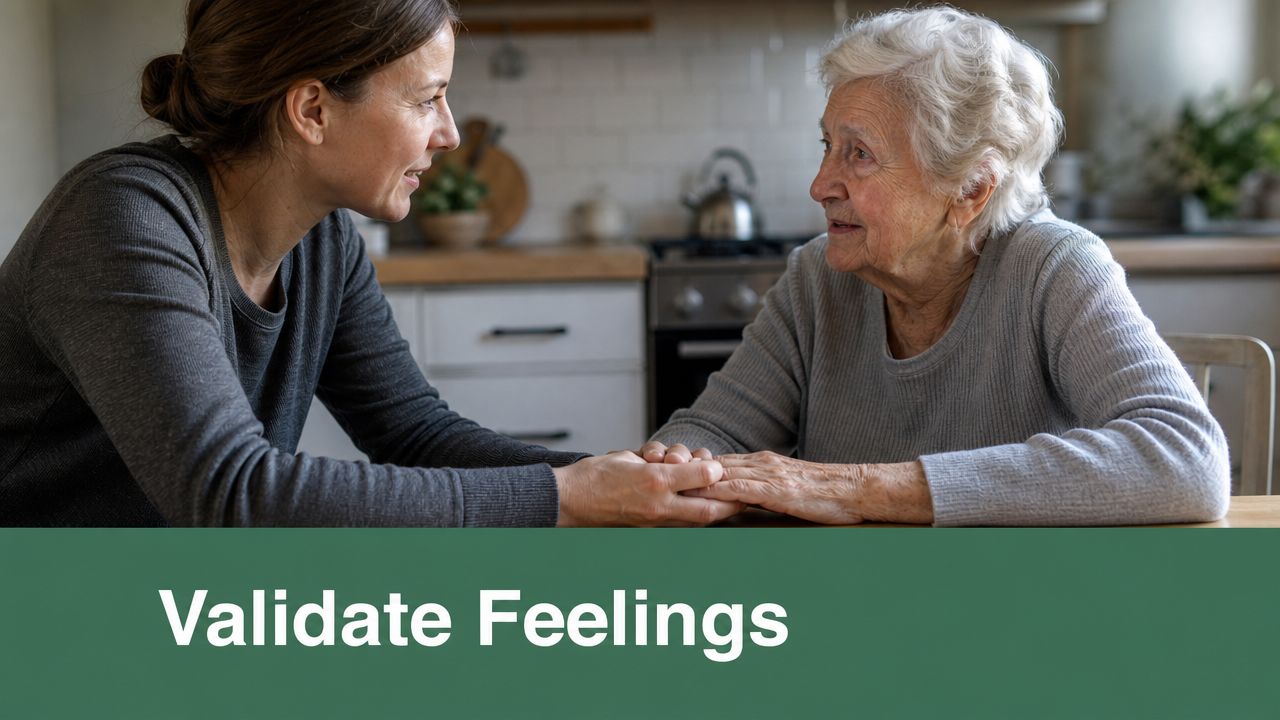
If your father says he needs to get to work, a reality check usually creates friction. A better response is, “You were always dependable. Are you worried about being late?” That reply does two useful things at once. It respects his sense of self, and it gives you more information about what is driving the distress.
Validation is not the same as agreeing with every belief. It is a calming technique. If safety is on the line, address safety clearly. If safety is not at stake, arguing over facts rarely helps.
What validation sounds like
On a phone call, I recommend a simple sequence: reflect the feeling, name the need, then guide the next step.
Instead of correcting: “Mom, Grandma died years ago.”
Try validating: “You're missing your mom today. Tell me what you miss most about her.”
Instead of confronting: “You already ate lunch.”
Try validating: “It sounds like something still feels off. Would a snack or some tea feel good right now?”
Instead of debating: “There is no bus coming.”
Try validating: “You want to be where you're supposed to be. You take that seriously. Let's check what comes next today.”
Practical rule: If a correction will not improve safety right now, save it.
This approach helps with repetitive questions, late-day distress, suspiciousness, and grief-related statements. It also fits well with other non-drug approaches that build connection and reduce pressure, including cognitive stimulation therapy for dementia.
In a structured phone-based system like Velma, validation gets stronger when the team uses the same language every time. If a participant often worries about “missing the bus,” “getting to work,” or “finding the children,” those are not random phrases. They point to a recurring emotional theme. Document the trigger, the words that helped, and the time of day. On the next call, the caregiver does not have to improvise. They can use a script that already works.
A practical Velma-style note might read: “4 to 7 p.m., asks for children. Best response: ‘You're making sure your family is okay. They're safe. I'm with you. Let's sit down and have tea.’ Avoid direct correction.” That kind of consistency matters. For many families, the biggest communication improvement does not come from finding a perfect phrase once. It comes from repeating a calming, familiar response often enough that the person begins to trust it.
2. Spaced Retrieval Training
Spaced retrieval is one of the few memory techniques that can still be useful even when free recall is getting harder. You don't ask the person to remember everything. You help them successfully recall one important piece of information at gradually longer intervals.
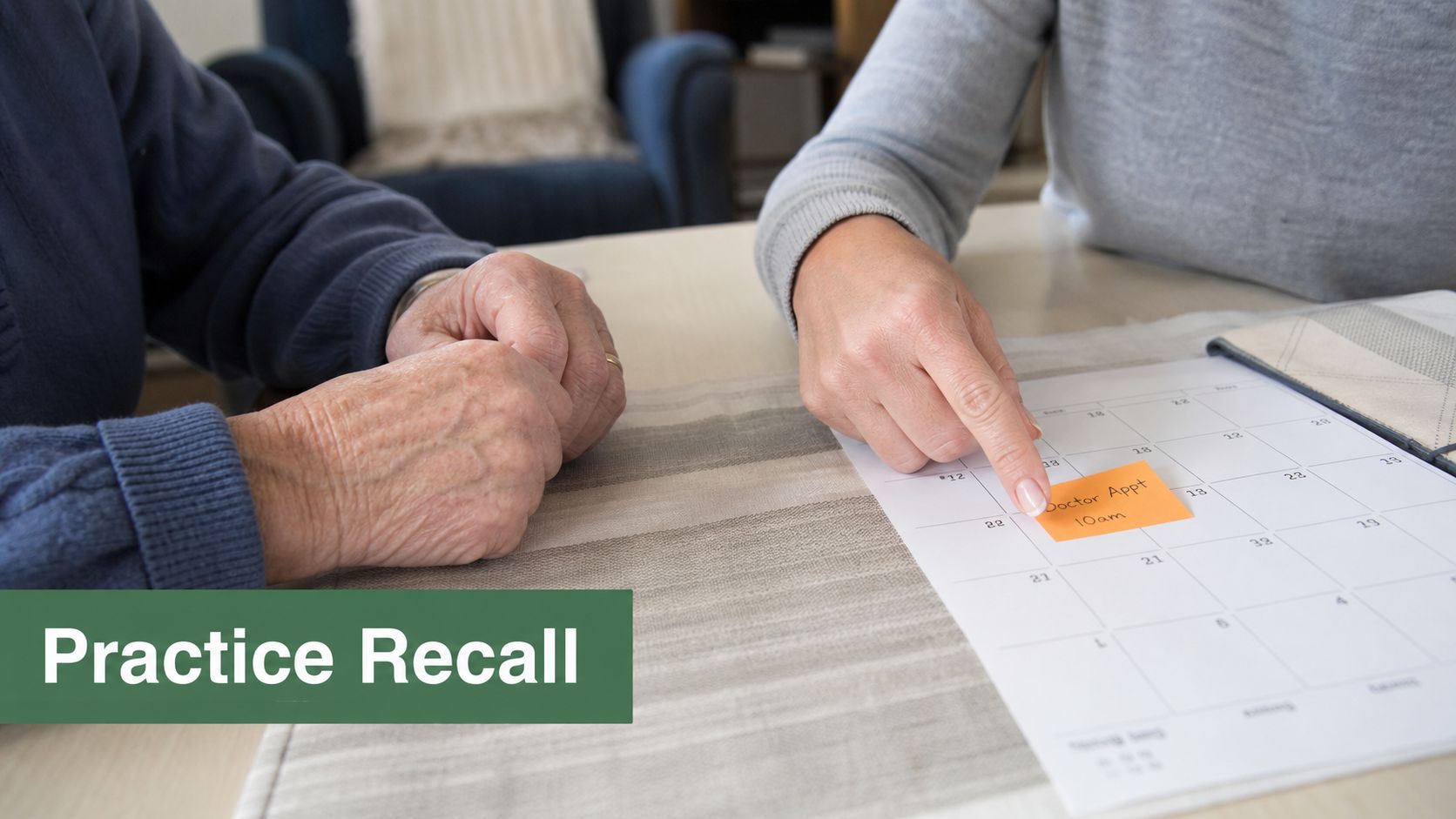
This works best for practical targets. Think one doctor's appointment, one caregiver name, one medication cue, or one safety phrase such as “Check the calendar by the phone.”
Research on digital support in Alzheimer's care suggests acceptance depends heavily on accessibility and ease of use, with voice-delivered, app-free support often seeing stronger engagement than screen-based tools because it reduces cognitive load and technical barriers, as described in JMIR Aging on digital technology adoption in Alzheimer's care. That's one reason spaced retrieval fits phone-based support so well. It doesn't require the person to learn a device.
Use it for one important fact at a time
A phone-based version might sound like this:
Caller: “Your appointment is Thursday at 10.”
Ten seconds later: “What time is your appointment?”
If correct: praise warmly and try again later.
If not correct: restate it calmly, then shorten the interval.
The mistake families make is turning this into a quiz. Don't do that. Spaced retrieval is a success-based exercise. You want the person to experience repeated wins, not repeated failures.
A good companion approach is cognitive stimulation therapy, especially when the recall practice is woven into enjoyable conversation instead of delivered like a drill. In practice, that means asking about the appointment, then talking briefly about the doctor they like, how they usually get there, or what they want to ask.
A short demonstration helps more than a long explanation:
What doesn't work is piling on extra detail. “It's Thursday at 10 with Dr. Patel at the cardiology office after breakfast, and don't forget the blue folder” is too much for one pass. Pick the single fact that matters most.
3. Reminiscence Therapy
The call starts badly. A daughter asks, “What did you have for lunch?” Her mother can't remember, gets embarrassed, and goes quiet. Then the caller shifts course. “Tell me about the garden you used to keep.” Within seconds, the conversation changes. The person relaxes, finds her footing, and starts talking.
That is the practical value of reminiscence therapy. Recent memory often fails first. Older memories, especially those tied to identity, routine, work, music, faith, or family roles, are often easier to reach. Used well, reminiscence does more than fill time. It gives the person a better chance of success in conversation, which can lower frustration for both sides.
Use the past to support the present
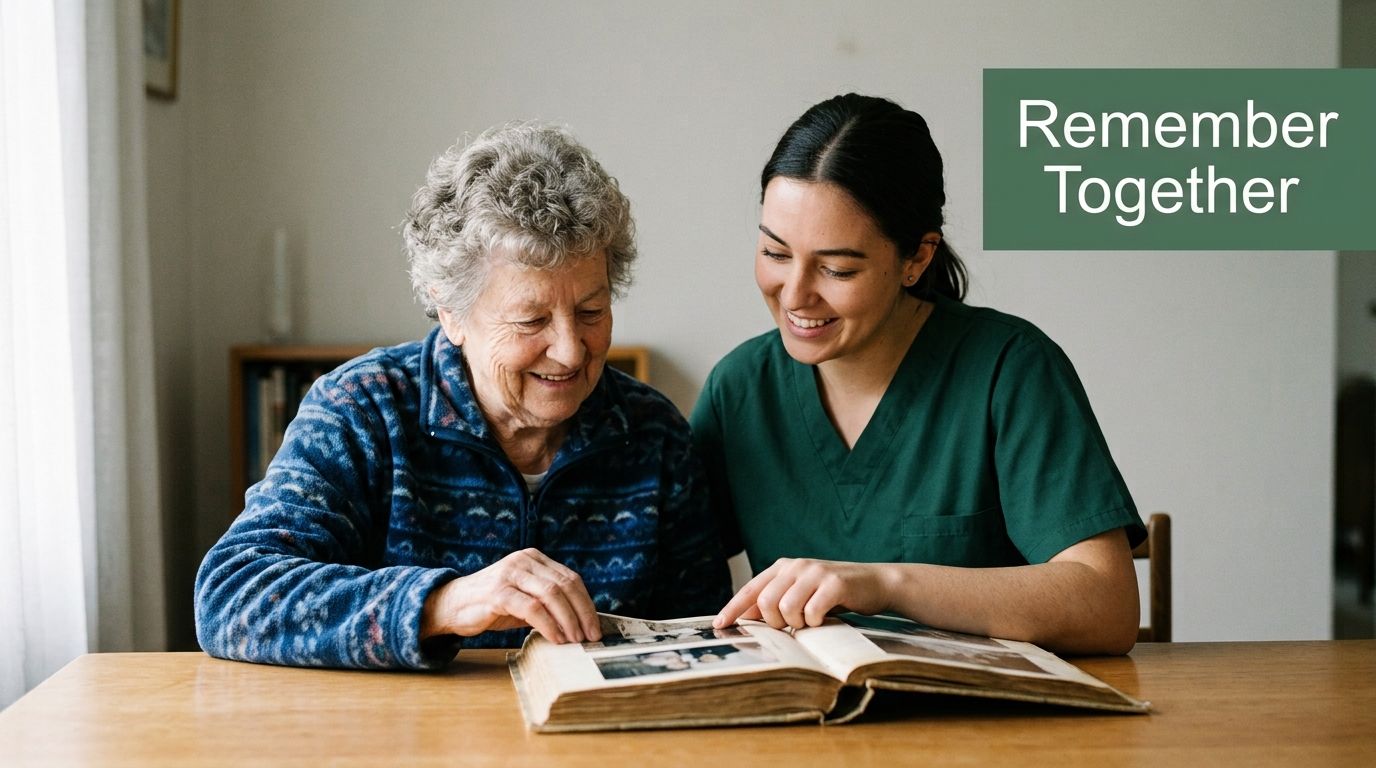
Start with topics that are concrete and identity-based. Work history, favorite songs, military service, cooking, parenting, church, sports, pets, and hometown routines usually work better than broad prompts like “Do you remember the old days?” Specific questions give the person something solid to grab onto.
Phone support works especially well when the caller prepares before dialing. If a family member shares that her father repaired radios, loved big-band music, and took pride in his tomato plants, the caller already has reliable openings. That preparation is what turns a pleasant chat into a repeatable communication strategy. In a structured support system like Velma, those details can be logged, updated, and reused so every caller starts from the same playbook instead of guessing.
Some memories comfort. Some increase distress. If a topic repeatedly brings up grief, shame, trauma, or fear, stop using it.
A practical script for remote support might sound like this:
Open with identity: “You knew so much about fixing things around the house.”
Invite a specific memory: “What did people ask you to repair most often?”
Reflect the feeling: “You sound proud of that work.”
Connect past to present: “You still notice details other people miss.”
Accuracy is not the main goal here. Connection is. If the person says he worked in a shop for 30 years and the family later says it was 20, there is usually no reason to correct that in the moment. Follow the emotion unless the memory creates a safety problem.
Families who want a more organized way to gather and use personal history often benefit from life review therapy for dementia care planning and connection. It helps caregivers collect the details that make future calls easier, such as which stories reliably calm the person, which names feel familiar, and which subjects are best left alone.
A few practical do's and don'ts help:
Do use photos, songs, recipes, old job roles, and family traditions as prompts.
Do keep a shared note with successful topics and phrases so every caller stays consistent.
Don't test memory with “Do you remember...?”
Don't argue over dates, names, or sequence unless the error affects care or safety.
That consistency matters. One well-prepared caller can have a good conversation. A coordinated phone-based team can repeat it, refine it, and make communication feel safer over time.
4. Structured Communication Framework DICE Method
Some communication failures aren't really about wording. They're about patterns you haven't mapped yet.
That's where a structured framework helps. DICE stands for Describe, Investigate, Create, and Evaluate. It gives families and care teams a way to stop reacting randomly and start solving the underlying problem.
A practical DICE example
Take repetitive questioning. A spouse says, “He asks where the car keys are every ten minutes.” The first step is to describe the behavior clearly. When does it happen? Before lunch? After a nap? Only when the house gets noisy?
Then investigate. Is he anxious about leaving the house? Is he hearing family members mention errands? Is he hungry, tired, or overwhelmed by the time of day? Recent guidance gaps matter here. Communication resources often under-address sundowning, even though 40 to 50% of dementia patients experience it, according to the Harvard Health discussion of sundowning and communication challenges. If the questions spike late in the day, the issue may be fatigue and sensory overload, not keys.
Create one solution at a time. You might place a visual cue by the door, shift errands earlier, add a snack before the usual agitation window, or train every caller and family member to use the same brief response. Then evaluate. Did the frequency drop? Did the distress level change?
Describe objectively: “Asked about keys five times between 4 and 5 p.m.”
Investigate context: lighting, hunger, noise, visitors, missed routine
Create one response plan: “The keys are put away. We're staying home tonight. Let's have tea.”
Evaluate consistently: use the same wording for several days before deciding it failed
Phone-based support helps because someone outside the household can spot patterns families miss. A Velma caller may notice that confusion rises on medication refill days, after poor sleep, or when multiple relatives call with different instructions. That kind of documentation turns “difficult behavior” into usable information.
5. Person-Centered Communication
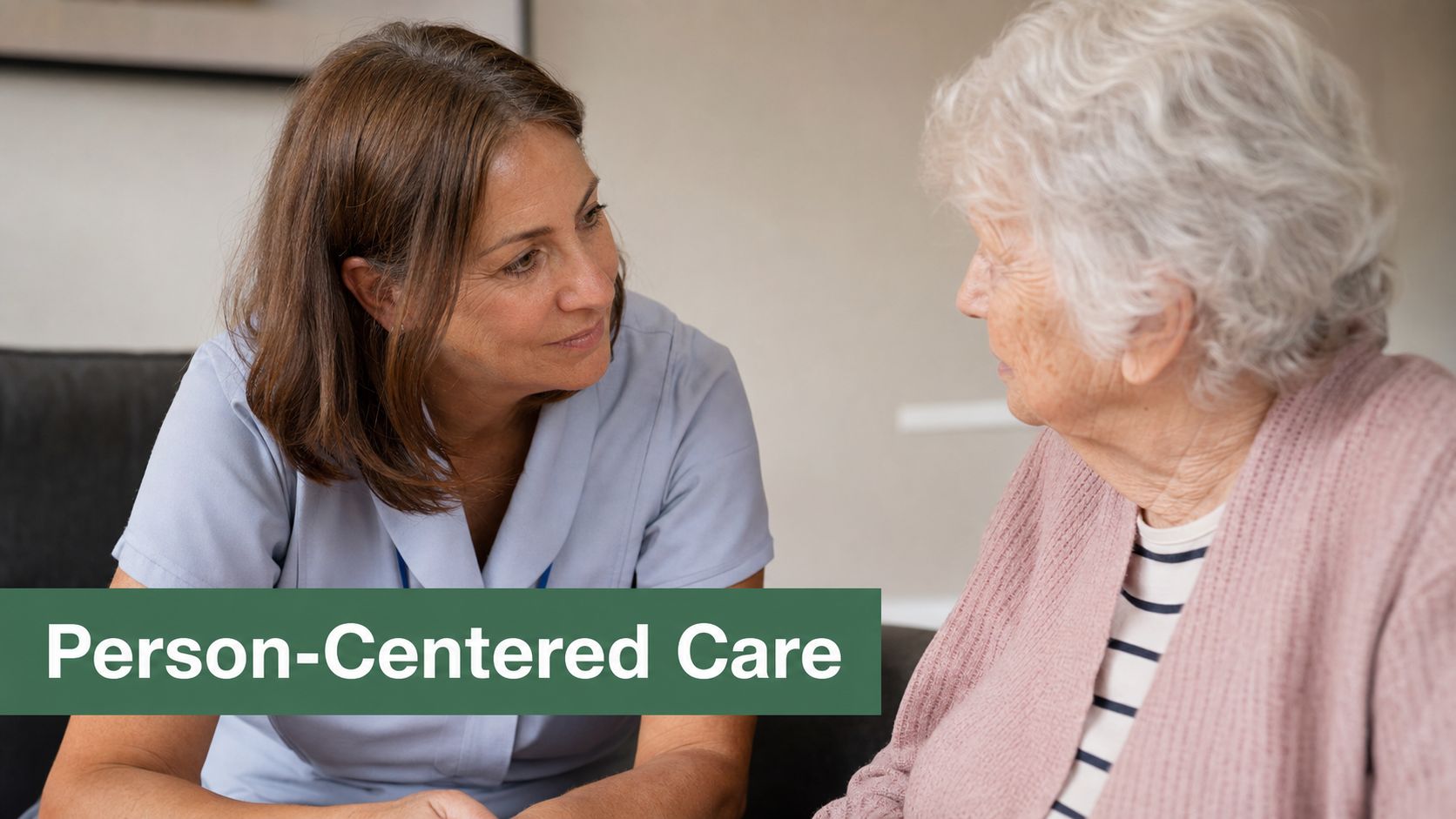
Person-centered communication sounds obvious until stress hits. Then many caregivers slip into task language. Take your pills. Sit down. Eat this. Answer me. The person stops feeling like a person and starts feeling managed.
A better approach starts with identity. Use the name they prefer. Ask in a tone that fits who they've always been. Respect their habits when possible. The result is often less resistance and a stronger sense of dignity.
What this sounds like on a real call
Two people may both have memory loss and need completely different language. One wants warm small talk before any practical check-in. Another prefers a brisk, respectful rhythm with little fussing.
A person-centered caller notices those differences and uses them deliberately.
Preferred name matters: “Mrs. Alvarez” may work far better than “Linda,” or the reverse.
Personal interests matter: a former gardener may engage best through seasons, weather, and plants.
Timing matters: some people are clearest in the morning and shouldn't be asked to do much by late afternoon.
What doesn't work is using a script that ignores personality. If your husband has always hated being told what to do, “It's time to take your pills now” may trigger pushback. “Let's check your pillbox together” often lands better because it preserves collaboration.
Respect often does more than reassurance. People with dementia still notice tone, status, and whether they're being talked down to.
This is one of the biggest advantages of a dedicated care manager model. When the same person or small team keeps calling, they learn humor, sensitivities, routines, and conversational openings that work. That turns generic dementia communication strategies into individualized ones.
6. Orientation Therapy and Environmental Cueing
The phone rings. Your mother answers, sounds unsettled, and asks, “Who is this?” The next sentence can either calm the moment or turn it into a test.
A better start is concrete and calm: “Hi, Joan. It's Sarah from Velma. I'm calling on Tuesday afternoon before dinner to check in.” That gives identity, time, and purpose in one pass. It also fits how remote support works best. Consistent phrasing from the same caller, or the same small team, reduces the effort required to get oriented each time.
Orientation helps when it supports the person's reality in the moment. It works poorly when caregivers ask for proof. Questions like “What day is it?” or “Do you know where you are?” often create failure, not clarity. Many people with dementia can still take in orientation cues even when they cannot reliably produce the right words on demand, as noted earlier.
Environmental cueing extends that support after the call ends. The goal is to reduce cognitive load, not to fill the house with signs. A large clock in the main sitting area, a readable calendar, a note by the phone, and a simple reminder board usually do more than a dozen labels no one looks at. On a Velma-style call, the support person can tie the conversation to those cues: “Please look at the calendar by your chair,” or “Your note says lunch is after this call.”
That structure matters even more for people who also have hearing loss. The University of Rochester communication resource on dementia and hearing loss highlights the value of simplified language and clear orientation cues for comprehension. On the phone, there are no gestures or facial cues to help. The trade-off is straightforward. The caller has to carry more of the structure through pacing, repetition, and word choice.
Use this pattern:
State your name every call: “Hi, Dad. It's Melissa.”
Add one time anchor: “It's Wednesday morning.”
Add one purpose anchor: “I'm calling before your aide arrives.”
Reference one visible cue: “Please check the note beside the phone.”
Keep the next step concrete: “After we hang up, it's time for breakfast.”
A short script often works better than improvising under stress. For example: “Hi, Mr. Lee. It's Anita from Velma. It's Friday morning, and I'm calling for our medication check. Your pillbox should be on the kitchen table.” That script does three jobs at once. It orients, reassures, and moves the person toward action.
What caregivers should watch for is overload. Too many cues in one sentence can blur together, especially late in the day. If the person seems confused, cut the message down and repeat the same words. Consistency is often more helpful than creativity here.
7. Active Listening and Reflective Response
Active listening is one of the most underused dementia communication strategies because it feels too simple. But many hard conversations improve when the caregiver stops trying to fix the content and starts listening for the message.
If someone says, “I need to go home,” the literal words may not be the underlying issue. Home may mean safety, familiarity, childhood, or relief from overstimulation. Reflective response gives you a way in: “You want to be somewhere that feels comfortable.” That's much more useful than “But you are home.”
What to listen for besides words
On the phone, you won't have full body language, so listen for pace, breathing, tone, and repeated phrases. Long pauses may mean processing time, not refusal. Irritability may mean fatigue. A flat, withdrawn voice may signal sadness or illness.
A recent systematic review found that only 61% of widely recommended dementia communication strategies were supported by evidence in systematic reviews or national guidance, as reported in the SAGE review of online dementia communication guidelines. For phone-based support, that's a good reminder to stick with better-supported basics such as simple yes-or-no questions and paced speech instead of adding complicated verbal tricks.
A few reflective responses that work well:
Name the feeling: “You sound worried.”
Reflect the concern: “You're trying to make sense of what's happening.”
Invite one more step: “Tell me what feels hardest right now.”
Offer a gentle choice: “Would it help to talk about your daughter, or would you rather sit in silence with me for a minute?”
Silence is part of communication. Give the brain time to catch up before you ask the next question.
What doesn't work is stacking questions. “Why are you upset, what happened, did someone come by, are you in pain?” That flood creates more pressure when the person is already struggling to organize language.
8. Routine and Predictability
A familiar phone call can prevent a hard moment from escalating.
A person with dementia hears the phone ring and already knows what comes next. The same voice. The same time of day. The same calm opening. That predictability reduces the amount of figuring out they have to do before the conversation even begins.
Routine matters because every unexpected step adds work. If the call time changes, the greeting changes, and the questions jump around, the person has to sort out who is calling, why they are calling, and whether they are expected to perform. Consistency lowers that load. It also makes the interaction feel safer.
Phone-based support works especially well here because structure is easier to repeat than spontaneity. A good caller does not try to make every conversation new. A good caller makes the framework familiar, then adjusts the content inside it.
A repeatable phone routine might include:
Same timing: every Tuesday and Friday afternoon
Same opening: “Hi Mary, it's Anna. It's Tuesday afternoon, and I'm calling for our check-in.”
Same sequence: brief grounding, one topic at a time, practical check-in, calm close
Same closing phrase: “I'll talk with you again on Friday after lunch”
That structure helps the caregiver too. Families know when support is happening, what is being reinforced, and what changes should be documented after the call. In a structured system such as Velma, that consistency turns a simple phone call into an ongoing communication plan. The person hears a familiar pattern. The family gets clearer follow-through. The care team can spot trends instead of relying on memory.
There is a trade-off. A rigid script can sound mechanical, and people notice. Keep the structure stable, but vary the human details. Ask about the usual garden, but not in the exact same words every time. Keep the same order, but slow down more on tired days and shorten the call when attention drops.
Useful script examples:
Do say: “I call after lunch on Tuesdays. I'm glad to hear your voice.”
Do say: “First we'll get settled, then we'll talk about dinner, then I'll let you rest.”
Don't say: “I know we usually talk later, but I had five minutes so I thought I'd squeeze this in.”
Don't say: “Let's do something different today,” unless there is a clear reason and you prepare the person first
Routine is not about making life smaller. It is about making communication easier to enter, easier to follow, and easier to trust. Over time, that reliability can reduce distress and improve cooperation, especially when support happens remotely and the call itself becomes a steady point in the week.
8-Point Dementia Communication Comparison
Strategy | 🔄 Implementation Complexity | ⚡ Resource Requirements | 📊⭐ Expected Outcomes | 💡 Ideal Use Cases | Key Advantages |
|---|---|---|---|---|---|
Validation Therapy | Medium, skill-based training and emotional labor | Low–Medium, caregiver time, basic training | ⭐⭐⭐, reduces agitation, improves mood and dignity | Emotional distress, memory-based confusion, de-escalation needs | Preserves dignity; de-escalates without confrontation |
Spaced Retrieval Training | High, structured scheduling and tracking | Medium–High, consistent sessions, documentation, reinforcement | ⭐⭐⭐⭐, measurable retention of facts/procedures; safety gains | Retaining meds/appointments/names; procedural memory training | Evidence-based; improves safety and confidence |
Reminiscence Therapy | Low–Medium, preparation of personal materials | Medium, photos, music, family history input | ⭐⭐⭐, enhances mood, identity, social engagement | Social stimulation, identity support, group or 1:1 sessions | Activates long-term memory; enjoyable engagement |
Structured Communication Framework (DICE) | High, multi-step analysis and coordination | Medium–High, time, documentation, team collaboration | ⭐⭐⭐, reduces problematic behaviors by addressing triggers | Persistent or complex behavior challenges requiring team input | Systematic problem-solving; targets root causes |
Person-Centered Communication | Medium–High, requires individualized knowledge & flexibility | High, time, ongoing training, detailed biographical info | ⭐⭐⭐⭐, improves quality of life and reduces resistance | Long-term care relationships, individualized care plans | Respects identity; tailors care to strengths/preferences |
Orientation Therapy & Environmental Cueing | Low–Medium, routine integration, gentle prompts | Low, visual aids, clocks/calendars, consistent reinforcement | ⭐⭐–⭐⭐⭐, reduces confusion and improves safety (stage-dependent) | Early–mid disorientation, appointment reminders, safety support | Practical, non-pharmacologic support for orientation |
Active Listening & Reflective Response | Medium, skill development and sustained attention | Low, caregiver presence and focused time | ⭐⭐⭐, strengthens trust, clarifies needs, reduces miscommunication | Emotional support, uncovering unmet needs, difficult conversations | Builds rapport; reveals underlying needs for intervention |
Routine and Predictability | Medium, coordination and consistency across caregivers | Medium, scheduling systems, caregiver coordination | ⭐⭐⭐, lowers anxiety, improves participation and adherence | Procedural memory support, regular phone/visit schedules | Creates stability; leverages procedural memory to reduce agitation |
Building a Bridge of Communication, One Call at a Time
Mastering dementia communication strategies isn't about memorizing the perfect line. It's about learning how to reduce pressure, notice patterns, and respond in ways the person can receive. Some days that means validating fear instead of correcting facts. Some days it means using one short sentence, then waiting. Some days it means dropping the original goal entirely because connection matters more than task completion.
That's why consistency matters so much. The person with dementia benefits from repeated language, familiar voices, and a call structure that doesn't keep changing. Family caregivers benefit too. When you're juggling work, appointments, medication questions, and your own stress, it's hard to apply these strategies with the same calm, patient rhythm every single day.
A structured phone-based system helps bridge that gap. It takes evidence-based communication practices and turns them into something repeatable. The caller uses the person's preferred name. The call starts with gentle orientation. Questions are short. Response time is respected. Reminiscence and validation are used to reduce distress. Practical topics such as appointments, medications, or household safety are folded into a familiar routine instead of dropped in abruptly.
That kind of support is especially helpful in early to mid-stage dementia, when many people can still engage well by phone but need conversations to be paced, purposeful, and reassuring. It also gives families better visibility. Patterns noticed across calls can reveal rising anxiety, recurring confusion, changes in language, or a routine that no longer fits.
The larger point is simple. Communication is not a side issue in dementia care. It is care. It shapes whether a person feels safe, respected, included, and understood. It also shapes whether everyday tasks become manageable or turn into battles.
If you're supporting a parent, spouse, or client, start smaller than you think. Use one validating response today. Slow down your phrasing on the next call. Choose one routine and repeat it. Ask one question instead of three. Those changes often look minor from the outside, but they can completely change the emotional direction of an interaction.
Over time, the goal isn't perfect communication. It's a stronger bridge. One that can still hold connection even when memory, language, and orientation become less reliable. With the right structure, even a phone call can become a stabilizing part of the day.
Velma gives families a practical way to put these dementia communication strategies into action. Through scheduled phone calls led by trained care team members, Velma combines conversation, cognitive stimulation, orientation, emotional support, and practical check-ins in a format that's easy for older adults to use. If your loved one is in the early to mid stages of dementia and would benefit from consistent, compassionate support between visits, Velma can help create that routine.
Beyond “Just Agreeing”: A New Way to Connect
You ask your mom if she took her morning pills. She insists she doesn't take pills. You know she does. The conversation spirals into frustration for you both, and nothing useful gets done.
This is one of the most common communication traps in dementia care. You're trying to solve a practical problem. Your parent is responding from a brain that may no longer organize memory, language, and stress in the same way it used to. Communication difficulties are a foundational feature of dementia, affecting approximately 90% of people as the disease progresses, and word-finding problems often show up early in Alzheimer's disease, the most common form of dementia, according to the Alzheimer's Association communication guidance.
The good news is that better dementia communication strategies are teachable. They're not about being endlessly cheerful, and they're not about pretending nothing is wrong. They're about reducing pressure, choosing the right prompt, and responding to the emotion underneath the words.
That matters even more in structured phone support. A calm, consistent caller can reinforce habits, reduce confusion, and help families avoid the same painful arguments over and over. In programs like Velma, communication isn't left to chance. It's built into a repeatable call structure that gives the person with dementia familiarity, dignity, and support.
Table of Contents
1. Validation Therapy
What validation sounds like
2. Spaced Retrieval Training
Use it for one important fact at a time
3. Reminiscence Therapy
Use the past to support the present
4. Structured Communication Framework DICE Method
A practical DICE example
5. Person-Centered Communication
What this sounds like on a real call
6. Orientation Therapy and Environmental Cueing
7. Active Listening and Reflective Response
What to listen for besides words
8. Routine and Predictability
8-Point Dementia Communication Comparison
Building a Bridge of Communication, One Call at a Time
1. Validation Therapy
Your phone rings at 6:15 p.m. Your mother is upset and says she has to leave now because the children are waiting for her. In that moment, the fastest way to lower distress is to respond to the feeling, not the factual error.
Validation therapy starts there. The goal is to identify the emotion underneath the statement and answer that emotion first. In practice, that often means hearing fear, urgency, grief, or responsibility where another person hears confusion.
If your father says he needs to get to work, a reality check usually creates friction. A better response is, “You were always dependable. Are you worried about being late?” That reply does two useful things at once. It respects his sense of self, and it gives you more information about what is driving the distress.
Validation is not the same as agreeing with every belief. It is a calming technique. If safety is on the line, address safety clearly. If safety is not at stake, arguing over facts rarely helps.
What validation sounds like
On a phone call, I recommend a simple sequence: reflect the feeling, name the need, then guide the next step.
Instead of correcting: “Mom, Grandma died years ago.”
Try validating: “You're missing your mom today. Tell me what you miss most about her.”
Instead of confronting: “You already ate lunch.”
Try validating: “It sounds like something still feels off. Would a snack or some tea feel good right now?”
Instead of debating: “There is no bus coming.”
Try validating: “You want to be where you're supposed to be. You take that seriously. Let's check what comes next today.”
Practical rule: If a correction will not improve safety right now, save it.
This approach helps with repetitive questions, late-day distress, suspiciousness, and grief-related statements. It also fits well with other non-drug approaches that build connection and reduce pressure, including cognitive stimulation therapy for dementia.
In a structured phone-based system like Velma, validation gets stronger when the team uses the same language every time. If a participant often worries about “missing the bus,” “getting to work,” or “finding the children,” those are not random phrases. They point to a recurring emotional theme. Document the trigger, the words that helped, and the time of day. On the next call, the caregiver does not have to improvise. They can use a script that already works.
A practical Velma-style note might read: “4 to 7 p.m., asks for children. Best response: ‘You're making sure your family is okay. They're safe. I'm with you. Let's sit down and have tea.’ Avoid direct correction.” That kind of consistency matters. For many families, the biggest communication improvement does not come from finding a perfect phrase once. It comes from repeating a calming, familiar response often enough that the person begins to trust it.
2. Spaced Retrieval Training
Spaced retrieval is one of the few memory techniques that can still be useful even when free recall is getting harder. You don't ask the person to remember everything. You help them successfully recall one important piece of information at gradually longer intervals.
This works best for practical targets. Think one doctor's appointment, one caregiver name, one medication cue, or one safety phrase such as “Check the calendar by the phone.”
Research on digital support in Alzheimer's care suggests acceptance depends heavily on accessibility and ease of use, with voice-delivered, app-free support often seeing stronger engagement than screen-based tools because it reduces cognitive load and technical barriers, as described in JMIR Aging on digital technology adoption in Alzheimer's care. That's one reason spaced retrieval fits phone-based support so well. It doesn't require the person to learn a device.
Use it for one important fact at a time
A phone-based version might sound like this:
Caller: “Your appointment is Thursday at 10.”
Ten seconds later: “What time is your appointment?”
If correct: praise warmly and try again later.
If not correct: restate it calmly, then shorten the interval.
The mistake families make is turning this into a quiz. Don't do that. Spaced retrieval is a success-based exercise. You want the person to experience repeated wins, not repeated failures.
A good companion approach is cognitive stimulation therapy, especially when the recall practice is woven into enjoyable conversation instead of delivered like a drill. In practice, that means asking about the appointment, then talking briefly about the doctor they like, how they usually get there, or what they want to ask.
A short demonstration helps more than a long explanation:
What doesn't work is piling on extra detail. “It's Thursday at 10 with Dr. Patel at the cardiology office after breakfast, and don't forget the blue folder” is too much for one pass. Pick the single fact that matters most.
3. Reminiscence Therapy
The call starts badly. A daughter asks, “What did you have for lunch?” Her mother can't remember, gets embarrassed, and goes quiet. Then the caller shifts course. “Tell me about the garden you used to keep.” Within seconds, the conversation changes. The person relaxes, finds her footing, and starts talking.
That is the practical value of reminiscence therapy. Recent memory often fails first. Older memories, especially those tied to identity, routine, work, music, faith, or family roles, are often easier to reach. Used well, reminiscence does more than fill time. It gives the person a better chance of success in conversation, which can lower frustration for both sides.
Use the past to support the present
Start with topics that are concrete and identity-based. Work history, favorite songs, military service, cooking, parenting, church, sports, pets, and hometown routines usually work better than broad prompts like “Do you remember the old days?” Specific questions give the person something solid to grab onto.
Phone support works especially well when the caller prepares before dialing. If a family member shares that her father repaired radios, loved big-band music, and took pride in his tomato plants, the caller already has reliable openings. That preparation is what turns a pleasant chat into a repeatable communication strategy. In a structured support system like Velma, those details can be logged, updated, and reused so every caller starts from the same playbook instead of guessing.
Some memories comfort. Some increase distress. If a topic repeatedly brings up grief, shame, trauma, or fear, stop using it.
A practical script for remote support might sound like this:
Open with identity: “You knew so much about fixing things around the house.”
Invite a specific memory: “What did people ask you to repair most often?”
Reflect the feeling: “You sound proud of that work.”
Connect past to present: “You still notice details other people miss.”
Accuracy is not the main goal here. Connection is. If the person says he worked in a shop for 30 years and the family later says it was 20, there is usually no reason to correct that in the moment. Follow the emotion unless the memory creates a safety problem.
Families who want a more organized way to gather and use personal history often benefit from life review therapy for dementia care planning and connection. It helps caregivers collect the details that make future calls easier, such as which stories reliably calm the person, which names feel familiar, and which subjects are best left alone.
A few practical do's and don'ts help:
Do use photos, songs, recipes, old job roles, and family traditions as prompts.
Do keep a shared note with successful topics and phrases so every caller stays consistent.
Don't test memory with “Do you remember...?”
Don't argue over dates, names, or sequence unless the error affects care or safety.
That consistency matters. One well-prepared caller can have a good conversation. A coordinated phone-based team can repeat it, refine it, and make communication feel safer over time.
4. Structured Communication Framework DICE Method
Some communication failures aren't really about wording. They're about patterns you haven't mapped yet.
That's where a structured framework helps. DICE stands for Describe, Investigate, Create, and Evaluate. It gives families and care teams a way to stop reacting randomly and start solving the underlying problem.
A practical DICE example
Take repetitive questioning. A spouse says, “He asks where the car keys are every ten minutes.” The first step is to describe the behavior clearly. When does it happen? Before lunch? After a nap? Only when the house gets noisy?
Then investigate. Is he anxious about leaving the house? Is he hearing family members mention errands? Is he hungry, tired, or overwhelmed by the time of day? Recent guidance gaps matter here. Communication resources often under-address sundowning, even though 40 to 50% of dementia patients experience it, according to the Harvard Health discussion of sundowning and communication challenges. If the questions spike late in the day, the issue may be fatigue and sensory overload, not keys.
Create one solution at a time. You might place a visual cue by the door, shift errands earlier, add a snack before the usual agitation window, or train every caller and family member to use the same brief response. Then evaluate. Did the frequency drop? Did the distress level change?
Describe objectively: “Asked about keys five times between 4 and 5 p.m.”
Investigate context: lighting, hunger, noise, visitors, missed routine
Create one response plan: “The keys are put away. We're staying home tonight. Let's have tea.”
Evaluate consistently: use the same wording for several days before deciding it failed
Phone-based support helps because someone outside the household can spot patterns families miss. A Velma caller may notice that confusion rises on medication refill days, after poor sleep, or when multiple relatives call with different instructions. That kind of documentation turns “difficult behavior” into usable information.
5. Person-Centered Communication
Person-centered communication sounds obvious until stress hits. Then many caregivers slip into task language. Take your pills. Sit down. Eat this. Answer me. The person stops feeling like a person and starts feeling managed.
A better approach starts with identity. Use the name they prefer. Ask in a tone that fits who they've always been. Respect their habits when possible. The result is often less resistance and a stronger sense of dignity.
What this sounds like on a real call
Two people may both have memory loss and need completely different language. One wants warm small talk before any practical check-in. Another prefers a brisk, respectful rhythm with little fussing.
A person-centered caller notices those differences and uses them deliberately.
Preferred name matters: “Mrs. Alvarez” may work far better than “Linda,” or the reverse.
Personal interests matter: a former gardener may engage best through seasons, weather, and plants.
Timing matters: some people are clearest in the morning and shouldn't be asked to do much by late afternoon.
What doesn't work is using a script that ignores personality. If your husband has always hated being told what to do, “It's time to take your pills now” may trigger pushback. “Let's check your pillbox together” often lands better because it preserves collaboration.
Respect often does more than reassurance. People with dementia still notice tone, status, and whether they're being talked down to.
This is one of the biggest advantages of a dedicated care manager model. When the same person or small team keeps calling, they learn humor, sensitivities, routines, and conversational openings that work. That turns generic dementia communication strategies into individualized ones.
6. Orientation Therapy and Environmental Cueing
The phone rings. Your mother answers, sounds unsettled, and asks, “Who is this?” The next sentence can either calm the moment or turn it into a test.
A better start is concrete and calm: “Hi, Joan. It's Sarah from Velma. I'm calling on Tuesday afternoon before dinner to check in.” That gives identity, time, and purpose in one pass. It also fits how remote support works best. Consistent phrasing from the same caller, or the same small team, reduces the effort required to get oriented each time.
Orientation helps when it supports the person's reality in the moment. It works poorly when caregivers ask for proof. Questions like “What day is it?” or “Do you know where you are?” often create failure, not clarity. Many people with dementia can still take in orientation cues even when they cannot reliably produce the right words on demand, as noted earlier.
Environmental cueing extends that support after the call ends. The goal is to reduce cognitive load, not to fill the house with signs. A large clock in the main sitting area, a readable calendar, a note by the phone, and a simple reminder board usually do more than a dozen labels no one looks at. On a Velma-style call, the support person can tie the conversation to those cues: “Please look at the calendar by your chair,” or “Your note says lunch is after this call.”
That structure matters even more for people who also have hearing loss. The University of Rochester communication resource on dementia and hearing loss highlights the value of simplified language and clear orientation cues for comprehension. On the phone, there are no gestures or facial cues to help. The trade-off is straightforward. The caller has to carry more of the structure through pacing, repetition, and word choice.
Use this pattern:
State your name every call: “Hi, Dad. It's Melissa.”
Add one time anchor: “It's Wednesday morning.”
Add one purpose anchor: “I'm calling before your aide arrives.”
Reference one visible cue: “Please check the note beside the phone.”
Keep the next step concrete: “After we hang up, it's time for breakfast.”
A short script often works better than improvising under stress. For example: “Hi, Mr. Lee. It's Anita from Velma. It's Friday morning, and I'm calling for our medication check. Your pillbox should be on the kitchen table.” That script does three jobs at once. It orients, reassures, and moves the person toward action.
What caregivers should watch for is overload. Too many cues in one sentence can blur together, especially late in the day. If the person seems confused, cut the message down and repeat the same words. Consistency is often more helpful than creativity here.
7. Active Listening and Reflective Response
Active listening is one of the most underused dementia communication strategies because it feels too simple. But many hard conversations improve when the caregiver stops trying to fix the content and starts listening for the message.
If someone says, “I need to go home,” the literal words may not be the underlying issue. Home may mean safety, familiarity, childhood, or relief from overstimulation. Reflective response gives you a way in: “You want to be somewhere that feels comfortable.” That's much more useful than “But you are home.”
What to listen for besides words
On the phone, you won't have full body language, so listen for pace, breathing, tone, and repeated phrases. Long pauses may mean processing time, not refusal. Irritability may mean fatigue. A flat, withdrawn voice may signal sadness or illness.
A recent systematic review found that only 61% of widely recommended dementia communication strategies were supported by evidence in systematic reviews or national guidance, as reported in the SAGE review of online dementia communication guidelines. For phone-based support, that's a good reminder to stick with better-supported basics such as simple yes-or-no questions and paced speech instead of adding complicated verbal tricks.
A few reflective responses that work well:
Name the feeling: “You sound worried.”
Reflect the concern: “You're trying to make sense of what's happening.”
Invite one more step: “Tell me what feels hardest right now.”
Offer a gentle choice: “Would it help to talk about your daughter, or would you rather sit in silence with me for a minute?”
Silence is part of communication. Give the brain time to catch up before you ask the next question.
What doesn't work is stacking questions. “Why are you upset, what happened, did someone come by, are you in pain?” That flood creates more pressure when the person is already struggling to organize language.
8. Routine and Predictability
A familiar phone call can prevent a hard moment from escalating.
A person with dementia hears the phone ring and already knows what comes next. The same voice. The same time of day. The same calm opening. That predictability reduces the amount of figuring out they have to do before the conversation even begins.
Routine matters because every unexpected step adds work. If the call time changes, the greeting changes, and the questions jump around, the person has to sort out who is calling, why they are calling, and whether they are expected to perform. Consistency lowers that load. It also makes the interaction feel safer.
Phone-based support works especially well here because structure is easier to repeat than spontaneity. A good caller does not try to make every conversation new. A good caller makes the framework familiar, then adjusts the content inside it.
A repeatable phone routine might include:
Same timing: every Tuesday and Friday afternoon
Same opening: “Hi Mary, it's Anna. It's Tuesday afternoon, and I'm calling for our check-in.”
Same sequence: brief grounding, one topic at a time, practical check-in, calm close
Same closing phrase: “I'll talk with you again on Friday after lunch”
That structure helps the caregiver too. Families know when support is happening, what is being reinforced, and what changes should be documented after the call. In a structured system such as Velma, that consistency turns a simple phone call into an ongoing communication plan. The person hears a familiar pattern. The family gets clearer follow-through. The care team can spot trends instead of relying on memory.
There is a trade-off. A rigid script can sound mechanical, and people notice. Keep the structure stable, but vary the human details. Ask about the usual garden, but not in the exact same words every time. Keep the same order, but slow down more on tired days and shorten the call when attention drops.
Useful script examples:
Do say: “I call after lunch on Tuesdays. I'm glad to hear your voice.”
Do say: “First we'll get settled, then we'll talk about dinner, then I'll let you rest.”
Don't say: “I know we usually talk later, but I had five minutes so I thought I'd squeeze this in.”
Don't say: “Let's do something different today,” unless there is a clear reason and you prepare the person first
Routine is not about making life smaller. It is about making communication easier to enter, easier to follow, and easier to trust. Over time, that reliability can reduce distress and improve cooperation, especially when support happens remotely and the call itself becomes a steady point in the week.
8-Point Dementia Communication Comparison
Strategy | 🔄 Implementation Complexity | ⚡ Resource Requirements | 📊⭐ Expected Outcomes | 💡 Ideal Use Cases | Key Advantages |
|---|---|---|---|---|---|
Validation Therapy | Medium, skill-based training and emotional labor | Low–Medium, caregiver time, basic training | ⭐⭐⭐, reduces agitation, improves mood and dignity | Emotional distress, memory-based confusion, de-escalation needs | Preserves dignity; de-escalates without confrontation |
Spaced Retrieval Training | High, structured scheduling and tracking | Medium–High, consistent sessions, documentation, reinforcement | ⭐⭐⭐⭐, measurable retention of facts/procedures; safety gains | Retaining meds/appointments/names; procedural memory training | Evidence-based; improves safety and confidence |
Reminiscence Therapy | Low–Medium, preparation of personal materials | Medium, photos, music, family history input | ⭐⭐⭐, enhances mood, identity, social engagement | Social stimulation, identity support, group or 1:1 sessions | Activates long-term memory; enjoyable engagement |
Structured Communication Framework (DICE) | High, multi-step analysis and coordination | Medium–High, time, documentation, team collaboration | ⭐⭐⭐, reduces problematic behaviors by addressing triggers | Persistent or complex behavior challenges requiring team input | Systematic problem-solving; targets root causes |
Person-Centered Communication | Medium–High, requires individualized knowledge & flexibility | High, time, ongoing training, detailed biographical info | ⭐⭐⭐⭐, improves quality of life and reduces resistance | Long-term care relationships, individualized care plans | Respects identity; tailors care to strengths/preferences |
Orientation Therapy & Environmental Cueing | Low–Medium, routine integration, gentle prompts | Low, visual aids, clocks/calendars, consistent reinforcement | ⭐⭐–⭐⭐⭐, reduces confusion and improves safety (stage-dependent) | Early–mid disorientation, appointment reminders, safety support | Practical, non-pharmacologic support for orientation |
Active Listening & Reflective Response | Medium, skill development and sustained attention | Low, caregiver presence and focused time | ⭐⭐⭐, strengthens trust, clarifies needs, reduces miscommunication | Emotional support, uncovering unmet needs, difficult conversations | Builds rapport; reveals underlying needs for intervention |
Routine and Predictability | Medium, coordination and consistency across caregivers | Medium, scheduling systems, caregiver coordination | ⭐⭐⭐, lowers anxiety, improves participation and adherence | Procedural memory support, regular phone/visit schedules | Creates stability; leverages procedural memory to reduce agitation |
Building a Bridge of Communication, One Call at a Time
Mastering dementia communication strategies isn't about memorizing the perfect line. It's about learning how to reduce pressure, notice patterns, and respond in ways the person can receive. Some days that means validating fear instead of correcting facts. Some days it means using one short sentence, then waiting. Some days it means dropping the original goal entirely because connection matters more than task completion.
That's why consistency matters so much. The person with dementia benefits from repeated language, familiar voices, and a call structure that doesn't keep changing. Family caregivers benefit too. When you're juggling work, appointments, medication questions, and your own stress, it's hard to apply these strategies with the same calm, patient rhythm every single day.
A structured phone-based system helps bridge that gap. It takes evidence-based communication practices and turns them into something repeatable. The caller uses the person's preferred name. The call starts with gentle orientation. Questions are short. Response time is respected. Reminiscence and validation are used to reduce distress. Practical topics such as appointments, medications, or household safety are folded into a familiar routine instead of dropped in abruptly.
That kind of support is especially helpful in early to mid-stage dementia, when many people can still engage well by phone but need conversations to be paced, purposeful, and reassuring. It also gives families better visibility. Patterns noticed across calls can reveal rising anxiety, recurring confusion, changes in language, or a routine that no longer fits.
The larger point is simple. Communication is not a side issue in dementia care. It is care. It shapes whether a person feels safe, respected, included, and understood. It also shapes whether everyday tasks become manageable or turn into battles.
If you're supporting a parent, spouse, or client, start smaller than you think. Use one validating response today. Slow down your phrasing on the next call. Choose one routine and repeat it. Ask one question instead of three. Those changes often look minor from the outside, but they can completely change the emotional direction of an interaction.
Over time, the goal isn't perfect communication. It's a stronger bridge. One that can still hold connection even when memory, language, and orientation become less reliable. With the right structure, even a phone call can become a stabilizing part of the day.
Velma gives families a practical way to put these dementia communication strategies into action. Through scheduled phone calls led by trained care team members, Velma combines conversation, cognitive stimulation, orientation, emotional support, and practical check-ins in a format that's easy for older adults to use. If your loved one is in the early to mid stages of dementia and would benefit from consistent, compassionate support between visits, Velma can help create that routine.
Suggested Article: