Medication Reminders for Seniors: Best Options 2026
You open the pill organizer at dinner and the Tuesday slot is still full.
That moment hits hard because it isn't just about a missed pill. It's about uncertainty. Did your parent forget? Did they take it straight from the bottle? Did they get confused and take it twice? When memory loss enters the picture, medication management stops being a simple routine and becomes a safety issue.
Most families start by looking for a gadget. That's understandable, but it's often the wrong starting point. The better question is this: what kind of support does this person need in order to reliably follow through? For some seniors, a basic pillbox works. For others, alarms only create noise. And for many people with early to mid-stage dementia, the most effective reminder includes structure, reassurance, and human connection.
Table of Contents
The Unsettling Reality of Missed Medications
Missed doses are often a memory problem, not a motivation problem
What families often miss
Why Simple Alarms Fail With Memory Loss
The brain has to do more than remember a time
Executive function is the hidden issue
What works better
Exploring Medication Reminder Systems From Low-Tech to High-Touch
Comparison of Medication Reminder Systems
Low-tech tools fit seniors who still trust routine
Mid-level systems help when the main problem is inconsistency
High-touch support is usually the right call once confusion is part of the routine
How to Choose the Right Reminder System for Your Loved One
Start with the person, not the product
Don't overestimate what technology can solve
Use this decision filter
Implementing a Reminder System for Safety and Success
Introduce the change without a power struggle
Build the routine around something that already happens
Simplify before you add more reminders
Expect resistance and plan for it
The Role of Phone-Based Cognitive Support in Medication Adherence
Why calls work differently
The hidden benefit is emotional steadiness
Building a Sustainable and Compassionate Medication Routine
The Unsettling Reality of Missed Medications
A lot of adult children tell me the same story. Their mother sounded fine on the phone. Their father insisted everything was under control. Then they visited and found unopened blister packs, duplicate bottles, or a weekly organizer that looked untouched.
That discovery changes the conversation. You're no longer asking whether a reminder might be helpful. You're asking how to prevent a dangerous pattern from becoming normal.
Missed doses are often a memory problem, not a motivation problem
Families sometimes assume a parent is being stubborn, careless, or resistant. Usually, that's not what's happening. Cognitive decline interferes with the steps required to manage medications correctly: remembering the schedule, locating the right bottle, understanding whether the dose was already taken, and following through at the right time.
Research shows that cognitive impairment can raise the relative risk of medication nonadherence in older adults by as high as 400% compared with patients without cognitive deficits (reviewed in this PubMed Central article). That is an enormous shift in risk. It tells families to stop treating missed medications as a minor lapse.
If you're seeing other signs of forgetfulness, confusion, or reduced follow-through, it's worth learning more about common patterns of cognitive decline in older adults.
Practical rule: If you find missed medications more than once, assume the current system is failing. Don't wait for a crisis to upgrade it.
What families often miss
Medication errors don't always look dramatic at first. Sometimes the clue is subtle. A blood pressure medication gets skipped often enough that readings drift. A diabetes routine becomes inconsistent. A person who seemed independent starts making small mistakes that point to a bigger problem with sequencing and memory.
Watch for patterns like these:
Full compartments by day's end: The medication was likely never taken.
Loose pills in odd places: Your loved one may have started the task and gotten distracted.
Repeated questions about timing: They may no longer trust their own memory.
Defensiveness when asked: Shame often shows up before clear admission of confusion.
What matters most is this. Medication reminders for seniors are not just convenience tools. In the context of memory loss, they're part of a safety plan.
Why Simple Alarms Fail With Memory Loss
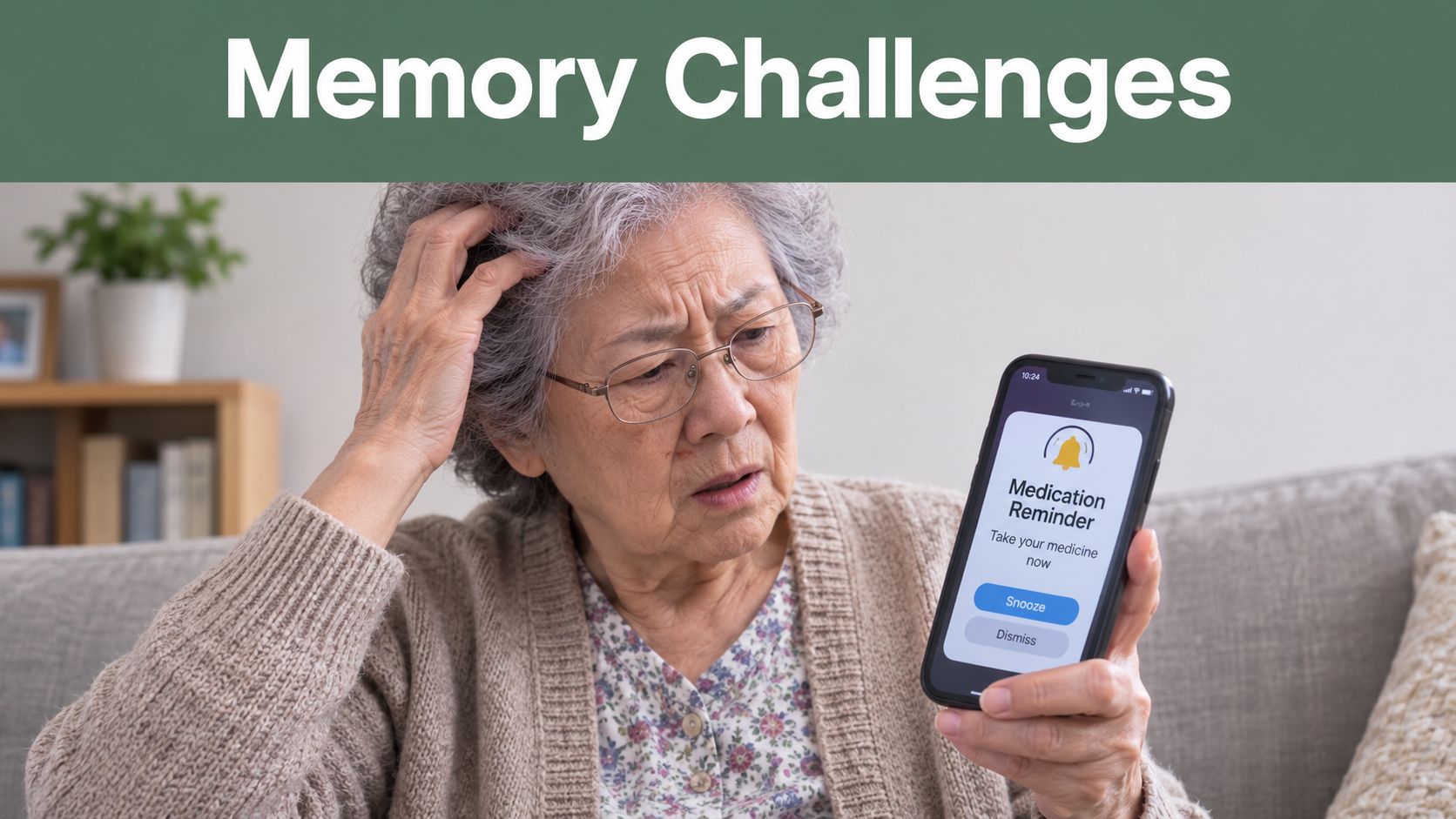
A phone alarm sounds useful because it seems direct. The problem is that an alarm only does one job. It signals that something should happen. It does not help a person understand the task, sequence the steps, stay focused, or confirm completion.
The brain has to do more than remember a time
Think of medication management like a small chain of actions. Notice the reminder. Decide what it means. Go to the medication. Identify the right dose. Take it correctly. Remember that it was done.
Memory loss can disrupt any link in that chain.
A senior may hear the alarm and think, "I need to do something," but not remember what. They may open a cabinet and forget why they walked there. They may see several bottles and freeze. Or they may silence the alert because it feels irritating, then lose the thread completely.
Executive function is the hidden issue
The deeper problem is often executive function, which is the brain's ability to organize, initiate, and complete tasks. When that system weakens, a reminder becomes too thin to be useful. It's like ringing a doorbell when no one is available to answer it.
This is why families get frustrated with systems that seemed logical on paper. The technology worked. The person couldn't reliably translate that cue into action.
Common failure points include:
Task initiation: The senior knows it's time but can't get started.
Sequencing: They begin, then mix up bottles or timing.
Time awareness: Morning and evening doses blur together.
Working memory: They forget midway through the task.
Emotional overload: Anxiety causes shutdown or avoidance.
A reminder that only announces the task often fails when the person needs help completing the task.
What works better
Medication reminders for seniors with memory loss need to do more than beep. They need to support orientation and follow-through. That usually means one of three things:
Reducing complexity so fewer steps are required.
Making the cue interactive so someone or something asks for a response.
Adding human reinforcement so the reminder includes reassurance, not just noise.
If your parent does well with routines but struggles with anything new or multi-step, don't keep adding more alerts. Choose a system that reduces decisions and increases support.
Exploring Medication Reminder Systems From Low-Tech to High-Touch
Your mother hears the alarm, walks to the kitchen, opens the pill organizer, then stops. Is this the morning dose or the evening dose? Did she already take it? In that moment, the problem is not the reminder. The problem is that the system asks her to make decisions she can no longer make reliably.
That is how families should sort medication reminder options. Start with the amount of judgment the system requires from the senior, then decide how much structure and human contact to add.
Comparison of Medication Reminder Systems
System Type | Best For | Key Limitation for Memory Loss | Caregiver Oversight |
|---|---|---|---|
Manual logs and paper charts | Seniors with intact routines who like writing things down | Easy to forget to record or misread later | Moderate |
Basic pill organizers | People who can still identify day and time compartments | Doesn't confirm whether pills were actually taken | Moderate |
Timed pill organizers or blister packs | Seniors who need clearer structure and fewer choices | Still requires task initiation | Moderate to high |
Phone alarms, calendar alerts, smart speakers, text reminders | Tech-comfortable seniors with mild forgetfulness | Alert can be ignored, silenced, or misunderstood | Moderate |
Smart dispensers and connected wearables | Families who want more automation and remote visibility | Setup burden can be high, and confusion still happens at the point of use | High |
Shared caregiver apps and coordinated family systems | Families managing refills, schedules, and oversight together | Works for the family, not always for the senior using it | High |
Human-led phone check-ins | Seniors who need prompting, orientation, and encouragement | Requires consistent scheduling and a responsive caller | High, but more supportive |
Low-tech tools fit seniors who still trust routine
Paper charts, fridge calendars, and handwritten checklists still have a place. I recommend them only for seniors who follow a stable daily rhythm, read clearly, and can recognize whether a task is finished without second-guessing themselves.
A weekly pill organizer also works well for the right person. It reduces sorting mistakes and makes the dose visible. That simplicity matters.
It stops working once memory loss creates doubt. A written checkmark does not calm someone who no longer trusts their own memory. In fact, it can increase anxiety. They stare at the paper, know it should help, and still feel unsure.
Mid-level systems help when the main problem is inconsistency
Timed organizers, pharmacy blister packs, smartphone alerts, smart speakers, and reminder texts all add structure. They are useful when a senior can still respond to a cue, but benefits from fewer choices and clearer timing.
Blister packs are often underrated. They remove a lot of daily decision-making and make missed doses easier for families to spot. Timed dispensers go one step further by presenting the medication at the right time instead of asking the person to sort and select it.
Phone alerts and voice reminders are less reliable than families expect. They work best for seniors with mild forgetfulness who still understand what the alarm means and can act right away. If the person tends to postpone, get distracted, or become flustered by devices, these systems create the appearance of safety more than real safety.
Shared caregiver apps can help the family stay organized. They track schedules, refill needs, and notes. They do very little for a senior who is alone at the moment the pills need to be taken.
For families weighing technology against personal support, daily check-in calls for seniors often solve the underlying problem better than adding another device. A calm voice can orient, reassure, and confirm follow-through in a way an alert cannot.
High-touch support is usually the right call once confusion is part of the routine
When memory loss is progressing, the best system includes another person on purpose. That might be a spouse, adult child, home care aide, or scheduled caller. The value is not just oversight. It is emotional regulation, cueing, and immediate help when the person freezes or becomes uncertain.
This matters more than families want to admit. Many seniors do not miss medication because they are careless. They miss it because the task feels confusing, lonely, or overwhelming in the moment.
The best medication reminder is the one your loved one can actually use on a tired, anxious, distracted day.
If a system depends on troubleshooting an app, interpreting several prompts, or remembering what the alert meant five minutes later, reject it. Choose the option that reduces decisions, fits the senior's routine, and adds human contact before a mistake happens.
How to Choose the Right Reminder System for Your Loved One
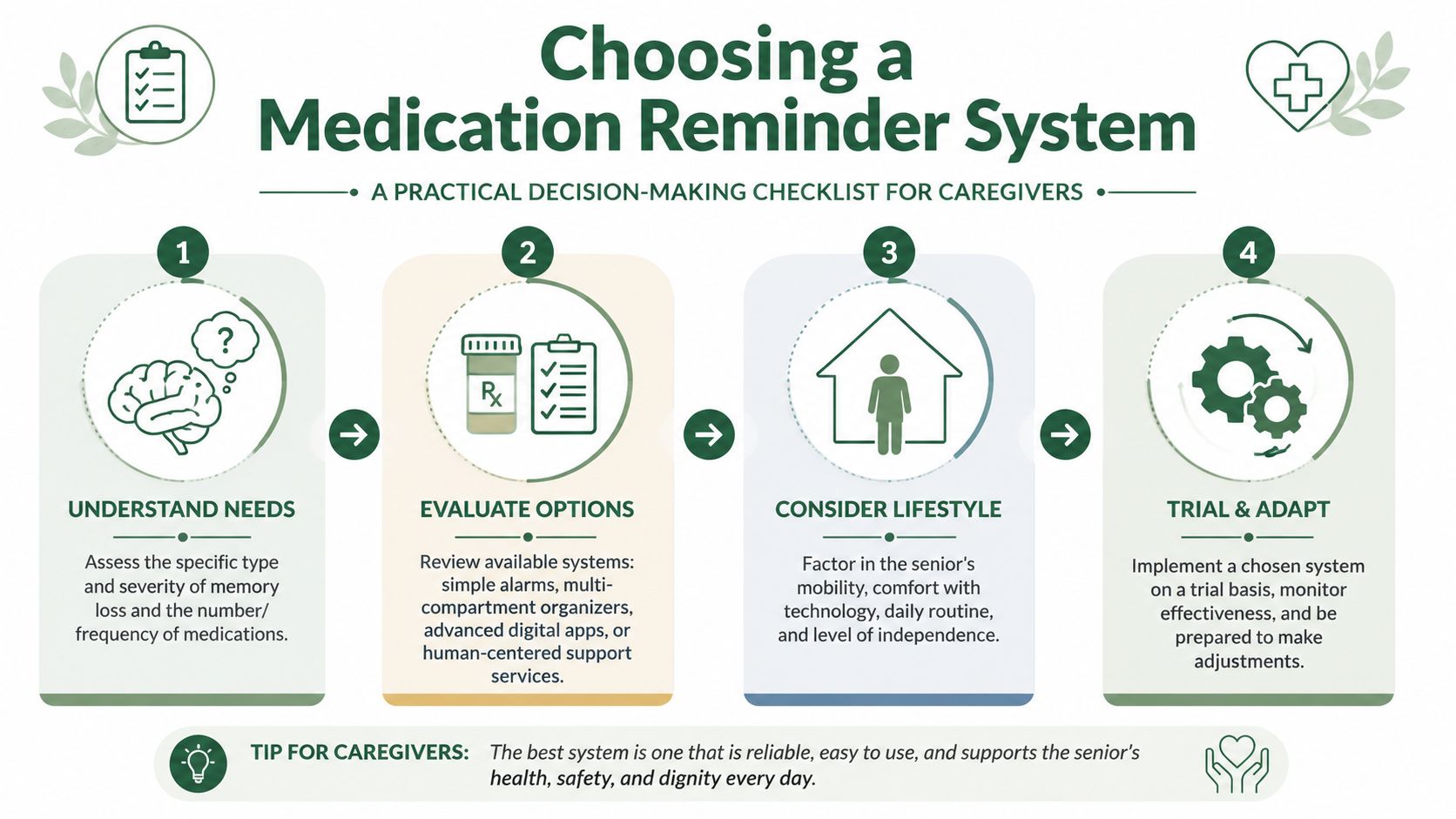
Families often choose the most impressive tool they can afford. I think that's a mistake. Choose the simplest system that matches your loved one's current abilities and the seriousness of the medication routine.
Start with the person, not the product
A reminder system has to fit the senior's real life. Not the life they had five years ago. Not the life they want to project on the phone. Their actual daily functioning.
Ask yourself:
Can they follow a multi-step task without getting sidetracked?
Do they live alone for long stretches?
Do they recognize pills and understand the schedule?
Are they comfortable with phones, apps, or devices?
Does anxiety make routines harder?
How risky is a missed or doubled dose in their specific regimen?
A person who still cooks, manages appointments, and responds well to routines may do fine with a pill organizer plus alarms. A person who asks the same question several times in one conversation probably needs something interactive and supervised.
Don't overestimate what technology can solve
I like useful technology. I don't like false reassurance.
A recent review found that reminders may improve some clinical metrics, but evidence on cost-effectiveness, service use, and caregiver experiences is "limited or absent" (2024 review in Age and Ageing). That should make families pause before assuming a device will reduce stress, prevent crises, or lighten the caregiving load in a meaningful way.
A slick app can still fail if your mother doesn't hear the alert, doesn't understand the prompt, or forgets what happened ten seconds later.
Use this decision filter
I tell families to sort options into three buckets.
Good enough for now
These are appropriate when memory loss is mild and routines are still strong.
Weekly pill organizers
Pharmacy blister packs
Phone or smart speaker reminders
Simple written medication checklists
Better with caregiver backup
These can work, but only if someone checks adherence regularly.
Timed dispensers
Shared family apps
Automated text systems
Connected devices with caregiver notifications
Needs a human component
This is the category many families resist at first, then end up choosing.
Scheduled phone reminders with conversation
Home care medication prompting
Family member check-ins at medication times
Combination systems that include supervision plus simplification
Choose the system your loved one can succeed with consistently, not the one that sounds most modern.
If you're torn, err on the side of more support. You can always scale back if the person does well. Cleaning up after medication mistakes is much harder than starting with a stronger system.
Implementing a Reminder System for Safety and Success
The right tool can still fail if you introduce it badly. Seniors with memory loss often resist new systems because the change feels confusing, infantilizing, or threatening. Your job is to make the routine feel supportive and familiar.
Introduce the change without a power struggle
Don't open with, "You keep forgetting your pills." That invites shame and denial. Start with collaboration.
Try language like this:
"Let's make this easier so you don't have to keep track of everything in your head."
Or:
"I want mornings to feel simpler. Let's set up one routine that does the work for you."
That small shift matters. You're reducing burden, not taking control away.
Build the routine around something that already happens
Medication routines stick better when they're attached to an existing anchor. Breakfast. The first cup of coffee. The evening news. Brushing teeth. A scheduled phone call.
Use practical habit cues:
Place medications strategically: Keep them in a safe, visible location tied to the routine.
Reduce decisions: Use pre-sorted doses whenever possible.
Keep timing consistent: Irregular schedules create more confusion.
Limit competing clutter: A crowded countertop makes follow-through harder.
Simplify before you add more reminders
This is one of the most overlooked steps. If the medication plan itself is messy, no reminder system will fully compensate.
Research shows that multi-component behavioral interventions that combine regimen simplification with interactive reminders outperform static notifications by 15 to 20% (PubMed Central review on adherence interventions). That finding lines up with what families see every day. Fewer doses and more interactive support usually beat a complicated schedule plus a louder alarm.
Ask the prescribing clinician or pharmacist about:
Once-daily options: Fewer dosing times are easier to manage.
Alignment across prescribers: Conflicting instructions create mistakes.
Blister packaging or synchronization: One organized system is better than several bottle routines.
High-risk confusion points: Look-alike bottles and changing instructions should be cleaned up fast.
Expect resistance and plan for it
Some seniors will say they don't need help. Others will agree in the moment and ignore the system later. Treat that as information, not defiance.
If resistance shows up:
Reduce complexity further instead of repeating instructions louder.
Trial one change at a time so the person isn't overwhelmed.
Use gentle repetition without arguing about what they forgot.
Add a human check-in if independent follow-through remains unreliable.
Medication reminders for seniors work best when the system feels calm, consistent, and hard to mess up.
The Role of Phone-Based Cognitive Support in Medication Adherence
At 8:00 a.m., your mother hears the alarm, turns it off, and then stands in the kitchen unsure why it went off in the first place. By 8:10, the moment is gone. That is why phone-based support works for many seniors with memory loss. It meets them in the moment with guidance, reassurance, and follow-through.

A scheduled call can do several jobs at once. It can reorient the person to the day and time, cue the exact medication task, stay with them through the step, and confirm whether the dose was taken. For a senior who feels embarrassed, flustered, or mentally foggy, that human contact often matters more than the reminder itself.
Why calls work differently
Phone-based support works because it responds to the person, not just the clock. A caller can say, "It's Tuesday morning. Your pills are in the green organizer by the toaster. Let's take the morning dose now." If your loved one hesitates, the caller can slow down, repeat the instruction, or redirect them back to the routine without creating a fight.
That interaction gives families something alarms and app notifications do not. Real-time context.
You can learn a lot from a two-minute call. Is your parent mixing up breakfast and bedtime pills? Do they sound unusually confused today? Are they short of breath, upset, or withdrawn? Those details help families judge whether the medication problem is a memory issue, an emotional issue, or an early warning sign that something else is wrong.
As noted earlier, interactive support tends to beat static reminders. In daily life, that makes perfect sense. A call does not just say "take your meds." It helps the person get unstuck.
If you want a concrete example, this family guide to daily cognitive support by phone shows how scheduled calls can combine reminders, orientation, conversation, and well-being check-ins.
The hidden benefit is emotional steadiness
Families often focus on forgetting and miss the emotional side of medication adherence. Many older adults do not skip doses because they are careless. They skip because the task feels confusing, lonely, or stressful. Once that stress starts, avoidance follows.
A reliable call can steady the whole day. It creates rhythm. It gives the person a familiar voice. It reduces the sense that they are failing at something basic. For seniors with early to mid-stage memory loss, that emotional steadiness is often the difference between a routine that holds and one that falls apart.
A short video helps illustrate why a human-centered model can be different from a simple reminder tool.
If missed doses are becoming a pattern, stop expecting a notification to solve a memory problem. Add a person.
Building a Sustainable and Compassionate Medication Routine
The best medication system is rarely a single product. It's a matched routine. The right level of structure, the right amount of simplification, and the right amount of human follow-through.
For a senior with mild forgetfulness, that may be a pill organizer and a steady daily anchor. For someone with progressing memory loss, it often means interactive reminders and regular oversight. When families ignore that difference, they usually end up frustrated, and their loved one ends up less safe.
What works over time is a system that respects the person's dignity while accepting the reality of their cognitive limits. Keep it simple. Keep it consistent. And if the current setup depends too much on memory, change it sooner, not later.
You don't need a perfect solution. You need one your loved one can succeed with on an ordinary day.
If your family needs more than a gadget, Velma offers phone-based cognitive support for older adults with memory loss through scheduled calls that combine reminders, conversation, orientation, and well-being check-ins. It's a practical option for families who want consistent daily support without adding more apps or devices.
You open the pill organizer at dinner and the Tuesday slot is still full.
That moment hits hard because it isn't just about a missed pill. It's about uncertainty. Did your parent forget? Did they take it straight from the bottle? Did they get confused and take it twice? When memory loss enters the picture, medication management stops being a simple routine and becomes a safety issue.
Most families start by looking for a gadget. That's understandable, but it's often the wrong starting point. The better question is this: what kind of support does this person need in order to reliably follow through? For some seniors, a basic pillbox works. For others, alarms only create noise. And for many people with early to mid-stage dementia, the most effective reminder includes structure, reassurance, and human connection.
Table of Contents
The Unsettling Reality of Missed Medications
Missed doses are often a memory problem, not a motivation problem
What families often miss
Why Simple Alarms Fail With Memory Loss
The brain has to do more than remember a time
Executive function is the hidden issue
What works better
Exploring Medication Reminder Systems From Low-Tech to High-Touch
Comparison of Medication Reminder Systems
Low-tech tools fit seniors who still trust routine
Mid-level systems help when the main problem is inconsistency
High-touch support is usually the right call once confusion is part of the routine
How to Choose the Right Reminder System for Your Loved One
Start with the person, not the product
Don't overestimate what technology can solve
Use this decision filter
Implementing a Reminder System for Safety and Success
Introduce the change without a power struggle
Build the routine around something that already happens
Simplify before you add more reminders
Expect resistance and plan for it
The Role of Phone-Based Cognitive Support in Medication Adherence
Why calls work differently
The hidden benefit is emotional steadiness
Building a Sustainable and Compassionate Medication Routine
The Unsettling Reality of Missed Medications
A lot of adult children tell me the same story. Their mother sounded fine on the phone. Their father insisted everything was under control. Then they visited and found unopened blister packs, duplicate bottles, or a weekly organizer that looked untouched.
That discovery changes the conversation. You're no longer asking whether a reminder might be helpful. You're asking how to prevent a dangerous pattern from becoming normal.
Missed doses are often a memory problem, not a motivation problem
Families sometimes assume a parent is being stubborn, careless, or resistant. Usually, that's not what's happening. Cognitive decline interferes with the steps required to manage medications correctly: remembering the schedule, locating the right bottle, understanding whether the dose was already taken, and following through at the right time.
Research shows that cognitive impairment can raise the relative risk of medication nonadherence in older adults by as high as 400% compared with patients without cognitive deficits (reviewed in this PubMed Central article). That is an enormous shift in risk. It tells families to stop treating missed medications as a minor lapse.
If you're seeing other signs of forgetfulness, confusion, or reduced follow-through, it's worth learning more about common patterns of cognitive decline in older adults.
Practical rule: If you find missed medications more than once, assume the current system is failing. Don't wait for a crisis to upgrade it.
What families often miss
Medication errors don't always look dramatic at first. Sometimes the clue is subtle. A blood pressure medication gets skipped often enough that readings drift. A diabetes routine becomes inconsistent. A person who seemed independent starts making small mistakes that point to a bigger problem with sequencing and memory.
Watch for patterns like these:
Full compartments by day's end: The medication was likely never taken.
Loose pills in odd places: Your loved one may have started the task and gotten distracted.
Repeated questions about timing: They may no longer trust their own memory.
Defensiveness when asked: Shame often shows up before clear admission of confusion.
What matters most is this. Medication reminders for seniors are not just convenience tools. In the context of memory loss, they're part of a safety plan.
Why Simple Alarms Fail With Memory Loss
A phone alarm sounds useful because it seems direct. The problem is that an alarm only does one job. It signals that something should happen. It does not help a person understand the task, sequence the steps, stay focused, or confirm completion.
The brain has to do more than remember a time
Think of medication management like a small chain of actions. Notice the reminder. Decide what it means. Go to the medication. Identify the right dose. Take it correctly. Remember that it was done.
Memory loss can disrupt any link in that chain.
A senior may hear the alarm and think, "I need to do something," but not remember what. They may open a cabinet and forget why they walked there. They may see several bottles and freeze. Or they may silence the alert because it feels irritating, then lose the thread completely.
Executive function is the hidden issue
The deeper problem is often executive function, which is the brain's ability to organize, initiate, and complete tasks. When that system weakens, a reminder becomes too thin to be useful. It's like ringing a doorbell when no one is available to answer it.
This is why families get frustrated with systems that seemed logical on paper. The technology worked. The person couldn't reliably translate that cue into action.
Common failure points include:
Task initiation: The senior knows it's time but can't get started.
Sequencing: They begin, then mix up bottles or timing.
Time awareness: Morning and evening doses blur together.
Working memory: They forget midway through the task.
Emotional overload: Anxiety causes shutdown or avoidance.
A reminder that only announces the task often fails when the person needs help completing the task.
What works better
Medication reminders for seniors with memory loss need to do more than beep. They need to support orientation and follow-through. That usually means one of three things:
Reducing complexity so fewer steps are required.
Making the cue interactive so someone or something asks for a response.
Adding human reinforcement so the reminder includes reassurance, not just noise.
If your parent does well with routines but struggles with anything new or multi-step, don't keep adding more alerts. Choose a system that reduces decisions and increases support.
Exploring Medication Reminder Systems From Low-Tech to High-Touch
Your mother hears the alarm, walks to the kitchen, opens the pill organizer, then stops. Is this the morning dose or the evening dose? Did she already take it? In that moment, the problem is not the reminder. The problem is that the system asks her to make decisions she can no longer make reliably.
That is how families should sort medication reminder options. Start with the amount of judgment the system requires from the senior, then decide how much structure and human contact to add.
Comparison of Medication Reminder Systems
System Type | Best For | Key Limitation for Memory Loss | Caregiver Oversight |
|---|---|---|---|
Manual logs and paper charts | Seniors with intact routines who like writing things down | Easy to forget to record or misread later | Moderate |
Basic pill organizers | People who can still identify day and time compartments | Doesn't confirm whether pills were actually taken | Moderate |
Timed pill organizers or blister packs | Seniors who need clearer structure and fewer choices | Still requires task initiation | Moderate to high |
Phone alarms, calendar alerts, smart speakers, text reminders | Tech-comfortable seniors with mild forgetfulness | Alert can be ignored, silenced, or misunderstood | Moderate |
Smart dispensers and connected wearables | Families who want more automation and remote visibility | Setup burden can be high, and confusion still happens at the point of use | High |
Shared caregiver apps and coordinated family systems | Families managing refills, schedules, and oversight together | Works for the family, not always for the senior using it | High |
Human-led phone check-ins | Seniors who need prompting, orientation, and encouragement | Requires consistent scheduling and a responsive caller | High, but more supportive |
Low-tech tools fit seniors who still trust routine
Paper charts, fridge calendars, and handwritten checklists still have a place. I recommend them only for seniors who follow a stable daily rhythm, read clearly, and can recognize whether a task is finished without second-guessing themselves.
A weekly pill organizer also works well for the right person. It reduces sorting mistakes and makes the dose visible. That simplicity matters.
It stops working once memory loss creates doubt. A written checkmark does not calm someone who no longer trusts their own memory. In fact, it can increase anxiety. They stare at the paper, know it should help, and still feel unsure.
Mid-level systems help when the main problem is inconsistency
Timed organizers, pharmacy blister packs, smartphone alerts, smart speakers, and reminder texts all add structure. They are useful when a senior can still respond to a cue, but benefits from fewer choices and clearer timing.
Blister packs are often underrated. They remove a lot of daily decision-making and make missed doses easier for families to spot. Timed dispensers go one step further by presenting the medication at the right time instead of asking the person to sort and select it.
Phone alerts and voice reminders are less reliable than families expect. They work best for seniors with mild forgetfulness who still understand what the alarm means and can act right away. If the person tends to postpone, get distracted, or become flustered by devices, these systems create the appearance of safety more than real safety.
Shared caregiver apps can help the family stay organized. They track schedules, refill needs, and notes. They do very little for a senior who is alone at the moment the pills need to be taken.
For families weighing technology against personal support, daily check-in calls for seniors often solve the underlying problem better than adding another device. A calm voice can orient, reassure, and confirm follow-through in a way an alert cannot.
High-touch support is usually the right call once confusion is part of the routine
When memory loss is progressing, the best system includes another person on purpose. That might be a spouse, adult child, home care aide, or scheduled caller. The value is not just oversight. It is emotional regulation, cueing, and immediate help when the person freezes or becomes uncertain.
This matters more than families want to admit. Many seniors do not miss medication because they are careless. They miss it because the task feels confusing, lonely, or overwhelming in the moment.
The best medication reminder is the one your loved one can actually use on a tired, anxious, distracted day.
If a system depends on troubleshooting an app, interpreting several prompts, or remembering what the alert meant five minutes later, reject it. Choose the option that reduces decisions, fits the senior's routine, and adds human contact before a mistake happens.
How to Choose the Right Reminder System for Your Loved One
Families often choose the most impressive tool they can afford. I think that's a mistake. Choose the simplest system that matches your loved one's current abilities and the seriousness of the medication routine.
Start with the person, not the product
A reminder system has to fit the senior's real life. Not the life they had five years ago. Not the life they want to project on the phone. Their actual daily functioning.
Ask yourself:
Can they follow a multi-step task without getting sidetracked?
Do they live alone for long stretches?
Do they recognize pills and understand the schedule?
Are they comfortable with phones, apps, or devices?
Does anxiety make routines harder?
How risky is a missed or doubled dose in their specific regimen?
A person who still cooks, manages appointments, and responds well to routines may do fine with a pill organizer plus alarms. A person who asks the same question several times in one conversation probably needs something interactive and supervised.
Don't overestimate what technology can solve
I like useful technology. I don't like false reassurance.
A recent review found that reminders may improve some clinical metrics, but evidence on cost-effectiveness, service use, and caregiver experiences is "limited or absent" (2024 review in Age and Ageing). That should make families pause before assuming a device will reduce stress, prevent crises, or lighten the caregiving load in a meaningful way.
A slick app can still fail if your mother doesn't hear the alert, doesn't understand the prompt, or forgets what happened ten seconds later.
Use this decision filter
I tell families to sort options into three buckets.
Good enough for now
These are appropriate when memory loss is mild and routines are still strong.
Weekly pill organizers
Pharmacy blister packs
Phone or smart speaker reminders
Simple written medication checklists
Better with caregiver backup
These can work, but only if someone checks adherence regularly.
Timed dispensers
Shared family apps
Automated text systems
Connected devices with caregiver notifications
Needs a human component
This is the category many families resist at first, then end up choosing.
Scheduled phone reminders with conversation
Home care medication prompting
Family member check-ins at medication times
Combination systems that include supervision plus simplification
Choose the system your loved one can succeed with consistently, not the one that sounds most modern.
If you're torn, err on the side of more support. You can always scale back if the person does well. Cleaning up after medication mistakes is much harder than starting with a stronger system.
Implementing a Reminder System for Safety and Success
The right tool can still fail if you introduce it badly. Seniors with memory loss often resist new systems because the change feels confusing, infantilizing, or threatening. Your job is to make the routine feel supportive and familiar.
Introduce the change without a power struggle
Don't open with, "You keep forgetting your pills." That invites shame and denial. Start with collaboration.
Try language like this:
"Let's make this easier so you don't have to keep track of everything in your head."
Or:
"I want mornings to feel simpler. Let's set up one routine that does the work for you."
That small shift matters. You're reducing burden, not taking control away.
Build the routine around something that already happens
Medication routines stick better when they're attached to an existing anchor. Breakfast. The first cup of coffee. The evening news. Brushing teeth. A scheduled phone call.
Use practical habit cues:
Place medications strategically: Keep them in a safe, visible location tied to the routine.
Reduce decisions: Use pre-sorted doses whenever possible.
Keep timing consistent: Irregular schedules create more confusion.
Limit competing clutter: A crowded countertop makes follow-through harder.
Simplify before you add more reminders
This is one of the most overlooked steps. If the medication plan itself is messy, no reminder system will fully compensate.
Research shows that multi-component behavioral interventions that combine regimen simplification with interactive reminders outperform static notifications by 15 to 20% (PubMed Central review on adherence interventions). That finding lines up with what families see every day. Fewer doses and more interactive support usually beat a complicated schedule plus a louder alarm.
Ask the prescribing clinician or pharmacist about:
Once-daily options: Fewer dosing times are easier to manage.
Alignment across prescribers: Conflicting instructions create mistakes.
Blister packaging or synchronization: One organized system is better than several bottle routines.
High-risk confusion points: Look-alike bottles and changing instructions should be cleaned up fast.
Expect resistance and plan for it
Some seniors will say they don't need help. Others will agree in the moment and ignore the system later. Treat that as information, not defiance.
If resistance shows up:
Reduce complexity further instead of repeating instructions louder.
Trial one change at a time so the person isn't overwhelmed.
Use gentle repetition without arguing about what they forgot.
Add a human check-in if independent follow-through remains unreliable.
Medication reminders for seniors work best when the system feels calm, consistent, and hard to mess up.
The Role of Phone-Based Cognitive Support in Medication Adherence
At 8:00 a.m., your mother hears the alarm, turns it off, and then stands in the kitchen unsure why it went off in the first place. By 8:10, the moment is gone. That is why phone-based support works for many seniors with memory loss. It meets them in the moment with guidance, reassurance, and follow-through.
A scheduled call can do several jobs at once. It can reorient the person to the day and time, cue the exact medication task, stay with them through the step, and confirm whether the dose was taken. For a senior who feels embarrassed, flustered, or mentally foggy, that human contact often matters more than the reminder itself.
Why calls work differently
Phone-based support works because it responds to the person, not just the clock. A caller can say, "It's Tuesday morning. Your pills are in the green organizer by the toaster. Let's take the morning dose now." If your loved one hesitates, the caller can slow down, repeat the instruction, or redirect them back to the routine without creating a fight.
That interaction gives families something alarms and app notifications do not. Real-time context.
You can learn a lot from a two-minute call. Is your parent mixing up breakfast and bedtime pills? Do they sound unusually confused today? Are they short of breath, upset, or withdrawn? Those details help families judge whether the medication problem is a memory issue, an emotional issue, or an early warning sign that something else is wrong.
As noted earlier, interactive support tends to beat static reminders. In daily life, that makes perfect sense. A call does not just say "take your meds." It helps the person get unstuck.
If you want a concrete example, this family guide to daily cognitive support by phone shows how scheduled calls can combine reminders, orientation, conversation, and well-being check-ins.
The hidden benefit is emotional steadiness
Families often focus on forgetting and miss the emotional side of medication adherence. Many older adults do not skip doses because they are careless. They skip because the task feels confusing, lonely, or stressful. Once that stress starts, avoidance follows.
A reliable call can steady the whole day. It creates rhythm. It gives the person a familiar voice. It reduces the sense that they are failing at something basic. For seniors with early to mid-stage memory loss, that emotional steadiness is often the difference between a routine that holds and one that falls apart.
A short video helps illustrate why a human-centered model can be different from a simple reminder tool.
If missed doses are becoming a pattern, stop expecting a notification to solve a memory problem. Add a person.
Building a Sustainable and Compassionate Medication Routine
The best medication system is rarely a single product. It's a matched routine. The right level of structure, the right amount of simplification, and the right amount of human follow-through.
For a senior with mild forgetfulness, that may be a pill organizer and a steady daily anchor. For someone with progressing memory loss, it often means interactive reminders and regular oversight. When families ignore that difference, they usually end up frustrated, and their loved one ends up less safe.
What works over time is a system that respects the person's dignity while accepting the reality of their cognitive limits. Keep it simple. Keep it consistent. And if the current setup depends too much on memory, change it sooner, not later.
You don't need a perfect solution. You need one your loved one can succeed with on an ordinary day.
If your family needs more than a gadget, Velma offers phone-based cognitive support for older adults with memory loss through scheduled calls that combine reminders, conversation, orientation, and well-being check-ins. It's a practical option for families who want consistent daily support without adding more apps or devices.
Suggested Article: