How to Prevent Falls in Elderly: A Caregiver's Guide
You've cleared the hallway. You bought the non-slip mat. You reminded your mother to use the grab bar. Then you find her shuffling to the bathroom in loose slippers, walker parked three feet away, reaching for the doorframe instead of the support you installed.
That's the part many fall prevention guides miss.
When families search for how to prevent falls in elderly loved ones, they usually get solid advice about rugs, lighting, exercise, and medications. All of that matters. But when memory loss is part of the picture, safety isn't just about whether the home is set up correctly. It's also about whether the person can remember, sequence, and follow the safety steps in the moment.
For many caregivers, that's where the frustration and fear live. You can do everything “right” and still watch unsafe habits repeat. This is especially common in early to mid-stage dementia, where a person may still walk independently but can't reliably carry out protective routines. Families trying to understand cognitive decline in older adults often recognize this pattern long before anyone names it.
Table of Contents
The Hidden Risk Beyond Unsteady Feet
Fortifying the Home Against Fall Risks
Start with the paths that are used under pressure
Reduce confusion, not just hazards
Build the environment around real behavior
Building Foundational Strength and Balance
Why targeted exercise works better than generic activity
Four home exercises that build real-world stability
Managing Health Medication and Vision
Bring the medication list and ask direct questions
Treat vision and vitamin D as mobility issues
Embedding Safety into Daily Routines
A safer morning starts before the first step
Use prompts that meet memory loss where it is
Your Proactive Fall Prevention Plan
Recognition and assessment
Treatment and monitoring
The Hidden Risk Beyond Unsteady Feet
A lot of falls don't start with weak legs alone. They start with a missed step in thinking.
A person with dementia may physically be able to stand, turn, and walk to the kitchen. What breaks down is the safety sequence: put on supportive shoes, turn on the light, use the walker, slow down at the threshold, hold the rail. Standard advice often assumes those steps will happen automatically. In dementia care, that assumption fails often.
The RNAO guideline identifies a dementia-specific cognitive-mobility disconnect, where standard fall prevention advice assumes someone can consistently remember and execute safety behaviors, even though early-to-mid dementia often disrupts those routines through forgetfulness or confusion (RNAO fall prevention guideline).
Practical rule: A safer home doesn't guarantee safer behavior. The person has to notice the support, remember the support, and use the support at the right time.
That's why some families feel like home modifications “didn't work,” when the issue is incomplete follow-through. The grab bar is there. The handrail is sturdy. The hazard was removed. But the person still stands up too quickly, walks in socks, forgets the cane, or gets distracted halfway through the task.
This doesn't mean the usual recommendations are wrong. It means they're incomplete for a person with memory loss.
The most effective approach combines environmental safety, physical conditioning, and cognitive support in real time. In plain terms, you want fewer hazards, stronger balance, and more cueing. Without all three, families end up solving only part of the problem.
A caregiver should also pay attention to patterns, not just incidents. If your father keeps “furniture surfing,” leaves the walker behind when heading to the bathroom, or becomes more unsteady late in the day, that's not random. It's useful information. Those details tell you where the breakdown is happening: strength, judgment, attention, lighting, urgency, fatigue, or some mix of all of them.
Fortifying the Home Against Fall Risks
At 2 a.m., the danger is rarely a dramatic spill in the middle of the room. It is the rushed trip from bed to bathroom, the walker left two steps away, the dark patch in the hallway, or the low chair that takes too much effort to stand up from. In dementia care, those moments matter because the problem is not only weakness or poor balance. It is the gap between what the body needs and what the brain can remember to do in time.
Home changes help most when they reduce the number of decisions a person has to make. Clinical guidance supports home hazard assessment and modification for older adults at increased risk of falling, especially when the changes are specific to the person's actual routine and environment (CDC STEADI clinical resources).
Start with the paths that are used under pressure
Do not try to fix the whole house in one weekend. Families burn out that way, and the highest-risk spots often stay unchanged. Start with the routes used when the person is tired, distracted, in pain, or hurrying: bed to bathroom, recliner to kitchen, bedroom to front door.
Walk those paths yourself, at the person's pace, and ask practical questions. Is there a place to steady with one hand before standing? Is the light easy to turn on before the first step? Is the walker within reach, not parked across the room? Can the person see the toilet, the chair, or the doorway without sorting through visual clutter?
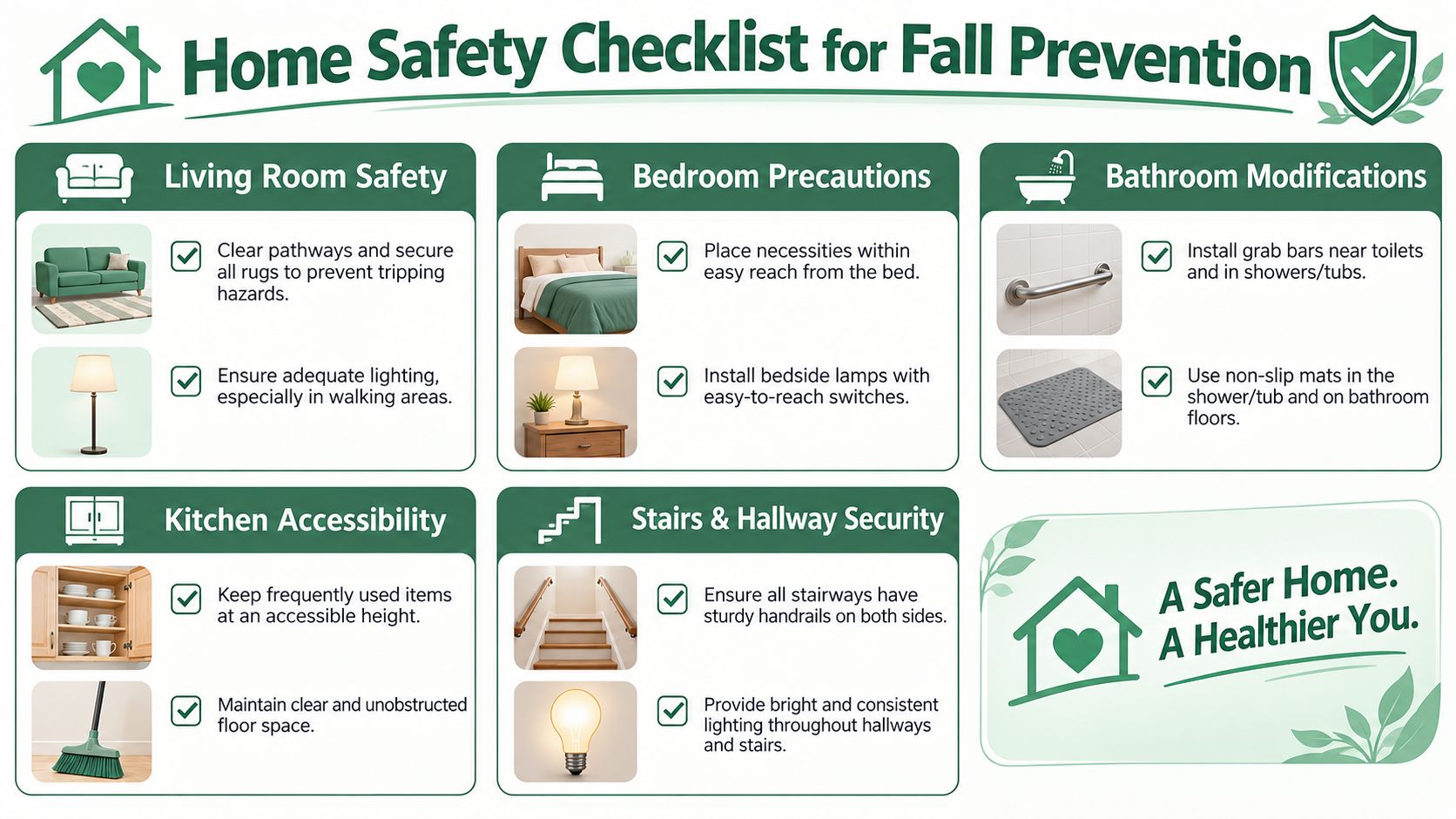
Use this checklist as your working plan:
Living room walkways: Remove low stools, baskets, footrests, plant stands, and loose cords from walking paths. If a rug stays, secure it firmly. If it shifts, curls, or catches a toe, remove it.
Bedroom lighting: Put a lamp within arm's reach of the bed. Make sure the route to the bathroom is clear and familiar, especially at night.
Bathroom supports: Install grab bars near the toilet and inside the shower or tub. Add a non-slip mat where wet feet hit the floor.
Kitchen setup: Move frequently used dishes, mugs, and food items to easy-to-reach shelves. Do not set up a home that requires climbing, stretching, or kneeling for everyday tasks.
Hallways and stairs: Keep handrails sturdy and easy to grasp. Improve lighting so transitions, shadows, and edges are easier to read.
Reduce confusion, not just hazards
This is the part many standard fall-prevention lists miss. A room can be technically safer and still fail a person with dementia.
Busy patterns, dark flooring changes, shiny surfaces, crowded tabletops, and too many objects near a walking path all compete for attention. That can slow reaction time, trigger hesitation, or lead to misjudging distance. I often tell families to aim for clear cues over attractive design. The safer room is the one that tells the person, at a glance, where to walk, where to sit, and what to hold.
A few examples I tell families to look for:
Area | Common miss | Better fix |
|---|---|---|
Bathroom doorway | Slick threshold or bathmat edge | Use a flat, non-slip surface and remove anything that bunches |
Bedside area | Slippers without grip | Place supportive shoes where feet land first |
Favorite chair | Seat too low to stand safely | Add a firmer cushion or choose a higher chair |
Stairs | Poor visual contrast on steps | Mark step edges clearly and improve overhead lighting |
One more detail matters. Put supports where the action happens. A grab bar on the wrong wall, a nightlight that leaves the first step dim, or a walker stored outside arm's reach often gets counted as a safety upgrade, but it does not change behavior.
Good fall prevention removes hesitation points. If someone has to twist, reach, guess, or improvise, risk goes up.
Build the environment around real behavior
Families sometimes install good equipment and still see falls. That does not mean the effort failed. It usually means the setup addressed the room but not the person's pattern inside it.
If your mother stands before she has her balance, the answer may be a higher chair, a clearly placed walker, and a verbal cue posted at eye level. If your father forgets the bathroom light at night, motion-sensor lighting may work better than asking him to remember a switch. If urgency leads to rushing, a bedside commode may be safer than a long trip down the hall. Good care accounts for trade-offs. The most dignified option is not always the safest one, and the safest option is not always the least intrusive. Families have to choose the change that the person will use.
Prioritize modifications around transfers, toileting, and nighttime walking first. Those are the situations where attention slips, judgment narrows, and falls happen fast.
Building Foundational Strength and Balance
A common pattern goes like this. An older adult has enough leg strength to stand, but not enough balance control or attention to do it safely every time. In dementia care, that gap matters. The body can move before the brain has organized the sequence: scoot forward, place feet, push up, pause, reach for the walker, then step. Many family members focus on strength alone and miss the cognitive-mobility disconnect that turns a routine transfer into a fall.
Targeted exercise helps because it trains both the muscles and the movement pattern. For community-dwelling older adults, programs that focus on balance, gait, and strength are among the most effective single interventions for reducing falls, with best results when done at least three times a week for 12 weeks or longer (Public Health Agency of Canada report on seniors' falls).

Why targeted exercise works better than generic activity
Walking is useful, but it does not reliably rebuild the skills behind safer transfers and steadier turns. Fall prevention exercise trains the tasks people lose: rising from a chair, shifting weight, stepping in more than one direction, narrowing the base of support, and correcting a small loss of balance before it becomes a fall.
The U.S. Preventive Services Task Force states with moderate certainty that exercise interventions provide a moderate net benefit for adults 65 and older who are at increased fall risk, especially when the program includes balance and functional training over time (USPSTF recommendation in JAMA).
In practice, I see families run into the same trade-off. A pleasant class may improve mood and social contact, but if it does not challenge balance safely and progressively, it may do little for the moments that cause falls at home. For a person with memory loss, the right program also needs cueing. The exercise itself is only half the job. The other half is helping the person start the movement in the right order and stop rushing through it.
Four home exercises that build real-world stability
These exercises should be done near a sturdy counter or heavy chair. If the person is very unsteady, or has dementia and follows directions inconsistently, start with a physical therapist or clinician who can set the right level and teach the family how to cue the movement.
Sit-to-stand from a chair
This builds the leg strength and forward weight shift needed for toilets, beds, and dining chairs. Use a firm chair. Ask the person to scoot forward, place both feet under the knees, lean forward, stand, pause, then reach for the walker only after they are upright and steady. That pause is important for people who stand quickly before they have their balance.Heel-to-toe walking
This challenges balance during walking. Have the person walk along a counter, placing the heel of one foot directly in front of the toes of the other. Keep one hand close to support if needed. For someone with cognitive impairment, short verbal cues such as “slow,” “heel to toe,” and “hand near counter” usually work better than long explanations.Single-leg stand with support nearby
Brief one-leg standing helps with dressing, stepping over thresholds, and turning. Start with fingertips on a counter. A few safe seconds done consistently are more useful than a long, shaky hold.Side stepping and backward stepping
Many falls happen while turning, backing away from a sink, or moving around furniture. Practice side stepping along a counter, then backward stepping in a slow, deliberate pattern. This improves the ability to recover when the path changes.
Progression matters. Start with feet apart, then feet together, then more challenging balance positions as tolerated. Increase difficulty only when the person can do the current step safely and repeatedly. For dementia care, keep the routine and the wording the same each time. Consistent prompts lower confusion and reduce impulsive movement. The same principle behind medication reminders for seniors with memory loss applies here. Repetition and timely cues improve follow-through.
This demonstration can help families visualize safe form before trying exercises at home.
The best exercise plan often looks ordinary. Better chair rises, steadier turns, and fewer rushed steps are the actual goal.
If the person enjoys Tai Chi, it can be a good fit. The deciding factors are safety, repetition, and whether the program matches the person's actual fall pattern. For someone with memory loss, that often means pairing exercise with live cueing, a simple sequence, and practice in the same setting where the stumbles usually happen.
Managing Health Medication and Vision
A person can have enough leg strength to stand, enough balance to take a few steps, and still fall because the brain did not keep up with the body. I see this often in dementia care. The person stands on cue, forgets the walker, misjudges the doorway, then keeps moving before anyone can redirect.
That is why medication, vision, and cognition have to be reviewed together. A fall is not always caused by weak muscles or a cluttered room. Sometimes the trigger is sleepiness from a medication, a blood pressure drop after standing, blurred vision, or a brain that cannot process those changes fast enough in real time.
Bring the medication list and ask direct questions
Bring every prescription, over the counter medication, vitamin, and supplement to the visit. The goal is not just to confirm what the person takes. The goal is to find what may be changing alertness, timing, judgment, and steadiness.
Ask specific questions:
Which medications can cause dizziness, sleepiness, or slower reaction time?
Could any of these lower blood pressure when standing up?
Are there medications here that may worsen confusion or impulsive walking?
Does the timing of any dose line up with the person's usual unsteady period?
Is there anything that can be reduced, stopped, or switched more safely?
For dementia, this review needs one extra question that families often miss. Ask, “Could this medication affect the person's ability to follow safety steps, not just their physical balance?” That is the cognitive-mobility disconnect. A medication may leave strength unchanged while making it harder to wait, sequence, judge distance, or remember to reach for support.
For families supporting someone with memory loss, the medication plan also has to be usable at home. Medication reminders for seniors with memory loss can reduce missed doses, double doses, and the foggy periods that lead to unsafe walking.

Treat vision and vitamin D as mobility issues
Vision problems rarely announce themselves clearly. Families may notice hesitation at a dark hallway, a hand sliding along the wall, or a foot catching at a threshold. The person may say they see fine. Their walking says otherwise.
Poor vision changes movement in subtle ways. It makes edges harder to judge, surface changes less obvious, and turns less accurate. In dementia, the problem gets bigger because the brain may not interpret visual information well even when the eyes are partly corrected. New glasses help some people. For others, too much change in a prescription can briefly make walking less familiar. That trade-off is worth discussing before a major lens change.
Book a vision visit if you notice patterns like these:
Sign at home | Why it matters |
|---|---|
Reaching for walls in dim rooms | Boundaries may be hard to see or process |
Hesitating at curbs or stairs | Depth perception or visual processing may be off |
More spills, bumps, or misjudged turns | Vision may be affecting movement planning |
Vitamin D also belongs in this conversation, but it should be handled through the clinician, not guesswork. Ask whether supplementation makes sense for this person's health history, diet, kidney function, fracture risk, and current medications.
These appointments take time. Medication changes can create a rough week before things improve. Eye appointments can tire out a person with dementia. Even so, leaving these issues unchecked means accepting fall risks that may be reversible.
Embedding Safety into Daily Routines
This is the part that changes outcomes for families dealing with dementia.
You can remove the rug in one afternoon. You can install grab bars in a week. What's harder is getting a person to make the same safe choices every day when memory, sequencing, and judgment are slipping. That's where routines do the heavy lifting.
A safer morning starts before the first step
Think about the first hour of the day. That's often when people stand too quickly, head to the bathroom in low light, and walk before they're fully oriented.
A safer routine might look like this:
Shoes before walking: Put supportive shoes beside the bed, not across the room and not buried in a closet.
Light first: Make turning on the bedside lamp the first action, before standing.
Walker in position: Place the walker where the person naturally reaches for support.
Slow rise: Cue a pause at the edge of the bed before standing and taking the first step.
The goal is to remove decisions. With dementia, fewer choices usually means safer follow-through.
I often tell families to stop relying on verbal reminders alone. If the same warning has to be repeated every day, the system is too fragile. Build the cue into the environment and the schedule.
Use prompts that meet memory loss where it is
The RNAO guideline points to a gap many families already know well: standard fall advice assumes the person can remember and carry out safety actions consistently, but that often isn't true in early to mid dementia. Real-time prompting is the missing bridge.
That may include:
Simple verbal scripts: “Shoes on, light on, walker first.”
Visual cues: A note on the bathroom door that says “Use the grab bar.”
Routine-based check-ins: A call or reminder tied to high-risk times such as waking, bathing, or evening restlessness.
Behavior-specific prompts: Not “Be careful,” but “Use both hands when you stand.”
General warnings fade fast. Specific cues tied to one action work better.
Here's what that looks like in ordinary life. A daughter calls before lunch because that's when her father tends to hurry to the kitchen. She doesn't ask vague questions. She says, “Dad, are your shoes on?” Then, “Take the walker with you when you get up.” The script is short because attention is limited. The timing matters because the risk moment is predictable.
Another family leaves a basket near the front door with glasses, shoes, and house keys. That setup doesn't cure forgetfulness. It reduces the number of missed steps before a walk outside.
For someone with memory loss, safety has to become repetitive, visible, and almost automatic. If the routine depends on recall alone, it won't hold.
Your Proactive Fall Prevention Plan
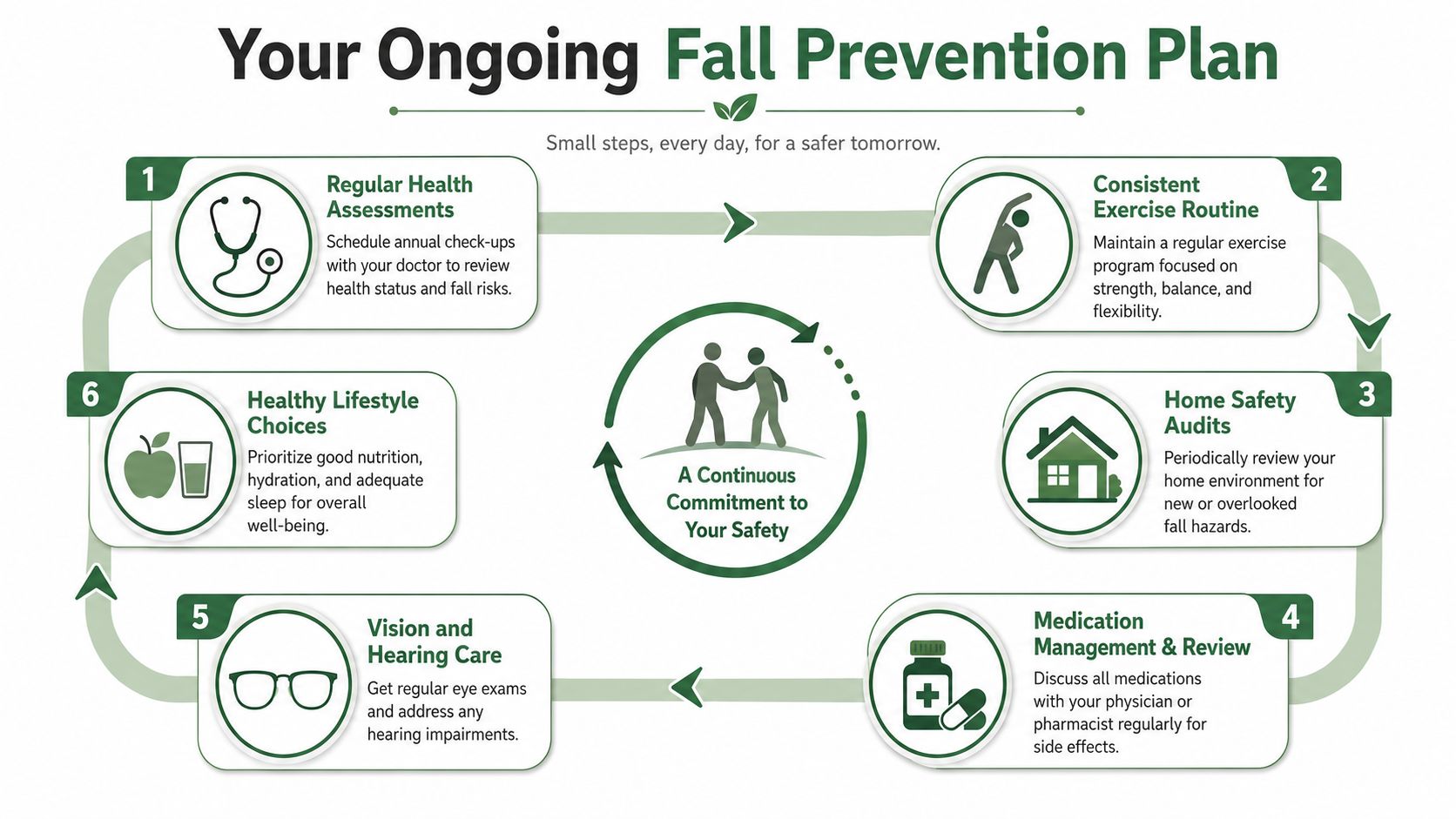
Fall prevention works best as an ongoing management system, not a one-time cleanup project. Clinical guidelines use a four-phase protocol: Recognition, Assessment, Treatment, and Monitoring, with tools such as the Timed Up & Go Test used during assessment (evidence-based fall prevention framework).
That framework is useful because it gives families a way to act before a crisis.
Recognition and assessment
Recognition starts with noticing small changes before the first serious fall. Don't wait for an injury.
Watch for patterns like these:
Furniture surfing: Using walls and chairs instead of walking steadily
Abandoning mobility aids: Leaving the cane or walker behind for short trips
Trouble with transfers: Pushing off hard from chairs or dropping into the seat
Late-day unsteadiness: More confusion or poor judgment in the evening
Near falls: Sudden grabs, stumbles, or misjudged turns that “almost” became falls
Assessment turns those observations into action. A clinician may use the Timed Up & Go, the 4-Stage Balance Test, or the 30-Second Chair Stand as part of the workup. Families don't need to administer formal tools on their own to be helpful. They do need to describe what they're seeing clearly.
A useful update sounds like this: “He's steady in the morning, but after dinner he forgets the walker and reaches for furniture.” That gives the care team something concrete.
Don't report only the fall. Report the pattern that led to it.
Treatment and monitoring
Treatment is the combined plan. For most families, that means home safety changes, targeted exercise, medication review, vision follow-up, and routine-based prompts that support safer behavior.
Multifactorial approaches offer the broadest protection because they address more than one cause at the same time. In real life, that matters. A person may have weak legs, poor depth perception, sedating medication, and memory lapses all contributing at once.
Monitoring is where many plans unravel. The handrail gets installed, but no one revisits whether it's being used. The exercise program starts, then fades after a few weeks. A medication is adjusted, but the family doesn't track whether morning dizziness improved.
Keep monitoring simple:
What to monitor | What to note |
|---|---|
Walking pattern | Slower, shuffling, veering, grabbing furniture |
Transfers | Easier standing, harder standing, more collapse into chairs |
Routine compliance | Wearing shoes, using walker, turning on lights |
Timing of risk | Morning, after naps, evenings, after bathing |
Health changes | New confusion, dizziness, blurred vision, sedation |
A phone-based check-in system can help families maintain visibility between visits, especially when an older adult lives alone. Services built around daily check-in calls for seniors can help surface missed routines, mobility concerns, and changes in function before they become emergencies.
The biggest shift is mental. Stop asking, “How do I stop one fall?” Ask, “What system will make the next month safer than the last one?” That question leads to better decisions.
If you're trying to protect a parent with dementia, remember this: the safest plan is the one that matches both the body and the brain. Stronger legs matter. Safer rooms matter. But for many families, the missing piece is consistent prompting that helps safe behavior happen in the moment it's needed.
Velma offers phone-based cognitive support for older adults with memory loss through scheduled calls that reinforce routines, support brain health, and help families notice concerns earlier. For caregivers worried about missed medications, unsafe habits, loneliness, or day-to-day changes between visits, Velma adds a practical layer of structure and visibility without requiring apps or new devices.
You've cleared the hallway. You bought the non-slip mat. You reminded your mother to use the grab bar. Then you find her shuffling to the bathroom in loose slippers, walker parked three feet away, reaching for the doorframe instead of the support you installed.
That's the part many fall prevention guides miss.
When families search for how to prevent falls in elderly loved ones, they usually get solid advice about rugs, lighting, exercise, and medications. All of that matters. But when memory loss is part of the picture, safety isn't just about whether the home is set up correctly. It's also about whether the person can remember, sequence, and follow the safety steps in the moment.
For many caregivers, that's where the frustration and fear live. You can do everything “right” and still watch unsafe habits repeat. This is especially common in early to mid-stage dementia, where a person may still walk independently but can't reliably carry out protective routines. Families trying to understand cognitive decline in older adults often recognize this pattern long before anyone names it.
Table of Contents
The Hidden Risk Beyond Unsteady Feet
Fortifying the Home Against Fall Risks
Start with the paths that are used under pressure
Reduce confusion, not just hazards
Build the environment around real behavior
Building Foundational Strength and Balance
Why targeted exercise works better than generic activity
Four home exercises that build real-world stability
Managing Health Medication and Vision
Bring the medication list and ask direct questions
Treat vision and vitamin D as mobility issues
Embedding Safety into Daily Routines
A safer morning starts before the first step
Use prompts that meet memory loss where it is
Your Proactive Fall Prevention Plan
Recognition and assessment
Treatment and monitoring
The Hidden Risk Beyond Unsteady Feet
A lot of falls don't start with weak legs alone. They start with a missed step in thinking.
A person with dementia may physically be able to stand, turn, and walk to the kitchen. What breaks down is the safety sequence: put on supportive shoes, turn on the light, use the walker, slow down at the threshold, hold the rail. Standard advice often assumes those steps will happen automatically. In dementia care, that assumption fails often.
The RNAO guideline identifies a dementia-specific cognitive-mobility disconnect, where standard fall prevention advice assumes someone can consistently remember and execute safety behaviors, even though early-to-mid dementia often disrupts those routines through forgetfulness or confusion (RNAO fall prevention guideline).
Practical rule: A safer home doesn't guarantee safer behavior. The person has to notice the support, remember the support, and use the support at the right time.
That's why some families feel like home modifications “didn't work,” when the issue is incomplete follow-through. The grab bar is there. The handrail is sturdy. The hazard was removed. But the person still stands up too quickly, walks in socks, forgets the cane, or gets distracted halfway through the task.
This doesn't mean the usual recommendations are wrong. It means they're incomplete for a person with memory loss.
The most effective approach combines environmental safety, physical conditioning, and cognitive support in real time. In plain terms, you want fewer hazards, stronger balance, and more cueing. Without all three, families end up solving only part of the problem.
A caregiver should also pay attention to patterns, not just incidents. If your father keeps “furniture surfing,” leaves the walker behind when heading to the bathroom, or becomes more unsteady late in the day, that's not random. It's useful information. Those details tell you where the breakdown is happening: strength, judgment, attention, lighting, urgency, fatigue, or some mix of all of them.
Fortifying the Home Against Fall Risks
At 2 a.m., the danger is rarely a dramatic spill in the middle of the room. It is the rushed trip from bed to bathroom, the walker left two steps away, the dark patch in the hallway, or the low chair that takes too much effort to stand up from. In dementia care, those moments matter because the problem is not only weakness or poor balance. It is the gap between what the body needs and what the brain can remember to do in time.
Home changes help most when they reduce the number of decisions a person has to make. Clinical guidance supports home hazard assessment and modification for older adults at increased risk of falling, especially when the changes are specific to the person's actual routine and environment (CDC STEADI clinical resources).
Start with the paths that are used under pressure
Do not try to fix the whole house in one weekend. Families burn out that way, and the highest-risk spots often stay unchanged. Start with the routes used when the person is tired, distracted, in pain, or hurrying: bed to bathroom, recliner to kitchen, bedroom to front door.
Walk those paths yourself, at the person's pace, and ask practical questions. Is there a place to steady with one hand before standing? Is the light easy to turn on before the first step? Is the walker within reach, not parked across the room? Can the person see the toilet, the chair, or the doorway without sorting through visual clutter?
Use this checklist as your working plan:
Living room walkways: Remove low stools, baskets, footrests, plant stands, and loose cords from walking paths. If a rug stays, secure it firmly. If it shifts, curls, or catches a toe, remove it.
Bedroom lighting: Put a lamp within arm's reach of the bed. Make sure the route to the bathroom is clear and familiar, especially at night.
Bathroom supports: Install grab bars near the toilet and inside the shower or tub. Add a non-slip mat where wet feet hit the floor.
Kitchen setup: Move frequently used dishes, mugs, and food items to easy-to-reach shelves. Do not set up a home that requires climbing, stretching, or kneeling for everyday tasks.
Hallways and stairs: Keep handrails sturdy and easy to grasp. Improve lighting so transitions, shadows, and edges are easier to read.
Reduce confusion, not just hazards
This is the part many standard fall-prevention lists miss. A room can be technically safer and still fail a person with dementia.
Busy patterns, dark flooring changes, shiny surfaces, crowded tabletops, and too many objects near a walking path all compete for attention. That can slow reaction time, trigger hesitation, or lead to misjudging distance. I often tell families to aim for clear cues over attractive design. The safer room is the one that tells the person, at a glance, where to walk, where to sit, and what to hold.
A few examples I tell families to look for:
Area | Common miss | Better fix |
|---|---|---|
Bathroom doorway | Slick threshold or bathmat edge | Use a flat, non-slip surface and remove anything that bunches |
Bedside area | Slippers without grip | Place supportive shoes where feet land first |
Favorite chair | Seat too low to stand safely | Add a firmer cushion or choose a higher chair |
Stairs | Poor visual contrast on steps | Mark step edges clearly and improve overhead lighting |
One more detail matters. Put supports where the action happens. A grab bar on the wrong wall, a nightlight that leaves the first step dim, or a walker stored outside arm's reach often gets counted as a safety upgrade, but it does not change behavior.
Good fall prevention removes hesitation points. If someone has to twist, reach, guess, or improvise, risk goes up.
Build the environment around real behavior
Families sometimes install good equipment and still see falls. That does not mean the effort failed. It usually means the setup addressed the room but not the person's pattern inside it.
If your mother stands before she has her balance, the answer may be a higher chair, a clearly placed walker, and a verbal cue posted at eye level. If your father forgets the bathroom light at night, motion-sensor lighting may work better than asking him to remember a switch. If urgency leads to rushing, a bedside commode may be safer than a long trip down the hall. Good care accounts for trade-offs. The most dignified option is not always the safest one, and the safest option is not always the least intrusive. Families have to choose the change that the person will use.
Prioritize modifications around transfers, toileting, and nighttime walking first. Those are the situations where attention slips, judgment narrows, and falls happen fast.
Building Foundational Strength and Balance
A common pattern goes like this. An older adult has enough leg strength to stand, but not enough balance control or attention to do it safely every time. In dementia care, that gap matters. The body can move before the brain has organized the sequence: scoot forward, place feet, push up, pause, reach for the walker, then step. Many family members focus on strength alone and miss the cognitive-mobility disconnect that turns a routine transfer into a fall.
Targeted exercise helps because it trains both the muscles and the movement pattern. For community-dwelling older adults, programs that focus on balance, gait, and strength are among the most effective single interventions for reducing falls, with best results when done at least three times a week for 12 weeks or longer (Public Health Agency of Canada report on seniors' falls).
Why targeted exercise works better than generic activity
Walking is useful, but it does not reliably rebuild the skills behind safer transfers and steadier turns. Fall prevention exercise trains the tasks people lose: rising from a chair, shifting weight, stepping in more than one direction, narrowing the base of support, and correcting a small loss of balance before it becomes a fall.
The U.S. Preventive Services Task Force states with moderate certainty that exercise interventions provide a moderate net benefit for adults 65 and older who are at increased fall risk, especially when the program includes balance and functional training over time (USPSTF recommendation in JAMA).
In practice, I see families run into the same trade-off. A pleasant class may improve mood and social contact, but if it does not challenge balance safely and progressively, it may do little for the moments that cause falls at home. For a person with memory loss, the right program also needs cueing. The exercise itself is only half the job. The other half is helping the person start the movement in the right order and stop rushing through it.
Four home exercises that build real-world stability
These exercises should be done near a sturdy counter or heavy chair. If the person is very unsteady, or has dementia and follows directions inconsistently, start with a physical therapist or clinician who can set the right level and teach the family how to cue the movement.
Sit-to-stand from a chair
This builds the leg strength and forward weight shift needed for toilets, beds, and dining chairs. Use a firm chair. Ask the person to scoot forward, place both feet under the knees, lean forward, stand, pause, then reach for the walker only after they are upright and steady. That pause is important for people who stand quickly before they have their balance.Heel-to-toe walking
This challenges balance during walking. Have the person walk along a counter, placing the heel of one foot directly in front of the toes of the other. Keep one hand close to support if needed. For someone with cognitive impairment, short verbal cues such as “slow,” “heel to toe,” and “hand near counter” usually work better than long explanations.Single-leg stand with support nearby
Brief one-leg standing helps with dressing, stepping over thresholds, and turning. Start with fingertips on a counter. A few safe seconds done consistently are more useful than a long, shaky hold.Side stepping and backward stepping
Many falls happen while turning, backing away from a sink, or moving around furniture. Practice side stepping along a counter, then backward stepping in a slow, deliberate pattern. This improves the ability to recover when the path changes.
Progression matters. Start with feet apart, then feet together, then more challenging balance positions as tolerated. Increase difficulty only when the person can do the current step safely and repeatedly. For dementia care, keep the routine and the wording the same each time. Consistent prompts lower confusion and reduce impulsive movement. The same principle behind medication reminders for seniors with memory loss applies here. Repetition and timely cues improve follow-through.
This demonstration can help families visualize safe form before trying exercises at home.
The best exercise plan often looks ordinary. Better chair rises, steadier turns, and fewer rushed steps are the actual goal.
If the person enjoys Tai Chi, it can be a good fit. The deciding factors are safety, repetition, and whether the program matches the person's actual fall pattern. For someone with memory loss, that often means pairing exercise with live cueing, a simple sequence, and practice in the same setting where the stumbles usually happen.
Managing Health Medication and Vision
A person can have enough leg strength to stand, enough balance to take a few steps, and still fall because the brain did not keep up with the body. I see this often in dementia care. The person stands on cue, forgets the walker, misjudges the doorway, then keeps moving before anyone can redirect.
That is why medication, vision, and cognition have to be reviewed together. A fall is not always caused by weak muscles or a cluttered room. Sometimes the trigger is sleepiness from a medication, a blood pressure drop after standing, blurred vision, or a brain that cannot process those changes fast enough in real time.
Bring the medication list and ask direct questions
Bring every prescription, over the counter medication, vitamin, and supplement to the visit. The goal is not just to confirm what the person takes. The goal is to find what may be changing alertness, timing, judgment, and steadiness.
Ask specific questions:
Which medications can cause dizziness, sleepiness, or slower reaction time?
Could any of these lower blood pressure when standing up?
Are there medications here that may worsen confusion or impulsive walking?
Does the timing of any dose line up with the person's usual unsteady period?
Is there anything that can be reduced, stopped, or switched more safely?
For dementia, this review needs one extra question that families often miss. Ask, “Could this medication affect the person's ability to follow safety steps, not just their physical balance?” That is the cognitive-mobility disconnect. A medication may leave strength unchanged while making it harder to wait, sequence, judge distance, or remember to reach for support.
For families supporting someone with memory loss, the medication plan also has to be usable at home. Medication reminders for seniors with memory loss can reduce missed doses, double doses, and the foggy periods that lead to unsafe walking.
Treat vision and vitamin D as mobility issues
Vision problems rarely announce themselves clearly. Families may notice hesitation at a dark hallway, a hand sliding along the wall, or a foot catching at a threshold. The person may say they see fine. Their walking says otherwise.
Poor vision changes movement in subtle ways. It makes edges harder to judge, surface changes less obvious, and turns less accurate. In dementia, the problem gets bigger because the brain may not interpret visual information well even when the eyes are partly corrected. New glasses help some people. For others, too much change in a prescription can briefly make walking less familiar. That trade-off is worth discussing before a major lens change.
Book a vision visit if you notice patterns like these:
Sign at home | Why it matters |
|---|---|
Reaching for walls in dim rooms | Boundaries may be hard to see or process |
Hesitating at curbs or stairs | Depth perception or visual processing may be off |
More spills, bumps, or misjudged turns | Vision may be affecting movement planning |
Vitamin D also belongs in this conversation, but it should be handled through the clinician, not guesswork. Ask whether supplementation makes sense for this person's health history, diet, kidney function, fracture risk, and current medications.
These appointments take time. Medication changes can create a rough week before things improve. Eye appointments can tire out a person with dementia. Even so, leaving these issues unchecked means accepting fall risks that may be reversible.
Embedding Safety into Daily Routines
This is the part that changes outcomes for families dealing with dementia.
You can remove the rug in one afternoon. You can install grab bars in a week. What's harder is getting a person to make the same safe choices every day when memory, sequencing, and judgment are slipping. That's where routines do the heavy lifting.
A safer morning starts before the first step
Think about the first hour of the day. That's often when people stand too quickly, head to the bathroom in low light, and walk before they're fully oriented.
A safer routine might look like this:
Shoes before walking: Put supportive shoes beside the bed, not across the room and not buried in a closet.
Light first: Make turning on the bedside lamp the first action, before standing.
Walker in position: Place the walker where the person naturally reaches for support.
Slow rise: Cue a pause at the edge of the bed before standing and taking the first step.
The goal is to remove decisions. With dementia, fewer choices usually means safer follow-through.
I often tell families to stop relying on verbal reminders alone. If the same warning has to be repeated every day, the system is too fragile. Build the cue into the environment and the schedule.
Use prompts that meet memory loss where it is
The RNAO guideline points to a gap many families already know well: standard fall advice assumes the person can remember and carry out safety actions consistently, but that often isn't true in early to mid dementia. Real-time prompting is the missing bridge.
That may include:
Simple verbal scripts: “Shoes on, light on, walker first.”
Visual cues: A note on the bathroom door that says “Use the grab bar.”
Routine-based check-ins: A call or reminder tied to high-risk times such as waking, bathing, or evening restlessness.
Behavior-specific prompts: Not “Be careful,” but “Use both hands when you stand.”
General warnings fade fast. Specific cues tied to one action work better.
Here's what that looks like in ordinary life. A daughter calls before lunch because that's when her father tends to hurry to the kitchen. She doesn't ask vague questions. She says, “Dad, are your shoes on?” Then, “Take the walker with you when you get up.” The script is short because attention is limited. The timing matters because the risk moment is predictable.
Another family leaves a basket near the front door with glasses, shoes, and house keys. That setup doesn't cure forgetfulness. It reduces the number of missed steps before a walk outside.
For someone with memory loss, safety has to become repetitive, visible, and almost automatic. If the routine depends on recall alone, it won't hold.
Your Proactive Fall Prevention Plan
Fall prevention works best as an ongoing management system, not a one-time cleanup project. Clinical guidelines use a four-phase protocol: Recognition, Assessment, Treatment, and Monitoring, with tools such as the Timed Up & Go Test used during assessment (evidence-based fall prevention framework).
That framework is useful because it gives families a way to act before a crisis.
Recognition and assessment
Recognition starts with noticing small changes before the first serious fall. Don't wait for an injury.
Watch for patterns like these:
Furniture surfing: Using walls and chairs instead of walking steadily
Abandoning mobility aids: Leaving the cane or walker behind for short trips
Trouble with transfers: Pushing off hard from chairs or dropping into the seat
Late-day unsteadiness: More confusion or poor judgment in the evening
Near falls: Sudden grabs, stumbles, or misjudged turns that “almost” became falls
Assessment turns those observations into action. A clinician may use the Timed Up & Go, the 4-Stage Balance Test, or the 30-Second Chair Stand as part of the workup. Families don't need to administer formal tools on their own to be helpful. They do need to describe what they're seeing clearly.
A useful update sounds like this: “He's steady in the morning, but after dinner he forgets the walker and reaches for furniture.” That gives the care team something concrete.
Don't report only the fall. Report the pattern that led to it.
Treatment and monitoring
Treatment is the combined plan. For most families, that means home safety changes, targeted exercise, medication review, vision follow-up, and routine-based prompts that support safer behavior.
Multifactorial approaches offer the broadest protection because they address more than one cause at the same time. In real life, that matters. A person may have weak legs, poor depth perception, sedating medication, and memory lapses all contributing at once.
Monitoring is where many plans unravel. The handrail gets installed, but no one revisits whether it's being used. The exercise program starts, then fades after a few weeks. A medication is adjusted, but the family doesn't track whether morning dizziness improved.
Keep monitoring simple:
What to monitor | What to note |
|---|---|
Walking pattern | Slower, shuffling, veering, grabbing furniture |
Transfers | Easier standing, harder standing, more collapse into chairs |
Routine compliance | Wearing shoes, using walker, turning on lights |
Timing of risk | Morning, after naps, evenings, after bathing |
Health changes | New confusion, dizziness, blurred vision, sedation |
A phone-based check-in system can help families maintain visibility between visits, especially when an older adult lives alone. Services built around daily check-in calls for seniors can help surface missed routines, mobility concerns, and changes in function before they become emergencies.
The biggest shift is mental. Stop asking, “How do I stop one fall?” Ask, “What system will make the next month safer than the last one?” That question leads to better decisions.
If you're trying to protect a parent with dementia, remember this: the safest plan is the one that matches both the body and the brain. Stronger legs matter. Safer rooms matter. But for many families, the missing piece is consistent prompting that helps safe behavior happen in the moment it's needed.
Velma offers phone-based cognitive support for older adults with memory loss through scheduled calls that reinforce routines, support brain health, and help families notice concerns earlier. For caregivers worried about missed medications, unsafe habits, loneliness, or day-to-day changes between visits, Velma adds a practical layer of structure and visibility without requiring apps or new devices.
Suggested Article: