Social Isolation in Seniors: Signs & Support 2026

One in four older adults worldwide lacks adequate social connection, according to a pooled analysis on social isolation among community-dwelling seniors published on PubMed. In the United States, that same body of evidence includes 2020 data showing 24% of adults age 65 and older, about 7.7 million people, were socially isolated even before the pandemic.
If you're worried about a parent, spouse, or older neighbor, your concern is justified. Social isolation in seniors isn't just about having a quiet week or preferring time alone. It can change mood, daily functioning, and health in ways families often notice before anyone else has a name for it.
The good news is that isolation is something you can look for, talk about, and respond to. And when memory loss is part of the picture, it helps to understand that the problem isn't always simple loneliness. Sometimes the deeper issue is a loss of meaningful back-and-forth connection.
Table of Contents
The Hidden Epidemic of Social Isolation in Seniors
What Is Social Isolation vs Loneliness
Two problems that overlap but aren't identical
Where relational isolation fits
Major Health Risks Linked to Senior Isolation
Why isolation affects the brain
Why families shouldn't dismiss it as a social issue only
How to Spot the Warning Signs of Isolation
Emotional and verbal clues
Behavior and daily living changes
Who is at higher risk
Practical Ways Caregivers Can Foster Connection
Start with what the person can still enjoy
Build a simple weekly structure
Types of Social Interventions for Seniors
How Phone-Based Cognitive Support Bridges the Gap
Why digital tools miss many older adults
What makes a structured phone call different
Building a Support System and Finding Help
When to involve professionals
Reliable places to look for support
The Hidden Epidemic of Social Isolation in Seniors
About 1 in 4 older adults living in the community are socially isolated, as noted earlier. That helps explain why so many families are dealing with this problem, even when nothing looks obviously wrong at first.
Social isolation usually does not arrive as a single event. It builds the way a room slowly grows dimmer at dusk. A spouse dies. Driving stops. Hearing becomes strained. Walking takes more effort. One missed outing turns into a month of staying home, and a once-active social circle narrows to a few practical contacts.
That shrinking world can be hard to spot from the outside.
Families often look for dramatic warning signs, but many older adults still have contact with other people. The issue is the quality and purpose of that contact. A senior may speak with someone every day and still spend most conversations on medications, appointments, meals, and reminders. The calendar looks active. The person still feels mentally sidelined.
Practical rule: If most contact has become task-focused rather than relationship-focused, isolation may still be affecting the person's mood, thinking, and sense of self.
This matters even more in cognitive decline. An older adult with memory loss may be surrounded by people and still be relationally isolated. They may not be able to keep up with quick group conversations, follow topic changes, or join in the back-and-forth that makes connection feel mutual. Family check-ins help, but brief updates and casual visits often do not provide the steady, voice-based engagement that supports attention, confidence, and participation.
That is why generic advice can miss the mark. The problem is not always being alone. Sometimes it is being present without being included, understood, or able to engage.
What Is Social Isolation vs Loneliness
Families often use these words as if they mean the same thing. They don't. Knowing the difference helps you choose better support.
Two problems that overlap but aren't identical
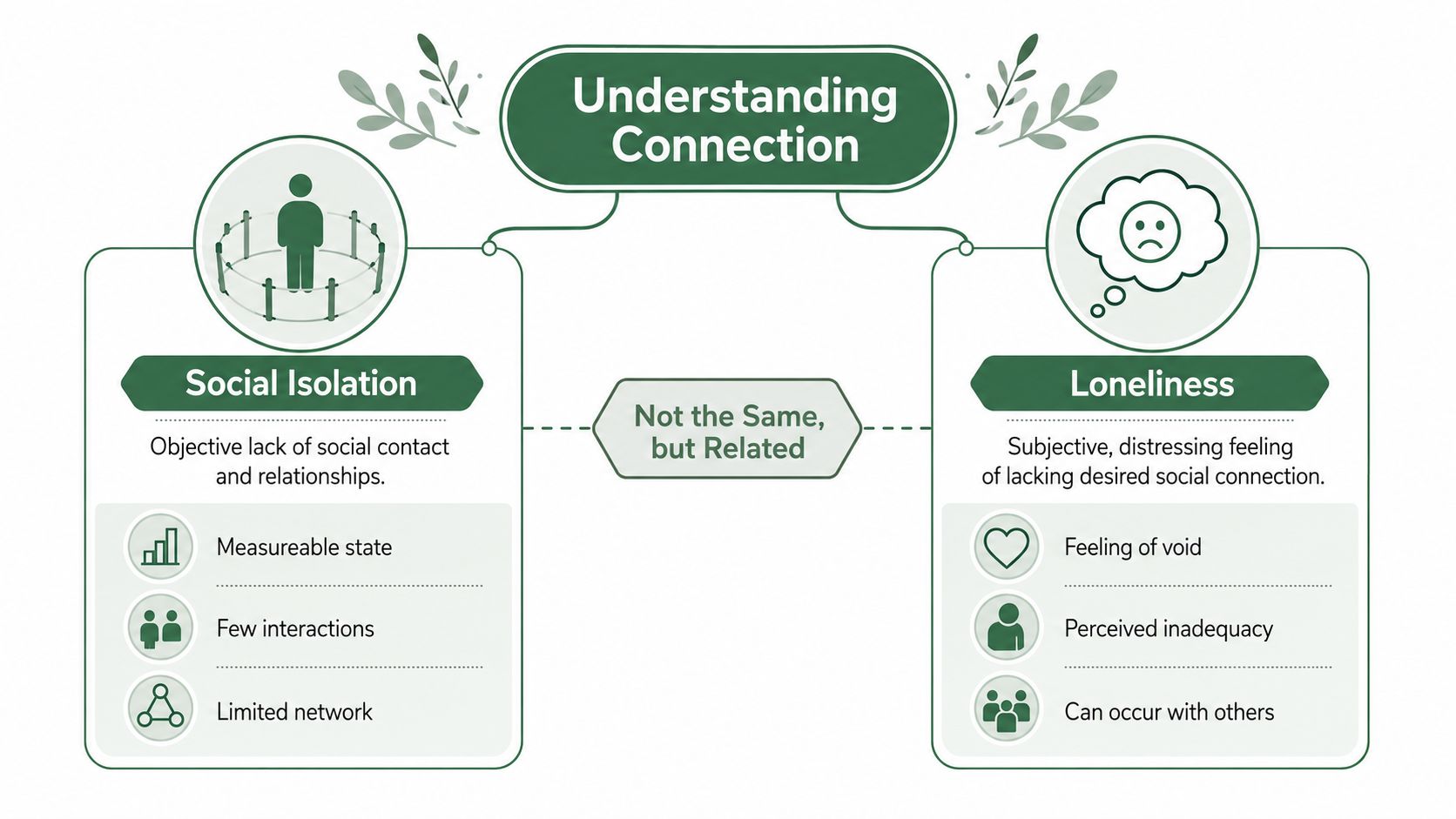
Social isolation is the objective side. It means a person has too little social contact, too few relationships, or a very limited network. This is the part you can often observe. Fewer visitors. Fewer outings. Fewer phone calls. Less participation.
Loneliness is the subjective side. It's the painful feeling that the connection you want isn't the connection you're getting. Someone can live alone and not feel lonely. Someone else can sit in a busy house and still feel alone.
A simple example helps. An older adult who enjoys solitude, reads daily, and talks with a close friend every evening may spend a lot of time alone without feeling lonely. Another older adult may live with family but feel ignored because conversations are rushed, confusing, or one-sided.
Isolation is about the size and frequency of connection. Loneliness is about how that connection feels from the inside.
Where relational isolation fits
For seniors with cognitive decline, there's often a third problem that doesn't get enough attention. Researchers describe a gap that many general interventions miss. Relational isolation happens when cognitive changes make it harder to sustain shared interests or conversational reciprocity, weakening experiences of generativity and contribution and intimacy and understanding, as discussed in this review on social relationship expectations in later life.
In plain language, the senior isn't only missing people. They may be missing the ability to feel useful, understood, and a true connection with another person.
That can happen when:
Conversation moves too fast: The person can't keep up with topic changes and starts withdrawing.
Shared activities no longer fit: A book club, card game, or church group may now feel overwhelming.
Roles have changed: A parent who once gave advice may now feel spoken for rather than included.
Check-ins become transactional: Calls focus on meals, medication, and appointments, not identity or enjoyment.
This is why simple companionship sometimes falls short. A friendly visitor helps, but if the interaction doesn't match the person's cognitive abilities, it may not create real connection. The person can leave the exchange more tired than comforted.
For many families, this is the moment things click. Your loved one may not just be lonely. They may be losing access to the kinds of interactions that used to make relationships feel natural.
Major Health Risks Linked to Senior Isolation
Social isolation in seniors carries health consequences that go well beyond mood. It affects the brain, the cardiovascular system, and survival. That's why clinicians treat it as a health issue, not just a quality-of-life concern.
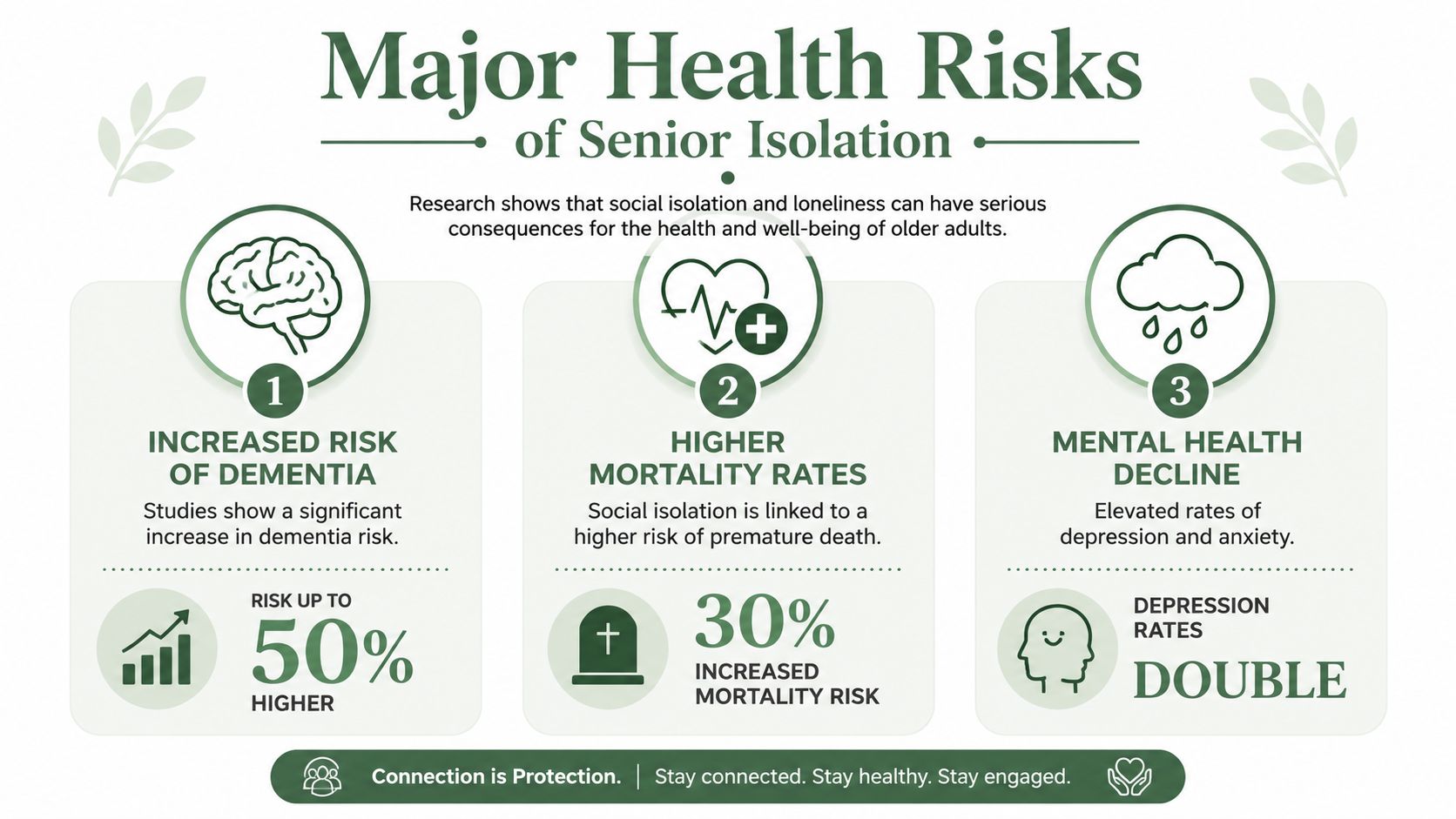
A major review from the National Academies via NCBI Bookshelf found that social isolation is associated with an approximately 50% increased risk of developing dementia, a 29% increased likelihood of death from all causes, and a 30% increased risk of coronary heart disease or stroke.
To keep those risks in view, this visual can help.
Why isolation affects the brain
Connection isn't a luxury for the brain. Conversation, routine social contact, shared attention, and mentally engaging interactions all ask the brain to do important work. A person listens, recalls, responds, interprets tone, and shifts attention. When that input drops, daily cognitive exercise often drops with it.
A separate NIH-hosted article on social isolation and dementia goes further. It notes that social isolation is associated with a 50% increased risk of developing dementia and discusses evidence linking greater loneliness with higher levels of brain amyloid and regional tau accumulation, both linked to early Alzheimer's disease.
That doesn't mean every isolated senior will develop dementia. It does mean isolation deserves attention alongside other modifiable risks. Families sometimes treat social withdrawal as a secondary issue after medications, falls, and appointments are handled. In reality, connection belongs on the same care plan.
To understand the broader cognitive picture, some families also find it useful to review Z Audiology's cognitive decline research, especially when hearing loss may be making conversation harder and reducing participation.
Why families shouldn't dismiss it as a social issue only
The physical effects are serious too. The same National Academies review links poor social relationships with increased cardiovascular risk. For people already coping with chronic illness, isolation can make self-care harder. Meals get skipped. Exercise drops. Symptoms go unmentioned. Motivation fades.
Later in the course of illness, isolation can also magnify confusion and distress. A person may become more suspicious, more repetitive, or more anxious when they go long stretches without grounding contact. Family members sometimes interpret this as stubbornness or personality change, when part of the problem is under-stimulation and disconnection.
A short explanation from a physician can sometimes reframe the whole issue. This video does that well.
When an older adult stops engaging, don't assume they "just don't want to." Many are dealing with barriers they can't explain clearly.
The practical takeaway is direct. If a senior is spending long periods alone, withdrawing from conversation, or losing meaningful contact, treat that as clinically important information.
How to Spot the Warning Signs of Isolation
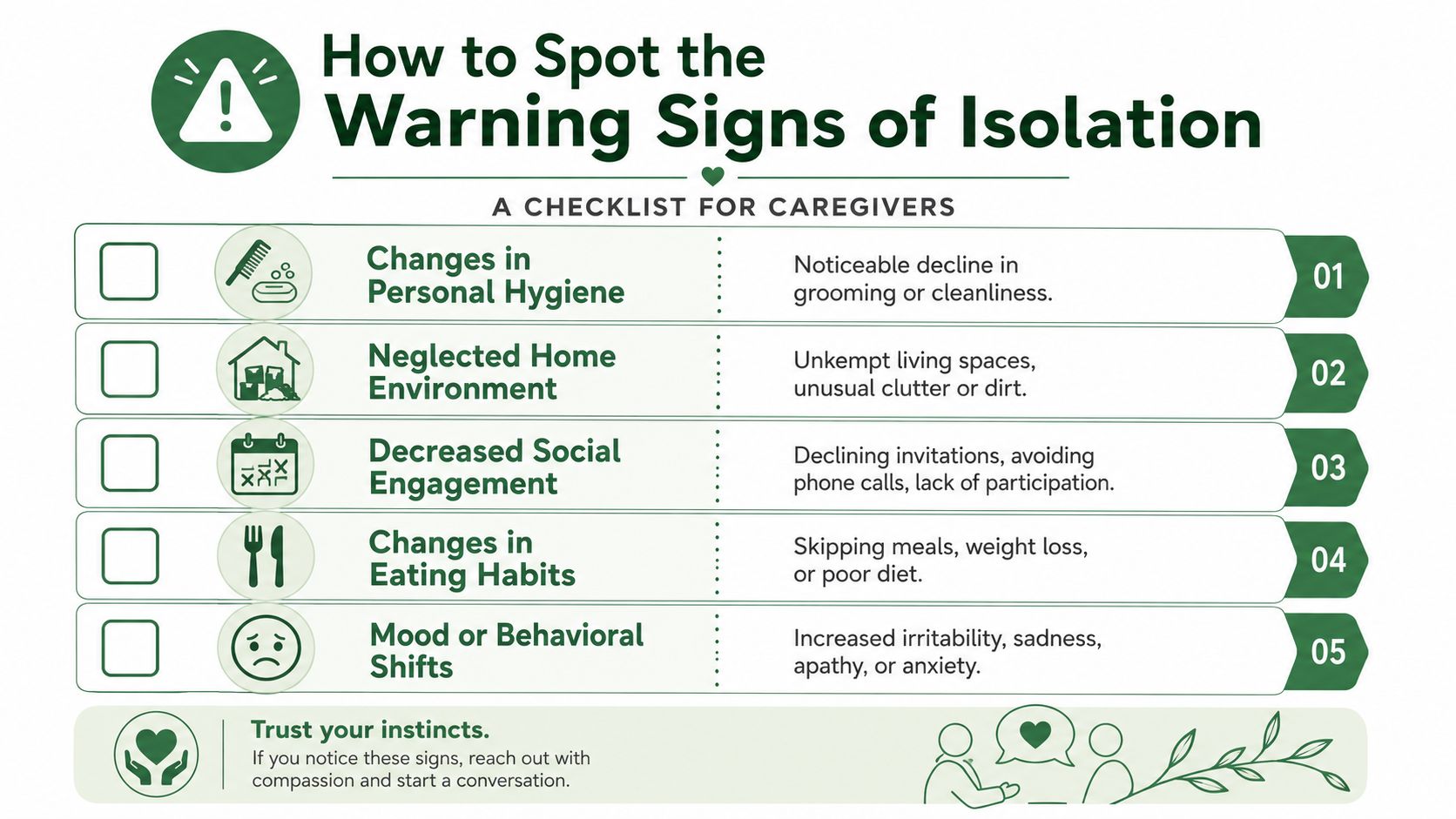
Caregivers usually notice changes before they have a clear label for them. The pattern often shows up in mood, habits, and the texture of conversation.
Emotional and verbal clues
Listen for changes in tone, not just content.
Flat or withdrawn mood: They seem harder to interest, harder to cheer, or emotionally "far away."
Irritability: Small disruptions trigger outsized frustration.
Anxiety about being alone: They may call repeatedly, especially in the evening, without a clear reason.
Nothing to share: Conversations become very short because there hasn't been any meaningful activity or interaction to talk about.
Comments that signal disconnection: Phrases like "Nobody has time" or "I don't want to bother anyone" often matter.
Sometimes families hear these cues and think the solution is to tell the person to join a group. That can work for some seniors. For others, especially those with memory problems, the group setting is exactly what has become too hard.
Behavior and daily living changes
Isolation often leaves fingerprints on everyday routines.
Personal care slips: Grooming, bathing, or changing clothes becomes less consistent.
The home changes: Mail piles up, dishes sit out, laundry goes undone, or the fridge holds very little.
Hobbies disappear: A gardener stops tending plants. A church member stops attending. A card player gives away the deck.
Sleep and eating shift: They nap more, stay in bed longer, forget meals, or lose interest in cooking.
Phone avoidance grows: Calls go unanswered, or they answer but seem eager to end the conversation quickly.
Caregiver cue: Look for loss of rhythm. When daily life loses structure, isolation is often part of the story.
Who is at higher risk
Some older adults need more proactive support because their barriers stack up quickly.
Watch closely if your loved one has any of these risk factors:
Recent bereavement: The loss of a spouse, sibling, or close friend can collapse a daily routine overnight.
Living alone: Time alone isn't always a problem, but it raises the stakes when other supports weaken.
Mobility limits: Pain, balance problems, and driving cessation shrink the practical world.
Hearing trouble: If conversation is exhausting, people often withdraw to avoid embarrassment.
Early dementia or mild cognitive impairment: These changes can reduce confidence in social settings.
Major life transitions: Retirement, a move, or returning home after hospitalization can break familiar patterns.
The most useful question isn't "Are they lonely?" It's "What has become harder for them to do, follow, or enjoy with other people?"
Practical Ways Caregivers Can Foster Connection
The best plan is usually simple, repeatable, and matched to the older adult's abilities. Families often aim too high at first. A weekly lunch, one well-timed phone call, or a familiar activity done consistently can matter more than ambitious plans that fall apart after two weeks.
Start with what the person can still enjoy
Begin with activities that fit the senior's energy, hearing, mobility, and memory.
Use old interests as anchors: If they loved gardening, talk about seasons, seed catalogs, or porch plants. If they followed baseball, listen to a game together.
Keep tasks shared, not performative: Folding towels, sorting photos, shelling peas, or setting the table can create natural interaction.
Shrink the social demand: One calm visitor is often better than a crowded event.
Protect dignity: Avoid putting the person in situations that highlight mistakes or memory gaps.
If you need ideas for what supportive nonmedical presence can look like day to day, this guide to companionship for elderly gives families a useful overview of common companionship options.
Build a simple weekly structure
Connection improves when it becomes predictable. Many seniors do better with routine than with spontaneous outreach.
Try a framework like this:
One dependable family call: Same day, same time, every week.
One in-person touchpoint: A meal, walk, errand, porch visit, or coffee.
One purposeful activity: Music, sorting photos, religious service, crafts, or a favorite show discussed afterward.
One outside contact: Neighbor, volunteer, faith visitor, senior center, or companion.
Families who are comparing support options may also find this overview of companion care for elderly helpful for thinking through what kind of help fits best.
Consistency usually beats intensity. A smaller plan that actually happens lowers isolation more than a big plan nobody can sustain.
Types of Social Interventions for Seniors
Intervention Type | Examples | Best For |
|---|---|---|
Family routine | Scheduled calls, Sunday dinner, shared photo review, visitor calendar | Seniors who respond well to familiar people and predictable contact |
Community connection | Senior center activities, faith community visits, volunteer roles, small local groups | Older adults who can still manage some outside engagement |
Home-based engagement | Companion visits, music sessions, crafts, meal prep together, porch chats | Seniors with mobility limits or fatigue |
Cognitive-friendly interaction | Reminiscence prompts, short structured conversations, simple word games, orientation-based chats | People with early to mid-stage memory loss |
Practical support with social value | Grocery trip together, medication setup plus conversation, rides to appointments with extra time to connect | Seniors whose isolation is tied to transportation or daily task barriers |
A few decisions make these efforts work better:
Match the activity to the time of day. If your parent is clearest in the morning, don't schedule the important conversation at dusk.
Choose familiar over novel. Novelty can be stimulating, but it can also be stressful.
Watch the recovery after the activity. If they seem calmer and more alert afterward, that's a good sign. If they seem depleted, simplify.
The goal isn't to fill every empty hour. It's to create repeated moments where the person feels included, oriented, and known.
How Phone-Based Cognitive Support Bridges the Gap
Some seniors won't use apps. Others can no longer manage video calls without help. Some dislike screens altogether. That leaves many families with a hard question. How do you create meaningful connection when in-person support is limited and digital tools aren't realistic?
Why digital tools miss many older adults
A United Nations background paper on social isolation in older persons notes that nearly all research on digital interventions focuses on apps or video calls, which can exclude 40% to 50% of older adults with low digital literacy or technology anxiety, as described in this UN report on social isolation and loneliness among older people.
That matters because the seniors with the greatest need are often the least likely to benefit from tech-heavy solutions. Rural older adults, homebound seniors, and people with limited income may have trouble with devices, internet access, charging routines, passwords, or the stress of troubleshooting.
When memory loss is involved, the problem gets bigger. A person may forget how to answer a tablet, become suspicious of unfamiliar screens, or lose track of what the call is for.
What makes a structured phone call different
A plain phone call is familiar. There's no app to open, camera to position, or login to remember. That alone lowers friction.
But for seniors with cognitive decline, the stronger model is often a structured phone call rather than a casual check-in. Structured calls can include orientation cues, reminiscence prompts, attention tasks, mood support, and practical check-ins woven into natural conversation. That approach doesn't just provide company. It supports engagement.

For families exploring this type of support, this article on daily check-in calls for seniors offers a useful look at how recurring calls can support safety, mood, and routine.
This kind of support is especially relevant when the unmet need isn't only "someone to talk to." It's "someone who knows how to keep the person engaged without overwhelming them." That's the gap between generic check-ins and cognitive-friendly connection.
A good call isn't measured only by length. It's measured by whether the person felt calmer, more oriented, and more connected when it ended.
Building a Support System and Finding Help
Caregivers often wait too long to ask for help because they think isolation should be solved informally. Family does what it can, but social isolation in seniors can intersect with grief, hearing loss, depression, mobility problems, and cognitive decline. That usually calls for a team approach.
When to involve professionals
Bring concerns to a primary care clinician, geriatrician, neurologist, or social worker if you notice rapid withdrawal, major mood changes, new confusion, skipped meals, worsening self-care, or frequent distress when the person is alone. Those signs don't prove one cause. They do mean the situation deserves a fuller look.
It also helps to involve professionals when family contact has become mostly crisis management. If every call is about fear, confusion, or conflict, outside support can stabilize the routine and reduce strain on everyone.
Reliable places to look for support
Start with trusted organizations and local aging services. Useful options often include:
Area Agencies on Aging: Good for local transportation, meal, and caregiver support programs.
National Institute on Aging: Helpful for education on aging, caregiving, and cognitive change.
AARP: Offers caregiver tools and practical planning resources.
Alzheimer's and dementia organizations: Useful when memory loss affects conversation and participation.
Community groups: Faith communities, libraries, and senior centers can sometimes provide small, manageable forms of contact.
Some families also add low-pressure supports that don't rely entirely on conversation. For example, this guide to pet therapy for elderly adults can help you think about comfort, routine, and emotional regulation in a different way.
The main thing to remember is this. Needing help doesn't mean you've failed. It means the problem is real, and you're responding to it thoughtfully.
If your loved one is living with early to mid-stage memory loss, Velma offers phone-based cognitive support through scheduled calls that combine conversation, research-backed cognitive exercises, companionship, and practical check-ins. For families trying to reduce isolation without adding new technology, it can be a simple way to support connection, brain engagement, and daily routine.
One in four older adults worldwide lacks adequate social connection, according to a pooled analysis on social isolation among community-dwelling seniors published on PubMed. In the United States, that same body of evidence includes 2020 data showing 24% of adults age 65 and older, about 7.7 million people, were socially isolated even before the pandemic.
If you're worried about a parent, spouse, or older neighbor, your concern is justified. Social isolation in seniors isn't just about having a quiet week or preferring time alone. It can change mood, daily functioning, and health in ways families often notice before anyone else has a name for it.
The good news is that isolation is something you can look for, talk about, and respond to. And when memory loss is part of the picture, it helps to understand that the problem isn't always simple loneliness. Sometimes the deeper issue is a loss of meaningful back-and-forth connection.
Table of Contents
The Hidden Epidemic of Social Isolation in Seniors
What Is Social Isolation vs Loneliness
Two problems that overlap but aren't identical
Where relational isolation fits
Major Health Risks Linked to Senior Isolation
Why isolation affects the brain
Why families shouldn't dismiss it as a social issue only
How to Spot the Warning Signs of Isolation
Emotional and verbal clues
Behavior and daily living changes
Who is at higher risk
Practical Ways Caregivers Can Foster Connection
Start with what the person can still enjoy
Build a simple weekly structure
Types of Social Interventions for Seniors
How Phone-Based Cognitive Support Bridges the Gap
Why digital tools miss many older adults
What makes a structured phone call different
Building a Support System and Finding Help
When to involve professionals
Reliable places to look for support
The Hidden Epidemic of Social Isolation in Seniors
About 1 in 4 older adults living in the community are socially isolated, as noted earlier. That helps explain why so many families are dealing with this problem, even when nothing looks obviously wrong at first.
Social isolation usually does not arrive as a single event. It builds the way a room slowly grows dimmer at dusk. A spouse dies. Driving stops. Hearing becomes strained. Walking takes more effort. One missed outing turns into a month of staying home, and a once-active social circle narrows to a few practical contacts.
That shrinking world can be hard to spot from the outside.
Families often look for dramatic warning signs, but many older adults still have contact with other people. The issue is the quality and purpose of that contact. A senior may speak with someone every day and still spend most conversations on medications, appointments, meals, and reminders. The calendar looks active. The person still feels mentally sidelined.
Practical rule: If most contact has become task-focused rather than relationship-focused, isolation may still be affecting the person's mood, thinking, and sense of self.
This matters even more in cognitive decline. An older adult with memory loss may be surrounded by people and still be relationally isolated. They may not be able to keep up with quick group conversations, follow topic changes, or join in the back-and-forth that makes connection feel mutual. Family check-ins help, but brief updates and casual visits often do not provide the steady, voice-based engagement that supports attention, confidence, and participation.
That is why generic advice can miss the mark. The problem is not always being alone. Sometimes it is being present without being included, understood, or able to engage.
What Is Social Isolation vs Loneliness
Families often use these words as if they mean the same thing. They don't. Knowing the difference helps you choose better support.
Two problems that overlap but aren't identical
Social isolation is the objective side. It means a person has too little social contact, too few relationships, or a very limited network. This is the part you can often observe. Fewer visitors. Fewer outings. Fewer phone calls. Less participation.
Loneliness is the subjective side. It's the painful feeling that the connection you want isn't the connection you're getting. Someone can live alone and not feel lonely. Someone else can sit in a busy house and still feel alone.
A simple example helps. An older adult who enjoys solitude, reads daily, and talks with a close friend every evening may spend a lot of time alone without feeling lonely. Another older adult may live with family but feel ignored because conversations are rushed, confusing, or one-sided.
Isolation is about the size and frequency of connection. Loneliness is about how that connection feels from the inside.
Where relational isolation fits
For seniors with cognitive decline, there's often a third problem that doesn't get enough attention. Researchers describe a gap that many general interventions miss. Relational isolation happens when cognitive changes make it harder to sustain shared interests or conversational reciprocity, weakening experiences of generativity and contribution and intimacy and understanding, as discussed in this review on social relationship expectations in later life.
In plain language, the senior isn't only missing people. They may be missing the ability to feel useful, understood, and a true connection with another person.
That can happen when:
Conversation moves too fast: The person can't keep up with topic changes and starts withdrawing.
Shared activities no longer fit: A book club, card game, or church group may now feel overwhelming.
Roles have changed: A parent who once gave advice may now feel spoken for rather than included.
Check-ins become transactional: Calls focus on meals, medication, and appointments, not identity or enjoyment.
This is why simple companionship sometimes falls short. A friendly visitor helps, but if the interaction doesn't match the person's cognitive abilities, it may not create real connection. The person can leave the exchange more tired than comforted.
For many families, this is the moment things click. Your loved one may not just be lonely. They may be losing access to the kinds of interactions that used to make relationships feel natural.
Major Health Risks Linked to Senior Isolation
Social isolation in seniors carries health consequences that go well beyond mood. It affects the brain, the cardiovascular system, and survival. That's why clinicians treat it as a health issue, not just a quality-of-life concern.
A major review from the National Academies via NCBI Bookshelf found that social isolation is associated with an approximately 50% increased risk of developing dementia, a 29% increased likelihood of death from all causes, and a 30% increased risk of coronary heart disease or stroke.
To keep those risks in view, this visual can help.
Why isolation affects the brain
Connection isn't a luxury for the brain. Conversation, routine social contact, shared attention, and mentally engaging interactions all ask the brain to do important work. A person listens, recalls, responds, interprets tone, and shifts attention. When that input drops, daily cognitive exercise often drops with it.
A separate NIH-hosted article on social isolation and dementia goes further. It notes that social isolation is associated with a 50% increased risk of developing dementia and discusses evidence linking greater loneliness with higher levels of brain amyloid and regional tau accumulation, both linked to early Alzheimer's disease.
That doesn't mean every isolated senior will develop dementia. It does mean isolation deserves attention alongside other modifiable risks. Families sometimes treat social withdrawal as a secondary issue after medications, falls, and appointments are handled. In reality, connection belongs on the same care plan.
To understand the broader cognitive picture, some families also find it useful to review Z Audiology's cognitive decline research, especially when hearing loss may be making conversation harder and reducing participation.
Why families shouldn't dismiss it as a social issue only
The physical effects are serious too. The same National Academies review links poor social relationships with increased cardiovascular risk. For people already coping with chronic illness, isolation can make self-care harder. Meals get skipped. Exercise drops. Symptoms go unmentioned. Motivation fades.
Later in the course of illness, isolation can also magnify confusion and distress. A person may become more suspicious, more repetitive, or more anxious when they go long stretches without grounding contact. Family members sometimes interpret this as stubbornness or personality change, when part of the problem is under-stimulation and disconnection.
A short explanation from a physician can sometimes reframe the whole issue. This video does that well.
When an older adult stops engaging, don't assume they "just don't want to." Many are dealing with barriers they can't explain clearly.
The practical takeaway is direct. If a senior is spending long periods alone, withdrawing from conversation, or losing meaningful contact, treat that as clinically important information.
How to Spot the Warning Signs of Isolation
Caregivers usually notice changes before they have a clear label for them. The pattern often shows up in mood, habits, and the texture of conversation.
Emotional and verbal clues
Listen for changes in tone, not just content.
Flat or withdrawn mood: They seem harder to interest, harder to cheer, or emotionally "far away."
Irritability: Small disruptions trigger outsized frustration.
Anxiety about being alone: They may call repeatedly, especially in the evening, without a clear reason.
Nothing to share: Conversations become very short because there hasn't been any meaningful activity or interaction to talk about.
Comments that signal disconnection: Phrases like "Nobody has time" or "I don't want to bother anyone" often matter.
Sometimes families hear these cues and think the solution is to tell the person to join a group. That can work for some seniors. For others, especially those with memory problems, the group setting is exactly what has become too hard.
Behavior and daily living changes
Isolation often leaves fingerprints on everyday routines.
Personal care slips: Grooming, bathing, or changing clothes becomes less consistent.
The home changes: Mail piles up, dishes sit out, laundry goes undone, or the fridge holds very little.
Hobbies disappear: A gardener stops tending plants. A church member stops attending. A card player gives away the deck.
Sleep and eating shift: They nap more, stay in bed longer, forget meals, or lose interest in cooking.
Phone avoidance grows: Calls go unanswered, or they answer but seem eager to end the conversation quickly.
Caregiver cue: Look for loss of rhythm. When daily life loses structure, isolation is often part of the story.
Who is at higher risk
Some older adults need more proactive support because their barriers stack up quickly.
Watch closely if your loved one has any of these risk factors:
Recent bereavement: The loss of a spouse, sibling, or close friend can collapse a daily routine overnight.
Living alone: Time alone isn't always a problem, but it raises the stakes when other supports weaken.
Mobility limits: Pain, balance problems, and driving cessation shrink the practical world.
Hearing trouble: If conversation is exhausting, people often withdraw to avoid embarrassment.
Early dementia or mild cognitive impairment: These changes can reduce confidence in social settings.
Major life transitions: Retirement, a move, or returning home after hospitalization can break familiar patterns.
The most useful question isn't "Are they lonely?" It's "What has become harder for them to do, follow, or enjoy with other people?"
Practical Ways Caregivers Can Foster Connection
The best plan is usually simple, repeatable, and matched to the older adult's abilities. Families often aim too high at first. A weekly lunch, one well-timed phone call, or a familiar activity done consistently can matter more than ambitious plans that fall apart after two weeks.
Start with what the person can still enjoy
Begin with activities that fit the senior's energy, hearing, mobility, and memory.
Use old interests as anchors: If they loved gardening, talk about seasons, seed catalogs, or porch plants. If they followed baseball, listen to a game together.
Keep tasks shared, not performative: Folding towels, sorting photos, shelling peas, or setting the table can create natural interaction.
Shrink the social demand: One calm visitor is often better than a crowded event.
Protect dignity: Avoid putting the person in situations that highlight mistakes or memory gaps.
If you need ideas for what supportive nonmedical presence can look like day to day, this guide to companionship for elderly gives families a useful overview of common companionship options.
Build a simple weekly structure
Connection improves when it becomes predictable. Many seniors do better with routine than with spontaneous outreach.
Try a framework like this:
One dependable family call: Same day, same time, every week.
One in-person touchpoint: A meal, walk, errand, porch visit, or coffee.
One purposeful activity: Music, sorting photos, religious service, crafts, or a favorite show discussed afterward.
One outside contact: Neighbor, volunteer, faith visitor, senior center, or companion.
Families who are comparing support options may also find this overview of companion care for elderly helpful for thinking through what kind of help fits best.
Consistency usually beats intensity. A smaller plan that actually happens lowers isolation more than a big plan nobody can sustain.
Types of Social Interventions for Seniors
Intervention Type | Examples | Best For |
|---|---|---|
Family routine | Scheduled calls, Sunday dinner, shared photo review, visitor calendar | Seniors who respond well to familiar people and predictable contact |
Community connection | Senior center activities, faith community visits, volunteer roles, small local groups | Older adults who can still manage some outside engagement |
Home-based engagement | Companion visits, music sessions, crafts, meal prep together, porch chats | Seniors with mobility limits or fatigue |
Cognitive-friendly interaction | Reminiscence prompts, short structured conversations, simple word games, orientation-based chats | People with early to mid-stage memory loss |
Practical support with social value | Grocery trip together, medication setup plus conversation, rides to appointments with extra time to connect | Seniors whose isolation is tied to transportation or daily task barriers |
A few decisions make these efforts work better:
Match the activity to the time of day. If your parent is clearest in the morning, don't schedule the important conversation at dusk.
Choose familiar over novel. Novelty can be stimulating, but it can also be stressful.
Watch the recovery after the activity. If they seem calmer and more alert afterward, that's a good sign. If they seem depleted, simplify.
The goal isn't to fill every empty hour. It's to create repeated moments where the person feels included, oriented, and known.
How Phone-Based Cognitive Support Bridges the Gap
Some seniors won't use apps. Others can no longer manage video calls without help. Some dislike screens altogether. That leaves many families with a hard question. How do you create meaningful connection when in-person support is limited and digital tools aren't realistic?
Why digital tools miss many older adults
A United Nations background paper on social isolation in older persons notes that nearly all research on digital interventions focuses on apps or video calls, which can exclude 40% to 50% of older adults with low digital literacy or technology anxiety, as described in this UN report on social isolation and loneliness among older people.
That matters because the seniors with the greatest need are often the least likely to benefit from tech-heavy solutions. Rural older adults, homebound seniors, and people with limited income may have trouble with devices, internet access, charging routines, passwords, or the stress of troubleshooting.
When memory loss is involved, the problem gets bigger. A person may forget how to answer a tablet, become suspicious of unfamiliar screens, or lose track of what the call is for.
What makes a structured phone call different
A plain phone call is familiar. There's no app to open, camera to position, or login to remember. That alone lowers friction.
But for seniors with cognitive decline, the stronger model is often a structured phone call rather than a casual check-in. Structured calls can include orientation cues, reminiscence prompts, attention tasks, mood support, and practical check-ins woven into natural conversation. That approach doesn't just provide company. It supports engagement.
For families exploring this type of support, this article on daily check-in calls for seniors offers a useful look at how recurring calls can support safety, mood, and routine.
This kind of support is especially relevant when the unmet need isn't only "someone to talk to." It's "someone who knows how to keep the person engaged without overwhelming them." That's the gap between generic check-ins and cognitive-friendly connection.
A good call isn't measured only by length. It's measured by whether the person felt calmer, more oriented, and more connected when it ended.
Building a Support System and Finding Help
Caregivers often wait too long to ask for help because they think isolation should be solved informally. Family does what it can, but social isolation in seniors can intersect with grief, hearing loss, depression, mobility problems, and cognitive decline. That usually calls for a team approach.
When to involve professionals
Bring concerns to a primary care clinician, geriatrician, neurologist, or social worker if you notice rapid withdrawal, major mood changes, new confusion, skipped meals, worsening self-care, or frequent distress when the person is alone. Those signs don't prove one cause. They do mean the situation deserves a fuller look.
It also helps to involve professionals when family contact has become mostly crisis management. If every call is about fear, confusion, or conflict, outside support can stabilize the routine and reduce strain on everyone.
Reliable places to look for support
Start with trusted organizations and local aging services. Useful options often include:
Area Agencies on Aging: Good for local transportation, meal, and caregiver support programs.
National Institute on Aging: Helpful for education on aging, caregiving, and cognitive change.
AARP: Offers caregiver tools and practical planning resources.
Alzheimer's and dementia organizations: Useful when memory loss affects conversation and participation.
Community groups: Faith communities, libraries, and senior centers can sometimes provide small, manageable forms of contact.
Some families also add low-pressure supports that don't rely entirely on conversation. For example, this guide to pet therapy for elderly adults can help you think about comfort, routine, and emotional regulation in a different way.
The main thing to remember is this. Needing help doesn't mean you've failed. It means the problem is real, and you're responding to it thoughtfully.
If your loved one is living with early to mid-stage memory loss, Velma offers phone-based cognitive support through scheduled calls that combine conversation, research-backed cognitive exercises, companionship, and practical check-ins. For families trying to reduce isolation without adding new technology, it can be a simple way to support connection, brain engagement, and daily routine.
Suggested Article: