Care Coordination Platform: A Guide for Dementia Care

You may be living this right now. One doctor changes a medication. A home aide mentions a new concern. Your brother texts that Mom sounded confused on the phone. Someone writes the next appointment on a sticky note, but someone else already put a different time on the kitchen calendar.
For families caring for a person with dementia, the hard part often isn't one single medical task. It's the constant work of keeping everyone aligned. The details are small, but the consequences aren't. A missed refill, a forgotten follow-up, or a change in mood that nobody connects in time can turn a manageable week into a crisis.
A care coordination platform is meant to bring order to that confusion. Think of it as a shared system for the people around the older adult, not just another app to download and ignore. When it works well, it helps families, clinicians, aides, and care managers see the same plan, track the same tasks, and respond to the same concerns.
Table of Contents
The Overwhelming Task of Coordinating Modern Care
Where families usually get stuck
What Exactly Is a Care Coordination Platform
Think of it as a family command center
How it's different from common tools
Why this matters so much in dementia care
Core Features That Power Coordinated Care
One shared record
Task routing that matches real roles
Safer transitions and referrals
Secure communication and smarter insight
The Real-World Benefits for Families and Care Teams
What families gain
What professional care teams gain
One system, different kinds of relief
Bridging the Digital Divide with Phone-Based Support
Why app-first care leaves people out
What phone-based support adds
The strongest care plans are blended
How to Choose and Implement the Right Platform
What to look for first
How to roll it out without chaos
The Overwhelming Task of Coordinating Modern Care
Anna keeps a notebook for her father. One page has his medications. Another has the neurologist's advice. The home care aide leaves updates on scraps of paper near the coffee maker. Her sister prefers text messages. Her father's primary care office uses a patient portal. The memory clinic sends printed visit summaries. Nobody is trying to make care harder, but the system still feels scattered.
That scattered feeling is one of the most exhausting parts of dementia care. Family members often become part scheduler, part detective, part translator, and part crisis responder. They repeat the same history to different professionals and try to remember which advice came from whom. Over time, the work of coordinating care can become as draining as the hands-on care itself.
If that sounds familiar, it helps to know the problem isn't just personal disorganization. Modern care is fragmented by design. Different settings use different tools. Different people hold different pieces of the story. Dementia makes that fragmentation even harder because consistency, routine, and follow-through matter so much.
Practical rule: If important care information lives in five places, someone will miss something.
A good care coordination platform doesn't remove the emotional weight of caregiving, but it can reduce the administrative chaos around it. Instead of relying on memory, side conversations, and duplicate notes, the team gets one working space for updates, tasks, and follow-up.
That shift is part of a larger change in healthcare. The global care coordination and patient journey management connected healthcare platform market reached US$ 4,087.2 million in 2025 and is projected to reach USD 6,783.8 million by 2033, growing at a 6.7% CAGR, according to Grand View Research's connected healthcare platform market outlook. In plain language, healthcare organizations are treating coordination tools as core infrastructure, not optional extras.
Where families usually get stuck
Too many communication channels. One person uses text, another emails, and a clinic uploads notes to a portal that nobody checks often enough.
No single owner of the plan. Everyone helps, but nobody can quickly confirm what should happen today.
Changes get lost. A medication adjustment, mobility concern, or behavior change may be noticed by one person and never shared clearly with the rest of the team.
Stress spreads through the family. The more unclear the plan is, the more likely caregivers are to feel overwhelmed. Many families recognize this pattern in discussions of caregiver stress and burnout.
When people talk about "getting organized," they often mean buying a bigger binder or starting another group chat. Those can help for a while. But when care involves multiple professionals, changing routines, and daily safety concerns, families usually need something more reliable than good intentions.
What Exactly Is a Care Coordination Platform
A care coordination platform is a secure digital workspace that helps everyone involved in a person's care work from the same playbook. If an electronic health record is the clinic's chart, a care coordination platform is the team's shared operations board.
That's an important difference. A chart stores information. A coordination platform helps people act on it.
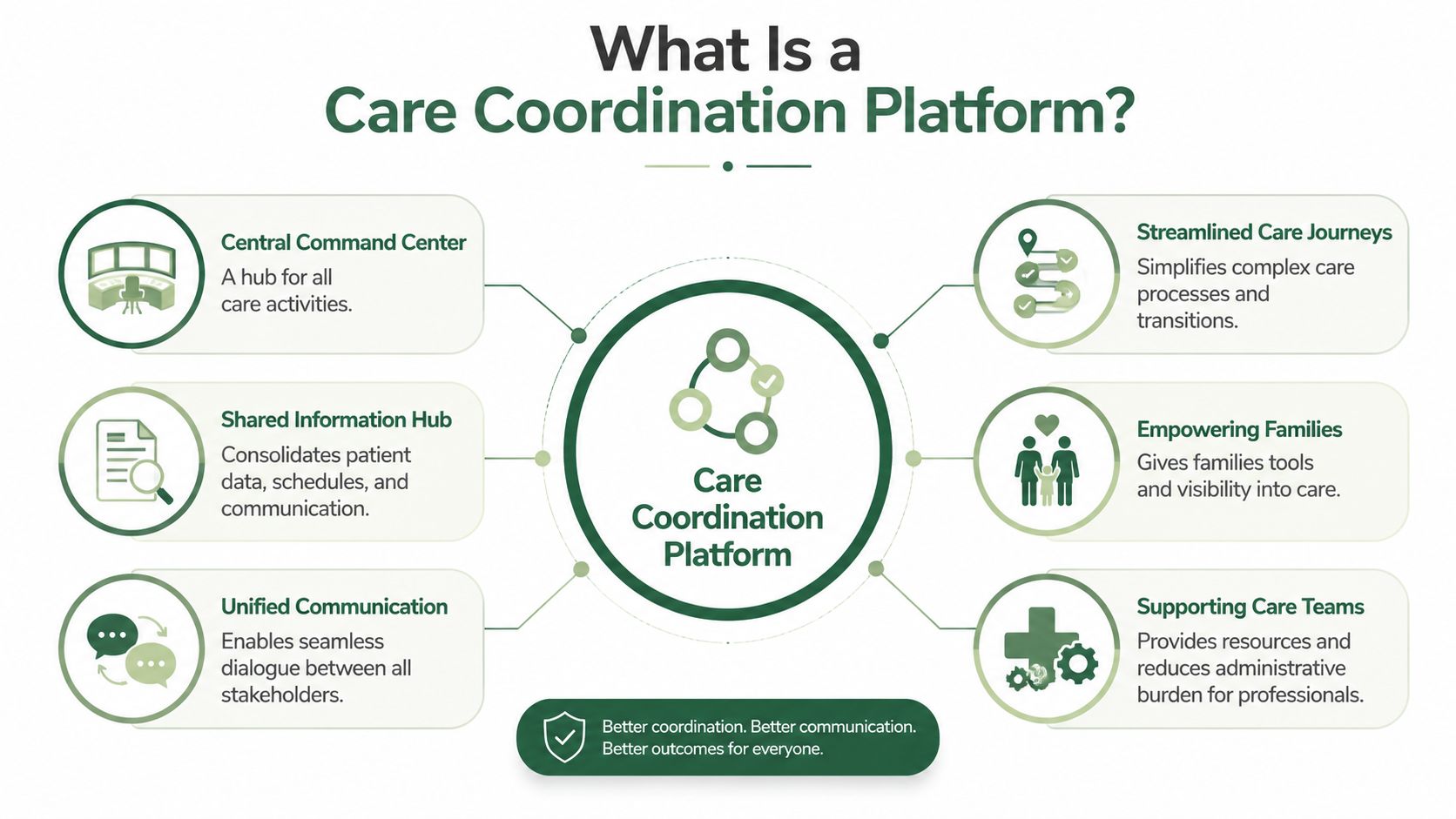
Think of it as a family command center
A simple analogy helps. Picture a kitchen used by a busy household. One drawer has bills, another has school forms, and someone taped a grocery list to the fridge. You can survive like that, but only if life stays simple.
Now picture a labeled family binder with one calendar, one task list, and one place for important contacts and instructions. That's closer to what a care coordination platform does, except it's built for healthcare and shared by the people who need to coordinate in real time.
In dementia care, that can mean one place to check today's appointments, note yesterday's confusion, see who handled the refill request, and confirm whether the daughter, home aide, or care manager is following up.
How it's different from common tools
Families often ask why they can't just use a group text, a shared note, or the doctor portal. Those tools each solve one piece of the problem, but not the whole thing.
Tool | What it does well | What it misses |
|---|---|---|
Group chat | Fast updates | Important details disappear in the thread |
Calendar app | Tracks dates and visits | Doesn't connect tasks, notes, and care history |
Patient portal | Shows information from one health system | Usually doesn't organize the whole care team |
Paper binder | Familiar and simple | Hard to update, share, and track across people |
Care coordination platform | Brings communication, tasks, records, and follow-up together | Requires setup and team adoption |
A useful platform doesn't just answer "What happened?" It helps the team answer "Who is doing what next?"
Why this matters so much in dementia care
Dementia care depends on repetition, visibility, and follow-through. A person might see a neurologist, primary care clinician, home aide, family caregiver, and social worker. Each person observes something valuable. The problem is that those observations often stay separate.
A care coordination platform creates a single, secure place to connect those dots. It can help a daughter notice that missed lunches, medication confusion, and increased anxiety are happening in the same week. It can help a care manager see whether a referral closed the loop. It can help everyone avoid relying on "I thought someone else was handling it."
The best way to understand the platform is this: it's less like a filing cabinet and more like a working care map. It doesn't replace human judgment. It gives that judgment a place to live, move, and stay visible.
Core Features That Power Coordinated Care
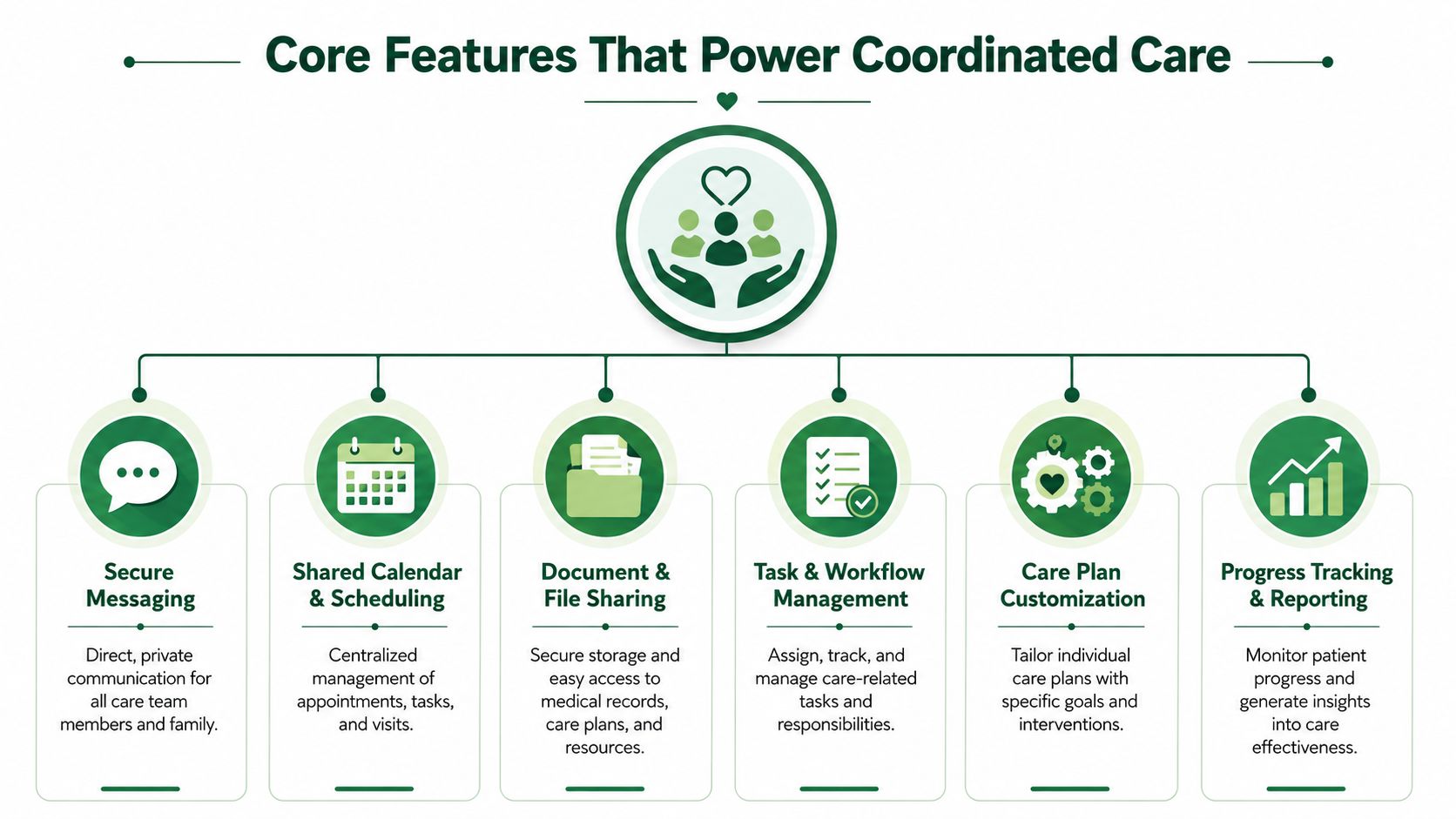
The phrase "care coordination platform" can sound broad, so it helps to break it into the functions that matter day to day. A strong platform isn't just a dashboard with a lot of tabs. It supports a few critical jobs very well.
One shared record
At the center is a shared patient record. For a production-ready platform, that record should be built on a HIPAA-compliant, FHIR-aware foundation and aggregate core information such as problems, medications, allergies, and recent encounters through FHIR reads, as described in this care coordination platform development guide.
For families, that means less guessing. Instead of keeping separate lists, the team can refer to one updated view of the person's current situation.
In dementia care, this shared record is especially useful when behavior changes may have several causes. A sudden change in mood could relate to sleep, a medication issue, a recent hospitalization, or an infection. A shared record doesn't diagnose the cause, but it helps the team see the context faster.
Task routing that matches real roles
A platform also needs role-based task routing. That's a technical phrase for a simple idea. The right task should go to the right person.
A refill request might belong to one family member. A fall-risk follow-up might go to a care manager. A transportation task might go to the neighbor who already helps with appointments. Good coordination software doesn't treat every update as a message for everyone. It directs action where it belongs.
Dementia care creates many small tasks that are easy to lose. Medication prompts, meal checks, appointment reminders, referral follow-up, and home safety concerns all need owners. Families looking for practical support around daily routines often use tools like medication reminders for seniors with memory loss alongside broader coordination systems.
Safer transitions and referrals
Some of the riskiest moments in care happen during handoffs. A hospital discharge. A new specialist visit. A referral to therapy. A move from independent living to more support at home.
A strong platform tracks transitions of care and closed-loop referrals. In plain terms, that means the system doesn't stop at "referral sent." It helps the team see whether the next step occurred.
Consider a common dementia scenario. A primary care clinician recommends physical therapy after a fall scare. Without a coordination system, one person assumes the office sent the referral, another assumes the therapist will call, and the family waits. Weeks pass. With a better platform, someone can see the referral status, track the follow-up, and confirm the appointment happened.
Secure communication and smarter insight
Families often share sensitive information in places that weren't designed for health data. Secure team communication matters because it reduces the chance that private health information gets scattered across text threads and casual messages. Production-ready systems are built so that no protected health information appears in push or SMS bodies, which protects privacy while still alerting team members that action is needed.
Some platforms also add AI-powered analytics. According to SolGuruz's overview of care coordination software, effective platforms use AI-powered analytics to identify high-risk patients and recommend interventions, combine EHR data with social determinants of health for a 360-degree view, and automate task routing to reduce fragmentation.
That can sound abstract, so here's the plain-language version. If the platform sees a pattern of missed appointments, rising confusion, increased caregiver concern, and mobility issues, it may help flag that this person needs closer follow-up.
Good software doesn't replace a caregiver's instinct. It helps the whole team act on that instinct sooner.
Not every family needs the most advanced setup. But the core idea stays the same. The platform should help the right people see the right information and turn it into the right next step.
The Real-World Benefits for Families and Care Teams
The value of a care coordination platform isn't the software itself. It's what daily life feels like when care is less fragmented.

What families gain
Families usually notice the emotional benefit first. They don't have to keep the whole plan in their head.
When one system shows appointments, tasks, notes, and updates, caregiving becomes more shareable. The daughter who lives nearby doesn't have to carry every detail alone. The son in another state can check the same information without asking for a recap every night. The spouse can stop wondering whether the home aide already mentioned the skipped lunch or the rough morning.
That clarity often changes the tone of family communication. Fewer messages start with "Did anyone..." or "I thought you were handling..." The platform won't erase grief or uncertainty, but it can reduce confusion-driven conflict.
A few benefits families often describe are easier to recognize than to measure:
Less repetition. You don't have to retell the same story to every helper.
More confidence. You can see whether something was assigned, completed, or still needs follow-up.
Better continuity. If one caregiver is unavailable, another can step in without starting from scratch.
Improved peace of mind. You have a place to check reality when your brain is overloaded.
The biggest relief is often simple. The family knows where to look.
What professional care teams gain
For professionals, the benefit is less drama and more reliability. Care managers, social workers, home care agencies, and clinicians all work better when information arrives in a usable format.
A platform can reduce time spent chasing updates across voicemail, email, and handwritten notes. It can also make responsibilities clearer. Instead of every concern becoming everybody's problem, teams can triage and assign issues more cleanly.
That has practical effects in dementia care, where small shifts matter. A home care agency can document that a client seemed more disoriented during breakfast visits. A care manager can connect that pattern to a recent medication change. A family can be notified with enough context to know whether the issue is urgent or just worth watching.
For a quick visual overview, this short video captures how coordinated care tools support communication and follow-through across teams:
One system, different kinds of relief
The same platform can feel different depending on who's using it.
User | Relief it provides |
|---|---|
Adult child caregiver | Less mental overload and fewer loose ends |
Spouse caregiver | More structure in daily routines and follow-up |
Care manager | Cleaner visibility into tasks, patterns, and next steps |
Home care team | Better handoff notes and clearer communication |
Clinical team | Faster context for changes in condition or adherence |
The software doesn't create compassion, judgment, or trust. People do that. What the platform can do is support those human strengths instead of making everyone work around fragmented systems.
Bridging the Digital Divide with Phone-Based Support
Many discussions about care technology assume the older adult will use an app, respond to alerts, or learn a new digital routine. In dementia care, that assumption often breaks down.
A person may still hold a conversation, enjoy routine, and benefit from daily support while struggling with passwords, notifications, tiny screens, and shifting app interfaces. If the care plan depends on digital fluency the person doesn't have, the "solution" can subtly become another burden for the family.

Why app-first care leaves people out
This gap isn't theoretical. A major gap in care technology is its reliance on digital access. 78% of adults with early-stage dementia struggle with smartphones, yet much platform coverage assumes digital literacy, leaving phone-based cognitive support underserved, according to Ekipa's analysis of care coordination platform gaps.
That explains why some families feel disappointed after adopting a digital tool. The family may become more organized, but the person receiving care still isn't directly supported in a way that fits their abilities.
A care coordination platform is excellent for organizing the team around the older adult. It is not always the best tool for engaging the older adult directly.
Technology works best when it fits the person's actual daily abilities, not the abilities we wish they had.
What phone-based support adds
Phone-based support fills a different role. It meets the older adult in a familiar format and adds human contact without requiring app use, logins, or device management.
For someone with memory loss, a recurring phone call can support routine, orientation, companionship, and practical check-ins. A trained caller can notice confusion, anxiety, mobility concerns, or repeated worries that might never appear in a portal or calendar. Families who want a steadier rhythm between in-person visits often look for services centered on daily check-in calls for seniors.
The care coordination platform enhances the utility of a comprehensive understanding by organizing the care team. Phone-based support can generate real-world observations from the person's daily life. When a care manager documents those observations back into the shared system, the team gets a more accurate picture of the person's current state.
The strongest care plans are blended
A complete care plan for dementia often needs both structure and touch.
The platform organizes. It holds tasks, records, communication, and follow-up.
Phone support engages. It reaches the person in a format they can use.
A care manager connects the two. Observations from calls become actionable updates for the rest of the team.
Families get better visibility. They don't just know what was scheduled. They also learn how the person sounded, coped, and functioned.
That blended approach respects a simple truth. Not every important part of care should happen through a screen.
How to Choose and Implement the Right Platform
Choosing a care coordination platform can feel like comparing a dozen promises at once. The easiest way to cut through the noise is to focus on the foundation first, then the workflow fit.
A production-ready platform should be built on a HIPAA-compliant, FHIR-aware foundation and include key capabilities such as a shared patient record, role-based task routing, and secure team communication to protect patient health information, as outlined in SpeedMVP's care coordination platform development guidance.
What to look for first
Start with a short checklist. If a platform misses these basics, the rest of the feature list won't matter much.
Privacy and compliance. It should protect health information appropriately and handle communication securely.
Shared visibility. Family and professional users should be able to see the parts of the plan relevant to them without digging.
Task ownership. The system should make it obvious who is responsible for what.
Interoperability. FHIR awareness matters because it makes it easier to work with modern health data sources.
Usability. If family members avoid the platform because it's clumsy, adoption will stall.
Fit for dementia care. Look for support for routines, medication tracking, safety follow-up, and longitudinal notes, not just one-time episodes of care.
A simple question helps during demos: "Show me how this platform handles a missed appointment, a medication change, and a rising fall concern in the same week."
If the answer is hard to follow, daily use will probably be hard too.
How to roll it out without chaos
Implementation often fails because teams try to digitize everything at once. A calmer approach works better.
Name the core team. Decide who needs access first. Usually that's one or two family caregivers, one care manager or agency lead, and any professional partners who will use the system.
Map the essential routines. Focus on the workflows that create the most stress now, such as medication follow-up, appointment tracking, behavior updates, and safety concerns.
Keep the first version lean. Don't try to build the perfect system on day one. A platform people use beats an all-encompassing one they avoid.
Set rules for communication. Decide what belongs in the platform, what counts as urgent, and who closes the loop on referrals or follow-up tasks.
Train with real scenarios. Don't just show buttons. Practice common events like a discharge, a missed meal report, or a new confusion concern.
Review after the first few weeks. Ask what people still handle outside the platform. Those gaps reveal whether the workflow needs adjusting.
The right platform won't make dementia care easy. It can make it more coherent. And when you combine a strong coordination system with high-touch support that meets the older adult where they are, care becomes less reactive, less fragmented, and more humane.
If you're looking for support that complements a care coordination platform rather than replacing it, Velma offers phone-based cognitive support for older adults with early to mid-stage dementia. Through recurring calls, cognitive engagement, companionship, practical check-ins, and care manager coordination, it helps families add consistent human contact where app-based tools often fall short.
You may be living this right now. One doctor changes a medication. A home aide mentions a new concern. Your brother texts that Mom sounded confused on the phone. Someone writes the next appointment on a sticky note, but someone else already put a different time on the kitchen calendar.
For families caring for a person with dementia, the hard part often isn't one single medical task. It's the constant work of keeping everyone aligned. The details are small, but the consequences aren't. A missed refill, a forgotten follow-up, or a change in mood that nobody connects in time can turn a manageable week into a crisis.
A care coordination platform is meant to bring order to that confusion. Think of it as a shared system for the people around the older adult, not just another app to download and ignore. When it works well, it helps families, clinicians, aides, and care managers see the same plan, track the same tasks, and respond to the same concerns.
Table of Contents
The Overwhelming Task of Coordinating Modern Care
Where families usually get stuck
What Exactly Is a Care Coordination Platform
Think of it as a family command center
How it's different from common tools
Why this matters so much in dementia care
Core Features That Power Coordinated Care
One shared record
Task routing that matches real roles
Safer transitions and referrals
Secure communication and smarter insight
The Real-World Benefits for Families and Care Teams
What families gain
What professional care teams gain
One system, different kinds of relief
Bridging the Digital Divide with Phone-Based Support
Why app-first care leaves people out
What phone-based support adds
The strongest care plans are blended
How to Choose and Implement the Right Platform
What to look for first
How to roll it out without chaos
The Overwhelming Task of Coordinating Modern Care
Anna keeps a notebook for her father. One page has his medications. Another has the neurologist's advice. The home care aide leaves updates on scraps of paper near the coffee maker. Her sister prefers text messages. Her father's primary care office uses a patient portal. The memory clinic sends printed visit summaries. Nobody is trying to make care harder, but the system still feels scattered.
That scattered feeling is one of the most exhausting parts of dementia care. Family members often become part scheduler, part detective, part translator, and part crisis responder. They repeat the same history to different professionals and try to remember which advice came from whom. Over time, the work of coordinating care can become as draining as the hands-on care itself.
If that sounds familiar, it helps to know the problem isn't just personal disorganization. Modern care is fragmented by design. Different settings use different tools. Different people hold different pieces of the story. Dementia makes that fragmentation even harder because consistency, routine, and follow-through matter so much.
Practical rule: If important care information lives in five places, someone will miss something.
A good care coordination platform doesn't remove the emotional weight of caregiving, but it can reduce the administrative chaos around it. Instead of relying on memory, side conversations, and duplicate notes, the team gets one working space for updates, tasks, and follow-up.
That shift is part of a larger change in healthcare. The global care coordination and patient journey management connected healthcare platform market reached US$ 4,087.2 million in 2025 and is projected to reach USD 6,783.8 million by 2033, growing at a 6.7% CAGR, according to Grand View Research's connected healthcare platform market outlook. In plain language, healthcare organizations are treating coordination tools as core infrastructure, not optional extras.
Where families usually get stuck
Too many communication channels. One person uses text, another emails, and a clinic uploads notes to a portal that nobody checks often enough.
No single owner of the plan. Everyone helps, but nobody can quickly confirm what should happen today.
Changes get lost. A medication adjustment, mobility concern, or behavior change may be noticed by one person and never shared clearly with the rest of the team.
Stress spreads through the family. The more unclear the plan is, the more likely caregivers are to feel overwhelmed. Many families recognize this pattern in discussions of caregiver stress and burnout.
When people talk about "getting organized," they often mean buying a bigger binder or starting another group chat. Those can help for a while. But when care involves multiple professionals, changing routines, and daily safety concerns, families usually need something more reliable than good intentions.
What Exactly Is a Care Coordination Platform
A care coordination platform is a secure digital workspace that helps everyone involved in a person's care work from the same playbook. If an electronic health record is the clinic's chart, a care coordination platform is the team's shared operations board.
That's an important difference. A chart stores information. A coordination platform helps people act on it.
Think of it as a family command center
A simple analogy helps. Picture a kitchen used by a busy household. One drawer has bills, another has school forms, and someone taped a grocery list to the fridge. You can survive like that, but only if life stays simple.
Now picture a labeled family binder with one calendar, one task list, and one place for important contacts and instructions. That's closer to what a care coordination platform does, except it's built for healthcare and shared by the people who need to coordinate in real time.
In dementia care, that can mean one place to check today's appointments, note yesterday's confusion, see who handled the refill request, and confirm whether the daughter, home aide, or care manager is following up.
How it's different from common tools
Families often ask why they can't just use a group text, a shared note, or the doctor portal. Those tools each solve one piece of the problem, but not the whole thing.
Tool | What it does well | What it misses |
|---|---|---|
Group chat | Fast updates | Important details disappear in the thread |
Calendar app | Tracks dates and visits | Doesn't connect tasks, notes, and care history |
Patient portal | Shows information from one health system | Usually doesn't organize the whole care team |
Paper binder | Familiar and simple | Hard to update, share, and track across people |
Care coordination platform | Brings communication, tasks, records, and follow-up together | Requires setup and team adoption |
A useful platform doesn't just answer "What happened?" It helps the team answer "Who is doing what next?"
Why this matters so much in dementia care
Dementia care depends on repetition, visibility, and follow-through. A person might see a neurologist, primary care clinician, home aide, family caregiver, and social worker. Each person observes something valuable. The problem is that those observations often stay separate.
A care coordination platform creates a single, secure place to connect those dots. It can help a daughter notice that missed lunches, medication confusion, and increased anxiety are happening in the same week. It can help a care manager see whether a referral closed the loop. It can help everyone avoid relying on "I thought someone else was handling it."
The best way to understand the platform is this: it's less like a filing cabinet and more like a working care map. It doesn't replace human judgment. It gives that judgment a place to live, move, and stay visible.
Core Features That Power Coordinated Care
The phrase "care coordination platform" can sound broad, so it helps to break it into the functions that matter day to day. A strong platform isn't just a dashboard with a lot of tabs. It supports a few critical jobs very well.
One shared record
At the center is a shared patient record. For a production-ready platform, that record should be built on a HIPAA-compliant, FHIR-aware foundation and aggregate core information such as problems, medications, allergies, and recent encounters through FHIR reads, as described in this care coordination platform development guide.
For families, that means less guessing. Instead of keeping separate lists, the team can refer to one updated view of the person's current situation.
In dementia care, this shared record is especially useful when behavior changes may have several causes. A sudden change in mood could relate to sleep, a medication issue, a recent hospitalization, or an infection. A shared record doesn't diagnose the cause, but it helps the team see the context faster.
Task routing that matches real roles
A platform also needs role-based task routing. That's a technical phrase for a simple idea. The right task should go to the right person.
A refill request might belong to one family member. A fall-risk follow-up might go to a care manager. A transportation task might go to the neighbor who already helps with appointments. Good coordination software doesn't treat every update as a message for everyone. It directs action where it belongs.
Dementia care creates many small tasks that are easy to lose. Medication prompts, meal checks, appointment reminders, referral follow-up, and home safety concerns all need owners. Families looking for practical support around daily routines often use tools like medication reminders for seniors with memory loss alongside broader coordination systems.
Safer transitions and referrals
Some of the riskiest moments in care happen during handoffs. A hospital discharge. A new specialist visit. A referral to therapy. A move from independent living to more support at home.
A strong platform tracks transitions of care and closed-loop referrals. In plain terms, that means the system doesn't stop at "referral sent." It helps the team see whether the next step occurred.
Consider a common dementia scenario. A primary care clinician recommends physical therapy after a fall scare. Without a coordination system, one person assumes the office sent the referral, another assumes the therapist will call, and the family waits. Weeks pass. With a better platform, someone can see the referral status, track the follow-up, and confirm the appointment happened.
Secure communication and smarter insight
Families often share sensitive information in places that weren't designed for health data. Secure team communication matters because it reduces the chance that private health information gets scattered across text threads and casual messages. Production-ready systems are built so that no protected health information appears in push or SMS bodies, which protects privacy while still alerting team members that action is needed.
Some platforms also add AI-powered analytics. According to SolGuruz's overview of care coordination software, effective platforms use AI-powered analytics to identify high-risk patients and recommend interventions, combine EHR data with social determinants of health for a 360-degree view, and automate task routing to reduce fragmentation.
That can sound abstract, so here's the plain-language version. If the platform sees a pattern of missed appointments, rising confusion, increased caregiver concern, and mobility issues, it may help flag that this person needs closer follow-up.
Good software doesn't replace a caregiver's instinct. It helps the whole team act on that instinct sooner.
Not every family needs the most advanced setup. But the core idea stays the same. The platform should help the right people see the right information and turn it into the right next step.
The Real-World Benefits for Families and Care Teams
The value of a care coordination platform isn't the software itself. It's what daily life feels like when care is less fragmented.
What families gain
Families usually notice the emotional benefit first. They don't have to keep the whole plan in their head.
When one system shows appointments, tasks, notes, and updates, caregiving becomes more shareable. The daughter who lives nearby doesn't have to carry every detail alone. The son in another state can check the same information without asking for a recap every night. The spouse can stop wondering whether the home aide already mentioned the skipped lunch or the rough morning.
That clarity often changes the tone of family communication. Fewer messages start with "Did anyone..." or "I thought you were handling..." The platform won't erase grief or uncertainty, but it can reduce confusion-driven conflict.
A few benefits families often describe are easier to recognize than to measure:
Less repetition. You don't have to retell the same story to every helper.
More confidence. You can see whether something was assigned, completed, or still needs follow-up.
Better continuity. If one caregiver is unavailable, another can step in without starting from scratch.
Improved peace of mind. You have a place to check reality when your brain is overloaded.
The biggest relief is often simple. The family knows where to look.
What professional care teams gain
For professionals, the benefit is less drama and more reliability. Care managers, social workers, home care agencies, and clinicians all work better when information arrives in a usable format.
A platform can reduce time spent chasing updates across voicemail, email, and handwritten notes. It can also make responsibilities clearer. Instead of every concern becoming everybody's problem, teams can triage and assign issues more cleanly.
That has practical effects in dementia care, where small shifts matter. A home care agency can document that a client seemed more disoriented during breakfast visits. A care manager can connect that pattern to a recent medication change. A family can be notified with enough context to know whether the issue is urgent or just worth watching.
For a quick visual overview, this short video captures how coordinated care tools support communication and follow-through across teams:
One system, different kinds of relief
The same platform can feel different depending on who's using it.
User | Relief it provides |
|---|---|
Adult child caregiver | Less mental overload and fewer loose ends |
Spouse caregiver | More structure in daily routines and follow-up |
Care manager | Cleaner visibility into tasks, patterns, and next steps |
Home care team | Better handoff notes and clearer communication |
Clinical team | Faster context for changes in condition or adherence |
The software doesn't create compassion, judgment, or trust. People do that. What the platform can do is support those human strengths instead of making everyone work around fragmented systems.
Bridging the Digital Divide with Phone-Based Support
Many discussions about care technology assume the older adult will use an app, respond to alerts, or learn a new digital routine. In dementia care, that assumption often breaks down.
A person may still hold a conversation, enjoy routine, and benefit from daily support while struggling with passwords, notifications, tiny screens, and shifting app interfaces. If the care plan depends on digital fluency the person doesn't have, the "solution" can subtly become another burden for the family.
Why app-first care leaves people out
This gap isn't theoretical. A major gap in care technology is its reliance on digital access. 78% of adults with early-stage dementia struggle with smartphones, yet much platform coverage assumes digital literacy, leaving phone-based cognitive support underserved, according to Ekipa's analysis of care coordination platform gaps.
That explains why some families feel disappointed after adopting a digital tool. The family may become more organized, but the person receiving care still isn't directly supported in a way that fits their abilities.
A care coordination platform is excellent for organizing the team around the older adult. It is not always the best tool for engaging the older adult directly.
Technology works best when it fits the person's actual daily abilities, not the abilities we wish they had.
What phone-based support adds
Phone-based support fills a different role. It meets the older adult in a familiar format and adds human contact without requiring app use, logins, or device management.
For someone with memory loss, a recurring phone call can support routine, orientation, companionship, and practical check-ins. A trained caller can notice confusion, anxiety, mobility concerns, or repeated worries that might never appear in a portal or calendar. Families who want a steadier rhythm between in-person visits often look for services centered on daily check-in calls for seniors.
The care coordination platform enhances the utility of a comprehensive understanding by organizing the care team. Phone-based support can generate real-world observations from the person's daily life. When a care manager documents those observations back into the shared system, the team gets a more accurate picture of the person's current state.
The strongest care plans are blended
A complete care plan for dementia often needs both structure and touch.
The platform organizes. It holds tasks, records, communication, and follow-up.
Phone support engages. It reaches the person in a format they can use.
A care manager connects the two. Observations from calls become actionable updates for the rest of the team.
Families get better visibility. They don't just know what was scheduled. They also learn how the person sounded, coped, and functioned.
That blended approach respects a simple truth. Not every important part of care should happen through a screen.
How to Choose and Implement the Right Platform
Choosing a care coordination platform can feel like comparing a dozen promises at once. The easiest way to cut through the noise is to focus on the foundation first, then the workflow fit.
A production-ready platform should be built on a HIPAA-compliant, FHIR-aware foundation and include key capabilities such as a shared patient record, role-based task routing, and secure team communication to protect patient health information, as outlined in SpeedMVP's care coordination platform development guidance.
What to look for first
Start with a short checklist. If a platform misses these basics, the rest of the feature list won't matter much.
Privacy and compliance. It should protect health information appropriately and handle communication securely.
Shared visibility. Family and professional users should be able to see the parts of the plan relevant to them without digging.
Task ownership. The system should make it obvious who is responsible for what.
Interoperability. FHIR awareness matters because it makes it easier to work with modern health data sources.
Usability. If family members avoid the platform because it's clumsy, adoption will stall.
Fit for dementia care. Look for support for routines, medication tracking, safety follow-up, and longitudinal notes, not just one-time episodes of care.
A simple question helps during demos: "Show me how this platform handles a missed appointment, a medication change, and a rising fall concern in the same week."
If the answer is hard to follow, daily use will probably be hard too.
How to roll it out without chaos
Implementation often fails because teams try to digitize everything at once. A calmer approach works better.
Name the core team. Decide who needs access first. Usually that's one or two family caregivers, one care manager or agency lead, and any professional partners who will use the system.
Map the essential routines. Focus on the workflows that create the most stress now, such as medication follow-up, appointment tracking, behavior updates, and safety concerns.
Keep the first version lean. Don't try to build the perfect system on day one. A platform people use beats an all-encompassing one they avoid.
Set rules for communication. Decide what belongs in the platform, what counts as urgent, and who closes the loop on referrals or follow-up tasks.
Train with real scenarios. Don't just show buttons. Practice common events like a discharge, a missed meal report, or a new confusion concern.
Review after the first few weeks. Ask what people still handle outside the platform. Those gaps reveal whether the workflow needs adjusting.
The right platform won't make dementia care easy. It can make it more coherent. And when you combine a strong coordination system with high-touch support that meets the older adult where they are, care becomes less reactive, less fragmented, and more humane.
If you're looking for support that complements a care coordination platform rather than replacing it, Velma offers phone-based cognitive support for older adults with early to mid-stage dementia. Through recurring calls, cognitive engagement, companionship, practical check-ins, and care manager coordination, it helps families add consistent human contact where app-based tools often fall short.
Suggested Article: