Cognitive Decline Prevention a Practical Guide for 2026

You may be here because something small has started to feel bigger.
Your mother asks the same question twice in one phone call. Your husband gets lost in the middle of a familiar story. Your dad still pays his bills and makes coffee every morning, but lately he seems slower, less confident, easier to overwhelm. You don't know whether this is normal aging, the start of something more serious, or just a rough stretch caused by stress, poor sleep, or another health problem.
That uncertainty is hard. Families often swing between minimizing what they see and fearing the worst.
The good news is that cognitive decline prevention isn't only about trying to stop a diagnosis before it happens. It's also about protecting brain health early, noticing changes sooner, and adjusting support when a person is no longer in the “prevention only” stage. There are practical steps that matter. There are also clear moments when home strategies should be paired with medical evaluation and more individualized support.
Table of Contents
An Introduction to Protecting Brain Health
What Is Cognitive Decline Really
Think of brain health as cognitive fitness
A simple way to tell the stages apart
The Six Pillars of Cognitive Decline Prevention
Why a combined approach works better
The six pillars in daily life
Putting Your Brain Health Plan into Action
Start with a week you can sustain
Track what helps and adjust quickly
When You Already See Signs Supporting a Loved One
When the goal changes from prevention to support
What tailored support can look like at home
Your Path Forward with Confidence
When to call the doctor
How to look for the right kind of support
An Introduction to Protecting Brain Health
Brain changes rarely announce themselves all at once. More often, families notice a pattern.
A daughter might first see that her mother, who used to manage three grandchildren's schedules from memory, now misses appointments unless they're written down twice. A spouse may notice that dinner conversations feel different. Not because a loved one has “lost themselves,” but because word-finding, attention, or short-term recall no longer come as easily as they used to.
That's where many people get stuck. They ask, “Is this just aging?” and then wait too long because they don't want to overreact. Or they panic and assume every memory slip means dementia.
Both reactions are understandable. Neither helps much.
Cognitive decline is better understood as a range of changes in memory, attention, language, problem-solving, and day-to-day functioning. Some mild slowing can happen with age. More significant decline is not an automatic part of getting older. It deserves attention, especially when it starts affecting safety, independence, routines, or relationships.
Practical rule: If a change is noticeable enough to worry the family more than once, it's worth paying attention to.
Protecting brain health usually works best when families think in layers. First, reduce the risks you can influence. Second, support the abilities that are still strong. Third, get help early when the pattern changes.
That approach is more realistic than chasing one miracle fix. It's also kinder. People don't need lectures when they're frightened. They need clear next steps, explained in plain language, with room for real life.
What Is Cognitive Decline Really
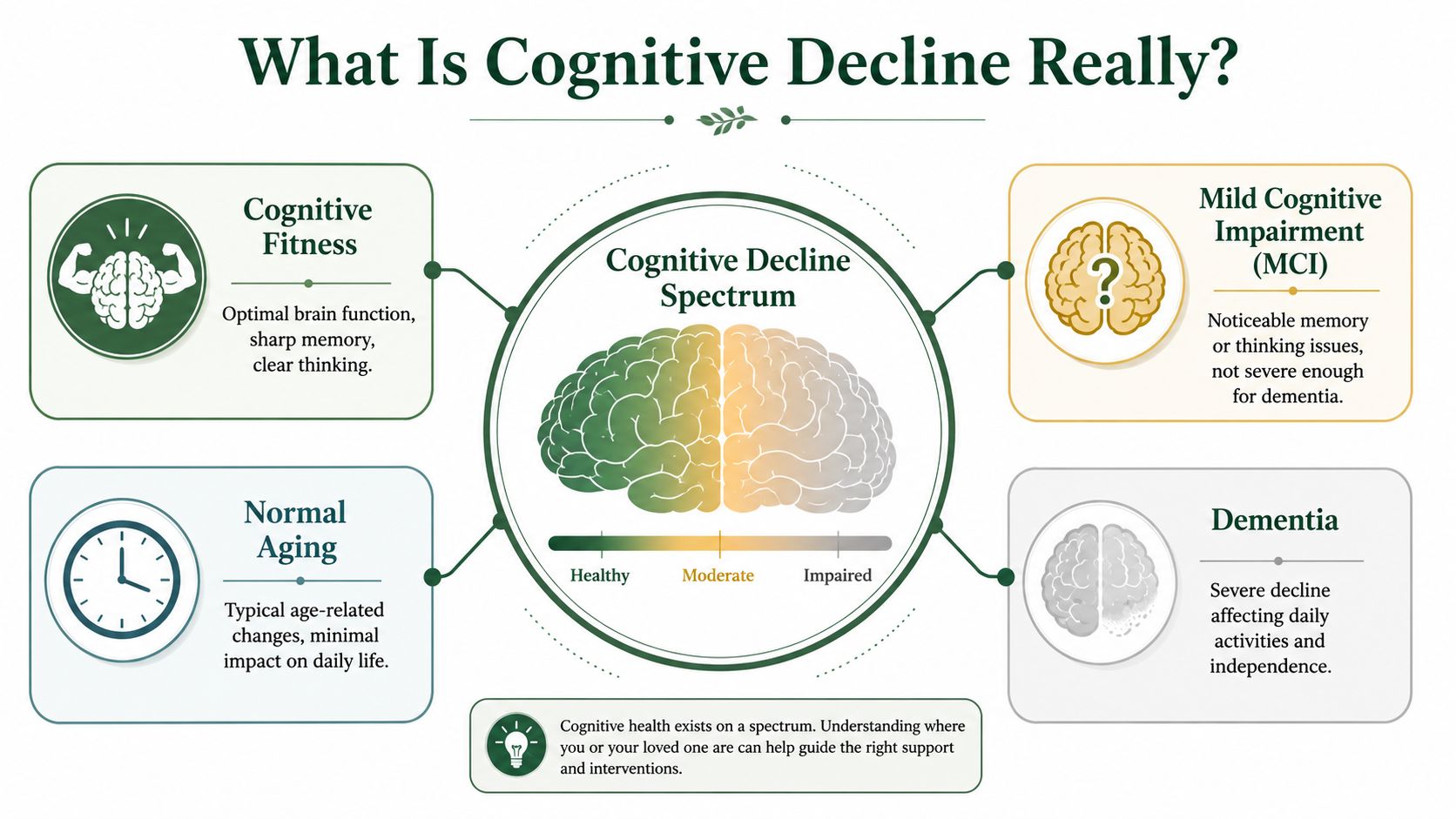
The easiest way to understand cognitive decline is to stop thinking of it as a single event. It's more like cognitive fitness.
A person can have strong cognitive fitness, just as they can have strong physical fitness. They stay mentally flexible, manage routines, follow conversations, remember important information, and recover from distractions. Over time, that fitness can change. Some changes are mild and manageable. Others interfere with independent living.
Think of brain health as cognitive fitness
When people age normally, they may need a little longer to recall a name, learn a new app, or switch between tasks. That can be frustrating, but it usually doesn't derail daily life. They still manage medications, finances, meals, and basic problem-solving.
Mild Cognitive Impairment, or MCI, sits in the middle. The person has more noticeable trouble with memory or thinking than expected for age, but they're often still functioning fairly independently. A man with MCI may repeat stories more often, struggle with planning a trip, or need reminders for appointments, yet still live alone and manage most tasks.
Dementia is different because the decline becomes significant enough to interfere with everyday activities and independence. The issue isn't only forgetting. It can include confusion about time, difficulty following steps, poor judgment, language problems, or trouble handling familiar routines.
A point that often confuses families is the difference between improving function and preventing disease. The American Academy of Family Physicians notes that cognitive training can improve function in older adults, but there is currently no evidence that such interventions prevent the onset of Alzheimer disease itself (AAFP summary in this review). That distinction matters. Supporting memory and attention is worthwhile even when it isn't the same as preventing a specific disease process.
A simple way to tell the stages apart
This comparison helps many families organize what they're seeing:
Stage | What it often looks like | Daily life impact |
|---|---|---|
Cognitive fitness | Sharp recall, good focus, flexible thinking | Little to no concern |
Normal aging | Occasional forgetfulness, slower recall | Minimal disruption |
MCI | Noticeable memory or thinking changes | Some extra effort, but most independence remains |
Dementia | Persistent decline across thinking and functioning | Daily routines and safety are affected |
A useful question isn't “Does my loved one ever forget?” Everybody does. The better question is, “Can they still manage life reliably?”
When memory problems start changing routines, decisions, or safety, it's time to move from observation to action.
The Six Pillars of Cognitive Decline Prevention
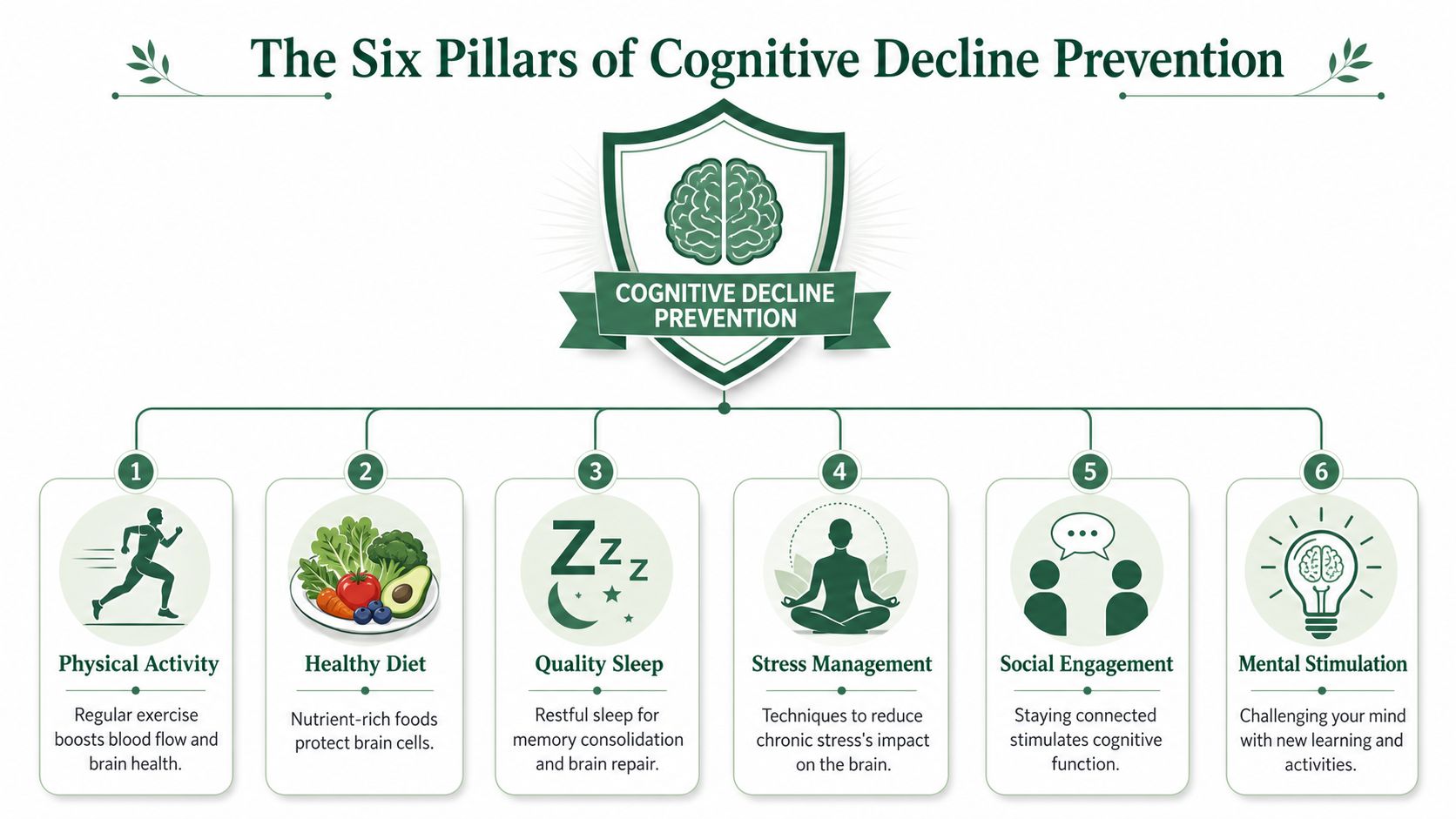
Strong prevention doesn't rest on one habit. It rests on a pattern.
Research consistently points toward a multidomain lifestyle approach. In plain terms, that means several protective habits working together at the same time. According to the World Health Organization, this combined approach is the most effective prevention strategy, and the WHO strongly recommends at least 150 minutes of moderate-intensity aerobic activity per week, or 75 minutes of vigorous-intensity activity, with aerobic exercise showing a stronger protective effect on cognitive function than non-aerobic exercise (WHO guideline review).
Why a combined approach works better
Brain health is tied to the rest of the body. Blood flow matters. Blood pressure matters. Diabetes management matters. Movement matters. So do mental activity and social contact.
That's why a family can do everything “brainy,” like puzzles or memory games, and still miss major opportunities if the person rarely moves, smokes, eats poorly, or has uncontrolled hypertension. Brain health isn't separate from vascular and metabolic health. They're connected.
Big takeaway: The best prevention plan looks less like a single app and more like a weekly routine.
The six pillars in daily life
Here's how to think about each pillar in a practical way.
Physical activity
This is the pillar with the strongest evidence base in the guidelines above. Aerobic movement helps support blood flow and overall brain function. For some people, that means brisk walking. For others, it may be cycling, swimming, or dancing.
The key is regularity. A person doesn't need a perfect workout identity. They need a form of movement they'll repeat.
A brain-healthy diet
Families often overcomplicate this. You don't need a specialty meal plan to start helping. Think in patterns: balanced meals, more whole foods, less reliance on highly processed convenience foods, and steady eating habits that support vascular and metabolic health.
The point isn't dietary perfection. It's reducing the strain that poor nutrition can place on blood sugar, blood pressure, and energy.
Restorative sleep
Sleep problems can mimic or worsen cognitive problems. A person who sleeps badly may look more forgetful, more irritable, and less mentally flexible. Families sometimes miss this because the daytime memory issue is more visible than the nighttime disruption.
If someone snores heavily, naps constantly, wakes confused, or seems dramatically worse after poor sleep, that deserves attention.
Vascular health management
This is one of the most overlooked parts of cognitive decline prevention. Managing blood pressure and diabetes is brain care, not just heart care.
Class 1 evidence supports blood pressure control, and the SPRINT-MIND study found that lowering systolic blood pressure to under 120 mmHg reduced dementia incidence by 19% in high-risk participants (SPRINT-MIND review). For families, the practical message is simple: if a clinician is tracking hypertension carefully, that work may also help protect brain function.
Cognitive stimulation
Mental activity helps maintain function, especially when it is structured, repeated, and matched to the person's abilities. This isn't limited to crosswords. It can include naming tasks, conversation prompts, orientation practice, reading aloud, sorting activities, reminiscence, or simple reasoning exercises.
Families who want a plain-language overview of one structured approach can read this explanation of cognitive stimulation therapy. The most useful mental activity is often the one a person can tolerate without frustration.
Social engagement
Social connection matters, but families often misunderstand what that means. It doesn't have to be a busy calendar or large gatherings. Sometimes one dependable conversation partner matters more than a crowded room.
Social engagement gives a person reasons to talk, listen, remember, respond, and stay emotionally anchored. It also helps families notice subtle changes earlier.
A simple way to remember these pillars is to ask six weekly questions:
Movement: Did they move enough to raise energy and circulation?
Food: Did meals support steady health rather than chaos?
Sleep: Are they waking rested enough to function?
Medical care: Are blood pressure and diabetes being managed?
Mental activity: Did they use their mind in a structured way?
Connection: Did they have meaningful contact with other people?
If several answers are “no,” that's where to start. Not with guilt. With priorities.
Putting Your Brain Health Plan into Action
Sunday evening is often when families realize good intentions are not the same as a workable plan. Someone says they should walk more, sleep better, eat better, call the doctor, and stay socially engaged. By Tuesday, life gets busy, the list feels too big, and nothing sticks.
A better plan works like a handrail. It does not solve everything at once. It gives the person and the family something steady to hold onto during an ordinary week.

Start with a week you can sustain
Build the plan around routines that already happen. Breakfast can cue medications. Morning coffee can cue a short walk. A favorite television program can cue a snack and hydration break. A regular church service or family call can become the anchor for social connection.
That matters for healthy older adults who want to lower risk, and it matters even more when someone is already showing mild changes. In that stage, the goal is no longer just prevention in the abstract. The goal is to protect function in daily life and reduce the chance that a good idea turns into a frustrating demand.
A simple weekly structure might include:
Morning movement: A walk, stationary bike, or another comfortable aerobic activity on most days.
Meal rhythm: Balanced meals at consistent times, with help for shopping or preparation when needed.
Mental engagement: One short, structured thinking activity a few times a week, matched to the person's tolerance.
Connection: A planned call, visit, or shared activity that supports real conversation.
Medical follow-through: Blood pressure checks, medication review, and appointment tracking.
If your family needs more dependable contact between visits, daily check-in calls for seniors can add routine and shorten long stretches of isolation.
Blood pressure deserves special attention. Earlier research in this article noted that better control is linked with lower risk of later cognitive problems. The practical takeaway is straightforward. Make blood pressure management part of the brain health plan, and review targets and medications with the treating clinician rather than changing anything on your own.
Track what helps and adjust quickly
Families often stop useful habits because they are watching effort instead of results. A notebook or shared phone note can make patterns easier to see.
Keep it simple:
Energy: Better, worse, or unchanged after walks or outings
Attention: Sharper in the morning or afternoon
Mood: Calmer after social contact, music, or creative activity
Sleep: Restful nights versus restless nights
Function: Easier or harder time with meals, medications, bathing, or appointments
This kind of tracking helps you answer practical questions. Is the activity helping, or is it too much? Is the person more engaged after lunch, or more confused? Do shorter visits work better than longer ones?
A short educational refresher can also help families think about how daily habits fit together:
A good plan is one the person can follow when life is ordinary, not one that only works on a perfect week.
If something repeatedly leads to agitation, confusion, or refusal, reduce the difficulty, shorten the activity, or change the timing. The strongest plan is usually the one that feels ordinary. It supports health without making the person feel tested from morning to night.
When You Already See Signs Supporting a Loved One
Once a loved one is clearly changing, families often ask the wrong question. They ask, “How do we prevent this?” when the more useful question is, “How do we support the person we have today and help them function as well as possible?”
That shift matters. Prevention is still relevant, but the goal becomes broader. You're trying to sustain ability, reduce distress, preserve routines, and catch problems early.
When the goal changes from prevention to support
A major gap in care appears right here. Guidelines recommend cognitive training for people with normal cognition or MCI, but they stop short of providing evidence-based daily, non-digital frameworks for people with established early-to-mid dementia who can't reliably use standard brain games (Alzheimer's Drug Discovery Foundation discussion).
That leaves families improvising. They try apps that are too confusing. They buy puzzle books that create frustration. They rely on occasional visits, even though the person may need frequent prompting, calm repetition, and familiar conversation more than a “challenge.”

A useful home approach usually includes:
Shorter activities: Ten good minutes is better than an hour of struggle.
Familiar material: Old photos, family names, routines, favorite topics, simple orientation cues.
Low-tech delivery: Phone calls, printed prompts, spoken reminders, face-to-face conversation.
Emotional steadiness: Validation first, correction second.
Repetition without pressure: The person doesn't need to “perform” to benefit.
Families often recognize these changes before a doctor documents them. If you're wondering whether what you're seeing fits a larger pattern, this guide to early signs of memory loss in aging parents can help organize what you've noticed before an appointment.
What tailored support can look like at home
Support works better when it is specific. “Keep their brain active” is too vague. A better plan sounds like this:
Call at the same time each day.
Start with orientation cues such as the day, time, weather, or upcoming routine.
Ask about one familiar topic.
Use one language or attention task the person can complete successfully.
Check a practical issue such as medications, meals, or whether they seem more confused than usual.
End on a reassuring note.
Phone-based, structured conversation can be useful, especially for seniors who live alone or struggle with technology. Velma is one example of a phone-based cognitive support program for older adults in the early to mid stages of dementia. It uses scheduled calls that combine conversation, simple cognitive exercises, emotional support, and practical check-ins, which can complement medical care and family caregiving.
The right support often looks less like testing and more like guided conversation with purpose.
This kind of structure matters because many families can't be present several times a day, and many older adults won't use tablets, portals, or apps consistently. A repeatable phone routine lowers barriers. It can also help families notice patterns in confusion, anxiety, safety concerns, or withdrawal before those issues turn into crises.
Your Path Forward with Confidence
By the time families seek answers, they're often carrying two jobs at once. They're trying to protect the future and manage the present.
Both matter. Cognitive decline prevention works best when it's broad and steady, with attention to physical activity, overall health, daily routine, and meaningful engagement. When signs have already begun, the work changes. The focus becomes preserving function, reducing isolation, and putting the right support around the person instead of waiting for things to get worse.
When to call the doctor
Arrange a clinical evaluation if you're seeing changes that are persistent, worsening, or affecting daily life. That includes repeated confusion, trouble managing medications or bills, getting lost in familiar settings, major word-finding difficulty, unsafe kitchen mistakes, or a clear change in judgment, mood, or personality.
Also ask for medical review when the decline seems sudden. Infection, medication effects, sleep problems, depression, dehydration, and other health issues can worsen cognition and need treatment.
How to look for the right kind of support
Support should match the person's actual stage and abilities. For someone who is still largely independent, that may mean strengthening habits and monitoring changes. For someone with early memory loss, it may mean adding structured reminders and regular check-ins. For someone in early-to-mid dementia, it may mean low-tech cognitive engagement, routine reinforcement, and dependable companionship.
One important gap remains: while social isolation is a major preventable risk factor for dementia, current guidance doesn't spell out the exact mechanism or frequency of structured conversation needed to slow functional loss in diagnosed patients (Norton Healthcare discussion). That's why families often need to evaluate practical supports based on fit, consistency, and whether they reduce distress while sustaining daily function.
The next right step doesn't have to solve everything. It just has to move your family from guessing to supporting.
If your family needs more consistent support between visits, Velma offers a phone-based cognitive care program for older adults with early to mid-stage memory loss. It's designed to add structured conversation, cognitive engagement, companionship, and practical check-ins in a format many seniors can use without new technology.
You may be here because something small has started to feel bigger.
Your mother asks the same question twice in one phone call. Your husband gets lost in the middle of a familiar story. Your dad still pays his bills and makes coffee every morning, but lately he seems slower, less confident, easier to overwhelm. You don't know whether this is normal aging, the start of something more serious, or just a rough stretch caused by stress, poor sleep, or another health problem.
That uncertainty is hard. Families often swing between minimizing what they see and fearing the worst.
The good news is that cognitive decline prevention isn't only about trying to stop a diagnosis before it happens. It's also about protecting brain health early, noticing changes sooner, and adjusting support when a person is no longer in the “prevention only” stage. There are practical steps that matter. There are also clear moments when home strategies should be paired with medical evaluation and more individualized support.
Table of Contents
An Introduction to Protecting Brain Health
What Is Cognitive Decline Really
Think of brain health as cognitive fitness
A simple way to tell the stages apart
The Six Pillars of Cognitive Decline Prevention
Why a combined approach works better
The six pillars in daily life
Putting Your Brain Health Plan into Action
Start with a week you can sustain
Track what helps and adjust quickly
When You Already See Signs Supporting a Loved One
When the goal changes from prevention to support
What tailored support can look like at home
Your Path Forward with Confidence
When to call the doctor
How to look for the right kind of support
An Introduction to Protecting Brain Health
Brain changes rarely announce themselves all at once. More often, families notice a pattern.
A daughter might first see that her mother, who used to manage three grandchildren's schedules from memory, now misses appointments unless they're written down twice. A spouse may notice that dinner conversations feel different. Not because a loved one has “lost themselves,” but because word-finding, attention, or short-term recall no longer come as easily as they used to.
That's where many people get stuck. They ask, “Is this just aging?” and then wait too long because they don't want to overreact. Or they panic and assume every memory slip means dementia.
Both reactions are understandable. Neither helps much.
Cognitive decline is better understood as a range of changes in memory, attention, language, problem-solving, and day-to-day functioning. Some mild slowing can happen with age. More significant decline is not an automatic part of getting older. It deserves attention, especially when it starts affecting safety, independence, routines, or relationships.
Practical rule: If a change is noticeable enough to worry the family more than once, it's worth paying attention to.
Protecting brain health usually works best when families think in layers. First, reduce the risks you can influence. Second, support the abilities that are still strong. Third, get help early when the pattern changes.
That approach is more realistic than chasing one miracle fix. It's also kinder. People don't need lectures when they're frightened. They need clear next steps, explained in plain language, with room for real life.
What Is Cognitive Decline Really
The easiest way to understand cognitive decline is to stop thinking of it as a single event. It's more like cognitive fitness.
A person can have strong cognitive fitness, just as they can have strong physical fitness. They stay mentally flexible, manage routines, follow conversations, remember important information, and recover from distractions. Over time, that fitness can change. Some changes are mild and manageable. Others interfere with independent living.
Think of brain health as cognitive fitness
When people age normally, they may need a little longer to recall a name, learn a new app, or switch between tasks. That can be frustrating, but it usually doesn't derail daily life. They still manage medications, finances, meals, and basic problem-solving.
Mild Cognitive Impairment, or MCI, sits in the middle. The person has more noticeable trouble with memory or thinking than expected for age, but they're often still functioning fairly independently. A man with MCI may repeat stories more often, struggle with planning a trip, or need reminders for appointments, yet still live alone and manage most tasks.
Dementia is different because the decline becomes significant enough to interfere with everyday activities and independence. The issue isn't only forgetting. It can include confusion about time, difficulty following steps, poor judgment, language problems, or trouble handling familiar routines.
A point that often confuses families is the difference between improving function and preventing disease. The American Academy of Family Physicians notes that cognitive training can improve function in older adults, but there is currently no evidence that such interventions prevent the onset of Alzheimer disease itself (AAFP summary in this review). That distinction matters. Supporting memory and attention is worthwhile even when it isn't the same as preventing a specific disease process.
A simple way to tell the stages apart
This comparison helps many families organize what they're seeing:
Stage | What it often looks like | Daily life impact |
|---|---|---|
Cognitive fitness | Sharp recall, good focus, flexible thinking | Little to no concern |
Normal aging | Occasional forgetfulness, slower recall | Minimal disruption |
MCI | Noticeable memory or thinking changes | Some extra effort, but most independence remains |
Dementia | Persistent decline across thinking and functioning | Daily routines and safety are affected |
A useful question isn't “Does my loved one ever forget?” Everybody does. The better question is, “Can they still manage life reliably?”
When memory problems start changing routines, decisions, or safety, it's time to move from observation to action.
The Six Pillars of Cognitive Decline Prevention
Strong prevention doesn't rest on one habit. It rests on a pattern.
Research consistently points toward a multidomain lifestyle approach. In plain terms, that means several protective habits working together at the same time. According to the World Health Organization, this combined approach is the most effective prevention strategy, and the WHO strongly recommends at least 150 minutes of moderate-intensity aerobic activity per week, or 75 minutes of vigorous-intensity activity, with aerobic exercise showing a stronger protective effect on cognitive function than non-aerobic exercise (WHO guideline review).
Why a combined approach works better
Brain health is tied to the rest of the body. Blood flow matters. Blood pressure matters. Diabetes management matters. Movement matters. So do mental activity and social contact.
That's why a family can do everything “brainy,” like puzzles or memory games, and still miss major opportunities if the person rarely moves, smokes, eats poorly, or has uncontrolled hypertension. Brain health isn't separate from vascular and metabolic health. They're connected.
Big takeaway: The best prevention plan looks less like a single app and more like a weekly routine.
The six pillars in daily life
Here's how to think about each pillar in a practical way.
Physical activity
This is the pillar with the strongest evidence base in the guidelines above. Aerobic movement helps support blood flow and overall brain function. For some people, that means brisk walking. For others, it may be cycling, swimming, or dancing.
The key is regularity. A person doesn't need a perfect workout identity. They need a form of movement they'll repeat.
A brain-healthy diet
Families often overcomplicate this. You don't need a specialty meal plan to start helping. Think in patterns: balanced meals, more whole foods, less reliance on highly processed convenience foods, and steady eating habits that support vascular and metabolic health.
The point isn't dietary perfection. It's reducing the strain that poor nutrition can place on blood sugar, blood pressure, and energy.
Restorative sleep
Sleep problems can mimic or worsen cognitive problems. A person who sleeps badly may look more forgetful, more irritable, and less mentally flexible. Families sometimes miss this because the daytime memory issue is more visible than the nighttime disruption.
If someone snores heavily, naps constantly, wakes confused, or seems dramatically worse after poor sleep, that deserves attention.
Vascular health management
This is one of the most overlooked parts of cognitive decline prevention. Managing blood pressure and diabetes is brain care, not just heart care.
Class 1 evidence supports blood pressure control, and the SPRINT-MIND study found that lowering systolic blood pressure to under 120 mmHg reduced dementia incidence by 19% in high-risk participants (SPRINT-MIND review). For families, the practical message is simple: if a clinician is tracking hypertension carefully, that work may also help protect brain function.
Cognitive stimulation
Mental activity helps maintain function, especially when it is structured, repeated, and matched to the person's abilities. This isn't limited to crosswords. It can include naming tasks, conversation prompts, orientation practice, reading aloud, sorting activities, reminiscence, or simple reasoning exercises.
Families who want a plain-language overview of one structured approach can read this explanation of cognitive stimulation therapy. The most useful mental activity is often the one a person can tolerate without frustration.
Social engagement
Social connection matters, but families often misunderstand what that means. It doesn't have to be a busy calendar or large gatherings. Sometimes one dependable conversation partner matters more than a crowded room.
Social engagement gives a person reasons to talk, listen, remember, respond, and stay emotionally anchored. It also helps families notice subtle changes earlier.
A simple way to remember these pillars is to ask six weekly questions:
Movement: Did they move enough to raise energy and circulation?
Food: Did meals support steady health rather than chaos?
Sleep: Are they waking rested enough to function?
Medical care: Are blood pressure and diabetes being managed?
Mental activity: Did they use their mind in a structured way?
Connection: Did they have meaningful contact with other people?
If several answers are “no,” that's where to start. Not with guilt. With priorities.
Putting Your Brain Health Plan into Action
Sunday evening is often when families realize good intentions are not the same as a workable plan. Someone says they should walk more, sleep better, eat better, call the doctor, and stay socially engaged. By Tuesday, life gets busy, the list feels too big, and nothing sticks.
A better plan works like a handrail. It does not solve everything at once. It gives the person and the family something steady to hold onto during an ordinary week.
Start with a week you can sustain
Build the plan around routines that already happen. Breakfast can cue medications. Morning coffee can cue a short walk. A favorite television program can cue a snack and hydration break. A regular church service or family call can become the anchor for social connection.
That matters for healthy older adults who want to lower risk, and it matters even more when someone is already showing mild changes. In that stage, the goal is no longer just prevention in the abstract. The goal is to protect function in daily life and reduce the chance that a good idea turns into a frustrating demand.
A simple weekly structure might include:
Morning movement: A walk, stationary bike, or another comfortable aerobic activity on most days.
Meal rhythm: Balanced meals at consistent times, with help for shopping or preparation when needed.
Mental engagement: One short, structured thinking activity a few times a week, matched to the person's tolerance.
Connection: A planned call, visit, or shared activity that supports real conversation.
Medical follow-through: Blood pressure checks, medication review, and appointment tracking.
If your family needs more dependable contact between visits, daily check-in calls for seniors can add routine and shorten long stretches of isolation.
Blood pressure deserves special attention. Earlier research in this article noted that better control is linked with lower risk of later cognitive problems. The practical takeaway is straightforward. Make blood pressure management part of the brain health plan, and review targets and medications with the treating clinician rather than changing anything on your own.
Track what helps and adjust quickly
Families often stop useful habits because they are watching effort instead of results. A notebook or shared phone note can make patterns easier to see.
Keep it simple:
Energy: Better, worse, or unchanged after walks or outings
Attention: Sharper in the morning or afternoon
Mood: Calmer after social contact, music, or creative activity
Sleep: Restful nights versus restless nights
Function: Easier or harder time with meals, medications, bathing, or appointments
This kind of tracking helps you answer practical questions. Is the activity helping, or is it too much? Is the person more engaged after lunch, or more confused? Do shorter visits work better than longer ones?
A short educational refresher can also help families think about how daily habits fit together:
A good plan is one the person can follow when life is ordinary, not one that only works on a perfect week.
If something repeatedly leads to agitation, confusion, or refusal, reduce the difficulty, shorten the activity, or change the timing. The strongest plan is usually the one that feels ordinary. It supports health without making the person feel tested from morning to night.
When You Already See Signs Supporting a Loved One
Once a loved one is clearly changing, families often ask the wrong question. They ask, “How do we prevent this?” when the more useful question is, “How do we support the person we have today and help them function as well as possible?”
That shift matters. Prevention is still relevant, but the goal becomes broader. You're trying to sustain ability, reduce distress, preserve routines, and catch problems early.
When the goal changes from prevention to support
A major gap in care appears right here. Guidelines recommend cognitive training for people with normal cognition or MCI, but they stop short of providing evidence-based daily, non-digital frameworks for people with established early-to-mid dementia who can't reliably use standard brain games (Alzheimer's Drug Discovery Foundation discussion).
That leaves families improvising. They try apps that are too confusing. They buy puzzle books that create frustration. They rely on occasional visits, even though the person may need frequent prompting, calm repetition, and familiar conversation more than a “challenge.”
A useful home approach usually includes:
Shorter activities: Ten good minutes is better than an hour of struggle.
Familiar material: Old photos, family names, routines, favorite topics, simple orientation cues.
Low-tech delivery: Phone calls, printed prompts, spoken reminders, face-to-face conversation.
Emotional steadiness: Validation first, correction second.
Repetition without pressure: The person doesn't need to “perform” to benefit.
Families often recognize these changes before a doctor documents them. If you're wondering whether what you're seeing fits a larger pattern, this guide to early signs of memory loss in aging parents can help organize what you've noticed before an appointment.
What tailored support can look like at home
Support works better when it is specific. “Keep their brain active” is too vague. A better plan sounds like this:
Call at the same time each day.
Start with orientation cues such as the day, time, weather, or upcoming routine.
Ask about one familiar topic.
Use one language or attention task the person can complete successfully.
Check a practical issue such as medications, meals, or whether they seem more confused than usual.
End on a reassuring note.
Phone-based, structured conversation can be useful, especially for seniors who live alone or struggle with technology. Velma is one example of a phone-based cognitive support program for older adults in the early to mid stages of dementia. It uses scheduled calls that combine conversation, simple cognitive exercises, emotional support, and practical check-ins, which can complement medical care and family caregiving.
The right support often looks less like testing and more like guided conversation with purpose.
This kind of structure matters because many families can't be present several times a day, and many older adults won't use tablets, portals, or apps consistently. A repeatable phone routine lowers barriers. It can also help families notice patterns in confusion, anxiety, safety concerns, or withdrawal before those issues turn into crises.
Your Path Forward with Confidence
By the time families seek answers, they're often carrying two jobs at once. They're trying to protect the future and manage the present.
Both matter. Cognitive decline prevention works best when it's broad and steady, with attention to physical activity, overall health, daily routine, and meaningful engagement. When signs have already begun, the work changes. The focus becomes preserving function, reducing isolation, and putting the right support around the person instead of waiting for things to get worse.
When to call the doctor
Arrange a clinical evaluation if you're seeing changes that are persistent, worsening, or affecting daily life. That includes repeated confusion, trouble managing medications or bills, getting lost in familiar settings, major word-finding difficulty, unsafe kitchen mistakes, or a clear change in judgment, mood, or personality.
Also ask for medical review when the decline seems sudden. Infection, medication effects, sleep problems, depression, dehydration, and other health issues can worsen cognition and need treatment.
How to look for the right kind of support
Support should match the person's actual stage and abilities. For someone who is still largely independent, that may mean strengthening habits and monitoring changes. For someone with early memory loss, it may mean adding structured reminders and regular check-ins. For someone in early-to-mid dementia, it may mean low-tech cognitive engagement, routine reinforcement, and dependable companionship.
One important gap remains: while social isolation is a major preventable risk factor for dementia, current guidance doesn't spell out the exact mechanism or frequency of structured conversation needed to slow functional loss in diagnosed patients (Norton Healthcare discussion). That's why families often need to evaluate practical supports based on fit, consistency, and whether they reduce distress while sustaining daily function.
The next right step doesn't have to solve everything. It just has to move your family from guessing to supporting.
If your family needs more consistent support between visits, Velma offers a phone-based cognitive care program for older adults with early to mid-stage memory loss. It's designed to add structured conversation, cognitive engagement, companionship, and practical check-ins in a format many seniors can use without new technology.
Suggested Article: