Dementia Care Facilities: A Complete 2026 Guide

You may be reading this after another hard week. Maybe your mom left the stove on again. Maybe your husband is waking at night and trying to “go to work.” Maybe you've reached the point where every phone call, every nap, and every errand carries a layer of fear.
That moment is painful because it forces two truths to sit side by side. You want to keep your loved one safe, and you also want to protect their dignity. Families often feel guilty for even searching for dementia care facilities, as if looking means giving up. It doesn't. It means you're trying to build the right support around someone you love.
Some people need a move soon. Others may still be able to stay home with stronger support, better routines, and more consistent check-ins. The right answer isn't always “find a facility now.” Often, it's “understand the options clearly, then choose the least disruptive support that still keeps everyone safe.”
Table of Contents
Navigating the Path to Dementia Care
Understanding the Landscape of Dementia Care Facilities
Why the setting matters
Comparing dementia care facility types
A simple way to narrow the choice
Key Services and Staffing to Expect
What good daily care looks like
Training is not a small detail
Decoding the Costs and Payment Options
What families are really paying for
How payment sources usually work
How to Evaluate a Facility and Spot Red Flags
What to notice on a tour
Questions that reveal the real culture
Red flags that deserve attention
The Role of Cognitive Support Beyond Facility Walls
Why safety and engagement are not the same thing
When support at home can delay placement
Easing the Transition for Your Loved One
What helps in the first days
How families can support without overwhelming
Navigating the Path to Dementia Care
A daughter notices that her father can still joke, recognize family, and enjoy lunch out, but he can't reliably manage medications, showers, or evenings alone. A spouse realizes that what used to be “forgetfulness” has become wandering, nighttime confusion, and rising anger when routines change. These are the moments when the question changes from “How do we help?” to “What level of help is enough?”
The hardest part is that the care map isn't simple. “Assisted living,” “memory care,” and “nursing home” get used as if they mean the same thing. They don't. Families also get mixed messages about when a move is necessary, what a facility provides, and whether support at home can still work for a while longer.
Practical rule: Don't start by asking, “What facility is best?” Start by asking, “What problems do we need solved right now?”
Sometimes the urgent problem is fall risk. Sometimes it's medication mistakes. Sometimes it's loneliness, caregiver burnout, or a loved one spending long stretches confused and unstimulated. Naming the specific problem helps you choose support that fits the person, not just the label on the building.
Here's the calmer way to approach it:
Define today's risks: wandering, missed meals, medication errors, nighttime confusion, falls, or unsafe driving.
Separate medical needs from supervision needs: someone may need cueing, structure, and safety more than hands-on nursing care.
Look at the whole support system: family visits, home care, day structure, cognitive engagement, and, when needed, dementia care facilities.
Plan for the next stage too: the best choice should fit current needs and hold up if memory loss worsens.
A good decision rarely comes from panic. It comes from understanding what each care setting does well, where the gaps are, and how to layer support around your loved one with as little disruption as possible.
Understanding the Landscape of Dementia Care Facilities
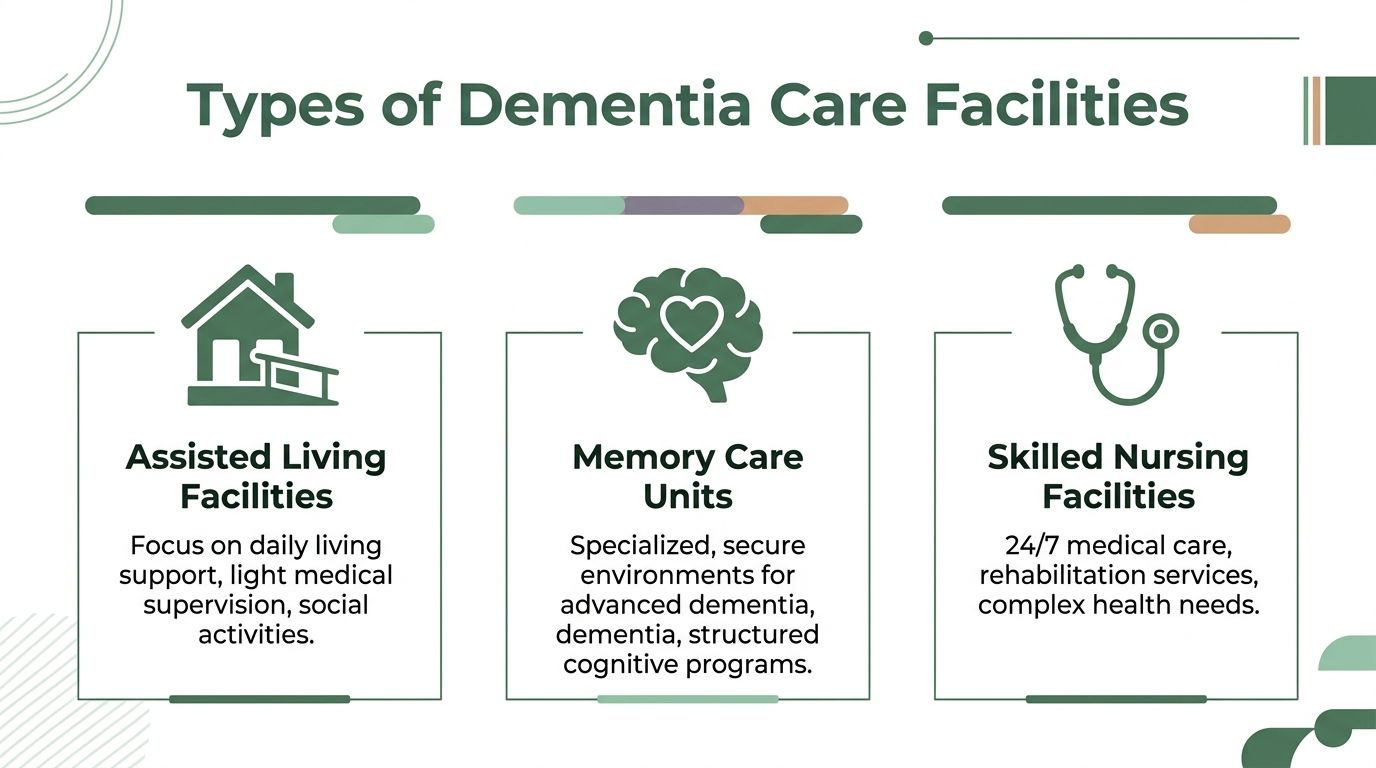
Families often compare dementia care facilities as if they were hotel categories. A better comparison is schools. Some people do well in a broad setting with added support. Others need a specialized environment built around one condition. Others still need continuous medical care because health needs are as important as memory loss.
Why the setting matters
In the United States, 40% of residents in assisted living facilities have a dementia diagnosis, yet only about 18% of these communities have specialized memory care units, according to U.S. assisted living and memory care statistics. That gap helps explain why families can feel confused after touring communities that all say they “support memory loss,” even when their environments and staffing models differ a lot.
An assisted living community with a memory care unit usually works best for a person who needs help with daily tasks and benefits from access to a more secure, more structured area as dementia progresses. It can be a good fit when the person still has some independence but isn't safe living entirely on their own.
A standalone memory care facility is more specialized. The whole building, staff routine, and daily rhythm are built for cognitive impairment. This setting often suits someone who needs close supervision, a predictable environment, and staff who spend most of their working day supporting residents with dementia-related confusion, agitation, or wandering.
A skilled nursing facility, often called a nursing home, adds a stronger medical layer. This is generally the right setting when dementia comes with complex physical illness, rehabilitation needs, heavy mobility assistance, or ongoing nursing needs that go beyond supervision and cueing.
Choosing the wrong level of care creates two problems at once. The person may be under-supported, and the family may pay for a setting that still doesn't solve the daily risks.
Comparing dementia care facility types
Feature | Assisted Living with Memory Care | Standalone Memory Care | Skilled Nursing Facility |
|---|---|---|---|
Primary purpose | Support with daily living plus added cognitive support | Specialized dementia-focused care | Ongoing nursing and medical care |
Best fit | Early to mid-stage needs with some retained independence | Moderate to advanced dementia needing structure and security | Dementia plus significant medical or physical care needs |
Environment | Broader senior living setting, sometimes with a dedicated unit | Entire setting designed around memory loss | Clinical setting with stronger medical presence |
Security level | Varies by unit and campus | Usually stronger and more consistent | Strong supervision, often driven by medical needs |
Daily routine | Social and supportive, can be less specialized outside the unit | More structured and dementia-specific | Care routines often shaped by health needs and nursing tasks |
Medical care | Limited medical oversight | Limited to moderate, depending on provider setup | Highest level of medical and nursing support |
Resident independence | More independence when safe | Less emphasis on independence alone, more on guided living | Independence is often secondary to health support |
Typical family question | “Can Mom still live with some freedom but more support?” | “Does Dad need a secure, dementia-focused setting now?” | “Are nursing needs now equal to or greater than memory care needs?” |
A simple way to narrow the choice
If safety is the main concern, look closely at memory-focused settings.
If medical complexity is rising, ask whether skilled nursing is necessary.
If your loved one still does well with cueing and routine, assisted living with a strong memory care option may be enough for now.
Many families feel pressure to make a permanent choice. In reality, care often happens in stages. The most useful question isn't “Where will they live forever?” It's “What setting meets this stage well without creating avoidable stress?”
Key Services and Staffing to Expect
A beautiful lobby doesn't tell you much about daily dementia care. What matters is what happens at 7 a.m., at lunch, during sundowning hours, and in the middle of the night when a resident is confused, frightened, or trying to leave their room.
What good daily care looks like
Strong dementia care facilities usually have a rhythm that reduces confusion. Residents aren't left to drift through long empty hours. Staff guide meals, hygiene, movement, rest, and activities in ways that make the day feel predictable.
In certified Alzheimer's assisted living settings, facilities are often required to provide a minimum of three hours of direct care staff time per resident per day, and direct care workers must complete at least eight hours of specialized dementia in-service training annually, according to the LTCCC dementia care fact sheet. The same fact sheet also describes activity expectations that include cognitive, recreational, and daily living activities rather than passive supervision alone.
That matters because dementia care isn't just about preventing harm. It's also about preserving function. A resident who gets kind cueing at dressing time, encouragement to join a simple activity, and calm redirection during confusion may stay more engaged than someone who is merely watched.
Look for signs like these:
Structured activities: not just a calendar on the wall, but actual participation suited to ability.
Cueing instead of rushing: staff who break tasks into steps and speak calmly.
Meaningful routine: meals, rest, activity, and transitions handled consistently.
Support for daily living: bathing, dressing, toileting, eating, and medication help delivered without shame.
A facility can be clean and still be custodial. Good dementia care should feel active, respectful, and human.
Training is not a small detail
Families often ask about friendliness first. That matters, but training is what allows kindness to hold up under stress. Dementia changes communication, behavior, visual perception, and tolerance for stimulation. Staff need specific tools, not just good intentions.
Administrators in certified settings may be required to complete dementia training soon after employment, and staff beyond direct caregivers may also receive dementia-related education, based on the same dementia training requirements overview. That broader training matters more than many families realize. A housekeeper, dining worker, or receptionist may be the person who first notices agitation, confusion, or a sudden decline.
Ask how the facility handles situations such as:
A resident refusing a bath.
A person insisting they need to go home.
Repeated questions every few minutes.
Late-day agitation.
A resident becoming suspicious or fearful.
The quality difference is easy to hear. Weak answers sound generic: “We redirect them.” Better answers are concrete: staff describe pacing, tone, familiar cues, quiet spaces, family input, and individualized approaches.
Decoding the Costs and Payment Options
Money conversations around dementia care facilities can feel disorienting because families are often comparing services that sound similar but are priced very differently. One place may quote a base rate and then add charges for help with medications, bathing, escorts, or incontinence care. Another may bundle more into a single monthly price.
What families are really paying for
Part of the reason institutional care feels expensive is that dementia itself carries a huge economic burden. The global cost of dementia was estimated at $1.3 trillion in 2019 and is projected to rise to $2.8 trillion by 2030, with high-income countries shouldering 74% of that cost, according to the WHO global dementia status report. That context doesn't make a monthly bill easier to absorb, but it does explain why specialized institutional care is financially heavy.
When you review pricing, ask what the number includes. In many communities, families are paying for a combination of housing, meals, supervision, staffing, safety infrastructure, activity programming, and help with activities of daily living. In more specialized settings, you're also paying for environmental design and staffing practices specific to cognitive impairment.
Costs often rise when a loved one needs more hands-on help. That can include:
Personal care assistance: bathing, dressing, toileting, grooming, transfers.
Medication support: ordering, storing, prompting, or administering medications.
Behavior-related supervision: extra staff attention when confusion or exit-seeking increases.
Special diets or feeding support: more staff time during meals and hydration monitoring.
How payment sources usually work
Families are often surprised by how limited some payment options are. Medicare doesn't generally function as a long-term payment source for room, board, and ongoing custodial dementia care. Medicaid can be important in some situations, but eligibility and coverage vary by state and by care setting. Long-term care insurance may help, but only if the policy applies and the claim is approved under that contract's terms.
A practical review should include these questions:
Payment option | What to clarify |
|---|---|
Private pay | What is the monthly base rate, and what triggers added fees? |
Long-term care insurance | Does the policy cover this exact setting and level of assistance? |
Medicaid | Does the community accept it now, later, or not at all? |
Veterans-related benefits | Does a local advisor see any applicable support path? |
Family contribution plan | Who can pay what, and for how long, without crisis? |
One caution: never assume a facility's “starting price” reflects the likely cost for a person with progressing dementia.
The most helpful financial conversation is a blunt one. Ask for a written breakdown. Ask what happens if your loved one needs more assistance in six months. Ask whether a move to another unit would change pricing. It's far better to feel uncomfortable in the meeting than blindsided later.
How to Evaluate a Facility and Spot Red Flags
Touring dementia care facilities can make almost every place look reassuring for an hour. Soft music, friendly greetings, and a tidy common room don't tell you how people are treated when they're frightened, resist care, or need help at night.

What to notice on a tour
Start with the environment itself. Expert design guidance for dementia settings includes sensor-activated, low-level night lighting to reduce fall risk, wider corridors and clearances for safe movement, and avoiding mirrors or shimmery surfaces that can create glare and confusion, according to the Victorian dementia facility design guidelines.
That kind of detail matters because dementia changes how people interpret space. A shiny floor can look wet. A mirror can feel like a stranger in the room. A dark hallway can become frightening at dusk.
Notice these basics on your walk-through:
Lighting and visibility: Is the space easy to read, or full of shadows and glare?
Noise level: Does it feel settled, or chaotic and overstimulating?
Outdoor access: Is there a safe, secure place to walk?
Wayfinding: Can residents tell where they are and where they're going?
Movement space: Are hallways and rooms navigable for walkers and wheelchairs?
Questions that reveal the real culture
Marketing language won't tell you much. Specific questions will. A strong facility should answer plainly and without defensiveness. For a useful framework, families can compare their questions with guidance on how to evaluate a memory loss support program, then apply the same discipline to a facility tour.
Ask staff and leadership questions like these:
How do you respond when a resident wants to leave or becomes fixated on going home?
How do you communicate changes in condition to families?
What happens overnight if someone is awake, anxious, or wandering?
How do you learn a resident's preferences, routines, and calming strategies?
What would make you recommend a higher level of care?
Then stop talking and listen carefully. Good answers include examples, not slogans.
If staff members speak about residents with patience and specificity, that's a better sign than any brochure.
Red flags that deserve attention
Some warning signs are easy to miss because families are under pressure. You may want a place to work out, especially after a long search. That's exactly when it helps to stay observant.
Watch for:
Evasive answers: staff avoid direct responses about supervision, behavior support, or family communication.
Residents sitting disengaged for long periods: not occasional quiet, but a pattern of inactivity.
A strong odor that lingers: this can suggest poor continence care or weak housekeeping systems.
Visible agitation met with impatience: sharp corrections, rushing, or talking over residents.
Security without warmth: locked doors alone don't equal good dementia care.
A good tour should leave you informed, not dazzled. If you leave with a polished folder but no clear picture of daily life, keep looking.
The Role of Cognitive Support Beyond Facility Walls
Families sometimes assume the care decision is binary. Keep someone at home, or move them into a facility. Real life is less tidy. Many people need a layered support system that changes over time.
Why safety and engagement are not the same thing
A facility may do an excellent job with meals, medications, hygiene, supervision, and fall prevention. That still doesn't guarantee regular one-to-one cognitive engagement or emotionally meaningful conversation throughout the week. Staff work across many residents, and the demands of daily care are constant.

That gap matters. A person with early to mid-stage dementia may be physically safe but still lonely, under-stimulated, or anxious between family visits. The same issue can happen at home. A spouse may be handling medications and meals, but not have the bandwidth to provide calm, structured cognitive engagement every day.
Companion-based support can help fill that space. Families exploring options beyond hands-on care may find it useful to think about companion care for elderly adults as a separate layer of support, especially when isolation or repetitive distress is becoming part of the daily pattern.
Safety keeps a person from falling. Engagement helps keep a person connected to self, routine, and relationship.
When support at home can delay placement
Research highlighted by NeurologyLive on unmet needs and nursing home placement found that unmet needs in dementia, including socialization and caregiver support, are directly correlated with higher rates of facility placement. That doesn't mean every move can or should be postponed. It does mean some transitions happen partly because families lack practical, accessible support before a crisis.
This is especially important for families in rural areas, families managing work from a distance, and households where technology is a barrier. Not every older adult will use apps, portals, or video calls comfortably. Support that reaches them in simpler ways can matter.
A more complete care plan often includes questions like:
What support does this person need on ordinary days, not just emergencies?
Who provides conversation, orientation, and reassurance between visits?
Can added non-residential support make home safer for longer?
If the person does move, what will preserve emotional connection afterward?
Thinking this way helps families avoid a false choice. The question isn't only “facility or no facility.” It's “What combination of support protects safety, reduces isolation, and gives the family enough stability to make better decisions?”
Easing the Transition for Your Loved One
The move itself can be the most emotionally loaded part of the process. Even when placement is clearly necessary, families often feel grief, relief, doubt, and exhaustion all at once. Your loved one may feel fear, anger, or confusion. All of that is normal.
One family I've seen handle this well focused on reducing surprise. Instead of treating move-in day like a sudden event, they made the new place familiar first. They visited more than once. They learned the names of two staff members. They brought in a favorite chair, family photos, and the same bedspread used at home. Those details didn't erase distress, but they softened the shock.
What helps in the first days
A smoother transition usually comes from small choices made carefully.
Keep explanations simple: long reasoning often increases confusion. Short, calm reassurance usually works better.
Bring familiar objects: photos, a blanket, a lamp, favorite music, or everyday toiletries can make the room feel less foreign.
Share a personal guide with staff: note routines, nicknames, food preferences, former work, comforting topics, and known triggers.
Time visits thoughtfully: some people do better with short, steady visits rather than long emotional stays.
How families can support without overwhelming
Many relatives feel they must “make it perfect” immediately. That pressure can backfire. Some residents need time to settle into staff routines and the rhythm of the day. Visits that are loving but highly emotional can sometimes make departures harder.
Try to build partnership early. The family knows the person's history. Staff learn what works in this environment. Both matter.
It helps to choose one main family contact for communication, keep notes on changes you observe, and tell staff what success looks like for your loved one. For one person, that may be eating well and sleeping better. For another, it may be joining one activity and showing less panic in the evening.
You're not looking for a flawless transition. You're looking for a safer, steadier life with as much dignity and familiarity as possible.
If your family is trying to keep a loved one safely at home a little longer, or wants added cognitive and emotional support alongside other care, Velma offers phone-based cognitive support for older adults in the early to mid stages of dementia. Through scheduled calls, structured conversation, and practical check-ins, Velma can become one more dependable layer in a broader care system.
You may be reading this after another hard week. Maybe your mom left the stove on again. Maybe your husband is waking at night and trying to “go to work.” Maybe you've reached the point where every phone call, every nap, and every errand carries a layer of fear.
That moment is painful because it forces two truths to sit side by side. You want to keep your loved one safe, and you also want to protect their dignity. Families often feel guilty for even searching for dementia care facilities, as if looking means giving up. It doesn't. It means you're trying to build the right support around someone you love.
Some people need a move soon. Others may still be able to stay home with stronger support, better routines, and more consistent check-ins. The right answer isn't always “find a facility now.” Often, it's “understand the options clearly, then choose the least disruptive support that still keeps everyone safe.”
Table of Contents
Navigating the Path to Dementia Care
Understanding the Landscape of Dementia Care Facilities
Why the setting matters
Comparing dementia care facility types
A simple way to narrow the choice
Key Services and Staffing to Expect
What good daily care looks like
Training is not a small detail
Decoding the Costs and Payment Options
What families are really paying for
How payment sources usually work
How to Evaluate a Facility and Spot Red Flags
What to notice on a tour
Questions that reveal the real culture
Red flags that deserve attention
The Role of Cognitive Support Beyond Facility Walls
Why safety and engagement are not the same thing
When support at home can delay placement
Easing the Transition for Your Loved One
What helps in the first days
How families can support without overwhelming
Navigating the Path to Dementia Care
A daughter notices that her father can still joke, recognize family, and enjoy lunch out, but he can't reliably manage medications, showers, or evenings alone. A spouse realizes that what used to be “forgetfulness” has become wandering, nighttime confusion, and rising anger when routines change. These are the moments when the question changes from “How do we help?” to “What level of help is enough?”
The hardest part is that the care map isn't simple. “Assisted living,” “memory care,” and “nursing home” get used as if they mean the same thing. They don't. Families also get mixed messages about when a move is necessary, what a facility provides, and whether support at home can still work for a while longer.
Practical rule: Don't start by asking, “What facility is best?” Start by asking, “What problems do we need solved right now?”
Sometimes the urgent problem is fall risk. Sometimes it's medication mistakes. Sometimes it's loneliness, caregiver burnout, or a loved one spending long stretches confused and unstimulated. Naming the specific problem helps you choose support that fits the person, not just the label on the building.
Here's the calmer way to approach it:
Define today's risks: wandering, missed meals, medication errors, nighttime confusion, falls, or unsafe driving.
Separate medical needs from supervision needs: someone may need cueing, structure, and safety more than hands-on nursing care.
Look at the whole support system: family visits, home care, day structure, cognitive engagement, and, when needed, dementia care facilities.
Plan for the next stage too: the best choice should fit current needs and hold up if memory loss worsens.
A good decision rarely comes from panic. It comes from understanding what each care setting does well, where the gaps are, and how to layer support around your loved one with as little disruption as possible.
Understanding the Landscape of Dementia Care Facilities
Families often compare dementia care facilities as if they were hotel categories. A better comparison is schools. Some people do well in a broad setting with added support. Others need a specialized environment built around one condition. Others still need continuous medical care because health needs are as important as memory loss.
Why the setting matters
In the United States, 40% of residents in assisted living facilities have a dementia diagnosis, yet only about 18% of these communities have specialized memory care units, according to U.S. assisted living and memory care statistics. That gap helps explain why families can feel confused after touring communities that all say they “support memory loss,” even when their environments and staffing models differ a lot.
An assisted living community with a memory care unit usually works best for a person who needs help with daily tasks and benefits from access to a more secure, more structured area as dementia progresses. It can be a good fit when the person still has some independence but isn't safe living entirely on their own.
A standalone memory care facility is more specialized. The whole building, staff routine, and daily rhythm are built for cognitive impairment. This setting often suits someone who needs close supervision, a predictable environment, and staff who spend most of their working day supporting residents with dementia-related confusion, agitation, or wandering.
A skilled nursing facility, often called a nursing home, adds a stronger medical layer. This is generally the right setting when dementia comes with complex physical illness, rehabilitation needs, heavy mobility assistance, or ongoing nursing needs that go beyond supervision and cueing.
Choosing the wrong level of care creates two problems at once. The person may be under-supported, and the family may pay for a setting that still doesn't solve the daily risks.
Comparing dementia care facility types
Feature | Assisted Living with Memory Care | Standalone Memory Care | Skilled Nursing Facility |
|---|---|---|---|
Primary purpose | Support with daily living plus added cognitive support | Specialized dementia-focused care | Ongoing nursing and medical care |
Best fit | Early to mid-stage needs with some retained independence | Moderate to advanced dementia needing structure and security | Dementia plus significant medical or physical care needs |
Environment | Broader senior living setting, sometimes with a dedicated unit | Entire setting designed around memory loss | Clinical setting with stronger medical presence |
Security level | Varies by unit and campus | Usually stronger and more consistent | Strong supervision, often driven by medical needs |
Daily routine | Social and supportive, can be less specialized outside the unit | More structured and dementia-specific | Care routines often shaped by health needs and nursing tasks |
Medical care | Limited medical oversight | Limited to moderate, depending on provider setup | Highest level of medical and nursing support |
Resident independence | More independence when safe | Less emphasis on independence alone, more on guided living | Independence is often secondary to health support |
Typical family question | “Can Mom still live with some freedom but more support?” | “Does Dad need a secure, dementia-focused setting now?” | “Are nursing needs now equal to or greater than memory care needs?” |
A simple way to narrow the choice
If safety is the main concern, look closely at memory-focused settings.
If medical complexity is rising, ask whether skilled nursing is necessary.
If your loved one still does well with cueing and routine, assisted living with a strong memory care option may be enough for now.
Many families feel pressure to make a permanent choice. In reality, care often happens in stages. The most useful question isn't “Where will they live forever?” It's “What setting meets this stage well without creating avoidable stress?”
Key Services and Staffing to Expect
A beautiful lobby doesn't tell you much about daily dementia care. What matters is what happens at 7 a.m., at lunch, during sundowning hours, and in the middle of the night when a resident is confused, frightened, or trying to leave their room.
What good daily care looks like
Strong dementia care facilities usually have a rhythm that reduces confusion. Residents aren't left to drift through long empty hours. Staff guide meals, hygiene, movement, rest, and activities in ways that make the day feel predictable.
In certified Alzheimer's assisted living settings, facilities are often required to provide a minimum of three hours of direct care staff time per resident per day, and direct care workers must complete at least eight hours of specialized dementia in-service training annually, according to the LTCCC dementia care fact sheet. The same fact sheet also describes activity expectations that include cognitive, recreational, and daily living activities rather than passive supervision alone.
That matters because dementia care isn't just about preventing harm. It's also about preserving function. A resident who gets kind cueing at dressing time, encouragement to join a simple activity, and calm redirection during confusion may stay more engaged than someone who is merely watched.
Look for signs like these:
Structured activities: not just a calendar on the wall, but actual participation suited to ability.
Cueing instead of rushing: staff who break tasks into steps and speak calmly.
Meaningful routine: meals, rest, activity, and transitions handled consistently.
Support for daily living: bathing, dressing, toileting, eating, and medication help delivered without shame.
A facility can be clean and still be custodial. Good dementia care should feel active, respectful, and human.
Training is not a small detail
Families often ask about friendliness first. That matters, but training is what allows kindness to hold up under stress. Dementia changes communication, behavior, visual perception, and tolerance for stimulation. Staff need specific tools, not just good intentions.
Administrators in certified settings may be required to complete dementia training soon after employment, and staff beyond direct caregivers may also receive dementia-related education, based on the same dementia training requirements overview. That broader training matters more than many families realize. A housekeeper, dining worker, or receptionist may be the person who first notices agitation, confusion, or a sudden decline.
Ask how the facility handles situations such as:
A resident refusing a bath.
A person insisting they need to go home.
Repeated questions every few minutes.
Late-day agitation.
A resident becoming suspicious or fearful.
The quality difference is easy to hear. Weak answers sound generic: “We redirect them.” Better answers are concrete: staff describe pacing, tone, familiar cues, quiet spaces, family input, and individualized approaches.
Decoding the Costs and Payment Options
Money conversations around dementia care facilities can feel disorienting because families are often comparing services that sound similar but are priced very differently. One place may quote a base rate and then add charges for help with medications, bathing, escorts, or incontinence care. Another may bundle more into a single monthly price.
What families are really paying for
Part of the reason institutional care feels expensive is that dementia itself carries a huge economic burden. The global cost of dementia was estimated at $1.3 trillion in 2019 and is projected to rise to $2.8 trillion by 2030, with high-income countries shouldering 74% of that cost, according to the WHO global dementia status report. That context doesn't make a monthly bill easier to absorb, but it does explain why specialized institutional care is financially heavy.
When you review pricing, ask what the number includes. In many communities, families are paying for a combination of housing, meals, supervision, staffing, safety infrastructure, activity programming, and help with activities of daily living. In more specialized settings, you're also paying for environmental design and staffing practices specific to cognitive impairment.
Costs often rise when a loved one needs more hands-on help. That can include:
Personal care assistance: bathing, dressing, toileting, grooming, transfers.
Medication support: ordering, storing, prompting, or administering medications.
Behavior-related supervision: extra staff attention when confusion or exit-seeking increases.
Special diets or feeding support: more staff time during meals and hydration monitoring.
How payment sources usually work
Families are often surprised by how limited some payment options are. Medicare doesn't generally function as a long-term payment source for room, board, and ongoing custodial dementia care. Medicaid can be important in some situations, but eligibility and coverage vary by state and by care setting. Long-term care insurance may help, but only if the policy applies and the claim is approved under that contract's terms.
A practical review should include these questions:
Payment option | What to clarify |
|---|---|
Private pay | What is the monthly base rate, and what triggers added fees? |
Long-term care insurance | Does the policy cover this exact setting and level of assistance? |
Medicaid | Does the community accept it now, later, or not at all? |
Veterans-related benefits | Does a local advisor see any applicable support path? |
Family contribution plan | Who can pay what, and for how long, without crisis? |
One caution: never assume a facility's “starting price” reflects the likely cost for a person with progressing dementia.
The most helpful financial conversation is a blunt one. Ask for a written breakdown. Ask what happens if your loved one needs more assistance in six months. Ask whether a move to another unit would change pricing. It's far better to feel uncomfortable in the meeting than blindsided later.
How to Evaluate a Facility and Spot Red Flags
Touring dementia care facilities can make almost every place look reassuring for an hour. Soft music, friendly greetings, and a tidy common room don't tell you how people are treated when they're frightened, resist care, or need help at night.
What to notice on a tour
Start with the environment itself. Expert design guidance for dementia settings includes sensor-activated, low-level night lighting to reduce fall risk, wider corridors and clearances for safe movement, and avoiding mirrors or shimmery surfaces that can create glare and confusion, according to the Victorian dementia facility design guidelines.
That kind of detail matters because dementia changes how people interpret space. A shiny floor can look wet. A mirror can feel like a stranger in the room. A dark hallway can become frightening at dusk.
Notice these basics on your walk-through:
Lighting and visibility: Is the space easy to read, or full of shadows and glare?
Noise level: Does it feel settled, or chaotic and overstimulating?
Outdoor access: Is there a safe, secure place to walk?
Wayfinding: Can residents tell where they are and where they're going?
Movement space: Are hallways and rooms navigable for walkers and wheelchairs?
Questions that reveal the real culture
Marketing language won't tell you much. Specific questions will. A strong facility should answer plainly and without defensiveness. For a useful framework, families can compare their questions with guidance on how to evaluate a memory loss support program, then apply the same discipline to a facility tour.
Ask staff and leadership questions like these:
How do you respond when a resident wants to leave or becomes fixated on going home?
How do you communicate changes in condition to families?
What happens overnight if someone is awake, anxious, or wandering?
How do you learn a resident's preferences, routines, and calming strategies?
What would make you recommend a higher level of care?
Then stop talking and listen carefully. Good answers include examples, not slogans.
If staff members speak about residents with patience and specificity, that's a better sign than any brochure.
Red flags that deserve attention
Some warning signs are easy to miss because families are under pressure. You may want a place to work out, especially after a long search. That's exactly when it helps to stay observant.
Watch for:
Evasive answers: staff avoid direct responses about supervision, behavior support, or family communication.
Residents sitting disengaged for long periods: not occasional quiet, but a pattern of inactivity.
A strong odor that lingers: this can suggest poor continence care or weak housekeeping systems.
Visible agitation met with impatience: sharp corrections, rushing, or talking over residents.
Security without warmth: locked doors alone don't equal good dementia care.
A good tour should leave you informed, not dazzled. If you leave with a polished folder but no clear picture of daily life, keep looking.
The Role of Cognitive Support Beyond Facility Walls
Families sometimes assume the care decision is binary. Keep someone at home, or move them into a facility. Real life is less tidy. Many people need a layered support system that changes over time.
Why safety and engagement are not the same thing
A facility may do an excellent job with meals, medications, hygiene, supervision, and fall prevention. That still doesn't guarantee regular one-to-one cognitive engagement or emotionally meaningful conversation throughout the week. Staff work across many residents, and the demands of daily care are constant.
That gap matters. A person with early to mid-stage dementia may be physically safe but still lonely, under-stimulated, or anxious between family visits. The same issue can happen at home. A spouse may be handling medications and meals, but not have the bandwidth to provide calm, structured cognitive engagement every day.
Companion-based support can help fill that space. Families exploring options beyond hands-on care may find it useful to think about companion care for elderly adults as a separate layer of support, especially when isolation or repetitive distress is becoming part of the daily pattern.
Safety keeps a person from falling. Engagement helps keep a person connected to self, routine, and relationship.
When support at home can delay placement
Research highlighted by NeurologyLive on unmet needs and nursing home placement found that unmet needs in dementia, including socialization and caregiver support, are directly correlated with higher rates of facility placement. That doesn't mean every move can or should be postponed. It does mean some transitions happen partly because families lack practical, accessible support before a crisis.
This is especially important for families in rural areas, families managing work from a distance, and households where technology is a barrier. Not every older adult will use apps, portals, or video calls comfortably. Support that reaches them in simpler ways can matter.
A more complete care plan often includes questions like:
What support does this person need on ordinary days, not just emergencies?
Who provides conversation, orientation, and reassurance between visits?
Can added non-residential support make home safer for longer?
If the person does move, what will preserve emotional connection afterward?
Thinking this way helps families avoid a false choice. The question isn't only “facility or no facility.” It's “What combination of support protects safety, reduces isolation, and gives the family enough stability to make better decisions?”
Easing the Transition for Your Loved One
The move itself can be the most emotionally loaded part of the process. Even when placement is clearly necessary, families often feel grief, relief, doubt, and exhaustion all at once. Your loved one may feel fear, anger, or confusion. All of that is normal.
One family I've seen handle this well focused on reducing surprise. Instead of treating move-in day like a sudden event, they made the new place familiar first. They visited more than once. They learned the names of two staff members. They brought in a favorite chair, family photos, and the same bedspread used at home. Those details didn't erase distress, but they softened the shock.
What helps in the first days
A smoother transition usually comes from small choices made carefully.
Keep explanations simple: long reasoning often increases confusion. Short, calm reassurance usually works better.
Bring familiar objects: photos, a blanket, a lamp, favorite music, or everyday toiletries can make the room feel less foreign.
Share a personal guide with staff: note routines, nicknames, food preferences, former work, comforting topics, and known triggers.
Time visits thoughtfully: some people do better with short, steady visits rather than long emotional stays.
How families can support without overwhelming
Many relatives feel they must “make it perfect” immediately. That pressure can backfire. Some residents need time to settle into staff routines and the rhythm of the day. Visits that are loving but highly emotional can sometimes make departures harder.
Try to build partnership early. The family knows the person's history. Staff learn what works in this environment. Both matter.
It helps to choose one main family contact for communication, keep notes on changes you observe, and tell staff what success looks like for your loved one. For one person, that may be eating well and sleeping better. For another, it may be joining one activity and showing less panic in the evening.
You're not looking for a flawless transition. You're looking for a safer, steadier life with as much dignity and familiarity as possible.
If your family is trying to keep a loved one safely at home a little longer, or wants added cognitive and emotional support alongside other care, Velma offers phone-based cognitive support for older adults in the early to mid stages of dementia. Through scheduled calls, structured conversation, and practical check-ins, Velma can become one more dependable layer in a broader care system.
Suggested Article: