Reality Orientation Therapy: A Guide for Dementia Care

You're standing in the kitchen, trying to finish breakfast, when your dad asks again what day it is and whether he's late for work. You already answered ten minutes ago. He doesn't seem stubborn, he seems frightened, and that's what makes the moment hard. Reality Orientation Therapy gives you a way to respond that's gentle, practical, and grounded in the moment without turning every conversation into a correction.
Table of Contents
An Introduction to Managing Disorientation
What Is Reality Orientation Therapy
The simple purpose behind it
What it sounds like in real life
Why the tone matters
Key Techniques and Everyday Activities
Build cues into the room and the routine
Use conversation as an orienting tool
Make it sensory, not just verbal
What a Typical Session Looks Like
The informal, all-day version
The structured, short-session version
Adapting ROT for Different Dementia Stages
Early stage, use light guidance
Middle stage, keep it structured and brief
Late stage, shift away from correction
Using Reality Orientation on the Phone and at Home
A phone call can sound like care, not checking up
Keep the structure simple enough to repeat
Keep the call emotionally useful
Precautions and Alternative Approaches
Use the right approach for the right moment
A simple decision rule for caregivers
An Introduction to Managing Disorientation
A daughter hears, for the third time that afternoon, “When are we going home?” while her mother is already sitting in her own living room. A spouse answers the same question about the date, the visitor, and the meal, then watches the frustration rise anyway. Moments like that can leave caregivers feeling as if they are failing a test they never agreed to take.
Reality Orientation Therapy gives the person steady anchors, such as time, place, names, and what happens next. It is a structured way to support awareness of the present moment, so the person has something concrete to hold onto when the day feels confusing.
The emotional side matters as much as the factual side. A review in the Cochrane Library found that reality orientation can help cognition, while effects on mood and behavior were less clear. Other review work has also raised questions about how long benefits last after treatment ends, which is why families often wonder when to orient, when to stop, and how to respond if the person gets upset.
Practical rule: if the person is asking for information and seems receptive, orienting can help. If they are distressed, correction usually is not the first move.
That is why the most useful home approach is often a calm blend of orientation and person-centered conversation. You give the person something concrete, but you also notice whether the underlying need is reassurance, connection, or relief from fear.
What Is Reality Orientation Therapy
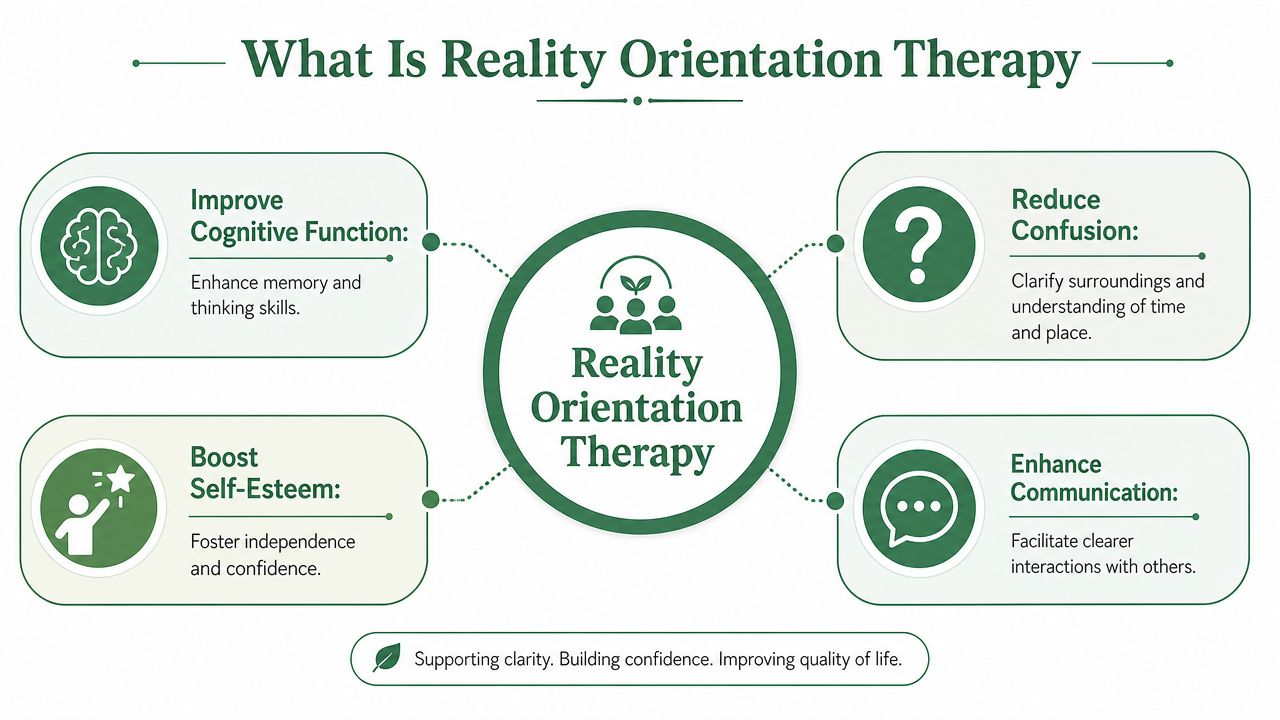
Reality Orientation Therapy is a communication method that keeps returning to the basics of the present moment. It brings in who, where, when, and what's happening now in a way that's meant to support thinking, not interrogate memory. Think of it as a cognitive anchor, something that helps steady a person when their internal sense of time or place has drifted.
The simple purpose behind it
The aim is to reduce confusion, support cognitive function, and help the person feel more in control of their surroundings. It can also support self-esteem when it's done respectfully, because the person isn't being treated like a problem to solve. They're being helped to stay oriented in a world that feels increasingly slippery.
The older literature describes different ways the approach has been delivered, including continuous 24-hour orientation and group-based orientation sessions. In home care, that often translates into ordinary conversation, helpful labels, visible calendars, and repeated cues that fit naturally into the day. The point isn't to drill facts. The point is to make the environment more readable.
What it sounds like in real life
A caregiver might say, “Good morning, Mom. It's Tuesday, and we're having oatmeal before your haircut.” That's orientation, but it doesn't feel like a quiz. It tells the person where they are in the day.
A harsh version would sound like, “What day is it? Do you remember where you are?” That changes the interaction from support to testing. The first version gives the brain a cue. The second one often raises stress.
Why the tone matters
People with dementia often remember the emotional tone of an exchange more clearly than the facts. If orientation is delivered with warmth and patience, it can feel safe. If it's delivered like a correction, it can feel shaming.
That's why the best home use isn't rigid. It's flexible, respectful, and tied to the person's mood. Reality orientation works best when it feels like a hand on the shoulder, not a pop quiz.
Key Techniques and Everyday Activities
A good home routine uses small, repeatable cues. You don't need a clinical setting to do this well. You need consistency, clear language, and a way to weave orientation into ordinary life so it doesn't stand out as an event.
Build cues into the room and the routine
An orientation board can hold the date, day, weather, appointments, and one or two key plans for the day. A large clock and calendar help too, especially when they're in the same spot every day. Labels on drawers, bathroom doors, and pantry shelves can reduce the mental work needed to find things.
Use the date board during breakfast: Start the day by glancing at the board together, then mention one concrete plan.
Label everyday spaces: “Bathroom,” “Coats,” and “Medicines” can make the house easier to find one's way around without a long explanation.
Match the cue to the task: If it's cloudy outside, looking out the window can support the idea that it's morning or afternoon.
Use conversation as an orienting tool
The most natural cues often come through speech. Saying, “Good morning, Dad. It's Tuesday, and your sister is coming after lunch,” does more than hand over information. It creates a clear thread between the present moment and the next step.
That same approach works on the phone too. A short call can start with the person's name, the day, and one thing that's happening soon. The call doesn't need to be long to be useful. It just needs to be predictable.
“The less it feels like a test, the more likely the person is to accept it.”
If you want to see how orientation can sit alongside memory-focused conversation, this overview of reminiscence therapy for dementia is a useful companion read. The two approaches serve different purposes, but they can fit together well at home.
Make it sensory, not just verbal
People orient better when the environment supports the message. A window that shows daylight, a familiar song before dinner, or a photo that confirms who's coming over can all reinforce the same point from different angles. These cues are simple, but they reduce the strain of having to figure everything out from scratch.
The goal is to make reality easy to notice. When the person doesn't have to work so hard to understand the day, they're often less anxious and more available for conversation.
What a Typical Session Looks Like
A lot of caregivers picture reality orientation therapy as a formal activity, but in a home setting it often looks like ordinary care with a few extra cues built in. One family may use it all day in small moments. Another may set aside a short, focused time after breakfast.
The informal, all-day version
A husband helping his wife get dressed might say, “It's Thursday, and we're seeing the doctor after lunch.” Later, while setting the table, he might add, “Your son called this morning, and he's coming on Sunday.” During each moment, the facts are brief, calm, and tied to what's happening.
That style works best when the person is still able to use the information right away. It can reduce uncertainty without forcing a formal sit-down. It also fits real caregiving, where there's rarely a perfect block of uninterrupted time.
The structured, short-session version
A more deliberate session might last a short stretch and focus on one theme, like the family calendar or the day's routine. The caregiver might sit beside the person, review the date, look at a card showing today's schedule, and talk through one upcoming event. A map, a photo album, or a few familiar objects can keep the conversation grounded.
Keep the task narrow: one calendar, one photo board, one topic.
Use a calm start: greet the person, name the day, then move into the activity.
Stop while it's still going well: a short, successful exchange beats a long one that ends in frustration.
Consistency matters most. A report from 2024 found that weekly 30- to 60-minute individualized sessions for 6 months improved cognition in mild-to-moderate Alzheimer's dementia, and the same source notes that the benefit depends on the therapy being active, structured, and sustained (PubMed). Families don't need to copy a clinic exactly, but they do need a rhythm the person can recognize.
If you're using structured calls as part of daily support, this guide on daily check-in calls for seniors fits naturally with that kind of routine.
Adapting ROT for Different Dementia Stages
Reality orientation doesn't land the same way at every stage of dementia. What feels reassuring in early changes can feel confusing or upsetting later on. The skill is not just knowing the technique, it's knowing when to use it lightly, when to use it directly, and when to step back.
Early stage, use light guidance
In earlier dementia, many people still want to stay connected to the present. Gentle reminders, repeated names, and visible cues can support independence without feeling intrusive. A note on the counter, a calendar near the kettle, or a quick verbal reminder before an appointment can be enough.
At this stage, the person may even ask for the information. If they say, “What day is it?” or “When is the dentist?” a direct answer helps. The more the answer fits the question, the more useful the orientation tends to be.
Middle stage, keep it structured and brief
As confusion grows, the person may need more repetition and simpler language. Orientation works better when it's short, familiar, and tied to immediate needs, like meals, visitors, or the next activity. A long explanation can overload them even when the information is correct.
This is also the stage where tone matters most. If they resist or seem upset, don't push harder. A calm, brief cue followed by a supportive change of topic is often more useful than trying to force understanding.
Late stage, shift away from correction
In later dementia, reality orientation is often less helpful and can become distressing. If the person can't hold onto new information, repeated correction can create fresh upset every time. In that situation, comfort and emotional safety matter more than factual accuracy.
That's where Validation Therapy often becomes the better choice. Instead of correcting the statement, you respond to the feeling behind it. If someone says they need to go home, the need may be comfort, not geography. If they ask for a parent who died long ago, the emotion may be longing, not confusion alone.
When correction causes pain, the right response is usually not more correction.
The practical question isn't “Is the fact accurate?” It's “Will this help the person feel safer, or will it make the moment worse?” That question is often the difference between a conversation that settles someone and one that escalates them.
Using Reality Orientation on the Phone and at Home
Phone calls can do more than pass the time. They can become a steady orientation cue, especially for someone living alone or supported by family between visits. A regular call that follows the same pattern gives the person something familiar to rely on.
A phone call can sound like care, not checking up
The call can open with the person's name, the day, and one or two things on the schedule. “Hi, Ruth, it's Monday morning. You have the grocery delivery after lunch, and your neighbor is coming by later.” That kind of call does three jobs at once. It orients, it reassures, and it signals that the day has shape.
The tone matters more than the script. If the caller sounds rushed or skeptical, the person may feel monitored. If the caller sounds warm and steady, the call feels like support.
Keep the structure simple enough to repeat
A useful phone routine usually has three parts. First, confirm the day or the next plan. Second, ask one grounded question about how the morning has been going. Third, end with the next expected contact so the person knows what comes next.
Open with a familiar anchor: use the same greeting and the same name.
Add one concrete fact: an appointment, meal, visit, or task.
Close with certainty: say when the next call or visit will happen.
That steady structure is one reason phone-based support can fit dementia care so well. It doesn't require new technology, and it doesn't ask the person to manage an app or device. For families using a program like Velma, the phone format can support orientation, conversation, and daily check-ins in a way that's easy to sustain over time.
Keep the call emotionally useful
Orientation works better when the person also feels heard. A brief question like “How's your energy today?” gives room for emotion without losing the thread of the day. If they drift into anxiety, the caller can acknowledge it first, then return to the simple facts that help the person stay grounded.
That balance matters in the home setting. The person doesn't just need information, they need the information to arrive in a way that feels safe enough to use.
Precautions and Alternative Approaches
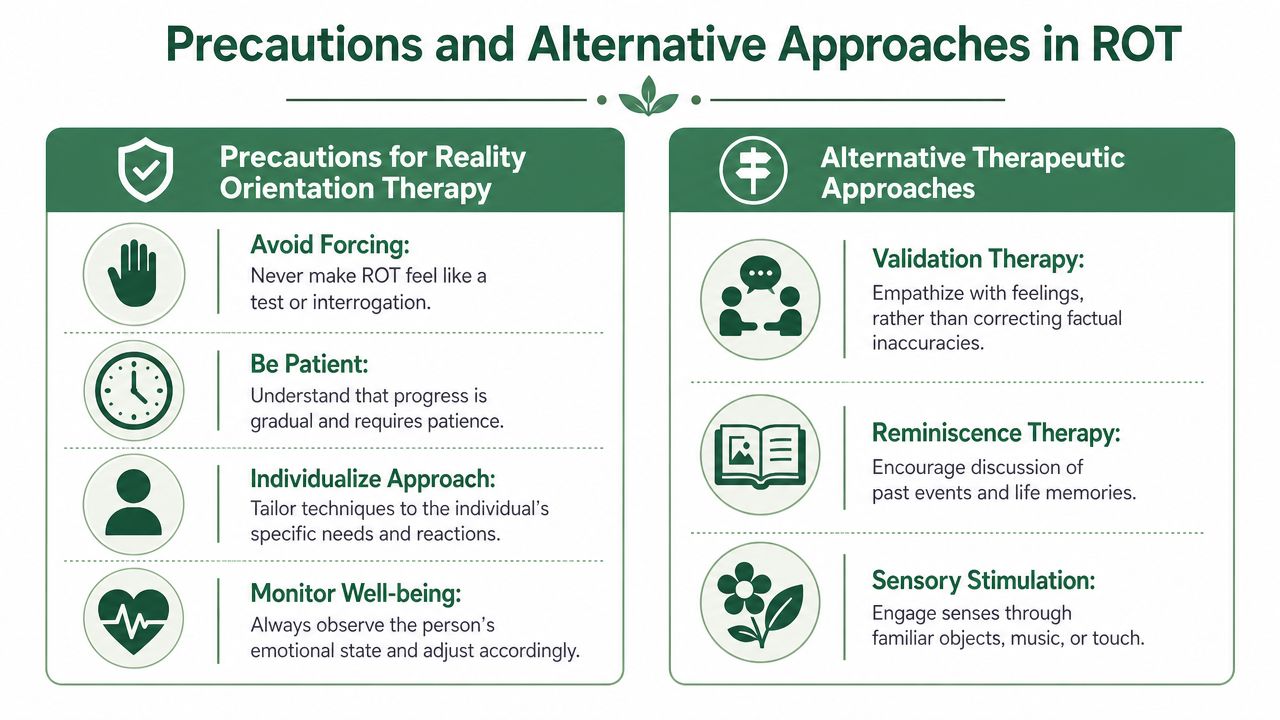
Reality orientation can help, yet it can also feel like a quiz if it is used too hard or too often. For a family caregiver, the safest approach is calm, brief, and guided by the person's reaction in the moment. If the person seems tired, confused, or irritated, the goal is to ease the pressure, not to correct every detail.
A useful rule is to watch for signs that the moment has shifted. If the person looks embarrassed, angry, frightened, or shut down, stop the correction and change direction. A fact can be correct and still be the wrong thing to press for right then, much like trying to force a key into the wrong lock.
The caution is not just practical, it is also supported by what has been seen in research. As noted in PubMed, reality orientation may improve cognitive performance for some people, but it does not clearly improve behavioral problems or depressive symptoms. That is why emotional comfort has to stay part of the plan.
Use the right approach for the right moment
Reality orientation works best when the person wants information, can use it, and does not seem upset by the correction. If the person is already distressed, a different approach may fit better. Validation Therapy gives attention to the feeling first, which can help when the person is frightened, grieving, or stuck in a distressing belief that facts will not quickly settle. Reminiscence Therapy uses familiar memories and can be comforting when a person settles into talking about the past.
If you want to compare reality orientation with another structured non-drug option, this guide to cognitive stimulation therapy explains how the two approaches support thinking in different ways.
A simple decision rule for caregivers
Start with emotion if you are unsure. A reassuring tone, a slow pace, and one short answer can tell you more than a long explanation. If the person settles after comfort or redirection, you may not need to correct anything further.
That middle path is often the kindest one in a home setting. Reality orientation therapy can still be useful, but it does not need to sound like a lecture. Families usually do best with gentle facts, patient listening, and the flexibility to shift from correction to comfort the moment the person needs support more than information.
You're standing in the kitchen, trying to finish breakfast, when your dad asks again what day it is and whether he's late for work. You already answered ten minutes ago. He doesn't seem stubborn, he seems frightened, and that's what makes the moment hard. Reality Orientation Therapy gives you a way to respond that's gentle, practical, and grounded in the moment without turning every conversation into a correction.
Table of Contents
An Introduction to Managing Disorientation
What Is Reality Orientation Therapy
The simple purpose behind it
What it sounds like in real life
Why the tone matters
Key Techniques and Everyday Activities
Build cues into the room and the routine
Use conversation as an orienting tool
Make it sensory, not just verbal
What a Typical Session Looks Like
The informal, all-day version
The structured, short-session version
Adapting ROT for Different Dementia Stages
Early stage, use light guidance
Middle stage, keep it structured and brief
Late stage, shift away from correction
Using Reality Orientation on the Phone and at Home
A phone call can sound like care, not checking up
Keep the structure simple enough to repeat
Keep the call emotionally useful
Precautions and Alternative Approaches
Use the right approach for the right moment
A simple decision rule for caregivers
An Introduction to Managing Disorientation
A daughter hears, for the third time that afternoon, “When are we going home?” while her mother is already sitting in her own living room. A spouse answers the same question about the date, the visitor, and the meal, then watches the frustration rise anyway. Moments like that can leave caregivers feeling as if they are failing a test they never agreed to take.
Reality Orientation Therapy gives the person steady anchors, such as time, place, names, and what happens next. It is a structured way to support awareness of the present moment, so the person has something concrete to hold onto when the day feels confusing.
The emotional side matters as much as the factual side. A review in the Cochrane Library found that reality orientation can help cognition, while effects on mood and behavior were less clear. Other review work has also raised questions about how long benefits last after treatment ends, which is why families often wonder when to orient, when to stop, and how to respond if the person gets upset.
Practical rule: if the person is asking for information and seems receptive, orienting can help. If they are distressed, correction usually is not the first move.
That is why the most useful home approach is often a calm blend of orientation and person-centered conversation. You give the person something concrete, but you also notice whether the underlying need is reassurance, connection, or relief from fear.
What Is Reality Orientation Therapy
Reality Orientation Therapy is a communication method that keeps returning to the basics of the present moment. It brings in who, where, when, and what's happening now in a way that's meant to support thinking, not interrogate memory. Think of it as a cognitive anchor, something that helps steady a person when their internal sense of time or place has drifted.
The simple purpose behind it
The aim is to reduce confusion, support cognitive function, and help the person feel more in control of their surroundings. It can also support self-esteem when it's done respectfully, because the person isn't being treated like a problem to solve. They're being helped to stay oriented in a world that feels increasingly slippery.
The older literature describes different ways the approach has been delivered, including continuous 24-hour orientation and group-based orientation sessions. In home care, that often translates into ordinary conversation, helpful labels, visible calendars, and repeated cues that fit naturally into the day. The point isn't to drill facts. The point is to make the environment more readable.
What it sounds like in real life
A caregiver might say, “Good morning, Mom. It's Tuesday, and we're having oatmeal before your haircut.” That's orientation, but it doesn't feel like a quiz. It tells the person where they are in the day.
A harsh version would sound like, “What day is it? Do you remember where you are?” That changes the interaction from support to testing. The first version gives the brain a cue. The second one often raises stress.
Why the tone matters
People with dementia often remember the emotional tone of an exchange more clearly than the facts. If orientation is delivered with warmth and patience, it can feel safe. If it's delivered like a correction, it can feel shaming.
That's why the best home use isn't rigid. It's flexible, respectful, and tied to the person's mood. Reality orientation works best when it feels like a hand on the shoulder, not a pop quiz.
Key Techniques and Everyday Activities
A good home routine uses small, repeatable cues. You don't need a clinical setting to do this well. You need consistency, clear language, and a way to weave orientation into ordinary life so it doesn't stand out as an event.
Build cues into the room and the routine
An orientation board can hold the date, day, weather, appointments, and one or two key plans for the day. A large clock and calendar help too, especially when they're in the same spot every day. Labels on drawers, bathroom doors, and pantry shelves can reduce the mental work needed to find things.
Use the date board during breakfast: Start the day by glancing at the board together, then mention one concrete plan.
Label everyday spaces: “Bathroom,” “Coats,” and “Medicines” can make the house easier to find one's way around without a long explanation.
Match the cue to the task: If it's cloudy outside, looking out the window can support the idea that it's morning or afternoon.
Use conversation as an orienting tool
The most natural cues often come through speech. Saying, “Good morning, Dad. It's Tuesday, and your sister is coming after lunch,” does more than hand over information. It creates a clear thread between the present moment and the next step.
That same approach works on the phone too. A short call can start with the person's name, the day, and one thing that's happening soon. The call doesn't need to be long to be useful. It just needs to be predictable.
“The less it feels like a test, the more likely the person is to accept it.”
If you want to see how orientation can sit alongside memory-focused conversation, this overview of reminiscence therapy for dementia is a useful companion read. The two approaches serve different purposes, but they can fit together well at home.
Make it sensory, not just verbal
People orient better when the environment supports the message. A window that shows daylight, a familiar song before dinner, or a photo that confirms who's coming over can all reinforce the same point from different angles. These cues are simple, but they reduce the strain of having to figure everything out from scratch.
The goal is to make reality easy to notice. When the person doesn't have to work so hard to understand the day, they're often less anxious and more available for conversation.
What a Typical Session Looks Like
A lot of caregivers picture reality orientation therapy as a formal activity, but in a home setting it often looks like ordinary care with a few extra cues built in. One family may use it all day in small moments. Another may set aside a short, focused time after breakfast.
The informal, all-day version
A husband helping his wife get dressed might say, “It's Thursday, and we're seeing the doctor after lunch.” Later, while setting the table, he might add, “Your son called this morning, and he's coming on Sunday.” During each moment, the facts are brief, calm, and tied to what's happening.
That style works best when the person is still able to use the information right away. It can reduce uncertainty without forcing a formal sit-down. It also fits real caregiving, where there's rarely a perfect block of uninterrupted time.
The structured, short-session version
A more deliberate session might last a short stretch and focus on one theme, like the family calendar or the day's routine. The caregiver might sit beside the person, review the date, look at a card showing today's schedule, and talk through one upcoming event. A map, a photo album, or a few familiar objects can keep the conversation grounded.
Keep the task narrow: one calendar, one photo board, one topic.
Use a calm start: greet the person, name the day, then move into the activity.
Stop while it's still going well: a short, successful exchange beats a long one that ends in frustration.
Consistency matters most. A report from 2024 found that weekly 30- to 60-minute individualized sessions for 6 months improved cognition in mild-to-moderate Alzheimer's dementia, and the same source notes that the benefit depends on the therapy being active, structured, and sustained (PubMed). Families don't need to copy a clinic exactly, but they do need a rhythm the person can recognize.
If you're using structured calls as part of daily support, this guide on daily check-in calls for seniors fits naturally with that kind of routine.
Adapting ROT for Different Dementia Stages
Reality orientation doesn't land the same way at every stage of dementia. What feels reassuring in early changes can feel confusing or upsetting later on. The skill is not just knowing the technique, it's knowing when to use it lightly, when to use it directly, and when to step back.
Early stage, use light guidance
In earlier dementia, many people still want to stay connected to the present. Gentle reminders, repeated names, and visible cues can support independence without feeling intrusive. A note on the counter, a calendar near the kettle, or a quick verbal reminder before an appointment can be enough.
At this stage, the person may even ask for the information. If they say, “What day is it?” or “When is the dentist?” a direct answer helps. The more the answer fits the question, the more useful the orientation tends to be.
Middle stage, keep it structured and brief
As confusion grows, the person may need more repetition and simpler language. Orientation works better when it's short, familiar, and tied to immediate needs, like meals, visitors, or the next activity. A long explanation can overload them even when the information is correct.
This is also the stage where tone matters most. If they resist or seem upset, don't push harder. A calm, brief cue followed by a supportive change of topic is often more useful than trying to force understanding.
Late stage, shift away from correction
In later dementia, reality orientation is often less helpful and can become distressing. If the person can't hold onto new information, repeated correction can create fresh upset every time. In that situation, comfort and emotional safety matter more than factual accuracy.
That's where Validation Therapy often becomes the better choice. Instead of correcting the statement, you respond to the feeling behind it. If someone says they need to go home, the need may be comfort, not geography. If they ask for a parent who died long ago, the emotion may be longing, not confusion alone.
When correction causes pain, the right response is usually not more correction.
The practical question isn't “Is the fact accurate?” It's “Will this help the person feel safer, or will it make the moment worse?” That question is often the difference between a conversation that settles someone and one that escalates them.
Using Reality Orientation on the Phone and at Home
Phone calls can do more than pass the time. They can become a steady orientation cue, especially for someone living alone or supported by family between visits. A regular call that follows the same pattern gives the person something familiar to rely on.
A phone call can sound like care, not checking up
The call can open with the person's name, the day, and one or two things on the schedule. “Hi, Ruth, it's Monday morning. You have the grocery delivery after lunch, and your neighbor is coming by later.” That kind of call does three jobs at once. It orients, it reassures, and it signals that the day has shape.
The tone matters more than the script. If the caller sounds rushed or skeptical, the person may feel monitored. If the caller sounds warm and steady, the call feels like support.
Keep the structure simple enough to repeat
A useful phone routine usually has three parts. First, confirm the day or the next plan. Second, ask one grounded question about how the morning has been going. Third, end with the next expected contact so the person knows what comes next.
Open with a familiar anchor: use the same greeting and the same name.
Add one concrete fact: an appointment, meal, visit, or task.
Close with certainty: say when the next call or visit will happen.
That steady structure is one reason phone-based support can fit dementia care so well. It doesn't require new technology, and it doesn't ask the person to manage an app or device. For families using a program like Velma, the phone format can support orientation, conversation, and daily check-ins in a way that's easy to sustain over time.
Keep the call emotionally useful
Orientation works better when the person also feels heard. A brief question like “How's your energy today?” gives room for emotion without losing the thread of the day. If they drift into anxiety, the caller can acknowledge it first, then return to the simple facts that help the person stay grounded.
That balance matters in the home setting. The person doesn't just need information, they need the information to arrive in a way that feels safe enough to use.
Precautions and Alternative Approaches
Reality orientation can help, yet it can also feel like a quiz if it is used too hard or too often. For a family caregiver, the safest approach is calm, brief, and guided by the person's reaction in the moment. If the person seems tired, confused, or irritated, the goal is to ease the pressure, not to correct every detail.
A useful rule is to watch for signs that the moment has shifted. If the person looks embarrassed, angry, frightened, or shut down, stop the correction and change direction. A fact can be correct and still be the wrong thing to press for right then, much like trying to force a key into the wrong lock.
The caution is not just practical, it is also supported by what has been seen in research. As noted in PubMed, reality orientation may improve cognitive performance for some people, but it does not clearly improve behavioral problems or depressive symptoms. That is why emotional comfort has to stay part of the plan.
Use the right approach for the right moment
Reality orientation works best when the person wants information, can use it, and does not seem upset by the correction. If the person is already distressed, a different approach may fit better. Validation Therapy gives attention to the feeling first, which can help when the person is frightened, grieving, or stuck in a distressing belief that facts will not quickly settle. Reminiscence Therapy uses familiar memories and can be comforting when a person settles into talking about the past.
If you want to compare reality orientation with another structured non-drug option, this guide to cognitive stimulation therapy explains how the two approaches support thinking in different ways.
A simple decision rule for caregivers
Start with emotion if you are unsure. A reassuring tone, a slow pace, and one short answer can tell you more than a long explanation. If the person settles after comfort or redirection, you may not need to correct anything further.
That middle path is often the kindest one in a home setting. Reality orientation therapy can still be useful, but it does not need to sound like a lecture. Families usually do best with gentle facts, patient listening, and the flexibility to shift from correction to comfort the moment the person needs support more than information.
Suggested Article: