Food Spoilage Prevention at Home: A Practical 2026 Guide

You know the smell when you open the fridge and something's gone off, but the problem usually started days earlier. There's a half-forgotten tub behind the milk, a bag of greens nobody planned to use, and leftovers that were supposed to be dinner twice this week. In a home where someone has memory loss, food spoilage prevention isn't mostly about being neat. It's about stopping the routine failures that let good food disappear before anyone can eat it.
The old rules still matter, of course. People have been drying food since about 12,000 BC in the Middle East, and pickling shows up as early as about 2400 BC in Mesopotamia, because lowering moisture or changing the food environment makes microbial growth harder (history of food preservation). Modern preservation still rests on the same logic, only with better control. The kitchen loses the battle when the workflow breaks, not when the science changes.
Table of Contents
Why Spoilage Is Really a Routine Problem
What actually breaks down
Getting Temperatures, Containers, and Airflow Right
The rules that matter most
A simple setup that works
A Labeling and Rotation System That Actually Sticks
Make rotation visual, not mental
Keep the nightly scan tiny
Meal Planning That Prevents the Leftovers No One Claims
Build the week around perishables
Cooking for one is different
Sensory Checks You Can Trust and Ones You Cannot
What your senses can tell you
Why Daily Check-Ins Catch What Labels Cannot
What daily eyes catch that kitchen systems miss
The real point of check-ins
A Caregiver Cheat Sheet for the Fridge Door
Why Spoilage Is Really a Routine Problem
The fridge tells the truth fast in a caregiver's house. Open the door and you usually find the same pattern, three unmarked tubs, a half-used carton, and produce shoved behind something taller. Nobody planned to waste the food. The routine broke down because someone was rushed, distracted, or too tired to keep track of what was already there.
That is why I do not start with “clean your fridge.” I start with who is supposed to remember what's inside, who is supposed to use it, and who is supposed to decide whether it is still safe. In households affected by memory loss, spoilage is usually a routine problem before it is a storage problem. Food sits there because nobody can confidently name it, date it, or claim it.
The lesson from older preservation methods is simple. Good food handling cuts down the number of decisions a household has to make and makes the food easier to sort, store, and use before it turns into waste.
Practical rule: If a food system relies on memory alone, it will fail in a household where memory is already under strain.
What actually breaks down
A parent opens yogurt, eats half, and forgets it. A helper buys more milk because the first carton got hidden. A pan of soup gets moved to the fridge, then buried under takeaway containers. None of that is a storage failure in the narrow sense. It is a routine failure, and no amount of “be more careful” fixes that.
The strongest food spoilage prevention plan in these homes is built around visibility, repetition, and fewer choices. The fridge layout, the labels, and the check-in habit matter more than a long list of kitchen rules. If you make the workflow easier to follow, the food has a chance.
Getting Temperatures, Containers, and Airflow Right
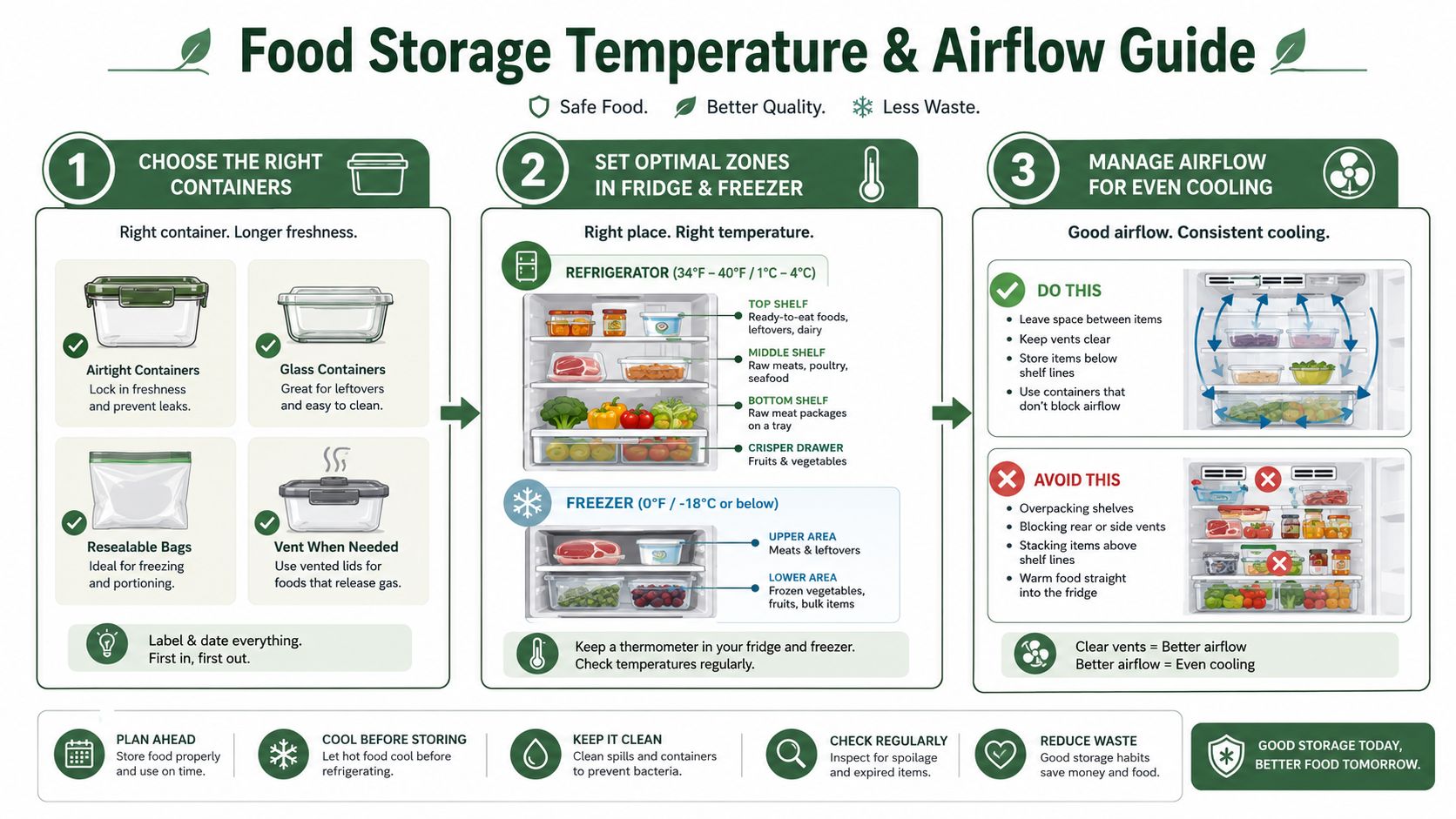
A fridge full of food can still fail if the temperature is off. For liquid foods like juice and dairy, the research-backed approach is a validated heat step, then immediate cooling and sealing so the product doesn't get recontaminated (PMC review on processing and spoilage control). For meat, the same review points to immediate refrigeration below 4 °C after slaughter and through transport and storage as a hygiene and shelf-life control. Temperature is not a vague comfort issue. It is a control point.
The rules that matter most
If you only remember a few storage habits, make them these:
Keep perishables cold fast. Food that needs refrigeration should get there quickly, not after a long detour on the counter.
Use containers that seal. Loose covers invite recontamination, moisture loss, and odor transfer.
Leave room for airflow. Stuffed shelves trap warm pockets and make the fridge work harder.
Don't trust the door shelf for fragile items. It gets the most temperature swings every time someone reaches in.
The meat and meat product review also describes storage around 5 °C as a common industry control point, especially when paired with chemical antioxidants such as TBHQ and ascorbic acid in some systems (hurdle technology review). That does not mean you need preservatives at home. It does mean temperature control is not optional.
Use this standard: cold food goes into a cold environment quickly, then stays protected from air, leaks, and repeated handling.
A simple setup that works
Buy a basic fridge thermometer if your fridge is inconsistent, then stop guessing. Put clear plastic bins on one shelf for dairy, one for produce, and one for leftovers so you can see what's there without rearranging everything. That setup beats a dozen reminders to “check the fridge” because it makes the food visible from the front.
A Labeling and Rotation System That Actually Sticks
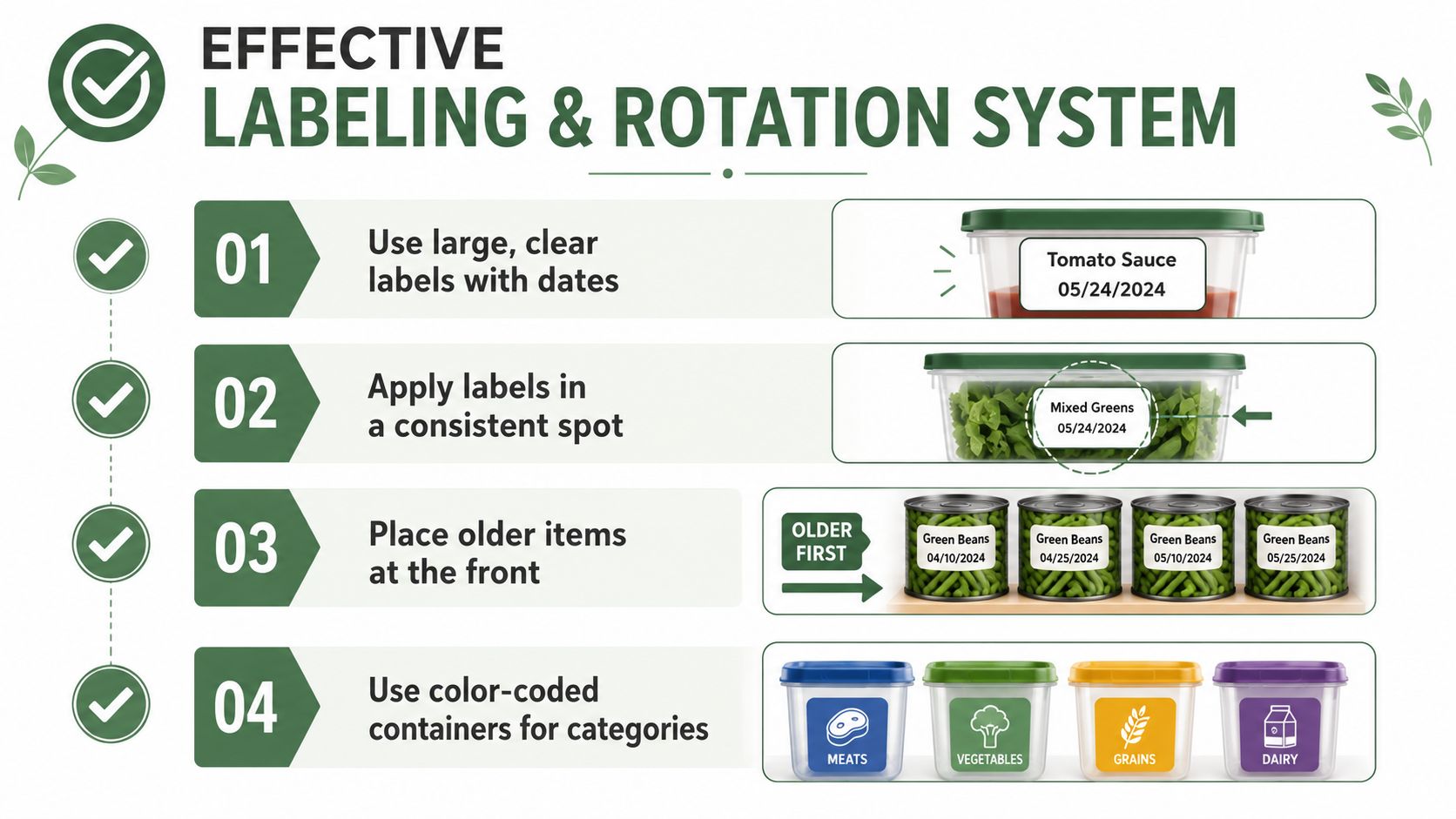
FIFO only works when people can see the older food first. In a messy real kitchen, that means the label has to do the remembering for you. I want three lines on every container that matters, item, date opened or cooked, and use-by. Put the label on the front edge, not the lid, so it's visible before anyone lifts the container.
Make rotation visual, not mental
One bin per category takes the burden off memory. Leftovers go in one bin, dairy in another, produce in a third. When a tired caregiver or an older adult can see “older items in front” at a glance, the system works even when nobody feels organized.
A Sunday-cooked soup is a good example. It goes into a container labeled “Chicken soup,” “Cooked Sunday,” and “Use by Wednesday.” If there's too much for two more meals, freeze a portion the same day in a smaller container with the same label format. That keeps the soup from sitting in the fridge long enough to become a guessing game.
The labeling part is not about being fussy. It's about preventing duplicate purchases and the lost-leftover problem that fills the back of the fridge. A caregiver who can read a label in two seconds is more likely to use the food than someone trying to identify a mystery tub by memory.
Keep the nightly scan tiny
The routine that makes this stick is a 60-second scan while the kettle boils. Open the fridge, pull stale items to the front, move anything close to its limit into a “use now” spot, and toss the obvious dead weight. Don't turn it into a cleaning project. You're building a habit the household can survive on a bad day.
Meal Planning That Prevents the Leftovers No One Claims
A short weekly plan prevents more spoilage than is commonly admitted. Not because meal planning is glamorous, but because it tells you what should be eaten first, what needs to be cooked, and what should never be bought in bulk. A 30-minute Sunday plan is enough if you use it for three things, a short shopping list, a planned-use list for perishables, and a place for leftovers before the week starts.
Build the week around perishables
If you're cooking for two, choose one or two meals that deliberately use the most fragile ingredients early in the week. Buy smaller amounts of berries, greens, dairy, and sliced meats if you know the household won't reliably finish them. The common mistake is Sunday overcooking, then acting surprised when no one wants the same casserole on Thursday.
For a two-person household, a practical rule works well. If a leftover will be eaten within the next meal cycle, keep it refrigerated and label it. If it won't be touched in time, freeze it in portions right away. If the food is already ambiguous, it goes in the bin. That's harsh, but it's cheaper than keeping unsafe food around because nobody wants to waste it.
The week works better when leftovers have a named home. One container for soup, one bin for cooked proteins, one shelf spot for “eat first.” Without that, leftovers become anonymous, then ignored.
If you need a simple companion routine for the person you care for, this daily routine guide for seniors with early memory loss fits neatly alongside a food plan. Keep the food rules small, visible, and repeatable.
Cooking for one is different
Cooking for one demands even tighter portions and more freezer use. Cooking for two gives you a little flexibility, but not much. In both cases, the fix is the same, make less food appear at once and give every cooked item a clear next step.
Sensory Checks You Can Trust and Ones You Cannot
People love the “look, smell, touch” advice because it feels practical. Some of it is. Some of it is lazy. A surface mold on bread is a problem because it often means the food is broadly compromised. A little mold on jam is different, but it still isn't something I'd keep in a home where food safety needs to be simple and conservative.
What your senses can tell you
Smell is useful for cooked foods that should be neutral or clean, especially if they've already been opened and refrigerated. A sour or rotten odor in cooked rice, for example, is a stronger warning than a faint color shift in ground beef. Texture matters too. Raw meat that's slimy or tacky is not the same as meat that looks darker at the edges.
Here's the key boundary. If the food is perishable, already opened, and giving off a clearly wrong smell or texture, don't negotiate with it. Toss it. A caregiver does not need a second opinion from the trash can.
Food | Trust This Cue | Do Not Trust This Cue |
|---|---|---|
Bread | Visible mold on the surface | “It only has a little spot” |
Cooked rice | Sour, off smell, sticky odd texture | “It looks fine” after sitting too long |
Raw meat | Slime, tackiness, sharp off odor | Color change alone |
Deli meat | Slimy surface, sour smell | Slight dulling of color |
Hard cheese | Mold on the outer edge can be cut away in some cases, if the rest is sound | Odor alone without checking the surface and packaging |
The less useful cues are the ones people overtrust. Color change by itself can mislead, especially in meat. Packaging puffiness is also a warning sign, but in a dementia household, I'd rather see a caregiver err on the side of discarding questionable food than trying to interpret every edge case.
Write this on the fridge: when in doubt, throw it out. That's cheaper than a clinic visit and easier than arguing with a tired memory.
Why Daily Check-Ins Catch What Labels Cannot
Labels are useful, but they don't catch a fridge door left ajar or a yogurt opened three days ago and forgotten. In a household affected by memory loss, the most effective layer is another human being checking in regularly. Not a sticker. Not an app. A person.
What daily eyes catch that kitchen systems miss
A short phone check can surface the things a label can't. The older adult may have bought duplicates because they forgot what was already there. They may have restocked the freezer on top of older packages. They may have left the fridge slightly open after breakfast and never noticed. None of those problems is solved by a better marker pen.
That's why scheduled check-ins matter. A quick call can ask what was cooked, what was opened, and what needs to be eaten today. It also catches non-food safety risks, like forgetting the stove, while the conversation is already happening. The point is not surveillance. The point is to create a second pair of eyes that works in real time.
This is also where phone-based support stands out. The older adult doesn't need another device, another login, or another screen to ignore. A regular call is simple enough to become part of the day instead of another task to manage. For families, that kind of support can make the difference between “I think it's fine” and “No, that milk needs to go.”
If you want a broader model for how that kind of support fits into family care, the daily check-in calls guide for seniors shows why the conversation itself can do a lot of the work.
The real point of check-ins
The missed reminder is usually the failure, not the missing instruction. A daily call closes that gap. It also gives the caregiver a chance to hear whether the fridge, the meals, and the household routine are still behaving the way they should.
A Caregiver Cheat Sheet for the Fridge Door
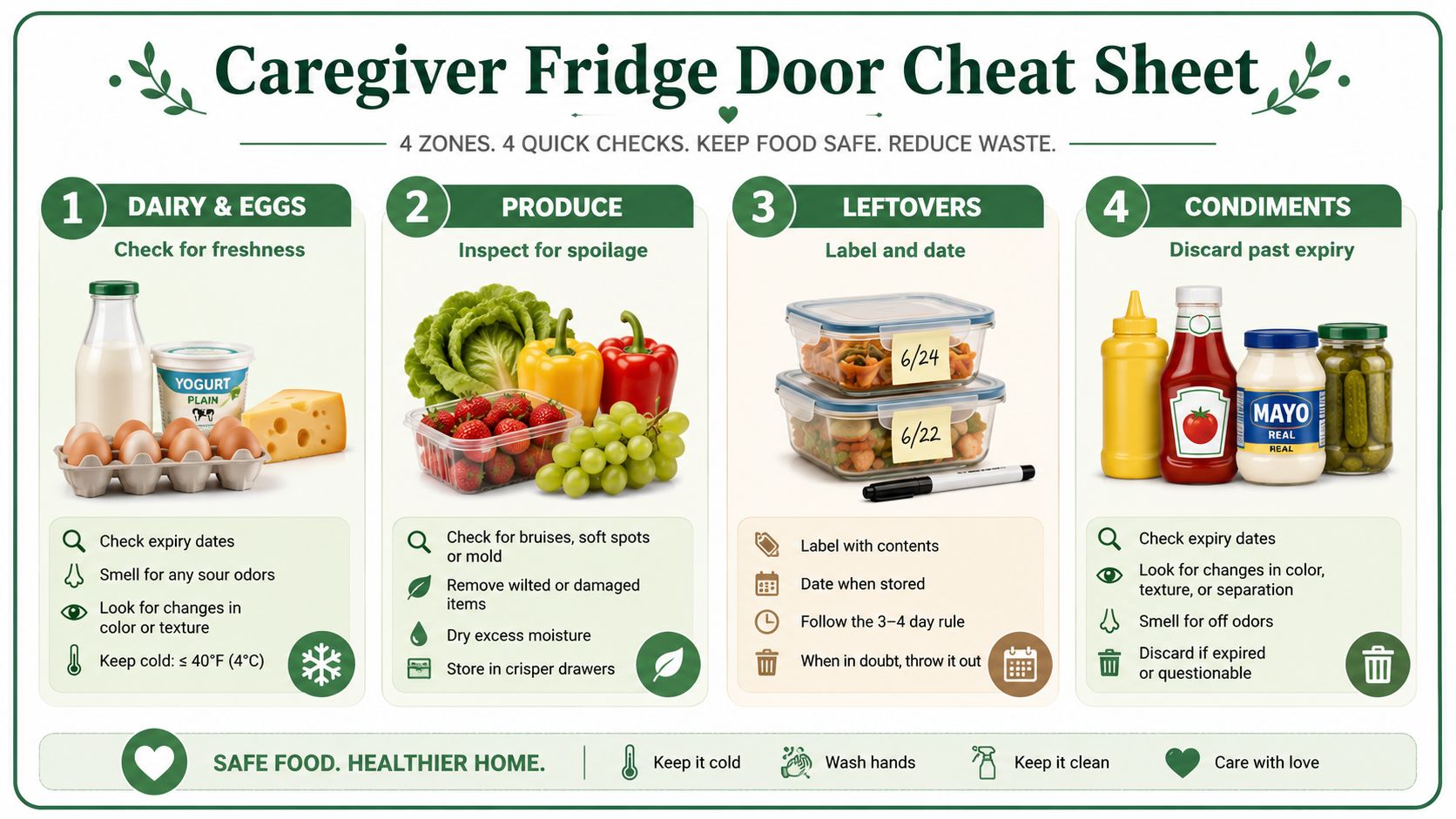
Use four buckets and stop overcomplicating it. A fridge only stays useful when the system is easy enough for a tired person to follow.
Temperatures
Keep perishables cold right away.
Use a fridge thermometer if the appliance runs warm or inconsistent.
Containers
Put leftovers in clear, sealed containers.
Label the front with item, date, and use-by.
Routine
Do a 60-second fridge scan nightly.
Keep one bin for leftovers and one place for food that needs to be eaten first.
Check-ins
Have one person call at the same time each day.
Ask what was opened, what was cooked, and what should be used next.
Tie the call to a simple family care routine, like the one described in the Velma guide to family cognitive support, so the check-in happens without debate.
Start with the easiest habit you can keep this week. For most households, that means labeling leftovers clearly or making the nightly scan automatic. Once that holds, add the next layer. Progress on spoilage is progress on safety, independence, and dignity at the same time.
A fridge plan works best when it is simple enough to survive a busy day and forgetful hands. Give one person the job of the daily call, then make three containers easy to identify before the week is out. This week, label three containers and schedule one daily call.
You know the smell when you open the fridge and something's gone off, but the problem usually started days earlier. There's a half-forgotten tub behind the milk, a bag of greens nobody planned to use, and leftovers that were supposed to be dinner twice this week. In a home where someone has memory loss, food spoilage prevention isn't mostly about being neat. It's about stopping the routine failures that let good food disappear before anyone can eat it.
The old rules still matter, of course. People have been drying food since about 12,000 BC in the Middle East, and pickling shows up as early as about 2400 BC in Mesopotamia, because lowering moisture or changing the food environment makes microbial growth harder (history of food preservation). Modern preservation still rests on the same logic, only with better control. The kitchen loses the battle when the workflow breaks, not when the science changes.
Table of Contents
Why Spoilage Is Really a Routine Problem
What actually breaks down
Getting Temperatures, Containers, and Airflow Right
The rules that matter most
A simple setup that works
A Labeling and Rotation System That Actually Sticks
Make rotation visual, not mental
Keep the nightly scan tiny
Meal Planning That Prevents the Leftovers No One Claims
Build the week around perishables
Cooking for one is different
Sensory Checks You Can Trust and Ones You Cannot
What your senses can tell you
Why Daily Check-Ins Catch What Labels Cannot
What daily eyes catch that kitchen systems miss
The real point of check-ins
A Caregiver Cheat Sheet for the Fridge Door
Why Spoilage Is Really a Routine Problem
The fridge tells the truth fast in a caregiver's house. Open the door and you usually find the same pattern, three unmarked tubs, a half-used carton, and produce shoved behind something taller. Nobody planned to waste the food. The routine broke down because someone was rushed, distracted, or too tired to keep track of what was already there.
That is why I do not start with “clean your fridge.” I start with who is supposed to remember what's inside, who is supposed to use it, and who is supposed to decide whether it is still safe. In households affected by memory loss, spoilage is usually a routine problem before it is a storage problem. Food sits there because nobody can confidently name it, date it, or claim it.
The lesson from older preservation methods is simple. Good food handling cuts down the number of decisions a household has to make and makes the food easier to sort, store, and use before it turns into waste.
Practical rule: If a food system relies on memory alone, it will fail in a household where memory is already under strain.
What actually breaks down
A parent opens yogurt, eats half, and forgets it. A helper buys more milk because the first carton got hidden. A pan of soup gets moved to the fridge, then buried under takeaway containers. None of that is a storage failure in the narrow sense. It is a routine failure, and no amount of “be more careful” fixes that.
The strongest food spoilage prevention plan in these homes is built around visibility, repetition, and fewer choices. The fridge layout, the labels, and the check-in habit matter more than a long list of kitchen rules. If you make the workflow easier to follow, the food has a chance.
Getting Temperatures, Containers, and Airflow Right
A fridge full of food can still fail if the temperature is off. For liquid foods like juice and dairy, the research-backed approach is a validated heat step, then immediate cooling and sealing so the product doesn't get recontaminated (PMC review on processing and spoilage control). For meat, the same review points to immediate refrigeration below 4 °C after slaughter and through transport and storage as a hygiene and shelf-life control. Temperature is not a vague comfort issue. It is a control point.
The rules that matter most
If you only remember a few storage habits, make them these:
Keep perishables cold fast. Food that needs refrigeration should get there quickly, not after a long detour on the counter.
Use containers that seal. Loose covers invite recontamination, moisture loss, and odor transfer.
Leave room for airflow. Stuffed shelves trap warm pockets and make the fridge work harder.
Don't trust the door shelf for fragile items. It gets the most temperature swings every time someone reaches in.
The meat and meat product review also describes storage around 5 °C as a common industry control point, especially when paired with chemical antioxidants such as TBHQ and ascorbic acid in some systems (hurdle technology review). That does not mean you need preservatives at home. It does mean temperature control is not optional.
Use this standard: cold food goes into a cold environment quickly, then stays protected from air, leaks, and repeated handling.
A simple setup that works
Buy a basic fridge thermometer if your fridge is inconsistent, then stop guessing. Put clear plastic bins on one shelf for dairy, one for produce, and one for leftovers so you can see what's there without rearranging everything. That setup beats a dozen reminders to “check the fridge” because it makes the food visible from the front.
A Labeling and Rotation System That Actually Sticks
FIFO only works when people can see the older food first. In a messy real kitchen, that means the label has to do the remembering for you. I want three lines on every container that matters, item, date opened or cooked, and use-by. Put the label on the front edge, not the lid, so it's visible before anyone lifts the container.
Make rotation visual, not mental
One bin per category takes the burden off memory. Leftovers go in one bin, dairy in another, produce in a third. When a tired caregiver or an older adult can see “older items in front” at a glance, the system works even when nobody feels organized.
A Sunday-cooked soup is a good example. It goes into a container labeled “Chicken soup,” “Cooked Sunday,” and “Use by Wednesday.” If there's too much for two more meals, freeze a portion the same day in a smaller container with the same label format. That keeps the soup from sitting in the fridge long enough to become a guessing game.
The labeling part is not about being fussy. It's about preventing duplicate purchases and the lost-leftover problem that fills the back of the fridge. A caregiver who can read a label in two seconds is more likely to use the food than someone trying to identify a mystery tub by memory.
Keep the nightly scan tiny
The routine that makes this stick is a 60-second scan while the kettle boils. Open the fridge, pull stale items to the front, move anything close to its limit into a “use now” spot, and toss the obvious dead weight. Don't turn it into a cleaning project. You're building a habit the household can survive on a bad day.
Meal Planning That Prevents the Leftovers No One Claims
A short weekly plan prevents more spoilage than is commonly admitted. Not because meal planning is glamorous, but because it tells you what should be eaten first, what needs to be cooked, and what should never be bought in bulk. A 30-minute Sunday plan is enough if you use it for three things, a short shopping list, a planned-use list for perishables, and a place for leftovers before the week starts.
Build the week around perishables
If you're cooking for two, choose one or two meals that deliberately use the most fragile ingredients early in the week. Buy smaller amounts of berries, greens, dairy, and sliced meats if you know the household won't reliably finish them. The common mistake is Sunday overcooking, then acting surprised when no one wants the same casserole on Thursday.
For a two-person household, a practical rule works well. If a leftover will be eaten within the next meal cycle, keep it refrigerated and label it. If it won't be touched in time, freeze it in portions right away. If the food is already ambiguous, it goes in the bin. That's harsh, but it's cheaper than keeping unsafe food around because nobody wants to waste it.
The week works better when leftovers have a named home. One container for soup, one bin for cooked proteins, one shelf spot for “eat first.” Without that, leftovers become anonymous, then ignored.
If you need a simple companion routine for the person you care for, this daily routine guide for seniors with early memory loss fits neatly alongside a food plan. Keep the food rules small, visible, and repeatable.
Cooking for one is different
Cooking for one demands even tighter portions and more freezer use. Cooking for two gives you a little flexibility, but not much. In both cases, the fix is the same, make less food appear at once and give every cooked item a clear next step.
Sensory Checks You Can Trust and Ones You Cannot
People love the “look, smell, touch” advice because it feels practical. Some of it is. Some of it is lazy. A surface mold on bread is a problem because it often means the food is broadly compromised. A little mold on jam is different, but it still isn't something I'd keep in a home where food safety needs to be simple and conservative.
What your senses can tell you
Smell is useful for cooked foods that should be neutral or clean, especially if they've already been opened and refrigerated. A sour or rotten odor in cooked rice, for example, is a stronger warning than a faint color shift in ground beef. Texture matters too. Raw meat that's slimy or tacky is not the same as meat that looks darker at the edges.
Here's the key boundary. If the food is perishable, already opened, and giving off a clearly wrong smell or texture, don't negotiate with it. Toss it. A caregiver does not need a second opinion from the trash can.
Food | Trust This Cue | Do Not Trust This Cue |
|---|---|---|
Bread | Visible mold on the surface | “It only has a little spot” |
Cooked rice | Sour, off smell, sticky odd texture | “It looks fine” after sitting too long |
Raw meat | Slime, tackiness, sharp off odor | Color change alone |
Deli meat | Slimy surface, sour smell | Slight dulling of color |
Hard cheese | Mold on the outer edge can be cut away in some cases, if the rest is sound | Odor alone without checking the surface and packaging |
The less useful cues are the ones people overtrust. Color change by itself can mislead, especially in meat. Packaging puffiness is also a warning sign, but in a dementia household, I'd rather see a caregiver err on the side of discarding questionable food than trying to interpret every edge case.
Write this on the fridge: when in doubt, throw it out. That's cheaper than a clinic visit and easier than arguing with a tired memory.
Why Daily Check-Ins Catch What Labels Cannot
Labels are useful, but they don't catch a fridge door left ajar or a yogurt opened three days ago and forgotten. In a household affected by memory loss, the most effective layer is another human being checking in regularly. Not a sticker. Not an app. A person.
What daily eyes catch that kitchen systems miss
A short phone check can surface the things a label can't. The older adult may have bought duplicates because they forgot what was already there. They may have restocked the freezer on top of older packages. They may have left the fridge slightly open after breakfast and never noticed. None of those problems is solved by a better marker pen.
That's why scheduled check-ins matter. A quick call can ask what was cooked, what was opened, and what needs to be eaten today. It also catches non-food safety risks, like forgetting the stove, while the conversation is already happening. The point is not surveillance. The point is to create a second pair of eyes that works in real time.
This is also where phone-based support stands out. The older adult doesn't need another device, another login, or another screen to ignore. A regular call is simple enough to become part of the day instead of another task to manage. For families, that kind of support can make the difference between “I think it's fine” and “No, that milk needs to go.”
If you want a broader model for how that kind of support fits into family care, the daily check-in calls guide for seniors shows why the conversation itself can do a lot of the work.
The real point of check-ins
The missed reminder is usually the failure, not the missing instruction. A daily call closes that gap. It also gives the caregiver a chance to hear whether the fridge, the meals, and the household routine are still behaving the way they should.
A Caregiver Cheat Sheet for the Fridge Door
Use four buckets and stop overcomplicating it. A fridge only stays useful when the system is easy enough for a tired person to follow.
Temperatures
Keep perishables cold right away.
Use a fridge thermometer if the appliance runs warm or inconsistent.
Containers
Put leftovers in clear, sealed containers.
Label the front with item, date, and use-by.
Routine
Do a 60-second fridge scan nightly.
Keep one bin for leftovers and one place for food that needs to be eaten first.
Check-ins
Have one person call at the same time each day.
Ask what was opened, what was cooked, and what should be used next.
Tie the call to a simple family care routine, like the one described in the Velma guide to family cognitive support, so the check-in happens without debate.
Start with the easiest habit you can keep this week. For most households, that means labeling leftovers clearly or making the nightly scan automatic. Once that holds, add the next layer. Progress on spoilage is progress on safety, independence, and dignity at the same time.
A fridge plan works best when it is simple enough to survive a busy day and forgetful hands. Give one person the job of the daily call, then make three containers easy to identify before the week is out. This week, label three containers and schedule one daily call.
Suggested Article: