7 Cognitive Exercises for Dementia to Try in 2026

You're standing in the kitchen, trying to think of something helpful to say, while your loved one repeats the same question for the third time. A calendar, a phone call, or a simple conversation can suddenly feel loaded with pressure. That's where cognitive exercises for dementia can help, not as a test, but as a way to create steadier moments of connection, attention, and calm.
The best activities are usually the ones that feel familiar, respectful, and doable in the person's current stage. Research-backed cognitive stimulation has shown small but measurable cognitive benefits in dementia, and it's often delivered in short, structured sessions that mix conversation, orientation, practical tasks, and guided prompts (Cochrane review on cognitive stimulation). The key is to match the exercise to the person, then keep the experience warm and low-pressure.
Table of Contents
1. Reminiscence Therapy
Why it works
Phone-based prompt script
2. Orientation to Reality
What to say without sounding clinical
3. Cognitive Stimulation Therapy
How to keep it structured at home
4. Memory Strategy Training and External Aids
Build aids into the routine
5. Language and Verbal Expression Activities
Use cues, not pressure
6. Structured Problem-Solving and Decision-Making Activities
Keep the scenario concrete
7. Validation Therapy and Emotional Processing
Lead with emotion, not correction
7-Point Comparison: Cognitive Exercises for Dementia
Making Cognitive Engagement a Consistent Practice
1. Reminiscence Therapy
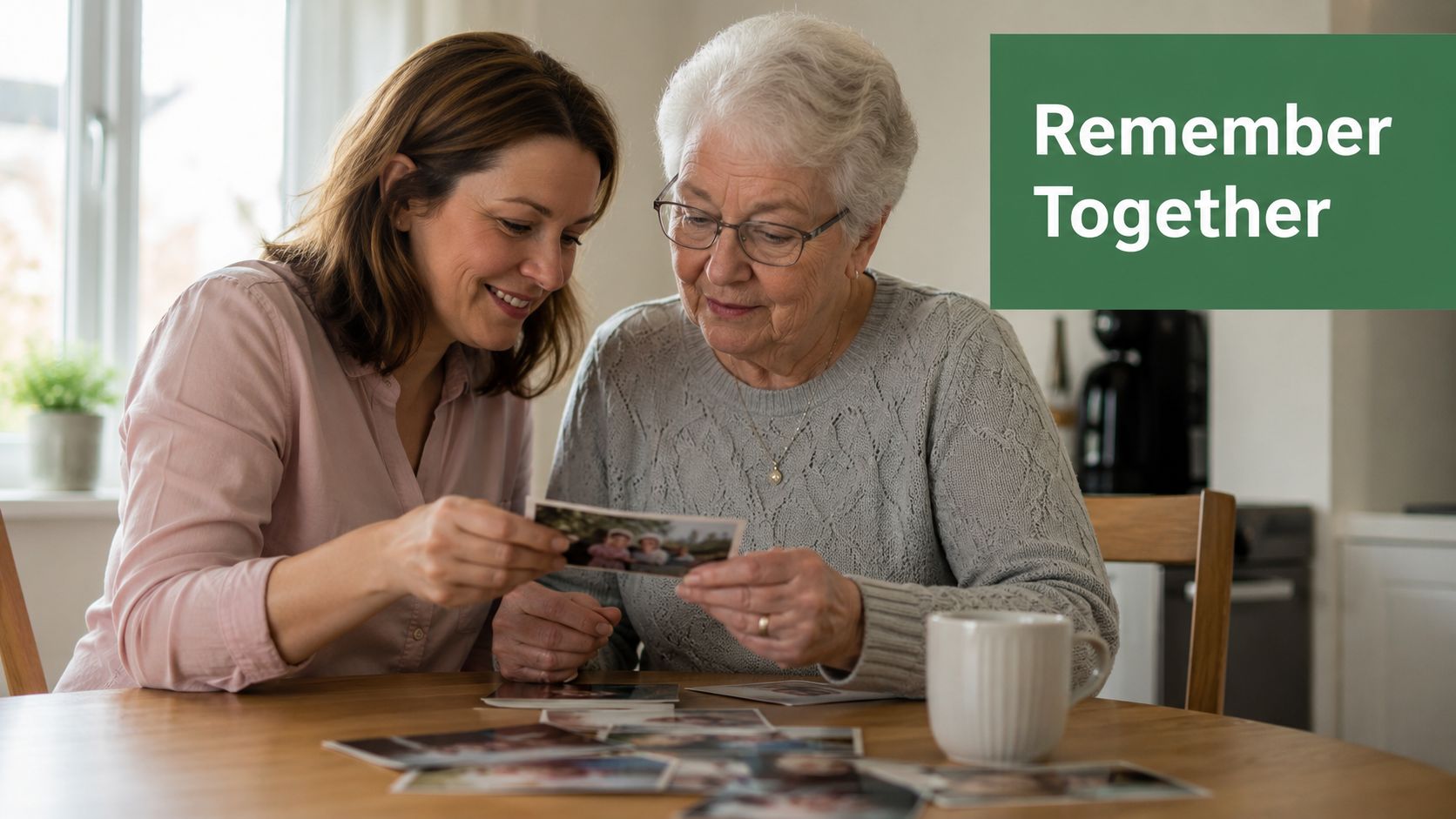
Reminiscence therapy works because many people with dementia can still access long-term memories more easily than recent ones. That makes it a useful starting point when a current-day conversation feels slippery or frustrating. A good session sounds less like an interview and more like a guided walk through a life story.
The most helpful prompts are specific and open ended. Ask about a first job, a favorite holiday, a family recipe, a neighborhood, or the music that marked a certain era. If the person served in a profession for years, a conversation about work pride, routines, or a meaningful project can bring out confidence and identity.
Why it works
A review of cognitive stimulation in dementia described sessions that often include discussion of past and present events, and that broader category is part of why reminiscence can be so effective in practice (Cochrane review on cognitive stimulation). Reminiscence also supports emotional continuity. When someone talks about a wedding, a favorite job, or the house they grew up in, you're not trying to force recall, you're protecting a sense of self.
For remote support, gather a little background before the call. Ask a spouse, adult child, or grandchild for a few anchor details, then use them gently. A phone-based prompt might sound like, “I heard you worked in manufacturing for many years. What part of the job did you feel most proud of?” That kind of question leaves room for story, not performance.
Practical rule: If a memory is inaccurate but emotionally true, don't correct it unless safety is involved. The emotional connection matters more than factual precision in this setting.
Phone-based prompt script
Start with a calm, familiar entry point. “I'd love to hear about a meal you used to make for your family. What ingredients do you remember most?” If the person stalls, offer a narrow cue, such as “Was it something with chicken, soup, or baking?” Then let silence do some work.
A few practical tips keep the call supportive:
Use family details first. Ask relatives what topics usually bring a smile or steady attention.
Keep one theme per call. A single strong memory works better than five scattered prompts.
Write down useful details. Repeating names, places, and stories across calls helps continuity.
Watch for distress. If a topic turns painful, shift to a safer memory without arguing.
For a broader framework on life review conversations, see Velma's life review therapy guide.
2. Orientation to Reality
Orientation to reality gives the person steady, nonjudgmental cues about time, place, person, and routine. Used well, it can lower confusion and make the day feel more predictable. Used poorly, it can feel like an interrogation, which is exactly what families want to avoid.
The best version is woven into ordinary conversation. Instead of asking, “Do you know what day it is?” try, “It's Tuesday morning, and the weather looks cold today. We've got lunch after this call.” That sounds natural, but it still gives the brain important anchors.
What to say without sounding clinical
The opening of a call is a good place to repeat the basics. Current date, day of week, weather, next meal, medication timing, or a family visit all help build a familiar map of the day. A simple reminder like “Your daughter Maria is coming after dinner” can reduce repeated worry about who's arriving and when.
Some families find it useful to pair orientation with visible cues. A clock on the wall, a calendar at eye level, or a weather app on speakerphone can reinforce the same message from another angle. In early to mid stage dementia, that kind of repetition can reduce the fear that comes from not knowing what's next.
Practical rule: Orient early in the call, then return to the information only when needed. Repeating the same facts every minute can feel patronizing.
A phone-based check-in can follow a simple pattern:
Name the day and time. “It's Thursday afternoon.”
Mention a routine event. “You've got supper after we talk.”
Name one safety item. “Your pills are on the counter for 6 p.m.”
Connect to something familiar. “This is the same hour you usually rest.”
For family check-ins that use orientation and companionship together, Velma's daily check-in call framework fits this approach well. It's not about drilling facts. It's about reducing uncertainty, one calm cue at a time.
3. Cognitive Stimulation Therapy
Cognitive Stimulation Therapy, often shortened to CST, is one of the clearest examples of structured cognitive exercises for dementia with measurable outcomes. In the Cochrane review, CST and related cognitive stimulation approaches were typically delivered by trained staff in 45-minute sessions twice weekly, and the review found a small improvement in cognitive function with an SMD of 0.40 (Cochrane review on cognitive stimulation). That matters because it shows this isn't just “keeping busy,” it's a therapeutic category with a real evidence base.
CST works best when sessions are organized, social, and varied. A good session might include a topic like weather, food, music, or current events, then move into discussion, a word game, or a practical problem. The person isn't expected to be right all the time. The goal is active participation.
How to keep it structured at home
A home or phone-based version should still feel intentional. Start with one theme, one prompt, and one follow-up activity. If the theme is food, ask about a favorite meal, then shift to naming ingredients, then end with a practical question like, “What would you cook first if the groceries arrived?”
Short, repeatable routines usually work better than elaborate plans. For example, a weekly call might include a weather discussion, a song from the person's era, and a simple reasoning prompt. That mirrors the everyday mix of conversation and task practice used in formal cognitive stimulation programs.
A useful phone script sounds like this:
Warm start. “Let's talk about foods you've always liked.”
One prompt. “What did Sunday dinner usually include?”
One extension. “Which ingredient took the longest to prepare?”
One closer. “That sounds like a meal people looked forward to.”
The reason CST matters for caregivers is practical. It supports the idea that cognitively engaging conversation can be therapeutic, not just social support. That's especially helpful when a loved one's attention drifts easily or when a family needs a repeatable model for remote support. A structured call can be easier to sustain than a long, open-ended visit, and that consistency often matters more than novelty.
4. Memory Strategy Training and External Aids
Some memory loss can't be trained away, so the smartest approach is often compensation. Memory strategy training teaches the person to lean on routines, written cues, and environmental supports instead of trying to remember everything internally. That keeps independence intact longer, especially for daily tasks.
External aids do a lot of heavy lifting. Calendars, labeled drawers, pill organizers, photo contact lists, and posted schedules can reduce the number of decisions the person has to hold in mind at once. The point is not to turn the home into a clinic. It's to make the right cue appear exactly where it's needed.
An image helps here because visual reminders are often easier to use than verbal instructions alone.

Build aids into the routine
Start with the task that causes the most trouble. If the person forgets medications, a labeled organizer and a daily check-off sheet can work better than repeated verbal reminders alone. If the problem is missed appointments, a large calendar with color coding and a fixed place near the phone is usually more effective than a calendar buried in a drawer.
One internal resource that fits this topic is Velma's medication reminder guide for seniors with memory loss. The same principle applies whether the reminder comes from a caregiver, a note, or a call, consistency beats intensity.
Practical rule: Use the same cue in the same place every time. Memory support fails when each caregiver improvises a different method.
A useful routine might look like this:
Morning: Check today's schedule and medications.
Midday: Confirm meals and appointments.
Evening: Review tomorrow's first task and safety items.
Ongoing: Keep labels large, plain, and easy to see.
It also helps to pair written support with verbal reinforcement. If a note says “Turn off the stove,” say it aloud while the person is standing near the kitchen. If a drawer is labeled “socks,” open it together the first few times. That repetition builds recognition, which is often easier to preserve than recall.
5. Language and Verbal Expression Activities
Language activities are more than word games. They keep the person using vocabulary, conversation flow, and comprehension in ways that still feel social. For many families, this is the most satisfying category because it can sound like ordinary conversation while still supporting cognition.
The trick is to reduce pressure. If someone can't retrieve a word quickly, give a clue instead of a correction. If they wander off topic, follow the thread if it still makes sense. Confidence often matters as much as accuracy.
Use cues, not pressure
Good language prompts are concrete and familiar. Ask the person to name animals, foods, or places, or invite them to finish a story about a trip, a holiday, or a childhood routine. You can also use description tasks, like “Tell me what your favorite chair looks like,” which supports both word retrieval and sustained attention.
The tone should stay warm and unhurried. Leave space for processing, and don't jump in too quickly. A pause is not failure. It's often the moment when a word is about to surface.
Here are a few practical ways to keep language work useful:
Use categories the person knows well. Food, music, pets, neighborhoods, and hobbies are easier than abstract subjects.
Accept partial answers. A description can still be valuable even if the exact word never comes.
Repeat back key phrases. That helps the person hear their own thought more clearly.
Stay on interest-rich topics. Personal relevance keeps people engaged longer.
A phone-based script can stay simple: “Tell me about a meal you loved making, and I'll ask about the ingredients.” If the person says, “I can't think of it,” offer a cue like “Was it baked, stirred, or fried?” That kind of support keeps the exchange moving without making it feel like a test.
Language work tends to go best when the caregiver speaks plainly too. Short sentences, one question at a time, and a steady pace all help. The more natural the conversation feels, the more likely the person is to stay with it.
6. Structured Problem-Solving and Decision-Making Activities
Problem-solving exercises help preserve executive function, the part of thinking that handles planning, judgment, and practical choices. In early to mid stage dementia, this can support real-life tasks like choosing clothes, checking whether medication was taken, or deciding what to make for lunch. The activity only works if it feels safe enough to think through, not so hard that it becomes embarrassing.
Start with concrete situations from daily life. If the weather is cold, ask what to wear. If lunch is approaching, ask what can be made from the food already in the kitchen. Those questions are easier to answer because the person can see the problem in front of them.
Keep the scenario concrete
A good facilitator doesn't rush to fix the problem. They guide the person through a few possible options, then help weigh them. That makes the exercise useful for both cognition and confidence. The person gets to practice choosing, not just receiving instructions.
A phone-based version might sound like this:
“Your appointment is this afternoon. What would help you be ready on time?”
If the person says, “I don't know,” follow with, “Would it help to check the calendar, gather your coat, or ask someone to set out the papers?”
This approach is especially helpful because some real-world decisions can't wait for a formal appointment. Small, repeated problem-solving moments build a habit of checking, comparing, and choosing. That's far more useful than abstract puzzles that don't connect to daily life.
Practical rule: Keep the decision small enough that success is possible. If the choice has too many moving parts, break it into the first step only.
Useful examples include:
Medication checks. “What would you do if you weren't sure whether you already took a dose?”
Visitor calls. “What's the safest way to answer if the phone rings from an unknown number?”
Meal planning. “What could we make with eggs, bread, and fruit?”
Clothing choices. “What works best for rain and cold?”
The value here is not perfect answers. It's watching how the person reasons, where they get stuck, and what type of support helps most. That information can guide care planning and reduce friction later.
7. Validation Therapy and Emotional Processing
Validation therapy begins with a simple habit, believe the feeling even when you can't confirm the fact. If a person says they want to go home while sitting in their own living room, the goal isn't to prove them wrong. The goal is to understand what “home” means in that moment, safety, familiarity, belonging, or relief.
This approach often lowers distress faster than correction. When someone is scared, correcting the timeline rarely helps. Responding to the emotion usually does.
Lead with emotion, not correction
If a spouse has passed away and the person asks for them, answer the feeling underneath the question. “You miss them a lot. Tell me about what you loved doing together.” That keeps the conversation human and avoids a painful argument about reality. It also preserves dignity, which matters every time confusion shows up.
The same principle works when someone is anxious about a child's late arrival or upset by a strange setting. Start with reassurance, then offer one comforting next step. A calm voice, eye contact, and a steady pace often do more than a lecture ever will.
A few simple responses help:
Name the feeling. “You seem worried.”
Acknowledge the need. “You want to feel safe.”
Offer a bridge. “Let's sit together while we wait.”
Redirect gently. “Would you like to hear that song you like?”
Remote support can be surprisingly effective. A phone call gives a person a familiar voice, and familiar voices can lower agitation when the day feels confusing. The call doesn't need to solve the whole emotional problem. It just needs to steady the moment.
7-Point Comparison: Cognitive Exercises for Dementia
Approach | Implementation complexity 🔄 | Resource requirements ⚡ | Expected outcomes ⭐📊 | Ideal use cases 💡 | Key advantages |
|---|---|---|---|---|---|
Reminiscence Therapy | Low–Moderate; guided conversation with some preparation | Low; phone, memories, optional photos/music | ⭐ Improved mood, identity preservation; 📊 variable cognitive benefit | Early–mid dementia; phone-based social engagement, family calls | Builds on preserved long-term memory; minimal tech; strengthens bonds |
Orientation to Reality (Reality Orientation) | Moderate; requires consistent, repeated cues and coordination | Low–Moderate; calendars/clocks, trained staff for consistency | ⭐ Reduces confusion/anxiety; 📊 improves safety and routine adherence | Early–mid stage with disorientation; safety-focused check-ins | Predictability reduces fear; supports daily decision-making |
Cognitive Stimulation Therapy (CST) | High; structured session plans and facilitator training required | Moderate–High; trained facilitators, materials, regular sessions | ⭐ Evidence-based cognitive gains; 📊 slows decline and boosts QoL | Early–mid stage with ability to participate; group or individual programs | Research-supported; measurable cognitive and mood improvements |
Memory Strategy Training & External Aids | Moderate; individualized planning and caregiver coordination | Low–Moderate; calendars, pill organizers, labels, caregiver time | ⭐ Increases independence; 📊 reduces missed meds/appointments | Practical support needs (medication, routines, safety) | Immediate functional impact; preserves dignity; customizable |
Language & Verbal Expression Activities | Moderate; skilled facilitation to avoid frustration or condescension | Low; phone-friendly prompts, word games, minimal materials | ⭐ Maintains communication skills; 📊 improves confidence and social connection | Those with word-finding decline who can engage in conversation | Naturally fits phone model; supports emotional expression |
Structured Problem-Solving & Decision-Making | High; requires assessment, scaffolding, and safety oversight | Moderate; trained facilitators, time for multi-step tasks | ⭐ Preserves executive function; 📊 supports independent daily decisions | Individuals needing help with daily decisions and planning | Practical, autonomy-supporting; identifies support/safety gaps |
Validation Therapy & Emotional Processing | Moderate; needs training and authentic empathetic skill | Low–Moderate; time-intensive, minimal materials | ⭐ Reduces distress/agitation; 📊 strengthens trust and emotional well‑being | Individuals with anxiety/agitation or when reality orientation harms | Preserves dignity; effective emotional regulation; reduces caregiver stress |
Making Cognitive Engagement a Consistent Practice
The strongest cognitive exercises for dementia are the ones a person will accept again tomorrow. That usually means starting with familiar topics, keeping the routine predictable, and adjusting the difficulty to fit the day, not the diagnosis label. A person might do well with reminiscence one day, then need validation and reassurance the next. That isn't inconsistency, it's dementia care.
Keep the focus on participation, not performance. A short call about family photos, a brief orientation to the day, or a guided decision about lunch can all count as meaningful cognitive work if the person is engaged. The evidence base for cognitive stimulation supports structured, repeatable contact, and the practical lesson is clear, gentle repetition works better than one-off effort (Cochrane review on cognitive stimulation).
Families often do best when they treat these exercises like part of daily care rather than an extra project. One person can manage reminiscence, another can handle calendar cues, and a caregiver can keep the external aids in place. The more consistent the handoff, the easier it is for the person with dementia to recognize the pattern and settle into it.
Phone-based support can be especially useful when the family lives far away, when in-person visits are uneven, or when a person is more comfortable talking than using devices. Velma is one example of a phone-based cognitive support program built around scheduled calls, structured conversation, and cognitive engagement for older adults with memory loss. For some families, that kind of regular contact fills the gap between medical visits and day-to-day caregiving.
The best next step is simple. Choose one exercise that matches your loved one's current stage, then repeat it consistently for a week or two before adding anything else. If you want a structured phone-based option that blends conversation, memory cues, and routine check-ins, explore Velma and see whether a regular call schedule could fit your family's care plan.
You're standing in the kitchen, trying to think of something helpful to say, while your loved one repeats the same question for the third time. A calendar, a phone call, or a simple conversation can suddenly feel loaded with pressure. That's where cognitive exercises for dementia can help, not as a test, but as a way to create steadier moments of connection, attention, and calm.
The best activities are usually the ones that feel familiar, respectful, and doable in the person's current stage. Research-backed cognitive stimulation has shown small but measurable cognitive benefits in dementia, and it's often delivered in short, structured sessions that mix conversation, orientation, practical tasks, and guided prompts (Cochrane review on cognitive stimulation). The key is to match the exercise to the person, then keep the experience warm and low-pressure.
Table of Contents
1. Reminiscence Therapy
Why it works
Phone-based prompt script
2. Orientation to Reality
What to say without sounding clinical
3. Cognitive Stimulation Therapy
How to keep it structured at home
4. Memory Strategy Training and External Aids
Build aids into the routine
5. Language and Verbal Expression Activities
Use cues, not pressure
6. Structured Problem-Solving and Decision-Making Activities
Keep the scenario concrete
7. Validation Therapy and Emotional Processing
Lead with emotion, not correction
7-Point Comparison: Cognitive Exercises for Dementia
Making Cognitive Engagement a Consistent Practice
1. Reminiscence Therapy
Reminiscence therapy works because many people with dementia can still access long-term memories more easily than recent ones. That makes it a useful starting point when a current-day conversation feels slippery or frustrating. A good session sounds less like an interview and more like a guided walk through a life story.
The most helpful prompts are specific and open ended. Ask about a first job, a favorite holiday, a family recipe, a neighborhood, or the music that marked a certain era. If the person served in a profession for years, a conversation about work pride, routines, or a meaningful project can bring out confidence and identity.
Why it works
A review of cognitive stimulation in dementia described sessions that often include discussion of past and present events, and that broader category is part of why reminiscence can be so effective in practice (Cochrane review on cognitive stimulation). Reminiscence also supports emotional continuity. When someone talks about a wedding, a favorite job, or the house they grew up in, you're not trying to force recall, you're protecting a sense of self.
For remote support, gather a little background before the call. Ask a spouse, adult child, or grandchild for a few anchor details, then use them gently. A phone-based prompt might sound like, “I heard you worked in manufacturing for many years. What part of the job did you feel most proud of?” That kind of question leaves room for story, not performance.
Practical rule: If a memory is inaccurate but emotionally true, don't correct it unless safety is involved. The emotional connection matters more than factual precision in this setting.
Phone-based prompt script
Start with a calm, familiar entry point. “I'd love to hear about a meal you used to make for your family. What ingredients do you remember most?” If the person stalls, offer a narrow cue, such as “Was it something with chicken, soup, or baking?” Then let silence do some work.
A few practical tips keep the call supportive:
Use family details first. Ask relatives what topics usually bring a smile or steady attention.
Keep one theme per call. A single strong memory works better than five scattered prompts.
Write down useful details. Repeating names, places, and stories across calls helps continuity.
Watch for distress. If a topic turns painful, shift to a safer memory without arguing.
For a broader framework on life review conversations, see Velma's life review therapy guide.
2. Orientation to Reality
Orientation to reality gives the person steady, nonjudgmental cues about time, place, person, and routine. Used well, it can lower confusion and make the day feel more predictable. Used poorly, it can feel like an interrogation, which is exactly what families want to avoid.
The best version is woven into ordinary conversation. Instead of asking, “Do you know what day it is?” try, “It's Tuesday morning, and the weather looks cold today. We've got lunch after this call.” That sounds natural, but it still gives the brain important anchors.
What to say without sounding clinical
The opening of a call is a good place to repeat the basics. Current date, day of week, weather, next meal, medication timing, or a family visit all help build a familiar map of the day. A simple reminder like “Your daughter Maria is coming after dinner” can reduce repeated worry about who's arriving and when.
Some families find it useful to pair orientation with visible cues. A clock on the wall, a calendar at eye level, or a weather app on speakerphone can reinforce the same message from another angle. In early to mid stage dementia, that kind of repetition can reduce the fear that comes from not knowing what's next.
Practical rule: Orient early in the call, then return to the information only when needed. Repeating the same facts every minute can feel patronizing.
A phone-based check-in can follow a simple pattern:
Name the day and time. “It's Thursday afternoon.”
Mention a routine event. “You've got supper after we talk.”
Name one safety item. “Your pills are on the counter for 6 p.m.”
Connect to something familiar. “This is the same hour you usually rest.”
For family check-ins that use orientation and companionship together, Velma's daily check-in call framework fits this approach well. It's not about drilling facts. It's about reducing uncertainty, one calm cue at a time.
3. Cognitive Stimulation Therapy
Cognitive Stimulation Therapy, often shortened to CST, is one of the clearest examples of structured cognitive exercises for dementia with measurable outcomes. In the Cochrane review, CST and related cognitive stimulation approaches were typically delivered by trained staff in 45-minute sessions twice weekly, and the review found a small improvement in cognitive function with an SMD of 0.40 (Cochrane review on cognitive stimulation). That matters because it shows this isn't just “keeping busy,” it's a therapeutic category with a real evidence base.
CST works best when sessions are organized, social, and varied. A good session might include a topic like weather, food, music, or current events, then move into discussion, a word game, or a practical problem. The person isn't expected to be right all the time. The goal is active participation.
How to keep it structured at home
A home or phone-based version should still feel intentional. Start with one theme, one prompt, and one follow-up activity. If the theme is food, ask about a favorite meal, then shift to naming ingredients, then end with a practical question like, “What would you cook first if the groceries arrived?”
Short, repeatable routines usually work better than elaborate plans. For example, a weekly call might include a weather discussion, a song from the person's era, and a simple reasoning prompt. That mirrors the everyday mix of conversation and task practice used in formal cognitive stimulation programs.
A useful phone script sounds like this:
Warm start. “Let's talk about foods you've always liked.”
One prompt. “What did Sunday dinner usually include?”
One extension. “Which ingredient took the longest to prepare?”
One closer. “That sounds like a meal people looked forward to.”
The reason CST matters for caregivers is practical. It supports the idea that cognitively engaging conversation can be therapeutic, not just social support. That's especially helpful when a loved one's attention drifts easily or when a family needs a repeatable model for remote support. A structured call can be easier to sustain than a long, open-ended visit, and that consistency often matters more than novelty.
4. Memory Strategy Training and External Aids
Some memory loss can't be trained away, so the smartest approach is often compensation. Memory strategy training teaches the person to lean on routines, written cues, and environmental supports instead of trying to remember everything internally. That keeps independence intact longer, especially for daily tasks.
External aids do a lot of heavy lifting. Calendars, labeled drawers, pill organizers, photo contact lists, and posted schedules can reduce the number of decisions the person has to hold in mind at once. The point is not to turn the home into a clinic. It's to make the right cue appear exactly where it's needed.
An image helps here because visual reminders are often easier to use than verbal instructions alone.
Build aids into the routine
Start with the task that causes the most trouble. If the person forgets medications, a labeled organizer and a daily check-off sheet can work better than repeated verbal reminders alone. If the problem is missed appointments, a large calendar with color coding and a fixed place near the phone is usually more effective than a calendar buried in a drawer.
One internal resource that fits this topic is Velma's medication reminder guide for seniors with memory loss. The same principle applies whether the reminder comes from a caregiver, a note, or a call, consistency beats intensity.
Practical rule: Use the same cue in the same place every time. Memory support fails when each caregiver improvises a different method.
A useful routine might look like this:
Morning: Check today's schedule and medications.
Midday: Confirm meals and appointments.
Evening: Review tomorrow's first task and safety items.
Ongoing: Keep labels large, plain, and easy to see.
It also helps to pair written support with verbal reinforcement. If a note says “Turn off the stove,” say it aloud while the person is standing near the kitchen. If a drawer is labeled “socks,” open it together the first few times. That repetition builds recognition, which is often easier to preserve than recall.
5. Language and Verbal Expression Activities
Language activities are more than word games. They keep the person using vocabulary, conversation flow, and comprehension in ways that still feel social. For many families, this is the most satisfying category because it can sound like ordinary conversation while still supporting cognition.
The trick is to reduce pressure. If someone can't retrieve a word quickly, give a clue instead of a correction. If they wander off topic, follow the thread if it still makes sense. Confidence often matters as much as accuracy.
Use cues, not pressure
Good language prompts are concrete and familiar. Ask the person to name animals, foods, or places, or invite them to finish a story about a trip, a holiday, or a childhood routine. You can also use description tasks, like “Tell me what your favorite chair looks like,” which supports both word retrieval and sustained attention.
The tone should stay warm and unhurried. Leave space for processing, and don't jump in too quickly. A pause is not failure. It's often the moment when a word is about to surface.
Here are a few practical ways to keep language work useful:
Use categories the person knows well. Food, music, pets, neighborhoods, and hobbies are easier than abstract subjects.
Accept partial answers. A description can still be valuable even if the exact word never comes.
Repeat back key phrases. That helps the person hear their own thought more clearly.
Stay on interest-rich topics. Personal relevance keeps people engaged longer.
A phone-based script can stay simple: “Tell me about a meal you loved making, and I'll ask about the ingredients.” If the person says, “I can't think of it,” offer a cue like “Was it baked, stirred, or fried?” That kind of support keeps the exchange moving without making it feel like a test.
Language work tends to go best when the caregiver speaks plainly too. Short sentences, one question at a time, and a steady pace all help. The more natural the conversation feels, the more likely the person is to stay with it.
6. Structured Problem-Solving and Decision-Making Activities
Problem-solving exercises help preserve executive function, the part of thinking that handles planning, judgment, and practical choices. In early to mid stage dementia, this can support real-life tasks like choosing clothes, checking whether medication was taken, or deciding what to make for lunch. The activity only works if it feels safe enough to think through, not so hard that it becomes embarrassing.
Start with concrete situations from daily life. If the weather is cold, ask what to wear. If lunch is approaching, ask what can be made from the food already in the kitchen. Those questions are easier to answer because the person can see the problem in front of them.
Keep the scenario concrete
A good facilitator doesn't rush to fix the problem. They guide the person through a few possible options, then help weigh them. That makes the exercise useful for both cognition and confidence. The person gets to practice choosing, not just receiving instructions.
A phone-based version might sound like this:
“Your appointment is this afternoon. What would help you be ready on time?”
If the person says, “I don't know,” follow with, “Would it help to check the calendar, gather your coat, or ask someone to set out the papers?”
This approach is especially helpful because some real-world decisions can't wait for a formal appointment. Small, repeated problem-solving moments build a habit of checking, comparing, and choosing. That's far more useful than abstract puzzles that don't connect to daily life.
Practical rule: Keep the decision small enough that success is possible. If the choice has too many moving parts, break it into the first step only.
Useful examples include:
Medication checks. “What would you do if you weren't sure whether you already took a dose?”
Visitor calls. “What's the safest way to answer if the phone rings from an unknown number?”
Meal planning. “What could we make with eggs, bread, and fruit?”
Clothing choices. “What works best for rain and cold?”
The value here is not perfect answers. It's watching how the person reasons, where they get stuck, and what type of support helps most. That information can guide care planning and reduce friction later.
7. Validation Therapy and Emotional Processing
Validation therapy begins with a simple habit, believe the feeling even when you can't confirm the fact. If a person says they want to go home while sitting in their own living room, the goal isn't to prove them wrong. The goal is to understand what “home” means in that moment, safety, familiarity, belonging, or relief.
This approach often lowers distress faster than correction. When someone is scared, correcting the timeline rarely helps. Responding to the emotion usually does.
Lead with emotion, not correction
If a spouse has passed away and the person asks for them, answer the feeling underneath the question. “You miss them a lot. Tell me about what you loved doing together.” That keeps the conversation human and avoids a painful argument about reality. It also preserves dignity, which matters every time confusion shows up.
The same principle works when someone is anxious about a child's late arrival or upset by a strange setting. Start with reassurance, then offer one comforting next step. A calm voice, eye contact, and a steady pace often do more than a lecture ever will.
A few simple responses help:
Name the feeling. “You seem worried.”
Acknowledge the need. “You want to feel safe.”
Offer a bridge. “Let's sit together while we wait.”
Redirect gently. “Would you like to hear that song you like?”
Remote support can be surprisingly effective. A phone call gives a person a familiar voice, and familiar voices can lower agitation when the day feels confusing. The call doesn't need to solve the whole emotional problem. It just needs to steady the moment.
7-Point Comparison: Cognitive Exercises for Dementia
Approach | Implementation complexity 🔄 | Resource requirements ⚡ | Expected outcomes ⭐📊 | Ideal use cases 💡 | Key advantages |
|---|---|---|---|---|---|
Reminiscence Therapy | Low–Moderate; guided conversation with some preparation | Low; phone, memories, optional photos/music | ⭐ Improved mood, identity preservation; 📊 variable cognitive benefit | Early–mid dementia; phone-based social engagement, family calls | Builds on preserved long-term memory; minimal tech; strengthens bonds |
Orientation to Reality (Reality Orientation) | Moderate; requires consistent, repeated cues and coordination | Low–Moderate; calendars/clocks, trained staff for consistency | ⭐ Reduces confusion/anxiety; 📊 improves safety and routine adherence | Early–mid stage with disorientation; safety-focused check-ins | Predictability reduces fear; supports daily decision-making |
Cognitive Stimulation Therapy (CST) | High; structured session plans and facilitator training required | Moderate–High; trained facilitators, materials, regular sessions | ⭐ Evidence-based cognitive gains; 📊 slows decline and boosts QoL | Early–mid stage with ability to participate; group or individual programs | Research-supported; measurable cognitive and mood improvements |
Memory Strategy Training & External Aids | Moderate; individualized planning and caregiver coordination | Low–Moderate; calendars, pill organizers, labels, caregiver time | ⭐ Increases independence; 📊 reduces missed meds/appointments | Practical support needs (medication, routines, safety) | Immediate functional impact; preserves dignity; customizable |
Language & Verbal Expression Activities | Moderate; skilled facilitation to avoid frustration or condescension | Low; phone-friendly prompts, word games, minimal materials | ⭐ Maintains communication skills; 📊 improves confidence and social connection | Those with word-finding decline who can engage in conversation | Naturally fits phone model; supports emotional expression |
Structured Problem-Solving & Decision-Making | High; requires assessment, scaffolding, and safety oversight | Moderate; trained facilitators, time for multi-step tasks | ⭐ Preserves executive function; 📊 supports independent daily decisions | Individuals needing help with daily decisions and planning | Practical, autonomy-supporting; identifies support/safety gaps |
Validation Therapy & Emotional Processing | Moderate; needs training and authentic empathetic skill | Low–Moderate; time-intensive, minimal materials | ⭐ Reduces distress/agitation; 📊 strengthens trust and emotional well‑being | Individuals with anxiety/agitation or when reality orientation harms | Preserves dignity; effective emotional regulation; reduces caregiver stress |
Making Cognitive Engagement a Consistent Practice
The strongest cognitive exercises for dementia are the ones a person will accept again tomorrow. That usually means starting with familiar topics, keeping the routine predictable, and adjusting the difficulty to fit the day, not the diagnosis label. A person might do well with reminiscence one day, then need validation and reassurance the next. That isn't inconsistency, it's dementia care.
Keep the focus on participation, not performance. A short call about family photos, a brief orientation to the day, or a guided decision about lunch can all count as meaningful cognitive work if the person is engaged. The evidence base for cognitive stimulation supports structured, repeatable contact, and the practical lesson is clear, gentle repetition works better than one-off effort (Cochrane review on cognitive stimulation).
Families often do best when they treat these exercises like part of daily care rather than an extra project. One person can manage reminiscence, another can handle calendar cues, and a caregiver can keep the external aids in place. The more consistent the handoff, the easier it is for the person with dementia to recognize the pattern and settle into it.
Phone-based support can be especially useful when the family lives far away, when in-person visits are uneven, or when a person is more comfortable talking than using devices. Velma is one example of a phone-based cognitive support program built around scheduled calls, structured conversation, and cognitive engagement for older adults with memory loss. For some families, that kind of regular contact fills the gap between medical visits and day-to-day caregiving.
The best next step is simple. Choose one exercise that matches your loved one's current stage, then repeat it consistently for a week or two before adding anything else. If you want a structured phone-based option that blends conversation, memory cues, and routine check-ins, explore Velma and see whether a regular call schedule could fit your family's care plan.
Suggested Article: