Silver Tsunami Statistics: What Families Should Know in 2026

In 2020, the U.S. already had 55.8 million people age 65 and older, and that group made up 16.8% of the population, up from 40.3 million in 2010 (Investopedia). That isn't a distant demographic trend. It's the population shift behind the everyday decisions families are making right now about who checks in, who drives, who manages medications, and who notices when a parent starts missing details.
The phrase silver tsunami statistics can sound abstract until you translate it into household reality. National averages tell you how big the wave is, but they don't tell you where the pressure lands first, which families are most exposed, or why some older adults have help around them while others are effectively on their own. That gap matters because the same aging trend can look very different in a two-adult household with nearby relatives than it does for a widow living alone in a rural area with long gaps between visits.
Families usually do not need more broad headlines. They need a clear way to read the numbers as risk signals. The sections below focus on what the data says about scale, where care demand concentrates, how dementia and caregiving needs rise together, and what practical support looks like when a loved one needs more consistency than an occasional phone call can provide.
Table of Contents
Why Silver Tsunami Statistics Matter to Families Now
The family question behind the national headline
What readers should watch for at home
The Demographic Shift Behind the Silver Tsunami
Why the acceleration matters more than the label
Why sustained inflow creates family strain
Where the Pressure Will Land First
Why living arrangement changes the risk
Geography can make ordinary care harder
Dementia Prevalence and the Caregiving Demand Wave
Dementia turns demographics into daily labor
Families become the default care infrastructure
Economic and Healthcare Impacts of an Aging Population
Costs show up in more than one place
Labor pressure makes every hour more valuable
The hidden cost is coordination
Practical Takeaways for Family Caregivers and Care Providers
Start with the home setup
Make support predictable
Use tools that match the care gap
Give caregivers a lighter load
Looking Ahead What the Next Decade of Aging Will Demand
Why Silver Tsunami Statistics Matter to Families Now
The value of silver tsunami statistics is not that they predict a single crisis. It's that they show how many families will be dealing with slow, compounding decisions at the same time. When the older-adult population expands this quickly, the ordinary support systems that used to feel adequate, a spouse, an adult child nearby, a neighbor who notices changes, can become thinner than families expect.
The family question behind the national headline
Most coverage stops at the headline that more Americans are aging into retirement. That is useful, but incomplete. The harder question is who absorbs the strain first, the older adult who lives alone, the adult child who lives hours away, or the family member already balancing work and caregiving.
Averages hide unequal access to help. An older adult with nearby relatives can often rely on informal support for transportation, reminders, and safety checks. Someone without that network can't. That's why the practical issue is not just how many older adults there are, but how many of them are aging with limited local support.
Practical rule: if the plan depends on one person remembering everything, it's already fragile.
Families should use the data as a screening tool, not a countdown clock. The point is to ask earlier whether a loved one needs daily touchpoints, whether the household is set up for safe aging at home, and whether the care load is already too concentrated on one exhausted person. A calm, evidence-led approach works better than waiting for a crisis to reveal the gaps.
What readers should watch for at home
Three patterns matter most. First, older adults who live alone are more likely to need structured check-ins. Second, households with limited caregiver availability need a backup plan before a fall, confusion episode, or missed medication becomes urgent. Third, rural access challenges can leave families with fewer local options and longer delays in getting support.
The data in this article is meant to help families answer those questions before the system is under even more pressure. That is where good planning starts, not with fear, but with a clearer picture of who needs help and how often they need it.
The Demographic Shift Behind the Silver Tsunami
The long view shows why this is more than a routine population change. In 1940, Americans age 65 and older made up less than 7% of the population. By 2020, that share had climbed to nearly 17%, and there were 55.8 million Americans in that age group (Investopedia). That shift changes the baseline for healthcare, housing, caregiving, and family planning.
Why the acceleration matters more than the label
The point is not only that the older population is larger now. Growth accelerated sharply in one decade. From 2010 to 2020, the 65+ population rose from 40.3 million to 55.8 million, a 38.6% increase (Investopedia). That makes the change feel less like a slow drift and more like a sustained wave moving through the system.
A historical trend that more than doubles the older-adult share over several decades creates pressure on ordinary family routines. More households have to coordinate prescriptions, mobility limits, cognitive changes, and transportation. Fewer adult children can assume that a parent's needs are rare or temporary.
U.S. Population Aged 65 and Older Over Time | ||
|---|---|---|
Year | 65+ Population | Share of Total Population |
1940 | Not provided in verified data | Less than 7% |
2010 | 40.3 million | Not provided in verified data |
2020 | 55.8 million | 16.8% |
The next marker is the projected 2030 crossing point, when all baby boomers will be older than 65 and the 65+ population is expected to reach about 74 million, nearly double the 2010 level (Mauldin Insurance Group). Families should treat this as a decade-scale transition, not a one-time peak. New retirees enter the system every year.
Why sustained inflow creates family strain
One estimate says about 3.5 million Americans are turning 65 each year during the peak baby-boomer retirement years (Mauldin Insurance Group). That matters because it signals continuing demand for care coordination, not a brief surge that fades on its own.
For families, the conclusion is straightforward. The next several years are not about reacting to a single event. They are about managing a long run of change, where more relatives will need help at once and the usual backup layers may not be there when they are needed.
Where the Pressure Will Land First
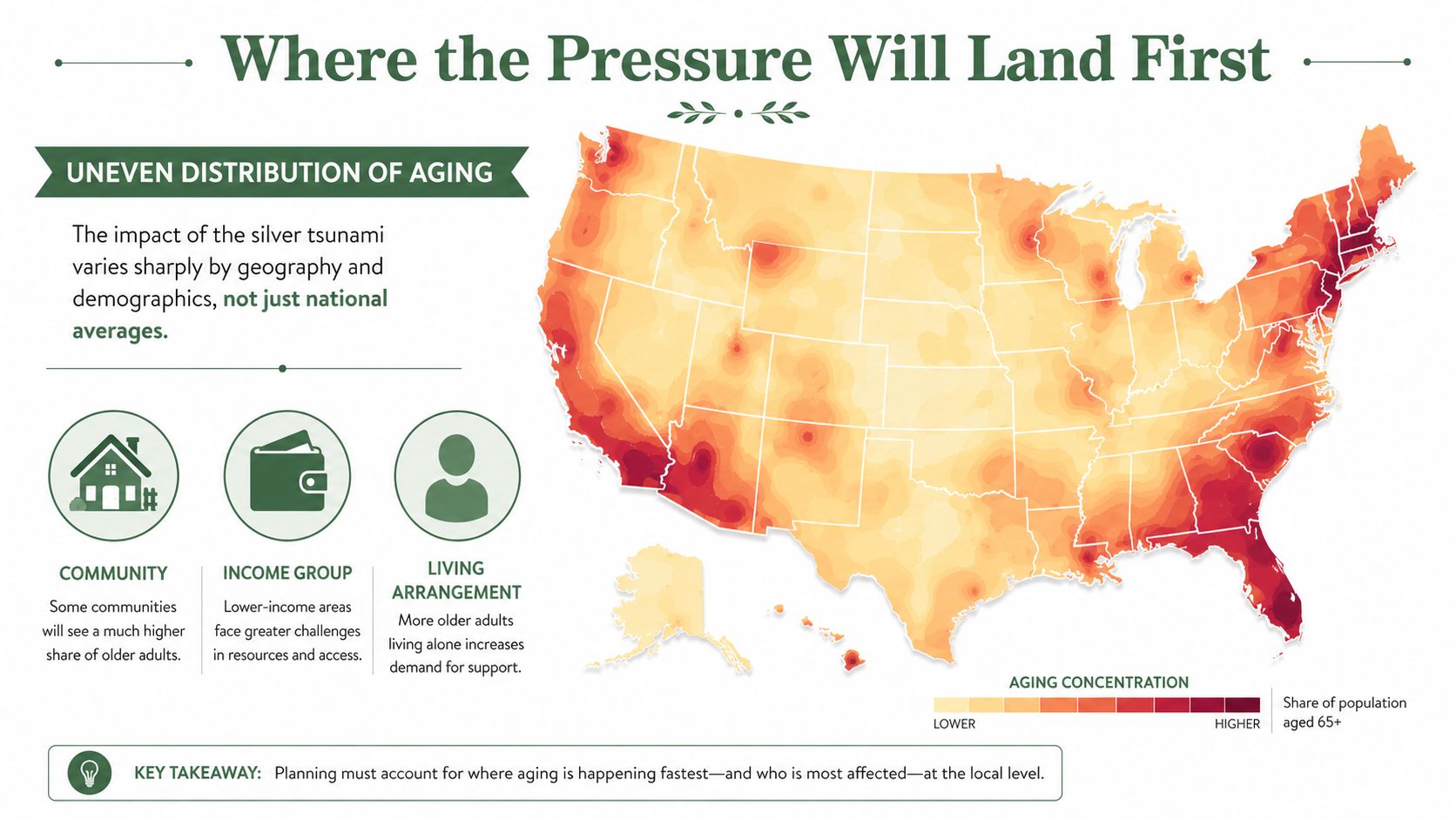
The national share of older adults is rising, but the practical pressure doesn't spread evenly. One overview notes that people age 65 and older were about 18.6% of the U.S. population in 2025 and are projected to reach 20.7% by 2030 (AllThrive 365). That matters less as a standalone figure than as a signal that the burden will concentrate in specific households first.
Why living arrangement changes the risk
Older adults living alone are usually the first group families should examine. They're the most exposed to missed medications, delayed responses to confusion, and long stretches without anyone noticing small changes. A spouse or adult child can often absorb some of that work, but solo living removes the easiest layer of informal protection.
The same is true for families with limited local support. If the nearest caregiver works full time, lives in another city, or is already stretched thin, the gap between “doing fine” and “needs help” can widen quickly. That is why broad national averages are not enough. They don't tell you whether a specific household has enough people nearby to notice when something changes.
Geography can make ordinary care harder
The difference between urban and rural access matters because it affects how quickly families can replace what they used to do informally. In urban areas, families may have more service options, but they can still run into waitlists and high coordination demands. In rural areas, the challenge is often distance, fewer local providers, and more reliance on family members who may have to travel.
Older-adult risk is not evenly distributed. The households with the least local backup feel the gap first.
The infographic on this section shows that the pressure is not just demographic, it's geographic and social. The house icon, the wallet icon, and the person icon all point to the same underlying reality. Community ties, income, and living arrangement all shape whether aging at home is manageable or fragile.
Families should use that lens on their own situation. If a loved one lives alone, has limited transportation, or depends on one primary helper, the pressure point is already visible. The issue is not whether the national average is rising. It's whether your household has enough real-world support to keep up with it.
Dementia Prevalence and the Caregiving Demand Wave
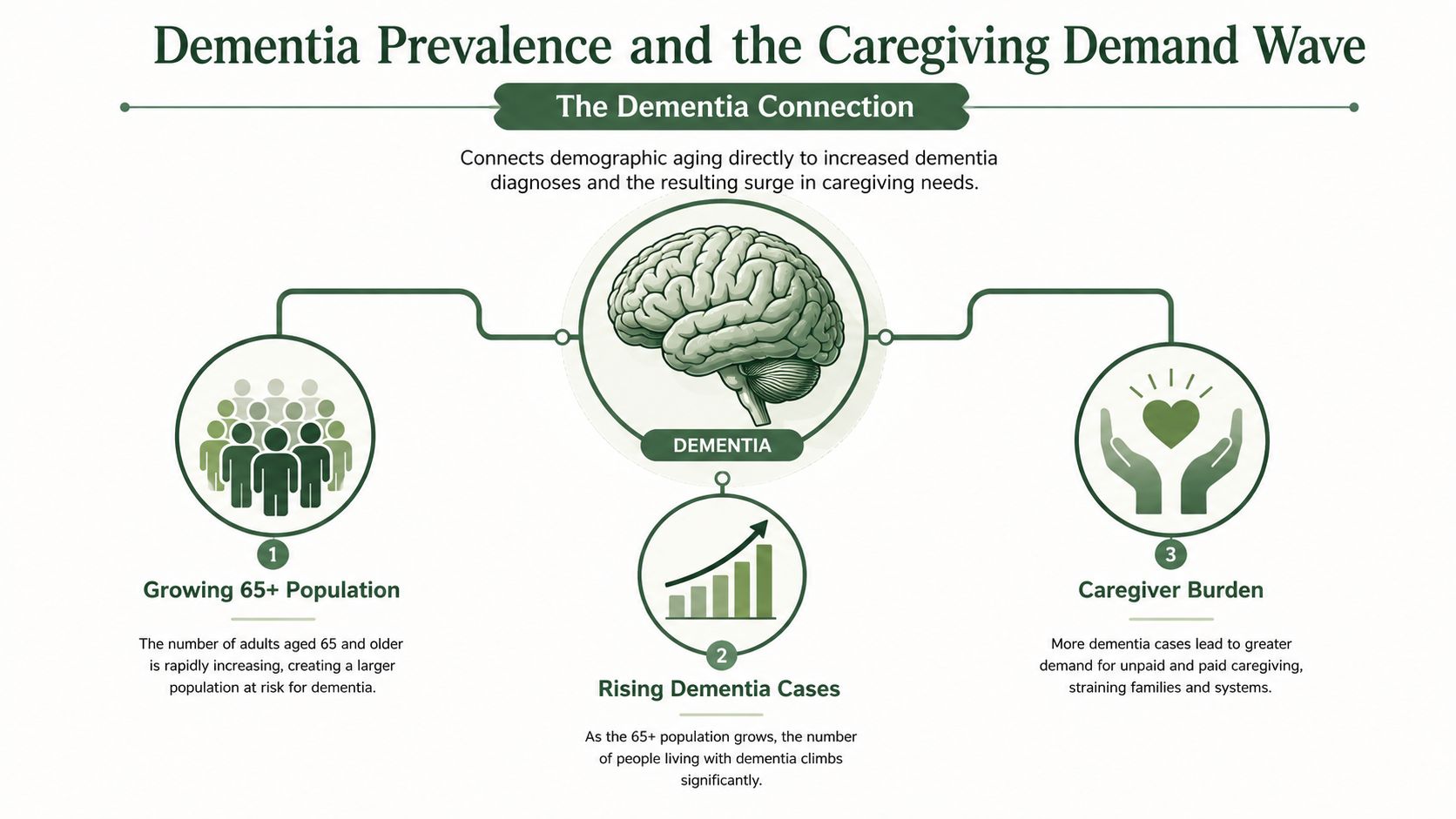
The aging wave matters most to families when it reaches memory loss. As the 65+ population grows, the number of households dealing with cognitive decline rises too, and that changes the shape of caregiving. Older adults with dementia often need repeated reminders, routine support, and calm oversight long before they need full-time institutional care.
Dementia turns demographics into daily labor
The connection is simple. More older adults means more families navigating memory-related changes. Those changes usually show up first in ordinary tasks, missed appointments, skipped meals, confusion about time, or repeated questions that signal a need for more structure.
That is why dementia care is rarely a single intervention. It becomes a series of small, repeated supports that make daily life safer and less stressful. The burden often lands on spouses, adult children, and care managers who are trying to preserve independence while reducing risk.
The video below reinforces that caregiving is not just about one crisis moment. It is about recognizing patterns early and building support around them.
Families become the default care infrastructure
Many families end up doing work that used to be spread across neighbors, clinics, and community programs. That includes reminders, companionship, medication prompts, and watchfulness for changes in mood or confusion. A useful overview of cognitive decline in older adults is available here, and it aligns with what families commonly see at home.
Caregiving reality: if support is only available when someone has time, it usually isn't reliable enough for memory loss.
The caregiving wave becomes a capacity problem. Not every family has the same bandwidth, and not every older adult has the same level of support. Some households can rotate tasks. Others rely on one person who is trying to hold together work, childcare, and elder care at the same time.
The practical takeaway is to treat caregiving as an evolving role, not a temporary interruption. When memory problems are present, families do better with repeated routines than with occasional heroics. That means building support into the week, not waiting for a rare emergency to show where the gaps are.
Economic and Healthcare Impacts of an Aging Population
The silver tsunami affects budgets as much as households. As Mauldin Insurance Group notes, the aging wave is linked to rising pressure on healthcare, senior housing, and caregiving systems in major markets. That pressure is not abstract. It changes who pays, who waits, and who leaves work early to help a parent.
Costs show up in more than one place
Families usually feel the direct costs first. Those include care services, housing adjustments, transportation, and the time spent coordinating appointments. The indirect costs can be just as important, especially when a caregiver has to miss work, reduce hours, or stay alert for long stretches.
The larger pattern is that aging shifts demand toward recurring services. Medicare-financed care, home support, and senior housing all absorb more attention when the older-adult population grows quickly. The result is a system that feels tighter even when nothing dramatic happens on a given day.
Labor pressure makes every hour more valuable
The labor side of aging is easy to miss because families usually experience it as delay. A call takes longer to return. A home care schedule is harder to set. A clinician has less time. These are all signs that the workforce is under strain, not just that demand is high.
The infographic here highlights the kinds of system stress families should expect to keep seeing. It ties together healthcare spending, care worker shortages, and the economic value of family caregiving. The point is not the exact chart shape. The point is that the same household that feels manageable today can become much harder to support once more families are competing for the same scarce help.
For a closer look at family fatigue and how it builds, see this guide on caregiver stress and burnout.
Specialized training also matters when the workload grows. A short guide to dementia care certification can help families and providers understand why memory care requires more than general caregiving experience.
The hidden cost is coordination
Aging creates more coordination work even before it creates more medical work. Someone has to remember the schedule, track changes, and notice when a loved one is drifting away from routine. That is why families often feel overloaded before the older adult's needs look severe on paper.
Useful rule of thumb: the more a plan depends on informal memory, the more expensive it becomes when life gets busy.
Velma fits into this gap as one option for phone-based cognitive support, with scheduled calls that combine conversation, cognitive exercises, reminders, and well-being check-ins for older adults experiencing memory loss. That kind of support does not replace family care or medical care, but it can reduce how much every task depends on one overextended person.
Practical Takeaways for Family Caregivers and Care Providers
The most useful response to silver tsunami statistics is not panic, it's routine. The data points to a future where more people need regular support, and where households with weak backup systems will feel the strain first. That makes small, repeatable actions more valuable than big but sporadic interventions.
Start with the home setup
Look first at the older adult's daily pattern. Is someone living alone with no reliable check-in? Are medications stored in a way that invites mistakes? Are appointments scattered across paper notes, phone reminders, and memory?
A short review of the environment can expose the biggest risks fast. Families should pay attention to the kitchen, the medication routine, and the times of day when confusion tends to appear. These are usually the first places where a missed detail turns into a bigger problem.
Make support predictable
Consistency matters more than intensity. A regular call at the same time, a medication reminder tied to an existing habit, or a weekly family update can stabilize a lot of uncertainty. Older adults with memory loss often do better when support feels routine rather than random.
The practical payoff is simple. Predictable contact makes it easier to notice a change in mood, appetite, or orientation. It also gives family members a steadier view of what's happening between in-person visits.
Use tools that match the care gap
Not every older adult needs the same kind of help. Some need transportation coordination. Others need a check-in that helps them stay oriented, supported, and emotionally connected. Phone-based services can work well for families who want low-friction support without asking an older adult to learn new technology.
If you're comparing options, look for services that combine conversation, reminders, and monitoring rather than just social contact. That combination is what helps families catch drift early, before a missed task becomes a safety issue.
Give caregivers a lighter load
Caregivers burn out when they become the only system holding everything together. One practical way to reduce that load is to divide responsibility into small pieces, one person handles appointments, another handles rides, another handles the weekly status call.
That structure also helps care providers. Home care agencies, care managers, and family coordinators all work better when they have a shared view of what matters most, safety, consistency, and changes in routine. The more visible the plan, the less likely a family is to miss a warning sign.
Looking Ahead What the Next Decade of Aging Will Demand
The next decade will not be defined by a single crisis point. It will be defined by a steady rise in the number of older adults, a continued move toward more households needing support, and a growing mismatch between what families need and what informal systems can reliably provide. The 2030 milestone of about 74 million Americans age 65 and older remains the clearest marker of that shift (Mauldin Insurance Group).
The families that handle this period best will be the ones that treat aging as a planning problem, not a surprise. They'll watch for solo living, thin caregiver coverage, and uneven local access, then build support before those gaps turn into emergencies. That approach is more durable than waiting for a major event to force a decision.
The same is true for providers. Care models that rely on occasional contact will struggle if demand keeps rising. Models that support regular check-ins, daily structure, and better visibility into what older adults are experiencing will be more useful as the wave continues.
The main lesson from the data is straightforward. Averages can tell you how big the silver tsunami is, but they can't tell you who needs help first. Families who read the numbers through the lens of living arrangement, caregiver availability, and access to local support are more likely to act early and stay ahead of the hardest part of the transition.
Velma helps older adults with memory loss through scheduled phone-based cognitive support, routine check-ins, and practical reminders that fit into daily life without requiring apps or new devices. If you're caring for a parent or spouse and want a steadier way to support independence, visit Velma to see how that kind of structured contact can fit into your care plan.
In 2020, the U.S. already had 55.8 million people age 65 and older, and that group made up 16.8% of the population, up from 40.3 million in 2010 (Investopedia). That isn't a distant demographic trend. It's the population shift behind the everyday decisions families are making right now about who checks in, who drives, who manages medications, and who notices when a parent starts missing details.
The phrase silver tsunami statistics can sound abstract until you translate it into household reality. National averages tell you how big the wave is, but they don't tell you where the pressure lands first, which families are most exposed, or why some older adults have help around them while others are effectively on their own. That gap matters because the same aging trend can look very different in a two-adult household with nearby relatives than it does for a widow living alone in a rural area with long gaps between visits.
Families usually do not need more broad headlines. They need a clear way to read the numbers as risk signals. The sections below focus on what the data says about scale, where care demand concentrates, how dementia and caregiving needs rise together, and what practical support looks like when a loved one needs more consistency than an occasional phone call can provide.
Table of Contents
Why Silver Tsunami Statistics Matter to Families Now
The family question behind the national headline
What readers should watch for at home
The Demographic Shift Behind the Silver Tsunami
Why the acceleration matters more than the label
Why sustained inflow creates family strain
Where the Pressure Will Land First
Why living arrangement changes the risk
Geography can make ordinary care harder
Dementia Prevalence and the Caregiving Demand Wave
Dementia turns demographics into daily labor
Families become the default care infrastructure
Economic and Healthcare Impacts of an Aging Population
Costs show up in more than one place
Labor pressure makes every hour more valuable
The hidden cost is coordination
Practical Takeaways for Family Caregivers and Care Providers
Start with the home setup
Make support predictable
Use tools that match the care gap
Give caregivers a lighter load
Looking Ahead What the Next Decade of Aging Will Demand
Why Silver Tsunami Statistics Matter to Families Now
The value of silver tsunami statistics is not that they predict a single crisis. It's that they show how many families will be dealing with slow, compounding decisions at the same time. When the older-adult population expands this quickly, the ordinary support systems that used to feel adequate, a spouse, an adult child nearby, a neighbor who notices changes, can become thinner than families expect.
The family question behind the national headline
Most coverage stops at the headline that more Americans are aging into retirement. That is useful, but incomplete. The harder question is who absorbs the strain first, the older adult who lives alone, the adult child who lives hours away, or the family member already balancing work and caregiving.
Averages hide unequal access to help. An older adult with nearby relatives can often rely on informal support for transportation, reminders, and safety checks. Someone without that network can't. That's why the practical issue is not just how many older adults there are, but how many of them are aging with limited local support.
Practical rule: if the plan depends on one person remembering everything, it's already fragile.
Families should use the data as a screening tool, not a countdown clock. The point is to ask earlier whether a loved one needs daily touchpoints, whether the household is set up for safe aging at home, and whether the care load is already too concentrated on one exhausted person. A calm, evidence-led approach works better than waiting for a crisis to reveal the gaps.
What readers should watch for at home
Three patterns matter most. First, older adults who live alone are more likely to need structured check-ins. Second, households with limited caregiver availability need a backup plan before a fall, confusion episode, or missed medication becomes urgent. Third, rural access challenges can leave families with fewer local options and longer delays in getting support.
The data in this article is meant to help families answer those questions before the system is under even more pressure. That is where good planning starts, not with fear, but with a clearer picture of who needs help and how often they need it.
The Demographic Shift Behind the Silver Tsunami
The long view shows why this is more than a routine population change. In 1940, Americans age 65 and older made up less than 7% of the population. By 2020, that share had climbed to nearly 17%, and there were 55.8 million Americans in that age group (Investopedia). That shift changes the baseline for healthcare, housing, caregiving, and family planning.
Why the acceleration matters more than the label
The point is not only that the older population is larger now. Growth accelerated sharply in one decade. From 2010 to 2020, the 65+ population rose from 40.3 million to 55.8 million, a 38.6% increase (Investopedia). That makes the change feel less like a slow drift and more like a sustained wave moving through the system.
A historical trend that more than doubles the older-adult share over several decades creates pressure on ordinary family routines. More households have to coordinate prescriptions, mobility limits, cognitive changes, and transportation. Fewer adult children can assume that a parent's needs are rare or temporary.
U.S. Population Aged 65 and Older Over Time | ||
|---|---|---|
Year | 65+ Population | Share of Total Population |
1940 | Not provided in verified data | Less than 7% |
2010 | 40.3 million | Not provided in verified data |
2020 | 55.8 million | 16.8% |
The next marker is the projected 2030 crossing point, when all baby boomers will be older than 65 and the 65+ population is expected to reach about 74 million, nearly double the 2010 level (Mauldin Insurance Group). Families should treat this as a decade-scale transition, not a one-time peak. New retirees enter the system every year.
Why sustained inflow creates family strain
One estimate says about 3.5 million Americans are turning 65 each year during the peak baby-boomer retirement years (Mauldin Insurance Group). That matters because it signals continuing demand for care coordination, not a brief surge that fades on its own.
For families, the conclusion is straightforward. The next several years are not about reacting to a single event. They are about managing a long run of change, where more relatives will need help at once and the usual backup layers may not be there when they are needed.
Where the Pressure Will Land First
The national share of older adults is rising, but the practical pressure doesn't spread evenly. One overview notes that people age 65 and older were about 18.6% of the U.S. population in 2025 and are projected to reach 20.7% by 2030 (AllThrive 365). That matters less as a standalone figure than as a signal that the burden will concentrate in specific households first.
Why living arrangement changes the risk
Older adults living alone are usually the first group families should examine. They're the most exposed to missed medications, delayed responses to confusion, and long stretches without anyone noticing small changes. A spouse or adult child can often absorb some of that work, but solo living removes the easiest layer of informal protection.
The same is true for families with limited local support. If the nearest caregiver works full time, lives in another city, or is already stretched thin, the gap between “doing fine” and “needs help” can widen quickly. That is why broad national averages are not enough. They don't tell you whether a specific household has enough people nearby to notice when something changes.
Geography can make ordinary care harder
The difference between urban and rural access matters because it affects how quickly families can replace what they used to do informally. In urban areas, families may have more service options, but they can still run into waitlists and high coordination demands. In rural areas, the challenge is often distance, fewer local providers, and more reliance on family members who may have to travel.
Older-adult risk is not evenly distributed. The households with the least local backup feel the gap first.
The infographic on this section shows that the pressure is not just demographic, it's geographic and social. The house icon, the wallet icon, and the person icon all point to the same underlying reality. Community ties, income, and living arrangement all shape whether aging at home is manageable or fragile.
Families should use that lens on their own situation. If a loved one lives alone, has limited transportation, or depends on one primary helper, the pressure point is already visible. The issue is not whether the national average is rising. It's whether your household has enough real-world support to keep up with it.
Dementia Prevalence and the Caregiving Demand Wave
The aging wave matters most to families when it reaches memory loss. As the 65+ population grows, the number of households dealing with cognitive decline rises too, and that changes the shape of caregiving. Older adults with dementia often need repeated reminders, routine support, and calm oversight long before they need full-time institutional care.
Dementia turns demographics into daily labor
The connection is simple. More older adults means more families navigating memory-related changes. Those changes usually show up first in ordinary tasks, missed appointments, skipped meals, confusion about time, or repeated questions that signal a need for more structure.
That is why dementia care is rarely a single intervention. It becomes a series of small, repeated supports that make daily life safer and less stressful. The burden often lands on spouses, adult children, and care managers who are trying to preserve independence while reducing risk.
The video below reinforces that caregiving is not just about one crisis moment. It is about recognizing patterns early and building support around them.
Families become the default care infrastructure
Many families end up doing work that used to be spread across neighbors, clinics, and community programs. That includes reminders, companionship, medication prompts, and watchfulness for changes in mood or confusion. A useful overview of cognitive decline in older adults is available here, and it aligns with what families commonly see at home.
Caregiving reality: if support is only available when someone has time, it usually isn't reliable enough for memory loss.
The caregiving wave becomes a capacity problem. Not every family has the same bandwidth, and not every older adult has the same level of support. Some households can rotate tasks. Others rely on one person who is trying to hold together work, childcare, and elder care at the same time.
The practical takeaway is to treat caregiving as an evolving role, not a temporary interruption. When memory problems are present, families do better with repeated routines than with occasional heroics. That means building support into the week, not waiting for a rare emergency to show where the gaps are.
Economic and Healthcare Impacts of an Aging Population
The silver tsunami affects budgets as much as households. As Mauldin Insurance Group notes, the aging wave is linked to rising pressure on healthcare, senior housing, and caregiving systems in major markets. That pressure is not abstract. It changes who pays, who waits, and who leaves work early to help a parent.
Costs show up in more than one place
Families usually feel the direct costs first. Those include care services, housing adjustments, transportation, and the time spent coordinating appointments. The indirect costs can be just as important, especially when a caregiver has to miss work, reduce hours, or stay alert for long stretches.
The larger pattern is that aging shifts demand toward recurring services. Medicare-financed care, home support, and senior housing all absorb more attention when the older-adult population grows quickly. The result is a system that feels tighter even when nothing dramatic happens on a given day.
Labor pressure makes every hour more valuable
The labor side of aging is easy to miss because families usually experience it as delay. A call takes longer to return. A home care schedule is harder to set. A clinician has less time. These are all signs that the workforce is under strain, not just that demand is high.
The infographic here highlights the kinds of system stress families should expect to keep seeing. It ties together healthcare spending, care worker shortages, and the economic value of family caregiving. The point is not the exact chart shape. The point is that the same household that feels manageable today can become much harder to support once more families are competing for the same scarce help.
For a closer look at family fatigue and how it builds, see this guide on caregiver stress and burnout.
Specialized training also matters when the workload grows. A short guide to dementia care certification can help families and providers understand why memory care requires more than general caregiving experience.
The hidden cost is coordination
Aging creates more coordination work even before it creates more medical work. Someone has to remember the schedule, track changes, and notice when a loved one is drifting away from routine. That is why families often feel overloaded before the older adult's needs look severe on paper.
Useful rule of thumb: the more a plan depends on informal memory, the more expensive it becomes when life gets busy.
Velma fits into this gap as one option for phone-based cognitive support, with scheduled calls that combine conversation, cognitive exercises, reminders, and well-being check-ins for older adults experiencing memory loss. That kind of support does not replace family care or medical care, but it can reduce how much every task depends on one overextended person.
Practical Takeaways for Family Caregivers and Care Providers
The most useful response to silver tsunami statistics is not panic, it's routine. The data points to a future where more people need regular support, and where households with weak backup systems will feel the strain first. That makes small, repeatable actions more valuable than big but sporadic interventions.
Start with the home setup
Look first at the older adult's daily pattern. Is someone living alone with no reliable check-in? Are medications stored in a way that invites mistakes? Are appointments scattered across paper notes, phone reminders, and memory?
A short review of the environment can expose the biggest risks fast. Families should pay attention to the kitchen, the medication routine, and the times of day when confusion tends to appear. These are usually the first places where a missed detail turns into a bigger problem.
Make support predictable
Consistency matters more than intensity. A regular call at the same time, a medication reminder tied to an existing habit, or a weekly family update can stabilize a lot of uncertainty. Older adults with memory loss often do better when support feels routine rather than random.
The practical payoff is simple. Predictable contact makes it easier to notice a change in mood, appetite, or orientation. It also gives family members a steadier view of what's happening between in-person visits.
Use tools that match the care gap
Not every older adult needs the same kind of help. Some need transportation coordination. Others need a check-in that helps them stay oriented, supported, and emotionally connected. Phone-based services can work well for families who want low-friction support without asking an older adult to learn new technology.
If you're comparing options, look for services that combine conversation, reminders, and monitoring rather than just social contact. That combination is what helps families catch drift early, before a missed task becomes a safety issue.
Give caregivers a lighter load
Caregivers burn out when they become the only system holding everything together. One practical way to reduce that load is to divide responsibility into small pieces, one person handles appointments, another handles rides, another handles the weekly status call.
That structure also helps care providers. Home care agencies, care managers, and family coordinators all work better when they have a shared view of what matters most, safety, consistency, and changes in routine. The more visible the plan, the less likely a family is to miss a warning sign.
Looking Ahead What the Next Decade of Aging Will Demand
The next decade will not be defined by a single crisis point. It will be defined by a steady rise in the number of older adults, a continued move toward more households needing support, and a growing mismatch between what families need and what informal systems can reliably provide. The 2030 milestone of about 74 million Americans age 65 and older remains the clearest marker of that shift (Mauldin Insurance Group).
The families that handle this period best will be the ones that treat aging as a planning problem, not a surprise. They'll watch for solo living, thin caregiver coverage, and uneven local access, then build support before those gaps turn into emergencies. That approach is more durable than waiting for a major event to force a decision.
The same is true for providers. Care models that rely on occasional contact will struggle if demand keeps rising. Models that support regular check-ins, daily structure, and better visibility into what older adults are experiencing will be more useful as the wave continues.
The main lesson from the data is straightforward. Averages can tell you how big the silver tsunami is, but they can't tell you who needs help first. Families who read the numbers through the lens of living arrangement, caregiver availability, and access to local support are more likely to act early and stay ahead of the hardest part of the transition.
Velma helps older adults with memory loss through scheduled phone-based cognitive support, routine check-ins, and practical reminders that fit into daily life without requiring apps or new devices. If you're caring for a parent or spouse and want a steadier way to support independence, visit Velma to see how that kind of structured contact can fit into your care plan.
Suggested Article: