Dementia Short Term Memory Loss: A Caregiver's Guide

You're probably reading this after a conversation that didn't go as expected. Someone you love asked the same question again, forgot a familiar name, or seemed fine one day and noticeably more confused the next. That kind of change can feel small at first, then suddenly it starts shaping the whole day.
Dementia short term memory loss is one of the most common reasons families begin to worry, because it shows up in ordinary moments. A missed appointment, a repeated story, or a bill that used to be routine can all be clues that something more than normal aging may be going on. The hard part is figuring out where that line sits in real life, not just in a clinic description.
Table of Contents
Recognizing Dementia Short Term Memory Loss in Daily Life
What families usually notice first
What Happens in the Brain During Short Term Memory Loss
Why the hippocampus matters so much
Why doctors look beyond memory alone
Normal Aging Versus Dementia Related Memory Changes
The pattern that raises concern
Signs that should move you from watching to acting
When to Seek Medical Evaluation and What to Expect
What to bring to the appointment
How to start the conversation
Daily Strategies for Supporting Someone with Memory Loss
Communication that lowers stress
Make the environment do part of the work
Keep the day predictable
Building a Support System Beyond Medical Visits
What structured phone support can add
Moving Forward with Confidence and Compassion
Recognizing Dementia Short Term Memory Loss in Daily Life
The first sign is often painfully ordinary. A mother asks where the grandchild's school forms went, then asks again ten minutes later. A husband who always handled errands forgets why he left the house, or a sister starts repeating the same story in one phone call, not because she's being careless, but because the new information didn't stick.
That pattern matters because dementia-related memory loss usually changes how someone handles recent information. The World Health Organization notes that Alzheimer's disease, the most common cause of dementia, commonly begins with memory complaints that affect episodic memory, language, and orientation, and it estimated more than 55 million people were living with dementia worldwide in 2023, with nearly 10 million new cases each year (WHO dementia fact sheet). Those numbers help explain why families are so often the first to notice something feels off in everyday life.
What families usually notice first
Short-term memory is the brain's ability to take in something recent, hold onto it, and use it a little later. When dementia begins to interfere, the problem often looks like this:
Repeated questions, even after a clear answer.
Missed appointments or forgotten plans that were just discussed.
Difficulty retaining new information, such as a new address, a medication change, or today's schedule.
Losing track of a task midstream, then seeming unsure how to restart it.
Practical rule: If the lapse keeps happening and it changes how daily life works, treat it as a pattern, not a one-off mistake.
A helpful way to think about it is this, normal forgetfulness usually comes with a later “oh right” moment. Dementia short term memory loss more often leaves the person without that recovery, or with a much weaker sense that anything was forgotten. For a family-oriented overview of common early warning patterns, see this guide on early signs of memory loss in aging parents.
The emotional part is real too. Families often feel torn between “maybe I'm overreacting” and “something is changing.” That uncertainty is exactly why watching the pattern over time matters more than judging any single incident.
What Happens in the Brain During Short Term Memory Loss
The brain does not store memory in one neat, isolated spot. In Alzheimer's disease, working memory and long-term declarative memory are affected early, so what families call “short-term memory loss” is often part of a wider breakdown in how the brain encodes and retrieves information (PMC review). A person may seem to follow the conversation in the moment, then lose the details almost immediately.
Why the hippocampus matters so much
The hippocampus functions as the brain's save button for new information. When it is working well, it helps move fresh experiences into a form the brain can store and use later. In Alzheimer's disease, hippocampal and cortical neuron degeneration and synapse loss drive brain atrophy and are closely tied to cognitive decline.
That matters in daily life because the problem is often not attention alone. The person may hear you, but the brain does not reliably hold the information long enough to use it later. Repeating the same reminder again and again can still fail if the underlying encoding process is compromised.
New learning is the fragile part. Repetition helps more than persuasion.
Why doctors look beyond memory alone
Short-term memory problems are not always caused by dementia. Some causes can be reversible, including hypothyroidism, vitamin deficiencies, depression, medications, alcohol use, head injury, and sleep apnea (Ohio State Health). StatPearls also notes that while memory loss from several treatable conditions can improve, most short-term memory loss is a feature of degenerative diseases such as Alzheimer disease (StatPearls).
That is why clinicians do not stop at “Can you remember three words?” They look for broader changes in attention, executive function, and judgment, because short-term memory damage is seldom selective. If planning, problem-solving, or safety awareness are changing too, the pattern becomes much more concerning. For a clearer guide to how the terms fit together, see the difference between Alzheimer's disease and dementia.
For families, the key takeaway is simple. When repeated cueing helps only briefly, and new information keeps slipping away, the issue is probably not ordinary distraction. The brain's system for holding onto new memories is being disrupted at a deeper level.
Normal Aging Versus Dementia Related Memory Changes

The hardest question families ask is whether they're seeing normal aging or something more serious. The answer usually comes from the pattern, not a single mistake. Occasional forgetfulness can happen in aging, but dementia becomes more likely when the changes are frequent, noticeable to others, and start interfering with independent functioning (IHS guidance).
The pattern that raises concern
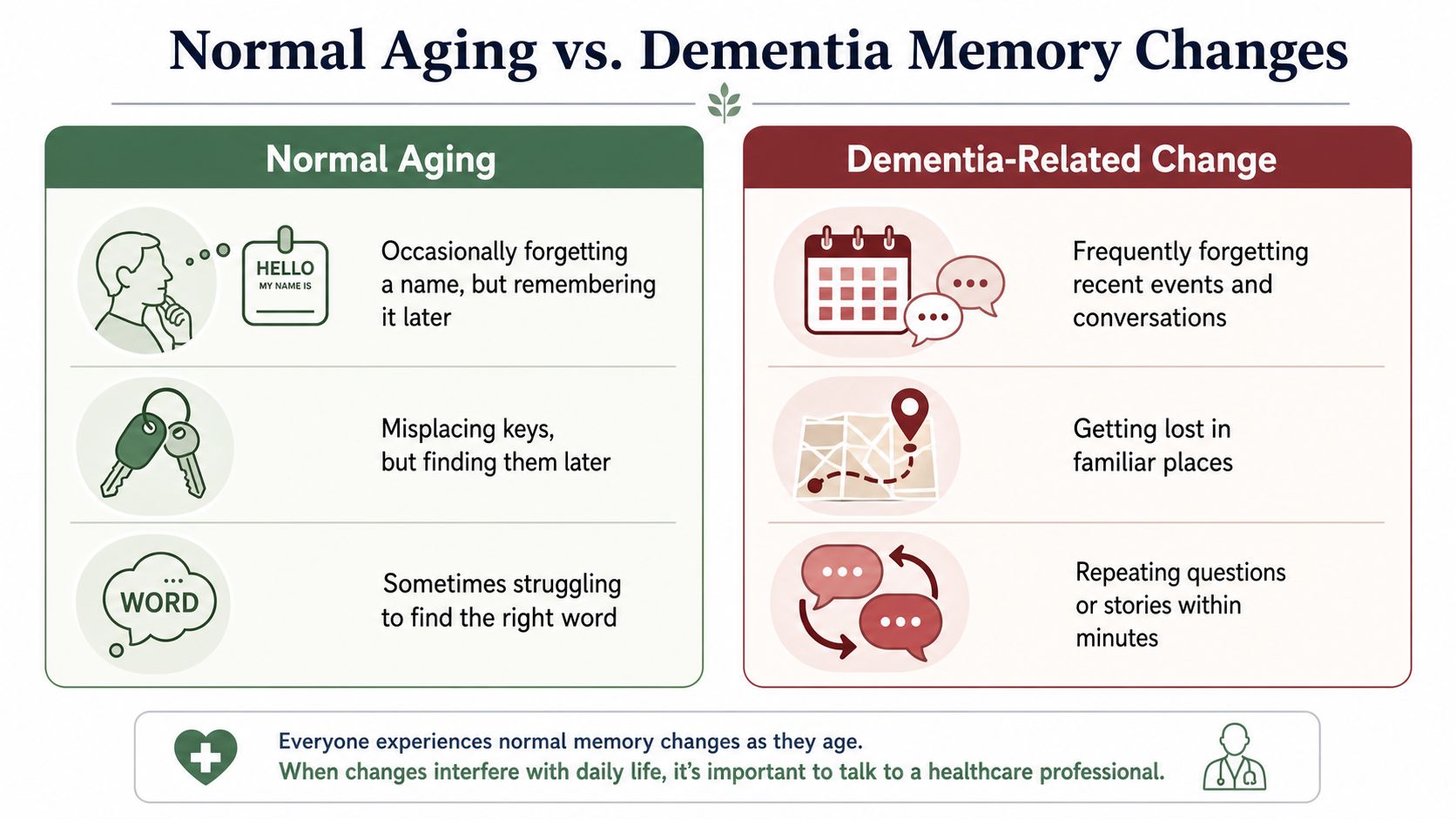
Normal aging can look like forgetting a name and remembering it later, misplacing keys, or needing a list to stay organized. Dementia-related change looks different. The person may forget an entire conversation, repeat a question within minutes, or lose track of why they entered a room.
The threshold becomes especially important when the change affects tasks that used to be routine. A person who once balanced bills without trouble may now make repeated mistakes. Someone who knew their way around a familiar store may start feeling lost or disoriented in places they've visited for years.
Signs that should move you from watching to acting
Repeated questions in a short period, especially if the answer was just given.
Disorientation in familiar places, including getting lost or unsure of surroundings.
Decline in complex tasks, like bills, medications, or following a recipe.
Changes other people notice, not just the person's own concern.
The National Institute on Aging notes that if memory problems from depression or other treatable conditions persist after a few weeks, medical evaluation is recommended, and people with memory problems should have follow-up memory checks every 6 to 12 months (StatPearls and NIA summary). That makes a real-world difference, because waiting for symptoms to “settle down” can waste time if the cause is progressive.
If you're still unsure, ask yourself one direct question. Is this a one-off lapse, or is it a repeatable pattern that is changing the person's daily independence? That answer is often the clearest signal.
If you want another family-focused explanation of how dementia differs from broader memory loss, this comparison of Alzheimer's disease vs. dementia can help make the language less confusing.
When to Seek Medical Evaluation and What to Expect
The right time to ask for help is before everyone is exhausted by guessing. Write down what happened, when it happened, and whether it affected safety, money, medications, driving, or appointments. A few specific examples are more useful than a general statement like “Mom seems forgetful.”
What to bring to the appointment
Keep the notes concrete.
Specific examples of memory lapses, such as repeated questions, missed bills, or confusion about recent events.
Frequency patterns, including how often it happens and whether it is getting worse.
Changes in daily functioning, such as trouble cooking, taking medication, or keeping track of time.
Behavior shifts, including agitation, withdrawal, or loss of confidence.
Good documentation makes the visit better. Doctors can't evaluate what no one can describe clearly.
A standard evaluation may include a conversation about medical history, a cognitive screening, and blood work to look for reversible contributors like thyroid problems or vitamin deficiencies. Some people also need brain imaging, depending on the clinical picture. If the first visit doesn't give a clear answer, follow-up matters, because memory change can become easier to assess over time.
How to start the conversation
If the person is defensive, keep the language calm and practical. Try, “I've noticed a few things that seem harder lately, and I'd feel better if we checked them with the doctor.” That phrasing focuses on health and support instead of blame.
Families sometimes wait because they hope the issue will improve on its own. The safer approach is to ask for an evaluation when the changes persist, especially if they touch daily life. Even when the cause turns out to be treatable, the appointment can uncover a fixable problem that's been slowing everything down.
Daily Strategies for Supporting Someone with Memory Loss
The most helpful daily support usually feels ordinary. Clear language, predictable routines, and visible reminders do more than long explanations. That's because dementia short term memory loss makes new learning harder, so the goal is to reduce the amount the person has to hold in mind at once.
Communication that lowers stress
Use one instruction at a time. Short sentences work better than bundled requests, especially when someone is already overwhelmed. If they ask the same question again, answer it the same way without turning it into a test.
Avoid saying, “Don't you remember?” That can create shame without improving recall. It's usually better to validate the feeling, then give the useful detail again in plain language.
Speak to the moment, not the mistake.
Make the environment do part of the work
Set up a memory station near the door or kitchen for keys, glasses, appointments, and medication reminders. Label drawers and cabinets so the person doesn't have to guess what's inside. Put the calendar where it's visible, not tucked away on a wall no one checks.
The same logic helps with safety. Do quick check-ins about the stove, expired food, and trip hazards. If the person lives alone, a repeatable phone reminder can help with appointments and medication timing, which is where medication reminders for seniors with memory loss become especially practical.
Keep the day predictable
A steady routine cuts down on the number of decisions the person has to make. Meals, calls, errands, and rest time should happen in a familiar order when possible. That predictability supports orientation and reduces frustration.
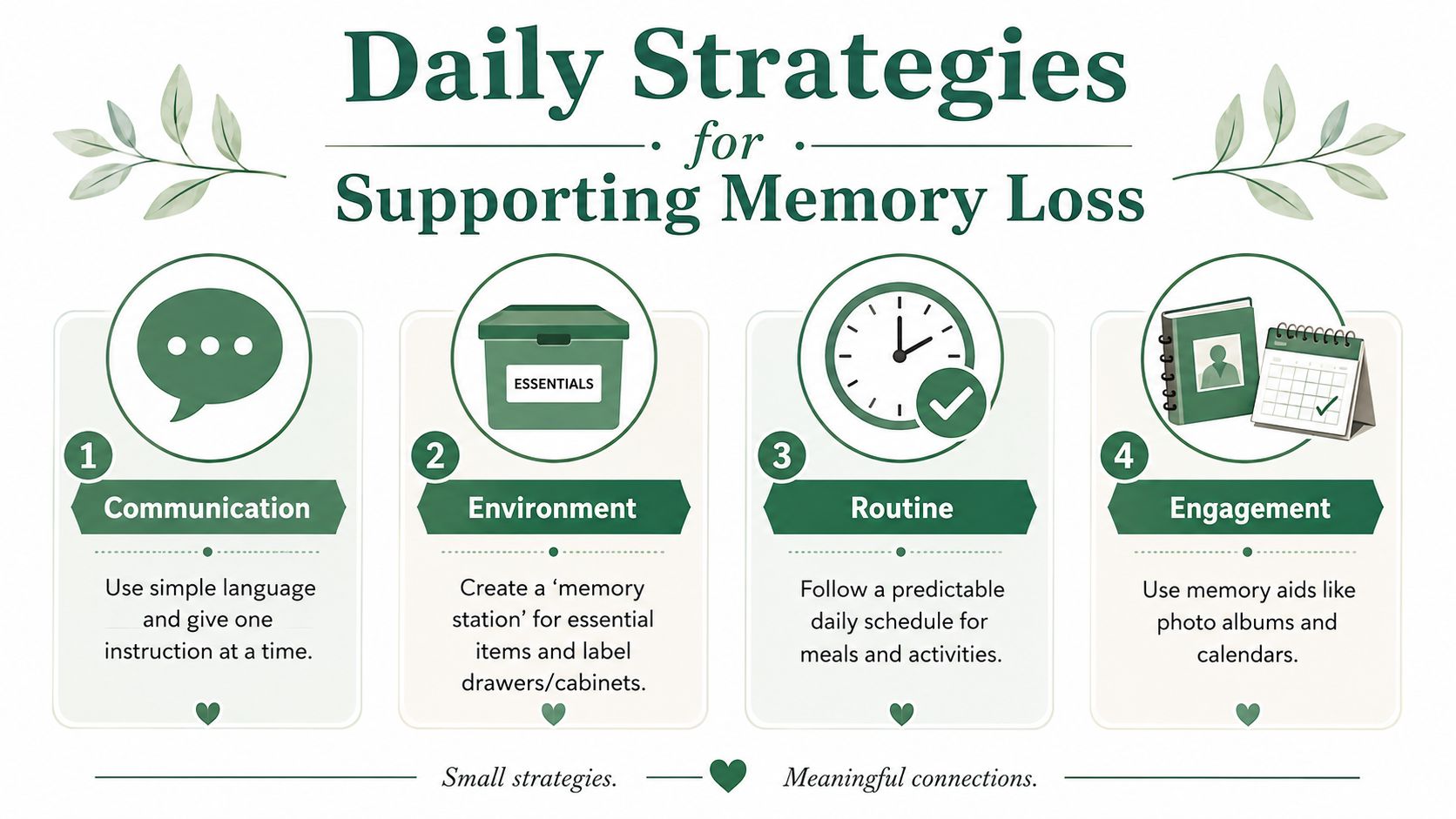
Communication: Use simple language and one instruction at a time.
Environment: Label common spaces and keep essentials in one visible place.
Routine: Repeat the same general schedule for meals, activities, and rest.
Engagement: Use calendars, photo albums, and other external cues to support recall.
The WHO also lists cognitive stimulation, social engagement, and writing down appointments as helpful non-pharmacological strategies for maintaining function and quality of life (WHO dementia fact sheet). In practice, that means the best support is often low-tech, consistent, and familiar.
Building a Support System Beyond Medical Visits
Most care happens in the gaps between appointments. A family might get a diagnosis, leave with instructions, then face a week of confusion, loneliness, and missed details at home. That's where outside support becomes useful, especially when the person is living in the community and the family can't be there all day.
Support can come from several places. In-person caregivers handle hands-on help. Adult day programs add structure and social contact. Support groups help families stay steady when the load gets heavy. Some families also use phone-based cognitive support programs, such as Velma, which provides scheduled recurring phone calls with conversation, orientation, and cognitive exercises adapted to the participant's history and daily routines.
What structured phone support can add
Phone-based support works well for people who don't want another app, device, or login. Regular calls can include reminiscence prompts, orientation to time and place, language tasks, and practical check-ins about safety or daily living. That kind of contact can also surface confusion, anxiety, or fall concerns earlier, because the family gets a more consistent picture of how the person is doing.
Loneliness and isolation often make memory problems feel worse, even when the underlying condition hasn't changed. A dependable call creates a routine touchpoint. It also gives caregivers a place to notice patterns, instead of relying on one stressful visit every so often.
Consistency is doing a lot of the care work here.
Families often need two things at once, emotional support for the person and reliable information for themselves. Structured documentation from recurring calls can help with both, especially when it's shared alongside clinician guidance. Used well, that kind of system doesn't replace medical care. It fills in the daily life between visits, where most decisions happen.
Moving Forward with Confidence and Compassion
One daughter may notice the same question repeated during every evening call and finally realize this isn't ordinary forgetfulness. A spouse may first see it when bills pile up or a once-easy trip to the store becomes confusing. Those moments are hard, but they're also useful, because they point toward action.
The main takeaways are simple. Pattern matters more than one lapse. Memory loss that affects daily life deserves evaluation. Daily support works best when it is repeated, gentle, and built into the environment. And families do not have to manage the whole thing alone.
If the changes feel new, persistent, or disruptive, schedule a medical assessment and bring notes. If the person is already living with dementia, keep building routines that support orientation, safety, and conversation without turning every interaction into a test. The goal is steadier days, not perfect memory.
If you're looking for a way to add consistent, low-burden support between appointments, Velma offers scheduled phone-based cognitive calls that combine conversation, orientation, and memory support for older adults with memory loss. It can help families keep track of daily status, reinforce routines, and add another layer of contact without asking someone to learn a new device.
You're probably reading this after a conversation that didn't go as expected. Someone you love asked the same question again, forgot a familiar name, or seemed fine one day and noticeably more confused the next. That kind of change can feel small at first, then suddenly it starts shaping the whole day.
Dementia short term memory loss is one of the most common reasons families begin to worry, because it shows up in ordinary moments. A missed appointment, a repeated story, or a bill that used to be routine can all be clues that something more than normal aging may be going on. The hard part is figuring out where that line sits in real life, not just in a clinic description.
Table of Contents
Recognizing Dementia Short Term Memory Loss in Daily Life
What families usually notice first
What Happens in the Brain During Short Term Memory Loss
Why the hippocampus matters so much
Why doctors look beyond memory alone
Normal Aging Versus Dementia Related Memory Changes
The pattern that raises concern
Signs that should move you from watching to acting
When to Seek Medical Evaluation and What to Expect
What to bring to the appointment
How to start the conversation
Daily Strategies for Supporting Someone with Memory Loss
Communication that lowers stress
Make the environment do part of the work
Keep the day predictable
Building a Support System Beyond Medical Visits
What structured phone support can add
Moving Forward with Confidence and Compassion
Recognizing Dementia Short Term Memory Loss in Daily Life
The first sign is often painfully ordinary. A mother asks where the grandchild's school forms went, then asks again ten minutes later. A husband who always handled errands forgets why he left the house, or a sister starts repeating the same story in one phone call, not because she's being careless, but because the new information didn't stick.
That pattern matters because dementia-related memory loss usually changes how someone handles recent information. The World Health Organization notes that Alzheimer's disease, the most common cause of dementia, commonly begins with memory complaints that affect episodic memory, language, and orientation, and it estimated more than 55 million people were living with dementia worldwide in 2023, with nearly 10 million new cases each year (WHO dementia fact sheet). Those numbers help explain why families are so often the first to notice something feels off in everyday life.
What families usually notice first
Short-term memory is the brain's ability to take in something recent, hold onto it, and use it a little later. When dementia begins to interfere, the problem often looks like this:
Repeated questions, even after a clear answer.
Missed appointments or forgotten plans that were just discussed.
Difficulty retaining new information, such as a new address, a medication change, or today's schedule.
Losing track of a task midstream, then seeming unsure how to restart it.
Practical rule: If the lapse keeps happening and it changes how daily life works, treat it as a pattern, not a one-off mistake.
A helpful way to think about it is this, normal forgetfulness usually comes with a later “oh right” moment. Dementia short term memory loss more often leaves the person without that recovery, or with a much weaker sense that anything was forgotten. For a family-oriented overview of common early warning patterns, see this guide on early signs of memory loss in aging parents.
The emotional part is real too. Families often feel torn between “maybe I'm overreacting” and “something is changing.” That uncertainty is exactly why watching the pattern over time matters more than judging any single incident.
What Happens in the Brain During Short Term Memory Loss
The brain does not store memory in one neat, isolated spot. In Alzheimer's disease, working memory and long-term declarative memory are affected early, so what families call “short-term memory loss” is often part of a wider breakdown in how the brain encodes and retrieves information (PMC review). A person may seem to follow the conversation in the moment, then lose the details almost immediately.
Why the hippocampus matters so much
The hippocampus functions as the brain's save button for new information. When it is working well, it helps move fresh experiences into a form the brain can store and use later. In Alzheimer's disease, hippocampal and cortical neuron degeneration and synapse loss drive brain atrophy and are closely tied to cognitive decline.
That matters in daily life because the problem is often not attention alone. The person may hear you, but the brain does not reliably hold the information long enough to use it later. Repeating the same reminder again and again can still fail if the underlying encoding process is compromised.
New learning is the fragile part. Repetition helps more than persuasion.
Why doctors look beyond memory alone
Short-term memory problems are not always caused by dementia. Some causes can be reversible, including hypothyroidism, vitamin deficiencies, depression, medications, alcohol use, head injury, and sleep apnea (Ohio State Health). StatPearls also notes that while memory loss from several treatable conditions can improve, most short-term memory loss is a feature of degenerative diseases such as Alzheimer disease (StatPearls).
That is why clinicians do not stop at “Can you remember three words?” They look for broader changes in attention, executive function, and judgment, because short-term memory damage is seldom selective. If planning, problem-solving, or safety awareness are changing too, the pattern becomes much more concerning. For a clearer guide to how the terms fit together, see the difference between Alzheimer's disease and dementia.
For families, the key takeaway is simple. When repeated cueing helps only briefly, and new information keeps slipping away, the issue is probably not ordinary distraction. The brain's system for holding onto new memories is being disrupted at a deeper level.
Normal Aging Versus Dementia Related Memory Changes
The hardest question families ask is whether they're seeing normal aging or something more serious. The answer usually comes from the pattern, not a single mistake. Occasional forgetfulness can happen in aging, but dementia becomes more likely when the changes are frequent, noticeable to others, and start interfering with independent functioning (IHS guidance).
The pattern that raises concern
Normal aging can look like forgetting a name and remembering it later, misplacing keys, or needing a list to stay organized. Dementia-related change looks different. The person may forget an entire conversation, repeat a question within minutes, or lose track of why they entered a room.
The threshold becomes especially important when the change affects tasks that used to be routine. A person who once balanced bills without trouble may now make repeated mistakes. Someone who knew their way around a familiar store may start feeling lost or disoriented in places they've visited for years.
Signs that should move you from watching to acting
Repeated questions in a short period, especially if the answer was just given.
Disorientation in familiar places, including getting lost or unsure of surroundings.
Decline in complex tasks, like bills, medications, or following a recipe.
Changes other people notice, not just the person's own concern.
The National Institute on Aging notes that if memory problems from depression or other treatable conditions persist after a few weeks, medical evaluation is recommended, and people with memory problems should have follow-up memory checks every 6 to 12 months (StatPearls and NIA summary). That makes a real-world difference, because waiting for symptoms to “settle down” can waste time if the cause is progressive.
If you're still unsure, ask yourself one direct question. Is this a one-off lapse, or is it a repeatable pattern that is changing the person's daily independence? That answer is often the clearest signal.
If you want another family-focused explanation of how dementia differs from broader memory loss, this comparison of Alzheimer's disease vs. dementia can help make the language less confusing.
When to Seek Medical Evaluation and What to Expect
The right time to ask for help is before everyone is exhausted by guessing. Write down what happened, when it happened, and whether it affected safety, money, medications, driving, or appointments. A few specific examples are more useful than a general statement like “Mom seems forgetful.”
What to bring to the appointment
Keep the notes concrete.
Specific examples of memory lapses, such as repeated questions, missed bills, or confusion about recent events.
Frequency patterns, including how often it happens and whether it is getting worse.
Changes in daily functioning, such as trouble cooking, taking medication, or keeping track of time.
Behavior shifts, including agitation, withdrawal, or loss of confidence.
Good documentation makes the visit better. Doctors can't evaluate what no one can describe clearly.
A standard evaluation may include a conversation about medical history, a cognitive screening, and blood work to look for reversible contributors like thyroid problems or vitamin deficiencies. Some people also need brain imaging, depending on the clinical picture. If the first visit doesn't give a clear answer, follow-up matters, because memory change can become easier to assess over time.
How to start the conversation
If the person is defensive, keep the language calm and practical. Try, “I've noticed a few things that seem harder lately, and I'd feel better if we checked them with the doctor.” That phrasing focuses on health and support instead of blame.
Families sometimes wait because they hope the issue will improve on its own. The safer approach is to ask for an evaluation when the changes persist, especially if they touch daily life. Even when the cause turns out to be treatable, the appointment can uncover a fixable problem that's been slowing everything down.
Daily Strategies for Supporting Someone with Memory Loss
The most helpful daily support usually feels ordinary. Clear language, predictable routines, and visible reminders do more than long explanations. That's because dementia short term memory loss makes new learning harder, so the goal is to reduce the amount the person has to hold in mind at once.
Communication that lowers stress
Use one instruction at a time. Short sentences work better than bundled requests, especially when someone is already overwhelmed. If they ask the same question again, answer it the same way without turning it into a test.
Avoid saying, “Don't you remember?” That can create shame without improving recall. It's usually better to validate the feeling, then give the useful detail again in plain language.
Speak to the moment, not the mistake.
Make the environment do part of the work
Set up a memory station near the door or kitchen for keys, glasses, appointments, and medication reminders. Label drawers and cabinets so the person doesn't have to guess what's inside. Put the calendar where it's visible, not tucked away on a wall no one checks.
The same logic helps with safety. Do quick check-ins about the stove, expired food, and trip hazards. If the person lives alone, a repeatable phone reminder can help with appointments and medication timing, which is where medication reminders for seniors with memory loss become especially practical.
Keep the day predictable
A steady routine cuts down on the number of decisions the person has to make. Meals, calls, errands, and rest time should happen in a familiar order when possible. That predictability supports orientation and reduces frustration.
Communication: Use simple language and one instruction at a time.
Environment: Label common spaces and keep essentials in one visible place.
Routine: Repeat the same general schedule for meals, activities, and rest.
Engagement: Use calendars, photo albums, and other external cues to support recall.
The WHO also lists cognitive stimulation, social engagement, and writing down appointments as helpful non-pharmacological strategies for maintaining function and quality of life (WHO dementia fact sheet). In practice, that means the best support is often low-tech, consistent, and familiar.
Building a Support System Beyond Medical Visits
Most care happens in the gaps between appointments. A family might get a diagnosis, leave with instructions, then face a week of confusion, loneliness, and missed details at home. That's where outside support becomes useful, especially when the person is living in the community and the family can't be there all day.
Support can come from several places. In-person caregivers handle hands-on help. Adult day programs add structure and social contact. Support groups help families stay steady when the load gets heavy. Some families also use phone-based cognitive support programs, such as Velma, which provides scheduled recurring phone calls with conversation, orientation, and cognitive exercises adapted to the participant's history and daily routines.
What structured phone support can add
Phone-based support works well for people who don't want another app, device, or login. Regular calls can include reminiscence prompts, orientation to time and place, language tasks, and practical check-ins about safety or daily living. That kind of contact can also surface confusion, anxiety, or fall concerns earlier, because the family gets a more consistent picture of how the person is doing.
Loneliness and isolation often make memory problems feel worse, even when the underlying condition hasn't changed. A dependable call creates a routine touchpoint. It also gives caregivers a place to notice patterns, instead of relying on one stressful visit every so often.
Consistency is doing a lot of the care work here.
Families often need two things at once, emotional support for the person and reliable information for themselves. Structured documentation from recurring calls can help with both, especially when it's shared alongside clinician guidance. Used well, that kind of system doesn't replace medical care. It fills in the daily life between visits, where most decisions happen.
Moving Forward with Confidence and Compassion
One daughter may notice the same question repeated during every evening call and finally realize this isn't ordinary forgetfulness. A spouse may first see it when bills pile up or a once-easy trip to the store becomes confusing. Those moments are hard, but they're also useful, because they point toward action.
The main takeaways are simple. Pattern matters more than one lapse. Memory loss that affects daily life deserves evaluation. Daily support works best when it is repeated, gentle, and built into the environment. And families do not have to manage the whole thing alone.
If the changes feel new, persistent, or disruptive, schedule a medical assessment and bring notes. If the person is already living with dementia, keep building routines that support orientation, safety, and conversation without turning every interaction into a test. The goal is steadier days, not perfect memory.
If you're looking for a way to add consistent, low-burden support between appointments, Velma offers scheduled phone-based cognitive calls that combine conversation, orientation, and memory support for older adults with memory loss. It can help families keep track of daily status, reinforce routines, and add another layer of contact without asking someone to learn a new device.
Suggested Article: