Cognitive Exercises for Memory: A 2026 Guide for Adults

You're helping a parent who repeats the same question, misses a familiar appointment, or pauses mid-sentence for a word they've always known. That moment is usually where families start asking the same hard question: can cognitive exercises help, or are they just another hopeful idea that won't hold up in real life?
Cognitive exercises for memory can help, but only when they're matched to the person's abilities and tied to everyday life. For early to mid-stage dementia, the goal isn't to “fix” memory, it's to support attention, orientation, language, mood, and safer routines with structured practice that feels doable. A phone-based format can be especially practical because it removes app barriers and turns the call itself into a familiar cue.
The evidence base is stronger than many families realize. The ACTIVE trial showed that 10 to 14 weeks of organized cognitive training in community-dwelling older adults was associated with better preserved cognitive abilities and functional status 10 years later than in non-trained peers, which is one reason structured practice is taken seriously in dementia care today (ACTIVE trial review). The research also shows the realistic limit, benefits exist, but they're not a cure.
Table of Contents
Why Memory Exercises Matter for Older Adults
What Cognitive Exercises Are
Cognitive stimulation and cognitive rehabilitation
What the exercises usually target
What the Research Says About Memory and Exercise
What helps most in the research
Six Cognitive Exercises for Memory You Can Start Today
1. Name and place recall
2. Day and date orientation
3. Familiar routine rehearsal
4. Category naming
5. Three-step task chain
6. Photo or object reminiscence
How Phone-Based Cognitive Support Delivers These Exercises
Weekly Plan and How to Track What Is Working
Two sample weekly rhythms
What to watch over time
Common Misconceptions About Memory Exercises
Why Memory Exercises Matter for Older Adults
The first sign is often small. A daughter hears her mother ask about lunch twice in ten minutes, or a spouse watches a familiar name slip away and sees the embarrassment land on the other person's face. That's usually when families start searching for memory exercises, hoping for something practical that doesn't feel like a sales pitch.
For early to mid-stage dementia, the honest answer is that exercises can support function and confidence, but they won't erase the underlying condition. They work best when they're designed for the person's current level, repeated often enough to build routine, and kept simple enough to avoid frustration. That's very different from generic “brain games” aimed at healthy adults.
A helpful way to think about this is that the right activity should reduce strain, not create it. A person who can still follow short directions may do well with orientation prompts or word-recall practice, while someone with more confusion may need familiar conversation, cueing, and caregiver support. A phone call fits that reality because it's low-tech, scheduled, and easy to repeat.
For families looking for a broader context on decline patterns and what to watch for, the overview at cognitive decline in older adults can help connect the memory slips to the bigger picture.
Practical rule: If the task leaves the person calmer, more engaged, or more oriented, you're probably in the right zone. If it leaves them shut down or irritable, the task is too hard or too long.
These exercises usually make the most sense for adult children, spouses, care managers, home-care agencies, and anyone trying to build a safer daily rhythm around memory loss. The next sections cover what the term includes, what the research supports, and six exercises you can adapt for a phone call tomorrow.
What Cognitive Exercises Are
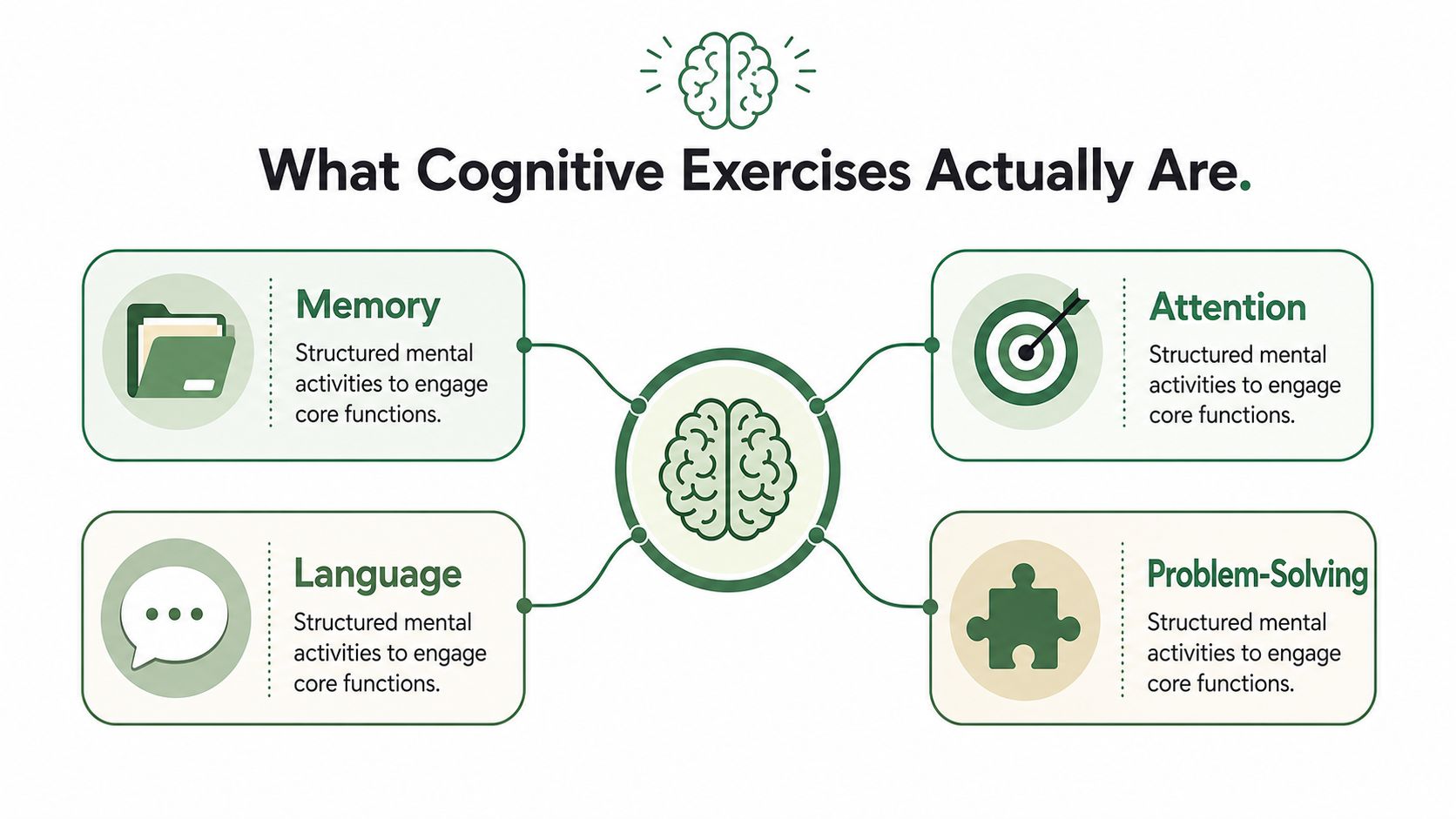
Cognitive exercises are structured mental activities that ask the brain to work on purpose. In memory care, that work usually involves attention, language, orientation, recall, or following a sequence. The point is not to keep someone busy. The point is repeated practice that matches what the person can still do.
Cognitive stimulation and cognitive rehabilitation
There are two useful categories. Cognitive stimulation keeps the person engaged in a supportive, broad way, often through conversation, reminiscence, naming, or orientation. Cognitive rehabilitation is more task-specific, like practicing the steps for remembering medications or rehearsing a daily routine until it becomes more reliable.
That distinction matters because a person with dementia does not need a harder puzzle for the sake of difficulty. They need the right level of mental challenge tied to the right real-world goal. An exercise menu gives options, while a prescription matches the task to the person.
What the exercises usually target
Most useful memory activities work across four domains:
Short-term recall, remembering a name, a message, or what was just discussed.
Working memory, holding small pieces of information long enough to act on them.
Procedural memory, drawing on familiar routines like a hymn, recipe, or folding task.
Orientation, keeping track of day, place, weather, and recent events.
A good activity can look simple on the surface and still be useful. Saying today's date, naming three kitchen items, or walking through a familiar recipe can each target a different part of memory function. What matters is whether the activity matches the person's abilities and is repeated in a steady way.
A good exercise feels familiar enough to start, but active enough that the person still has to think.
If you can look at an activity and tell which memory domain it uses, you are already ahead of most generic advice online. A crossword might involve language and attention. A call that reviews the day and asks about medication plans involves orientation and practical recall. That is the lens that makes these exercises useful in dementia care rather than just “brain work.”
What the Research Says About Memory and Exercise
A family member may ask whether memory exercises can really help when someone is already showing signs of dementia. The honest answer is yes, they can help, but the gains are usually modest and they are rarely dramatic. Research supports structured activity as a way to support memory, not as a way to reverse dementia or produce a quick turnaround in a few days.
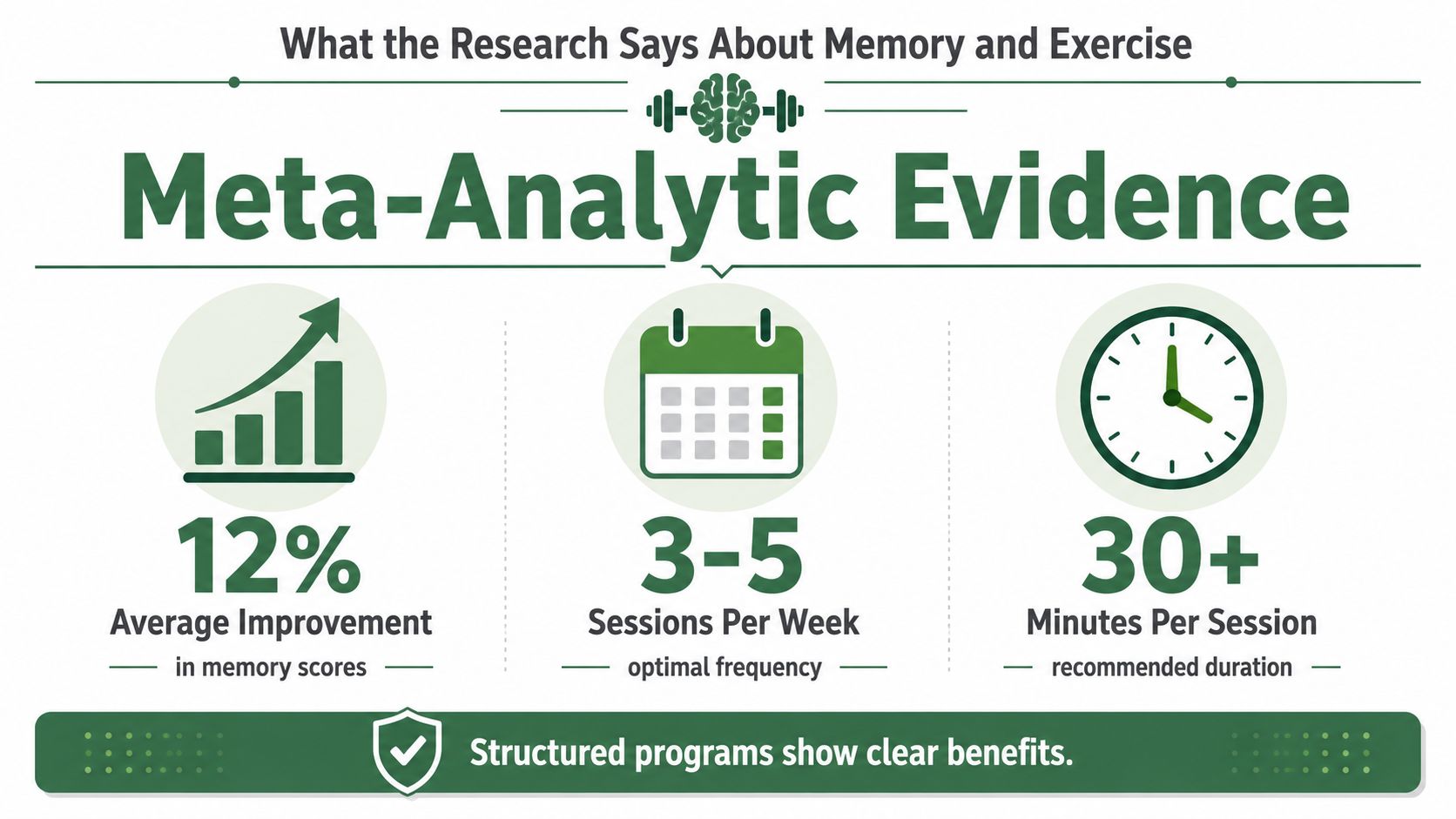
A 2025 meta-analysis that pooled 62 meta-analyses and 50,975 participants found that exercise improved memory with a standardized mean difference of 0.26 and improved general cognition with 0.42 and executive function with 0.24 (2025 meta-analysis). Another 2025 review covering 133 systematic reviews, 2,724 randomized controlled trials, and 258,279 participants also found memory benefits, with larger effects for low- and moderate-intensity routines and for programs lasting 1 to 3 months (2025 umbrella review). Those findings matter because they come from large bodies of evidence, but they also show that the effect size is steady rather than dramatic.
What helps most in the research
A separate 2025 network meta-analysis found that mind-body exercise had the largest effect on memory in healthy older adults, with SMD = 0.58, followed by aerobic exercise with SMD = 0.42 and resistance training with SMD = 0.35. The same analysis pointed to an optimal memory protocol of 3 or more sessions per week, 45 to 60 minutes per session, and 12 to 24 weeks of duration (2025 network meta-analysis).
That does not mean a person with dementia should be pushed into the same routine as a healthy volunteer in a trial. It means repeated, structured practice tends to work better than occasional effort, much like a familiar route becomes easier to follow when it is traveled often. The dose matters, but tolerance matters too. A person who tires easily may do better with shorter phone calls more often, while another may manage longer sessions a few times a week.
The older ACTIVE trial adds a different kind of support. It showed that a relatively brief window of organized training, 10 to 14 weeks, was linked to better cognitive and functional status 10 years later than no training (ACTIVE trial review). That long follow-up matters because it suggests practice can leave a lasting trace when the task is structured enough for learning to stick.
The research supports consistency more than intensity, and it supports realistic gains more than dramatic ones.
What the research does not show is that memory exercises alone can restore independence or stop dementia from progressing. A more accurate reading is that they can support day-to-day functioning, especially when the activities are matched to the person's ability, repeated in routine, and paired with cueing from a caregiver. Studies of social engagement and cognition also suggest that learning is stronger when the person is not working in isolation, which is one reason phone-based check-ins and caregiver participation can help a simple exercise become a usable routine.
Six Cognitive Exercises for Memory You Can Start Today
The safest starting point for dementia care is not the hardest task. It's the one the person can do with mild effort, some success, and a clear end. That's why these six exercises stay close to daily life instead of leaning on reverse spelling or high-pressure puzzle work.
1. Name and place recall
This targets short-term recall. Ask the person to say their own name, where they are, and who they're speaking with. Keep it short. If they get stuck, offer a cue rather than correcting them.
A phone-friendly version sounds like this, “Hi, it's Anna calling. Can you tell me your name and where you are right now?” If the person can answer two parts but not all three, that's still useful. If frustration starts to rise, stop after one successful round.
2. Day and date orientation
This supports orientation. Ask about the day of the week, the part of the day, the weather, and one upcoming plan. These questions work best when they're tied to a routine, like breakfast or a scheduled call.
The phone adaptation is simple, “What day is it today, and what's one thing on your calendar?” If the answer is wrong, gently give the correct cue and move on. The goal is orientation, not a quiz.
3. Familiar routine rehearsal
This uses procedural memory. Have the person walk through a well-known recipe, hymn, prayer, or household sequence. Familiar steps often hold up better than abstract memory tasks because they're tied to repetition and muscle memory.
A care manager might say, “Tell me how you'd make scrambled eggs from start to finish.” If the person loses the thread, invite the next step with a prompt. For more ideas that fit dementia-friendly life stories, the guide on reminiscence therapy for dementia is a useful companion.
4. Category naming
This works on language and attention. Ask for items in a familiar category, like fruits, pets, or things in a kitchen. Keep the time pressure gentle, not stressful.
A phone script could be, “Name as many fruits as you can think of, and I'll help if you pause.” Stop before the person tires out. This is supposed to feel like a conversation, not a test.
5. Three-step task chain
This trains working memory. Give three linked actions, such as “tea, then keys, then phone,” and ask the person to repeat them in order. The chain should be short enough to repeat successfully.
Over the phone, you can say, “Please remember these three things for after our call, glasses, water, and the TV remote.” If they can only hold one or two items, shorten the list next time. Ability-matched success builds trust.
6. Photo or object reminiscence
This supports memory through recognition and familiar language. Use a photo, keepsake, or object the person knows well, and ask what it brings to mind. This works especially well when a person struggles with new information but can still connect to long-held memories.
A caregiver can hold up a photo and ask, “Who's in this picture, and what do you remember about that day?” Stop if the person becomes distressed or starts searching for details they can't access. Warmth matters more than accuracy here.
Memory Domain | Example Activity | Phone-Friendly Adaptation |
|---|---|---|
Short-term recall | Name and place recall | Ask name, location, and who they're speaking with |
Orientation | Day and date check | Review day, weather, and one upcoming plan |
Procedural memory | Familiar recipe or hymn | Walk through a known sequence together |
Language and attention | Category naming | Name fruits, pets, or kitchen items |
Working memory | Three-step task chain | Repeat three simple items in order |
Reminiscence | Photo or object recall | Talk through a shared memory tied to an object |
When to step back: Stop the exercise when effort turns into tension. A short, successful call helps more than a long, frustrating one.
These activities are intentionally practical. They can stand alone in a family routine, or they can be folded into a daily support program with coaching and documentation.
How Phone-Based Cognitive Support Delivers These Exercises
A good phone call starts before the first exercise. The care manager says hello, confirms who they're speaking with, and helps the person settle into the moment. That opening matters because people with memory loss often do better when they know what kind of interaction is coming.
A typical call might open like this, “Hi, Mr. Lewis. It's Maria calling for your memory support time. How are you feeling today, and what's the weather like where you are?” That gives the person an orientation cue without making them feel tested. If they sound tired, the care manager can switch to a shorter, easier activity right away.
Then comes one guided exercise, not five. The best calls keep the cognitive load manageable, so the person can stay engaged instead of exhausted. A care team might use category naming one day, then a familiar routine the next, then a photo prompt later in the week.

The call often ends with something practical, like a medication reminder or a plan for the afternoon. A simple script is, “Before we hang up, what's one thing you need to remember after lunch?” That connects the exercise to daily life, which is where families usually want the help to show up.
Quiet progress often looks like fewer repeated questions, calmer transitions, and better follow-through on routine tasks.
A phone-based model also helps because the call itself becomes predictable. That consistency lowers anxiety, especially for people who don't want to learn a new app or manage a video link. Velma is one option in this category, with scheduled phone calls, guided cognitive exercises, and care-team documentation that helps families notice patterns between visits, all of which fits the kind of support this article is describing. For a fuller look at the workflow, see how Velma works as a family guide to daily cognitive support.
The point isn't to replace family visits or clinical care. It's to give the person a regular, guided touchpoint that supports memory, mood, and day-to-day reliability.
Weekly Plan and How to Track What Is Working
A workable plan should feel repetitive enough to be familiar and varied enough to stay interesting. For someone in early-stage dementia, three longer sessions a week can be a good fit. For someone in mid-stage dementia, shorter calls more often often work better because attention fades faster.
Two sample weekly rhythms
Plan | Schedule | Focus |
|---|---|---|
Early-stage plan | Monday, Wednesday, Friday, 30 minutes | Rotate orientation, recall, and familiar routine practice |
Mid-stage plan | Monday through Friday, shorter calls | Use one exercise per call with simpler cues and more repetition |
The early-stage schedule might begin with orientation on Monday, category naming on Wednesday, and familiar routine rehearsal on Friday. The mid-stage plan should keep the call shorter and lighter, with one clear task, one short check-in, and one practical close. That's enough to support engagement without fatigue.
What to watch over time
Track what changes in ordinary life, not just during the call:
Recall: Does the person remember names, short instructions, or recent topics a little more reliably?
Orientation: Are they less confused about the day, time, or where they are?
Mood: Do they seem calmer, less anxious, or more willing to join in?
Language: Do words come more easily, or do they get stuck less often?
Daily function: Are appointments, medications, and household routines easier to follow?
Review these notes every couple of weeks with the family or care manager. If confusion suddenly worsens, safety risks increase, or the person becomes more withdrawn, that's worth flagging to a clinician.
A tracking sheet doesn't need to be fancy. A few short notes after each call are enough to show patterns, and those patterns are often more useful than trying to judge success from one good day or one bad day.
Common Misconceptions About Memory Exercises
Harder isn't better when dementia is part of the picture. If a task keeps ending in confusion, the person starts to avoid it, and trust in the activity drops. Ability-matched exercises usually work better than puzzles that feel like a test.
More practice isn't always better either. Fatigue shows up fast in memory loss, and pushing past it can turn a helpful routine into a source of stress. Short, repeated sessions usually beat long sessions that leave the person drained.
Commercial brain-training apps also get too much credit. Many of them are built for healthy adults, not for people with dementia-stage changes in language, attention, or orientation. A program that doesn't adapt to those limits can look polished without being useful in daily life.
Results also don't show up in days. Families often notice the more meaningful changes first in mood, willingness to participate, or smoother routines around the house. Those are real outcomes, even when recall scores don't leap upward.
The most grounded approach is simple. Choose exercises the person can tolerate, repeat them on a predictable schedule, and judge success by daily life as much as by memory performance. When a family needs more structure, a phone-based program like Velma can provide guided calls, caregiver coordination, and a steadier way to turn memory support into part of the week.
If you're caring for someone with early to mid-stage dementia and want memory support that's structured, phone-based, and adapted to real life, visit Velma to see how guided cognitive calls can fit into a family routine. It's a practical option when you want more than a worksheet, but less than another app to manage.
You're helping a parent who repeats the same question, misses a familiar appointment, or pauses mid-sentence for a word they've always known. That moment is usually where families start asking the same hard question: can cognitive exercises help, or are they just another hopeful idea that won't hold up in real life?
Cognitive exercises for memory can help, but only when they're matched to the person's abilities and tied to everyday life. For early to mid-stage dementia, the goal isn't to “fix” memory, it's to support attention, orientation, language, mood, and safer routines with structured practice that feels doable. A phone-based format can be especially practical because it removes app barriers and turns the call itself into a familiar cue.
The evidence base is stronger than many families realize. The ACTIVE trial showed that 10 to 14 weeks of organized cognitive training in community-dwelling older adults was associated with better preserved cognitive abilities and functional status 10 years later than in non-trained peers, which is one reason structured practice is taken seriously in dementia care today (ACTIVE trial review). The research also shows the realistic limit, benefits exist, but they're not a cure.
Table of Contents
Why Memory Exercises Matter for Older Adults
What Cognitive Exercises Are
Cognitive stimulation and cognitive rehabilitation
What the exercises usually target
What the Research Says About Memory and Exercise
What helps most in the research
Six Cognitive Exercises for Memory You Can Start Today
1. Name and place recall
2. Day and date orientation
3. Familiar routine rehearsal
4. Category naming
5. Three-step task chain
6. Photo or object reminiscence
How Phone-Based Cognitive Support Delivers These Exercises
Weekly Plan and How to Track What Is Working
Two sample weekly rhythms
What to watch over time
Common Misconceptions About Memory Exercises
Why Memory Exercises Matter for Older Adults
The first sign is often small. A daughter hears her mother ask about lunch twice in ten minutes, or a spouse watches a familiar name slip away and sees the embarrassment land on the other person's face. That's usually when families start searching for memory exercises, hoping for something practical that doesn't feel like a sales pitch.
For early to mid-stage dementia, the honest answer is that exercises can support function and confidence, but they won't erase the underlying condition. They work best when they're designed for the person's current level, repeated often enough to build routine, and kept simple enough to avoid frustration. That's very different from generic “brain games” aimed at healthy adults.
A helpful way to think about this is that the right activity should reduce strain, not create it. A person who can still follow short directions may do well with orientation prompts or word-recall practice, while someone with more confusion may need familiar conversation, cueing, and caregiver support. A phone call fits that reality because it's low-tech, scheduled, and easy to repeat.
For families looking for a broader context on decline patterns and what to watch for, the overview at cognitive decline in older adults can help connect the memory slips to the bigger picture.
Practical rule: If the task leaves the person calmer, more engaged, or more oriented, you're probably in the right zone. If it leaves them shut down or irritable, the task is too hard or too long.
These exercises usually make the most sense for adult children, spouses, care managers, home-care agencies, and anyone trying to build a safer daily rhythm around memory loss. The next sections cover what the term includes, what the research supports, and six exercises you can adapt for a phone call tomorrow.
What Cognitive Exercises Are
Cognitive exercises are structured mental activities that ask the brain to work on purpose. In memory care, that work usually involves attention, language, orientation, recall, or following a sequence. The point is not to keep someone busy. The point is repeated practice that matches what the person can still do.
Cognitive stimulation and cognitive rehabilitation
There are two useful categories. Cognitive stimulation keeps the person engaged in a supportive, broad way, often through conversation, reminiscence, naming, or orientation. Cognitive rehabilitation is more task-specific, like practicing the steps for remembering medications or rehearsing a daily routine until it becomes more reliable.
That distinction matters because a person with dementia does not need a harder puzzle for the sake of difficulty. They need the right level of mental challenge tied to the right real-world goal. An exercise menu gives options, while a prescription matches the task to the person.
What the exercises usually target
Most useful memory activities work across four domains:
Short-term recall, remembering a name, a message, or what was just discussed.
Working memory, holding small pieces of information long enough to act on them.
Procedural memory, drawing on familiar routines like a hymn, recipe, or folding task.
Orientation, keeping track of day, place, weather, and recent events.
A good activity can look simple on the surface and still be useful. Saying today's date, naming three kitchen items, or walking through a familiar recipe can each target a different part of memory function. What matters is whether the activity matches the person's abilities and is repeated in a steady way.
A good exercise feels familiar enough to start, but active enough that the person still has to think.
If you can look at an activity and tell which memory domain it uses, you are already ahead of most generic advice online. A crossword might involve language and attention. A call that reviews the day and asks about medication plans involves orientation and practical recall. That is the lens that makes these exercises useful in dementia care rather than just “brain work.”
What the Research Says About Memory and Exercise
A family member may ask whether memory exercises can really help when someone is already showing signs of dementia. The honest answer is yes, they can help, but the gains are usually modest and they are rarely dramatic. Research supports structured activity as a way to support memory, not as a way to reverse dementia or produce a quick turnaround in a few days.
A 2025 meta-analysis that pooled 62 meta-analyses and 50,975 participants found that exercise improved memory with a standardized mean difference of 0.26 and improved general cognition with 0.42 and executive function with 0.24 (2025 meta-analysis). Another 2025 review covering 133 systematic reviews, 2,724 randomized controlled trials, and 258,279 participants also found memory benefits, with larger effects for low- and moderate-intensity routines and for programs lasting 1 to 3 months (2025 umbrella review). Those findings matter because they come from large bodies of evidence, but they also show that the effect size is steady rather than dramatic.
What helps most in the research
A separate 2025 network meta-analysis found that mind-body exercise had the largest effect on memory in healthy older adults, with SMD = 0.58, followed by aerobic exercise with SMD = 0.42 and resistance training with SMD = 0.35. The same analysis pointed to an optimal memory protocol of 3 or more sessions per week, 45 to 60 minutes per session, and 12 to 24 weeks of duration (2025 network meta-analysis).
That does not mean a person with dementia should be pushed into the same routine as a healthy volunteer in a trial. It means repeated, structured practice tends to work better than occasional effort, much like a familiar route becomes easier to follow when it is traveled often. The dose matters, but tolerance matters too. A person who tires easily may do better with shorter phone calls more often, while another may manage longer sessions a few times a week.
The older ACTIVE trial adds a different kind of support. It showed that a relatively brief window of organized training, 10 to 14 weeks, was linked to better cognitive and functional status 10 years later than no training (ACTIVE trial review). That long follow-up matters because it suggests practice can leave a lasting trace when the task is structured enough for learning to stick.
The research supports consistency more than intensity, and it supports realistic gains more than dramatic ones.
What the research does not show is that memory exercises alone can restore independence or stop dementia from progressing. A more accurate reading is that they can support day-to-day functioning, especially when the activities are matched to the person's ability, repeated in routine, and paired with cueing from a caregiver. Studies of social engagement and cognition also suggest that learning is stronger when the person is not working in isolation, which is one reason phone-based check-ins and caregiver participation can help a simple exercise become a usable routine.
Six Cognitive Exercises for Memory You Can Start Today
The safest starting point for dementia care is not the hardest task. It's the one the person can do with mild effort, some success, and a clear end. That's why these six exercises stay close to daily life instead of leaning on reverse spelling or high-pressure puzzle work.
1. Name and place recall
This targets short-term recall. Ask the person to say their own name, where they are, and who they're speaking with. Keep it short. If they get stuck, offer a cue rather than correcting them.
A phone-friendly version sounds like this, “Hi, it's Anna calling. Can you tell me your name and where you are right now?” If the person can answer two parts but not all three, that's still useful. If frustration starts to rise, stop after one successful round.
2. Day and date orientation
This supports orientation. Ask about the day of the week, the part of the day, the weather, and one upcoming plan. These questions work best when they're tied to a routine, like breakfast or a scheduled call.
The phone adaptation is simple, “What day is it today, and what's one thing on your calendar?” If the answer is wrong, gently give the correct cue and move on. The goal is orientation, not a quiz.
3. Familiar routine rehearsal
This uses procedural memory. Have the person walk through a well-known recipe, hymn, prayer, or household sequence. Familiar steps often hold up better than abstract memory tasks because they're tied to repetition and muscle memory.
A care manager might say, “Tell me how you'd make scrambled eggs from start to finish.” If the person loses the thread, invite the next step with a prompt. For more ideas that fit dementia-friendly life stories, the guide on reminiscence therapy for dementia is a useful companion.
4. Category naming
This works on language and attention. Ask for items in a familiar category, like fruits, pets, or things in a kitchen. Keep the time pressure gentle, not stressful.
A phone script could be, “Name as many fruits as you can think of, and I'll help if you pause.” Stop before the person tires out. This is supposed to feel like a conversation, not a test.
5. Three-step task chain
This trains working memory. Give three linked actions, such as “tea, then keys, then phone,” and ask the person to repeat them in order. The chain should be short enough to repeat successfully.
Over the phone, you can say, “Please remember these three things for after our call, glasses, water, and the TV remote.” If they can only hold one or two items, shorten the list next time. Ability-matched success builds trust.
6. Photo or object reminiscence
This supports memory through recognition and familiar language. Use a photo, keepsake, or object the person knows well, and ask what it brings to mind. This works especially well when a person struggles with new information but can still connect to long-held memories.
A caregiver can hold up a photo and ask, “Who's in this picture, and what do you remember about that day?” Stop if the person becomes distressed or starts searching for details they can't access. Warmth matters more than accuracy here.
Memory Domain | Example Activity | Phone-Friendly Adaptation |
|---|---|---|
Short-term recall | Name and place recall | Ask name, location, and who they're speaking with |
Orientation | Day and date check | Review day, weather, and one upcoming plan |
Procedural memory | Familiar recipe or hymn | Walk through a known sequence together |
Language and attention | Category naming | Name fruits, pets, or kitchen items |
Working memory | Three-step task chain | Repeat three simple items in order |
Reminiscence | Photo or object recall | Talk through a shared memory tied to an object |
When to step back: Stop the exercise when effort turns into tension. A short, successful call helps more than a long, frustrating one.
These activities are intentionally practical. They can stand alone in a family routine, or they can be folded into a daily support program with coaching and documentation.
How Phone-Based Cognitive Support Delivers These Exercises
A good phone call starts before the first exercise. The care manager says hello, confirms who they're speaking with, and helps the person settle into the moment. That opening matters because people with memory loss often do better when they know what kind of interaction is coming.
A typical call might open like this, “Hi, Mr. Lewis. It's Maria calling for your memory support time. How are you feeling today, and what's the weather like where you are?” That gives the person an orientation cue without making them feel tested. If they sound tired, the care manager can switch to a shorter, easier activity right away.
Then comes one guided exercise, not five. The best calls keep the cognitive load manageable, so the person can stay engaged instead of exhausted. A care team might use category naming one day, then a familiar routine the next, then a photo prompt later in the week.
The call often ends with something practical, like a medication reminder or a plan for the afternoon. A simple script is, “Before we hang up, what's one thing you need to remember after lunch?” That connects the exercise to daily life, which is where families usually want the help to show up.
Quiet progress often looks like fewer repeated questions, calmer transitions, and better follow-through on routine tasks.
A phone-based model also helps because the call itself becomes predictable. That consistency lowers anxiety, especially for people who don't want to learn a new app or manage a video link. Velma is one option in this category, with scheduled phone calls, guided cognitive exercises, and care-team documentation that helps families notice patterns between visits, all of which fits the kind of support this article is describing. For a fuller look at the workflow, see how Velma works as a family guide to daily cognitive support.
The point isn't to replace family visits or clinical care. It's to give the person a regular, guided touchpoint that supports memory, mood, and day-to-day reliability.
Weekly Plan and How to Track What Is Working
A workable plan should feel repetitive enough to be familiar and varied enough to stay interesting. For someone in early-stage dementia, three longer sessions a week can be a good fit. For someone in mid-stage dementia, shorter calls more often often work better because attention fades faster.
Two sample weekly rhythms
Plan | Schedule | Focus |
|---|---|---|
Early-stage plan | Monday, Wednesday, Friday, 30 minutes | Rotate orientation, recall, and familiar routine practice |
Mid-stage plan | Monday through Friday, shorter calls | Use one exercise per call with simpler cues and more repetition |
The early-stage schedule might begin with orientation on Monday, category naming on Wednesday, and familiar routine rehearsal on Friday. The mid-stage plan should keep the call shorter and lighter, with one clear task, one short check-in, and one practical close. That's enough to support engagement without fatigue.
What to watch over time
Track what changes in ordinary life, not just during the call:
Recall: Does the person remember names, short instructions, or recent topics a little more reliably?
Orientation: Are they less confused about the day, time, or where they are?
Mood: Do they seem calmer, less anxious, or more willing to join in?
Language: Do words come more easily, or do they get stuck less often?
Daily function: Are appointments, medications, and household routines easier to follow?
Review these notes every couple of weeks with the family or care manager. If confusion suddenly worsens, safety risks increase, or the person becomes more withdrawn, that's worth flagging to a clinician.
A tracking sheet doesn't need to be fancy. A few short notes after each call are enough to show patterns, and those patterns are often more useful than trying to judge success from one good day or one bad day.
Common Misconceptions About Memory Exercises
Harder isn't better when dementia is part of the picture. If a task keeps ending in confusion, the person starts to avoid it, and trust in the activity drops. Ability-matched exercises usually work better than puzzles that feel like a test.
More practice isn't always better either. Fatigue shows up fast in memory loss, and pushing past it can turn a helpful routine into a source of stress. Short, repeated sessions usually beat long sessions that leave the person drained.
Commercial brain-training apps also get too much credit. Many of them are built for healthy adults, not for people with dementia-stage changes in language, attention, or orientation. A program that doesn't adapt to those limits can look polished without being useful in daily life.
Results also don't show up in days. Families often notice the more meaningful changes first in mood, willingness to participate, or smoother routines around the house. Those are real outcomes, even when recall scores don't leap upward.
The most grounded approach is simple. Choose exercises the person can tolerate, repeat them on a predictable schedule, and judge success by daily life as much as by memory performance. When a family needs more structure, a phone-based program like Velma can provide guided calls, caregiver coordination, and a steadier way to turn memory support into part of the week.
If you're caring for someone with early to mid-stage dementia and want memory support that's structured, phone-based, and adapted to real life, visit Velma to see how guided cognitive calls can fit into a family routine. It's a practical option when you want more than a worksheet, but less than another app to manage.
Suggested Article: