Reminiscence Therapy for Elderly: A Practical Care Guide

Your mother can't remember what she had for lunch, but she can still tell you about the first job she ever loved. Your father may miss today's date, then suddenly light up when an old song comes on and he starts talking about a family holiday as if it happened yesterday. Those moments can feel random, but they're often the doorway into reminiscence therapy for elderly people, a structured way to use familiar memories to support mood, connection, and a steadier sense of self.
For families juggling work calls, medication reminders, and the quiet worry that memory loss is taking too much, this approach can feel surprisingly practical. It's not about forcing perfect recall. It's about using what still feels alive, stories, photos, music, and familiar routines, to make conversation easier and less lonely.
Table of Contents
Why Old Memories Matter More Than We Realize
The memories that stay accessible
Why families keep coming back to it
What Reminiscence Therapy Actually Is
A guided trip down memory lane
Who usually leads it
What the Research Really Shows About the Benefits
Where the evidence is strongest
Why repeated sessions matter
Practical Techniques and Prompts You Can Use This Week
Start with themes that feel safe
A simple 30-minute session
Mistakes to avoid
Choosing the Right Format for Your Situation
Match the format to the person's life
Where a phone call can fit
Safety, Suitability, and When to Be Cautious
Who tends to benefit most
Watch the reaction, not just the topic
Building a 12-Week Rhythm That Sticks
Make the schedule simple enough to repeat
What to look for over time
Why Old Memories Matter More Than We Realize
The memories that stay accessible
A lot of families notice the same thing. A parent may lose track of the day's events, then start talking clearly about an old wedding, a childhood home, or the factory floor where they spent decades working. That isn't magic, and it isn't denial. It's a pattern seen often in dementia care, where long-held autobiographical memories can remain easier to reach than new information.
That's why reminiscence therapy for elderly people makes sense in practice. Instead of fighting the memory system that's changed, it leans into the parts that are still available, especially stories tied to identity, emotion, and familiar routines. The goal is not to test memory. The goal is to create moments where the person feels known and can still participate.
Practical rule: if a memory makes someone smile, settle, or keep talking, it's worth following.
Emotional recall often survives longer than factual recall. Someone may not remember the name of the hospital they visited last month, but they can still describe their first bicycle, their wedding dress, or the smell of a family recipe. That's often where conversation becomes easier for both sides.
Why families keep coming back to it
The strongest reason families try reminiscence is simple. It usually feels better than quizzing. Instead of asking, “Do you remember what day it is?”, you can ask, “What did Sundays feel like when you were growing up?” That kind of question invites connection rather than failure.
The evidence also fits that instinct. A 2023 meta-analysis of 27 studies involving 1,755 older adults found that reminiscence therapy significantly reduced depressive symptoms, with a pooled SMD of -0.61 and a medium-to-large effect size described by the authors, and it also improved life satisfaction with an SMD of 0.40 after more than 8 weeks of intervention (Frontiers in Psychiatry). For worried adult children, that's the most honest promise to keep in mind. This is a mood and engagement tool first, not a cure.
What Reminiscence Therapy Actually Is
A guided trip down memory lane
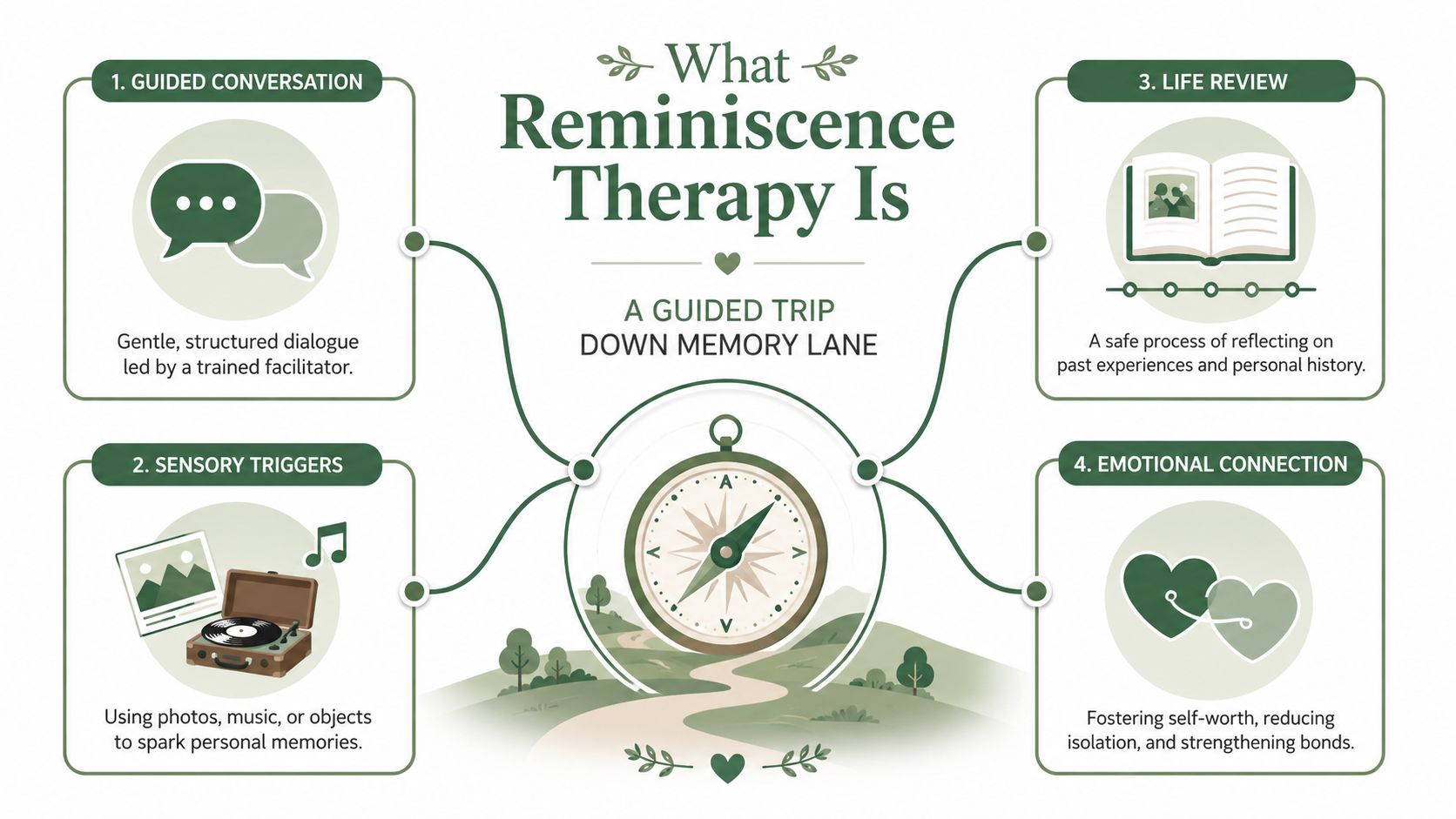
Think of reminiscence therapy as a guided trip down memory lane. A family member or trained clinician doesn't just let conversation wander. They choose a theme, add a prompt, listen carefully, and keep the person in a space where memories can surface without pressure.
The simplest version is simple reminiscence, which is just talking about the past in a relaxed way. Life-review therapy goes further, because it's more structured and often looks at the person's whole life story, including meaning, losses, and turning points. Life-story work usually creates something lasting, like a memory book or digital record, that family members can keep using.
That distinction matters. Casual family chat can be lovely, but a true session has a shape. It might start with a photograph, a song, a recipe, or a work object, then move into open conversation, then close gently so the person doesn't feel abruptly dropped.
Who usually leads it
This work is often led by nurses, occupational therapists, social workers, and trained care staff. In some settings, it's done in groups. In others, it's one-to-one at home or by phone with a care team that knows how to steer conversation without turning it into a memory test.
The session usually uses sensory cues. Photographs, familiar music, old tools, a recipe card, a church bulletin, even a scarf or piece of fabric can act like keys that open up a story. The listener's job is to notice the spark and follow it with calm, open questions.
If you want a plain-English comparison with another cognitive approach, this overview of cognitive stimulation therapy shows where reminiscence sits alongside other non-drug supports. Reminiscence isn't medical treatment on its own. It's a companion approach that can support mood, identity, and engagement while the broader care plan handles medication, safety, and daily functioning.
What the Research Really Shows About the Benefits
Where the evidence is strongest
Families often hope reminiscence will do one clear thing, such as sharpen memory or lift mood. The research says the picture is narrower and more practical. A 2019 systematic review of institutionalized older adults included only 6 eligible studies with 296 participants in total, which shows the field is still small even though the results are useful in care settings (PubMed). In that review, 2 of the 6 studies found significant cognitive benefits, and 3 of the 6 reported significant reductions in depressive symptoms. None assessed quality of life, so families should not expect every helpful effect to appear in the older trials.
The wider pattern is steadier. In dementia-focused research, reminiscence tends to help mood, life satisfaction, and engagement more reliably than it improves memory scores. A Cochrane review found the overall effect on self-reported quality of life was small and not important right after treatment, though a care-home subgroup did better, with a more favorable result in 3 trials and 193 participants. That same setting pattern keeps appearing, which is why the place where care happens matters so much.
The simplest way to read the evidence is this. Reminiscence works more like a conversation that steadies someone than a memory exercise that fixes every problem. Families often want a memory fix, but the studies point more toward a mood-and-connection approach that may also support thinking in some settings.
Why repeated sessions matter
A single good conversation can be warm and meaningful, yet the gains are more reliable when the work is structured and repeated. Reviews in older adults with Alzheimer's disease describe benefit with small-group sessions averaging 45 minutes, delivered once weekly or more over 8 to 12 weeks. Another review found effectiveness with 30 to 35 minute sessions at least weekly for 12 weeks (Wiley).
That gives families a useful rule of thumb. One photo album chat by itself is not a fair test of the method. It works more like gentle exercise than a one-time remedy. Repetition seems to matter more than intensity, and a steady rhythm gives the person enough contact with the same themes for trust and recall to build.
A newer layer of evidence also suggests that format shapes results. In a 2025 network meta-analysis, digital reminiscence therapy ranked strongest for cognition versus treatment as usual, and group reminiscence outperformed individual delivery for both cognition and adherence (PubMed). That does not mean every family needs technology. It does mean guided prompts, regular contact, and support from other people or a facilitator can change what happens. For families wondering whether phone-based or brief remote conversations can help when in-person sessions are not available, the research points to consistency and structure as the parts that matter most. A short, well-led call can still be worthwhile if it happens often enough and follows a clear pattern, much like how cognitive stimulation therapy is described in this overview as a structured support rather than an unplanned chat.
Practical Techniques and Prompts You Can Use This Week
Start with themes that feel safe
Good reminiscence often begins with ordinary life, not dramatic events. Ask about a first job, a childhood kitchen, school days, a favorite holiday, music from their teens, or the street they grew up on. Those topics tend to be easier because they're concrete, familiar, and usually tied to identity.
Use sensory anchors. A photo can bring back faces. A biscuit tin, apron, or old tool can bring back work routines. A song from the radio can bring back a whole era. If the person likes cooking, a familiar recipe card can do more than a dozen yes-or-no questions.
If you want a structured companion to this kind of conversation, life review therapy guidance can help families understand how a simple chat becomes a more deliberate session. The point is not to squeeze out perfect facts. It's to keep the person comfortably engaged.
A simple 30-minute session
A good session doesn't need to be elaborate. It needs to be calm, repeatable, and easy to end.
Warm-up check-in: start with how they're feeling right now, not with memory questions.
Theme and cue: show one photo, play one song, or place one meaningful object within reach.
Open conversation: ask, “What do you remember about this?” or “What was that like for you?”
Gentle elaboration: follow details they offer, and keep validating feelings even if the facts drift.
Calm close: thank them, name something enjoyable you heard, and end without rushing.
A few language habits help a lot. Use open prompts instead of quizzes. Don't correct small errors unless safety depends on it. If they drift into a different memory, follow the emotional thread rather than dragging them back.
Mistakes to avoid
Don't treat reminiscence like a quiz. The session should feel like being understood, not being examined.
Avoid piling on too many prompts at once. Don't push into painful memories just because a topic is historically interesting. And don't insist on accuracy when the person is clearly trying to connect. Validation usually works better than correction.
If memory falters halfway through, keep the atmosphere steady. A kind response like, “That sounds like an important time,” is often enough to preserve trust and keep the conversation going.
Choosing the Right Format for Your Situation
Match the format to the person's life
The right format is the one the person can keep doing without strain. A resident in a care home who enjoys company may settle into a small group. Someone who becomes tense in noisy settings may do better with one-to-one sessions. A homebound person with limited energy may get more from a brief phone call than from a trip to a center.
Format | Typical Session | Best Fit For | Key Trade-off |
|---|---|---|---|
One-to-one at home | Quiet, personalized conversation with photos, music, or objects | People who are withdrawn, easily distracted, or more comfortable with privacy | Requires a prepared listener and regular time |
Small group | Shared conversation with common prompts | Residents in care homes or day centers who enjoy social contact | Less individualized, but often stronger peer energy |
Phone-based or remote | Guided conversation over the phone with familiar prompts | People at home who can't travel or don't use apps confidently | Fewer visual cues, so the caller has to work harder with language |
The evidence points toward structured and repeated sessions across formats, not toward one perfect delivery style. Group delivery often supports attendance, while individual sessions can feel safer for people who do not want a roomful of listeners. Phone-based work matters most when the family needs something dependable without devices, logins, or complicated setup.
Where a phone call can fit
A phone-based program can work as a practical middle ground when in-person visits are hard to arrange. Velma is one option in that category, with scheduled calls led by trained care team members and designed for older adults in the early to mid stages of dementia. It uses conversation, reminiscence prompts, orientation cues, and routine check-ins over the phone, so the person does not need apps or new devices. For families who want a fuller overview of the approach, this reminiscence therapy for dementia guide explains how the method is used in care settings and at home.
For many families, that format makes the decision easier. If your parent is socially isolated, homebound, or inconsistent with face-to-face programs, a recurring call can create the repetition the research keeps pointing toward. If they are in a care home and enjoy groups, that may still be the better first choice.
A simple way to judge the “dose” is to ask whether the person can finish the call feeling settled rather than tired. A short, steady rhythm often does more good than an ambitious plan that never gets used. In practice, a brief phone conversation can be enough to keep the emotional thread alive when travel, staffing, or attention span make longer sessions hard to sustain.
Safety, Suitability, and When to Be Cautious
Who tends to benefit most
Reminiscence therapy is usually most useful in early to mid-stage dementia, when the person can still follow a theme, respond to prompts, and enjoy conversation. It can still be meaningful in more advanced stages, but the goals shift toward comfort, recognition, and emotional connection rather than long exchanges.
Caution rises when someone has active major depression, unresolved trauma, severe communication loss, or end-of-life distress. Those situations call for a clinician who can screen themes and adjust the pace. A memory session that seems harmless on paper can land badly if it touches grief too directly or if the person isn't emotionally ready.
Watch the reaction, not just the topic
The safest rule is to pay attention to what happens after the session. If the person looks lighter, more settled, or more engaged, that's a good sign. If they become more agitated, withdrawn, tearful, or fixed on loss after repeated sessions, that's a sign to pause and talk with a clinician.
Avoid themes that are clearly loaded, such as wartime trauma, the death of a child, or a very recent bereavement, unless a trained professional has planned the conversation. Consent matters too. Even when dementia is present, the person still needs to show assent in the moment. If they resist, change the topic.
The right memory is not always the oldest one. It's the one that leaves the person feeling safer after the conversation than before it.
One more expectation needs correcting. Reminiscence can support mood and connection, but it doesn't usually produce obvious memory recovery. That's not failure. It's the actual shape of the benefit.
Building a 12-Week Rhythm That Sticks
Make the schedule simple enough to repeat
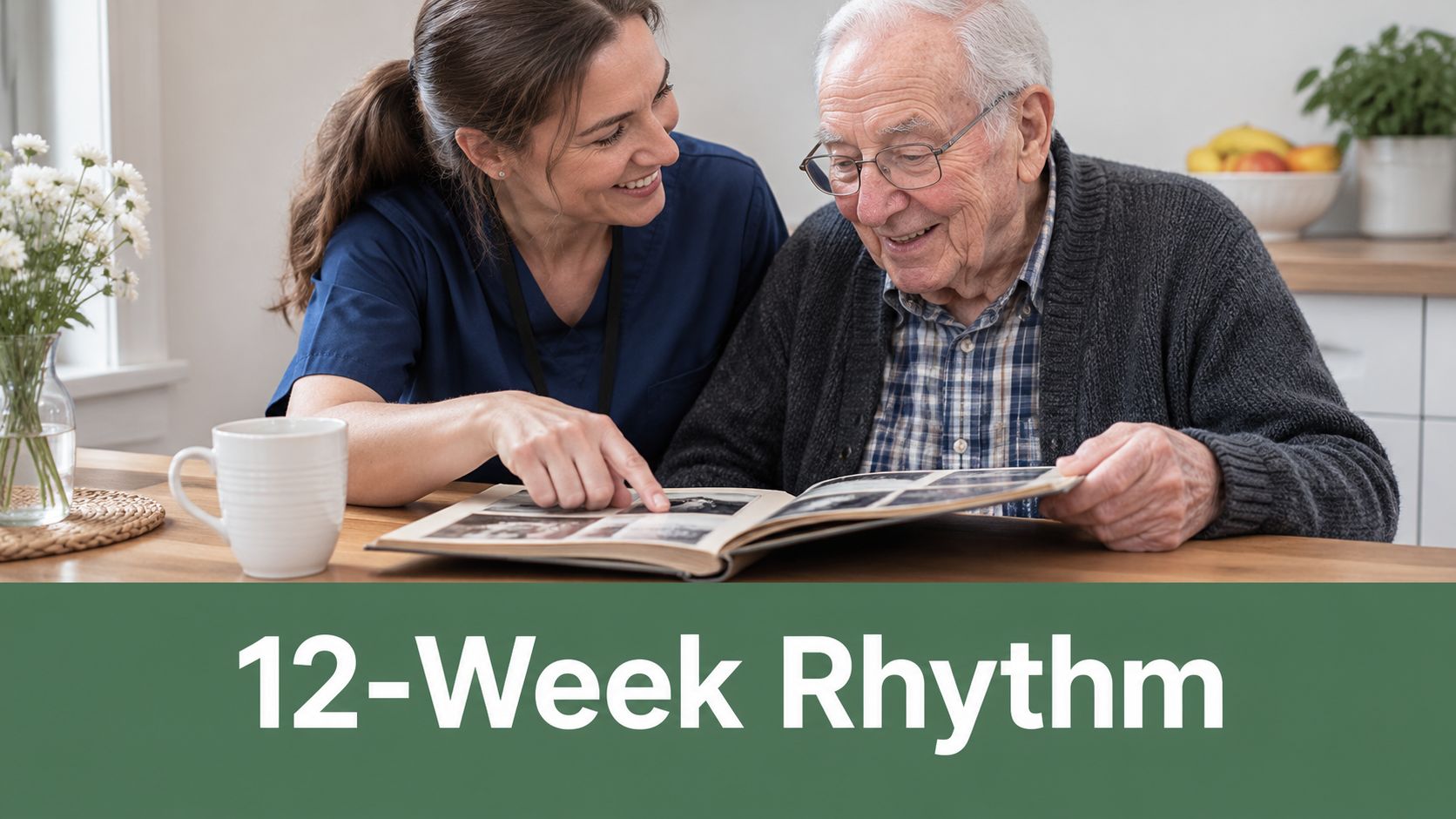
A family routine works best when it is easy to remember and hard to overcomplicate. The evidence points to weekly sessions that last 30 to 45 minutes over about 12 weeks, which gives families a practical rhythm to try and enough time to notice whether the person seems calmer, more talkative, or easier to engage.
A simple pattern can look like one focused call or visit each week, then light reinforcement during the week with a song, a photo, or a short story at mealtime. Keep a small tracking sheet with three things, mood, engagement, and any distressing themes that came up. That gives a neurologist or geriatrician something concrete to respond to instead of a vague feeling that “it seems okay.”
What to look for over time
You are not trying to prove a miracle. You are looking for small, usable shifts, fewer resistant moments, more conversation, less isolation, or a little more calm after difficult days. Those changes matter because they shape the daily mood of the household.
A phone-based cognitive care program can fit this rhythm when regular in-person support is hard to sustain. Scheduled calls, steady prompts, and written notes on what tends to help can keep memory support going without apps or extra equipment. That often makes the difference between a good idea and a routine that continues.
If you want one small, sustainable starting point, begin with a weekly memory conversation and keep it steady for a few months. Then notice what changes, not just in recall, but in your parent's comfort, energy, and willingness to connect. If you want a structured phone-based option that can support that kind of routine, visit Velma and see how scheduled calls can fit into your family's care plan.
Your mother can't remember what she had for lunch, but she can still tell you about the first job she ever loved. Your father may miss today's date, then suddenly light up when an old song comes on and he starts talking about a family holiday as if it happened yesterday. Those moments can feel random, but they're often the doorway into reminiscence therapy for elderly people, a structured way to use familiar memories to support mood, connection, and a steadier sense of self.
For families juggling work calls, medication reminders, and the quiet worry that memory loss is taking too much, this approach can feel surprisingly practical. It's not about forcing perfect recall. It's about using what still feels alive, stories, photos, music, and familiar routines, to make conversation easier and less lonely.
Table of Contents
Why Old Memories Matter More Than We Realize
The memories that stay accessible
Why families keep coming back to it
What Reminiscence Therapy Actually Is
A guided trip down memory lane
Who usually leads it
What the Research Really Shows About the Benefits
Where the evidence is strongest
Why repeated sessions matter
Practical Techniques and Prompts You Can Use This Week
Start with themes that feel safe
A simple 30-minute session
Mistakes to avoid
Choosing the Right Format for Your Situation
Match the format to the person's life
Where a phone call can fit
Safety, Suitability, and When to Be Cautious
Who tends to benefit most
Watch the reaction, not just the topic
Building a 12-Week Rhythm That Sticks
Make the schedule simple enough to repeat
What to look for over time
Why Old Memories Matter More Than We Realize
The memories that stay accessible
A lot of families notice the same thing. A parent may lose track of the day's events, then start talking clearly about an old wedding, a childhood home, or the factory floor where they spent decades working. That isn't magic, and it isn't denial. It's a pattern seen often in dementia care, where long-held autobiographical memories can remain easier to reach than new information.
That's why reminiscence therapy for elderly people makes sense in practice. Instead of fighting the memory system that's changed, it leans into the parts that are still available, especially stories tied to identity, emotion, and familiar routines. The goal is not to test memory. The goal is to create moments where the person feels known and can still participate.
Practical rule: if a memory makes someone smile, settle, or keep talking, it's worth following.
Emotional recall often survives longer than factual recall. Someone may not remember the name of the hospital they visited last month, but they can still describe their first bicycle, their wedding dress, or the smell of a family recipe. That's often where conversation becomes easier for both sides.
Why families keep coming back to it
The strongest reason families try reminiscence is simple. It usually feels better than quizzing. Instead of asking, “Do you remember what day it is?”, you can ask, “What did Sundays feel like when you were growing up?” That kind of question invites connection rather than failure.
The evidence also fits that instinct. A 2023 meta-analysis of 27 studies involving 1,755 older adults found that reminiscence therapy significantly reduced depressive symptoms, with a pooled SMD of -0.61 and a medium-to-large effect size described by the authors, and it also improved life satisfaction with an SMD of 0.40 after more than 8 weeks of intervention (Frontiers in Psychiatry). For worried adult children, that's the most honest promise to keep in mind. This is a mood and engagement tool first, not a cure.
What Reminiscence Therapy Actually Is
A guided trip down memory lane
Think of reminiscence therapy as a guided trip down memory lane. A family member or trained clinician doesn't just let conversation wander. They choose a theme, add a prompt, listen carefully, and keep the person in a space where memories can surface without pressure.
The simplest version is simple reminiscence, which is just talking about the past in a relaxed way. Life-review therapy goes further, because it's more structured and often looks at the person's whole life story, including meaning, losses, and turning points. Life-story work usually creates something lasting, like a memory book or digital record, that family members can keep using.
That distinction matters. Casual family chat can be lovely, but a true session has a shape. It might start with a photograph, a song, a recipe, or a work object, then move into open conversation, then close gently so the person doesn't feel abruptly dropped.
Who usually leads it
This work is often led by nurses, occupational therapists, social workers, and trained care staff. In some settings, it's done in groups. In others, it's one-to-one at home or by phone with a care team that knows how to steer conversation without turning it into a memory test.
The session usually uses sensory cues. Photographs, familiar music, old tools, a recipe card, a church bulletin, even a scarf or piece of fabric can act like keys that open up a story. The listener's job is to notice the spark and follow it with calm, open questions.
If you want a plain-English comparison with another cognitive approach, this overview of cognitive stimulation therapy shows where reminiscence sits alongside other non-drug supports. Reminiscence isn't medical treatment on its own. It's a companion approach that can support mood, identity, and engagement while the broader care plan handles medication, safety, and daily functioning.
What the Research Really Shows About the Benefits
Where the evidence is strongest
Families often hope reminiscence will do one clear thing, such as sharpen memory or lift mood. The research says the picture is narrower and more practical. A 2019 systematic review of institutionalized older adults included only 6 eligible studies with 296 participants in total, which shows the field is still small even though the results are useful in care settings (PubMed). In that review, 2 of the 6 studies found significant cognitive benefits, and 3 of the 6 reported significant reductions in depressive symptoms. None assessed quality of life, so families should not expect every helpful effect to appear in the older trials.
The wider pattern is steadier. In dementia-focused research, reminiscence tends to help mood, life satisfaction, and engagement more reliably than it improves memory scores. A Cochrane review found the overall effect on self-reported quality of life was small and not important right after treatment, though a care-home subgroup did better, with a more favorable result in 3 trials and 193 participants. That same setting pattern keeps appearing, which is why the place where care happens matters so much.
The simplest way to read the evidence is this. Reminiscence works more like a conversation that steadies someone than a memory exercise that fixes every problem. Families often want a memory fix, but the studies point more toward a mood-and-connection approach that may also support thinking in some settings.
Why repeated sessions matter
A single good conversation can be warm and meaningful, yet the gains are more reliable when the work is structured and repeated. Reviews in older adults with Alzheimer's disease describe benefit with small-group sessions averaging 45 minutes, delivered once weekly or more over 8 to 12 weeks. Another review found effectiveness with 30 to 35 minute sessions at least weekly for 12 weeks (Wiley).
That gives families a useful rule of thumb. One photo album chat by itself is not a fair test of the method. It works more like gentle exercise than a one-time remedy. Repetition seems to matter more than intensity, and a steady rhythm gives the person enough contact with the same themes for trust and recall to build.
A newer layer of evidence also suggests that format shapes results. In a 2025 network meta-analysis, digital reminiscence therapy ranked strongest for cognition versus treatment as usual, and group reminiscence outperformed individual delivery for both cognition and adherence (PubMed). That does not mean every family needs technology. It does mean guided prompts, regular contact, and support from other people or a facilitator can change what happens. For families wondering whether phone-based or brief remote conversations can help when in-person sessions are not available, the research points to consistency and structure as the parts that matter most. A short, well-led call can still be worthwhile if it happens often enough and follows a clear pattern, much like how cognitive stimulation therapy is described in this overview as a structured support rather than an unplanned chat.
Practical Techniques and Prompts You Can Use This Week
Start with themes that feel safe
Good reminiscence often begins with ordinary life, not dramatic events. Ask about a first job, a childhood kitchen, school days, a favorite holiday, music from their teens, or the street they grew up on. Those topics tend to be easier because they're concrete, familiar, and usually tied to identity.
Use sensory anchors. A photo can bring back faces. A biscuit tin, apron, or old tool can bring back work routines. A song from the radio can bring back a whole era. If the person likes cooking, a familiar recipe card can do more than a dozen yes-or-no questions.
If you want a structured companion to this kind of conversation, life review therapy guidance can help families understand how a simple chat becomes a more deliberate session. The point is not to squeeze out perfect facts. It's to keep the person comfortably engaged.
A simple 30-minute session
A good session doesn't need to be elaborate. It needs to be calm, repeatable, and easy to end.
Warm-up check-in: start with how they're feeling right now, not with memory questions.
Theme and cue: show one photo, play one song, or place one meaningful object within reach.
Open conversation: ask, “What do you remember about this?” or “What was that like for you?”
Gentle elaboration: follow details they offer, and keep validating feelings even if the facts drift.
Calm close: thank them, name something enjoyable you heard, and end without rushing.
A few language habits help a lot. Use open prompts instead of quizzes. Don't correct small errors unless safety depends on it. If they drift into a different memory, follow the emotional thread rather than dragging them back.
Mistakes to avoid
Don't treat reminiscence like a quiz. The session should feel like being understood, not being examined.
Avoid piling on too many prompts at once. Don't push into painful memories just because a topic is historically interesting. And don't insist on accuracy when the person is clearly trying to connect. Validation usually works better than correction.
If memory falters halfway through, keep the atmosphere steady. A kind response like, “That sounds like an important time,” is often enough to preserve trust and keep the conversation going.
Choosing the Right Format for Your Situation
Match the format to the person's life
The right format is the one the person can keep doing without strain. A resident in a care home who enjoys company may settle into a small group. Someone who becomes tense in noisy settings may do better with one-to-one sessions. A homebound person with limited energy may get more from a brief phone call than from a trip to a center.
Format | Typical Session | Best Fit For | Key Trade-off |
|---|---|---|---|
One-to-one at home | Quiet, personalized conversation with photos, music, or objects | People who are withdrawn, easily distracted, or more comfortable with privacy | Requires a prepared listener and regular time |
Small group | Shared conversation with common prompts | Residents in care homes or day centers who enjoy social contact | Less individualized, but often stronger peer energy |
Phone-based or remote | Guided conversation over the phone with familiar prompts | People at home who can't travel or don't use apps confidently | Fewer visual cues, so the caller has to work harder with language |
The evidence points toward structured and repeated sessions across formats, not toward one perfect delivery style. Group delivery often supports attendance, while individual sessions can feel safer for people who do not want a roomful of listeners. Phone-based work matters most when the family needs something dependable without devices, logins, or complicated setup.
Where a phone call can fit
A phone-based program can work as a practical middle ground when in-person visits are hard to arrange. Velma is one option in that category, with scheduled calls led by trained care team members and designed for older adults in the early to mid stages of dementia. It uses conversation, reminiscence prompts, orientation cues, and routine check-ins over the phone, so the person does not need apps or new devices. For families who want a fuller overview of the approach, this reminiscence therapy for dementia guide explains how the method is used in care settings and at home.
For many families, that format makes the decision easier. If your parent is socially isolated, homebound, or inconsistent with face-to-face programs, a recurring call can create the repetition the research keeps pointing toward. If they are in a care home and enjoy groups, that may still be the better first choice.
A simple way to judge the “dose” is to ask whether the person can finish the call feeling settled rather than tired. A short, steady rhythm often does more good than an ambitious plan that never gets used. In practice, a brief phone conversation can be enough to keep the emotional thread alive when travel, staffing, or attention span make longer sessions hard to sustain.
Safety, Suitability, and When to Be Cautious
Who tends to benefit most
Reminiscence therapy is usually most useful in early to mid-stage dementia, when the person can still follow a theme, respond to prompts, and enjoy conversation. It can still be meaningful in more advanced stages, but the goals shift toward comfort, recognition, and emotional connection rather than long exchanges.
Caution rises when someone has active major depression, unresolved trauma, severe communication loss, or end-of-life distress. Those situations call for a clinician who can screen themes and adjust the pace. A memory session that seems harmless on paper can land badly if it touches grief too directly or if the person isn't emotionally ready.
Watch the reaction, not just the topic
The safest rule is to pay attention to what happens after the session. If the person looks lighter, more settled, or more engaged, that's a good sign. If they become more agitated, withdrawn, tearful, or fixed on loss after repeated sessions, that's a sign to pause and talk with a clinician.
Avoid themes that are clearly loaded, such as wartime trauma, the death of a child, or a very recent bereavement, unless a trained professional has planned the conversation. Consent matters too. Even when dementia is present, the person still needs to show assent in the moment. If they resist, change the topic.
The right memory is not always the oldest one. It's the one that leaves the person feeling safer after the conversation than before it.
One more expectation needs correcting. Reminiscence can support mood and connection, but it doesn't usually produce obvious memory recovery. That's not failure. It's the actual shape of the benefit.
Building a 12-Week Rhythm That Sticks
Make the schedule simple enough to repeat
A family routine works best when it is easy to remember and hard to overcomplicate. The evidence points to weekly sessions that last 30 to 45 minutes over about 12 weeks, which gives families a practical rhythm to try and enough time to notice whether the person seems calmer, more talkative, or easier to engage.
A simple pattern can look like one focused call or visit each week, then light reinforcement during the week with a song, a photo, or a short story at mealtime. Keep a small tracking sheet with three things, mood, engagement, and any distressing themes that came up. That gives a neurologist or geriatrician something concrete to respond to instead of a vague feeling that “it seems okay.”
What to look for over time
You are not trying to prove a miracle. You are looking for small, usable shifts, fewer resistant moments, more conversation, less isolation, or a little more calm after difficult days. Those changes matter because they shape the daily mood of the household.
A phone-based cognitive care program can fit this rhythm when regular in-person support is hard to sustain. Scheduled calls, steady prompts, and written notes on what tends to help can keep memory support going without apps or extra equipment. That often makes the difference between a good idea and a routine that continues.
If you want one small, sustainable starting point, begin with a weekly memory conversation and keep it steady for a few months. Then notice what changes, not just in recall, but in your parent's comfort, energy, and willingness to connect. If you want a structured phone-based option that can support that kind of routine, visit Velma and see how scheduled calls can fit into your family's care plan.
Suggested Article: