Early Stage Dementia Care: A Practical Family Guide

The first sign is often small. A mother asks the same question twice in ten minutes, a spouse starts covering the bills because a stack of envelopes has gone unopened, and everyone in the house wonders whether they're overreacting. Then the diagnosis lands, and the room changes again, because now the uncertainty has a name but not yet a plan.
Early stage dementia care begins in that narrow space between “something is off” and “we need more help.” Families don't need to wait for a crisis to start making life easier, safer, and less confusing. A useful place to begin is to trust the pattern you're seeing, not just the single bad day. If you're trying to tell the difference between normal aging and a real shift, this guide from early signs of memory loss in aging parents is a practical companion.
The work ahead is not just medical. It's relational, daily, and surprisingly concrete. Small changes in how you talk, how you structure the day, and how you notice trouble can keep more independence intact for longer, which matters when so much of dementia care already falls on families. The World Health Organization reported 57 million people living with dementia in 2021, with nearly 10 million new cases each year, and projections rising to 78 million by 2030 and 139 million by 2050. The scale is enormous, but the day-to-day reality is still one household, one conversation, one calendar, one meal at a time (WHO dementia fact sheet).
Table of Contents
The Moment Families Realize Something Has Changed
What Early Stage Dementia Looks Like Day to Day
What still works, and what starts to wobble
Why this window matters
Communication Strategies That Reduce Friction
Say less, wait more
Redirect instead of correcting
Building a Daily Anchor Routine
Keep the day visually simple
Introduce structure without sounding controlling
Tracking Changes Between Doctor Visits
Write down patterns, not every detail
What not to overtrack
Where Phone Based Cognitive Support Fits
What phone support is actually doing
What it does not replace
Building the Wider Care Team and Knowing When to Step Up
Divide roles before confusion does it for you
Know when it's time to add help
Your First Thirty Days A Short Family Plan
The Moment Families Realize Something Has Changed
It usually doesn't begin with one dramatic event. A daughter notices that her mother asks about the same dentist appointment again after lunch. A husband finds himself taking over the checkbook because his wife is suddenly “just tired” every time the bills come out. Nobody says the word dementia right away, because the changes still look too ordinary to name.
That's why early stage dementia care often starts before people feel ready. The person may still make coffee, host dinner, pay some bills, and hold a conversation that sounds mostly normal. What shifts first is the amount of effort those tasks take, and the number of workarounds the family builds around them.
The most disorienting part is that everyone still sees a capable adult. That's real, and it's also why families miss the point for so long. Mild changes don't mean “nothing is happening.” They mean the support needs are small enough to miss, but important enough to matter.
Practical rule: if the family starts compensating for a task more than once a week, the task is no longer simple for the person living with dementia.
That doesn't mean taking over every responsibility. It means noticing which parts of the day now require a prompt, a second look, or a slower pace. The right response is usually gentle structure, not a sudden loss of autonomy.
What Early Stage Dementia Looks Like Day to Day
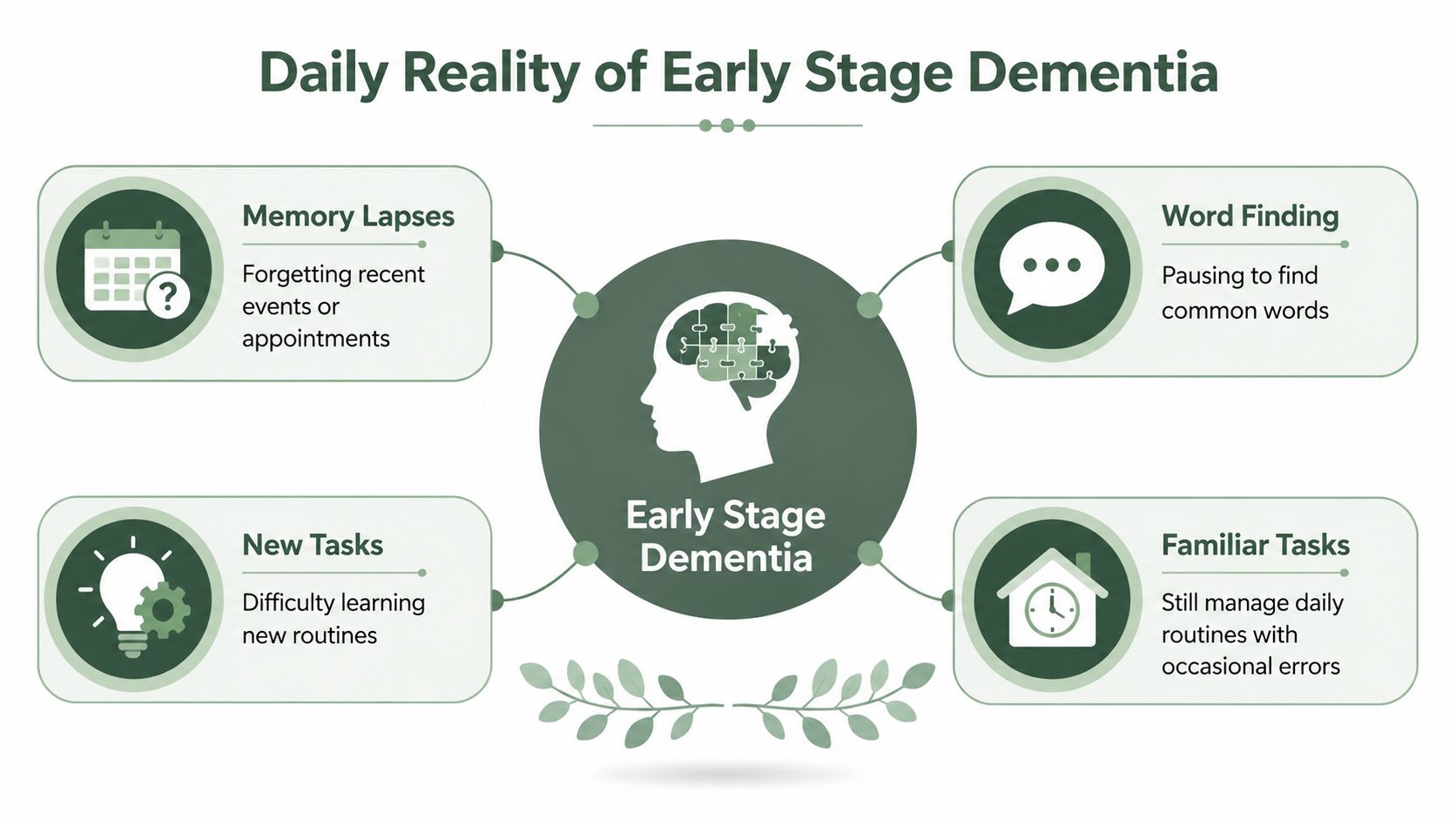
Early stage dementia can be misleading because “early” sounds minor, while daily life can still look fairly intact. A person may still recognize friends, speak naturally, and manage familiar routines, but recent memory starts slipping in ways that interrupt the flow of the day. Families usually notice repetition, slower word-finding, trouble learning a new routine, and mistakes with tasks that used to run on autopilot.
What still works, and what starts to wobble
A person in this stage may still handle social situations well. They can joke at the table, follow familiar traditions, and seem like themselves, which is why families sometimes assume they are “fine.” The strain shows up when something changes, a new appointment, a different route, an unfamiliar bill, or a request that depends on short-term memory rather than long-term habit.
A population-representative U.S. study found that many older adults received a dementia diagnosis at mild cognitive impairment or mild dementia stages, and that share improved over time (PMC study). In everyday terms, many families begin caregiving while the person is still fairly functional, not when they are fully dependent.
That is why the word mild can be confusing. It does not mean the condition is easy. It means the person may still do many things for themselves, but with growing effort, reminders, and occasional mistakes.
Why this window matters
Early support has the greatest effect here because there is still enough function to preserve and enough awareness to involve the person in decisions. The goal is not to strip away responsibility. It is to build supports around the parts that are starting to slip before those slips turn into safety problems.
The best early-stage support is often invisible. It keeps the person doing what they can, while quietly reducing the chances that one missed detail turns into a bigger problem.
Communication Strategies That Reduce Friction
The fastest way to create stress at home is to ask too much in one sentence. A person with early memory loss may be able to answer, but not while holding three ideas at once. Short, single-topic language gives the brain less to sort through, and that usually lowers defensiveness.
Say less, wait more
Try “It's time for lunch. Would you like soup or a sandwich?” instead of “What do you want to do about eating, and do you think you're hungry yet?” One question works better than three. Two choices work better than an open-ended prompt when the person is already tired or unsure.
When words get stuck, keep your face relaxed and don't rush to fill the silence. Silence is not failure. It's often just the moment when the person is reaching for the right word.
Redirect instead of correcting
If your mother says her sister is coming by, and her sister died years ago, correcting the fact can create grief all over again. It usually works better to respond to the feeling underneath it. You might say, “You're thinking about her a lot today,” and then move the conversation to something comforting or concrete.
Practical language: “Let me help with that” lands better than “You already told me that.”
Avoid asking, “Don't you remember?” It puts the person on the spot and turns memory into a test they can fail. A calmer phrase is, “I've got it written down,” or “Let me check the note.”
This kind of conversation doesn't erase the disease. It lowers friction. That matters, because each tense interaction can leave the person more anxious and less willing to accept help later.
Building a Daily Anchor Routine
A daily anchor routine gives the day a shape the brain can recognize. For someone with early memory loss, that often means the same wake-up window, the same meal rhythm, a steady cue for medications, and one familiar activity that marks the day as moving along. The routine does not need to be rigid. It needs to be reliable enough that each part of the day feels less confusing and fewer missed details turn into a bigger problem.

The Alzheimer's Association recommends preserving independence when there is no immediate injury risk and using practical supports such as daily routines, exercise, a balanced diet, and medication or appointment reminders, because early-stage patients often still function relatively independently but need help with recent memory, finances, travel to new places, and adherence tasks (Alzheimer's Association early-stage guidance). That balance matters. Families are trying to give enough structure to reduce errors without making every choice feel supervised.
Keep the day visually simple
A whiteboard in the kitchen can do more than a stack of verbal reminders. Write the day, the meal plan, and one important appointment or activity. Labeled drawers help too, especially for items the person reaches for often, like keys, chargers, and reading glasses.
The goal is not to redesign the house. Remove one tripping hazard, clear one cluttered walkway, and make one frequently used item easier to find. Small changes are easier to accept than a full safety overhaul, and they support independence without turning the home into a reminder system.
If you want a deeper, practical guide for the home rhythm itself, daily routines for seniors with early memory loss is a useful place to start.
Introduce structure without sounding controlling
A helpful frame is, “I want to make the day easier, not take over.” That keeps the conversation focused on comfort and independence rather than monitoring. If the person reacts as though they are being watched, pause and explain the benefit in plain language.
The strongest routines are tied to something meaningful, not just efficient. A short walk after lunch, a favorite radio show before dinner, or folding towels together can make structure feel like part of life instead of a schedule imposed from outside.
Tracking Changes Between Doctor Visits
Families often leave the appointment and realize they can't remember the details the clinician asked for. That's normal. A simple weekly log solves most of that problem without turning home into a charting unit.
Write down patterns, not every detail
Track sleep, meals, missed medications, mood changes, falls, unusual confusion, and moments when something felt clearly different. Those are the facts that help clinicians see whether the issue is stable, getting worse, or being triggered by something in the environment. You don't need to record every conversation or every repeated question.
A one-page note on the fridge can work. So can a shared phone note or a paper calendar. The point is to capture enough signal that the next visit feels informed instead of vague.
What not to overtrack
Don't document every normal lapse. Don't turn every repetitive question into an emergency note. And don't write long paragraphs that no one will read later.
Use this filter: if it doesn't change care, it probably doesn't need to be logged.
What does deserve attention is a cluster. If missed medications, poor sleep, and new confusion show up together, that pattern is more useful than any single incident. Families are not trying to diagnose at home. They're trying to make the next conversation with the clinician sharper and more useful.
The global picture explains why this matters. At least 1 in 5 people living with dementia receive no care in daily life, and in the U.S. 86% lacked formal support, while in Europe and England over 70% went without formal assistance (PMC review). A good home log won't close that gap, but it can make the support you do have more effective.
Where Phone Based Cognitive Support Fits
Phone-based support sits between clinic visits and whatever family members can realistically provide. It's useful when the person still benefits from conversation, reminders, and light cognitive work, but doesn't need a full in-person care shift. It also lowers the friction that comes with apps, devices, and passwords.
A program like Velma uses scheduled calls with conversation, cognitive exercises, reminders, and check-ins. It's one option for families who want regular contact without asking the person to learn new technology. A dedicated care manager also gives families a place for updates and coordination, which matters when details are spread across relatives, clinicians, and paid helpers.
What phone support is actually doing
The World Alzheimer Report summarizes randomized controlled trials showing that cognitive stimulation improves cognitive function in mild dementia, and that caregiver multicomponent interventions and case management improve carer mood and reduce institutionalization risk (World Alzheimer Report). That matters because phone-based programs operationalize those same ingredients at home, through orientation, reminiscence, language, attention tasks, and recurring human contact.
This isn't meant to replace family. It fills the gaps between visits, especially when someone is alone for long stretches or when family members need another set of eyes on mood, confusion, or follow-through. It also gives the person a consistent voice and rhythm, which can be calming when the rest of life feels less predictable.
Here's a short video overview you can share with relatives who want to understand the model more quickly.
What it does not replace
Phone-based support doesn't stop the need for medical care, and it doesn't solve every safety issue. It can't supervise a stove, drive someone to the pharmacy, or make legal decisions. What it can do is make daily life more visible and more consistent, which gives families better information and fewer surprises.
If you want a practical look at the rhythm of those calls, daily check-in calls for seniors is a helpful reference point.
Building the Wider Care Team and Knowing When to Step Up
Early stage dementia care works better when the load is shared. One person can't be the memory keeper, the emotional anchor, the transportation desk, the medication backstop, and the future planner forever. A workable team usually includes family, a primary clinician, possibly a neurologist or geriatrician, and community help that fits the household.
The WHO's dementia figures make the need for coordination hard to ignore. 57 million people were living with dementia in 2021, the total is projected to rise to 78 million by 2030 and 139 million by 2050, and the global economic cost is already above US$1.3 trillion annually (WHO dementia fact sheet). Those numbers describe a public-health challenge, but they also describe why families need systems, not just good intentions.
Divide roles before confusion does it for you
One person can handle appointments, another can keep the medication list updated, and another can check in on meals or transportation. A short family meeting every week or two helps keep everyone from duplicating work or assuming someone else already handled it. The meeting does not need to be formal. It just needs to be regular.
This is also where community services matter. Adult day programs, home health, and phone-based support can absorb some of the day-to-day load. The point is to choose tasks that fit the person's current needs, not to assemble every available service at once.
Know when it's time to add help
Some signs mean the care plan needs more support. Repeated falls, wandering, missed medications that affect health, sudden behavior changes, or caregiver burnout are all signs that the current setup is too thin. When those problems start showing up, the question is no longer whether the family can stretch a little more. It's whether the person is still safe and whether the caregiver can keep going.
If the household starts organizing itself around preventing the next emergency, the plan has already become too fragile.
That's the moment to step up, not as a failure, but as a practical response to a changing disease.
Your First Thirty Days A Short Family Plan
Start with the pieces that reduce confusion fastest. Schedule the clinical appointment, build one anchor routine, and begin a one-page weekly log so the next conversation with the doctor is based on facts, not memory. Have one honest conversation about future wishes while the person still has enough capacity to participate fully.
Then look at the support around the edges. If the person is alone a lot, or if family check-ins are already stretched thin, consider adding a phone-based cognitive support layer for regular contact and reminders. Early stage dementia care works best when it feels like support woven into normal life, not a pile of emergency decisions.
If you need a steady, low-burden way to add structure between visits, Velma offers scheduled phone-based cognitive support, reminders, and care coordination for people in the early to mid stages of memory loss. Visit Velma to see how a daily check-in layer can fit alongside family care, medical follow-up, and the routines already happening at home.
The first sign is often small. A mother asks the same question twice in ten minutes, a spouse starts covering the bills because a stack of envelopes has gone unopened, and everyone in the house wonders whether they're overreacting. Then the diagnosis lands, and the room changes again, because now the uncertainty has a name but not yet a plan.
Early stage dementia care begins in that narrow space between “something is off” and “we need more help.” Families don't need to wait for a crisis to start making life easier, safer, and less confusing. A useful place to begin is to trust the pattern you're seeing, not just the single bad day. If you're trying to tell the difference between normal aging and a real shift, this guide from early signs of memory loss in aging parents is a practical companion.
The work ahead is not just medical. It's relational, daily, and surprisingly concrete. Small changes in how you talk, how you structure the day, and how you notice trouble can keep more independence intact for longer, which matters when so much of dementia care already falls on families. The World Health Organization reported 57 million people living with dementia in 2021, with nearly 10 million new cases each year, and projections rising to 78 million by 2030 and 139 million by 2050. The scale is enormous, but the day-to-day reality is still one household, one conversation, one calendar, one meal at a time (WHO dementia fact sheet).
Table of Contents
The Moment Families Realize Something Has Changed
What Early Stage Dementia Looks Like Day to Day
What still works, and what starts to wobble
Why this window matters
Communication Strategies That Reduce Friction
Say less, wait more
Redirect instead of correcting
Building a Daily Anchor Routine
Keep the day visually simple
Introduce structure without sounding controlling
Tracking Changes Between Doctor Visits
Write down patterns, not every detail
What not to overtrack
Where Phone Based Cognitive Support Fits
What phone support is actually doing
What it does not replace
Building the Wider Care Team and Knowing When to Step Up
Divide roles before confusion does it for you
Know when it's time to add help
Your First Thirty Days A Short Family Plan
The Moment Families Realize Something Has Changed
It usually doesn't begin with one dramatic event. A daughter notices that her mother asks about the same dentist appointment again after lunch. A husband finds himself taking over the checkbook because his wife is suddenly “just tired” every time the bills come out. Nobody says the word dementia right away, because the changes still look too ordinary to name.
That's why early stage dementia care often starts before people feel ready. The person may still make coffee, host dinner, pay some bills, and hold a conversation that sounds mostly normal. What shifts first is the amount of effort those tasks take, and the number of workarounds the family builds around them.
The most disorienting part is that everyone still sees a capable adult. That's real, and it's also why families miss the point for so long. Mild changes don't mean “nothing is happening.” They mean the support needs are small enough to miss, but important enough to matter.
Practical rule: if the family starts compensating for a task more than once a week, the task is no longer simple for the person living with dementia.
That doesn't mean taking over every responsibility. It means noticing which parts of the day now require a prompt, a second look, or a slower pace. The right response is usually gentle structure, not a sudden loss of autonomy.
What Early Stage Dementia Looks Like Day to Day
Early stage dementia can be misleading because “early” sounds minor, while daily life can still look fairly intact. A person may still recognize friends, speak naturally, and manage familiar routines, but recent memory starts slipping in ways that interrupt the flow of the day. Families usually notice repetition, slower word-finding, trouble learning a new routine, and mistakes with tasks that used to run on autopilot.
What still works, and what starts to wobble
A person in this stage may still handle social situations well. They can joke at the table, follow familiar traditions, and seem like themselves, which is why families sometimes assume they are “fine.” The strain shows up when something changes, a new appointment, a different route, an unfamiliar bill, or a request that depends on short-term memory rather than long-term habit.
A population-representative U.S. study found that many older adults received a dementia diagnosis at mild cognitive impairment or mild dementia stages, and that share improved over time (PMC study). In everyday terms, many families begin caregiving while the person is still fairly functional, not when they are fully dependent.
That is why the word mild can be confusing. It does not mean the condition is easy. It means the person may still do many things for themselves, but with growing effort, reminders, and occasional mistakes.
Why this window matters
Early support has the greatest effect here because there is still enough function to preserve and enough awareness to involve the person in decisions. The goal is not to strip away responsibility. It is to build supports around the parts that are starting to slip before those slips turn into safety problems.
The best early-stage support is often invisible. It keeps the person doing what they can, while quietly reducing the chances that one missed detail turns into a bigger problem.
Communication Strategies That Reduce Friction
The fastest way to create stress at home is to ask too much in one sentence. A person with early memory loss may be able to answer, but not while holding three ideas at once. Short, single-topic language gives the brain less to sort through, and that usually lowers defensiveness.
Say less, wait more
Try “It's time for lunch. Would you like soup or a sandwich?” instead of “What do you want to do about eating, and do you think you're hungry yet?” One question works better than three. Two choices work better than an open-ended prompt when the person is already tired or unsure.
When words get stuck, keep your face relaxed and don't rush to fill the silence. Silence is not failure. It's often just the moment when the person is reaching for the right word.
Redirect instead of correcting
If your mother says her sister is coming by, and her sister died years ago, correcting the fact can create grief all over again. It usually works better to respond to the feeling underneath it. You might say, “You're thinking about her a lot today,” and then move the conversation to something comforting or concrete.
Practical language: “Let me help with that” lands better than “You already told me that.”
Avoid asking, “Don't you remember?” It puts the person on the spot and turns memory into a test they can fail. A calmer phrase is, “I've got it written down,” or “Let me check the note.”
This kind of conversation doesn't erase the disease. It lowers friction. That matters, because each tense interaction can leave the person more anxious and less willing to accept help later.
Building a Daily Anchor Routine
A daily anchor routine gives the day a shape the brain can recognize. For someone with early memory loss, that often means the same wake-up window, the same meal rhythm, a steady cue for medications, and one familiar activity that marks the day as moving along. The routine does not need to be rigid. It needs to be reliable enough that each part of the day feels less confusing and fewer missed details turn into a bigger problem.
The Alzheimer's Association recommends preserving independence when there is no immediate injury risk and using practical supports such as daily routines, exercise, a balanced diet, and medication or appointment reminders, because early-stage patients often still function relatively independently but need help with recent memory, finances, travel to new places, and adherence tasks (Alzheimer's Association early-stage guidance). That balance matters. Families are trying to give enough structure to reduce errors without making every choice feel supervised.
Keep the day visually simple
A whiteboard in the kitchen can do more than a stack of verbal reminders. Write the day, the meal plan, and one important appointment or activity. Labeled drawers help too, especially for items the person reaches for often, like keys, chargers, and reading glasses.
The goal is not to redesign the house. Remove one tripping hazard, clear one cluttered walkway, and make one frequently used item easier to find. Small changes are easier to accept than a full safety overhaul, and they support independence without turning the home into a reminder system.
If you want a deeper, practical guide for the home rhythm itself, daily routines for seniors with early memory loss is a useful place to start.
Introduce structure without sounding controlling
A helpful frame is, “I want to make the day easier, not take over.” That keeps the conversation focused on comfort and independence rather than monitoring. If the person reacts as though they are being watched, pause and explain the benefit in plain language.
The strongest routines are tied to something meaningful, not just efficient. A short walk after lunch, a favorite radio show before dinner, or folding towels together can make structure feel like part of life instead of a schedule imposed from outside.
Tracking Changes Between Doctor Visits
Families often leave the appointment and realize they can't remember the details the clinician asked for. That's normal. A simple weekly log solves most of that problem without turning home into a charting unit.
Write down patterns, not every detail
Track sleep, meals, missed medications, mood changes, falls, unusual confusion, and moments when something felt clearly different. Those are the facts that help clinicians see whether the issue is stable, getting worse, or being triggered by something in the environment. You don't need to record every conversation or every repeated question.
A one-page note on the fridge can work. So can a shared phone note or a paper calendar. The point is to capture enough signal that the next visit feels informed instead of vague.
What not to overtrack
Don't document every normal lapse. Don't turn every repetitive question into an emergency note. And don't write long paragraphs that no one will read later.
Use this filter: if it doesn't change care, it probably doesn't need to be logged.
What does deserve attention is a cluster. If missed medications, poor sleep, and new confusion show up together, that pattern is more useful than any single incident. Families are not trying to diagnose at home. They're trying to make the next conversation with the clinician sharper and more useful.
The global picture explains why this matters. At least 1 in 5 people living with dementia receive no care in daily life, and in the U.S. 86% lacked formal support, while in Europe and England over 70% went without formal assistance (PMC review). A good home log won't close that gap, but it can make the support you do have more effective.
Where Phone Based Cognitive Support Fits
Phone-based support sits between clinic visits and whatever family members can realistically provide. It's useful when the person still benefits from conversation, reminders, and light cognitive work, but doesn't need a full in-person care shift. It also lowers the friction that comes with apps, devices, and passwords.
A program like Velma uses scheduled calls with conversation, cognitive exercises, reminders, and check-ins. It's one option for families who want regular contact without asking the person to learn new technology. A dedicated care manager also gives families a place for updates and coordination, which matters when details are spread across relatives, clinicians, and paid helpers.
What phone support is actually doing
The World Alzheimer Report summarizes randomized controlled trials showing that cognitive stimulation improves cognitive function in mild dementia, and that caregiver multicomponent interventions and case management improve carer mood and reduce institutionalization risk (World Alzheimer Report). That matters because phone-based programs operationalize those same ingredients at home, through orientation, reminiscence, language, attention tasks, and recurring human contact.
This isn't meant to replace family. It fills the gaps between visits, especially when someone is alone for long stretches or when family members need another set of eyes on mood, confusion, or follow-through. It also gives the person a consistent voice and rhythm, which can be calming when the rest of life feels less predictable.
Here's a short video overview you can share with relatives who want to understand the model more quickly.
What it does not replace
Phone-based support doesn't stop the need for medical care, and it doesn't solve every safety issue. It can't supervise a stove, drive someone to the pharmacy, or make legal decisions. What it can do is make daily life more visible and more consistent, which gives families better information and fewer surprises.
If you want a practical look at the rhythm of those calls, daily check-in calls for seniors is a helpful reference point.
Building the Wider Care Team and Knowing When to Step Up
Early stage dementia care works better when the load is shared. One person can't be the memory keeper, the emotional anchor, the transportation desk, the medication backstop, and the future planner forever. A workable team usually includes family, a primary clinician, possibly a neurologist or geriatrician, and community help that fits the household.
The WHO's dementia figures make the need for coordination hard to ignore. 57 million people were living with dementia in 2021, the total is projected to rise to 78 million by 2030 and 139 million by 2050, and the global economic cost is already above US$1.3 trillion annually (WHO dementia fact sheet). Those numbers describe a public-health challenge, but they also describe why families need systems, not just good intentions.
Divide roles before confusion does it for you
One person can handle appointments, another can keep the medication list updated, and another can check in on meals or transportation. A short family meeting every week or two helps keep everyone from duplicating work or assuming someone else already handled it. The meeting does not need to be formal. It just needs to be regular.
This is also where community services matter. Adult day programs, home health, and phone-based support can absorb some of the day-to-day load. The point is to choose tasks that fit the person's current needs, not to assemble every available service at once.
Know when it's time to add help
Some signs mean the care plan needs more support. Repeated falls, wandering, missed medications that affect health, sudden behavior changes, or caregiver burnout are all signs that the current setup is too thin. When those problems start showing up, the question is no longer whether the family can stretch a little more. It's whether the person is still safe and whether the caregiver can keep going.
If the household starts organizing itself around preventing the next emergency, the plan has already become too fragile.
That's the moment to step up, not as a failure, but as a practical response to a changing disease.
Your First Thirty Days A Short Family Plan
Start with the pieces that reduce confusion fastest. Schedule the clinical appointment, build one anchor routine, and begin a one-page weekly log so the next conversation with the doctor is based on facts, not memory. Have one honest conversation about future wishes while the person still has enough capacity to participate fully.
Then look at the support around the edges. If the person is alone a lot, or if family check-ins are already stretched thin, consider adding a phone-based cognitive support layer for regular contact and reminders. Early stage dementia care works best when it feels like support woven into normal life, not a pile of emergency decisions.
If you need a steady, low-burden way to add structure between visits, Velma offers scheduled phone-based cognitive support, reminders, and care coordination for people in the early to mid stages of memory loss. Visit Velma to see how a daily check-in layer can fit alongside family care, medical follow-up, and the routines already happening at home.
Suggested Article: