Mild Cognitive Impairment Treatment: A 2026 Guide

You're usually not calling the doctor because of one dramatic event. It's more often the small, unnerving stuff, a parent asks the same question three times, forgets whether the stove is off, misses a bill, or seems less interested in conversations they used to enjoy. That's when families start wondering whether this is “just aging” or something more.
Mild cognitive impairment treatment starts with that question, but it doesn't end with a prescription. MCI is a real clinical stage, and the best care is usually a workup-first process that looks for reversible causes, then layers in exercise, cognitive support, routine, and safety planning. For an adult child, that can feel less dramatic than a pill bottle, but it's often more useful.
Table of Contents
When Memory Changes Feel Like Something More
What MCI Is and How It Is Diagnosed
What clinicians look for
Why the label is only the beginning
The Workup as the First Treatment
What gets checked
Why this changes the treatment plan
Why Medication Has Not Delivered and What to Expect
What that means in real life
How to read claims about supplements and brain boosters
Lifestyle Interventions That Move the Needle
How Cognitive Stimulation and Phone-Based Programs Fit In
Structured support versus casual brain games
Where scheduled calls help
Coordinating Care, Safety, and Daily Routines
Make the home easier to navigate
Reduce friction, not independence
Monitoring Progress and Planning for What Comes Next
What progress looks like
When to revisit the plan
When Memory Changes Feel Like Something More
Your mother asks where the car keys are, then asks again ten minutes later. Your father leaves the oven on twice in one week. Or maybe the change is quieter, a parent stops making plans, withdraws from calls, or seems embarrassed when they lose their train of thought. Those moments can feel like a family secret nobody wants to name.
That's where mild cognitive impairment fits. It's not the same thing as normal aging, and it's not the same thing as dementia. It's a recognized clinical stage where thinking changes are noticeable enough to matter, but daily life is still mostly intact.
For families, the hard part is uncertainty. A parent may still handle the basics, yet need reminders, structure, or help with decisions. That in-between zone is exactly why mild cognitive impairment treatment matters early, because the goal is often to preserve function, not chase a cure that doesn't exist.
The practical question is less, “Is this the end?” and more, “What can help right now?” That answer usually includes a medical workup, changes at home, and structured engagement that doesn't rely on memory alone. The earlier those supports start, the easier it is to keep a person safer and less frustrated.
If you're trying to spot the difference between ordinary forgetfulness and something that deserves evaluation, this guide on early signs of memory loss in aging parents is a useful companion.
What MCI Is and How It Is Diagnosed
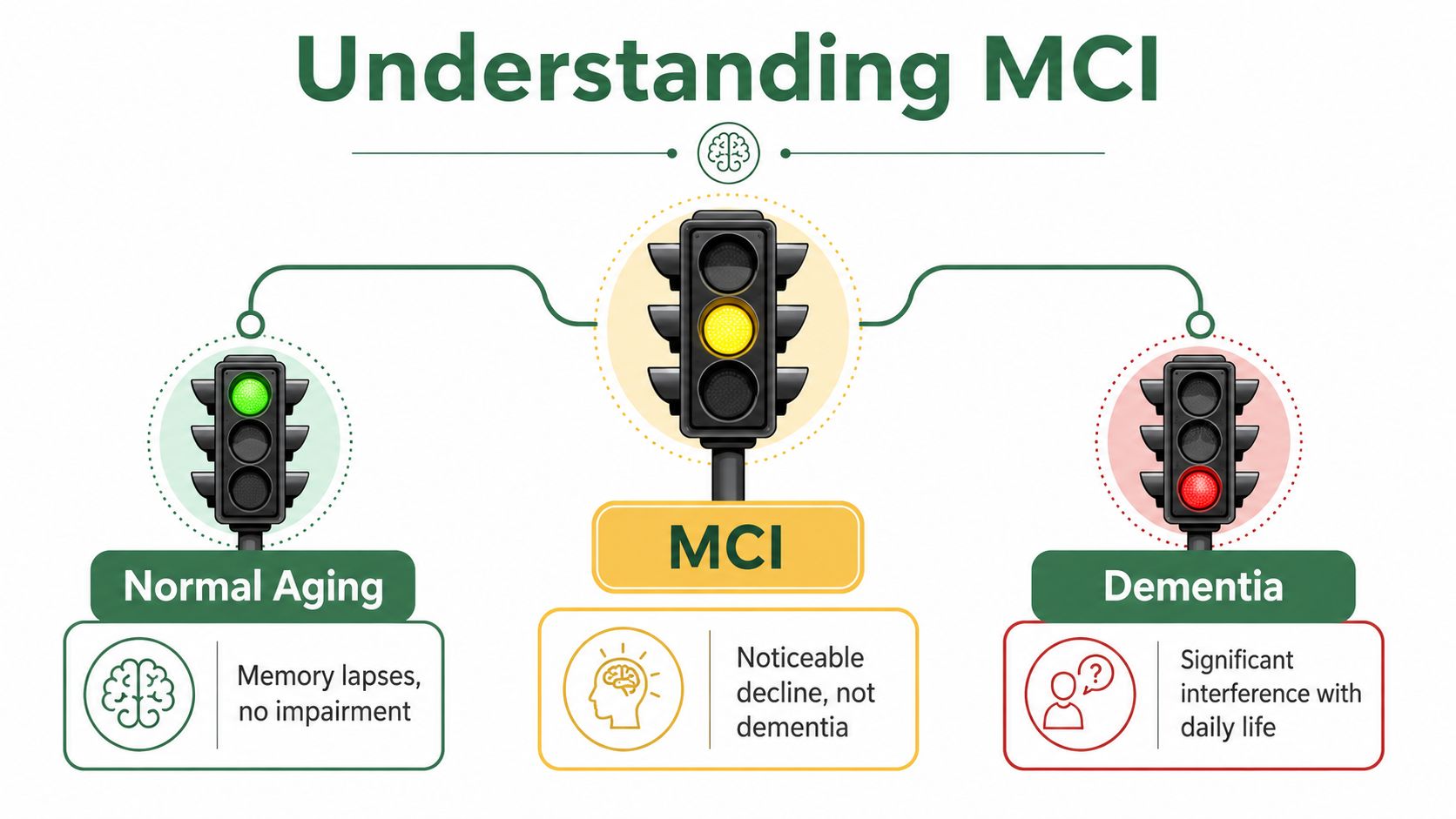
MCI sits between normal aging and dementia, like a yellow traffic light that tells the family to slow down and look more closely. Thinking changes are real, but day-to-day independence is still mostly there. Clinicians pay attention to both memory and the ability to manage ordinary life, because the diagnosis depends on that balance.
What clinicians look for
A good visit usually starts with concrete examples. The clinician wants to hear whether the person is repeating themselves, missing appointments, getting lost in familiar places, or having trouble finding words and organizing tasks. They also ask whether these changes are affecting bills, medicines, meals, driving, or other daily responsibilities.
That distinction matters because MCI is a measurable change in one or more thinking skills, with enough function preserved that it does not meet the level of dementia. Families often miss it when a parent is able to cover mistakes, rely on habits, or brush off concerns with a quick explanation.
Primary care does not always catch it early. In real life, diagnosis is often delayed because families treat the symptoms as ordinary aging, the appointment is rushed, or the concern gets folded into a general sense of “getting older.” For a broader primer on age-related cognitive change, cognitive decline in older adults offers a useful way to compare familiar changes with warning signs.
Why the label is only the beginning
MCI is one diagnosis label, but the reasons behind it are varied. Some cases are linked to vascular change, some to early Alzheimer's pathology, and some to reversible contributors that can look like memory loss from the outside. That mix is why treatment cannot be one-size-fits-all.
Practical rule: the diagnosis matters, but the cause matters more. If part of the picture can be improved, the plan should target that first.
The infographic below helps families keep the categories straight without medical jargon.
The Workup as the First Treatment
Before anyone talks about supplements or specialty drugs, the first step is a careful search for contributors that can be improved. That's not a delay in treatment. It is treatment, because the right fix can change what a person can do day to day.
What gets checked
Clinicians usually review medications first, because side effects and medication burden can cloud attention, slow thinking, and worsen confusion. They also screen for depression, sleep problems, vitamin issues, hearing or vision loss, and vascular risks that affect brain health. The Cleveland Clinic's overview of MCI emphasizes that treatment depends on the cause and that clinicians should adjust medications and treat underlying conditions, rather than assuming every case is a generic memory problem (Cleveland Clinic).

A visit may feel repetitive, but each piece matters for a reason. A medication review can uncover drugs that are making a person groggy or unsteady. A depression screen can separate low mood from memory loss. Sleep history can reveal untreated sleep apnea. Blood pressure and other vascular risks matter because the brain doesn't function well when the circulation around it is under strain.
Why this changes the treatment plan
The point is not to “blame” one problem for all the changes. The point is to find the part that can be changed. When families hear that a parent has MCI, they often assume the next step is a memory drug. In practice, the next step is usually a diagnostic cleanup.
Clinical shortcut: if the thinking problem worsened around a medication change, a sleep change, a mood shift, or a hearing decline, that clue belongs at the center of the treatment plan.
This is also where families can help by bringing a medication list, symptom timeline, and real-world examples to the appointment. The more concrete the history, the faster a clinician can decide what to adjust, treat, or monitor.
Why Medication Has Not Delivered and What to Expect
Families often hope for a pill that clears the fog. That hope makes sense, but the evidence has not matched it. For generic mild cognitive impairment, major guidelines and reviews still report no FDA-approved or broadly accepted pharmacologic treatment, and cholinesterase inhibitors have not shown consistent benefit on cognition or on conversion to dementia (guideline review).
What that means in real life
Medication still matters, just in a narrower way than many families expect. If depression is part of the picture, treating mood can improve day-to-day thinking. If blood pressure is high, controlling it matters. If a medicine is making someone foggy, changing it may help. A drug that specifically treats MCI itself is not available.
That is often the first hard message families hear. “There is no approved drug” can sound like “there is nothing to do.” That reading is too bleak. It means the most useful work usually sits outside the narrow idea of a memory pill, starting with a careful workup and then building the rest of care around what the person can still do.
The American Academy of Neurology guideline update found that in people with MCI, 6 months of exercise training is likely to improve cognitive measures, and cognitive training may improve cognitive measures (AAN guideline and related evidence). A later review of non-pharmacological interventions reported an average MoCA increase of 3.84 points in the studies it included. Those findings do not mean every person improves by the same amount, but they do show why medication alone has not delivered the results families hope for.
A useful way to frame this is by comparison. A memory drug, if it helped, would be like trying to fix a house by changing one light bulb. MCI care works better when the team checks the wiring first, then adds habits that support the whole system, such as exercise, sleep, and structured mental activity.
How to read claims about supplements and brain boosters
If a product promises fast reversal, better memory, or a “natural cure,” pause. MCI care has not been won by marketing language. It has been built around diagnosis, repetition, exercise, and structured support.
The safest stance is simple. If a treatment claim cannot be tied to a thorough workup, a function goal, or a measurable daily change, it probably belongs in the “unproven” pile.
Lifestyle Interventions That Move the Needle
The changes that help most are often the least flashy. Exercise, daily routine, sleep, nutrition, and social contact may sound ordinary, but they support the brain systems that memory depends on. In mild cognitive impairment treatment, that matters because the goal is to strengthen the person's day-to-day function, not chase a quick fix.
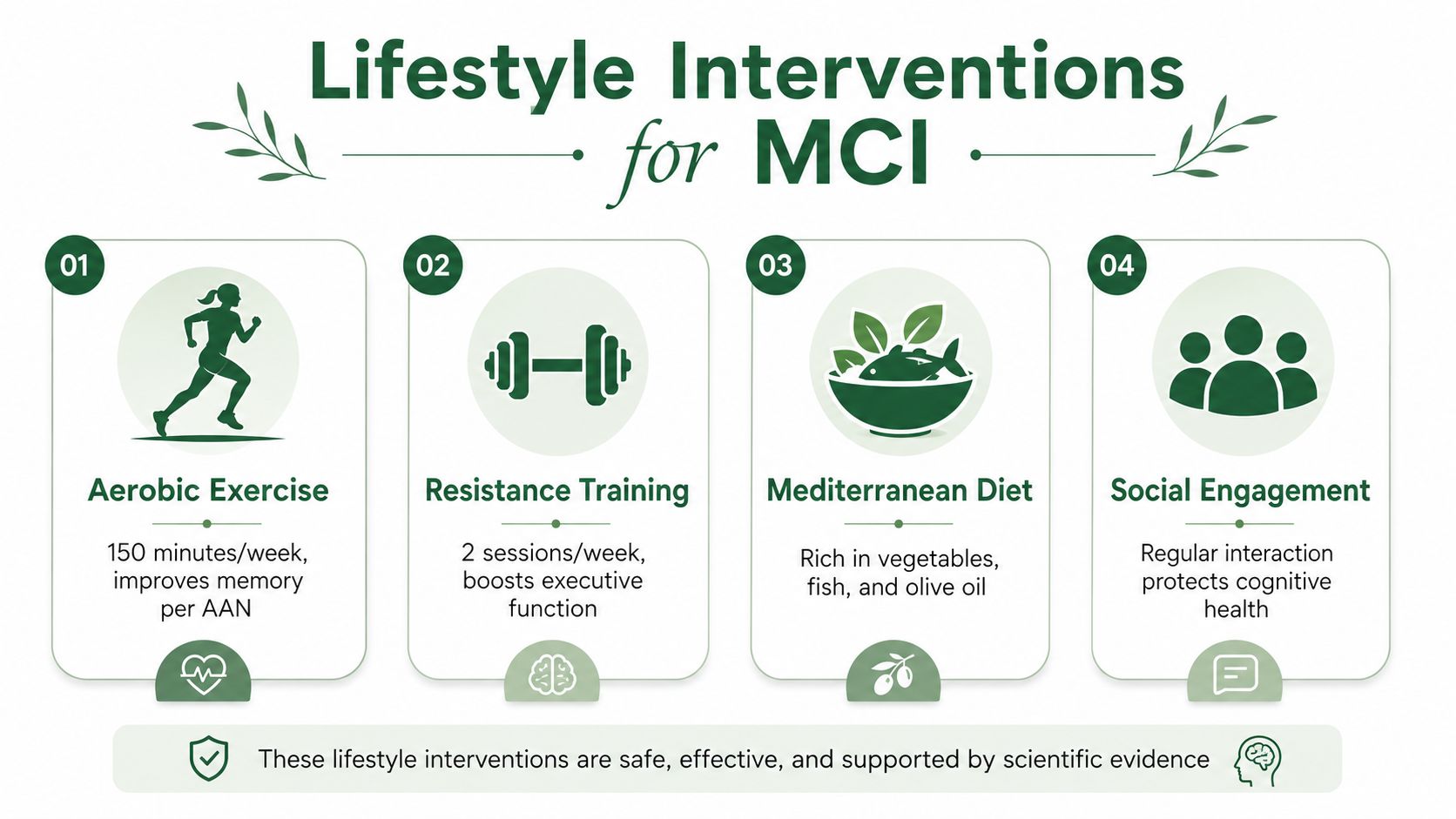
Start with movement. The American Academy of Neurology guideline found that exercise training is likely to improve cognitive measures in MCI, and families do not need a perfect fitness plan to begin. A steady walking routine, a safe stationary bike, chair-based strength work, or a supervised class can all be reasonable if the person will do them and can do them safely.
Repeatability matters more than ambition. If a parent can keep up a routine, that routine becomes part of treatment, not just a well-meaning idea on paper. A small plan that happens every week usually helps more than a large plan that never gets off the ground.
Food works the same way. The most helpful pattern is the one a family can keep using at home, at the store, and at the dinner table. A Mediterranean-style approach is practical because it is familiar and flexible, with more vegetables, fish, olive oil, beans, and fewer ultra-processed foods. It does not have to be perfect to be useful.
Sleep deserves the same attention. Broken sleep can make a person seem more forgetful than they really are, which is confusing for families who are trying to tell the difference between tiredness and true decline. Social contact helps too, because long stretches of isolation can make mood symptoms worse and make changes in memory easier to miss.
A simple next step is to build one reliable anchor into the day.
Morning walk: Pair it with breakfast so it happens before the day gets crowded.
Fixed medication time: Use alarms, pill organizers, or family prompts so doses are not guessed.
Scheduled human contact: A phone call, senior center visit, faith group, or lunch with a neighbor can all count.
Kitchen routine: Keep the same places for keys, glasses, and commonly used items so there is less searching.
Practical rule: the best lifestyle plan is the one a family can repeat on an ordinary Tuesday, not just on a motivated Sunday.
The image below gives a quick visual summary of the core habits families can put into place.
How Cognitive Stimulation and Phone-Based Programs Fit In
Not all brain exercises are equal. A casual puzzle app is not the same thing as structured cognitive stimulation, which uses repetition, cues, conversation, and tasks matched to the person's ability. That difference matters because older adults usually do better when the support is human, routine-based, and tied to everyday life.
Structured support versus casual brain games
Cognitive stimulation can include orientation to time and place, language tasks, attention practice, reminiscence prompts, and memory cues that fit the person's level. It's less about “staying busy” and more about giving the brain repeated, guided practice with skills that are slipping. The approach described in this overview of cognitive stimulation therapy aligns with that idea, especially when families need something consistent rather than improvised.
A phone-based program can fit well here because it lowers the barrier to participation. No app to learn. No new device to charge. No password to forget. For a parent who is comfortable on the phone, that simplicity can be the difference between daily engagement and another abandoned tool.
Where scheduled calls help
Velma is one example of a phone-based cognitive support program. It uses scheduled calls, guided exercises, mood and companionship support, and safety check-ins, which can be useful for families trying to keep a routine steady without depending on screens or apps. That kind of structure is not a replacement for medical care, but it can support the day-to-day follow-through that MCI care needs.
The video below is useful for families comparing therapy-style support with ordinary digital brain games.
If you're choosing among options, the question isn't which one sounds most modern. It's which one the person will accept, repeat, and understand. In-person adult day programs, clinician-led cognitive training, and phone-based support each have a place, but the simplest regular option often gets the most real-world use.
Coordinating Care, Safety, and Daily Routines
A good plan falls apart if nobody owns it. Families need one system for reminders, one person tracking concerns, and one set of routines that doesn't change every week. Without that, even a solid treatment plan turns into repeated confusion.
Make the home easier to navigate
Start with the tasks that create the most risk. Medications should be placed in a visible, repeatable system. The kitchen should be checked for stove safety, expired food, and clutter that increases falls. Driving deserves an honest review, because getting lost or hesitating in familiar places can be one of the earliest signs that a person needs limits.
Reduce friction, not independence
Independence doesn't mean doing everything alone. It means doing as much as possible safely, with the right level of support. A predictable morning routine, labeled drawers, a shared calendar, and one family contact for updates can remove a surprising amount of stress.
Helpful script: “I'm not trying to take over. I'm trying to make the day easier and safer.”
That sentence helps more than an argument about whether help is needed. So does assigning one relative, care manager, or clinician office as the main point of contact. Families do better when questions don't get lost across five different text threads.
If the person is still living alone, this is the moment to think about whether a home care helper, adult day program, or structured phone check-in would reduce the number of missed details. The right support often looks small from the outside and feels huge inside the household.
Monitoring Progress and Planning for What Comes Next
Treatment for MCI is not a one-time choice. It is a repeating check on what is improving, what is holding steady, and what is slipping. That matters because the diagnosis carries real risk, and the course looks different from one person to the next.
A historical and epidemiologic review reports that about 12% to 18% of adults aged 60+ live with MCI globally, and the annual conversion rate from MCI to dementia is commonly estimated at 8% to 15% per year. In one guideline summary, people older than 65 had a 14.9% cumulative dementia incidence over 2 years. Those figures do not predict what will happen to one person, but they explain why follow-up is part of treatment, not an afterthought.
What progress looks like
Families often watch for a dramatic turnaround, but progress is usually quieter. Fewer repeated questions. Fewer safety problems. Better mood. More regular use of reminders. Less friction around daily tasks. A steady course can count as success too, especially when the person is still doing the activities that matter most to them.
Small changes often matter more than headline changes. A parent who still misplaces things may also be missing fewer appointments, arguing less about routines, or needing less prompting to take medications correctly. That is real progress, even if memory is not back to baseline.
When to revisit the plan
A change in function, a new fall, more confusion, or a major life event should trigger another review. So should a plan that keeps getting ignored, because a plan that does not fit the person's routine is not much of a plan at all.
The best model is layered care. Workup first, then lifestyle changes, then structured cognitive engagement, then coordination and safety. Return to the whole setup every six months, or sooner if the household changes. That keeps treatment practical instead of theoretical.
If you are trying to sort out what your parent needs next, Velma offers scheduled phone-based cognitive support, routine check-ins, and structured engagement that can sit alongside medical care and family caregiving. Visit Velma to see how a phone-based program can fit into a daily routine when memory loss makes consistency hard.
You're usually not calling the doctor because of one dramatic event. It's more often the small, unnerving stuff, a parent asks the same question three times, forgets whether the stove is off, misses a bill, or seems less interested in conversations they used to enjoy. That's when families start wondering whether this is “just aging” or something more.
Mild cognitive impairment treatment starts with that question, but it doesn't end with a prescription. MCI is a real clinical stage, and the best care is usually a workup-first process that looks for reversible causes, then layers in exercise, cognitive support, routine, and safety planning. For an adult child, that can feel less dramatic than a pill bottle, but it's often more useful.
Table of Contents
When Memory Changes Feel Like Something More
What MCI Is and How It Is Diagnosed
What clinicians look for
Why the label is only the beginning
The Workup as the First Treatment
What gets checked
Why this changes the treatment plan
Why Medication Has Not Delivered and What to Expect
What that means in real life
How to read claims about supplements and brain boosters
Lifestyle Interventions That Move the Needle
How Cognitive Stimulation and Phone-Based Programs Fit In
Structured support versus casual brain games
Where scheduled calls help
Coordinating Care, Safety, and Daily Routines
Make the home easier to navigate
Reduce friction, not independence
Monitoring Progress and Planning for What Comes Next
What progress looks like
When to revisit the plan
When Memory Changes Feel Like Something More
Your mother asks where the car keys are, then asks again ten minutes later. Your father leaves the oven on twice in one week. Or maybe the change is quieter, a parent stops making plans, withdraws from calls, or seems embarrassed when they lose their train of thought. Those moments can feel like a family secret nobody wants to name.
That's where mild cognitive impairment fits. It's not the same thing as normal aging, and it's not the same thing as dementia. It's a recognized clinical stage where thinking changes are noticeable enough to matter, but daily life is still mostly intact.
For families, the hard part is uncertainty. A parent may still handle the basics, yet need reminders, structure, or help with decisions. That in-between zone is exactly why mild cognitive impairment treatment matters early, because the goal is often to preserve function, not chase a cure that doesn't exist.
The practical question is less, “Is this the end?” and more, “What can help right now?” That answer usually includes a medical workup, changes at home, and structured engagement that doesn't rely on memory alone. The earlier those supports start, the easier it is to keep a person safer and less frustrated.
If you're trying to spot the difference between ordinary forgetfulness and something that deserves evaluation, this guide on early signs of memory loss in aging parents is a useful companion.
What MCI Is and How It Is Diagnosed
MCI sits between normal aging and dementia, like a yellow traffic light that tells the family to slow down and look more closely. Thinking changes are real, but day-to-day independence is still mostly there. Clinicians pay attention to both memory and the ability to manage ordinary life, because the diagnosis depends on that balance.
What clinicians look for
A good visit usually starts with concrete examples. The clinician wants to hear whether the person is repeating themselves, missing appointments, getting lost in familiar places, or having trouble finding words and organizing tasks. They also ask whether these changes are affecting bills, medicines, meals, driving, or other daily responsibilities.
That distinction matters because MCI is a measurable change in one or more thinking skills, with enough function preserved that it does not meet the level of dementia. Families often miss it when a parent is able to cover mistakes, rely on habits, or brush off concerns with a quick explanation.
Primary care does not always catch it early. In real life, diagnosis is often delayed because families treat the symptoms as ordinary aging, the appointment is rushed, or the concern gets folded into a general sense of “getting older.” For a broader primer on age-related cognitive change, cognitive decline in older adults offers a useful way to compare familiar changes with warning signs.
Why the label is only the beginning
MCI is one diagnosis label, but the reasons behind it are varied. Some cases are linked to vascular change, some to early Alzheimer's pathology, and some to reversible contributors that can look like memory loss from the outside. That mix is why treatment cannot be one-size-fits-all.
Practical rule: the diagnosis matters, but the cause matters more. If part of the picture can be improved, the plan should target that first.
The infographic below helps families keep the categories straight without medical jargon.
The Workup as the First Treatment
Before anyone talks about supplements or specialty drugs, the first step is a careful search for contributors that can be improved. That's not a delay in treatment. It is treatment, because the right fix can change what a person can do day to day.
What gets checked
Clinicians usually review medications first, because side effects and medication burden can cloud attention, slow thinking, and worsen confusion. They also screen for depression, sleep problems, vitamin issues, hearing or vision loss, and vascular risks that affect brain health. The Cleveland Clinic's overview of MCI emphasizes that treatment depends on the cause and that clinicians should adjust medications and treat underlying conditions, rather than assuming every case is a generic memory problem (Cleveland Clinic).
A visit may feel repetitive, but each piece matters for a reason. A medication review can uncover drugs that are making a person groggy or unsteady. A depression screen can separate low mood from memory loss. Sleep history can reveal untreated sleep apnea. Blood pressure and other vascular risks matter because the brain doesn't function well when the circulation around it is under strain.
Why this changes the treatment plan
The point is not to “blame” one problem for all the changes. The point is to find the part that can be changed. When families hear that a parent has MCI, they often assume the next step is a memory drug. In practice, the next step is usually a diagnostic cleanup.
Clinical shortcut: if the thinking problem worsened around a medication change, a sleep change, a mood shift, or a hearing decline, that clue belongs at the center of the treatment plan.
This is also where families can help by bringing a medication list, symptom timeline, and real-world examples to the appointment. The more concrete the history, the faster a clinician can decide what to adjust, treat, or monitor.
Why Medication Has Not Delivered and What to Expect
Families often hope for a pill that clears the fog. That hope makes sense, but the evidence has not matched it. For generic mild cognitive impairment, major guidelines and reviews still report no FDA-approved or broadly accepted pharmacologic treatment, and cholinesterase inhibitors have not shown consistent benefit on cognition or on conversion to dementia (guideline review).
What that means in real life
Medication still matters, just in a narrower way than many families expect. If depression is part of the picture, treating mood can improve day-to-day thinking. If blood pressure is high, controlling it matters. If a medicine is making someone foggy, changing it may help. A drug that specifically treats MCI itself is not available.
That is often the first hard message families hear. “There is no approved drug” can sound like “there is nothing to do.” That reading is too bleak. It means the most useful work usually sits outside the narrow idea of a memory pill, starting with a careful workup and then building the rest of care around what the person can still do.
The American Academy of Neurology guideline update found that in people with MCI, 6 months of exercise training is likely to improve cognitive measures, and cognitive training may improve cognitive measures (AAN guideline and related evidence). A later review of non-pharmacological interventions reported an average MoCA increase of 3.84 points in the studies it included. Those findings do not mean every person improves by the same amount, but they do show why medication alone has not delivered the results families hope for.
A useful way to frame this is by comparison. A memory drug, if it helped, would be like trying to fix a house by changing one light bulb. MCI care works better when the team checks the wiring first, then adds habits that support the whole system, such as exercise, sleep, and structured mental activity.
How to read claims about supplements and brain boosters
If a product promises fast reversal, better memory, or a “natural cure,” pause. MCI care has not been won by marketing language. It has been built around diagnosis, repetition, exercise, and structured support.
The safest stance is simple. If a treatment claim cannot be tied to a thorough workup, a function goal, or a measurable daily change, it probably belongs in the “unproven” pile.
Lifestyle Interventions That Move the Needle
The changes that help most are often the least flashy. Exercise, daily routine, sleep, nutrition, and social contact may sound ordinary, but they support the brain systems that memory depends on. In mild cognitive impairment treatment, that matters because the goal is to strengthen the person's day-to-day function, not chase a quick fix.
Start with movement. The American Academy of Neurology guideline found that exercise training is likely to improve cognitive measures in MCI, and families do not need a perfect fitness plan to begin. A steady walking routine, a safe stationary bike, chair-based strength work, or a supervised class can all be reasonable if the person will do them and can do them safely.
Repeatability matters more than ambition. If a parent can keep up a routine, that routine becomes part of treatment, not just a well-meaning idea on paper. A small plan that happens every week usually helps more than a large plan that never gets off the ground.
Food works the same way. The most helpful pattern is the one a family can keep using at home, at the store, and at the dinner table. A Mediterranean-style approach is practical because it is familiar and flexible, with more vegetables, fish, olive oil, beans, and fewer ultra-processed foods. It does not have to be perfect to be useful.
Sleep deserves the same attention. Broken sleep can make a person seem more forgetful than they really are, which is confusing for families who are trying to tell the difference between tiredness and true decline. Social contact helps too, because long stretches of isolation can make mood symptoms worse and make changes in memory easier to miss.
A simple next step is to build one reliable anchor into the day.
Morning walk: Pair it with breakfast so it happens before the day gets crowded.
Fixed medication time: Use alarms, pill organizers, or family prompts so doses are not guessed.
Scheduled human contact: A phone call, senior center visit, faith group, or lunch with a neighbor can all count.
Kitchen routine: Keep the same places for keys, glasses, and commonly used items so there is less searching.
Practical rule: the best lifestyle plan is the one a family can repeat on an ordinary Tuesday, not just on a motivated Sunday.
The image below gives a quick visual summary of the core habits families can put into place.
How Cognitive Stimulation and Phone-Based Programs Fit In
Not all brain exercises are equal. A casual puzzle app is not the same thing as structured cognitive stimulation, which uses repetition, cues, conversation, and tasks matched to the person's ability. That difference matters because older adults usually do better when the support is human, routine-based, and tied to everyday life.
Structured support versus casual brain games
Cognitive stimulation can include orientation to time and place, language tasks, attention practice, reminiscence prompts, and memory cues that fit the person's level. It's less about “staying busy” and more about giving the brain repeated, guided practice with skills that are slipping. The approach described in this overview of cognitive stimulation therapy aligns with that idea, especially when families need something consistent rather than improvised.
A phone-based program can fit well here because it lowers the barrier to participation. No app to learn. No new device to charge. No password to forget. For a parent who is comfortable on the phone, that simplicity can be the difference between daily engagement and another abandoned tool.
Where scheduled calls help
Velma is one example of a phone-based cognitive support program. It uses scheduled calls, guided exercises, mood and companionship support, and safety check-ins, which can be useful for families trying to keep a routine steady without depending on screens or apps. That kind of structure is not a replacement for medical care, but it can support the day-to-day follow-through that MCI care needs.
The video below is useful for families comparing therapy-style support with ordinary digital brain games.
If you're choosing among options, the question isn't which one sounds most modern. It's which one the person will accept, repeat, and understand. In-person adult day programs, clinician-led cognitive training, and phone-based support each have a place, but the simplest regular option often gets the most real-world use.
Coordinating Care, Safety, and Daily Routines
A good plan falls apart if nobody owns it. Families need one system for reminders, one person tracking concerns, and one set of routines that doesn't change every week. Without that, even a solid treatment plan turns into repeated confusion.
Make the home easier to navigate
Start with the tasks that create the most risk. Medications should be placed in a visible, repeatable system. The kitchen should be checked for stove safety, expired food, and clutter that increases falls. Driving deserves an honest review, because getting lost or hesitating in familiar places can be one of the earliest signs that a person needs limits.
Reduce friction, not independence
Independence doesn't mean doing everything alone. It means doing as much as possible safely, with the right level of support. A predictable morning routine, labeled drawers, a shared calendar, and one family contact for updates can remove a surprising amount of stress.
Helpful script: “I'm not trying to take over. I'm trying to make the day easier and safer.”
That sentence helps more than an argument about whether help is needed. So does assigning one relative, care manager, or clinician office as the main point of contact. Families do better when questions don't get lost across five different text threads.
If the person is still living alone, this is the moment to think about whether a home care helper, adult day program, or structured phone check-in would reduce the number of missed details. The right support often looks small from the outside and feels huge inside the household.
Monitoring Progress and Planning for What Comes Next
Treatment for MCI is not a one-time choice. It is a repeating check on what is improving, what is holding steady, and what is slipping. That matters because the diagnosis carries real risk, and the course looks different from one person to the next.
A historical and epidemiologic review reports that about 12% to 18% of adults aged 60+ live with MCI globally, and the annual conversion rate from MCI to dementia is commonly estimated at 8% to 15% per year. In one guideline summary, people older than 65 had a 14.9% cumulative dementia incidence over 2 years. Those figures do not predict what will happen to one person, but they explain why follow-up is part of treatment, not an afterthought.
What progress looks like
Families often watch for a dramatic turnaround, but progress is usually quieter. Fewer repeated questions. Fewer safety problems. Better mood. More regular use of reminders. Less friction around daily tasks. A steady course can count as success too, especially when the person is still doing the activities that matter most to them.
Small changes often matter more than headline changes. A parent who still misplaces things may also be missing fewer appointments, arguing less about routines, or needing less prompting to take medications correctly. That is real progress, even if memory is not back to baseline.
When to revisit the plan
A change in function, a new fall, more confusion, or a major life event should trigger another review. So should a plan that keeps getting ignored, because a plan that does not fit the person's routine is not much of a plan at all.
The best model is layered care. Workup first, then lifestyle changes, then structured cognitive engagement, then coordination and safety. Return to the whole setup every six months, or sooner if the household changes. That keeps treatment practical instead of theoretical.
If you are trying to sort out what your parent needs next, Velma offers scheduled phone-based cognitive support, routine check-ins, and structured engagement that can sit alongside medical care and family caregiving. Visit Velma to see how a phone-based program can fit into a daily routine when memory loss makes consistency hard.
Suggested Article: