Caregiver Mental Health Support: A Practical Guide

During 2021 to 2022, 25.6% of caregivers had a lifetime diagnosis of depression, compared with 18.6% of noncaregivers in CDC surveillance data, and both groups were worse off than they had been in 2015 to 2016 (CDC report). That gap matters because it shows caregiver mental health is not a vague worry. It's a measurable, common health problem that shows up in national data and keeps showing up.
Caregiver mental health support means giving the caregiver practical help, emotional backup, and clear care coordination so they can keep going without disappearing into the role. For families dealing with dementia, that usually means more than telling someone to rest. It means making the day more manageable, reducing uncertainty, and making sure the caregiver isn't left alone to guess what to do next.
Table of Contents
What Caregiver Mental Health Support Really Means
What belongs under this umbrella
Why Family Caregivers Are Especially at Risk
Time, choice, and invisibility all matter
Warning Signs of Caregiver Stress and Burnout
What burnout sounds and feels like
When to stop guessing and get screened
Evidence-Based Strategies That Actually Help
Tier 1 Daily foundations
Tier 2 Weekly resilience
Tier 3 Professional support
Professional and Community Resources Worth Knowing
How Phone-Based Cognitive Programs Can Help
What the calls actually do
Your First Steps and What to Do This Week
Five-minute self-check
One conversation to schedule
One structural change
What Caregiver Mental Health Support Really Means

A caregiver is often the spouse, adult child, or relative who ends up managing medications, meals, appointments, wandering risk, and the emotional fallout that comes with dementia. Caregiver mental health support is the set of tools, services, and relationships that help that person stay steady while doing that work. It is not a bonus on top of care, and it is not the same thing as telling someone to "take better care of themselves."
The point is bigger than comfort. Caregiver support also has to deal with the way care is organized, because stress rises when the family is left to guess what to do next, who should be called, or how to get help after hours. A simple example is a family that has good intentions but no clear plan for medication changes, bathing help, or what to do when the person with dementia becomes suspicious at night. Even a caring family can feel overwhelmed fast when every day brings a new unknown.
The CDC's 2024 analysis shows why this deserves attention. In 2021 to 2022, caregivers had a 25.6% lifetime prevalence of diagnosed depression, versus 18.6% for noncaregivers, and both groups had higher depression than in 2015 to 2016 (CDC). The same report found frequent mental distress rose for both groups too, which points to a strain that does not go away after a hard week.
What belongs under this umbrella
The phrase covers several layers at once. It includes emotional support, but it also includes help getting through the maze of services, reminders, respite, and actual care coordination. If a family only gets coping tips but no backup, the burden stays in place.
A practical way to look at it is this, support has to touch both feelings and logistics. That can mean a support group, a primary care screening, a respite plan, or someone who helps the family decide which professional to contact first. It can also mean help with grief, especially when the person with dementia is changing in ways that feel like a series of small losses, a topic explored in this guide on grief and dementia. A one-time handout does not do that job.
Practical rule: if the advice does not reduce uncertainty, time pressure, or isolation, it probably is not enough on its own.
The AARP caregiver study makes the lived experience easy to picture without dressing it up. In a survey of 1,001 U.S. adults, the nation's estimated 48 million adult family caregivers reported major emotional strain, with 50% saying caregiving increased emotional stress, 37% saying it increased physical stress, and 39% saying they rarely or never felt relaxed (AARP). That is why caregiver mental health support needs to be concrete, recurring, and tied to the daily care experience, not just a suggestion to "be kind to yourself."
Why Family Caregivers Are Especially at Risk
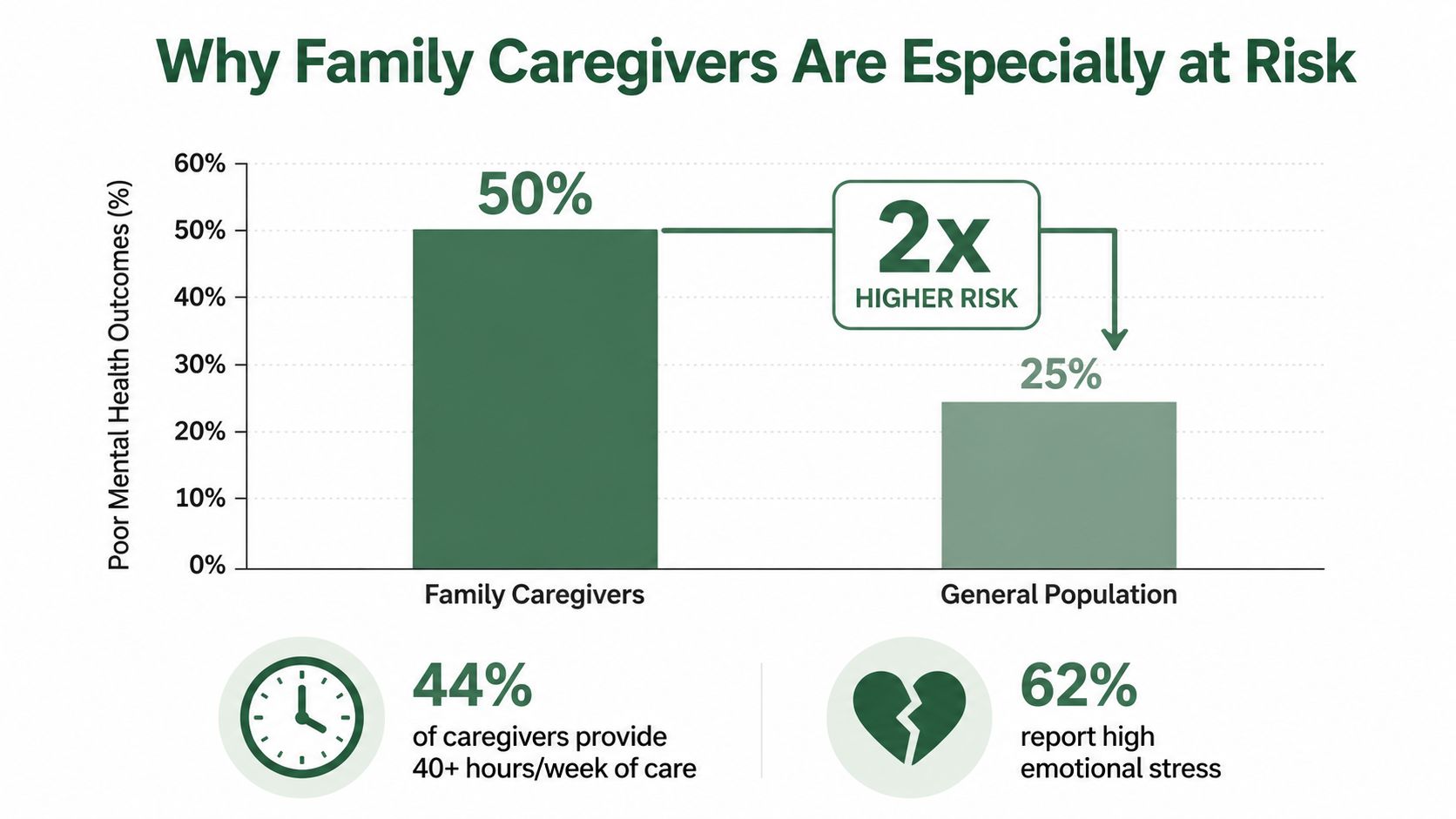
Family caregivers often live inside a schedule that never really ends. A spouse cannot clock out after dinner, and an adult child may be juggling work, a parent's confusion, and a pile of unanswered messages at the same time. That kind of load wears people down because the work is always present, even when nobody is watching.
The risk climbs when the role is intense and unclear. National survey findings summarized by the APA show that unpaid caregivers for older adults reported much higher emotional and behavioral distress than noncaregivers, and serious thoughts of suicide were also more common in the caregiving group (APA summary). Those findings are a warning that caregiver distress can move from strain into crisis when support stays too thin.
Time, choice, and invisibility all matter
Caregiving gets harder when the work piles up and no one sees the full picture. In the MHA survey, fewer than 6 in 10 caregivers felt involved in the mental health care of the person they were helping, and only about half to 60% said providers checked in with them about that care (MHA report). When caregivers are left out of those conversations, they are left to guess at the next step, and guessing adds pressure.
Choice matters too. The same report found that caregivers who felt they had no choice in taking on the role reported nearly double the poor mental health days, 8.0 vs. 4.5, and were nearly three times more likely to feel isolated, 34% vs. 12%, than those who chose the role (MHA report). That is not just a feeling. It is a measurable difference in well-being.
For families living with dementia, grief and dementia often sits right beside the daily workload. The person is still here, but the relationship keeps changing, and that loss can be hard to name. A caregiver may be trying to answer the same question again and again while also mourning the way conversations, routines, and roles used to work.
Risk factor | What it looks like in real life | Why it matters |
|---|---|---|
High time demand | Long stretches of hands-on help, constant watching, fewer breaks | Less recovery time, more exhaustion |
Low involvement | Caregivers are not included in care conversations | More uncertainty and fewer useful next steps |
Little sense of choice | The role feels forced or unavoidable | Higher isolation and worse mental health |
The care problem is often bigger than the feelings problem. If the person with dementia is getting clearer guidance, fewer mixed messages, and more steady support through a phone-based cognitive companion or other structured help, the family caregiver has fewer unknowns to carry alone. That can lower the daily stress that comes from waiting, wondering, and repeatedly filling in the gaps.
Bottom line: caregiver strain is not just about being busy. It becomes a mental health issue when the role consumes time, limits choice, and leaves families without enough support or clear next steps.
Warning Signs of Caregiver Stress and Burnout
One adult daughter I've worked with kept saying she was “fine” because the laundry was still getting done. Then she noticed she was snapping at her kids, forgetting meals, and dreading every call from the assisted living staff. That is how burnout often shows up in family caregiving. It usually starts as a slow narrowing of patience, energy, and hope.
A spouse may spot it in the smallest routines. The coffee sits untouched because there is no space to finish it. Sleep breaks apart under worry. A simple question from the person with dementia feels sharper than it really is. Those are signs that the body and mind are carrying too much for too long.
What burnout sounds and feels like
Burnout often shows up as emotional exhaustion, irritability, and a short fuse that was not there before. It can also look like pulling away from friends, answering texts days late, or avoiding calls because every conversation feels like one more demand. Physical symptoms matter too, especially headaches, stomach upset, tense muscles, or persistent fatigue.
A useful self-check is to ask whether the problem is temporary or becoming the new normal. A rough week happens. A month of feeling numb, angry, or constantly on edge is different.
If you keep telling yourself you just need to push through, pay attention to whether you are also sleeping worse, eating poorly, or dreading tasks you used to handle.
Higher-intensity warning signs deserve a clinician conversation, not just more endurance. A recent Tandfonline study found that caregiving for 20 or more hours per week was associated with more poor mental health days, and higher-intensity household and personal-care tasks were linked with worse outcomes. That kind of load can push a stressed caregiver into depression or crisis faster than families expect.
When to stop guessing and get screened
Some moments should trigger a direct check-in. A new dementia diagnosis, hospital discharge, the first major behavior change, and bereavement are all times when stress can spike and people often miss how much they are carrying. If you want a plain-language guide to the red flags, see caregiver stress and burnout warning signs.
Moodspan's guidance, summarized in the same study, also recommends asking about suicidality instead of assuming the person is only overwhelmed. That is not about being alarmist. It is about asking the question directly when the load has become too heavy to judge safely on instinct alone.
Sleep disruption: You are awake most nights listening, worrying, or checking.
Social withdrawal: You stop returning calls because you cannot bear one more conversation.
Anger turned inward: You call yourself a bad daughter, bad son, or bad spouse for struggling.
Loss of appetite or constant tension: Your body stays braced all the time.
If you recognize yourself in more than one of those, treat it as information, not failure. It means the support around you needs to change.
Evidence-Based Strategies That Actually Help
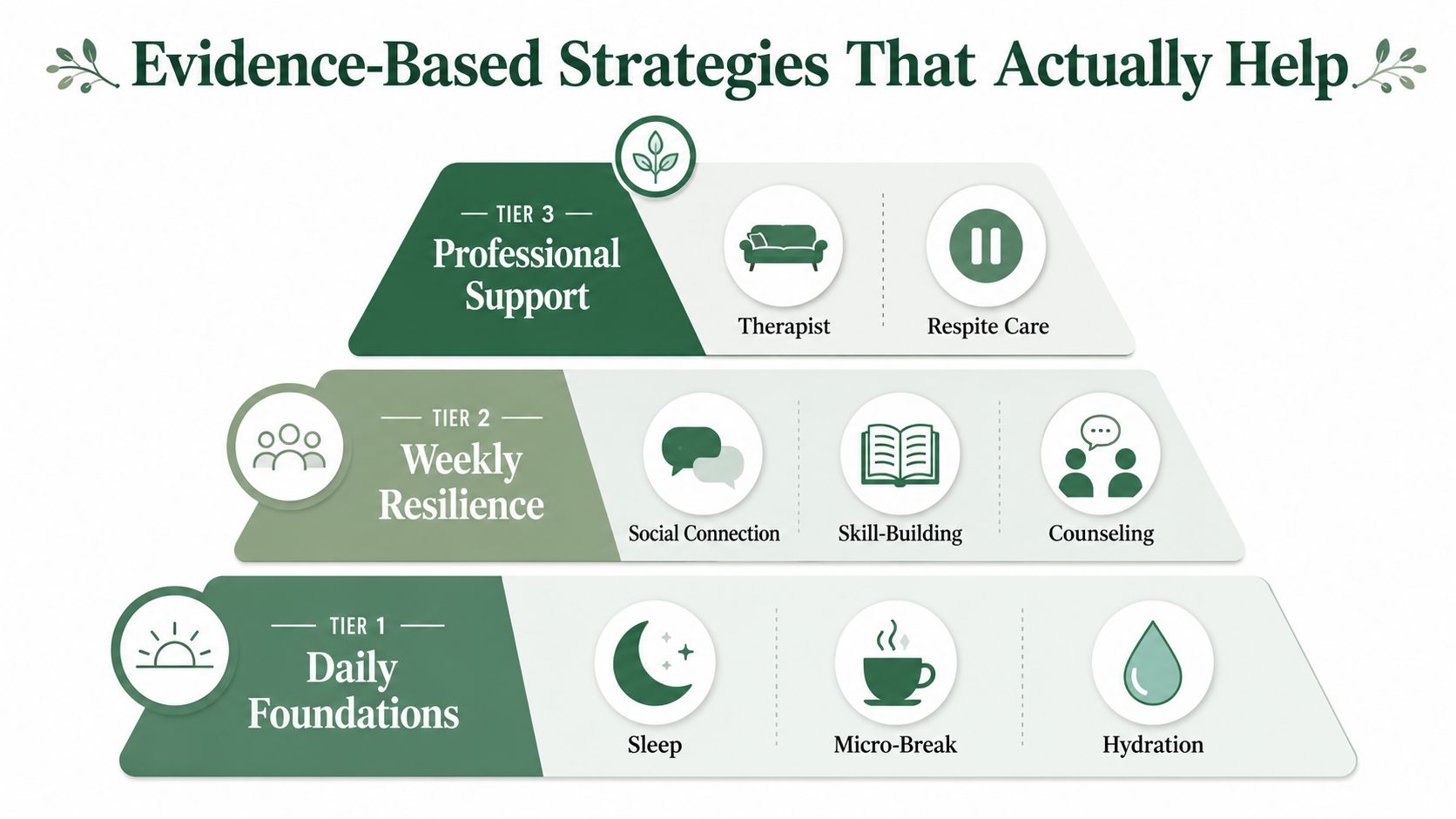
The best support usually starts small and becomes more structured when the strain stays high. A caregiver who slept badly last night needs a different response than one who has been running on empty for months. The point is to match the tool to the level of need.
Tier 1 Daily foundations
These are the things that keep the floor from dropping out. A real meal, a glass of water, a 10-minute sit-down, a reminder to breathe before answering a difficult question, those count. They don't solve the whole problem, but they make the next hard hour more manageable.
Mood tracking helps here too, even if it's simple. A note on your phone that says “exhausted,” “angry,” or “worried” can show a pattern you'd otherwise miss. If the same mood keeps returning, it's not random.
Tier 2 Weekly resilience
This level adds human support and structure. That can mean a caregiver support group, a few sessions with a counselor who understands dementia, or a regular respite block so you're not always on call. The 2026 review of caregiver needs found families repeatedly asking for help with information access, coordinated care, inclusive technology, and financial or workplace resources, along with social connection and grief support (systematic review).
Useful lens: if self-care only gives you a better feeling for an hour, but the care plan stays chaotic, the real bottleneck is still there.
Tier 3 Professional support
This tier is for persistent depression, panic, suicidal thoughts, or a caregiver who's starting to function poorly at work or at home. It can include therapy, medication evaluation, crisis support, or a primary care visit that names the caregiver role out loud. It can also include help with respite and coordination, because emotional relief often depends on reducing the load first.
The point is not to wait until you're breaking. The point is to notice earlier and step up faster.
Professional and Community Resources Worth Knowing
A lot of caregivers waste energy searching randomly, calling the wrong office, or trying to do everything through the same exhausted route. It helps to sort resources by what they do. Some are for diagnosis and treatment, some are for problem-solving, and some are for getting through the week without falling apart.
Resource Type | What It Provides | Best For |
|---|---|---|
Primary care clinician | Screening, referrals, medication review | Caregivers who feel persistently down, anxious, or overwhelmed |
Therapist or counselor | Emotional support, coping tools, grief work | Caregivers who need a private space to process strain |
Dementia nonprofit helpline | Navigation help and practical guidance | Families who don't know where to start |
Area Agency on Aging | Local referrals and community connections | Caregivers looking for respite, local services, or aging support |
Employer caregiver benefits | Leave options, flexibility, workplace support | Working caregivers balancing jobs and care |
Crisis line | Immediate help in a mental health emergency | Anyone with suicidal thoughts or a safety concern |
If you need a starting point this week, pick the door that matches the problem in front of you. A clinician can screen for depression and suicidality. A community resource can help you find local services. An employer may be able to help with leave or schedule flexibility.
Access still matters. A caregiver may need telehealth, a lower-cost clinic, or a provider who understands the family's language and culture. The right resource on paper isn't useful if nobody can realistically use it after work, after dinner, or from the parking lot outside a clinic.
One option some families use is a phone-based support program for the person with dementia, such as Velma, which uses scheduled calls and care coordination to provide recurring cognitive engagement and visibility between visits. That kind of support can reduce the number of small unknowns a caregiver has to carry, which matters when the mental load is already full.
How Phone-Based Cognitive Programs Can Help
A lot of caregiver anxiety comes from not knowing how the person with dementia is doing between visits. Was the stove left on. Did they eat lunch. Are they lonely. Did confusion get worse today or is this the same pattern as yesterday. A phone-based cognitive program can't answer every question, but it can reduce the number of blind spots.
That matters because regular, friendly check-ins can make the day feel less fragile for everyone involved. Scheduled calls, orientation cues, memory prompts, and simple conversation give the person with dementia something steady to respond to. For the caregiver, that can mean fewer long stretches of wondering whether their loved one is safe, bored, or spiraling.
What the calls actually do
A structured program can include reminiscence prompts, attention and language exercises, mood check-ins, and practical reminders about appointments or household safety. A dedicated care manager can also review patterns across calls, so the family isn't trying to make sense of every little change alone. That kind of continuity is useful when a dementia day changes from hour to hour.
A recurring call is not a substitute for a daughter, spouse, or clinician. It is a bridge for the hours when nobody is there and the silence makes everyone more anxious.
daily check-in calls for seniors can fit into a family plan. The benefit is not just companionship for the older adult. It is also the reduction of uncertainty for the caregiver, especially when the caregiver is working, commuting, or trying to sleep without worrying about every unsupervised hour.
The best programs don't act like one-off wellness products. They create a routine, notice patterns, and give families something concrete to act on. That kind of structure can ease guilt, lower daily guesswork, and help the caregiver reserve emotional energy for the problems that really need their attention.
Your First Steps and What to Do This Week

Start small. The goal this week is not to fix everything, it's to find out where the pressure is highest and move one piece of it. If you've been running on adrenaline, a clear next step is better than another vague promise to rest later.
Five-minute self-check
Ask yourself three plain questions. Am I sleeping, eating, and thinking clearly enough to get through the day. Am I more irritable or tearful than usual. Am I starting to feel trapped, numb, or hopeless. If the answer to more than one is yes, take that seriously.
One conversation to schedule
Choose one person to talk to in the next two weeks, a primary care clinician, a counselor, a caregiver support program, or a trusted family member who can help divide the load. Bring up the specific warning signs you've noticed, not just the word “stress.” That gives the other person something real to respond to.
One structural change
Make one change that reduces daily uncertainty. That could be a standing respite block, a shared family schedule, or a recurring phone companion for the person with dementia so there's less time spent wondering how they're doing alone. Small structural changes often do more than another hour of trying to be stronger.
You do not have to earn support by getting worse first. The data shows caregiver depression and distress are real, measurable, and common, which means getting help is a protective move, not a confession of failure.
If you want a practical way to add steadier support without adding more technology burden, Velma offers recurring phone-based cognitive calls and care coordination for older adults with memory loss. For families trying to lower uncertainty between visits, it can be one part of a broader caregiver mental health support plan that gives you more visibility, fewer blind spots, and a little more room to breathe.
During 2021 to 2022, 25.6% of caregivers had a lifetime diagnosis of depression, compared with 18.6% of noncaregivers in CDC surveillance data, and both groups were worse off than they had been in 2015 to 2016 (CDC report). That gap matters because it shows caregiver mental health is not a vague worry. It's a measurable, common health problem that shows up in national data and keeps showing up.
Caregiver mental health support means giving the caregiver practical help, emotional backup, and clear care coordination so they can keep going without disappearing into the role. For families dealing with dementia, that usually means more than telling someone to rest. It means making the day more manageable, reducing uncertainty, and making sure the caregiver isn't left alone to guess what to do next.
Table of Contents
What Caregiver Mental Health Support Really Means
What belongs under this umbrella
Why Family Caregivers Are Especially at Risk
Time, choice, and invisibility all matter
Warning Signs of Caregiver Stress and Burnout
What burnout sounds and feels like
When to stop guessing and get screened
Evidence-Based Strategies That Actually Help
Tier 1 Daily foundations
Tier 2 Weekly resilience
Tier 3 Professional support
Professional and Community Resources Worth Knowing
How Phone-Based Cognitive Programs Can Help
What the calls actually do
Your First Steps and What to Do This Week
Five-minute self-check
One conversation to schedule
One structural change
What Caregiver Mental Health Support Really Means
A caregiver is often the spouse, adult child, or relative who ends up managing medications, meals, appointments, wandering risk, and the emotional fallout that comes with dementia. Caregiver mental health support is the set of tools, services, and relationships that help that person stay steady while doing that work. It is not a bonus on top of care, and it is not the same thing as telling someone to "take better care of themselves."
The point is bigger than comfort. Caregiver support also has to deal with the way care is organized, because stress rises when the family is left to guess what to do next, who should be called, or how to get help after hours. A simple example is a family that has good intentions but no clear plan for medication changes, bathing help, or what to do when the person with dementia becomes suspicious at night. Even a caring family can feel overwhelmed fast when every day brings a new unknown.
The CDC's 2024 analysis shows why this deserves attention. In 2021 to 2022, caregivers had a 25.6% lifetime prevalence of diagnosed depression, versus 18.6% for noncaregivers, and both groups had higher depression than in 2015 to 2016 (CDC). The same report found frequent mental distress rose for both groups too, which points to a strain that does not go away after a hard week.
What belongs under this umbrella
The phrase covers several layers at once. It includes emotional support, but it also includes help getting through the maze of services, reminders, respite, and actual care coordination. If a family only gets coping tips but no backup, the burden stays in place.
A practical way to look at it is this, support has to touch both feelings and logistics. That can mean a support group, a primary care screening, a respite plan, or someone who helps the family decide which professional to contact first. It can also mean help with grief, especially when the person with dementia is changing in ways that feel like a series of small losses, a topic explored in this guide on grief and dementia. A one-time handout does not do that job.
Practical rule: if the advice does not reduce uncertainty, time pressure, or isolation, it probably is not enough on its own.
The AARP caregiver study makes the lived experience easy to picture without dressing it up. In a survey of 1,001 U.S. adults, the nation's estimated 48 million adult family caregivers reported major emotional strain, with 50% saying caregiving increased emotional stress, 37% saying it increased physical stress, and 39% saying they rarely or never felt relaxed (AARP). That is why caregiver mental health support needs to be concrete, recurring, and tied to the daily care experience, not just a suggestion to "be kind to yourself."
Why Family Caregivers Are Especially at Risk
Family caregivers often live inside a schedule that never really ends. A spouse cannot clock out after dinner, and an adult child may be juggling work, a parent's confusion, and a pile of unanswered messages at the same time. That kind of load wears people down because the work is always present, even when nobody is watching.
The risk climbs when the role is intense and unclear. National survey findings summarized by the APA show that unpaid caregivers for older adults reported much higher emotional and behavioral distress than noncaregivers, and serious thoughts of suicide were also more common in the caregiving group (APA summary). Those findings are a warning that caregiver distress can move from strain into crisis when support stays too thin.
Time, choice, and invisibility all matter
Caregiving gets harder when the work piles up and no one sees the full picture. In the MHA survey, fewer than 6 in 10 caregivers felt involved in the mental health care of the person they were helping, and only about half to 60% said providers checked in with them about that care (MHA report). When caregivers are left out of those conversations, they are left to guess at the next step, and guessing adds pressure.
Choice matters too. The same report found that caregivers who felt they had no choice in taking on the role reported nearly double the poor mental health days, 8.0 vs. 4.5, and were nearly three times more likely to feel isolated, 34% vs. 12%, than those who chose the role (MHA report). That is not just a feeling. It is a measurable difference in well-being.
For families living with dementia, grief and dementia often sits right beside the daily workload. The person is still here, but the relationship keeps changing, and that loss can be hard to name. A caregiver may be trying to answer the same question again and again while also mourning the way conversations, routines, and roles used to work.
Risk factor | What it looks like in real life | Why it matters |
|---|---|---|
High time demand | Long stretches of hands-on help, constant watching, fewer breaks | Less recovery time, more exhaustion |
Low involvement | Caregivers are not included in care conversations | More uncertainty and fewer useful next steps |
Little sense of choice | The role feels forced or unavoidable | Higher isolation and worse mental health |
The care problem is often bigger than the feelings problem. If the person with dementia is getting clearer guidance, fewer mixed messages, and more steady support through a phone-based cognitive companion or other structured help, the family caregiver has fewer unknowns to carry alone. That can lower the daily stress that comes from waiting, wondering, and repeatedly filling in the gaps.
Bottom line: caregiver strain is not just about being busy. It becomes a mental health issue when the role consumes time, limits choice, and leaves families without enough support or clear next steps.
Warning Signs of Caregiver Stress and Burnout
One adult daughter I've worked with kept saying she was “fine” because the laundry was still getting done. Then she noticed she was snapping at her kids, forgetting meals, and dreading every call from the assisted living staff. That is how burnout often shows up in family caregiving. It usually starts as a slow narrowing of patience, energy, and hope.
A spouse may spot it in the smallest routines. The coffee sits untouched because there is no space to finish it. Sleep breaks apart under worry. A simple question from the person with dementia feels sharper than it really is. Those are signs that the body and mind are carrying too much for too long.
What burnout sounds and feels like
Burnout often shows up as emotional exhaustion, irritability, and a short fuse that was not there before. It can also look like pulling away from friends, answering texts days late, or avoiding calls because every conversation feels like one more demand. Physical symptoms matter too, especially headaches, stomach upset, tense muscles, or persistent fatigue.
A useful self-check is to ask whether the problem is temporary or becoming the new normal. A rough week happens. A month of feeling numb, angry, or constantly on edge is different.
If you keep telling yourself you just need to push through, pay attention to whether you are also sleeping worse, eating poorly, or dreading tasks you used to handle.
Higher-intensity warning signs deserve a clinician conversation, not just more endurance. A recent Tandfonline study found that caregiving for 20 or more hours per week was associated with more poor mental health days, and higher-intensity household and personal-care tasks were linked with worse outcomes. That kind of load can push a stressed caregiver into depression or crisis faster than families expect.
When to stop guessing and get screened
Some moments should trigger a direct check-in. A new dementia diagnosis, hospital discharge, the first major behavior change, and bereavement are all times when stress can spike and people often miss how much they are carrying. If you want a plain-language guide to the red flags, see caregiver stress and burnout warning signs.
Moodspan's guidance, summarized in the same study, also recommends asking about suicidality instead of assuming the person is only overwhelmed. That is not about being alarmist. It is about asking the question directly when the load has become too heavy to judge safely on instinct alone.
Sleep disruption: You are awake most nights listening, worrying, or checking.
Social withdrawal: You stop returning calls because you cannot bear one more conversation.
Anger turned inward: You call yourself a bad daughter, bad son, or bad spouse for struggling.
Loss of appetite or constant tension: Your body stays braced all the time.
If you recognize yourself in more than one of those, treat it as information, not failure. It means the support around you needs to change.
Evidence-Based Strategies That Actually Help
The best support usually starts small and becomes more structured when the strain stays high. A caregiver who slept badly last night needs a different response than one who has been running on empty for months. The point is to match the tool to the level of need.
Tier 1 Daily foundations
These are the things that keep the floor from dropping out. A real meal, a glass of water, a 10-minute sit-down, a reminder to breathe before answering a difficult question, those count. They don't solve the whole problem, but they make the next hard hour more manageable.
Mood tracking helps here too, even if it's simple. A note on your phone that says “exhausted,” “angry,” or “worried” can show a pattern you'd otherwise miss. If the same mood keeps returning, it's not random.
Tier 2 Weekly resilience
This level adds human support and structure. That can mean a caregiver support group, a few sessions with a counselor who understands dementia, or a regular respite block so you're not always on call. The 2026 review of caregiver needs found families repeatedly asking for help with information access, coordinated care, inclusive technology, and financial or workplace resources, along with social connection and grief support (systematic review).
Useful lens: if self-care only gives you a better feeling for an hour, but the care plan stays chaotic, the real bottleneck is still there.
Tier 3 Professional support
This tier is for persistent depression, panic, suicidal thoughts, or a caregiver who's starting to function poorly at work or at home. It can include therapy, medication evaluation, crisis support, or a primary care visit that names the caregiver role out loud. It can also include help with respite and coordination, because emotional relief often depends on reducing the load first.
The point is not to wait until you're breaking. The point is to notice earlier and step up faster.
Professional and Community Resources Worth Knowing
A lot of caregivers waste energy searching randomly, calling the wrong office, or trying to do everything through the same exhausted route. It helps to sort resources by what they do. Some are for diagnosis and treatment, some are for problem-solving, and some are for getting through the week without falling apart.
Resource Type | What It Provides | Best For |
|---|---|---|
Primary care clinician | Screening, referrals, medication review | Caregivers who feel persistently down, anxious, or overwhelmed |
Therapist or counselor | Emotional support, coping tools, grief work | Caregivers who need a private space to process strain |
Dementia nonprofit helpline | Navigation help and practical guidance | Families who don't know where to start |
Area Agency on Aging | Local referrals and community connections | Caregivers looking for respite, local services, or aging support |
Employer caregiver benefits | Leave options, flexibility, workplace support | Working caregivers balancing jobs and care |
Crisis line | Immediate help in a mental health emergency | Anyone with suicidal thoughts or a safety concern |
If you need a starting point this week, pick the door that matches the problem in front of you. A clinician can screen for depression and suicidality. A community resource can help you find local services. An employer may be able to help with leave or schedule flexibility.
Access still matters. A caregiver may need telehealth, a lower-cost clinic, or a provider who understands the family's language and culture. The right resource on paper isn't useful if nobody can realistically use it after work, after dinner, or from the parking lot outside a clinic.
One option some families use is a phone-based support program for the person with dementia, such as Velma, which uses scheduled calls and care coordination to provide recurring cognitive engagement and visibility between visits. That kind of support can reduce the number of small unknowns a caregiver has to carry, which matters when the mental load is already full.
How Phone-Based Cognitive Programs Can Help
A lot of caregiver anxiety comes from not knowing how the person with dementia is doing between visits. Was the stove left on. Did they eat lunch. Are they lonely. Did confusion get worse today or is this the same pattern as yesterday. A phone-based cognitive program can't answer every question, but it can reduce the number of blind spots.
That matters because regular, friendly check-ins can make the day feel less fragile for everyone involved. Scheduled calls, orientation cues, memory prompts, and simple conversation give the person with dementia something steady to respond to. For the caregiver, that can mean fewer long stretches of wondering whether their loved one is safe, bored, or spiraling.
What the calls actually do
A structured program can include reminiscence prompts, attention and language exercises, mood check-ins, and practical reminders about appointments or household safety. A dedicated care manager can also review patterns across calls, so the family isn't trying to make sense of every little change alone. That kind of continuity is useful when a dementia day changes from hour to hour.
A recurring call is not a substitute for a daughter, spouse, or clinician. It is a bridge for the hours when nobody is there and the silence makes everyone more anxious.
daily check-in calls for seniors can fit into a family plan. The benefit is not just companionship for the older adult. It is also the reduction of uncertainty for the caregiver, especially when the caregiver is working, commuting, or trying to sleep without worrying about every unsupervised hour.
The best programs don't act like one-off wellness products. They create a routine, notice patterns, and give families something concrete to act on. That kind of structure can ease guilt, lower daily guesswork, and help the caregiver reserve emotional energy for the problems that really need their attention.
Your First Steps and What to Do This Week
Start small. The goal this week is not to fix everything, it's to find out where the pressure is highest and move one piece of it. If you've been running on adrenaline, a clear next step is better than another vague promise to rest later.
Five-minute self-check
Ask yourself three plain questions. Am I sleeping, eating, and thinking clearly enough to get through the day. Am I more irritable or tearful than usual. Am I starting to feel trapped, numb, or hopeless. If the answer to more than one is yes, take that seriously.
One conversation to schedule
Choose one person to talk to in the next two weeks, a primary care clinician, a counselor, a caregiver support program, or a trusted family member who can help divide the load. Bring up the specific warning signs you've noticed, not just the word “stress.” That gives the other person something real to respond to.
One structural change
Make one change that reduces daily uncertainty. That could be a standing respite block, a shared family schedule, or a recurring phone companion for the person with dementia so there's less time spent wondering how they're doing alone. Small structural changes often do more than another hour of trying to be stronger.
You do not have to earn support by getting worse first. The data shows caregiver depression and distress are real, measurable, and common, which means getting help is a protective move, not a confession of failure.
If you want a practical way to add steadier support without adding more technology burden, Velma offers recurring phone-based cognitive calls and care coordination for older adults with memory loss. For families trying to lower uncertainty between visits, it can be one part of a broader caregiver mental health support plan that gives you more visibility, fewer blind spots, and a little more room to breathe.
Suggested Article: