People Getting Old

You notice it in ordinary moments first. A parent asks the same question twice in one afternoon, leaves milk on the counter overnight, or stops calling about the book club they used to love. It doesn't feel like a dramatic event, it feels like a quiet mismatch between who they've always been and what's happening now, and that mismatch is often what makes people getting old so hard to recognize.
The hard part is that aging isn't only about wrinkles, slower walking, or needing more naps. It can touch memory, judgment, mood, and the small routines that keep a home running. That's why families often feel unprepared, even when nothing looks obviously “medical” yet.
Table of Contents
Why Aging Feels Different Than We Expected
Why the emotional reaction is so strong
What Actually Happens Inside the Aging Body
From cell biology to daily life
Recognizing Memory Changes and Early Dementia Signs
What families usually notice first
Practical Strategies for Family Caregivers and Partners
Use calm prompts, not corrections
Make everyday life easier to follow
The Hidden Factors That Determine Who Ages Well at Home
Why generic advice misses the point
Comparing Support and Monitoring Options for Aging Adults
Support options side by side
Building a Sustainable Care Plan for Your Loved One
Why Aging Feels Different Than We Expected
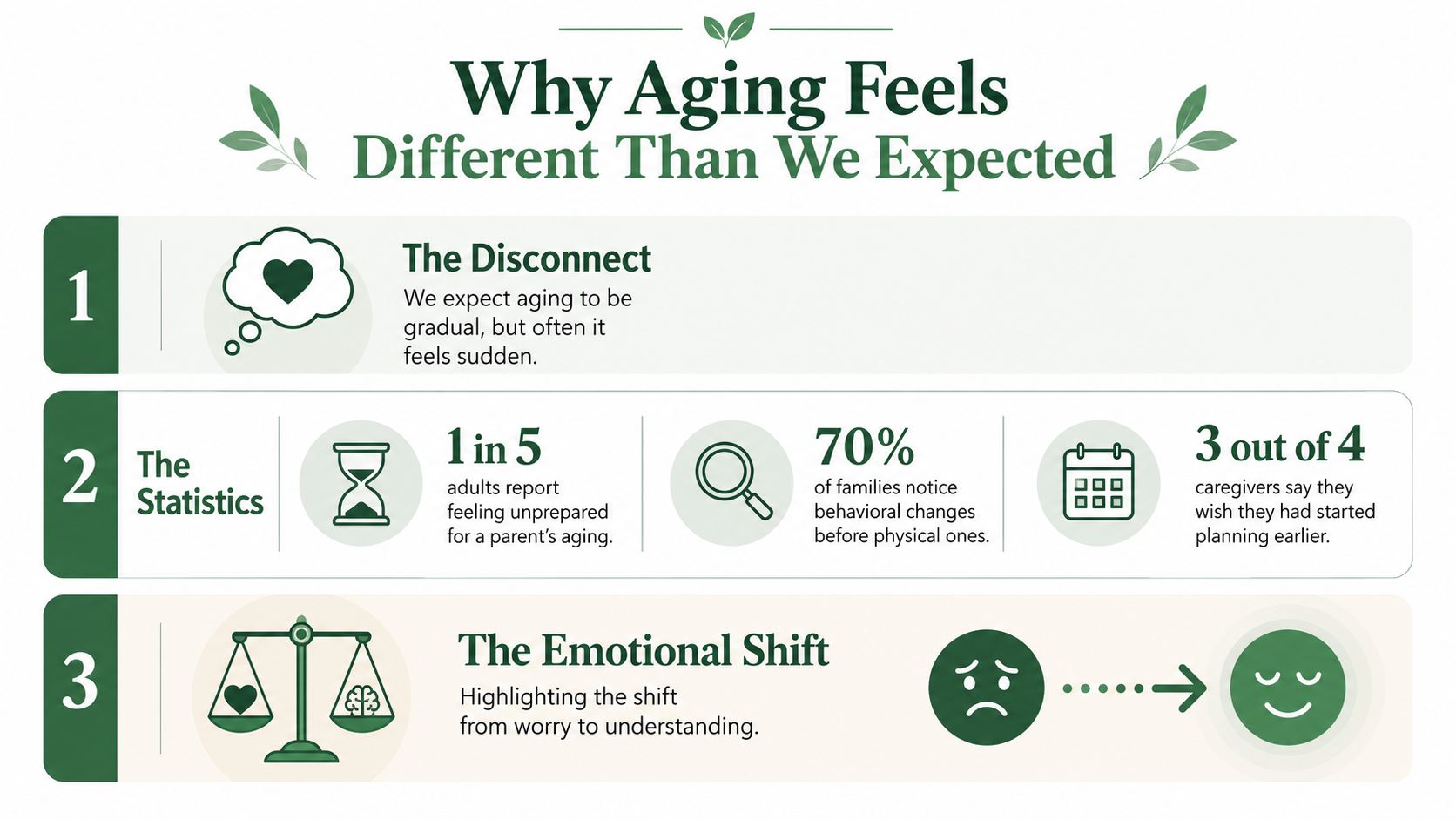
A daughter opens her father's fridge and finds expired food, then notices the same unpaid bill on the table for the third week in a row. It is easy to call that “just aging,” but the phrase stops being useful when the same father is also becoming quieter, less interested in cooking, and oddly defensive when anyone offers help. These moments often appear before a formal diagnosis, which is why they can feel so unsettling.
That unease is not only emotional, it also reflects a real mismatch between what many families expect and what aging often looks like in daily life. The World Health Organization describes population ageing as a major global shift, with more older adults living in every region and many aging at home with uneven access to support. The gap is widest when memory changes begin, because a person may still seem “fine” in short conversations while missing bills, repeating tasks, or withdrawing from routines that once anchored the household.
The problem is that generic healthy-aging advice often assumes stable income, safe housing, transportation, nearby help, and someone who can notice small changes early. In real families, those supports are uneven. A person with early dementia may be trying to manage stairs, medications, meal prep, loneliness, and bills at the same time, and each of those pressures can make the others worse. A home can look familiar and still become hard to manage, like a room where the lights are dimmer than everyone realizes.
Why the emotional reaction is so strong
People usually expect aging to be gradual and orderly. In real life, it often shows up as a series of small ruptures, a repeated question, a missed appointment, a stack of unopened mail, a favorite hobby left behind. That is why family members often feel grief before they feel certainty.
Practical rule: When a change starts affecting daily life, treat it as a real signal, even if you cannot name the cause yet.
The emotional strain is part of the picture, not a side note. Watching someone you love lose ease with everyday life can feel like losing the old map of the relationship. The most helpful response is not to rush to labels, but to start observing patterns with care and without panic.
What Actually Happens Inside the Aging Body
Aging is rarely one broken switch. It works more like a house where several maintenance systems begin to slow at the same time, the wiring, the plumbing, the roof, and the heating all need closer attention, and one small problem makes the others harder to ignore. Biologists now describe aging in a similarly layered way, because the changes inside the body affect one another instead of staying neatly separated.
The most widely cited hallmarks of aging include genomic instability, telomere attrition, epigenetic alterations, loss of proteostasis, mitochondrial dysfunction, cellular senescence, stem-cell exhaustion, and altered intercellular communication (hallmarks of aging review). These processes interact. DNA damage and telomere shortening can push cells into senescence, and senescent cells can weaken tissue repair while increasing inflammatory signaling that contributes to decline across organs.
From cell biology to daily life
That is one reason aging risk does not rise in a neat straight line. After midlife, the body often has less reserve to absorb stress, illness, or medication side effects. Families may see that reserve loss as slower recovery after a fall, more fatigue after a minor infection, or a sharper drop in functioning after a hospitalization.
Senescent cells add another layer to the picture. They are not just “old” cells sitting still. They can accumulate because they stop dividing, often do not die off normally, and immune clearance becomes less efficient with age (senescent cells and aging). That buildup is linked with poorer tissue regeneration, weaker stem-cell function, and more inflammatory signaling, which helps explain frailty, slower wound healing, and multiple chronic conditions appearing together.
The body can be doing several small repairs badly at the same time, and the result may look like one big change at home.
Families should not judge aging only by chronological age. The more useful questions are about mobility, cognition, medication adherence, nutrition, and fall risk, because those are the places where cellular aging becomes visible in everyday independence. For families trying to separate ordinary forgetfulness from something more serious, a clear guide to cognitive decline in older adults can help put the changes in context without turning every slip into a crisis.

Recognizing Memory Changes and Early Dementia Signs
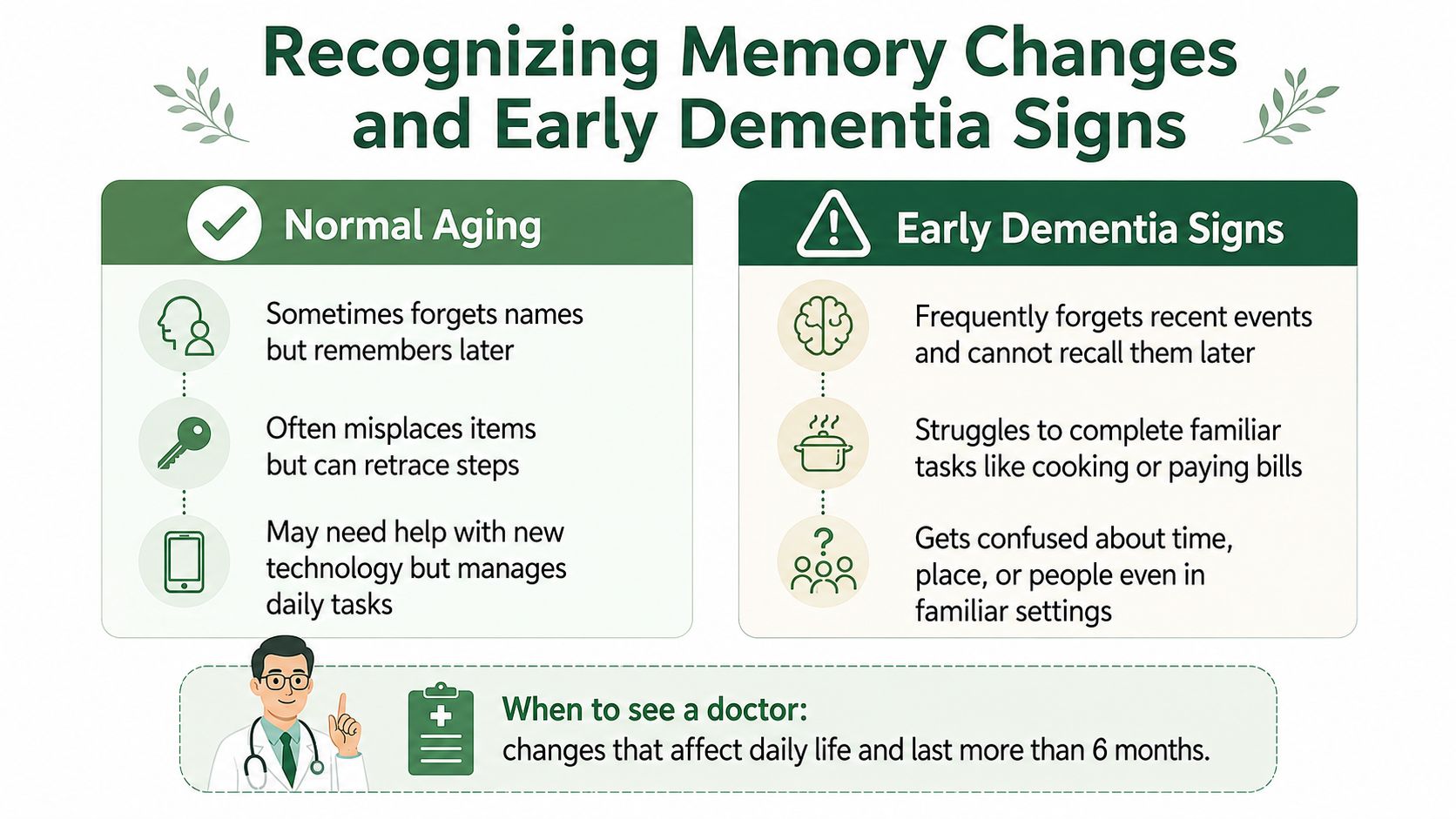
For many families, the question isn't whether a loved one is forgetting things. It's whether the forgetting is still within the range of ordinary aging or has crossed into something more serious. A person might misplace glasses and find them later, or blank on a name and remember it an hour after lunch. That can happen in normal aging.
Concern rises when the pattern changes from occasional slips to repeated breakdowns in everyday function. Putting keys in the refrigerator, missing the same bill over and over, or getting lost on a route that's always been familiar are different from being distracted. The key issue is not one forgotten fact, it's whether the change starts to interfere with daily life.
What families usually notice first
Early dementia often affects several areas together, not memory alone. Families may see problems with orientation to time and place, trouble following a conversation, difficulty with familiar tasks, or changes in judgment. Someone may struggle to prepare a regular meal, become confused about which day an appointment is scheduled, or lose the thread while paying bills.
The emotional side matters too. A person can become anxious, unusually focused on a purse, wallet, or pet, or withdrawn from people and activities they used to enjoy. Those changes can be as important as a memory lapse, because they often reflect how hard the person is working to compensate.
The most useful question is this, does the change affect function? If the answer is yes, it deserves attention even if the person still seems “fine” in conversation. A person can sound socially fluent and still have growing trouble with short-term memory, executive function, and routine management.
When to seek help: changes that affect daily life and keep happening are worth a medical evaluation, especially when they're confusing for the person or family.
The distinction between normal aging and early dementia is rarely made from one incident. It comes from watching patterns over time. If you're tracking those patterns, a concise guide can help, and the internal overview on cognitive decline in older adults is a useful companion reference for families comparing symptoms and next steps.
Practical Strategies for Family Caregivers and Partners
The first thing to do is reduce the number of moving parts. Keep the same place for keys, glasses, medications, and the phone charger, then say the location out loud when you use it. A stable routine helps because memory problems often get worse when the environment keeps changing.
Use calm prompts, not corrections
If someone asks the same question again, answer the question without making them feel tested. Repeating yourself in a calm voice is often more effective than pointing out that you already said it. When anxiety rises, the goal is not perfect logic, it's lowering distress enough for the person to function.
Label the day clearly: Use visible reminders for meals, appointments, and regular calls.
Break tasks into one step: Give one instruction at a time instead of a long list.
Check the basics daily: Look for missed meals, medication mix-ups, and signs of confusion around the stove or front door.
Keep contact predictable: A dependable call or visit often helps more than occasional long check-ins.
Mobility and falls deserve equal attention. Watch for shuffling, holding furniture for balance, or avoiding stairs. Those are often the practical signs that home safety needs to change before an emergency does.
Companionship matters more than many families expect. Long stretches alone can make confusion, anxiety, and repetitive behavior harder to manage, especially when the person is already trying to hide their difficulties from others. If you need support with the caregiver side of this work, the article on caregiver stress and burnout is a useful companion piece.
Make everyday life easier to follow
Use the simplest version of each task. Clear countertops, large-print notes, and a single visible calendar can reduce friction more than elaborate systems that need constant upkeep.
Practical rule: If a strategy takes more effort to maintain than the problem takes to create, it won't last.
The Hidden Factors That Determine Who Ages Well at Home
A family can do everything “right” on paper and still find that home is no longer working. The missing piece is often not willpower or a positive attitude, but the conditions around the person, whether the home is safe, affordable, and supported enough for daily life to stay stable. Boston University argues that secure aging rests on income, housing, and health, and that policy solutions have to help people stay safely in their homes and communities instead of treating aging as only a medical issue (Boston University on unequal aging). That matters because two people of the same age can live in completely different realities.
For an older adult with memory loss, the essential question is whether the home has enough structure around it. Stable housing, transportation, food access, and social connection all shape whether a person can remain independent, and those are social conditions, not just medical ones. A safe apartment with no nearby help can be harder to manage than a modest home with steady support.
Why generic advice misses the point
A lot of healthy aging advice assumes a person has money for services, a clinic they can reach, a reliable network, and a house that is easy to move through. That assumption leaves out people who live alone, have limited income, or are managing both cognitive change and housing stress. The advice sounds encouraging, but it often ignores the conditions that make it possible to follow in real life.
Ageism makes the problem worse. A UN and WHO-backed report links ageism with poorer physical and mental health, increased social isolation and loneliness, greater financial insecurity, decreased quality of life, and premature death (WHO ageism report). The same report also notes that aging research often excludes older adults because of age limits, comorbidities, language barriers, or physical and cognitive impairments, which means the evidence base can underrepresent the very people who need support most. That gap can leave families trying to make decisions with guidance that was never built around the hardest cases.
For people with early dementia, the details matter more than broad advice. A person may look fine in a short visit and still miss meals, misplace medications, or become unsafe at the stove once no one is checking in. The home then becomes less a place of comfort and more a test of whether money, companionship, and daily monitoring are in place.
Companion care can help fill that gap, especially when the goal is not only supervision but regular human contact and routine. For families weighing that kind of support, caregiver support and companion care for older adults can be part of the picture.
That leads to a blunt but important takeaway. If a family is trying to decide whether someone can stay home safely, the question is not whether the idea sounds dignified. The question is whether the person has enough money, housing stability, and day-to-day support for the home to remain workable.
Comparing Support and Monitoring Options for Aging Adults
Families usually end up choosing from a mix of support options, not one perfect solution. In-person visits can help with hands-on tasks, but they aren't always frequent enough to notice subtle cognitive changes. Apps and smart devices can provide alerts, but they can also be hard for older adults who don't want extra technology or can't manage it reliably.
Phone-based support fills a different gap. It uses a familiar tool, the phone, and can provide repeated conversation, orientation, reminders, and mood support without asking someone to learn a new platform. Velma is one option in that category, offering scheduled phone calls, cognitive exercises, daily reminders, and care manager coordination for older adults with early to mid-stage memory loss.
Support options side by side
Support Type | Technology Required | Cognitive Engagement | Emotional Support | Family Visibility |
|---|---|---|---|---|
In-person home care visits | Low to moderate | Depends on caregiver training | Strong when visits are consistent | Moderate, between visits can be limited |
Monitoring apps and smart devices | High | Usually low | Usually low | High for alerts, lower for context |
Adult day programs | Moderate | Strong in structured settings | Strong during program hours | Moderate, depending on reporting |
Phone-based cognitive support programs | Low | Strong, when calls are tailored | Strong through regular conversation | High when notes and updates are shared |
The best fit depends on the person's stage and tolerance for change. Someone who is still comfortable on the phone may benefit from regular call-based support, while someone needing hands-on bathing or meal prep will still need in-person help. For families comparing companionship-focused options, companion care for elderly gives a useful overview of how social support and monitoring can work together.
Practical rule: Choose the option that your loved one will actually accept and use consistently, not the one that looks most advanced on paper.
The biggest gap in many systems is continuity. A family may get one good visit, one reminder, and one alert, but still not know what happened between them. Support works better when someone is keeping track of patterns, not just reacting to single events.
Building a Sustainable Care Plan for Your Loved One
A workable care plan starts with three questions. What changes are showing up now, who is watching them, and what support can stay in place without wearing out the caregiver? If the answers are vague, the plan is too fragile to hold up when daily life gets harder.
A family can picture the plan as a relay, not a solo job. One person may handle medications, another may manage appointments, and a third may provide calls or visits that keep the older adult socially connected. If no one can do that consistently, outside help is better than hoping the situation will settle on its own.
For early changes, routine and observation matter just as much as medical testing. A simple pattern of missed bills, repeated questions, or trouble with familiar tasks can tell families more than a single appointment, especially when memory changes are still easy to overlook. A medical evaluation is important if daily function is slipping.

For more advanced memory problems, the plan usually needs more structure, more monitoring, and clearer division of labor among family members and professionals. A geriatrician or neurologist becomes important when confusion, safety problems, or repeated functional decline are hard to explain or are getting worse. In families facing early dementia, these supports matter because generic healthy-aging advice does not cover the social realities that shape outcomes, like income, housing, companionship, and whether someone is checking for small but meaningful changes over time.
The strongest care plans do not depend on one exhausted relative. If one support is working and another is creating stress, adjust it before there's a crisis. The goal is not a perfect schedule, it is to keep the person safer, calmer, and more connected while protecting the caregiver's energy.
When you're ready to turn concern into a plan, Velma offers scheduled phone-based cognitive support, daily reminders, and family-facing updates for older adults with memory loss. If you've been trying to balance safety, conversation, and consistency at home, it is worth seeing whether a phone-based routine can fill the gaps between visits and lighten the load on your family.
You notice it in ordinary moments first. A parent asks the same question twice in one afternoon, leaves milk on the counter overnight, or stops calling about the book club they used to love. It doesn't feel like a dramatic event, it feels like a quiet mismatch between who they've always been and what's happening now, and that mismatch is often what makes people getting old so hard to recognize.
The hard part is that aging isn't only about wrinkles, slower walking, or needing more naps. It can touch memory, judgment, mood, and the small routines that keep a home running. That's why families often feel unprepared, even when nothing looks obviously “medical” yet.
Table of Contents
Why Aging Feels Different Than We Expected
Why the emotional reaction is so strong
What Actually Happens Inside the Aging Body
From cell biology to daily life
Recognizing Memory Changes and Early Dementia Signs
What families usually notice first
Practical Strategies for Family Caregivers and Partners
Use calm prompts, not corrections
Make everyday life easier to follow
The Hidden Factors That Determine Who Ages Well at Home
Why generic advice misses the point
Comparing Support and Monitoring Options for Aging Adults
Support options side by side
Building a Sustainable Care Plan for Your Loved One
Why Aging Feels Different Than We Expected
A daughter opens her father's fridge and finds expired food, then notices the same unpaid bill on the table for the third week in a row. It is easy to call that “just aging,” but the phrase stops being useful when the same father is also becoming quieter, less interested in cooking, and oddly defensive when anyone offers help. These moments often appear before a formal diagnosis, which is why they can feel so unsettling.
That unease is not only emotional, it also reflects a real mismatch between what many families expect and what aging often looks like in daily life. The World Health Organization describes population ageing as a major global shift, with more older adults living in every region and many aging at home with uneven access to support. The gap is widest when memory changes begin, because a person may still seem “fine” in short conversations while missing bills, repeating tasks, or withdrawing from routines that once anchored the household.
The problem is that generic healthy-aging advice often assumes stable income, safe housing, transportation, nearby help, and someone who can notice small changes early. In real families, those supports are uneven. A person with early dementia may be trying to manage stairs, medications, meal prep, loneliness, and bills at the same time, and each of those pressures can make the others worse. A home can look familiar and still become hard to manage, like a room where the lights are dimmer than everyone realizes.
Why the emotional reaction is so strong
People usually expect aging to be gradual and orderly. In real life, it often shows up as a series of small ruptures, a repeated question, a missed appointment, a stack of unopened mail, a favorite hobby left behind. That is why family members often feel grief before they feel certainty.
Practical rule: When a change starts affecting daily life, treat it as a real signal, even if you cannot name the cause yet.
The emotional strain is part of the picture, not a side note. Watching someone you love lose ease with everyday life can feel like losing the old map of the relationship. The most helpful response is not to rush to labels, but to start observing patterns with care and without panic.
What Actually Happens Inside the Aging Body
Aging is rarely one broken switch. It works more like a house where several maintenance systems begin to slow at the same time, the wiring, the plumbing, the roof, and the heating all need closer attention, and one small problem makes the others harder to ignore. Biologists now describe aging in a similarly layered way, because the changes inside the body affect one another instead of staying neatly separated.
The most widely cited hallmarks of aging include genomic instability, telomere attrition, epigenetic alterations, loss of proteostasis, mitochondrial dysfunction, cellular senescence, stem-cell exhaustion, and altered intercellular communication (hallmarks of aging review). These processes interact. DNA damage and telomere shortening can push cells into senescence, and senescent cells can weaken tissue repair while increasing inflammatory signaling that contributes to decline across organs.
From cell biology to daily life
That is one reason aging risk does not rise in a neat straight line. After midlife, the body often has less reserve to absorb stress, illness, or medication side effects. Families may see that reserve loss as slower recovery after a fall, more fatigue after a minor infection, or a sharper drop in functioning after a hospitalization.
Senescent cells add another layer to the picture. They are not just “old” cells sitting still. They can accumulate because they stop dividing, often do not die off normally, and immune clearance becomes less efficient with age (senescent cells and aging). That buildup is linked with poorer tissue regeneration, weaker stem-cell function, and more inflammatory signaling, which helps explain frailty, slower wound healing, and multiple chronic conditions appearing together.
The body can be doing several small repairs badly at the same time, and the result may look like one big change at home.
Families should not judge aging only by chronological age. The more useful questions are about mobility, cognition, medication adherence, nutrition, and fall risk, because those are the places where cellular aging becomes visible in everyday independence. For families trying to separate ordinary forgetfulness from something more serious, a clear guide to cognitive decline in older adults can help put the changes in context without turning every slip into a crisis.
Recognizing Memory Changes and Early Dementia Signs
For many families, the question isn't whether a loved one is forgetting things. It's whether the forgetting is still within the range of ordinary aging or has crossed into something more serious. A person might misplace glasses and find them later, or blank on a name and remember it an hour after lunch. That can happen in normal aging.
Concern rises when the pattern changes from occasional slips to repeated breakdowns in everyday function. Putting keys in the refrigerator, missing the same bill over and over, or getting lost on a route that's always been familiar are different from being distracted. The key issue is not one forgotten fact, it's whether the change starts to interfere with daily life.
What families usually notice first
Early dementia often affects several areas together, not memory alone. Families may see problems with orientation to time and place, trouble following a conversation, difficulty with familiar tasks, or changes in judgment. Someone may struggle to prepare a regular meal, become confused about which day an appointment is scheduled, or lose the thread while paying bills.
The emotional side matters too. A person can become anxious, unusually focused on a purse, wallet, or pet, or withdrawn from people and activities they used to enjoy. Those changes can be as important as a memory lapse, because they often reflect how hard the person is working to compensate.
The most useful question is this, does the change affect function? If the answer is yes, it deserves attention even if the person still seems “fine” in conversation. A person can sound socially fluent and still have growing trouble with short-term memory, executive function, and routine management.
When to seek help: changes that affect daily life and keep happening are worth a medical evaluation, especially when they're confusing for the person or family.
The distinction between normal aging and early dementia is rarely made from one incident. It comes from watching patterns over time. If you're tracking those patterns, a concise guide can help, and the internal overview on cognitive decline in older adults is a useful companion reference for families comparing symptoms and next steps.
Practical Strategies for Family Caregivers and Partners
The first thing to do is reduce the number of moving parts. Keep the same place for keys, glasses, medications, and the phone charger, then say the location out loud when you use it. A stable routine helps because memory problems often get worse when the environment keeps changing.
Use calm prompts, not corrections
If someone asks the same question again, answer the question without making them feel tested. Repeating yourself in a calm voice is often more effective than pointing out that you already said it. When anxiety rises, the goal is not perfect logic, it's lowering distress enough for the person to function.
Label the day clearly: Use visible reminders for meals, appointments, and regular calls.
Break tasks into one step: Give one instruction at a time instead of a long list.
Check the basics daily: Look for missed meals, medication mix-ups, and signs of confusion around the stove or front door.
Keep contact predictable: A dependable call or visit often helps more than occasional long check-ins.
Mobility and falls deserve equal attention. Watch for shuffling, holding furniture for balance, or avoiding stairs. Those are often the practical signs that home safety needs to change before an emergency does.
Companionship matters more than many families expect. Long stretches alone can make confusion, anxiety, and repetitive behavior harder to manage, especially when the person is already trying to hide their difficulties from others. If you need support with the caregiver side of this work, the article on caregiver stress and burnout is a useful companion piece.
Make everyday life easier to follow
Use the simplest version of each task. Clear countertops, large-print notes, and a single visible calendar can reduce friction more than elaborate systems that need constant upkeep.
Practical rule: If a strategy takes more effort to maintain than the problem takes to create, it won't last.
The Hidden Factors That Determine Who Ages Well at Home
A family can do everything “right” on paper and still find that home is no longer working. The missing piece is often not willpower or a positive attitude, but the conditions around the person, whether the home is safe, affordable, and supported enough for daily life to stay stable. Boston University argues that secure aging rests on income, housing, and health, and that policy solutions have to help people stay safely in their homes and communities instead of treating aging as only a medical issue (Boston University on unequal aging). That matters because two people of the same age can live in completely different realities.
For an older adult with memory loss, the essential question is whether the home has enough structure around it. Stable housing, transportation, food access, and social connection all shape whether a person can remain independent, and those are social conditions, not just medical ones. A safe apartment with no nearby help can be harder to manage than a modest home with steady support.
Why generic advice misses the point
A lot of healthy aging advice assumes a person has money for services, a clinic they can reach, a reliable network, and a house that is easy to move through. That assumption leaves out people who live alone, have limited income, or are managing both cognitive change and housing stress. The advice sounds encouraging, but it often ignores the conditions that make it possible to follow in real life.
Ageism makes the problem worse. A UN and WHO-backed report links ageism with poorer physical and mental health, increased social isolation and loneliness, greater financial insecurity, decreased quality of life, and premature death (WHO ageism report). The same report also notes that aging research often excludes older adults because of age limits, comorbidities, language barriers, or physical and cognitive impairments, which means the evidence base can underrepresent the very people who need support most. That gap can leave families trying to make decisions with guidance that was never built around the hardest cases.
For people with early dementia, the details matter more than broad advice. A person may look fine in a short visit and still miss meals, misplace medications, or become unsafe at the stove once no one is checking in. The home then becomes less a place of comfort and more a test of whether money, companionship, and daily monitoring are in place.
Companion care can help fill that gap, especially when the goal is not only supervision but regular human contact and routine. For families weighing that kind of support, caregiver support and companion care for older adults can be part of the picture.
That leads to a blunt but important takeaway. If a family is trying to decide whether someone can stay home safely, the question is not whether the idea sounds dignified. The question is whether the person has enough money, housing stability, and day-to-day support for the home to remain workable.
Comparing Support and Monitoring Options for Aging Adults
Families usually end up choosing from a mix of support options, not one perfect solution. In-person visits can help with hands-on tasks, but they aren't always frequent enough to notice subtle cognitive changes. Apps and smart devices can provide alerts, but they can also be hard for older adults who don't want extra technology or can't manage it reliably.
Phone-based support fills a different gap. It uses a familiar tool, the phone, and can provide repeated conversation, orientation, reminders, and mood support without asking someone to learn a new platform. Velma is one option in that category, offering scheduled phone calls, cognitive exercises, daily reminders, and care manager coordination for older adults with early to mid-stage memory loss.
Support options side by side
Support Type | Technology Required | Cognitive Engagement | Emotional Support | Family Visibility |
|---|---|---|---|---|
In-person home care visits | Low to moderate | Depends on caregiver training | Strong when visits are consistent | Moderate, between visits can be limited |
Monitoring apps and smart devices | High | Usually low | Usually low | High for alerts, lower for context |
Adult day programs | Moderate | Strong in structured settings | Strong during program hours | Moderate, depending on reporting |
Phone-based cognitive support programs | Low | Strong, when calls are tailored | Strong through regular conversation | High when notes and updates are shared |
The best fit depends on the person's stage and tolerance for change. Someone who is still comfortable on the phone may benefit from regular call-based support, while someone needing hands-on bathing or meal prep will still need in-person help. For families comparing companionship-focused options, companion care for elderly gives a useful overview of how social support and monitoring can work together.
Practical rule: Choose the option that your loved one will actually accept and use consistently, not the one that looks most advanced on paper.
The biggest gap in many systems is continuity. A family may get one good visit, one reminder, and one alert, but still not know what happened between them. Support works better when someone is keeping track of patterns, not just reacting to single events.
Building a Sustainable Care Plan for Your Loved One
A workable care plan starts with three questions. What changes are showing up now, who is watching them, and what support can stay in place without wearing out the caregiver? If the answers are vague, the plan is too fragile to hold up when daily life gets harder.
A family can picture the plan as a relay, not a solo job. One person may handle medications, another may manage appointments, and a third may provide calls or visits that keep the older adult socially connected. If no one can do that consistently, outside help is better than hoping the situation will settle on its own.
For early changes, routine and observation matter just as much as medical testing. A simple pattern of missed bills, repeated questions, or trouble with familiar tasks can tell families more than a single appointment, especially when memory changes are still easy to overlook. A medical evaluation is important if daily function is slipping.
For more advanced memory problems, the plan usually needs more structure, more monitoring, and clearer division of labor among family members and professionals. A geriatrician or neurologist becomes important when confusion, safety problems, or repeated functional decline are hard to explain or are getting worse. In families facing early dementia, these supports matter because generic healthy-aging advice does not cover the social realities that shape outcomes, like income, housing, companionship, and whether someone is checking for small but meaningful changes over time.
The strongest care plans do not depend on one exhausted relative. If one support is working and another is creating stress, adjust it before there's a crisis. The goal is not a perfect schedule, it is to keep the person safer, calmer, and more connected while protecting the caregiver's energy.
When you're ready to turn concern into a plan, Velma offers scheduled phone-based cognitive support, daily reminders, and family-facing updates for older adults with memory loss. If you've been trying to balance safety, conversation, and consistency at home, it is worth seeing whether a phone-based routine can fill the gaps between visits and lighten the load on your family.
Suggested Article: