Memory Exercises for Seniors: Improve Recall & Focus

A long-term study changed the usual conversation about brain games. Older adults who completed 14 to 22 hours of speed-based brain training had a 25% lower risk of a dementia diagnosis two decades later than non-participants, according to reporting on research published in Alzheimer's & Dementia and based on the ACTIVE trial of more than 2,800 adults age 65 and older (AARP coverage of the 20-year brain training study). That finding matters because it points away from vague “stay mentally active” advice and toward targeted, repeated exercises that fit real life.
For families, that distinction is practical. Many articles on memory exercises for seniors stop at Sudoku, crossword books, or an app download. Those tools can help some people, but they often break down in early-to-mid dementia when planning, initiation, and follow-through become unreliable. Research and care experience both suggest that seniors do better when exercises are structured, emotionally meaningful, and supported by another person in real time.
That's where a better framework starts. The strongest memory exercises for seniors don't only train recall. They also reduce anxiety, reinforce orientation, support language, and create social contact that keeps someone engaged long enough to benefit. Phone-based support can fit this model well because it removes device friction while preserving repetition, coaching, and companionship.
Table of Contents
1. Reminiscence Therapy
Why older memories are a useful starting point
How to make it work in daily care
2. Orientation to Time, Place, and Person
Use orientation to lower anxiety, not to correct
Simple cues that reinforce orientation between conversations
3. Spaced Repetition and Errorless Learning
Limit the target set
Why errorless learning fits phone-based support
4. Attention and Concentration Exercises
5. Language and Word-Finding Exercises
6. Problem-Solving and Executive Function Tasks
Use tasks that mirror real decisions
Focus on function, not game scores
7. Musical Engagement and Rhythm Activities
Music can open access when direct recall stalls
How to use music without overstimulation
8. Social Engagement and Conversation-Based Cognitive Stimulation
Why conversation can support memory better than drills alone
What effective conversation-based stimulation looks like
8-Point Comparison: Memory Exercises for Seniors
Putting Memory Exercises into Action
1. Reminiscence Therapy
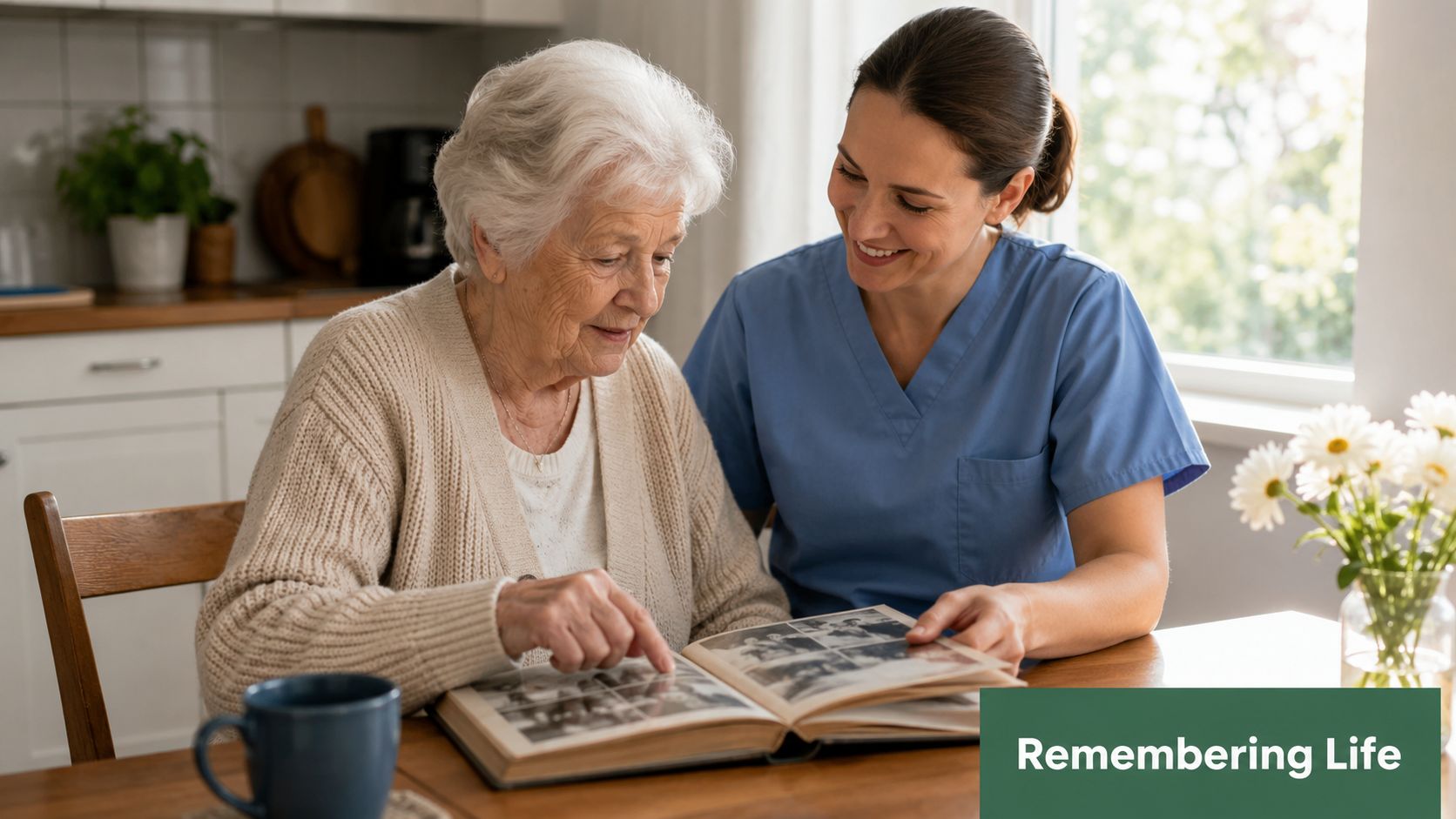
Reminiscence therapy works because it meets many seniors where access is strongest. In early-to-mid dementia, recent memory may be unreliable while older autobiographical memories remain easier to reach. A conversation about a first job, a childhood home, or a wedding song can produce more fluent speech and calmer engagement than a direct test of short-term recall.
This makes reminiscence one of the most adaptable memory exercises for seniors. It can happen with a daughter at the kitchen table, in a senior center with old photos and decade-specific music, or during a scheduled support call that starts with one specific prompt instead of a broad “How are you?”
Why older memories are a useful starting point
Reminiscence has an advantage that puzzle-based tasks often miss. It combines memory retrieval with emotion, identity, and social contact. That matters because current guidance for seniors increasingly points out that emotional well-being and companionship are tightly linked with cognitive preservation, and approaches that ignore mood can be less effective than interventions that address both memory and connection (Buckner Calder Woods on memory exercises and the role of emotional well-being and social connection).
Practical rule: Start with positive, low-pressure memories. “Tell me about a meal you loved cooking” usually works better than “Do you remember what happened last week?”
A Velma-style call might begin with, “What was your favorite job, and what made it special?” A family caregiver might use a printed life-history sheet with sections on school, work, family traditions, and favorite holidays.
How to make it work in daily care
The most effective prompts are personal and sensory.
Use concrete anchors: Ask about a first house, a school uniform, a wedding song, or a holiday meal.
Bring in cues: Photos, familiar music, scents, and keepsakes can enable richer recall than questions alone.
Protect dignity: Don't correct small inaccuracies unless safety depends on it. The value often lies in engagement, not perfect factual precision.
If you want a more structured framework, this guide to reminiscence therapy for dementia explains how families and care teams can shape prompts around a senior's own history.
2. Orientation to Time, Place, and Person
Reality orientation sounds clinical, but in practice it's simple. It means giving steady, calm reminders about who's calling, what day it is, where the person is, and what's happening next. For seniors who become anxious when they lose track of time or setting, those cues can reduce confusion before it escalates.
The key is tone. Orientation should feel like reassurance, not correction. “Good morning, Mom. It's Tuesday, you're at home, and your neighbor is bringing lunch later” lands very differently from “No, that's wrong, it isn't Monday.”
Use orientation to lower anxiety, not to correct
Many caregivers turn orientation into a quiz without meaning to. They ask, “What day is it?” or “Do you know where you are?” If the senior can't answer, the exchange can create shame and defensiveness.
A better pattern is built into normal conversation. A Velma care team member might open a call with, “Hi, this is Anna calling this morning. You're home, and it's almost lunchtime.” That sentence gives person, place, and time without putting performance pressure on the senior.
You're not trying to prove awareness. You're trying to restore stability.
Simple cues that reinforce orientation between conversations
Environmental supports matter because they continue working after the call ends.
Use visible references: Large wall calendars, analog clocks, and simple whiteboards can reinforce the same cues used in conversation.
Tie orientation to meaningful events: “Thursday is your daughter's visit day” is easier to hold onto than a date by itself.
Coordinate language across caregivers: Repeating the same phrasing helps seniors absorb routine information more reliably.
This is especially important because self-directed exercises often fail when executive function drops. Seniors in early-to-mid dementia may not initiate or complete tasks consistently without real-time human scaffolding, which can lead to frustration and disengagement (Neural Effects on the gap in self-administered exercises for dementia).
3. Spaced Repetition and Errorless Learning
Repeated retrieval over expanding intervals is one of the better-studied memory techniques in aging and dementia care. Its practical value is narrow but important. It helps seniors hold onto a small set of high-priority facts or routines when those items are presented consistently and reviewed before they are forgotten. Errorless learning strengthens that approach by giving the correct answer first, which reduces the chance that an incorrect response gets rehearsed instead.
That distinction matters in early-to-mid dementia. Open-ended recall can turn a useful exercise into a repeated experience of failure. A caregiver is usually better served by saying, “Sarah is your aide this week. She comes Thursday morning to help with your shower,” then revisiting the same wording later that day or the next day. The goal is not to test memory. The goal is to increase the odds that the right information is available when it is needed.
Limit the target set
Spaced repetition works best when the material is selective.
Families often try to reinforce too many items at once: names, appointments, medications, room locations, household rules, and safety reminders. That broad approach can dilute recall, especially when attention and processing speed are already reduced. A shorter list usually produces better retention and less resistance.
Choose high-value targets: Focus on information that affects daily function, such as a caregiver's name, the timing of one recurring appointment, a medication sequence, or one safety step.
Use identical phrasing: Stable wording reduces processing demands and makes later retrieval easier.
Attach the fact to routine: “After breakfast, you take your blue pill with water” is easier to retain than an isolated instruction.
Why errorless learning fits phone-based support
Phone support is well suited to this method because it removes visual complexity and keeps the interaction focused on one message at a time. A Velma care team member can repeat the same high-priority information across calls, then check for recognition in a low-pressure way. For example, after several supported repetitions of “Your daughter calls Wednesday after lunch,” the caller might ask a simpler cue-based question such as, “Your daughter calls on Wednesday. Is that before lunch or after lunch?” That structure lowers the chance of guessing, confusion, or embarrassment.
It also solves a common implementation problem. Many seniors with early-to-mid dementia do not reliably initiate app-based exercises or follow written practice plans without live prompting. Human delivery by phone can place repetition inside a familiar routine, which makes adherence more realistic than asking the person to manage another tool independently.
Digital brain-training products may still have a role, but caregivers should judge them cautiously. In day-to-day care, regular rehearsal of a few meaningful items often matters more than feature depth or novelty. For many families, the better question is not which platform offers the most exercises, but which support system can repeat the right information, at the right interval, in a format the senior will tolerate.
4. Attention and Concentration Exercises
Attention problems often appear before a caregiver labels them as memory problems. A senior may hear an instruction, miss one step, and then look forgetful when the true failure was sustained focus. That distinction matters because attention can be practiced directly, and better attention often makes other memory exercises more usable.

The strongest attention drills are usually simple. They ask the person to hold one rule in mind, ignore irrelevant input, and respond consistently for a short period. That can mean repeating a number sequence, listening for one target word in a short story, or naming items from a category under light time pressure. These tasks do more than fill time. They exercise selective attention, working memory, and mental control, which are functions that support everyday activities such as following medication instructions or staying with a conversation.
Research on cognitive training in older adults has found that attention-related skills can improve with structured practice, especially when tasks are repeated and matched to the person's baseline ability. The practical conclusion is narrower than many commercial brain-training claims. Seniors do not need endless novelty. They need brief exercises with a clear rule, a manageable difficulty level, and enough repetition to build stability.
That calibration becomes more important in early-to-mid dementia. A healthy older adult may benefit from tasks that push speed and complexity. A person with dementia usually does better when the exercise reduces distractions, uses one instruction at a time, and ends before fatigue turns the activity into failure practice.
Phone-based delivery fits that profile well because it removes visual clutter and narrows the task to one auditory cue. A Velma team member can guide attention practice in real time, adjust pace immediately, and notice early signs of overload such as delayed responses, losing the rule, or drifting off topic. That live adjustment is useful for seniors who do not start exercises on their own or who become confused by app interfaces.
Exercises that translate well to phone support include:
Digit span: “Please repeat 4, 9, 2.”
Target-word listening: “Tap the table every time you hear the word ‘garden.’”
Category fluency: “Name animals that live on a farm.”
Simple rule switching: “Say ‘yes' when I say a fruit, and stay quiet when I say a color.”
Backward counting: Use only if the senior tolerates it without visible frustration.
One pattern is easy to miss. Attention tasks are often more informative than they look. If a senior can repeat three digits but loses track during target-word listening, the issue may be distractibility rather than pure memory storage. If category naming starts strong and then fades within seconds, mental fatigue may be the limiting factor. Caregivers can use those patterns to choose better follow-up activities, shorten sessions, or shift practice to the time of day when focus is strongest.
For a brief demonstration format, this video shows the kind of guided cognitive task pacing that can support home practice:
A short, successful session usually does more good than a longer one that ends in frustration. For many seniors, especially those with early-to-mid dementia, five focused minutes done consistently will outperform a harder routine they start avoiding.
5. Language and Word-Finding Exercises
Verbal difficulty is one of the clearest early changes families notice in dementia. A senior may know the object, person, or place they want to mention, but the word does not arrive in time. That delay often leads to shorter answers, fewer phone calls, and less participation in conversation. Over time, reduced language use can limit both confidence and cognitive stimulation.
Language practice helps because it targets more than naming. It draws on semantic memory, attention, auditory processing, and the ability to retrieve a term under light pressure. For caregivers, that makes word-finding exercises useful both as practice and as observation. A senior who struggles only with low-frequency words needs a different approach than someone who loses track of the topic entirely.
The most effective tasks usually have familiar structure and low social threat. Category-based naming is a good example. “Types of fruit,” “things in a bathroom,” or “items used for sewing” gives enough constraint to support retrieval without making the exercise feel like a quiz. This is one reason clinicians often include structured conversation and naming tasks within broader cognitive stimulation therapy approaches for older adults.
Cueing method matters.
“What's the word?” often increases pressure and leads to freezing. A layered cue works better. Start with meaning, then function, then sound. For example: “You wore it in the rain.” Then, “It keeps your head dry.” Then, if needed, “It starts with h.” If the word still does not come, provide it calmly and ask the senior to use it in a short phrase. That supports retrieval practice without turning the moment into a failure.
For early-to-mid dementia, adaptation matters more than difficulty. Open-ended verbal tasks may work well early on, while later stages often benefit from recognition-based prompts, forced-choice options, or visual cues paired with speech. A former teacher may respond well to finish-the-saying prompts. A retired mechanic may do better naming tools, car parts, or repair actions. Relevance improves participation because it reduces the cognitive load required to understand the task itself.
Useful formats include:
category naming from daily life
sentence completion
opposites and simple associations
naming from description or function
photo-based conversation prompts
repeating a target word in a short, meaningful sentence
Phone-based support can extend this work between in-person visits. Velma can help caregivers maintain a consistent routine with short calls that use familiar categories, guided cueing, and repetition at a pace the senior can tolerate. That format is especially helpful for seniors who speak more freely on the phone than they do in face-to-face practice, or for families trying to monitor whether word-finding is stable, improving, or becoming more effortful across weeks.
The goal is not perfect performance. The goal is to preserve access to language that supports daily life, relationships, and self-expression. In practice, a brief exchange that ends with success usually has more therapeutic value than a harder exercise that produces silence.
6. Problem-Solving and Executive Function Tasks
Executive function often determines whether a senior can still carry out a plan, even when they recognize the goal. It supports sequencing, judgment, task switching, and follow-through. In early-to-mid dementia, decline in these skills often shows up before a family can clearly separate “memory problems” from difficulty organizing action.
That distinction matters for care. A senior may remember that breakfast comes before medication, yet still miss doses because the routine has too many steps, distractions, or choices. Exercises that target executive function help caregivers see whether the barrier is recall, sequencing, initiation, or decision-making.
Use tasks that mirror real decisions
The strongest exercises look like ordinary life, not test items. Ask, “You have an appointment tomorrow morning. What should you do tonight so the morning goes smoothly?” A prompt like that draws on planning, prioritization, and prospective memory while staying tied to a concrete outcome.
Another useful format is guided sequencing. Invite the senior to explain how they would prepare for a phone call, make tea, get ready for church, or leave for a haircut. If the order breaks down, that gives more usable information than a generic puzzle because it points to the exact place where support is needed.
For early dementia, open-ended scenarios may still work well. In mid-stage dementia, performance often improves when the task is narrowed. Offer two choices, visual cues, or a short set of steps to arrange in order. This keeps the exercise achievable while still testing planning and judgment.
Focus on function, not game scores
Research on cognitive stimulation consistently suggests that benefits are more likely when activities are socially meaningful, repeated, and connected to daily life rather than isolated screen-based drills. Caregivers who want a structured model can review how cognitive stimulation therapy supports thinking and communication in practice. The practical lesson is straightforward. Exercises should help a person manage routines more successfully, not just perform better on an abstract task.
A few formats tend to work well:
planning for a real upcoming event
putting routine steps in order
choosing what to do first when two needs compete
spotting the missing step in a familiar activity
solving small household problems with guided prompts
Phone-based support can extend this work between visits. Velma can help caregivers run short check-ins built around real tasks, such as preparing for lunch, getting ready for an appointment, or deciding what to bring on an outing. That format is especially useful when a senior does better with one voice, one prompt, and a slower pace than they do in a busy room.
Success here means clearer action, fewer stalled routines, and less frustration. A simple plan completed in the right order usually has more clinical value than a harder exercise that never transfers into daily life.
7. Musical Engagement and Rhythm Activities

Music often reaches people when direct recall doesn't. A senior who struggles to answer a factual question may sing a chorus, tap to a beat, or tell a vivid story once a familiar song starts. That makes musical engagement one of the most flexible options for early-to-mid dementia.
Its strength is range. Music can support memory retrieval, improve mood, prompt movement, and create a sense of companionship in a single activity. A support call that opens with part of a known hymn, swing standard, or family favorite can feel less like therapy and more like recognition.
Music can open access when direct recall stalls
The practical value of music isn't only nostalgia. It gives the brain multiple entry points at once. Melody, rhythm, lyrics, and emotion can all cue participation. For some seniors, that's enough to initiate conversation that wasn't available a minute earlier.
A strong example is music-prompted reminiscence. After playing or singing a familiar song, ask, “What does this bring back?” The answer may include people, places, dances, jobs, holidays, or church services. That's memory exercise embedded inside pleasure.
A song can succeed where a question fails because it doesn't demand retrieval in the same way.
How to use music without overstimulation
Personalization matters more than performance quality.
Ask family for specifics: favorite artists, genres, wedding songs, church music, and songs tied to adolescence or young adulthood
Invite gentle participation: humming, tapping, clapping, or finishing a lyric is enough
Watch for emotional shifts: some songs comfort, others trigger grief or agitation
Phone-based support can still use music effectively. A care manager can sing a first line, reference a familiar recording on Spotify or Apple Music, or pair music with a conversational prompt. For seniors who get tired easily, even a brief rhythm exercise can be enough to re-engage attention.
8. Social Engagement and Conversation-Based Cognitive Stimulation
Older adults with dementia who have regular, meaningful social contact often function better day to day than peers who are socially isolated. The mechanism is practical, not abstract. Conversation asks the brain to retrieve words, track turn-taking, interpret emotion, organize events in sequence, and respond in real time. That combination makes it one of the few cognitive activities that resembles daily life.
For seniors with early-to-mid dementia, this matters because skill transfer is usually the weak point. A person may complete a worksheet or app task, then struggle to use the same ability during a phone call, meal, or medical visit. Conversation-based stimulation works closer to the setting where those skills are needed.
Why conversation can support memory better than drills alone
A structured exchange recruits several systems at once. A prompt such as “What was the hardest part of raising children?” draws on autobiographical memory, emotional meaning, and language production. “How did you decide where to live?” adds reasoning and sequencing. Even brief follow-up questions can test attention and help the speaker stay with a topic.
The format also allows adaptation without making the task feel clinical. If a senior loses track easily, the caregiver can shorten the question, offer two choices, or repeat the last successful detail. If word-finding is the main problem, cues such as the first letter, category, or context often keep the conversation moving without creating the frustration that repeated correction can cause.
That makes conversation especially useful in early-to-mid dementia care.
What effective conversation-based stimulation looks like
The strongest sessions are guided, but still natural.
Start with topics that carry personal meaning: family roles, work history, routines, holidays, neighborhood changes, or opinions about familiar subjects
Use prompts that invite retrieval and structure: ask what happened first, who was there, what changed over time, or why something mattered
Add orientation gently: reference the day's plan, the season, an upcoming appointment, or who will visit later
Reduce avoidable failure: give cues before the person becomes stuck, and avoid rapid topic switching
Close with a practical anchor: repeat one useful detail such as lunch plans, medication timing, or the next call
This approach combines established cognitive methods with support that can be delivered consistently by family, staff, or phone-based services. For households comparing support models, companion care for elderly adults often describes this mix of conversation, observation, prompting, and routine reinforcement.
A phone call can do more than fill time. With the right structure, it can reinforce orientation, practice retrieval, and reduce the stress that often blocks participation. Velma fits well here because phone-based support lets caregivers maintain repetition and familiarity without requiring screens, travel, or new technology. That is often a better match for seniors who fatigue easily or become confused by app-based tasks.
A useful pattern is simple: begin with a familiar check-in, shift to one topic with personal relevance, add cueing only as needed, and end by restating one concrete next step. The conversation still feels human. The cognitive work is built into it.
8-Point Comparison: Memory Exercises for Seniors
Technique | 🔄 Implementation Complexity | 💡 Resource Requirements | ⭐ Expected Outcomes | 📊 Key Advantages | Ideal Use Cases |
|---|---|---|---|---|---|
Reminiscence Therapy | Low–Medium, straightforward scripts, needs personalization 🔄 | Low, photos/music/biography; minimal training 💡 | ⭐⭐⭐⭐, improves mood, identity, engagement | 📊 Emotional connection, easy personalization, rapport building | Early–mid dementia with preserved long‑term memory; phone or group sessions |
Orientation to Time, Place, and Person (Reality Orientation) | Low, simple routines but requires consistency across team 🔄 | Very Low, calendars/clocks, coordinated messaging 💡 | ⭐⭐⭐, reduces confusion and safety risks | 📊 Low‑cost, immediate impact on safety and adherence | Seniors with disorientation or safety/appointment adherence concerns |
Spaced Repetition & Errorless Learning | Medium–High, requires planning, schedules and tracking 🔄 | Medium, documentation systems, scheduled follow‑ups, trained staff 💡⚡ | ⭐⭐⭐⭐, strong retention for specific facts/routines | 📊 Error reduction, durable learning, evidence‑based retention | Teaching names, medication routines, appointment reminders |
Attention & Concentration Exercises | Medium, needs baseline calibration and progressive adjustment 🔄 | Low–Medium, trained facilitator, short structured tasks, tracking 💡 | ⭐⭐⭐, improves focus and task performance (task‑specific) | 📊 Strengthens foundational cognition; phone‑friendly | Early attention decline; to support memory and executive tasks |
Language & Word‑Finding Exercises | Medium, skilled facilitation to avoid frustration 🔄 | Low–Medium, conversational prompts; possible SLP input 💡 | ⭐⭐⭐, maintains verbal fluency and communication confidence | 📊 Directly targets anomia; socially reinforcing | Early word‑finding difficulties; preserving conversational ability |
Problem‑Solving & Executive Function Tasks | Medium–High, requires assessment, scaffolding, adaptive scenarios 🔄 | Medium, skilled staff, real‑life scenario planning, documentation 💡 | ⭐⭐⭐, supports planning, decision‑making, functional independence | 📊 Practical transfer to daily tasks; informs safety assessments | Difficulties with planning, sequencing, managing daily tasks |
Musical Engagement & Rhythm Activities | Low–Medium, easy to run but needs preference data and audio setup 🔄 | Low, playlists/headphones, curated selections, basic facilitation 💡 | ⭐⭐⭐⭐, strong mood and multi‑network stimulation | 📊 Emotional uplift, preserved musical memory, multi‑domain benefits | Mood elevation, reminiscence, social connection; music‑responsive seniors |
Social Engagement & Conversation‑Based Stimulation | High, requires highly trained, consistent caregivers and preparation 🔄 | Medium, skilled care managers, biographical data, continuity systems 💡 | ⭐⭐⭐⭐, broad cognitive + emotional benefits over time | 📊 Combines engagement, monitoring, and practical support; highly personal | Ongoing phone‑based care to reduce isolation and monitor cognition |
Putting Memory Exercises into Action
The best memory exercises for seniors aren't the most complicated ones. They're the ones a senior can repeat with enough support, enough personalization, and enough emotional safety to keep participating. That's the main pattern across the evidence and the practical examples above. Cognitive work helps most when it fits the person, not when the person has to fit the exercise.
Start small. Pick two or three exercise types that match the senior's current abilities. A good weekly mix might include one reminiscence conversation, one orientation routine used daily, one language game, and one practical planning task tied to a real event. If music is soothing, add it. If number or word puzzles are enjoyable and still manageable, use them, but don't assume they're enough on their own.
Caregivers should watch for three signs that an exercise is well calibrated. The senior stays engaged through most of the activity. Frustration stays low. The content connects back to daily life, mood, or relationships. If an activity repeatedly creates shutdown, embarrassment, or agitation, simplify it or swap it out. In dementia support, persistence matters, but rigid persistence can backfire.
Consistency also matters more than intensity. A brief phone call or short guided activity done regularly is often more realistic than expecting long, self-directed sessions. That point becomes even more important as executive function declines. Many seniors can still participate meaningfully when another person initiates, structures, and gently redirects the exercise in real time.
Documentation helps families make better decisions. Keep notes on which prompts work, what time of day the senior is most alert, which songs improve mood, and where confusion tends to appear. Patterns often show up before a crisis does. A senior may do well with reminiscence after breakfast but struggle with sequencing in the evening. That kind of detail helps families adjust routines before frustration turns into refusal.
For families who want more structure, phone-based support can be a practical format because it removes app friction and still allows guided conversation, orientation, spaced reinforcement, and well-being monitoring. Velma is one example of that model. It uses scheduled phone calls with structured cognitive exercises and companionship for older adults in the early to mid stages of dementia.
The goal isn't to “beat” memory loss with a single tool. It's to preserve function, reduce anxiety, support identity, and keep daily life more navigable for as long as possible. That happens one well-designed interaction at a time.
If you're looking for a way to make these exercises consistent, Velma offers scheduled phone-based cognitive support for older adults with early to mid-stage memory loss, combining guided conversation, orientation, recall prompts, and practical check-ins in a format many seniors can use without learning new technology.
A long-term study changed the usual conversation about brain games. Older adults who completed 14 to 22 hours of speed-based brain training had a 25% lower risk of a dementia diagnosis two decades later than non-participants, according to reporting on research published in Alzheimer's & Dementia and based on the ACTIVE trial of more than 2,800 adults age 65 and older (AARP coverage of the 20-year brain training study). That finding matters because it points away from vague “stay mentally active” advice and toward targeted, repeated exercises that fit real life.
For families, that distinction is practical. Many articles on memory exercises for seniors stop at Sudoku, crossword books, or an app download. Those tools can help some people, but they often break down in early-to-mid dementia when planning, initiation, and follow-through become unreliable. Research and care experience both suggest that seniors do better when exercises are structured, emotionally meaningful, and supported by another person in real time.
That's where a better framework starts. The strongest memory exercises for seniors don't only train recall. They also reduce anxiety, reinforce orientation, support language, and create social contact that keeps someone engaged long enough to benefit. Phone-based support can fit this model well because it removes device friction while preserving repetition, coaching, and companionship.
Table of Contents
1. Reminiscence Therapy
Why older memories are a useful starting point
How to make it work in daily care
2. Orientation to Time, Place, and Person
Use orientation to lower anxiety, not to correct
Simple cues that reinforce orientation between conversations
3. Spaced Repetition and Errorless Learning
Limit the target set
Why errorless learning fits phone-based support
4. Attention and Concentration Exercises
5. Language and Word-Finding Exercises
6. Problem-Solving and Executive Function Tasks
Use tasks that mirror real decisions
Focus on function, not game scores
7. Musical Engagement and Rhythm Activities
Music can open access when direct recall stalls
How to use music without overstimulation
8. Social Engagement and Conversation-Based Cognitive Stimulation
Why conversation can support memory better than drills alone
What effective conversation-based stimulation looks like
8-Point Comparison: Memory Exercises for Seniors
Putting Memory Exercises into Action
1. Reminiscence Therapy
Reminiscence therapy works because it meets many seniors where access is strongest. In early-to-mid dementia, recent memory may be unreliable while older autobiographical memories remain easier to reach. A conversation about a first job, a childhood home, or a wedding song can produce more fluent speech and calmer engagement than a direct test of short-term recall.
This makes reminiscence one of the most adaptable memory exercises for seniors. It can happen with a daughter at the kitchen table, in a senior center with old photos and decade-specific music, or during a scheduled support call that starts with one specific prompt instead of a broad “How are you?”
Why older memories are a useful starting point
Reminiscence has an advantage that puzzle-based tasks often miss. It combines memory retrieval with emotion, identity, and social contact. That matters because current guidance for seniors increasingly points out that emotional well-being and companionship are tightly linked with cognitive preservation, and approaches that ignore mood can be less effective than interventions that address both memory and connection (Buckner Calder Woods on memory exercises and the role of emotional well-being and social connection).
Practical rule: Start with positive, low-pressure memories. “Tell me about a meal you loved cooking” usually works better than “Do you remember what happened last week?”
A Velma-style call might begin with, “What was your favorite job, and what made it special?” A family caregiver might use a printed life-history sheet with sections on school, work, family traditions, and favorite holidays.
How to make it work in daily care
The most effective prompts are personal and sensory.
Use concrete anchors: Ask about a first house, a school uniform, a wedding song, or a holiday meal.
Bring in cues: Photos, familiar music, scents, and keepsakes can enable richer recall than questions alone.
Protect dignity: Don't correct small inaccuracies unless safety depends on it. The value often lies in engagement, not perfect factual precision.
If you want a more structured framework, this guide to reminiscence therapy for dementia explains how families and care teams can shape prompts around a senior's own history.
2. Orientation to Time, Place, and Person
Reality orientation sounds clinical, but in practice it's simple. It means giving steady, calm reminders about who's calling, what day it is, where the person is, and what's happening next. For seniors who become anxious when they lose track of time or setting, those cues can reduce confusion before it escalates.
The key is tone. Orientation should feel like reassurance, not correction. “Good morning, Mom. It's Tuesday, you're at home, and your neighbor is bringing lunch later” lands very differently from “No, that's wrong, it isn't Monday.”
Use orientation to lower anxiety, not to correct
Many caregivers turn orientation into a quiz without meaning to. They ask, “What day is it?” or “Do you know where you are?” If the senior can't answer, the exchange can create shame and defensiveness.
A better pattern is built into normal conversation. A Velma care team member might open a call with, “Hi, this is Anna calling this morning. You're home, and it's almost lunchtime.” That sentence gives person, place, and time without putting performance pressure on the senior.
You're not trying to prove awareness. You're trying to restore stability.
Simple cues that reinforce orientation between conversations
Environmental supports matter because they continue working after the call ends.
Use visible references: Large wall calendars, analog clocks, and simple whiteboards can reinforce the same cues used in conversation.
Tie orientation to meaningful events: “Thursday is your daughter's visit day” is easier to hold onto than a date by itself.
Coordinate language across caregivers: Repeating the same phrasing helps seniors absorb routine information more reliably.
This is especially important because self-directed exercises often fail when executive function drops. Seniors in early-to-mid dementia may not initiate or complete tasks consistently without real-time human scaffolding, which can lead to frustration and disengagement (Neural Effects on the gap in self-administered exercises for dementia).
3. Spaced Repetition and Errorless Learning
Repeated retrieval over expanding intervals is one of the better-studied memory techniques in aging and dementia care. Its practical value is narrow but important. It helps seniors hold onto a small set of high-priority facts or routines when those items are presented consistently and reviewed before they are forgotten. Errorless learning strengthens that approach by giving the correct answer first, which reduces the chance that an incorrect response gets rehearsed instead.
That distinction matters in early-to-mid dementia. Open-ended recall can turn a useful exercise into a repeated experience of failure. A caregiver is usually better served by saying, “Sarah is your aide this week. She comes Thursday morning to help with your shower,” then revisiting the same wording later that day or the next day. The goal is not to test memory. The goal is to increase the odds that the right information is available when it is needed.
Limit the target set
Spaced repetition works best when the material is selective.
Families often try to reinforce too many items at once: names, appointments, medications, room locations, household rules, and safety reminders. That broad approach can dilute recall, especially when attention and processing speed are already reduced. A shorter list usually produces better retention and less resistance.
Choose high-value targets: Focus on information that affects daily function, such as a caregiver's name, the timing of one recurring appointment, a medication sequence, or one safety step.
Use identical phrasing: Stable wording reduces processing demands and makes later retrieval easier.
Attach the fact to routine: “After breakfast, you take your blue pill with water” is easier to retain than an isolated instruction.
Why errorless learning fits phone-based support
Phone support is well suited to this method because it removes visual complexity and keeps the interaction focused on one message at a time. A Velma care team member can repeat the same high-priority information across calls, then check for recognition in a low-pressure way. For example, after several supported repetitions of “Your daughter calls Wednesday after lunch,” the caller might ask a simpler cue-based question such as, “Your daughter calls on Wednesday. Is that before lunch or after lunch?” That structure lowers the chance of guessing, confusion, or embarrassment.
It also solves a common implementation problem. Many seniors with early-to-mid dementia do not reliably initiate app-based exercises or follow written practice plans without live prompting. Human delivery by phone can place repetition inside a familiar routine, which makes adherence more realistic than asking the person to manage another tool independently.
Digital brain-training products may still have a role, but caregivers should judge them cautiously. In day-to-day care, regular rehearsal of a few meaningful items often matters more than feature depth or novelty. For many families, the better question is not which platform offers the most exercises, but which support system can repeat the right information, at the right interval, in a format the senior will tolerate.
4. Attention and Concentration Exercises
Attention problems often appear before a caregiver labels them as memory problems. A senior may hear an instruction, miss one step, and then look forgetful when the true failure was sustained focus. That distinction matters because attention can be practiced directly, and better attention often makes other memory exercises more usable.
The strongest attention drills are usually simple. They ask the person to hold one rule in mind, ignore irrelevant input, and respond consistently for a short period. That can mean repeating a number sequence, listening for one target word in a short story, or naming items from a category under light time pressure. These tasks do more than fill time. They exercise selective attention, working memory, and mental control, which are functions that support everyday activities such as following medication instructions or staying with a conversation.
Research on cognitive training in older adults has found that attention-related skills can improve with structured practice, especially when tasks are repeated and matched to the person's baseline ability. The practical conclusion is narrower than many commercial brain-training claims. Seniors do not need endless novelty. They need brief exercises with a clear rule, a manageable difficulty level, and enough repetition to build stability.
That calibration becomes more important in early-to-mid dementia. A healthy older adult may benefit from tasks that push speed and complexity. A person with dementia usually does better when the exercise reduces distractions, uses one instruction at a time, and ends before fatigue turns the activity into failure practice.
Phone-based delivery fits that profile well because it removes visual clutter and narrows the task to one auditory cue. A Velma team member can guide attention practice in real time, adjust pace immediately, and notice early signs of overload such as delayed responses, losing the rule, or drifting off topic. That live adjustment is useful for seniors who do not start exercises on their own or who become confused by app interfaces.
Exercises that translate well to phone support include:
Digit span: “Please repeat 4, 9, 2.”
Target-word listening: “Tap the table every time you hear the word ‘garden.’”
Category fluency: “Name animals that live on a farm.”
Simple rule switching: “Say ‘yes' when I say a fruit, and stay quiet when I say a color.”
Backward counting: Use only if the senior tolerates it without visible frustration.
One pattern is easy to miss. Attention tasks are often more informative than they look. If a senior can repeat three digits but loses track during target-word listening, the issue may be distractibility rather than pure memory storage. If category naming starts strong and then fades within seconds, mental fatigue may be the limiting factor. Caregivers can use those patterns to choose better follow-up activities, shorten sessions, or shift practice to the time of day when focus is strongest.
For a brief demonstration format, this video shows the kind of guided cognitive task pacing that can support home practice:
A short, successful session usually does more good than a longer one that ends in frustration. For many seniors, especially those with early-to-mid dementia, five focused minutes done consistently will outperform a harder routine they start avoiding.
5. Language and Word-Finding Exercises
Verbal difficulty is one of the clearest early changes families notice in dementia. A senior may know the object, person, or place they want to mention, but the word does not arrive in time. That delay often leads to shorter answers, fewer phone calls, and less participation in conversation. Over time, reduced language use can limit both confidence and cognitive stimulation.
Language practice helps because it targets more than naming. It draws on semantic memory, attention, auditory processing, and the ability to retrieve a term under light pressure. For caregivers, that makes word-finding exercises useful both as practice and as observation. A senior who struggles only with low-frequency words needs a different approach than someone who loses track of the topic entirely.
The most effective tasks usually have familiar structure and low social threat. Category-based naming is a good example. “Types of fruit,” “things in a bathroom,” or “items used for sewing” gives enough constraint to support retrieval without making the exercise feel like a quiz. This is one reason clinicians often include structured conversation and naming tasks within broader cognitive stimulation therapy approaches for older adults.
Cueing method matters.
“What's the word?” often increases pressure and leads to freezing. A layered cue works better. Start with meaning, then function, then sound. For example: “You wore it in the rain.” Then, “It keeps your head dry.” Then, if needed, “It starts with h.” If the word still does not come, provide it calmly and ask the senior to use it in a short phrase. That supports retrieval practice without turning the moment into a failure.
For early-to-mid dementia, adaptation matters more than difficulty. Open-ended verbal tasks may work well early on, while later stages often benefit from recognition-based prompts, forced-choice options, or visual cues paired with speech. A former teacher may respond well to finish-the-saying prompts. A retired mechanic may do better naming tools, car parts, or repair actions. Relevance improves participation because it reduces the cognitive load required to understand the task itself.
Useful formats include:
category naming from daily life
sentence completion
opposites and simple associations
naming from description or function
photo-based conversation prompts
repeating a target word in a short, meaningful sentence
Phone-based support can extend this work between in-person visits. Velma can help caregivers maintain a consistent routine with short calls that use familiar categories, guided cueing, and repetition at a pace the senior can tolerate. That format is especially helpful for seniors who speak more freely on the phone than they do in face-to-face practice, or for families trying to monitor whether word-finding is stable, improving, or becoming more effortful across weeks.
The goal is not perfect performance. The goal is to preserve access to language that supports daily life, relationships, and self-expression. In practice, a brief exchange that ends with success usually has more therapeutic value than a harder exercise that produces silence.
6. Problem-Solving and Executive Function Tasks
Executive function often determines whether a senior can still carry out a plan, even when they recognize the goal. It supports sequencing, judgment, task switching, and follow-through. In early-to-mid dementia, decline in these skills often shows up before a family can clearly separate “memory problems” from difficulty organizing action.
That distinction matters for care. A senior may remember that breakfast comes before medication, yet still miss doses because the routine has too many steps, distractions, or choices. Exercises that target executive function help caregivers see whether the barrier is recall, sequencing, initiation, or decision-making.
Use tasks that mirror real decisions
The strongest exercises look like ordinary life, not test items. Ask, “You have an appointment tomorrow morning. What should you do tonight so the morning goes smoothly?” A prompt like that draws on planning, prioritization, and prospective memory while staying tied to a concrete outcome.
Another useful format is guided sequencing. Invite the senior to explain how they would prepare for a phone call, make tea, get ready for church, or leave for a haircut. If the order breaks down, that gives more usable information than a generic puzzle because it points to the exact place where support is needed.
For early dementia, open-ended scenarios may still work well. In mid-stage dementia, performance often improves when the task is narrowed. Offer two choices, visual cues, or a short set of steps to arrange in order. This keeps the exercise achievable while still testing planning and judgment.
Focus on function, not game scores
Research on cognitive stimulation consistently suggests that benefits are more likely when activities are socially meaningful, repeated, and connected to daily life rather than isolated screen-based drills. Caregivers who want a structured model can review how cognitive stimulation therapy supports thinking and communication in practice. The practical lesson is straightforward. Exercises should help a person manage routines more successfully, not just perform better on an abstract task.
A few formats tend to work well:
planning for a real upcoming event
putting routine steps in order
choosing what to do first when two needs compete
spotting the missing step in a familiar activity
solving small household problems with guided prompts
Phone-based support can extend this work between visits. Velma can help caregivers run short check-ins built around real tasks, such as preparing for lunch, getting ready for an appointment, or deciding what to bring on an outing. That format is especially useful when a senior does better with one voice, one prompt, and a slower pace than they do in a busy room.
Success here means clearer action, fewer stalled routines, and less frustration. A simple plan completed in the right order usually has more clinical value than a harder exercise that never transfers into daily life.
7. Musical Engagement and Rhythm Activities
Music often reaches people when direct recall doesn't. A senior who struggles to answer a factual question may sing a chorus, tap to a beat, or tell a vivid story once a familiar song starts. That makes musical engagement one of the most flexible options for early-to-mid dementia.
Its strength is range. Music can support memory retrieval, improve mood, prompt movement, and create a sense of companionship in a single activity. A support call that opens with part of a known hymn, swing standard, or family favorite can feel less like therapy and more like recognition.
Music can open access when direct recall stalls
The practical value of music isn't only nostalgia. It gives the brain multiple entry points at once. Melody, rhythm, lyrics, and emotion can all cue participation. For some seniors, that's enough to initiate conversation that wasn't available a minute earlier.
A strong example is music-prompted reminiscence. After playing or singing a familiar song, ask, “What does this bring back?” The answer may include people, places, dances, jobs, holidays, or church services. That's memory exercise embedded inside pleasure.
A song can succeed where a question fails because it doesn't demand retrieval in the same way.
How to use music without overstimulation
Personalization matters more than performance quality.
Ask family for specifics: favorite artists, genres, wedding songs, church music, and songs tied to adolescence or young adulthood
Invite gentle participation: humming, tapping, clapping, or finishing a lyric is enough
Watch for emotional shifts: some songs comfort, others trigger grief or agitation
Phone-based support can still use music effectively. A care manager can sing a first line, reference a familiar recording on Spotify or Apple Music, or pair music with a conversational prompt. For seniors who get tired easily, even a brief rhythm exercise can be enough to re-engage attention.
8. Social Engagement and Conversation-Based Cognitive Stimulation
Older adults with dementia who have regular, meaningful social contact often function better day to day than peers who are socially isolated. The mechanism is practical, not abstract. Conversation asks the brain to retrieve words, track turn-taking, interpret emotion, organize events in sequence, and respond in real time. That combination makes it one of the few cognitive activities that resembles daily life.
For seniors with early-to-mid dementia, this matters because skill transfer is usually the weak point. A person may complete a worksheet or app task, then struggle to use the same ability during a phone call, meal, or medical visit. Conversation-based stimulation works closer to the setting where those skills are needed.
Why conversation can support memory better than drills alone
A structured exchange recruits several systems at once. A prompt such as “What was the hardest part of raising children?” draws on autobiographical memory, emotional meaning, and language production. “How did you decide where to live?” adds reasoning and sequencing. Even brief follow-up questions can test attention and help the speaker stay with a topic.
The format also allows adaptation without making the task feel clinical. If a senior loses track easily, the caregiver can shorten the question, offer two choices, or repeat the last successful detail. If word-finding is the main problem, cues such as the first letter, category, or context often keep the conversation moving without creating the frustration that repeated correction can cause.
That makes conversation especially useful in early-to-mid dementia care.
What effective conversation-based stimulation looks like
The strongest sessions are guided, but still natural.
Start with topics that carry personal meaning: family roles, work history, routines, holidays, neighborhood changes, or opinions about familiar subjects
Use prompts that invite retrieval and structure: ask what happened first, who was there, what changed over time, or why something mattered
Add orientation gently: reference the day's plan, the season, an upcoming appointment, or who will visit later
Reduce avoidable failure: give cues before the person becomes stuck, and avoid rapid topic switching
Close with a practical anchor: repeat one useful detail such as lunch plans, medication timing, or the next call
This approach combines established cognitive methods with support that can be delivered consistently by family, staff, or phone-based services. For households comparing support models, companion care for elderly adults often describes this mix of conversation, observation, prompting, and routine reinforcement.
A phone call can do more than fill time. With the right structure, it can reinforce orientation, practice retrieval, and reduce the stress that often blocks participation. Velma fits well here because phone-based support lets caregivers maintain repetition and familiarity without requiring screens, travel, or new technology. That is often a better match for seniors who fatigue easily or become confused by app-based tasks.
A useful pattern is simple: begin with a familiar check-in, shift to one topic with personal relevance, add cueing only as needed, and end by restating one concrete next step. The conversation still feels human. The cognitive work is built into it.
8-Point Comparison: Memory Exercises for Seniors
Technique | 🔄 Implementation Complexity | 💡 Resource Requirements | ⭐ Expected Outcomes | 📊 Key Advantages | Ideal Use Cases |
|---|---|---|---|---|---|
Reminiscence Therapy | Low–Medium, straightforward scripts, needs personalization 🔄 | Low, photos/music/biography; minimal training 💡 | ⭐⭐⭐⭐, improves mood, identity, engagement | 📊 Emotional connection, easy personalization, rapport building | Early–mid dementia with preserved long‑term memory; phone or group sessions |
Orientation to Time, Place, and Person (Reality Orientation) | Low, simple routines but requires consistency across team 🔄 | Very Low, calendars/clocks, coordinated messaging 💡 | ⭐⭐⭐, reduces confusion and safety risks | 📊 Low‑cost, immediate impact on safety and adherence | Seniors with disorientation or safety/appointment adherence concerns |
Spaced Repetition & Errorless Learning | Medium–High, requires planning, schedules and tracking 🔄 | Medium, documentation systems, scheduled follow‑ups, trained staff 💡⚡ | ⭐⭐⭐⭐, strong retention for specific facts/routines | 📊 Error reduction, durable learning, evidence‑based retention | Teaching names, medication routines, appointment reminders |
Attention & Concentration Exercises | Medium, needs baseline calibration and progressive adjustment 🔄 | Low–Medium, trained facilitator, short structured tasks, tracking 💡 | ⭐⭐⭐, improves focus and task performance (task‑specific) | 📊 Strengthens foundational cognition; phone‑friendly | Early attention decline; to support memory and executive tasks |
Language & Word‑Finding Exercises | Medium, skilled facilitation to avoid frustration 🔄 | Low–Medium, conversational prompts; possible SLP input 💡 | ⭐⭐⭐, maintains verbal fluency and communication confidence | 📊 Directly targets anomia; socially reinforcing | Early word‑finding difficulties; preserving conversational ability |
Problem‑Solving & Executive Function Tasks | Medium–High, requires assessment, scaffolding, adaptive scenarios 🔄 | Medium, skilled staff, real‑life scenario planning, documentation 💡 | ⭐⭐⭐, supports planning, decision‑making, functional independence | 📊 Practical transfer to daily tasks; informs safety assessments | Difficulties with planning, sequencing, managing daily tasks |
Musical Engagement & Rhythm Activities | Low–Medium, easy to run but needs preference data and audio setup 🔄 | Low, playlists/headphones, curated selections, basic facilitation 💡 | ⭐⭐⭐⭐, strong mood and multi‑network stimulation | 📊 Emotional uplift, preserved musical memory, multi‑domain benefits | Mood elevation, reminiscence, social connection; music‑responsive seniors |
Social Engagement & Conversation‑Based Stimulation | High, requires highly trained, consistent caregivers and preparation 🔄 | Medium, skilled care managers, biographical data, continuity systems 💡 | ⭐⭐⭐⭐, broad cognitive + emotional benefits over time | 📊 Combines engagement, monitoring, and practical support; highly personal | Ongoing phone‑based care to reduce isolation and monitor cognition |
Putting Memory Exercises into Action
The best memory exercises for seniors aren't the most complicated ones. They're the ones a senior can repeat with enough support, enough personalization, and enough emotional safety to keep participating. That's the main pattern across the evidence and the practical examples above. Cognitive work helps most when it fits the person, not when the person has to fit the exercise.
Start small. Pick two or three exercise types that match the senior's current abilities. A good weekly mix might include one reminiscence conversation, one orientation routine used daily, one language game, and one practical planning task tied to a real event. If music is soothing, add it. If number or word puzzles are enjoyable and still manageable, use them, but don't assume they're enough on their own.
Caregivers should watch for three signs that an exercise is well calibrated. The senior stays engaged through most of the activity. Frustration stays low. The content connects back to daily life, mood, or relationships. If an activity repeatedly creates shutdown, embarrassment, or agitation, simplify it or swap it out. In dementia support, persistence matters, but rigid persistence can backfire.
Consistency also matters more than intensity. A brief phone call or short guided activity done regularly is often more realistic than expecting long, self-directed sessions. That point becomes even more important as executive function declines. Many seniors can still participate meaningfully when another person initiates, structures, and gently redirects the exercise in real time.
Documentation helps families make better decisions. Keep notes on which prompts work, what time of day the senior is most alert, which songs improve mood, and where confusion tends to appear. Patterns often show up before a crisis does. A senior may do well with reminiscence after breakfast but struggle with sequencing in the evening. That kind of detail helps families adjust routines before frustration turns into refusal.
For families who want more structure, phone-based support can be a practical format because it removes app friction and still allows guided conversation, orientation, spaced reinforcement, and well-being monitoring. Velma is one example of that model. It uses scheduled phone calls with structured cognitive exercises and companionship for older adults in the early to mid stages of dementia.
The goal isn't to “beat” memory loss with a single tool. It's to preserve function, reduce anxiety, support identity, and keep daily life more navigable for as long as possible. That happens one well-designed interaction at a time.
If you're looking for a way to make these exercises consistent, Velma offers scheduled phone-based cognitive support for older adults with early to mid-stage memory loss, combining guided conversation, orientation, recall prompts, and practical check-ins in a format many seniors can use without learning new technology.
Suggested Article: