Dementia Agitation Management: A Practical Care Guide

At 4 p.m., your father refuses the shower he accepted yesterday. He pushes your hand away, calls you by your sister's name, and shouts when you explain that he needs to wash. The television is loud, the kitchen is cluttered, and you're already tired. You need to know what to do next, not read another list of calming tips.
Good dementia agitation management follows an order. First identify the trigger, then lower distress, then check for a medical cause, and only after that discuss medication or a higher level of support. The central question is whether the episode is primarily behavioral, or whether agitation is announcing pain, infection, dehydration, delirium, poor sleep, or a medication problem.
This guide gives you a practical decision flow for the hard afternoon, the difficult week, and the medication conversation. It starts with trigger identification, moves through communication and environmental changes, adds phone-based monitoring between visits, and ends with medication sequencing and a written safety plan.
Table of Contents
When a Good Day Turns Bad
Why Agitation Is the Center of Dementia Care
The gap between guidance and practice
Reading the Trigger Before You React
Describe the episode
Investigate before intervening
Create a targeted response
Evaluate what changed
Communication and Environment Adjustments That Reduce Agitation
Tune the room to the trigger
How Regular Phone Check-Ins Change the Agitation Curve
Make the call part of the care record
When Medication Enters the Conversation
Building Your Family's Agitation Safety Plan
The family safety checklist
When a Good Day Turns Bad
Agitation often arrives during an ordinary task. A shower, a change of clothes, a trip to the bathroom, or a request to leave the house can suddenly feel threatening to someone with dementia. Your father may not understand what you're asking, may not recognize you, or may experience your urgency as pressure. His shouting is real, but it may not be a deliberate refusal.
Start by stopping the task. Don't argue about whether he needs a shower, and don't keep repeating the reason. Step back, lower your voice, and give him physical space. If he's at immediate risk of hurting himself or someone else, move other people away and seek urgent help.
Then ask a more useful question than “How do I make him cooperate?” Ask, “What changed just before this started?”
Was the bathroom cold? Did you approach from behind? Had he slept poorly? Was the television competing with your instructions? Did he show signs of pain when standing, reaching, or removing clothing? Did a new medication start recently? Those details point toward different solutions.
Practical rule: Treat the episode as information before treating it as misconduct.
Behavioral agitation often follows a recognizable pattern. It appears around a particular task, time of day, person, noise level, or unmet need. Medically driven agitation tends to be more abrupt, more intense, or noticeably different from the person's usual behavior. The two can overlap, which is why investigation comes before reassurance, redirection, or medication.
For the next episode, write down four things: what happened, what came immediately before it, what your parent did, and what helped. That short record is more valuable than a vague note saying “bad behavior.” It gives the family and clinician something they can act on.
The goal isn't to win the shower argument. The goal is to restore safety, find the driver, and make the next attempt less threatening. Sometimes the right decision is to abandon the shower for now and try again after food, rest, a quieter room, or a different caregiver.
Why Agitation Is the Center of Dementia Care
Agitation isn't a side issue in dementia care. It changes how much supervision a person needs, how safely they can remain at home, and how much strain falls on the family. A systematic review found agitation prevalence estimates ranging from 5% to 88% across studies, with 38% of studies reporting prevalence at or above 50%. In Alzheimer's disease, estimates range from 30% to 76%, and many other dementia subtypes show estimates around 30% to 50% according to the systematic review of agitation in dementia.
One large real-world study of 1,349 patients found that 48.6% had at least one agitation symptom. The operational difference was substantial: 86.2% of agitated patients required a caregiver, compared with 67.8% of non-agitated patients. Mean direct healthcare costs over 12 months were $20,041 for agitated patients, compared with $9,243 for non-agitated patients. Those figures describe why a family can feel that one recurring behavior has taken over the entire care plan.
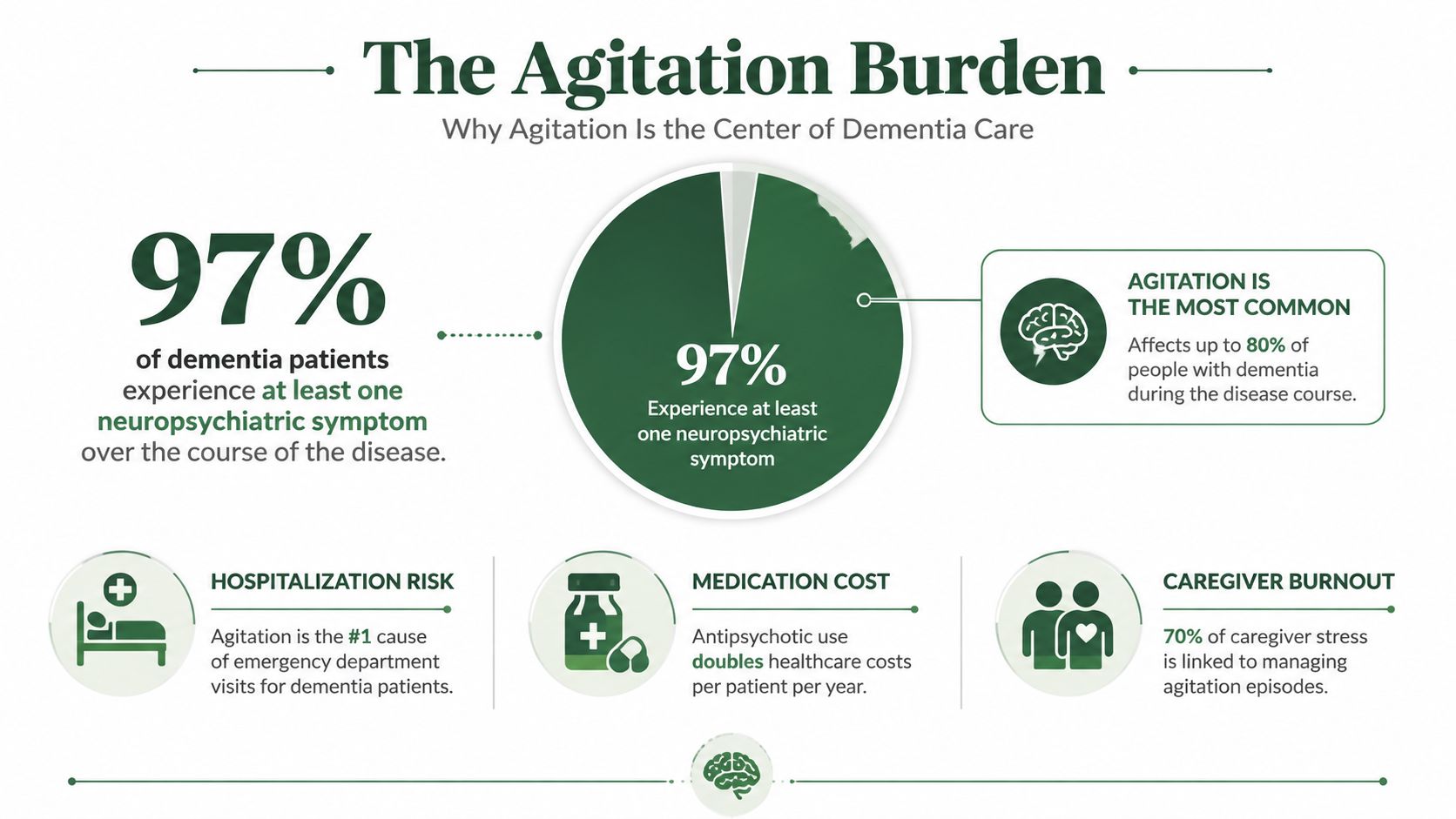
The review links agitation with higher care needs, more institutionalization, and greater health-service use. In practical terms, agitation can turn a manageable morning routine into a missed appointment, an unsafe transfer, an emergency call, or a decision to seek residential care sooner than the family expected. It also makes caregivers less able to sleep, work, and respond patiently.
The gap between guidance and practice
Clinical guidance has repeatedly moved toward non-pharmacological care first, with medication reserved for selected situations. Yet a U.S. chart review found that among patients who eventually started an antipsychotic after an agitation episode, 74.5% started within three months of onset, while non-pharmacological therapy had been tried first in only 37.8% of residential-care patients and 21.3% of community-dwelling patients according to the published chart review.
That gap matters. Families often receive a prescription before anyone has examined the room, the routine, the communication style, or the person's likely unmet need. Integrated care models can help teams combine behavioral assessment, medical review, caregiver support, and follow-up. A practical overview of the benefits of integrated behavioral health models can help families understand why coordinated support is more useful than isolated advice.
The working model is straightforward: use a DICE-style investigation, adjust the environment and communication, monitor patterns between appointments, and sequence medication carefully. That approach won't make every episode disappear, but it gives the family a repeatable response instead of a series of desperate guesses.
Reading the Trigger Before You React
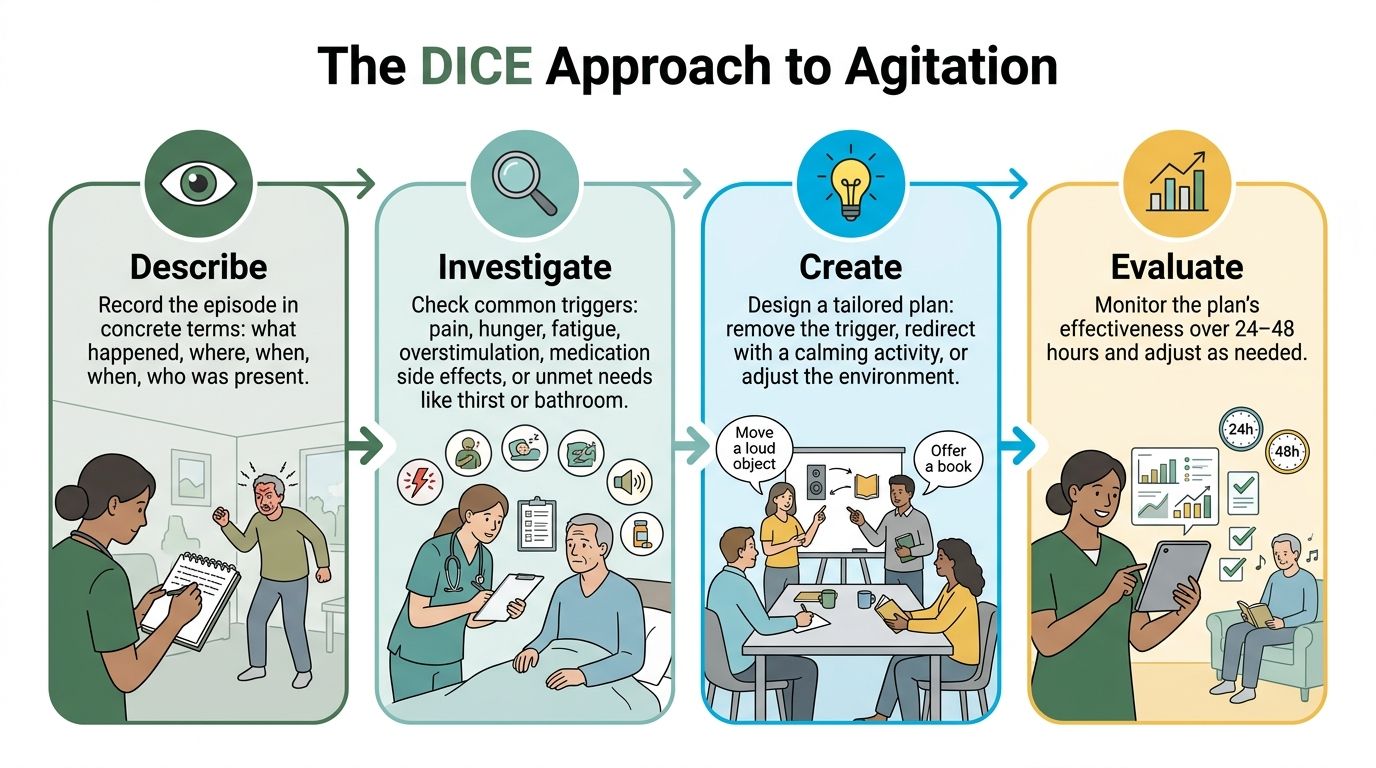
The DICE framework gives agitation management a usable order: Describe, Investigate, Create, Evaluate. You don't need clinical language to use it. You need accurate observations.
Describe the episode
Write what you saw, not what you think it meant. “He shouted, pushed the towel away, and walked toward the front door after I mentioned the shower” is useful. “He was difficult” isn't.
Record the location, time, people present, task underway, words used, physical actions, and length of the episode. Note whether the agitation was verbal, physical, restless, fearful, repetitive, or directed at a particular person.
Investigate before intervening
Look first for a change in the body or surroundings. A toothache can look like resistance during mouth care. Constipation, urinary symptoms, dehydration, infection, poor sleep, and medication side effects can all increase distress. Sudden confusion or a sharp departure from the usual pattern deserves medical attention because delirium may be involved.
Then examine ordinary triggers:
Pain or discomfort: Watch for grimacing, guarding, rubbing a body part, or resistance during movement.
Overstimulation: A blaring television, dishwasher, several conversations, or bright glare can overwhelm processing.
Time of day: Afternoon decline, often called sundowning, can make familiar routines harder.
Boredom or isolation: Restlessness may begin after a caregiver leaves or when the person has nothing meaningful to do.
Caregiver mismatch: A rushed voice, complex instructions, or an unfamiliar helper can turn a neutral task into a confrontation.
Create a targeted response
Match the intervention to the suspected driver. Turn off the television for overstimulation. Offer a drink and a bathroom visit if thirst or urgency is possible. Delay the shower if fatigue is obvious. Use a familiar song or a simple folding task if boredom appears to be the problem.
Avoid generic activity prescriptions. A person who becomes agitated during bathing needs a bathing plan, not merely “more activities.” That plan might include a warmer room, a familiar caregiver, one instruction at a time, and a towel visible before the task begins.
Evaluate what changed
After the episode, ask whether the response reduced distress, prevented escalation, or made no difference. Keep a short trigger log across days, looking for repetition rather than demanding certainty after one event.
Investigation precedes intervention every time. If agitation is sudden, unusually severe, accompanied by physical symptoms, or unlike the person's established pattern, contact a clinician promptly rather than assuming dementia progression.
Communication and Environment Adjustments That Reduce Agitation
After a hard afternoon, change the interaction before changing the whole care plan. Low-grade agitation often rises when a person is asked to process too much language, speed, or background noise. Use fewer words, slow your pace, and remove competing sensory input.
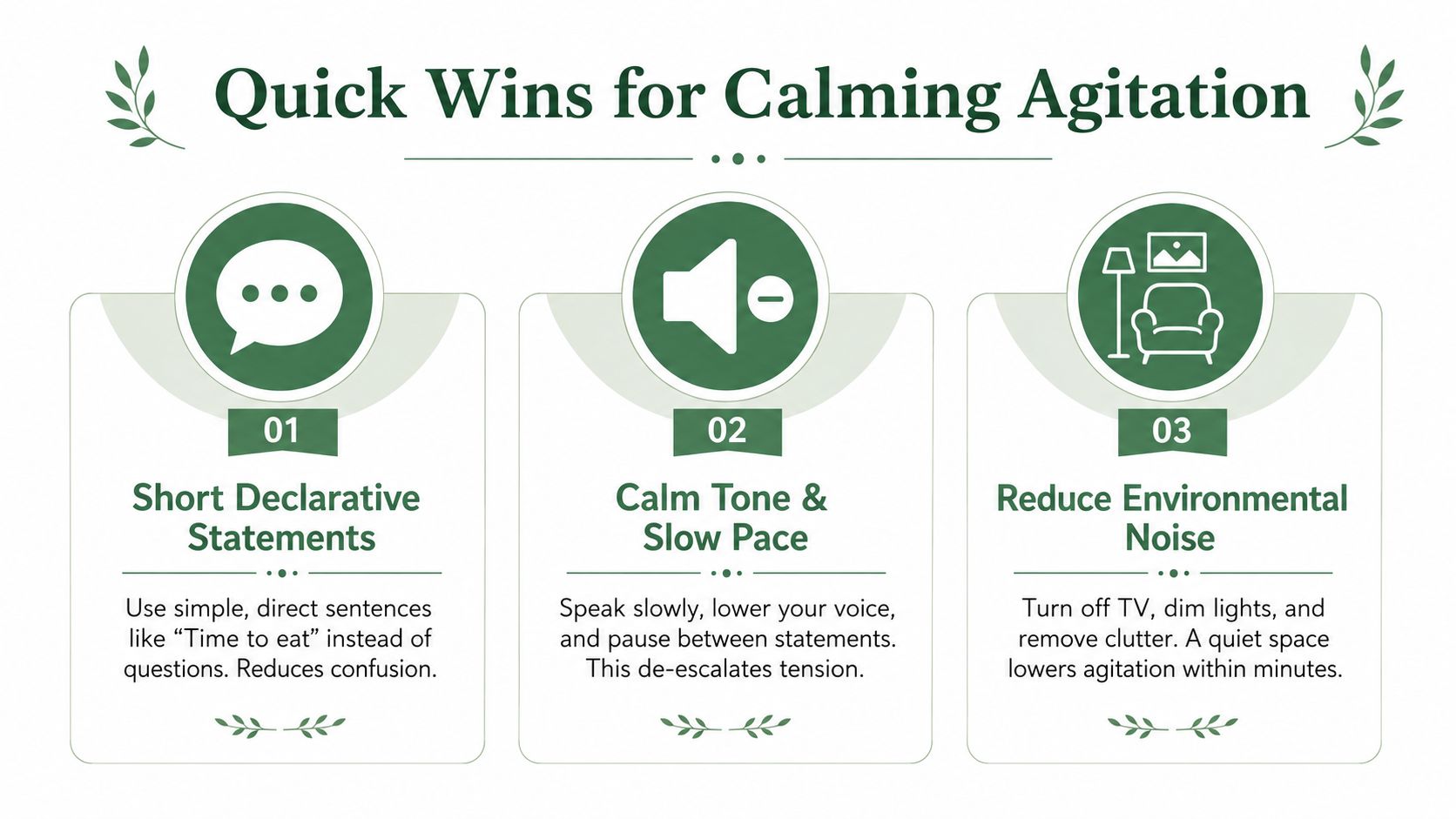
Give one clear instruction at a time. Open-ended questions such as “Do you want to take a shower?” can create a decision that feels confusing or threatening. Try “Your warm towel is ready. Let's go together.” Other useful swaps include:
“Time to eat” instead of “Are you hungry?”
“Your blue sweater is here” instead of “What do you want to wear?”
“Let's sit by the window” instead of “Where would you like to sit?”
“I'm going to help with your coat” instead of “Can I help you get dressed?”
“First the shoes, then we'll go” instead of explaining the entire outing.
Speak more slowly than feels natural. Pause after each statement and wait for a response before giving another instruction. Approach from the front, stay at eye level, and keep your hands visible. Leaning over your parent or touching them without warning can feel threatening, even when you mean to help.
“One calm sentence is often more effective than five explanations.”
Tune the room to the trigger
Change the setting before repeating yourself. Turn off the television if it is blaring. If the dishwasher and television are running together, remove one competing sound. Reduce mirror visibility where reflections cause confusion. Clear walking paths of clutter and trip hazards, especially when agitation includes pacing.
Daylight and suitable room lighting can support orientation. Glare and shadows can make faces, floors, bathroom fixtures, or offered objects harder to interpret. Use a practical test: can your parent see your face and the immediate surroundings without glare or confusing shadows?
Reassurance can become another source of pressure when repeated. Say, “You're upset. I'm here,” once, then redirect to a quieter place: “Let's sit in the quiet room.” Match your words, tone, distance, and touch. These details matter as much as the sentence itself. For more phrasing options, review these essential dementia communication strategies.
Use the same approach across family members and paid caregivers. A shared script reduces mixed signals and gives everyone a consistent response during a difficult moment. This guide to better patient experience offers practical ideas for keeping care respectful and consistent.
Here's a short demonstration of how tone, pacing, and nonverbal behavior can affect a difficult interaction:
How Regular Phone Check-Ins Change the Agitation Curve
Regular phone calls create a daily baseline and help families spot changes between clinical visits. They cannot confirm a urinary infection or reveal a painful tooth, but a new pattern still deserves attention, especially when agitation differs sharply from the person's usual behavior.
Keep the call predictable without making it rigid. Use the same trained caller when possible. Start with orientation and connection, then ask about sleep, food, pain, mood, and the day's routine. Listen for a flattening mood before an outburst, new word-finding difficulty that may accompany delirium or a medication problem, and withdrawal before a familiar late-day pattern. Those observations help you decide whether to continue supportive adjustments or seek medical review.
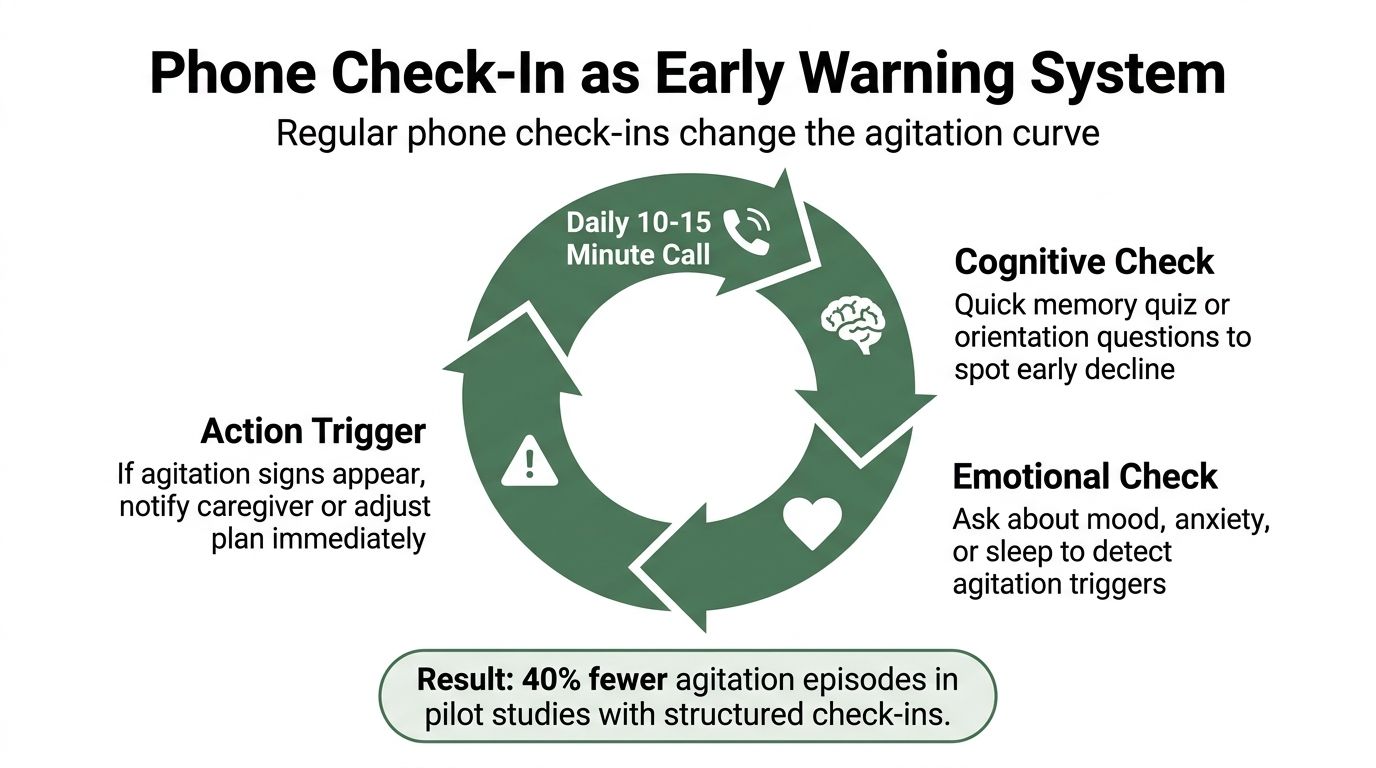
Do not turn the call into an interrogation. Try familiar prompts such as “Tell me about breakfast,” “How did your body feel when you got up?” and “What part of today felt hard?” A brief orientation activity, reminiscence prompt, or simple language task can show change without making the person feel tested.
Make the call part of the care record
A practical routine includes regular contact from the same trained caller or family member, followed by care-manager review of recurring concerns. Velma provides scheduled phone calls combining conversation, cognitive stimulation, mood support, and practical check-ins, with observations documented for family coordination. Use it to support in-person care, not to replace physical assessment. Families can also compare their process with Gini Help's caregiver alert system guide.
After each call, record:
Sleep: Whether the night was settled or fragmented.
Appetite and fluids: Missed meals, reduced drinking, or thirst.
Pain language: New complaints, grimacing, guarding, or unusual resistance.
Engagement: Whether the person joined in, withdrew, or became anxious.
Timing: A repeated increase in distress at a particular time.
Safety concerns: Falls, wandering, missed medication, or reported household hazards.
Phone contact cannot reliably detect dehydration, examine a fall injury, or rule out untreated pain. Place it between the DICE assessment and the medication decision. Use these daily check-in calls for seniors as a model for building a repeatable routine, then start a brief call log after the first week. Review changes in sleep, engagement, timing, and safety with the care team, particularly when agitation is new, escalating, or paired with confusion.
When Medication Enters the Conversation
Medication belongs in the plan when agitation remains persistent, severely distressing, dangerous, or disabling after reversible causes and environmental factors have been addressed. It shouldn't be the first response to shouting, resistance, pacing, or a staffing problem.
Begin with a medical review. Check pain, including dental pain and pain from arthritis or constipation. Review sleep disruption, hydration, infection symptoms, recent medication changes, and drugs that may worsen confusion or sedation. Ask whether the episode represents delirium or a meaningful change from baseline.
The medication sequence described in clinical reviews starts with optimizing cognition-supporting treatment, addressing insomnia or sundowning when present, and considering citalopram if agitation persists, while accounting for QT prolongation risk as outlined in this treatment review. Medication choices depend on the person's diagnosis, medical history, current drugs, symptom pattern, and goals of care.
Step | When to consider | Typical agents | Review window | Key safety check |
|---|---|---|---|---|
Medical and medication review | First, especially after sudden change | Treatment for the identified driver | Prompt clinical review | Pain, infection, dehydration, delirium, side effects |
Non-drug plan | For behavioral triggers and unmet needs | Environmental change, communication adjustment, tailored activity | Reassess response and fidelity | Confirm the plan was actually delivered |
Symptom-targeted treatment | Persistent symptoms with a defined target | Citalopram or another clinician-selected agent | Set a clinician-defined follow-up | QT prolongation and interactions where relevant |
Antipsychotic discussion | Severe distress or safety risk after assessment | A clinician-selected antipsychotic | Frequent review and taper discussion | Adverse effects, informed consent, goals of care |
Ask the prescriber four direct questions: What exact symptom are we treating? What medical causes have been ruled out? When will we review it? What is the deprescribing plan if it doesn't help? If the answer is “to calm him down,” the target is not specific enough.
Antipsychotics carry serious safety concerns, and their potential benefit must be weighed against adverse effects. Don't accept them as a substitute for adequate staffing, caregiver coaching, or a behavioral assessment. Likewise, don't add sleep aids casually without reviewing anticholinergic burden and the possibility of worsening confusion.
Recent guidance continues to emphasize individualized care, with non-pharmacological strategies first and medication reserved for intense, disruptive, or unsafe behavior. The 2025 practitioner guidance on dementia agitation also reflects the field's move toward clearer medication sequencing and avoidance of restraints or seclusion.
Building Your Family's Agitation Safety Plan
Hoping for a calm week isn't a plan. A written plan turns a frightened reaction into a practiced response, especially when several relatives or paid caregivers share responsibility.
Keep the document to one page. It should contain five blocks:
Baseline: Describe your parent's usual mood, communication, sleep, appetite, mobility, and late-day behavior.
Trigger ranking: List known triggers from most frequent to least frequent, such as bathing, noise, hunger, unfamiliar caregivers, or rushed transitions.
Response sequence: Write the exact first steps for each trigger, including what to stop, what to say, where to move, and what activity can redirect attention.
Medical checklist: Before labeling an episode behavioral, check for pain, constipation, dehydration, infection symptoms, poor sleep, delirium, and a new medication or dose.
Escalation path: Name who calls the prescriber after a persistent concern, who arranges same-day evaluation, and who stays with your parent if safety deteriorates.
Track patterns week by week rather than relying on memory. Record sleep, hydration, missed meals, caregiver changes, engagement during phone check-ins, time of day, and any as-needed medication use. A care plan should also identify what “better” means, such as fewer confrontations during bathing, less pacing after dinner, or faster recovery after a trigger.
Use a cognitive care plan example as a starting point, then make it specific to your parent's routines and risks.
The family safety checklist
Environment: Remove trip hazards, improve visibility, reduce competing noise, and secure unsafe areas.
Wandering: Decide who checks exits, who carries the emergency information, and what action follows an unexplained absence.
Medication reconciliation: Review the full medication list with a clinician at regular intervals, including over-the-counter sleep products.
Respite: Schedule relief before the primary caregiver reaches crisis point.
Communication: Give every caregiver the same short phrases and response sequence.
Documentation: Bring the trigger log and medication questions to appointments.
Escalation: Seek urgent help when there's immediate danger, a sudden major change, serious injury, or signs of acute illness.
The plan's value is operational. It keeps one difficult afternoon from becoming a permanent conclusion that your parent can no longer live safely at home. It also gives clinicians better information than a single appointment can provide.
If your family needs consistent support between visits, Velma provides scheduled phone calls with cognitive engagement, emotional support, orientation, and practical well-being check-ins for older adults with memory loss. Visit Velma to see whether a structured phone-based routine can add an early-warning layer to your dementia agitation management plan.
At 4 p.m., your father refuses the shower he accepted yesterday. He pushes your hand away, calls you by your sister's name, and shouts when you explain that he needs to wash. The television is loud, the kitchen is cluttered, and you're already tired. You need to know what to do next, not read another list of calming tips.
Good dementia agitation management follows an order. First identify the trigger, then lower distress, then check for a medical cause, and only after that discuss medication or a higher level of support. The central question is whether the episode is primarily behavioral, or whether agitation is announcing pain, infection, dehydration, delirium, poor sleep, or a medication problem.
This guide gives you a practical decision flow for the hard afternoon, the difficult week, and the medication conversation. It starts with trigger identification, moves through communication and environmental changes, adds phone-based monitoring between visits, and ends with medication sequencing and a written safety plan.
Table of Contents
When a Good Day Turns Bad
Why Agitation Is the Center of Dementia Care
The gap between guidance and practice
Reading the Trigger Before You React
Describe the episode
Investigate before intervening
Create a targeted response
Evaluate what changed
Communication and Environment Adjustments That Reduce Agitation
Tune the room to the trigger
How Regular Phone Check-Ins Change the Agitation Curve
Make the call part of the care record
When Medication Enters the Conversation
Building Your Family's Agitation Safety Plan
The family safety checklist
When a Good Day Turns Bad
Agitation often arrives during an ordinary task. A shower, a change of clothes, a trip to the bathroom, or a request to leave the house can suddenly feel threatening to someone with dementia. Your father may not understand what you're asking, may not recognize you, or may experience your urgency as pressure. His shouting is real, but it may not be a deliberate refusal.
Start by stopping the task. Don't argue about whether he needs a shower, and don't keep repeating the reason. Step back, lower your voice, and give him physical space. If he's at immediate risk of hurting himself or someone else, move other people away and seek urgent help.
Then ask a more useful question than “How do I make him cooperate?” Ask, “What changed just before this started?”
Was the bathroom cold? Did you approach from behind? Had he slept poorly? Was the television competing with your instructions? Did he show signs of pain when standing, reaching, or removing clothing? Did a new medication start recently? Those details point toward different solutions.
Practical rule: Treat the episode as information before treating it as misconduct.
Behavioral agitation often follows a recognizable pattern. It appears around a particular task, time of day, person, noise level, or unmet need. Medically driven agitation tends to be more abrupt, more intense, or noticeably different from the person's usual behavior. The two can overlap, which is why investigation comes before reassurance, redirection, or medication.
For the next episode, write down four things: what happened, what came immediately before it, what your parent did, and what helped. That short record is more valuable than a vague note saying “bad behavior.” It gives the family and clinician something they can act on.
The goal isn't to win the shower argument. The goal is to restore safety, find the driver, and make the next attempt less threatening. Sometimes the right decision is to abandon the shower for now and try again after food, rest, a quieter room, or a different caregiver.
Why Agitation Is the Center of Dementia Care
Agitation isn't a side issue in dementia care. It changes how much supervision a person needs, how safely they can remain at home, and how much strain falls on the family. A systematic review found agitation prevalence estimates ranging from 5% to 88% across studies, with 38% of studies reporting prevalence at or above 50%. In Alzheimer's disease, estimates range from 30% to 76%, and many other dementia subtypes show estimates around 30% to 50% according to the systematic review of agitation in dementia.
One large real-world study of 1,349 patients found that 48.6% had at least one agitation symptom. The operational difference was substantial: 86.2% of agitated patients required a caregiver, compared with 67.8% of non-agitated patients. Mean direct healthcare costs over 12 months were $20,041 for agitated patients, compared with $9,243 for non-agitated patients. Those figures describe why a family can feel that one recurring behavior has taken over the entire care plan.
The review links agitation with higher care needs, more institutionalization, and greater health-service use. In practical terms, agitation can turn a manageable morning routine into a missed appointment, an unsafe transfer, an emergency call, or a decision to seek residential care sooner than the family expected. It also makes caregivers less able to sleep, work, and respond patiently.
The gap between guidance and practice
Clinical guidance has repeatedly moved toward non-pharmacological care first, with medication reserved for selected situations. Yet a U.S. chart review found that among patients who eventually started an antipsychotic after an agitation episode, 74.5% started within three months of onset, while non-pharmacological therapy had been tried first in only 37.8% of residential-care patients and 21.3% of community-dwelling patients according to the published chart review.
That gap matters. Families often receive a prescription before anyone has examined the room, the routine, the communication style, or the person's likely unmet need. Integrated care models can help teams combine behavioral assessment, medical review, caregiver support, and follow-up. A practical overview of the benefits of integrated behavioral health models can help families understand why coordinated support is more useful than isolated advice.
The working model is straightforward: use a DICE-style investigation, adjust the environment and communication, monitor patterns between appointments, and sequence medication carefully. That approach won't make every episode disappear, but it gives the family a repeatable response instead of a series of desperate guesses.
Reading the Trigger Before You React
The DICE framework gives agitation management a usable order: Describe, Investigate, Create, Evaluate. You don't need clinical language to use it. You need accurate observations.
Describe the episode
Write what you saw, not what you think it meant. “He shouted, pushed the towel away, and walked toward the front door after I mentioned the shower” is useful. “He was difficult” isn't.
Record the location, time, people present, task underway, words used, physical actions, and length of the episode. Note whether the agitation was verbal, physical, restless, fearful, repetitive, or directed at a particular person.
Investigate before intervening
Look first for a change in the body or surroundings. A toothache can look like resistance during mouth care. Constipation, urinary symptoms, dehydration, infection, poor sleep, and medication side effects can all increase distress. Sudden confusion or a sharp departure from the usual pattern deserves medical attention because delirium may be involved.
Then examine ordinary triggers:
Pain or discomfort: Watch for grimacing, guarding, rubbing a body part, or resistance during movement.
Overstimulation: A blaring television, dishwasher, several conversations, or bright glare can overwhelm processing.
Time of day: Afternoon decline, often called sundowning, can make familiar routines harder.
Boredom or isolation: Restlessness may begin after a caregiver leaves or when the person has nothing meaningful to do.
Caregiver mismatch: A rushed voice, complex instructions, or an unfamiliar helper can turn a neutral task into a confrontation.
Create a targeted response
Match the intervention to the suspected driver. Turn off the television for overstimulation. Offer a drink and a bathroom visit if thirst or urgency is possible. Delay the shower if fatigue is obvious. Use a familiar song or a simple folding task if boredom appears to be the problem.
Avoid generic activity prescriptions. A person who becomes agitated during bathing needs a bathing plan, not merely “more activities.” That plan might include a warmer room, a familiar caregiver, one instruction at a time, and a towel visible before the task begins.
Evaluate what changed
After the episode, ask whether the response reduced distress, prevented escalation, or made no difference. Keep a short trigger log across days, looking for repetition rather than demanding certainty after one event.
Investigation precedes intervention every time. If agitation is sudden, unusually severe, accompanied by physical symptoms, or unlike the person's established pattern, contact a clinician promptly rather than assuming dementia progression.
Communication and Environment Adjustments That Reduce Agitation
After a hard afternoon, change the interaction before changing the whole care plan. Low-grade agitation often rises when a person is asked to process too much language, speed, or background noise. Use fewer words, slow your pace, and remove competing sensory input.
Give one clear instruction at a time. Open-ended questions such as “Do you want to take a shower?” can create a decision that feels confusing or threatening. Try “Your warm towel is ready. Let's go together.” Other useful swaps include:
“Time to eat” instead of “Are you hungry?”
“Your blue sweater is here” instead of “What do you want to wear?”
“Let's sit by the window” instead of “Where would you like to sit?”
“I'm going to help with your coat” instead of “Can I help you get dressed?”
“First the shoes, then we'll go” instead of explaining the entire outing.
Speak more slowly than feels natural. Pause after each statement and wait for a response before giving another instruction. Approach from the front, stay at eye level, and keep your hands visible. Leaning over your parent or touching them without warning can feel threatening, even when you mean to help.
“One calm sentence is often more effective than five explanations.”
Tune the room to the trigger
Change the setting before repeating yourself. Turn off the television if it is blaring. If the dishwasher and television are running together, remove one competing sound. Reduce mirror visibility where reflections cause confusion. Clear walking paths of clutter and trip hazards, especially when agitation includes pacing.
Daylight and suitable room lighting can support orientation. Glare and shadows can make faces, floors, bathroom fixtures, or offered objects harder to interpret. Use a practical test: can your parent see your face and the immediate surroundings without glare or confusing shadows?
Reassurance can become another source of pressure when repeated. Say, “You're upset. I'm here,” once, then redirect to a quieter place: “Let's sit in the quiet room.” Match your words, tone, distance, and touch. These details matter as much as the sentence itself. For more phrasing options, review these essential dementia communication strategies.
Use the same approach across family members and paid caregivers. A shared script reduces mixed signals and gives everyone a consistent response during a difficult moment. This guide to better patient experience offers practical ideas for keeping care respectful and consistent.
Here's a short demonstration of how tone, pacing, and nonverbal behavior can affect a difficult interaction:
How Regular Phone Check-Ins Change the Agitation Curve
Regular phone calls create a daily baseline and help families spot changes between clinical visits. They cannot confirm a urinary infection or reveal a painful tooth, but a new pattern still deserves attention, especially when agitation differs sharply from the person's usual behavior.
Keep the call predictable without making it rigid. Use the same trained caller when possible. Start with orientation and connection, then ask about sleep, food, pain, mood, and the day's routine. Listen for a flattening mood before an outburst, new word-finding difficulty that may accompany delirium or a medication problem, and withdrawal before a familiar late-day pattern. Those observations help you decide whether to continue supportive adjustments or seek medical review.
Do not turn the call into an interrogation. Try familiar prompts such as “Tell me about breakfast,” “How did your body feel when you got up?” and “What part of today felt hard?” A brief orientation activity, reminiscence prompt, or simple language task can show change without making the person feel tested.
Make the call part of the care record
A practical routine includes regular contact from the same trained caller or family member, followed by care-manager review of recurring concerns. Velma provides scheduled phone calls combining conversation, cognitive stimulation, mood support, and practical check-ins, with observations documented for family coordination. Use it to support in-person care, not to replace physical assessment. Families can also compare their process with Gini Help's caregiver alert system guide.
After each call, record:
Sleep: Whether the night was settled or fragmented.
Appetite and fluids: Missed meals, reduced drinking, or thirst.
Pain language: New complaints, grimacing, guarding, or unusual resistance.
Engagement: Whether the person joined in, withdrew, or became anxious.
Timing: A repeated increase in distress at a particular time.
Safety concerns: Falls, wandering, missed medication, or reported household hazards.
Phone contact cannot reliably detect dehydration, examine a fall injury, or rule out untreated pain. Place it between the DICE assessment and the medication decision. Use these daily check-in calls for seniors as a model for building a repeatable routine, then start a brief call log after the first week. Review changes in sleep, engagement, timing, and safety with the care team, particularly when agitation is new, escalating, or paired with confusion.
When Medication Enters the Conversation
Medication belongs in the plan when agitation remains persistent, severely distressing, dangerous, or disabling after reversible causes and environmental factors have been addressed. It shouldn't be the first response to shouting, resistance, pacing, or a staffing problem.
Begin with a medical review. Check pain, including dental pain and pain from arthritis or constipation. Review sleep disruption, hydration, infection symptoms, recent medication changes, and drugs that may worsen confusion or sedation. Ask whether the episode represents delirium or a meaningful change from baseline.
The medication sequence described in clinical reviews starts with optimizing cognition-supporting treatment, addressing insomnia or sundowning when present, and considering citalopram if agitation persists, while accounting for QT prolongation risk as outlined in this treatment review. Medication choices depend on the person's diagnosis, medical history, current drugs, symptom pattern, and goals of care.
Step | When to consider | Typical agents | Review window | Key safety check |
|---|---|---|---|---|
Medical and medication review | First, especially after sudden change | Treatment for the identified driver | Prompt clinical review | Pain, infection, dehydration, delirium, side effects |
Non-drug plan | For behavioral triggers and unmet needs | Environmental change, communication adjustment, tailored activity | Reassess response and fidelity | Confirm the plan was actually delivered |
Symptom-targeted treatment | Persistent symptoms with a defined target | Citalopram or another clinician-selected agent | Set a clinician-defined follow-up | QT prolongation and interactions where relevant |
Antipsychotic discussion | Severe distress or safety risk after assessment | A clinician-selected antipsychotic | Frequent review and taper discussion | Adverse effects, informed consent, goals of care |
Ask the prescriber four direct questions: What exact symptom are we treating? What medical causes have been ruled out? When will we review it? What is the deprescribing plan if it doesn't help? If the answer is “to calm him down,” the target is not specific enough.
Antipsychotics carry serious safety concerns, and their potential benefit must be weighed against adverse effects. Don't accept them as a substitute for adequate staffing, caregiver coaching, or a behavioral assessment. Likewise, don't add sleep aids casually without reviewing anticholinergic burden and the possibility of worsening confusion.
Recent guidance continues to emphasize individualized care, with non-pharmacological strategies first and medication reserved for intense, disruptive, or unsafe behavior. The 2025 practitioner guidance on dementia agitation also reflects the field's move toward clearer medication sequencing and avoidance of restraints or seclusion.
Building Your Family's Agitation Safety Plan
Hoping for a calm week isn't a plan. A written plan turns a frightened reaction into a practiced response, especially when several relatives or paid caregivers share responsibility.
Keep the document to one page. It should contain five blocks:
Baseline: Describe your parent's usual mood, communication, sleep, appetite, mobility, and late-day behavior.
Trigger ranking: List known triggers from most frequent to least frequent, such as bathing, noise, hunger, unfamiliar caregivers, or rushed transitions.
Response sequence: Write the exact first steps for each trigger, including what to stop, what to say, where to move, and what activity can redirect attention.
Medical checklist: Before labeling an episode behavioral, check for pain, constipation, dehydration, infection symptoms, poor sleep, delirium, and a new medication or dose.
Escalation path: Name who calls the prescriber after a persistent concern, who arranges same-day evaluation, and who stays with your parent if safety deteriorates.
Track patterns week by week rather than relying on memory. Record sleep, hydration, missed meals, caregiver changes, engagement during phone check-ins, time of day, and any as-needed medication use. A care plan should also identify what “better” means, such as fewer confrontations during bathing, less pacing after dinner, or faster recovery after a trigger.
Use a cognitive care plan example as a starting point, then make it specific to your parent's routines and risks.
The family safety checklist
Environment: Remove trip hazards, improve visibility, reduce competing noise, and secure unsafe areas.
Wandering: Decide who checks exits, who carries the emergency information, and what action follows an unexplained absence.
Medication reconciliation: Review the full medication list with a clinician at regular intervals, including over-the-counter sleep products.
Respite: Schedule relief before the primary caregiver reaches crisis point.
Communication: Give every caregiver the same short phrases and response sequence.
Documentation: Bring the trigger log and medication questions to appointments.
Escalation: Seek urgent help when there's immediate danger, a sudden major change, serious injury, or signs of acute illness.
The plan's value is operational. It keeps one difficult afternoon from becoming a permanent conclusion that your parent can no longer live safely at home. It also gives clinicians better information than a single appointment can provide.
If your family needs consistent support between visits, Velma provides scheduled phone calls with cognitive engagement, emotional support, orientation, and practical well-being check-ins for older adults with memory loss. Visit Velma to see whether a structured phone-based routine can add an early-warning layer to your dementia agitation management plan.
Suggested Article: