Instrumental Activities Daily Living

You arrive at your father's home and notice the unopened bills before he notices you looking. In the refrigerator, the milk has expired. On the counter, a cardiology appointment reminder sits beneath a stack of mail, already past its date. Your father is dressed neatly, answers questions easily, and seems like himself, so you hesitate to raise the subject.
That hesitation is common. Families often expect a serious problem to appear as difficulty bathing, dressing, eating, or walking. Yet a person can manage these visible basics while struggling with the hidden logistics that make independent life possible: paying bills, taking medications correctly, shopping, preparing meals, arranging transportation, and keeping in touch by phone.
These tasks are called activities of daily living, or IADLs. They provide a practical lens for understanding changes that may otherwise look like isolated oversights. Even changes in physical comfort and mobility can affect independence, so resources such as Top Mobility's lift chair guide may help families think through safer ways to support movement at home.
The aim isn't to label your parent or take over immediately. It's to understand what has changed, observe patterns, and add the right support while preserving as much participation as possible.
Table of Contents
A Moment Most Families Recognize
What Instrumental Activities of Daily Living Actually Mean
The eight core IADLs
Why IADLs Decline Before Basic Self-Care
Four especially informative tasks
Everyday Signs of IADL Decline to Watch For
What to notice at home
How IADLs Are Assessed in Dementia Care
From conversation to demonstration
Practical Ways to Support and Adapt Each IADL
Build support around the task
How Phone-Based Check-Ins Reinforce Daily Routines
Listen for changes, not perfect answers
A Simple Starting Plan for Families
A Moment Most Families Recognize
Your father insists the bills are handled. He may even become annoyed when you ask. From his perspective, the papers are waiting for later, the milk may look acceptable, and the appointment reminder may have been overlooked because the week felt unusually busy. A single missed task doesn't prove anything. The concern grows when ordinary breakdowns begin appearing across different parts of daily life.
IADLs sit between personal self-care and complete dependence. They include the decisions and sequences that connect a person with the wider community. A person may still shower, choose clothes, eat independently, and hold a warm conversation, while losing track of which bill is due, whether a prescription was taken, or how to reach a familiar clinic.
Practical rule: Look for a change in routine, not one isolated mistake.
This distinction matters because families sometimes wait for an obvious crisis. They may assume that a parent who looks well must be managing well. In reality, the most important clues can be quiet: a neglected bank statement, repeated grocery purchases, an unexplained reluctance to drive, or a phone that no longer gets answered.
Start by asking what the task requires. Paying a bill involves opening mail, identifying the amount, remembering the due date, accessing an account, and confirming payment. Taking medication involves recognizing the right container, reading instructions, tracking time, and adjusting when a routine changes. These are more demanding than they appear.
You don't need to diagnose dementia from the kitchen counter. You do need to notice whether your parent is losing reliable control over tasks that once happened without help. A calm record of those changes can guide the next conversation with family members and a clinician.
What Instrumental Activities of Daily Living Actually Mean
Activities for independent living are the complex everyday tasks a person manages to live independently at home and in the community. They differ from activities of daily living, or ADLs, which focus on basic self-care such as bathing, dressing, eating, toileting, and transferring.
A useful mental model is simple: ADLs are the body, while IADLs are the operating system that connects a person to daily life. ADLs show whether someone can care for basic physical needs. IADLs show whether they can organize the household, make decisions, and participate safely outside it.
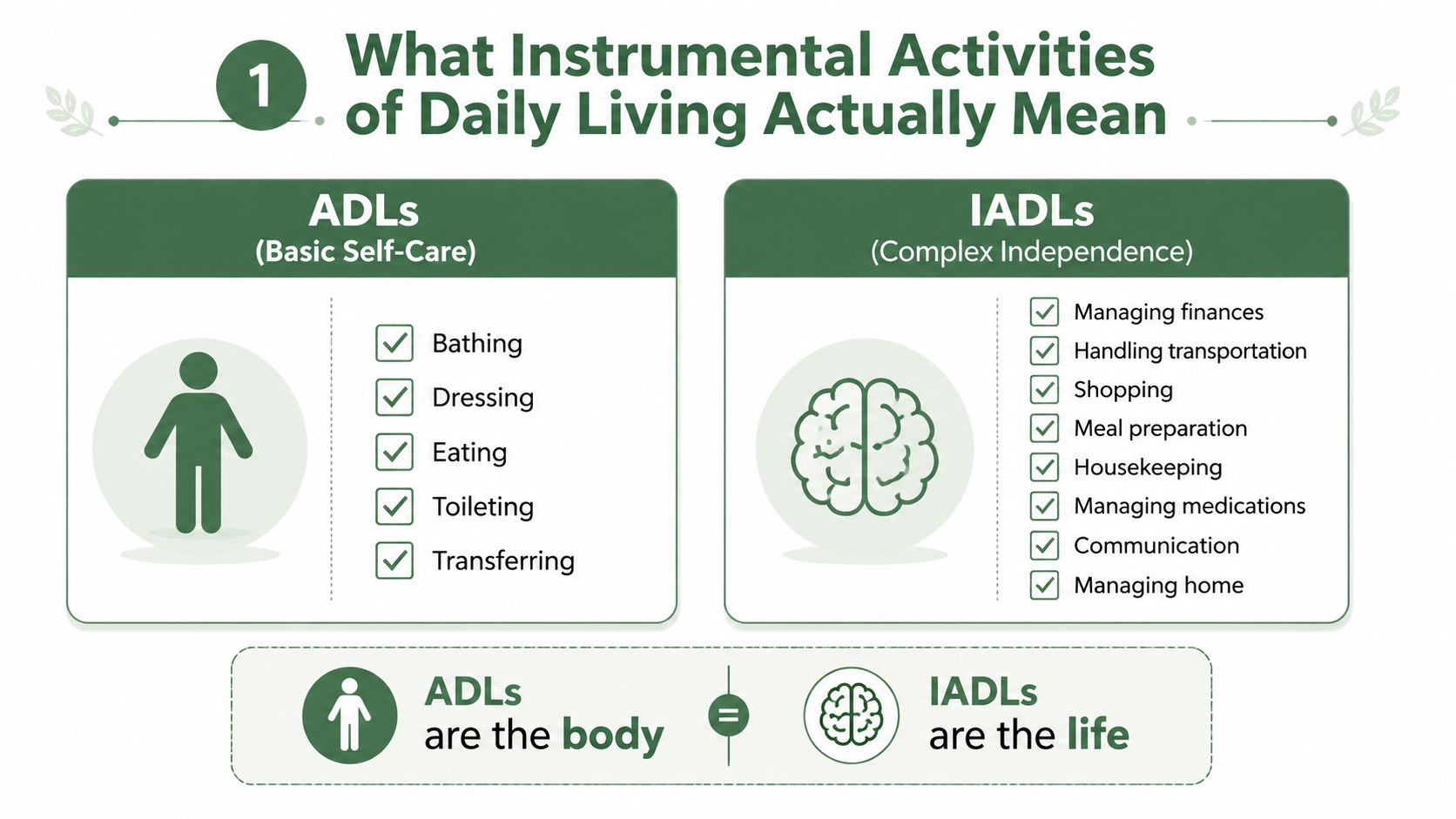
The classic Lawton and Brody framework helped make IADL measurement a standard part of geriatric functional assessment. Its focus is on higher-order tasks that require organization, judgment, and independent community living.
The eight core IADLs
Telephone use: Making and receiving calls, finding contacts, listening to messages, and responding appropriately.
Shopping: Creating a list, choosing needed items, paying, and bringing purchases home.
Managing finances: Opening mail, paying bills, monitoring accounts, and recognizing unusual transactions.
Medication management: Knowing which medications to take, when to take them, and whether a dose has already been taken.
Meal preparation: Planning food, gathering ingredients, using appliances safely, and cleaning afterward.
Housekeeping: Maintaining a reasonably safe and usable living environment.
Transportation: Driving, arranging rides, using public transportation, or reaching appointments safely.
Laundry: Sorting clothes, operating a washer and dryer, choosing appropriate settings, and putting items away.
These tasks overlap. Shopping affects meals, transportation affects appointments, and phone use supports nearly every other activity. The working definition you can repeat to a sibling or clinician is this: IADLs are the planning-heavy tasks that allow a person to run a household and remain connected to the community, even when basic self-care is still intact.
Why IADLs Decline Before Basic Self-Care
IADLs usually require more than physical ability. They depend on executive functions, including planning, sequencing, working memory, sustained attention, and flexible problem-solving. A person must hold several steps in mind, notice when something has gone wrong, and adjust without another person directing each move.
Basic self-care often relies more heavily on familiar motor routines. Dressing, eating, or using the bathroom can remain relatively stable while the person's ability to compare bank statements, organize prescriptions, or manage an altered travel plan becomes unreliable. This is why someone can look capable during a visit while needing meaningful support behind the scenes.
Population research supports the importance of these changes. In a U.S. analysis of adults aged 50 and older, IADL impairment prevalence was 31.9% in 2006 and 25.4% in 2018, meaning about one in four people in that age range still had an IADL limitation at the end of the study period (U.S. population analysis). In the same analysis, the 2018 burden was 31.3% among Americans aged 50 and older, compared with 19.2% among middle-aged adults.
Four especially informative tasks
Finances, medications, transportation, and telephone use are particularly useful early warning areas because they combine memory with judgment and real-world consequences. A classic community-based screening study found that telephone use, transportation, medication responsibility, and handling finances were independently correlated with cognitive impairment after adjustment for age, sex, and education. A score above zero had 0.94 sensitivity and 0.71 specificity for dementia detection (classic IADL screening study).
IADL task | Executive function required | Early warning sign |
|---|---|---|
Finances | Sequencing, judgment, error detection | Unpaid bills or difficulty recognizing a familiar payment |
Medication management | Working memory, timing, self-monitoring | Missed doses, duplicate doses, or unexplained refill confusion |
Transportation | Planning, orientation, flexible problem-solving | Getting lost on a familiar route or abandoning a routine trip |
Telephone use | Attention, recall, and communication sequencing | Ignoring calls, losing contacts, or forgetting messages |
These signs aren't proof of dementia. Pain, depression, poor vision, medication side effects, hearing loss, and other medical conditions can also affect IADLs. Their value lies in showing where a focused evaluation may be needed.
Everyday Signs of IADL Decline to Watch For
Observe before you correct. The question isn't whether your parent completes a task exactly as you would. Ask whether the result is safe, consistent, and different from the person's previous routine.
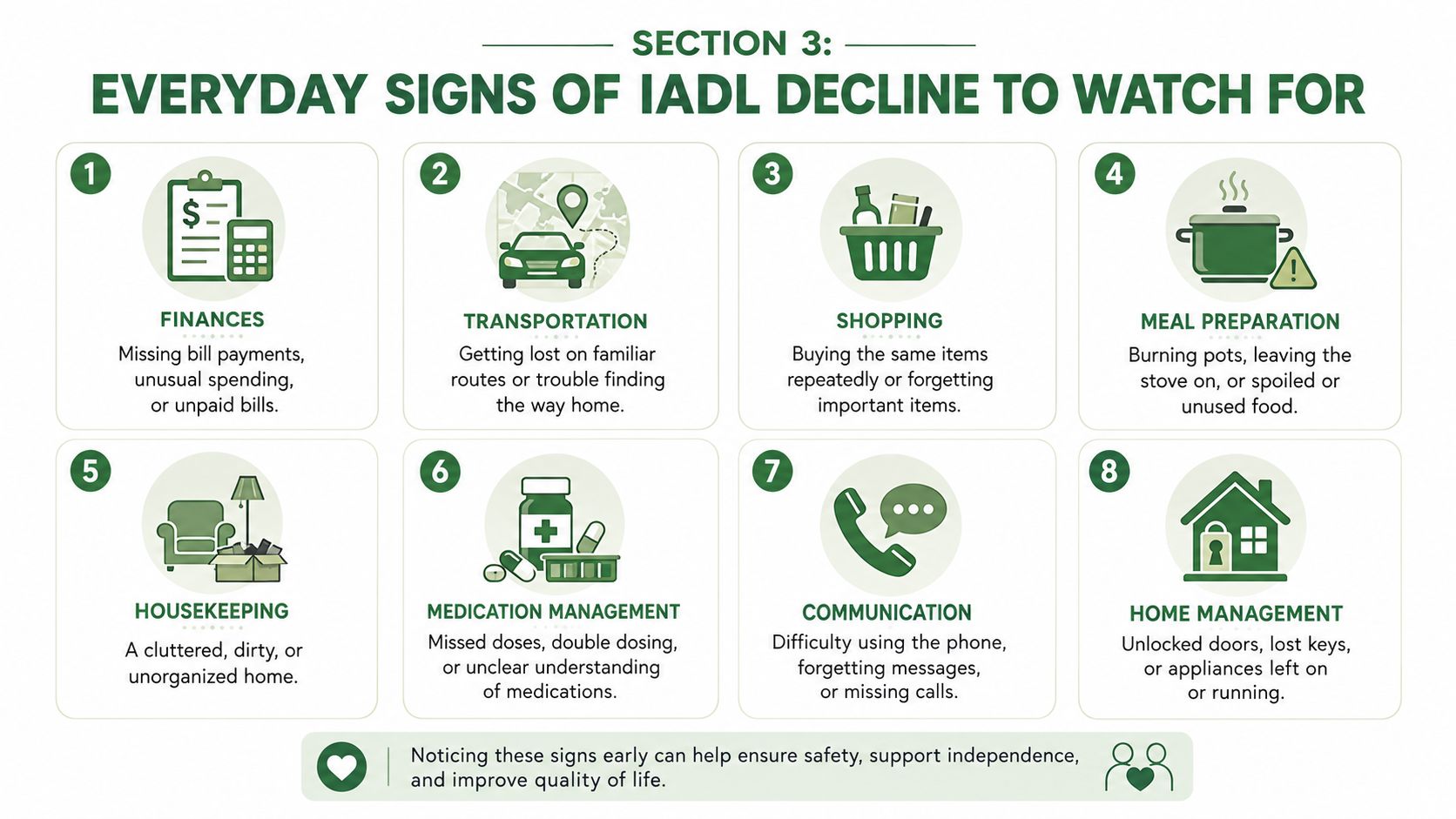
What to notice at home
Finances: Bills remain unopened, payments happen late, familiar accounts seem confusing, or purchases don't fit the person's normal habits.
Medications: Pills are missed, taken twice, left in unusual places, or refilled without a clear explanation.
Transportation: A familiar route becomes difficult, appointments are missed, or your parent stops driving without explaining why.
Telephone use: Calls go unanswered, contacts disappear, messages are forgotten, or the person repeats the same conversation because they can't track what was said.
Shopping: The same item is bought repeatedly, essential foods are missing, or your parent can't follow a short list.
Meal preparation: Food spoils, pots are left unattended, meals are skipped, or the person relies on a narrower and less nutritious routine.
Housekeeping: Clutter accumulates in new areas, appliances are left on, or ordinary cleaning tasks become confusing.
Laundry and home management: Clothes aren't washed, doors are left open, or household supplies and routines are no longer maintained.
A single example may reflect a bad day. Several changes across unrelated tasks deserve closer attention. Physical limitations can also explain trouble with shopping, laundry, or housekeeping, so note whether the barrier appears cognitive, physical, or mixed.
Keep a brief log for a couple of weeks. Record the date, task, what happened, what support was offered, and whether the problem repeated. Don't write conclusions such as “Dad is declining.” Write observable details such as “missed cardiology appointment despite reminder” or “opened the same bill twice and couldn't identify it.”
For additional context, families can review this guide to early signs of memory loss in aging parents. Share your notes with the primary care clinician rather than relying on memory during the appointment.
A simple log turns worry into useful information. It can also help your family avoid arguing about impressions and focus on specific tasks that need support.
How IADLs Are Assessed in Dementia Care
Clinicians don't assess IADLs only by asking, “Can you manage your medications?” Many people answer based on intention, habit, or what they believe they should be able to do. A thorough assessment combines several perspectives.
The Lawton IADL framework provides a structured way to review areas such as phone use, shopping, food preparation, housekeeping, laundry, transportation, medication management, and finances. A clinician may ask what the person does independently, what requires help, and what has changed over time. A family member's account adds important context, especially when insight has become less reliable.
From conversation to demonstration
Performance-based assessment adds another layer. Instead of asking whether someone can manage pills, a professional might ask them to demonstrate how they sort medications for a routine. Instead of asking whether they can use transportation, the evaluator might examine how they read a schedule, plan a route, or respond to a change.
Research on performance-based IADLs supports this approach. In an older-adult study, an Everyday Problems Test financial subscore predicted later five-year cognitive status, and each one-point increase in baseline financial performance was associated with a 26% reduction in the odds of later cognitive impairment (performance-based IADL research). The same source reports that an IADL scale cutoff of 6/7 had AUC 0.925, sensitivity 89%, specificity 81%, and classification accuracy 0.82 in a dementia diagnostic study.
Method | What it measures | Main limitation |
|---|---|---|
Self-report questionnaire | The person's understanding of their own abilities | May miss errors caused by reduced insight or memory |
Informant report | Changes noticed by a spouse, adult child, or caregiver | Can be affected by limited observation or caregiver interpretation |
Performance-based task | How the person completes a real or simulated activity | May be influenced by anxiety, unfamiliar materials, vision, or education |
Structured clinical interview | Patterns across cognition, function, health, and safety | A short visit may not capture ordinary home routines |
Assessment findings can shape care planning, medication oversight, driving discussions, financial safeguards, rehabilitation goals, and decisions about additional services. For a broader explanation of dementia evaluation and care, families may also find this dementia guide from Life Primary Care useful.
The strongest evaluation usually compares what the person says, what the family observes, and what the person can demonstrate. No single score should replace clinical judgment.
Practical Ways to Support and Adapt Each IADL
Support should begin with the least intrusive change that makes the task safer. The goal isn't to remove every responsibility. It's to preserve the part your parent can still do while adding structure around the vulnerable steps.
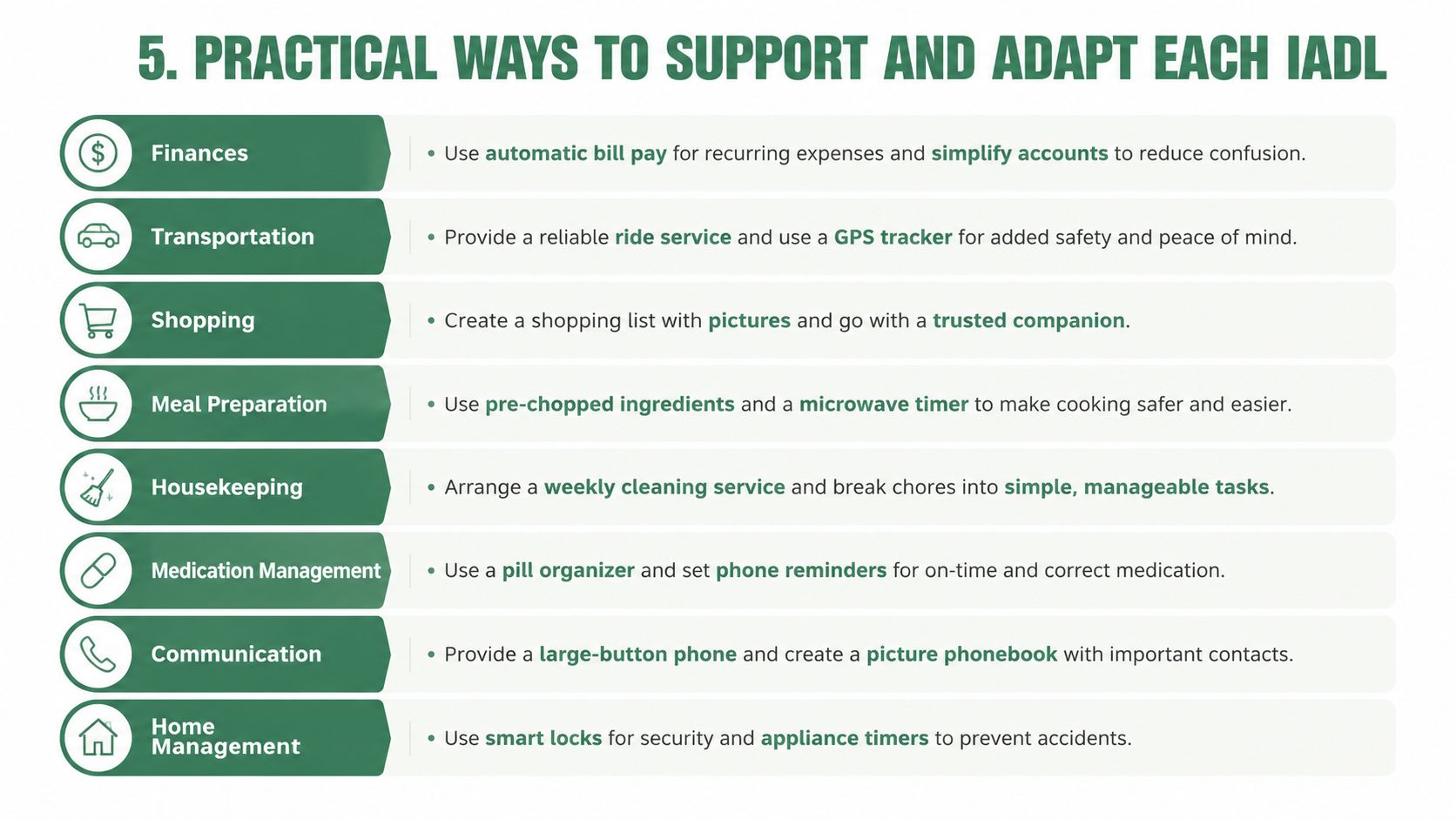
Build support around the task
Finances: Reduce the number of accounts that need active attention, use automatic payments where appropriate, and review statements with your parent. A trusted person can help monitor activity without taking every financial decision away immediately.
Medications: Ask the pharmacist about blister packaging or a clearly labeled pill organizer. Add one consistent alarm, then confirm whether the medication was taken instead of asking a vague question such as “Did you take your pills?”
Transportation: Don't make driving the only option or the first issue in every conversation. Try a supervised ride, a familiar driver, or a scheduled transportation service while you gather better information about safety.
Telephone use: Pre-program important contacts, use large labels or photographs, and keep a written list beside the phone. Practice one action at a time, such as answering a call or checking voicemail.
Shopping: Use a short list with familiar brands or pictures. Shop together when possible, and let your parent choose items while you handle navigation, payment, or carrying bags.
Meal preparation: Place frequently used ingredients within reach, prepare portions in advance, and use visual instructions. If stove safety is uncertain, shift cooking toward a microwave, slow cooker, or supervised preparation.
Housekeeping: Break chores into visible, manageable tasks. “Put the dishes in the sink” is easier to follow than “clean the kitchen.” Consider outside help for heavy cleaning while keeping a simple task for your parent.
Laundry and home management: Label washer settings, keep detergent in one location, and use appliance timers or reminders where suitable. Reduce hazards by checking locks, clutter, and kitchen equipment as part of a routine rather than an occasional inspection.
Physical accessibility can determine whether someone participates in these tasks. If getting in and out of the bathtub has become difficult, families can review safety considerations in this guide to walk-in tubs for seniors from SouthRay Kitchen & Bath.
Preserve the role, not necessarily every step: Your parent might choose the groceries, sort the laundry, or make the call while another person handles the risky part.
Supervision can be more useful than direct care. Dementia research found that supervision time explained more variation in complex IADL performance than direct IADL care hours, suggesting that families should learn how to guide participation rather than automatically replace it (research on supervision and IADL care).
Use repetition, visual cues, and predictable routines. Arguments about whether a task “should” be easy rarely improve performance. A calmer environment and a smaller number of steps often do.
How Phone-Based Check-Ins Reinforce Daily Routines
A scheduled phone call can serve as a daily anchor for someone who lives alone or spends long periods without in-person support. The call doesn't need to become an interrogation. It works best as a friendly, predictable contact that gently cues the next part of the day.
A morning call might orient the person to the day, prompt breakfast, and ask whether the first medication routine is complete. A midday call can encourage lunch, hydration, or preparation for an appointment. An evening call can review dinner, confirm that doors are locked, and help the person settle into a familiar bedtime pattern.
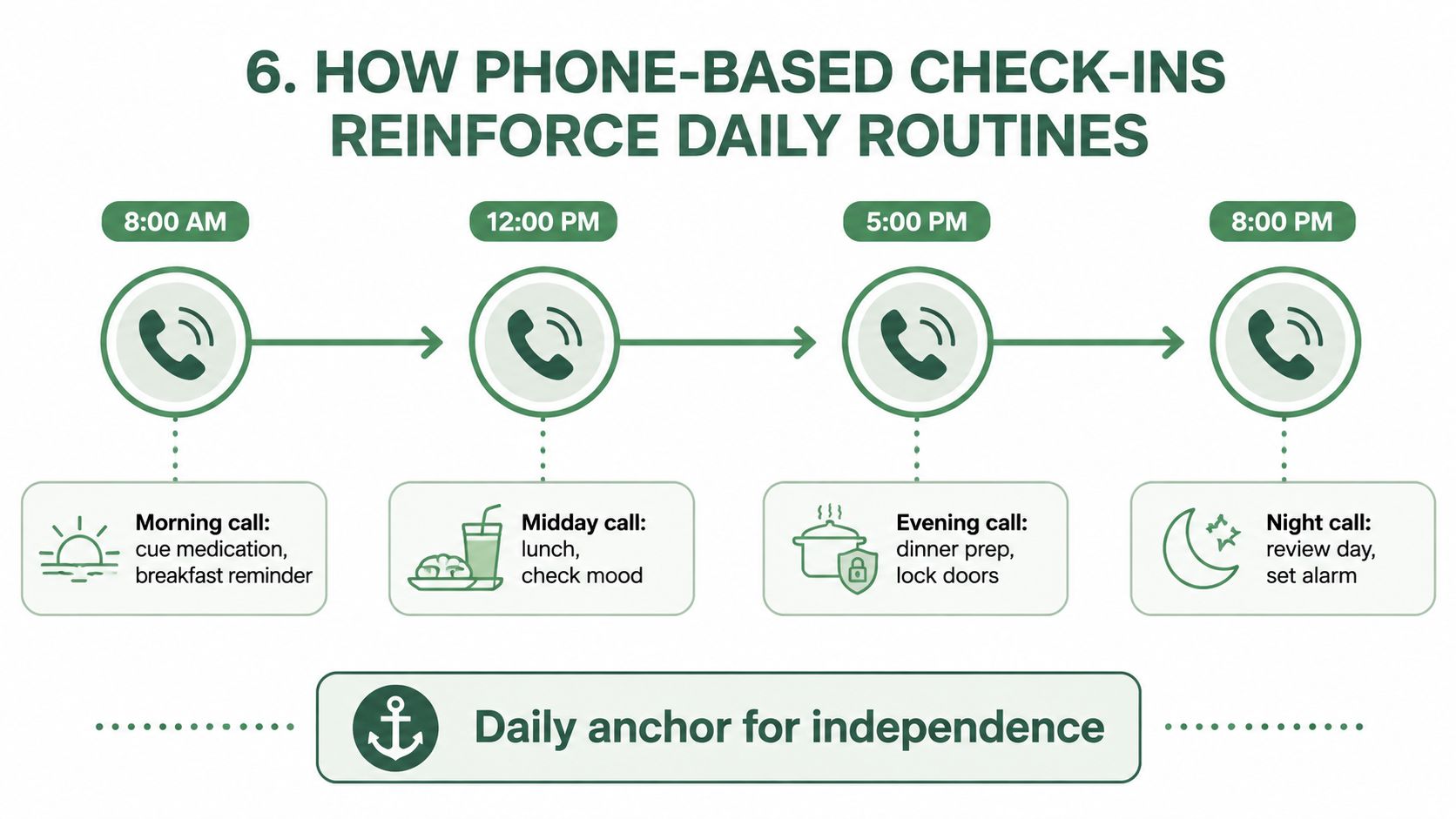
Listen for changes, not perfect answers
During a call, the care partner can listen for confusion about the date, repeated questions, a missed appointment, uncertainty about meals, or a report that bills are piling up. These observations don't establish a diagnosis, but they can identify a pattern that warrants family follow-up.
A check-in also provides social contact. Conversation can reduce long stretches of isolation and create an opportunity for gentle cognitive engagement. It should complement medical care, in-person caregiving, and emergency planning, not replace them.
Families who want a practical framework for recurring calls can review these daily check-in call ideas for seniors. The most useful schedule is one the person can recognize and anticipate. Another useful read is Bigmike.
Velma is one phone-based option for older adults with early to mid-stage memory loss. Its scheduled calls combine conversation, cognitive exercises, routine prompts, and observations that can be shared with family through a care manager. Whether calls come from a relative, neighbor, volunteer, or care program, brief and consistent contact usually works better than a long, complicated conversation.
A Simple Starting Plan for Families
You don't need to redesign your parent's life this week. Start with observation and one carefully chosen safeguard.
Observe two or three higher-risk IADLs. Spend a quiet afternoon noticing how your parent handles medications, bills, and transportation. Don't test or quiz them. Watch the ordinary routine and write down specific events.
Have a calm conversation. Use factual language: “I noticed the cardiology reminder was missed,” rather than “You can't manage anything anymore.” Ask what felt difficult and what kind of help would feel acceptable.
Add one small support. Choose the clearest immediate risk. That might mean a pill organizer, automatic bill payment with oversight, a shared calendar, or one scheduled phone call each day.
Arrange a medical appointment. Bring your observation log and a current medication list. Ask the clinician to consider cognitive, physical, emotional, sensory, and medication-related causes of the change.
Create a shared care record. Write down routines, medications, clinicians, transportation contacts, emergency numbers, and the support already in place. A cognitive care plan example can help your family organize the information.
Small adjustments can protect independence longer than waiting for a crisis. Focus on the task that carries the greatest risk, invite your parent into the solution, and increase supervision gradually as circumstances require.
Velma offers scheduled phone calls with trained care team members, combining conversation, cognitive exercises, routine reminders, and practical check-ins about medications, appointments, meals, and household safety. Visit Velma to explore whether structured phone-based support could complement your family's dementia care plan.
You arrive at your father's home and notice the unopened bills before he notices you looking. In the refrigerator, the milk has expired. On the counter, a cardiology appointment reminder sits beneath a stack of mail, already past its date. Your father is dressed neatly, answers questions easily, and seems like himself, so you hesitate to raise the subject.
That hesitation is common. Families often expect a serious problem to appear as difficulty bathing, dressing, eating, or walking. Yet a person can manage these visible basics while struggling with the hidden logistics that make independent life possible: paying bills, taking medications correctly, shopping, preparing meals, arranging transportation, and keeping in touch by phone.
These tasks are called activities of daily living, or IADLs. They provide a practical lens for understanding changes that may otherwise look like isolated oversights. Even changes in physical comfort and mobility can affect independence, so resources such as Top Mobility's lift chair guide may help families think through safer ways to support movement at home.
The aim isn't to label your parent or take over immediately. It's to understand what has changed, observe patterns, and add the right support while preserving as much participation as possible.
Table of Contents
A Moment Most Families Recognize
What Instrumental Activities of Daily Living Actually Mean
The eight core IADLs
Why IADLs Decline Before Basic Self-Care
Four especially informative tasks
Everyday Signs of IADL Decline to Watch For
What to notice at home
How IADLs Are Assessed in Dementia Care
From conversation to demonstration
Practical Ways to Support and Adapt Each IADL
Build support around the task
How Phone-Based Check-Ins Reinforce Daily Routines
Listen for changes, not perfect answers
A Simple Starting Plan for Families
A Moment Most Families Recognize
Your father insists the bills are handled. He may even become annoyed when you ask. From his perspective, the papers are waiting for later, the milk may look acceptable, and the appointment reminder may have been overlooked because the week felt unusually busy. A single missed task doesn't prove anything. The concern grows when ordinary breakdowns begin appearing across different parts of daily life.
IADLs sit between personal self-care and complete dependence. They include the decisions and sequences that connect a person with the wider community. A person may still shower, choose clothes, eat independently, and hold a warm conversation, while losing track of which bill is due, whether a prescription was taken, or how to reach a familiar clinic.
Practical rule: Look for a change in routine, not one isolated mistake.
This distinction matters because families sometimes wait for an obvious crisis. They may assume that a parent who looks well must be managing well. In reality, the most important clues can be quiet: a neglected bank statement, repeated grocery purchases, an unexplained reluctance to drive, or a phone that no longer gets answered.
Start by asking what the task requires. Paying a bill involves opening mail, identifying the amount, remembering the due date, accessing an account, and confirming payment. Taking medication involves recognizing the right container, reading instructions, tracking time, and adjusting when a routine changes. These are more demanding than they appear.
You don't need to diagnose dementia from the kitchen counter. You do need to notice whether your parent is losing reliable control over tasks that once happened without help. A calm record of those changes can guide the next conversation with family members and a clinician.
What Instrumental Activities of Daily Living Actually Mean
Activities for independent living are the complex everyday tasks a person manages to live independently at home and in the community. They differ from activities of daily living, or ADLs, which focus on basic self-care such as bathing, dressing, eating, toileting, and transferring.
A useful mental model is simple: ADLs are the body, while IADLs are the operating system that connects a person to daily life. ADLs show whether someone can care for basic physical needs. IADLs show whether they can organize the household, make decisions, and participate safely outside it.
The classic Lawton and Brody framework helped make IADL measurement a standard part of geriatric functional assessment. Its focus is on higher-order tasks that require organization, judgment, and independent community living.
The eight core IADLs
Telephone use: Making and receiving calls, finding contacts, listening to messages, and responding appropriately.
Shopping: Creating a list, choosing needed items, paying, and bringing purchases home.
Managing finances: Opening mail, paying bills, monitoring accounts, and recognizing unusual transactions.
Medication management: Knowing which medications to take, when to take them, and whether a dose has already been taken.
Meal preparation: Planning food, gathering ingredients, using appliances safely, and cleaning afterward.
Housekeeping: Maintaining a reasonably safe and usable living environment.
Transportation: Driving, arranging rides, using public transportation, or reaching appointments safely.
Laundry: Sorting clothes, operating a washer and dryer, choosing appropriate settings, and putting items away.
These tasks overlap. Shopping affects meals, transportation affects appointments, and phone use supports nearly every other activity. The working definition you can repeat to a sibling or clinician is this: IADLs are the planning-heavy tasks that allow a person to run a household and remain connected to the community, even when basic self-care is still intact.
Why IADLs Decline Before Basic Self-Care
IADLs usually require more than physical ability. They depend on executive functions, including planning, sequencing, working memory, sustained attention, and flexible problem-solving. A person must hold several steps in mind, notice when something has gone wrong, and adjust without another person directing each move.
Basic self-care often relies more heavily on familiar motor routines. Dressing, eating, or using the bathroom can remain relatively stable while the person's ability to compare bank statements, organize prescriptions, or manage an altered travel plan becomes unreliable. This is why someone can look capable during a visit while needing meaningful support behind the scenes.
Population research supports the importance of these changes. In a U.S. analysis of adults aged 50 and older, IADL impairment prevalence was 31.9% in 2006 and 25.4% in 2018, meaning about one in four people in that age range still had an IADL limitation at the end of the study period (U.S. population analysis). In the same analysis, the 2018 burden was 31.3% among Americans aged 50 and older, compared with 19.2% among middle-aged adults.
Four especially informative tasks
Finances, medications, transportation, and telephone use are particularly useful early warning areas because they combine memory with judgment and real-world consequences. A classic community-based screening study found that telephone use, transportation, medication responsibility, and handling finances were independently correlated with cognitive impairment after adjustment for age, sex, and education. A score above zero had 0.94 sensitivity and 0.71 specificity for dementia detection (classic IADL screening study).
IADL task | Executive function required | Early warning sign |
|---|---|---|
Finances | Sequencing, judgment, error detection | Unpaid bills or difficulty recognizing a familiar payment |
Medication management | Working memory, timing, self-monitoring | Missed doses, duplicate doses, or unexplained refill confusion |
Transportation | Planning, orientation, flexible problem-solving | Getting lost on a familiar route or abandoning a routine trip |
Telephone use | Attention, recall, and communication sequencing | Ignoring calls, losing contacts, or forgetting messages |
These signs aren't proof of dementia. Pain, depression, poor vision, medication side effects, hearing loss, and other medical conditions can also affect IADLs. Their value lies in showing where a focused evaluation may be needed.
Everyday Signs of IADL Decline to Watch For
Observe before you correct. The question isn't whether your parent completes a task exactly as you would. Ask whether the result is safe, consistent, and different from the person's previous routine.
What to notice at home
Finances: Bills remain unopened, payments happen late, familiar accounts seem confusing, or purchases don't fit the person's normal habits.
Medications: Pills are missed, taken twice, left in unusual places, or refilled without a clear explanation.
Transportation: A familiar route becomes difficult, appointments are missed, or your parent stops driving without explaining why.
Telephone use: Calls go unanswered, contacts disappear, messages are forgotten, or the person repeats the same conversation because they can't track what was said.
Shopping: The same item is bought repeatedly, essential foods are missing, or your parent can't follow a short list.
Meal preparation: Food spoils, pots are left unattended, meals are skipped, or the person relies on a narrower and less nutritious routine.
Housekeeping: Clutter accumulates in new areas, appliances are left on, or ordinary cleaning tasks become confusing.
Laundry and home management: Clothes aren't washed, doors are left open, or household supplies and routines are no longer maintained.
A single example may reflect a bad day. Several changes across unrelated tasks deserve closer attention. Physical limitations can also explain trouble with shopping, laundry, or housekeeping, so note whether the barrier appears cognitive, physical, or mixed.
Keep a brief log for a couple of weeks. Record the date, task, what happened, what support was offered, and whether the problem repeated. Don't write conclusions such as “Dad is declining.” Write observable details such as “missed cardiology appointment despite reminder” or “opened the same bill twice and couldn't identify it.”
For additional context, families can review this guide to early signs of memory loss in aging parents. Share your notes with the primary care clinician rather than relying on memory during the appointment.
A simple log turns worry into useful information. It can also help your family avoid arguing about impressions and focus on specific tasks that need support.
How IADLs Are Assessed in Dementia Care
Clinicians don't assess IADLs only by asking, “Can you manage your medications?” Many people answer based on intention, habit, or what they believe they should be able to do. A thorough assessment combines several perspectives.
The Lawton IADL framework provides a structured way to review areas such as phone use, shopping, food preparation, housekeeping, laundry, transportation, medication management, and finances. A clinician may ask what the person does independently, what requires help, and what has changed over time. A family member's account adds important context, especially when insight has become less reliable.
From conversation to demonstration
Performance-based assessment adds another layer. Instead of asking whether someone can manage pills, a professional might ask them to demonstrate how they sort medications for a routine. Instead of asking whether they can use transportation, the evaluator might examine how they read a schedule, plan a route, or respond to a change.
Research on performance-based IADLs supports this approach. In an older-adult study, an Everyday Problems Test financial subscore predicted later five-year cognitive status, and each one-point increase in baseline financial performance was associated with a 26% reduction in the odds of later cognitive impairment (performance-based IADL research). The same source reports that an IADL scale cutoff of 6/7 had AUC 0.925, sensitivity 89%, specificity 81%, and classification accuracy 0.82 in a dementia diagnostic study.
Method | What it measures | Main limitation |
|---|---|---|
Self-report questionnaire | The person's understanding of their own abilities | May miss errors caused by reduced insight or memory |
Informant report | Changes noticed by a spouse, adult child, or caregiver | Can be affected by limited observation or caregiver interpretation |
Performance-based task | How the person completes a real or simulated activity | May be influenced by anxiety, unfamiliar materials, vision, or education |
Structured clinical interview | Patterns across cognition, function, health, and safety | A short visit may not capture ordinary home routines |
Assessment findings can shape care planning, medication oversight, driving discussions, financial safeguards, rehabilitation goals, and decisions about additional services. For a broader explanation of dementia evaluation and care, families may also find this dementia guide from Life Primary Care useful.
The strongest evaluation usually compares what the person says, what the family observes, and what the person can demonstrate. No single score should replace clinical judgment.
Practical Ways to Support and Adapt Each IADL
Support should begin with the least intrusive change that makes the task safer. The goal isn't to remove every responsibility. It's to preserve the part your parent can still do while adding structure around the vulnerable steps.
Build support around the task
Finances: Reduce the number of accounts that need active attention, use automatic payments where appropriate, and review statements with your parent. A trusted person can help monitor activity without taking every financial decision away immediately.
Medications: Ask the pharmacist about blister packaging or a clearly labeled pill organizer. Add one consistent alarm, then confirm whether the medication was taken instead of asking a vague question such as “Did you take your pills?”
Transportation: Don't make driving the only option or the first issue in every conversation. Try a supervised ride, a familiar driver, or a scheduled transportation service while you gather better information about safety.
Telephone use: Pre-program important contacts, use large labels or photographs, and keep a written list beside the phone. Practice one action at a time, such as answering a call or checking voicemail.
Shopping: Use a short list with familiar brands or pictures. Shop together when possible, and let your parent choose items while you handle navigation, payment, or carrying bags.
Meal preparation: Place frequently used ingredients within reach, prepare portions in advance, and use visual instructions. If stove safety is uncertain, shift cooking toward a microwave, slow cooker, or supervised preparation.
Housekeeping: Break chores into visible, manageable tasks. “Put the dishes in the sink” is easier to follow than “clean the kitchen.” Consider outside help for heavy cleaning while keeping a simple task for your parent.
Laundry and home management: Label washer settings, keep detergent in one location, and use appliance timers or reminders where suitable. Reduce hazards by checking locks, clutter, and kitchen equipment as part of a routine rather than an occasional inspection.
Physical accessibility can determine whether someone participates in these tasks. If getting in and out of the bathtub has become difficult, families can review safety considerations in this guide to walk-in tubs for seniors from SouthRay Kitchen & Bath.
Preserve the role, not necessarily every step: Your parent might choose the groceries, sort the laundry, or make the call while another person handles the risky part.
Supervision can be more useful than direct care. Dementia research found that supervision time explained more variation in complex IADL performance than direct IADL care hours, suggesting that families should learn how to guide participation rather than automatically replace it (research on supervision and IADL care).
Use repetition, visual cues, and predictable routines. Arguments about whether a task “should” be easy rarely improve performance. A calmer environment and a smaller number of steps often do.
How Phone-Based Check-Ins Reinforce Daily Routines
A scheduled phone call can serve as a daily anchor for someone who lives alone or spends long periods without in-person support. The call doesn't need to become an interrogation. It works best as a friendly, predictable contact that gently cues the next part of the day.
A morning call might orient the person to the day, prompt breakfast, and ask whether the first medication routine is complete. A midday call can encourage lunch, hydration, or preparation for an appointment. An evening call can review dinner, confirm that doors are locked, and help the person settle into a familiar bedtime pattern.
Listen for changes, not perfect answers
During a call, the care partner can listen for confusion about the date, repeated questions, a missed appointment, uncertainty about meals, or a report that bills are piling up. These observations don't establish a diagnosis, but they can identify a pattern that warrants family follow-up.
A check-in also provides social contact. Conversation can reduce long stretches of isolation and create an opportunity for gentle cognitive engagement. It should complement medical care, in-person caregiving, and emergency planning, not replace them.
Families who want a practical framework for recurring calls can review these daily check-in call ideas for seniors. The most useful schedule is one the person can recognize and anticipate. Another useful read is Bigmike.
Velma is one phone-based option for older adults with early to mid-stage memory loss. Its scheduled calls combine conversation, cognitive exercises, routine prompts, and observations that can be shared with family through a care manager. Whether calls come from a relative, neighbor, volunteer, or care program, brief and consistent contact usually works better than a long, complicated conversation.
A Simple Starting Plan for Families
You don't need to redesign your parent's life this week. Start with observation and one carefully chosen safeguard.
Observe two or three higher-risk IADLs. Spend a quiet afternoon noticing how your parent handles medications, bills, and transportation. Don't test or quiz them. Watch the ordinary routine and write down specific events.
Have a calm conversation. Use factual language: “I noticed the cardiology reminder was missed,” rather than “You can't manage anything anymore.” Ask what felt difficult and what kind of help would feel acceptable.
Add one small support. Choose the clearest immediate risk. That might mean a pill organizer, automatic bill payment with oversight, a shared calendar, or one scheduled phone call each day.
Arrange a medical appointment. Bring your observation log and a current medication list. Ask the clinician to consider cognitive, physical, emotional, sensory, and medication-related causes of the change.
Create a shared care record. Write down routines, medications, clinicians, transportation contacts, emergency numbers, and the support already in place. A cognitive care plan example can help your family organize the information.
Small adjustments can protect independence longer than waiting for a crisis. Focus on the task that carries the greatest risk, invite your parent into the solution, and increase supervision gradually as circumstances require.
Velma offers scheduled phone calls with trained care team members, combining conversation, cognitive exercises, routine reminders, and practical check-ins about medications, appointments, meals, and household safety. Visit Velma to explore whether structured phone-based support could complement your family's dementia care plan.
Suggested Article: