Long Term Care Insurance Options

At 2 a.m., a daughter gets a call that changes the family's financial plan. Her father has fallen in the kitchen. The ambulance has already been delayed for hours, and nobody knows who'll manage the next morning, much less the next few years. The immediate crisis is medical, but the larger problem is practical: who will provide help, where will that help happen, and how will the family pay for it?
That's why long term care insurance options exist. Long-term care isn't the same as ordinary medical treatment. It can involve help with bathing, dressing, eating, supervision, household routines, or living safely at home. Insurance is only one part of the answer, but the right policy can keep a prolonged care need from consuming a family's savings before other resources are organized.
Families often begin researching after a parent's diagnosis, a fall, or a difficult conversation about who'll provide care. The earlier discussion is more productive. Use this guide to silver tsunami statistics as a starting point, then compare coverage, public benefits, legal planning, and daily support as one connected plan.
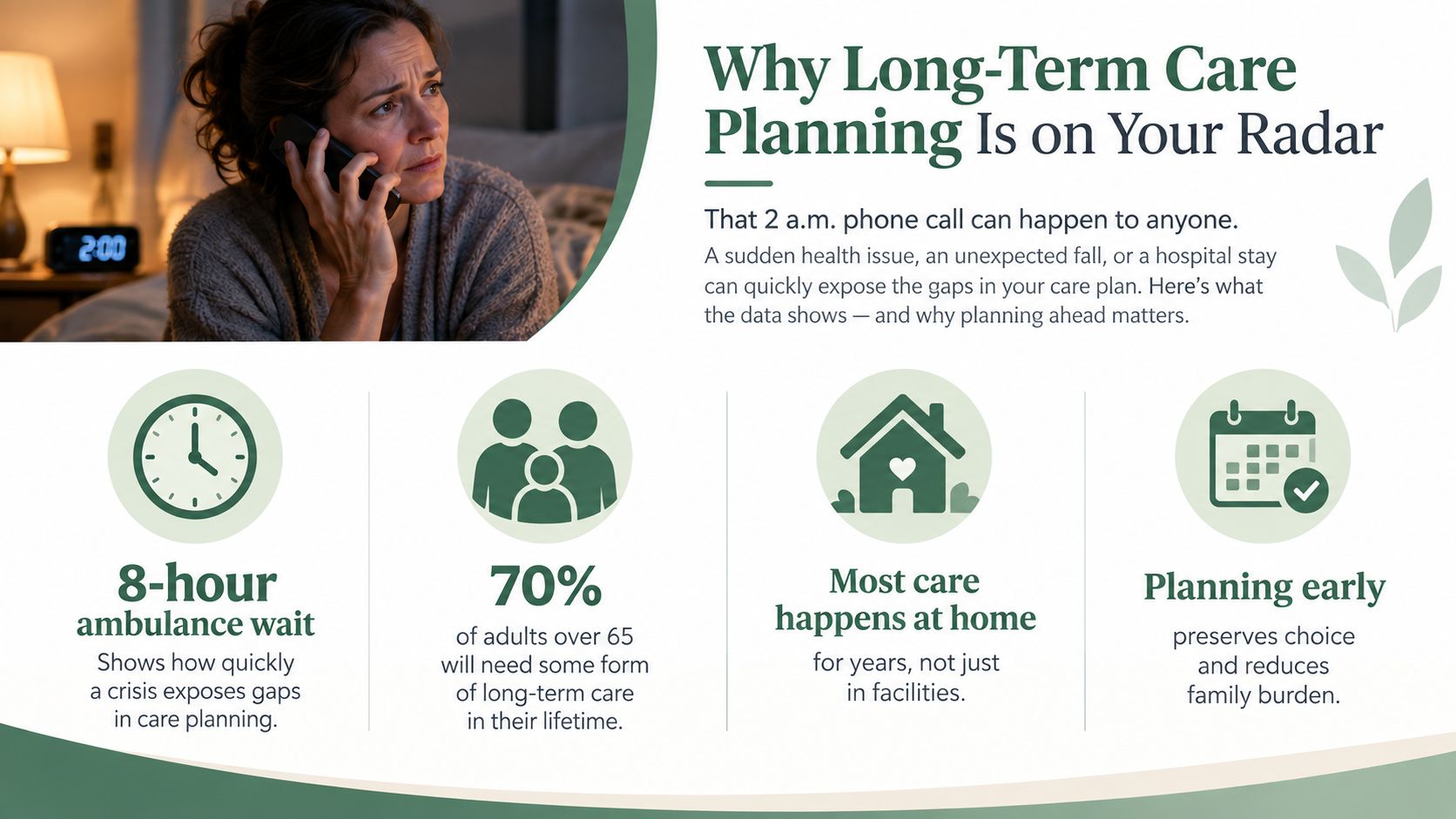
Table of Contents
Why Long-Term Care Planning Is on Your Radar
The planning problem is bigger than a policy
The Main Long-Term Care Insurance Options
Cost, Premiums, and the Fine Print That Moves the Bill
Read beyond the premium
Underwriting and Timing Windows That Shape Eligibility
Why timing matters
Medicaid, State Partnerships, and Annuity-Based Alternatives
State Partnership programs
Why Insurance Alone Is Not the Full Plan
Daily support can preserve the value of coverage
Choosing the Right Stack and Putting It in Motion
Use this decision checklist
Why Long-Term Care Planning Is on Your Radar
The reason to plan isn't that every older adult will enter a nursing facility. It's that care needs can arrive suddenly, continue for years, and fall outside the coverage many families assume they have. Medicare and traditional health insurance generally aren't designed to pay for ongoing custodial help, such as assistance with daily living at home or in a facility.
Long-term care insurance emerged in the late 1970s and early 1980s to address that financing gap. It was built as a risk-transfer tool, allowing a policyholder to move some uncertain future care costs to an insurer in exchange for premiums. The product remains relevant despite its shrinking market. Milliman reports that about 5.8 million people held stand-alone private long-term care insurance at year-end 2024, while covered lives declined by roughly 1% to 3% annually over the prior decade (Milliman's 2024 long-term care insurance statistics).
The planning problem is bigger than a policy
A policy can reimburse eligible care. It can't choose a caregiver, repair a dangerous bathroom, coordinate siblings, or reassure someone who's confused at night. Families need a financial plan and an operating plan.
Start by asking four practical questions:
Where could care happen? Consider the current home, a relative's home, assisted living, and skilled nursing care.
Who could provide it? List family members, paid aides, friends, and professional care managers.
What can the household afford? Separate recurring premiums from the assets available for deductibles, uncovered services, and waiting periods.
What decisions must be made now? Review powers of attorney, health directives, beneficiary designations, and preferences for home-based care.
The insurance market still pays meaningful claims. An industry statistics source reports that traditional long-term care insurers paid $14 billion in claims in 2023 (the long-term care insurance facts and FAQs). That doesn't make every policy a good purchase. It does show that coverage can matter when a policyholder needs extended care.
Practical rule: Don't ask only, “Will this policy pay?” Ask, “What part of the family's care plan will this policy make easier?”
The Main Long-Term Care Insurance Options
No single product wins for every household. Stand-alone coverage usually focuses most directly on care expenses, while hybrid products add life insurance or annuity value. Short-term and critical illness products can fill narrow gaps, but they shouldn't be mistaken for full long-term care protection.
Option | Core Mechanic | Best Fit | Key Trade-Off |
|---|---|---|---|
Traditional stand-alone LTC policy | Pays an approved daily or monthly benefit after a covered trigger and elimination period | Buyers seeking broad, care-focused protection | Premiums may change, and benefits may have no residual value if care isn't needed |
Hybrid life insurance with an LTC rider | Accelerates or provides life insurance benefits for qualifying long-term care | Buyers who value a death benefit and more predictable premium structure | Care benefits are limited by the policy's rider and benefit formula |
Hybrid annuity and LTC combination | Uses an annuity structure to provide income or leveraged care benefits | Buyers with assets who want care protection tied to an asset-based contract | Liquidity, taxation, surrender terms, and benefit limits require careful modeling |
Short-term care insurance | Covers a limited care period, often with simpler underwriting than traditional LTC coverage | Buyers who want a narrower supplement or may not qualify for comprehensive LTC insurance | It may end before a prolonged claim is over |
Critical illness rider | Pays a lump sum after a qualifying serious illness | Households seeking flexible cash for an acute event | A lump sum isn't the same as ongoing daily care reimbursement |
Self-funding with Medicaid planning | Uses personal assets first, with Medicaid as a potential backstop if eligibility is met | Households with sufficient liquid assets and a properly reviewed public-benefit plan | The strategy can expose assets to care costs and fails if the balance sheet is too small |
The central choice is straightforward. Stand-alone coverage generally offers the purest protection for care expenses, but the buyer accepts the possibility of premium pressure and may receive no benefit if care never occurs. Hybrid coverage trades some benefit flexibility for premium certainty and a death-benefit floor, which appeals to people who dislike “use it or lose it.”
Critical illness coverage and short-term care insurance are supplements. They can provide useful cash or a limited layer of protection, but they're poor substitutes for a policy designed around a long care claim.
Self-funding is also more demanding than it sounds. It works only when the household can absorb several years of care costs in liquid assets without damaging retirement income, housing security, or a surviving spouse's needs. If you're comparing the market, a resource such as finding affordable long-term care insurance can help you organize questions before requesting illustrations.
Cost, Premiums, and the Fine Print That Moves the Bill
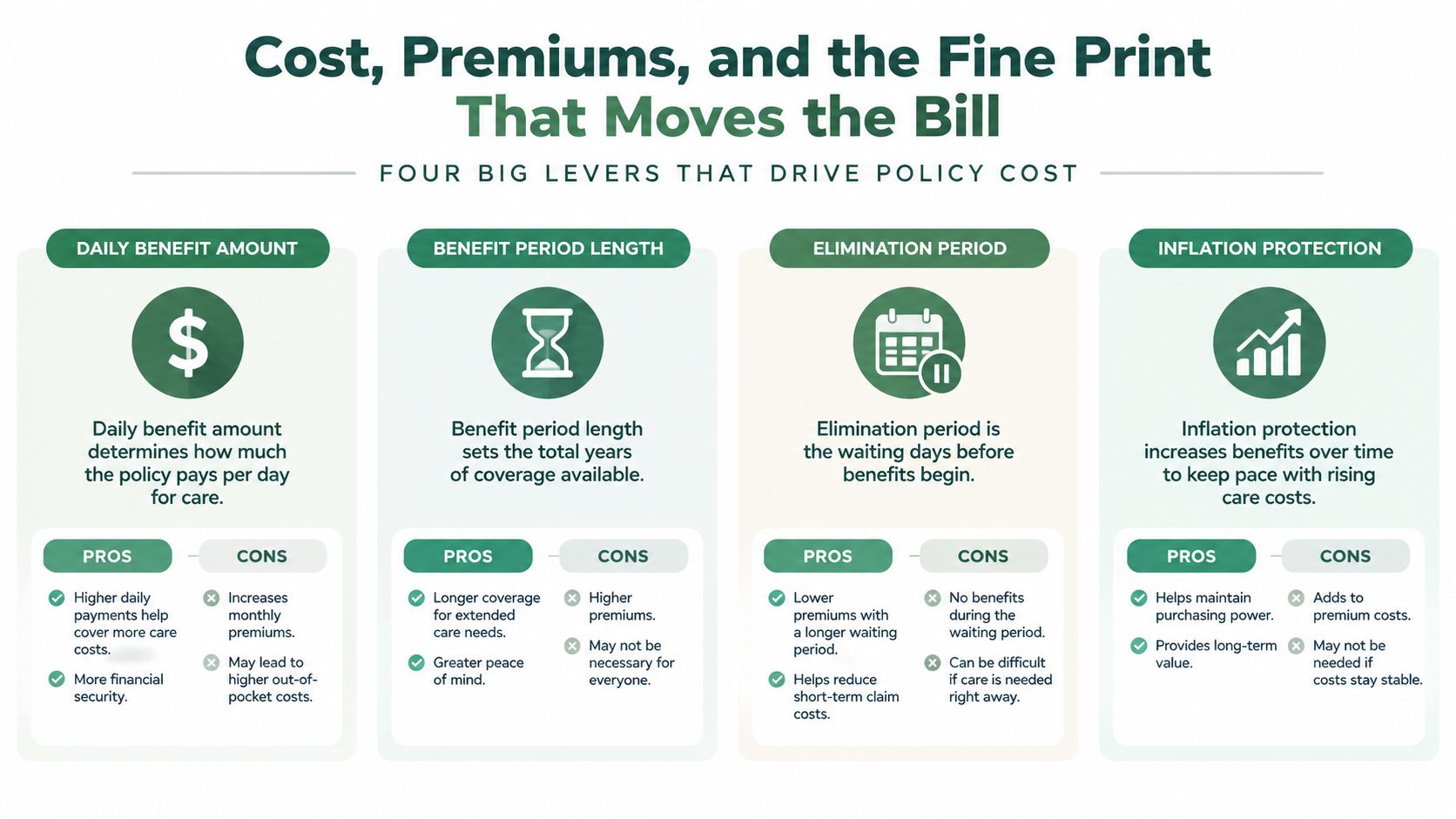
A long-term care policy's price follows its design, not its brochure label. The promised daily benefit, length of coverage, growth rate, and amount you pay before reimbursement all move the premium. Set the budget first, then decide which risk the family can carry.
The main pricing levers are:
Daily benefit: A higher daily amount pays more toward eligible care, but it also raises the premium.
Benefit period: A longer period offers more protection during a prolonged claim. A shorter period costs less but leaves greater exposure afterward.
Elimination period: This works like a time-based deductible. Once the policy's benefit trigger is met, the insured pays during the selected waiting period before reimbursement begins.
Inflation protection: A benefit that grows over time helps preserve purchasing power when the policy is purchased years before a claim.
Common elimination-period choices include 0, 30, 60, 90, and 100 days, according to major U.S. consumer guidance in the Connecticut long-term care insurance shopping guide. A longer period can reduce the premium, but the family must fund more of the early care. Confirm whether the period applies once, separately to each care episode, or again after a lapse. A policy that requires satisfaction only once over its life can be especially useful when care needs come and go.
Read beyond the premium
Stand-alone policies have faced rate pressure as insurers revised assumptions about claims, claim duration, and policy lapses. Older contracts and some association products may have a different rate history from newer offerings, while carrier availability has changed over time. Treat an initial premium as a projection unless the contract clearly guarantees it.
Hybrid pricing combines life insurance, cash value or annuity features, and long-term care access. The care benefit may come through an acceleration formula or rider. Compare the effective monthly benefit, inflation treatment, payment schedule, and remaining death benefit, not premiums alone. A guide to comparing long-term care insurance rates can organize that review, but a carrier illustration still deserves professional scrutiny.
Phone-based cognitive support can also make the insurance dollar work harder. Regular, non-medical conversation and daily engagement may help someone maintain routines and stay connected at home. It does not replace covered care or change a benefit trigger, but it can complement the plan and potentially delay a move to higher-acuity services. Include it in the family's care budget, alongside policy benefits and hands-on support.
Check shared-care provisions for couples, household discounts, waiver-of-premium rules, return-of-premium terms, and exclusions. A claim can fail or be delayed if the insured does not meet the policy's functional-limitation definition, the care setting is ineligible, or required certification and documentation are missing.
Underwriting and Timing Windows That Shape Eligibility
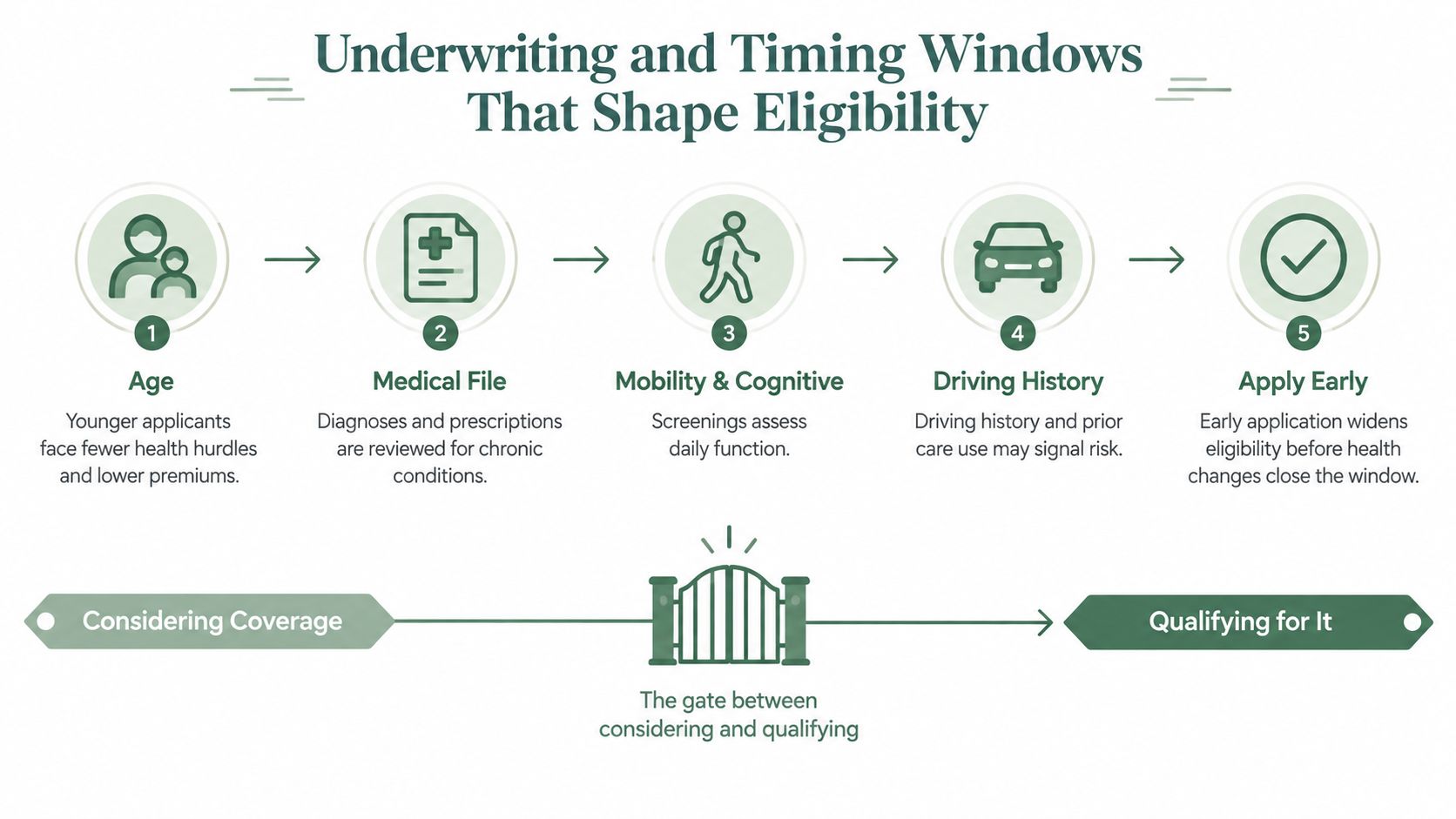
Underwriting decides whether an insurer will offer coverage and on what terms. The application may examine diagnoses, prescriptions, mobility, cognition, prior care, daily activities, and other indicators of future claims. A family history alone usually isn't the same as an applicant's diagnosis, but memory concerns, stroke history, cancer, diabetes, arthritis, depression, or current help with daily activities can affect the outcome.
Insurers don't all interpret a medical file identically. That's why an independent broker can be useful. Apply with several carriers, disclose your health accurately, and compare the best approved offer rather than chasing the lowest preliminary quote.
Why timing matters
For many buyers, the 50s are the practical sweet spot. Applicants may still be healthy enough to qualify, and they're early enough in the planning process to consider meaningful inflation protection and a benefit period that matches their broader retirement strategy. Buying in the 60s can still make sense for a healthy applicant, but the available design may become narrower or more expensive.
Waiting until cognitive decline or hands-on help is already required is usually too late for traditional underwriting. Re-shopping later is also difficult because a new application reflects the applicant's current health, not the health they had when they first considered coverage.
Ask the broker and carrier to document more than eligibility. Review financial strength, claims practices, premium guarantees, waiver-of-premium triggers, home-care rules, and any return-of-premium feature. Couples should also ask whether a surviving spouse can access shared benefits after the first covered person dies.
A younger applicant planning for a long retirement may prioritize automatic compound inflation protection or a longer benefit period. Someone near retirement may reasonably choose a smaller design that preserves cash flow and accepts more self-funding. The right answer depends on what the household can sustain without abandoning the policy during a difficult year.
Medicaid, State Partnerships, and Annuity-Based Alternatives
Private insurance isn't affordable or available for every household. When it isn't, the answer shouldn't be an improvised asset transfer or an assumption that Medicaid will cover whatever remains. Medicaid eligibility generally depends on state-specific rules involving income, assets, disability, and functional need.
Medicaid planning may involve exempt property, carefully structured trusts, or an annuity that converts assets into an income stream. These tools can have serious consequences when used incorrectly. A gift, transfer, or annuity that violates applicable rules can create a penalty period and postpone eligibility.
State Partnership programs
A qualifying State Partnership policy coordinates private coverage with Medicaid. If the policy benefits are exhausted, the program may provide dollar-for-dollar asset protection under applicable state rules. That protection can affect how much of the recipient's estate remains exposed, but the treatment varies by state and by policy.
Confirm partnership status in writing before relying on it. Check whether the policy meets the current state standard, how reciprocity works if the insured moves, and how the state treats protected assets after death. A general overview of how to protect assets from Medicaid may help generate questions, but it isn't a substitute for advice from an elder-law attorney in the relevant state.
Option | Primary Advantage | Main Limitation |
|---|---|---|
Medicaid planning | Can provide a public-benefit pathway when private resources are insufficient | Eligibility rules are complex, state-specific, and sensitive to transfers |
State Partnership policy | May preserve assets after qualifying private benefits are exhausted | Protection depends on policy standards and state rules |
Immediate annuity | Can create a predictable income stream for a qualifying Medicaid strategy | Ownership, income treatment, taxes, and beneficiary terms must be analyzed |
Deferred-income annuity | May support future income planning | It can be treated as an available asset in a Medicaid analysis |
Hybrid life or LTC product | Can combine care access with residual death-benefit value | Requires capital, underwriting, and close review of the benefit formula |
Annuity-based planning belongs in a full balance-sheet review. Compare liquidity, taxes, spouse protection, estate goals, and the possibility that care will begin earlier or last longer than expected. Coordinate the work with an elder-law attorney and a fee-only planner. Families should also understand that Medicare coverage for dementia care doesn't eliminate the need to plan for ongoing custodial support.
Why Insurance Alone Is Not the Full Plan
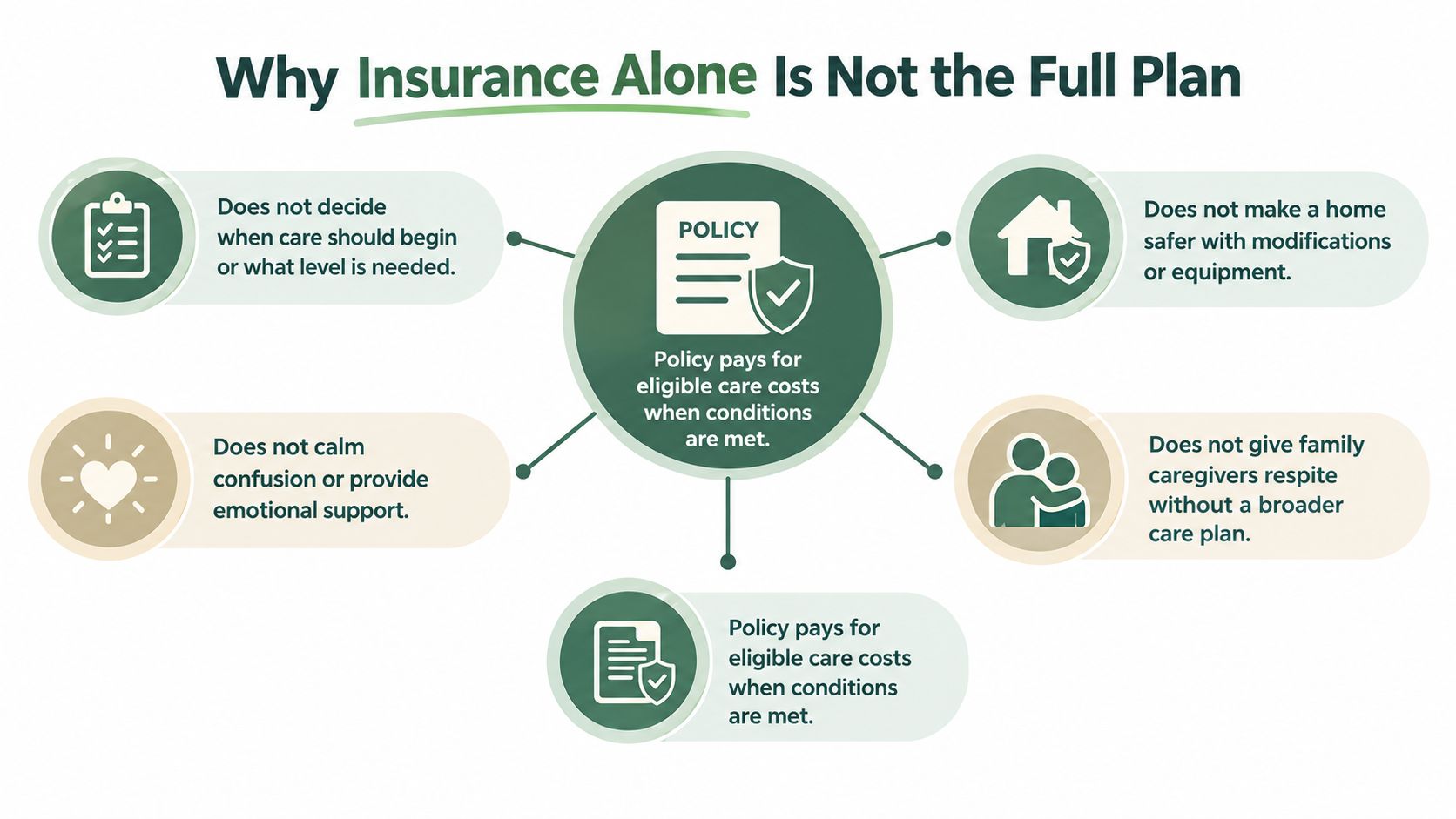
A policy pays when its conditions are met. It doesn't decide that a parent shouldn't drive, identify a dangerous stove, arrange a bath aide, or give a family caregiver an afternoon away. Treating insurance as the complete plan leaves the most immediate daily problems unanswered.
The better approach combines financial protection with practical support. That can include home modifications, medication routines, transportation, respite, legal documents, professional care management, and structured social engagement.
Daily support can preserve the value of coverage
Phone-based cognitive support has a specific role here. For someone with mild cognitive impairment or early dementia, scheduled calls can provide orientation, reminders, structured conversation, music, language activities, attention exercises, and a dependable social check-in. These services are non-medical. They shouldn't be described as preventing dementia or replacing clinical care.
A consistent caller may notice that a participant sounds more confused, has missed a routine, or reports a fall concern. That information can help a family respond sooner and decide whether an in-person visit, clinician contact, or care-manager review is needed. It may also support a carefully designed home-care plan by filling a narrow gap between family visits.
Phone support has firm limits. It can't provide emergency response, medication administration, transportation, meal preparation, bathing, lifting, or hands-on supervision. It also needs consent, privacy safeguards, a workable schedule, and a named person who'll act if a concern is reported.
A policy funds care. A care plan makes care workable.
Build the stack around outcomes rather than product count:
Safer routines: Improve lighting, add grab bars, reduce trip hazards, and keep important appointments visible.
Human backup: Schedule family check-ins, paid respite, and professional coordination before the primary caregiver reaches exhaustion.
Cognitive engagement: Use flexible conversation and activities that match hearing, language, mood, interests, and attention.
Escalation rules: Decide who responds when a call reveals confusion, missed medication, a fall, or a household risk.
Financial alignment: Match benefits to the care settings and services the family is willing to use.
A useful care manager can connect these pieces. Review care manager responsibilities when deciding which coordination tasks belong to family members and which should be assigned to a professional.
Choosing the Right Stack and Putting It in Motion
Consider a couple in their late 50s who wants protection but doesn't want every retirement dollar tied up in premiums. They might choose a traditional long-term care policy for a strong care-focused benefit, then add a modest hybrid life rider for residual value. If the private policy qualifies for their state's Partnership program, the couple may gain an additional asset-protection layer after covered benefits are exhausted.
That approach has a clear logic. The stand-alone policy handles the main care risk, while the hybrid component addresses the emotional objection that premiums might produce no value if care never occurs. The couple still needs to test premium sustainability, benefit growth, shared-care terms, and the policy's home-care definition.
A single retiree may choose a different route. Suppose traditional coverage doesn't fit the person's budget or underwriting profile, but the retiree has assets available for an annuity-based design. A deferred annuity with a long-term care rider might provide a structured income and care benefit, while scheduled phone engagement and family oversight support safer routines at home.
That arrangement doesn't guarantee that facility placement will be avoided. It can, however, give the family a way to monitor changes, reinforce daily structure, and respond before a small problem becomes a crisis. The financial product and the daily support solve different problems, so they shouldn't be evaluated as substitutes.
Use this decision checklist
Estimate the likely care pattern. Decide whether the household is primarily planning for home care, assisted living, nursing care, or flexibility across settings.
Calculate the self-funding runway. Identify liquid assets available after protecting housing, income needs, taxes, and the surviving spouse.
Stress-test inflation. Model benefits against a 4% to 5% compound inflation assumption, then compare the result with the policy's actual inflation option. Don't rely on a starting benefit that looks adequate only today.
Compare policy mechanics. Review the elimination period, benefit duration, inflation method, cash versus reimbursement benefits, triggers, exclusions, and claim documentation.
Check Partnership treatment. Confirm eligibility in your state, reciprocity if relocation is possible, and how asset protection interacts with estate planning.
Review annually. Revisit coverage, savings, health, family availability, and care preferences at major planning milestones, including ages 50, 60, and 70.
Pull three carrier illustrations before signing anything. Ask each carrier to show the same benefit assumptions so the comparison is meaningful. Then confirm Partnership eligibility with the state and interview a fiduciary advisor, an independent insurance professional, and an elder-law attorney where appropriate.
The strongest plan isn't necessarily the largest policy. It's the combination a family can afford, understand, maintain, and activate when daily life becomes harder.
Velma provides scheduled phone calls, cognitive engagement, companionship, and practical check-ins for older adults experiencing memory loss, giving families a consistent layer of support alongside insurance and in-person care. Visit Velma to see how phone-based support can strengthen a long-term care plan.
At 2 a.m., a daughter gets a call that changes the family's financial plan. Her father has fallen in the kitchen. The ambulance has already been delayed for hours, and nobody knows who'll manage the next morning, much less the next few years. The immediate crisis is medical, but the larger problem is practical: who will provide help, where will that help happen, and how will the family pay for it?
That's why long term care insurance options exist. Long-term care isn't the same as ordinary medical treatment. It can involve help with bathing, dressing, eating, supervision, household routines, or living safely at home. Insurance is only one part of the answer, but the right policy can keep a prolonged care need from consuming a family's savings before other resources are organized.
Families often begin researching after a parent's diagnosis, a fall, or a difficult conversation about who'll provide care. The earlier discussion is more productive. Use this guide to silver tsunami statistics as a starting point, then compare coverage, public benefits, legal planning, and daily support as one connected plan.
Table of Contents
Why Long-Term Care Planning Is on Your Radar
The planning problem is bigger than a policy
The Main Long-Term Care Insurance Options
Cost, Premiums, and the Fine Print That Moves the Bill
Read beyond the premium
Underwriting and Timing Windows That Shape Eligibility
Why timing matters
Medicaid, State Partnerships, and Annuity-Based Alternatives
State Partnership programs
Why Insurance Alone Is Not the Full Plan
Daily support can preserve the value of coverage
Choosing the Right Stack and Putting It in Motion
Use this decision checklist
Why Long-Term Care Planning Is on Your Radar
The reason to plan isn't that every older adult will enter a nursing facility. It's that care needs can arrive suddenly, continue for years, and fall outside the coverage many families assume they have. Medicare and traditional health insurance generally aren't designed to pay for ongoing custodial help, such as assistance with daily living at home or in a facility.
Long-term care insurance emerged in the late 1970s and early 1980s to address that financing gap. It was built as a risk-transfer tool, allowing a policyholder to move some uncertain future care costs to an insurer in exchange for premiums. The product remains relevant despite its shrinking market. Milliman reports that about 5.8 million people held stand-alone private long-term care insurance at year-end 2024, while covered lives declined by roughly 1% to 3% annually over the prior decade (Milliman's 2024 long-term care insurance statistics).
The planning problem is bigger than a policy
A policy can reimburse eligible care. It can't choose a caregiver, repair a dangerous bathroom, coordinate siblings, or reassure someone who's confused at night. Families need a financial plan and an operating plan.
Start by asking four practical questions:
Where could care happen? Consider the current home, a relative's home, assisted living, and skilled nursing care.
Who could provide it? List family members, paid aides, friends, and professional care managers.
What can the household afford? Separate recurring premiums from the assets available for deductibles, uncovered services, and waiting periods.
What decisions must be made now? Review powers of attorney, health directives, beneficiary designations, and preferences for home-based care.
The insurance market still pays meaningful claims. An industry statistics source reports that traditional long-term care insurers paid $14 billion in claims in 2023 (the long-term care insurance facts and FAQs). That doesn't make every policy a good purchase. It does show that coverage can matter when a policyholder needs extended care.
Practical rule: Don't ask only, “Will this policy pay?” Ask, “What part of the family's care plan will this policy make easier?”
The Main Long-Term Care Insurance Options
No single product wins for every household. Stand-alone coverage usually focuses most directly on care expenses, while hybrid products add life insurance or annuity value. Short-term and critical illness products can fill narrow gaps, but they shouldn't be mistaken for full long-term care protection.
Option | Core Mechanic | Best Fit | Key Trade-Off |
|---|---|---|---|
Traditional stand-alone LTC policy | Pays an approved daily or monthly benefit after a covered trigger and elimination period | Buyers seeking broad, care-focused protection | Premiums may change, and benefits may have no residual value if care isn't needed |
Hybrid life insurance with an LTC rider | Accelerates or provides life insurance benefits for qualifying long-term care | Buyers who value a death benefit and more predictable premium structure | Care benefits are limited by the policy's rider and benefit formula |
Hybrid annuity and LTC combination | Uses an annuity structure to provide income or leveraged care benefits | Buyers with assets who want care protection tied to an asset-based contract | Liquidity, taxation, surrender terms, and benefit limits require careful modeling |
Short-term care insurance | Covers a limited care period, often with simpler underwriting than traditional LTC coverage | Buyers who want a narrower supplement or may not qualify for comprehensive LTC insurance | It may end before a prolonged claim is over |
Critical illness rider | Pays a lump sum after a qualifying serious illness | Households seeking flexible cash for an acute event | A lump sum isn't the same as ongoing daily care reimbursement |
Self-funding with Medicaid planning | Uses personal assets first, with Medicaid as a potential backstop if eligibility is met | Households with sufficient liquid assets and a properly reviewed public-benefit plan | The strategy can expose assets to care costs and fails if the balance sheet is too small |
The central choice is straightforward. Stand-alone coverage generally offers the purest protection for care expenses, but the buyer accepts the possibility of premium pressure and may receive no benefit if care never occurs. Hybrid coverage trades some benefit flexibility for premium certainty and a death-benefit floor, which appeals to people who dislike “use it or lose it.”
Critical illness coverage and short-term care insurance are supplements. They can provide useful cash or a limited layer of protection, but they're poor substitutes for a policy designed around a long care claim.
Self-funding is also more demanding than it sounds. It works only when the household can absorb several years of care costs in liquid assets without damaging retirement income, housing security, or a surviving spouse's needs. If you're comparing the market, a resource such as finding affordable long-term care insurance can help you organize questions before requesting illustrations.
Cost, Premiums, and the Fine Print That Moves the Bill
A long-term care policy's price follows its design, not its brochure label. The promised daily benefit, length of coverage, growth rate, and amount you pay before reimbursement all move the premium. Set the budget first, then decide which risk the family can carry.
The main pricing levers are:
Daily benefit: A higher daily amount pays more toward eligible care, but it also raises the premium.
Benefit period: A longer period offers more protection during a prolonged claim. A shorter period costs less but leaves greater exposure afterward.
Elimination period: This works like a time-based deductible. Once the policy's benefit trigger is met, the insured pays during the selected waiting period before reimbursement begins.
Inflation protection: A benefit that grows over time helps preserve purchasing power when the policy is purchased years before a claim.
Common elimination-period choices include 0, 30, 60, 90, and 100 days, according to major U.S. consumer guidance in the Connecticut long-term care insurance shopping guide. A longer period can reduce the premium, but the family must fund more of the early care. Confirm whether the period applies once, separately to each care episode, or again after a lapse. A policy that requires satisfaction only once over its life can be especially useful when care needs come and go.
Read beyond the premium
Stand-alone policies have faced rate pressure as insurers revised assumptions about claims, claim duration, and policy lapses. Older contracts and some association products may have a different rate history from newer offerings, while carrier availability has changed over time. Treat an initial premium as a projection unless the contract clearly guarantees it.
Hybrid pricing combines life insurance, cash value or annuity features, and long-term care access. The care benefit may come through an acceleration formula or rider. Compare the effective monthly benefit, inflation treatment, payment schedule, and remaining death benefit, not premiums alone. A guide to comparing long-term care insurance rates can organize that review, but a carrier illustration still deserves professional scrutiny.
Phone-based cognitive support can also make the insurance dollar work harder. Regular, non-medical conversation and daily engagement may help someone maintain routines and stay connected at home. It does not replace covered care or change a benefit trigger, but it can complement the plan and potentially delay a move to higher-acuity services. Include it in the family's care budget, alongside policy benefits and hands-on support.
Check shared-care provisions for couples, household discounts, waiver-of-premium rules, return-of-premium terms, and exclusions. A claim can fail or be delayed if the insured does not meet the policy's functional-limitation definition, the care setting is ineligible, or required certification and documentation are missing.
Underwriting and Timing Windows That Shape Eligibility
Underwriting decides whether an insurer will offer coverage and on what terms. The application may examine diagnoses, prescriptions, mobility, cognition, prior care, daily activities, and other indicators of future claims. A family history alone usually isn't the same as an applicant's diagnosis, but memory concerns, stroke history, cancer, diabetes, arthritis, depression, or current help with daily activities can affect the outcome.
Insurers don't all interpret a medical file identically. That's why an independent broker can be useful. Apply with several carriers, disclose your health accurately, and compare the best approved offer rather than chasing the lowest preliminary quote.
Why timing matters
For many buyers, the 50s are the practical sweet spot. Applicants may still be healthy enough to qualify, and they're early enough in the planning process to consider meaningful inflation protection and a benefit period that matches their broader retirement strategy. Buying in the 60s can still make sense for a healthy applicant, but the available design may become narrower or more expensive.
Waiting until cognitive decline or hands-on help is already required is usually too late for traditional underwriting. Re-shopping later is also difficult because a new application reflects the applicant's current health, not the health they had when they first considered coverage.
Ask the broker and carrier to document more than eligibility. Review financial strength, claims practices, premium guarantees, waiver-of-premium triggers, home-care rules, and any return-of-premium feature. Couples should also ask whether a surviving spouse can access shared benefits after the first covered person dies.
A younger applicant planning for a long retirement may prioritize automatic compound inflation protection or a longer benefit period. Someone near retirement may reasonably choose a smaller design that preserves cash flow and accepts more self-funding. The right answer depends on what the household can sustain without abandoning the policy during a difficult year.
Medicaid, State Partnerships, and Annuity-Based Alternatives
Private insurance isn't affordable or available for every household. When it isn't, the answer shouldn't be an improvised asset transfer or an assumption that Medicaid will cover whatever remains. Medicaid eligibility generally depends on state-specific rules involving income, assets, disability, and functional need.
Medicaid planning may involve exempt property, carefully structured trusts, or an annuity that converts assets into an income stream. These tools can have serious consequences when used incorrectly. A gift, transfer, or annuity that violates applicable rules can create a penalty period and postpone eligibility.
State Partnership programs
A qualifying State Partnership policy coordinates private coverage with Medicaid. If the policy benefits are exhausted, the program may provide dollar-for-dollar asset protection under applicable state rules. That protection can affect how much of the recipient's estate remains exposed, but the treatment varies by state and by policy.
Confirm partnership status in writing before relying on it. Check whether the policy meets the current state standard, how reciprocity works if the insured moves, and how the state treats protected assets after death. A general overview of how to protect assets from Medicaid may help generate questions, but it isn't a substitute for advice from an elder-law attorney in the relevant state.
Option | Primary Advantage | Main Limitation |
|---|---|---|
Medicaid planning | Can provide a public-benefit pathway when private resources are insufficient | Eligibility rules are complex, state-specific, and sensitive to transfers |
State Partnership policy | May preserve assets after qualifying private benefits are exhausted | Protection depends on policy standards and state rules |
Immediate annuity | Can create a predictable income stream for a qualifying Medicaid strategy | Ownership, income treatment, taxes, and beneficiary terms must be analyzed |
Deferred-income annuity | May support future income planning | It can be treated as an available asset in a Medicaid analysis |
Hybrid life or LTC product | Can combine care access with residual death-benefit value | Requires capital, underwriting, and close review of the benefit formula |
Annuity-based planning belongs in a full balance-sheet review. Compare liquidity, taxes, spouse protection, estate goals, and the possibility that care will begin earlier or last longer than expected. Coordinate the work with an elder-law attorney and a fee-only planner. Families should also understand that Medicare coverage for dementia care doesn't eliminate the need to plan for ongoing custodial support.
Why Insurance Alone Is Not the Full Plan
A policy pays when its conditions are met. It doesn't decide that a parent shouldn't drive, identify a dangerous stove, arrange a bath aide, or give a family caregiver an afternoon away. Treating insurance as the complete plan leaves the most immediate daily problems unanswered.
The better approach combines financial protection with practical support. That can include home modifications, medication routines, transportation, respite, legal documents, professional care management, and structured social engagement.
Daily support can preserve the value of coverage
Phone-based cognitive support has a specific role here. For someone with mild cognitive impairment or early dementia, scheduled calls can provide orientation, reminders, structured conversation, music, language activities, attention exercises, and a dependable social check-in. These services are non-medical. They shouldn't be described as preventing dementia or replacing clinical care.
A consistent caller may notice that a participant sounds more confused, has missed a routine, or reports a fall concern. That information can help a family respond sooner and decide whether an in-person visit, clinician contact, or care-manager review is needed. It may also support a carefully designed home-care plan by filling a narrow gap between family visits.
Phone support has firm limits. It can't provide emergency response, medication administration, transportation, meal preparation, bathing, lifting, or hands-on supervision. It also needs consent, privacy safeguards, a workable schedule, and a named person who'll act if a concern is reported.
A policy funds care. A care plan makes care workable.
Build the stack around outcomes rather than product count:
Safer routines: Improve lighting, add grab bars, reduce trip hazards, and keep important appointments visible.
Human backup: Schedule family check-ins, paid respite, and professional coordination before the primary caregiver reaches exhaustion.
Cognitive engagement: Use flexible conversation and activities that match hearing, language, mood, interests, and attention.
Escalation rules: Decide who responds when a call reveals confusion, missed medication, a fall, or a household risk.
Financial alignment: Match benefits to the care settings and services the family is willing to use.
A useful care manager can connect these pieces. Review care manager responsibilities when deciding which coordination tasks belong to family members and which should be assigned to a professional.
Choosing the Right Stack and Putting It in Motion
Consider a couple in their late 50s who wants protection but doesn't want every retirement dollar tied up in premiums. They might choose a traditional long-term care policy for a strong care-focused benefit, then add a modest hybrid life rider for residual value. If the private policy qualifies for their state's Partnership program, the couple may gain an additional asset-protection layer after covered benefits are exhausted.
That approach has a clear logic. The stand-alone policy handles the main care risk, while the hybrid component addresses the emotional objection that premiums might produce no value if care never occurs. The couple still needs to test premium sustainability, benefit growth, shared-care terms, and the policy's home-care definition.
A single retiree may choose a different route. Suppose traditional coverage doesn't fit the person's budget or underwriting profile, but the retiree has assets available for an annuity-based design. A deferred annuity with a long-term care rider might provide a structured income and care benefit, while scheduled phone engagement and family oversight support safer routines at home.
That arrangement doesn't guarantee that facility placement will be avoided. It can, however, give the family a way to monitor changes, reinforce daily structure, and respond before a small problem becomes a crisis. The financial product and the daily support solve different problems, so they shouldn't be evaluated as substitutes.
Use this decision checklist
Estimate the likely care pattern. Decide whether the household is primarily planning for home care, assisted living, nursing care, or flexibility across settings.
Calculate the self-funding runway. Identify liquid assets available after protecting housing, income needs, taxes, and the surviving spouse.
Stress-test inflation. Model benefits against a 4% to 5% compound inflation assumption, then compare the result with the policy's actual inflation option. Don't rely on a starting benefit that looks adequate only today.
Compare policy mechanics. Review the elimination period, benefit duration, inflation method, cash versus reimbursement benefits, triggers, exclusions, and claim documentation.
Check Partnership treatment. Confirm eligibility in your state, reciprocity if relocation is possible, and how asset protection interacts with estate planning.
Review annually. Revisit coverage, savings, health, family availability, and care preferences at major planning milestones, including ages 50, 60, and 70.
Pull three carrier illustrations before signing anything. Ask each carrier to show the same benefit assumptions so the comparison is meaningful. Then confirm Partnership eligibility with the state and interview a fiduciary advisor, an independent insurance professional, and an elder-law attorney where appropriate.
The strongest plan isn't necessarily the largest policy. It's the combination a family can afford, understand, maintain, and activate when daily life becomes harder.
Velma provides scheduled phone calls, cognitive engagement, companionship, and practical check-ins for older adults experiencing memory loss, giving families a consistent layer of support alongside insurance and in-person care. Visit Velma to see how phone-based support can strengthen a long-term care plan.
Suggested Article: